

The AI Revenue Engine: What It Is, What It Costs, and Why Most Fail
Your CRO came back from a conference with a new mandate: "We need an AI revenue engine." Nobody in the room could define what that actually means, but the budget request is already in motion. Worldwide AI spending is projected to hit $2.023T in 2026, the AI-in-sales market sits at $8.8B growing at 32.6% CAGR, and 80% of AI projects still fail. Revenue engines are no exception.
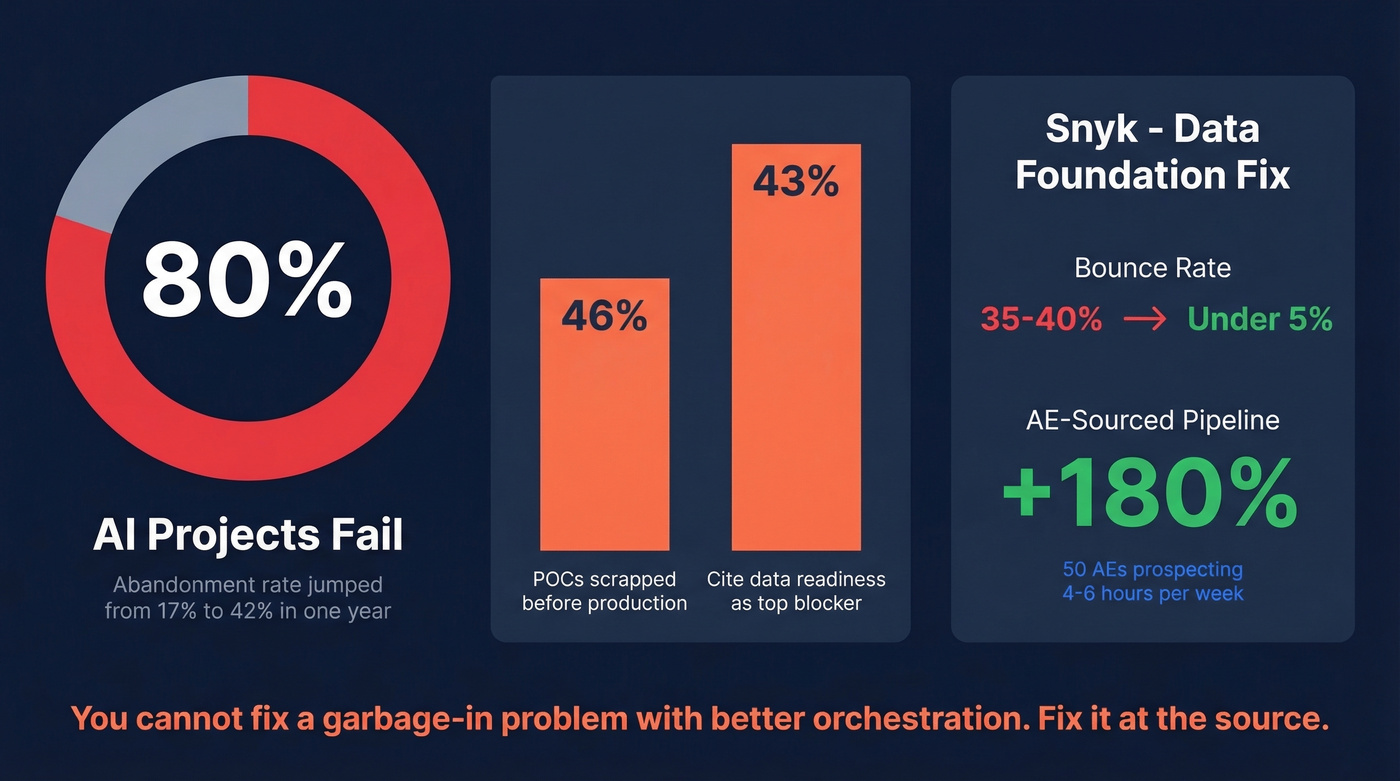
Here's the short version: an AI-powered revenue engine isn't a product you buy - it's a 4-layer system you build. Most fail because the data layer is garbage. Start with verified contact data, add intelligence, then orchestrate. Skip the $200K platforms until you've nailed data quality.
What an AI Revenue Engine Actually Is
An AI revenue engine is a closed-loop system that continuously learns from revenue outcomes to guide GTM decisions across planning and execution. It's not a dashboard. It's not a chatbot bolted onto your CRM. Outcomes feed back into predictions, and predictions drive actions - a cycle that tightens over time as the models ingest more data about what's actually closing.
The confusion comes from lumping it in with narrower categories:
| Category | What It Does | Limitation | Example |
|---|---|---|---|
| Conversation Intelligence | Call coaching + deal insights | Limited targeting impact | Gong |
| Revenue Intelligence | Pipeline visibility + forecasting | Mostly reactive | Clari |
| ABM Platform | Intent data + account targeting | Superficial signals | 6sense |
| AI Revenue Engine | Revenue decisions across full GTM | Requires outcome data + cross-functional input | Full stack |
Conversation intelligence tells you what happened on a call. Revenue intelligence tells you which deals are at risk. A true revenue engine tells you which accounts to pursue, how to pursue them, and reallocates resources based on what's actually closing. Prescriptive, not descriptive.
Architecture: The 4 Layers
We've seen teams try to buy their way into this with a single platform. It doesn't work. You're building a layered system, and each layer has to function before the next one delivers value.
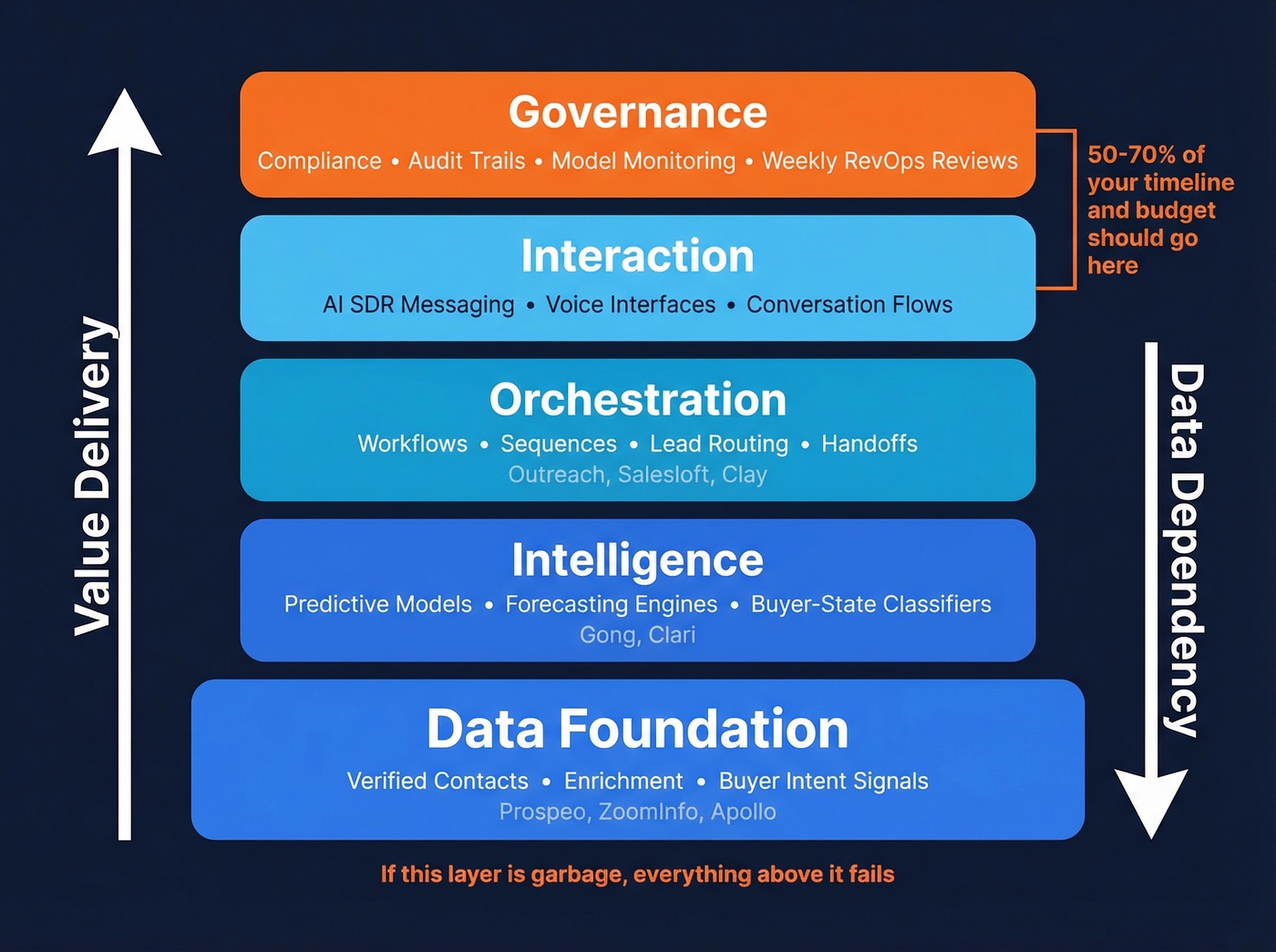
Layer 0 - Data Foundation
Verified contacts, enrichment, buyer intent signals. Without clean data, every other layer optimizes against garbage. This is where tools like Prospeo sit - 300M+ profiles refreshed every 7 days, 98% email accuracy, 125M+ verified mobiles, and intent data across 15,000 topics. Not glamorous, but it determines whether everything above it works or fails.
Layer 1 - Intelligence
Predictive models, buyer-state classifiers, forecasting engines. Only 7% of sales orgs hit 90%+ forecast accuracy today. AI/ML-assisted forecasting reduces variance to ±8-15%, compared to ±25-35% for manual rep roll-ups. The more outcome data your models ingest, the tighter your forecasts become.
Here's a benchmark worth internalizing: opportunities closed within 50 days hit a 47% win rate versus roughly 20% after that threshold. The intelligence layer identifies which deals are on track and which are drifting past the point of no return. Expect 30-60 days before predictions become useful - the models need data to learn from.
Layer 2 - Orchestration
Workflows, sequences, routing, handoffs. This is where Outreach, Salesloft, and Clay live. Sales reps spend 65% of their time on non-selling activities**, and orchestration exists to claw that time back. A well-designed workflow connects the intelligence layer's outputs directly to rep actions - auto-prioritizing accounts, triggering sequences, and routing leads without manual intervention. Budget 60-120 days for implementation. It requires process redesign, not just software installation.
Layer 3 - Interaction
Voice and text interfaces, conversation flows, AI SDR messaging. The visible tip of the iceberg. Already, 45% of high-performing teams run hybrid human + AI-SDR models that cut research and personalization time by 90%.
Layer 4 - Governance
Compliance, audit trails, model monitoring. This prevents "set and forget" drift. Treat the engine as a weekly operating rhythm - RevOps pods reviewing model outputs, SLAs on data freshness, scheduled audits - not a one-time deployment.
Let's be honest: governance should consume 50-70% of your timeline and budget. Most teams treat it as an afterthought. That's why most engines fail.
What AI-Powered Revenue Generation Looks Like
A mid-sized eCommerce operator built a $1,500 automation stack using AI agents for lead capture, multi-channel follow-up, cart recovery, and order management. Conversion rate went from 0.8% to 2.15%. Additional revenue: ~$56K/month.
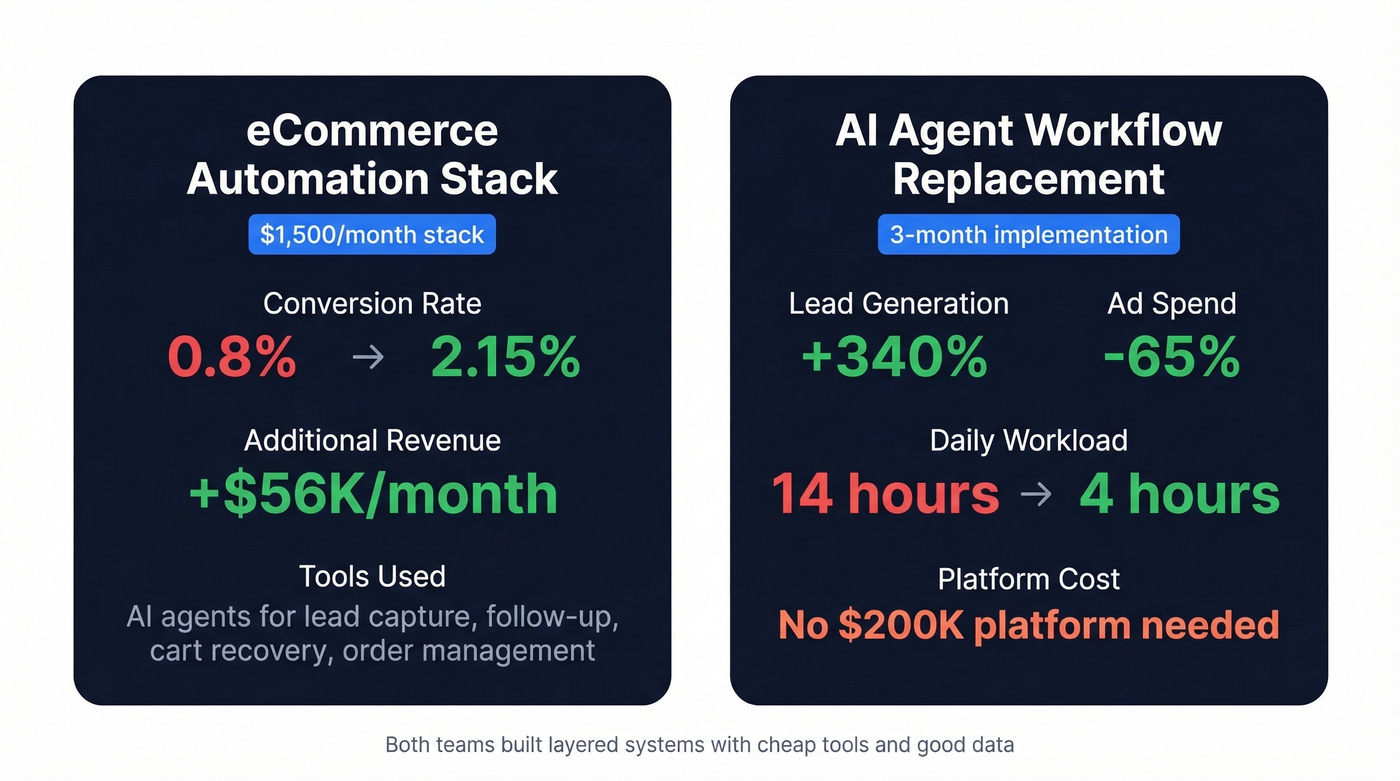
Another operator shared on Reddit that replacing manual workflows with a team of AI agents handling research, content, ads optimization, and analytics produced 340% more leads, 65% less ad spend, and cut workload from 14 hours/day to 4 - all within three months. Neither team bought a $200K platform. They built layered systems with cheap tools and good data.

Layer 0 determines whether your AI revenue engine works or becomes another failed project. Prospeo gives you 300M+ profiles refreshed every 7 days, 98% email accuracy, 125M+ verified mobiles, and intent data across 15,000 topics - the exact data foundation this architecture demands, starting at $0.01 per email.
Stop optimizing against garbage. Nail your data layer first.
Tools and Pricing (2026)
The market is consolidating fast. Gartner created a new "Revenue Action Orchestration" Magic Quadrant merging sales engagement, conversation intelligence, and revenue intelligence into one category. Clari and Salesloft merged into a $450M ARR entity. The average B2B company uses 87 software tools, but only 23% directly impact revenue.
Expect most standalone vendors in this space to become features inside larger platforms within 18 months. The Clari/Salesloft merger is the template, not the exception. Buy modular tools you can swap, not monoliths you're locked into.
| Tool | Layer | Starting Price | Best For |
|---|---|---|---|
| Prospeo | Data Foundation | Free; ~$0.01/email | Verified emails + mobiles, intent data |
| Apollo | Data + Engagement | Free; $49-$119/user/mo | SMB outbound + prospecting |
| Clay | Enrichment + Orchestration | $134-$720/mo | Multi-step enrichment workflows |
| Gong | Intelligence (Conversation) | ~$1,400/user/yr + $5K/yr platform fee | Call coaching + deal insights |
| Clari | Intelligence (Forecasting) | ~$100-$120/user/mo | Enterprise forecasting |
| Outreach | Orchestration | ~$100-$150/user/mo | Sales sequences + AI coaching |
| Salesloft | Orchestration (merged with Clari) | ~$140-$180/user/mo | Engagement + cadences |
| 6sense | ABM / Intent | $55K-$200K/yr | Enterprise account targeting |
| ZoomInfo | Data + Sales Intelligence | $15K-$40K+/yr | Large-scale firmographic data |
| Groove | Engagement | $24/user/mo | Lightweight SF-native engagement |
You don't need all ten. A startup can run Prospeo for data plus Apollo for outreach and have a functional two-layer engine for under $200/month. Enterprise teams adding Clari, Gong, and 6sense are looking at $100K-$300K/year before implementation costs.
Why Most Fail
80% of AI projects fail. That number alone should make you pause before signing a six-figure contract. The abandonment rate hit 42% in 2025 - up from 17% the year before - and 46% of AI proof-of-concepts get scrapped before production. The #1 obstacle? Data readiness. 43% of organizations cite it as their top blocker.
Here's the scenario we see constantly: a team deployed an AI SDR three months ago. It sends 500 emails a day. Bounce rate: 35%. Domain reputation: tanking. The AI works perfectly - on terrible data. The sequences are personalized, the timing is optimized, and none of it matters because a third of those emails never reach an inbox.
You can't fix a garbage-in problem with better orchestration. You fix it at the source. One of our customers, Snyk, had 50 AEs prospecting 4-6 hours a week with bounce rates of 35-40%. After switching their data foundation, bounces dropped under 5% and AE-sourced pipeline jumped 180%. The tool didn't change their process - it changed what the process was built on.
How to Build One From Scratch
You don't need $200K and a six-month implementation. Here's a realistic timeline:
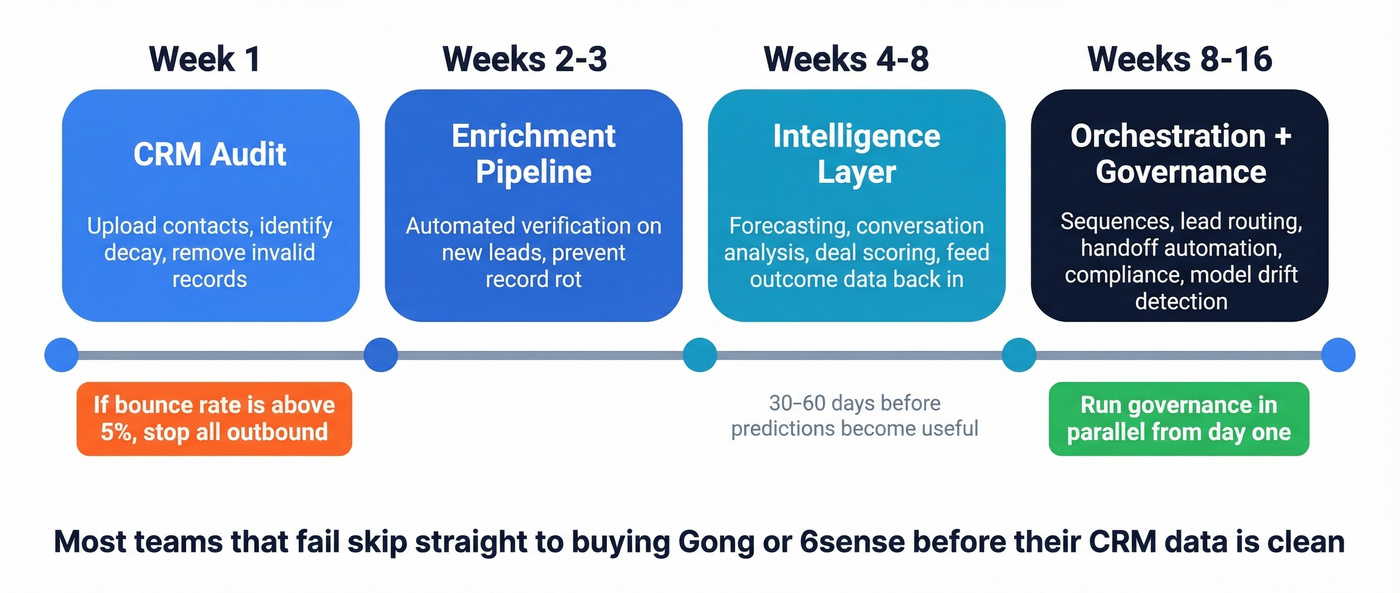
Week 1: Audit your CRM. Upload your contact list, identify decay, remove invalid records. If your bounce rate is above 5%, stop all outbound until this is fixed.
Week 2-3: Connect an enrichment pipeline so records don't rot. Set up automated verification on new leads entering the system.
Weeks 4-8: Add the intelligence layer - forecasting, conversation analysis, deal scoring. This is where you start feeding outcome data back into the system.
Weeks 8-16: Build orchestration workflows for sequences, lead routing, and handoff automation. Run governance in parallel from day one - monitoring, compliance checks, model drift detection.
Most teams that fail skip straight to buying Gong or 6sense before their CRM data is clean. Then they wonder why the AI's recommendations are wrong. Start boring. Start with data.
Skip the enterprise stack entirely if you're under 20 reps. A verified data layer plus one orchestration tool will outperform a $150K platform running on a dirty CRM every single time.
You don't need a $200K platform to build a working revenue engine. Teams run Prospeo as their data foundation for under $200/month - with 30+ search filters, buyer intent signals, and a 7-day refresh cycle that keeps your intelligence layer fed with accurate data, not stale records from six weeks ago.
Build a revenue engine that actually closes. Start with the data.
FAQ
Do I need this if my team is under 20 reps?
No. Start with a verified data layer and one orchestration tool. A $1,500 automation stack generated $56K/month for an eCommerce store - you don't need enterprise software to see results. Scale the engine as you scale the team.
What's the minimum budget?
Data foundation: free to ~$200/month. Add orchestration at $100-$150/user/month. A full enterprise stack with intelligence, ABM, and governance runs $50K-$200K+/year. Start under $500/month and add layers as you prove ROI.
How long before I see ROI?
Data layer improvements show results in days - bounce rates drop, deliverability climbs. Intelligence tools need 30-60 days of historical data before predictions sharpen. Full orchestration ROI typically materializes in 3-6 months, assuming the data foundation is solid from day one.
Why do 80% of AI revenue projects fail?
Data readiness is the #1 blocker - 43% of organizations cite it as their top obstacle. Teams buy expensive orchestration and intelligence tools before cleaning their CRM, then wonder why AI recommendations miss the mark. Fix the foundation first.