

AI Sales in 2026: What Actually Works
An enterprise seller we know - 18 years in the game - told us his SDR team made 200 calls a day last quarter and got zero connections. Not low connections. Zero. Meanwhile, their sequences blasted thousands of emails that sounded exactly like everyone else's because, surprise, everyone's using the same ChatGPT prompts. Over 91% of cold emails now get no reply, and cold call success rates have dropped to 2.3%. The AI sales tools are here, and most teams are using them to make things worse faster.
The problem isn't conceptual. Teams buy tools before fixing their data, automate volume instead of relevance, and wonder why their pipeline looks the same six months later. We've spent the last year testing stacks, tracking pricing, and talking to teams who are actually hitting quota with AI - and the gap between what works and what's wasting budget is enormous.
What You Need (Quick Version)
If you don't read anything else, build this three-tool starter stack:
- A conversation intelligence tool - Gong for enterprise, Fireflies.ai if you're budget-conscious. This is the highest-ROI AI category we see most consistently right now.
- A sequencing tool - Lemlist for personalization-first outreach, Outreach for enterprise-scale orchestration.
Here's the contrarian take that'll save you thousands: if your email bounce rate is above 5%, stop buying new tools and fix your data first. No AI sequencer can rescue a list full of dead addresses.
AI Sales Adoption by the Numbers
81% of sales teams are now experimenting with or have fully implemented AI - 41% at full implementation, 40% still experimenting, and 19% haven't started. That adoption curve is steep, but here's the number that matters more: teams using AI report 83% revenue growth compared to 66% without. The gap is real, but it's not evenly distributed.
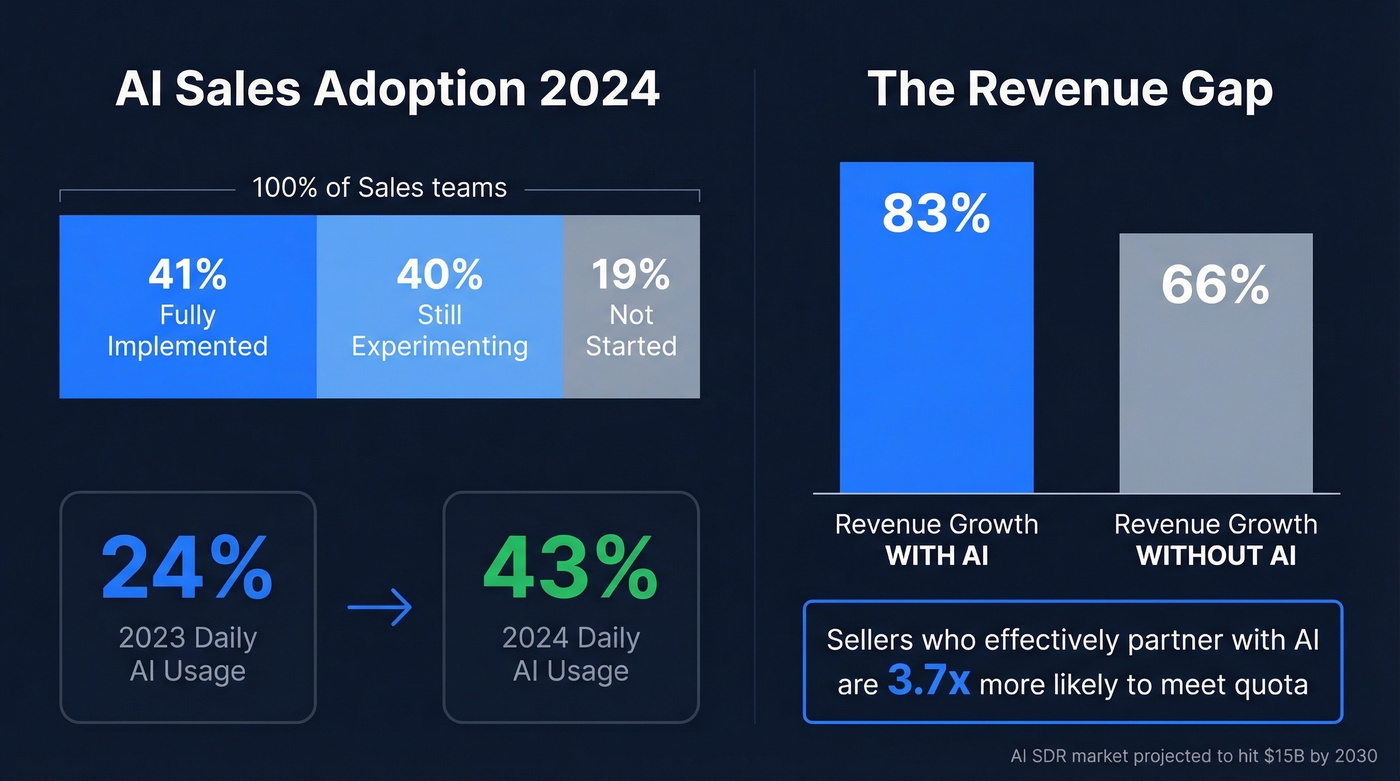
Daily AI usage among reps jumped from 24% in 2023 to 43% in 2024, and sellers who effectively partner with AI are 3.7x more likely to meet quota. The AI SDR market alone is projected to hit $15B by 2030.
But here's the counterweight everyone ignores. Gartner predicts that by 2028, AI agents will outnumber human sellers 10x - yet fewer than 40% of sellers will report those agents actually improved their productivity. Ten times more agents, and most sellers won't feel the difference. The adoption-to-productivity gap is the defining challenge of 2026, and it comes down to implementation quality, not tool selection.
What AI Does in Sales Today
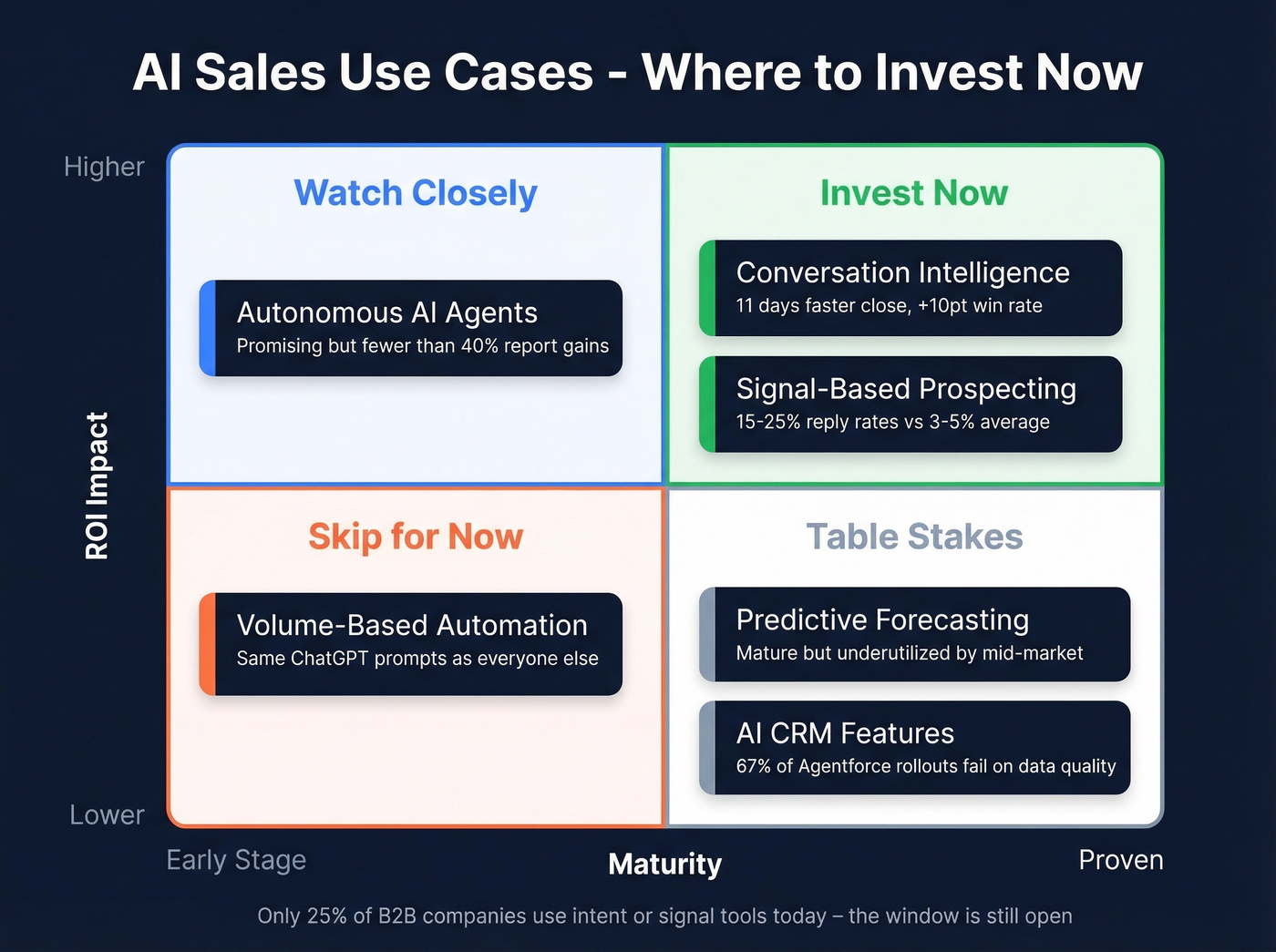
Not every use case delivers equal ROI. Here's what's working and what's still aspirational.
Signal-Based Prospecting
The biggest shift we're seeing is from volume-based to signal-based prospecting. Instead of blasting 10,000 contacts and hoping, signal-personalized outreach - triggered by job changes, funding rounds, tech stack shifts, or intent data - pulls 15-25% reply rates versus the 3-5% industry average. That's a 5x difference from the same rep, same product, same market.
Only 25% of B2B companies use intent or signal tools today. Three-quarters of your competitors are still spraying and praying. Early movers on signal-based prospecting have a genuine window before the market catches up.
Conversation Intelligence
This is where AI delivers the most measurable ROI right now. Outreach's data shows that deals supported by their Kaia coaching assistant close 11 days faster on average. For deals over $50K, Kaia users see up to a 10 percentage point win rate lift. There's a hard benchmark worth knowing: opportunities closed within 50 days have a 47% win rate, but after that threshold, win rates drop to 20% or lower. Conversation intelligence tools compress that timeline by flagging deal risks early and coaching reps in real time.
Forecasting and Pipeline
Predictive analytics tools like Clari (~$200-300/user/mo) and Salesforce Einstein analyze deal signals - email engagement, meeting frequency, stakeholder involvement - to surface pipeline risk before it shows up in your forecast. This category is mature but still underutilized by mid-market teams.
Autonomous Agents
AI sales agents fall into two camps: supportive agents that assist reps (Gong's coaching, Clay's enrichment workflows) and autonomous agents that act independently (scheduling meetings, qualifying inbound, running email sequences without human input). 45% of sales leaders already identify AI agents as a board-level topic.
But by 2028, fewer than 40% of sellers will report productivity gains from these agents. The autonomous agent category is promising but immature. We've seen teams deploy autonomous SDR agents only to discover the "personalized" emails read like a slightly better mail merge. Use supportive agents now. Watch autonomous agents closely. Don't bet your pipeline on them yet.
Tools by Category and Price
Here's the full breakdown. Pricing reflects current published ranges and community-reported figures.
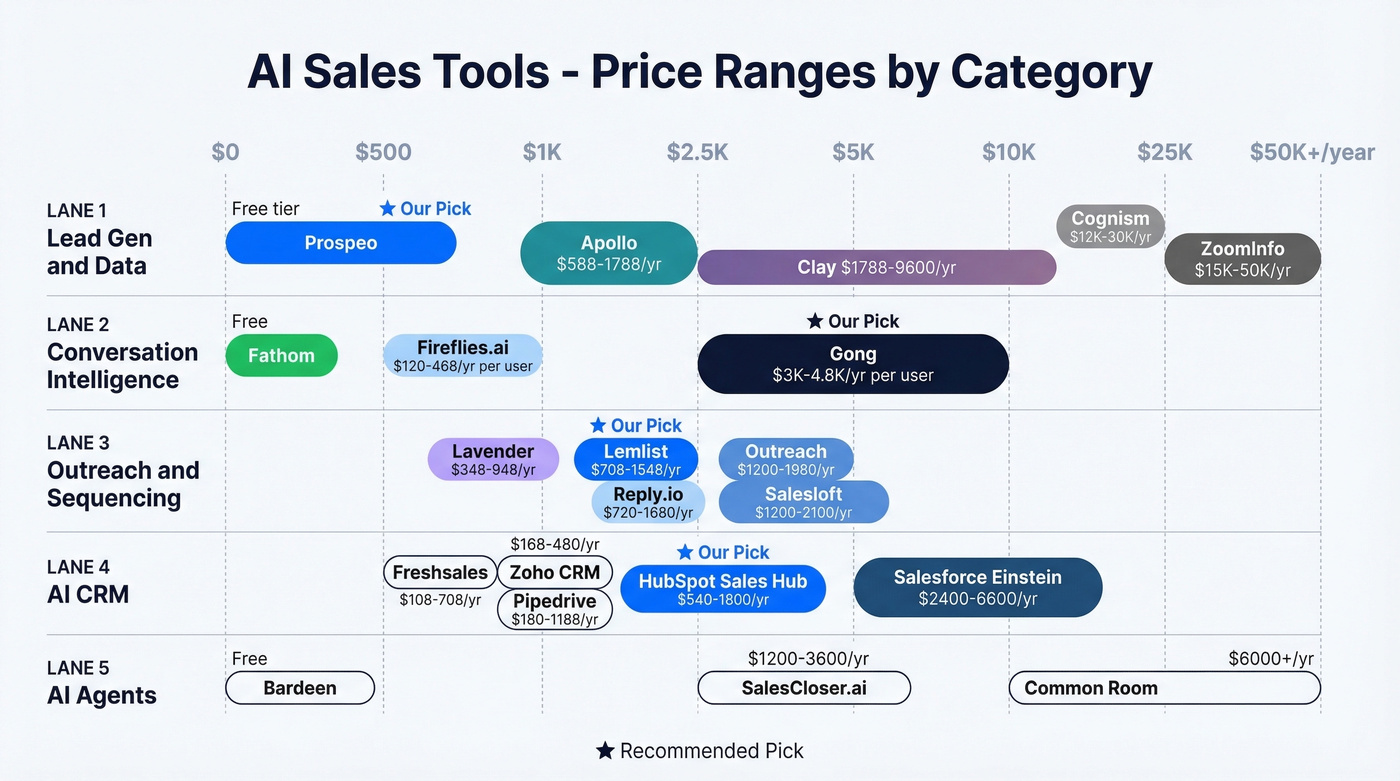
| Category | Tool | Starting Price | Best For | Pick |
|---|---|---|---|---|
| Lead Gen & Data | Prospeo | Free (75 emails/mo) | Email accuracy, intent data | ⭐ Our Pick |
| Lead Gen & Data | Apollo | ~$49/user/mo | All-in-one prospecting | |
| Lead Gen & Data | Clay | ~$149/mo | Enrichment workflows | |
| Lead Gen & Data | ZoomInfo | ~$15K-50K/yr | Enterprise database | |
| Lead Gen & Data | Cognism | ~$12K-30K/yr | EMEA mobile numbers | |
| Conversation Intel | Gong | ~$250-400/user/mo | Enterprise coaching | ⭐ Our Pick |
| Conversation Intel | Fireflies.ai | ~$10-39/user/mo | Budget call recording | |
| Conversation Intel | Fathom | Free-$25/user/mo | Solo reps, free tier | |
| Outreach | Lemlist | ~$59-129/user/mo | Personalized campaigns | ⭐ Our Pick |
| Outreach | Outreach | ~$100-165/user/mo | Enterprise sequencing | |
| Outreach | Salesloft | ~$100-175/user/mo | Mid-market sequencing | |
| Outreach | Lavender | ~$29-79/user/mo | Email writing coach | |
| Outreach | Reply.io | ~$60-140/user/mo | Multichannel sequences | |
| AI CRM | HubSpot Sales Hub | ~$45-150/user/mo | Mid-market CRM | ⭐ Our Pick |
| AI CRM | Salesforce Einstein | ~$200-550/user/mo | Enterprise AI CRM | |
| AI CRM | Zoho CRM | ~$14-40/user/mo | Budget AI CRM | |
| AI CRM | Freshsales | ~$9-59/user/mo | SMB CRM | |
| AI CRM | Pipedrive | ~$15-99/user/mo | Pipeline-focused CRM | |
| AI Agents | Common Room | ~$500+/mo | Signal-based GTM | |
| AI Agents | SalesCloser.ai | ~$100-300/mo | Autonomous demo agent | |
| AI Agents | Bardeen | Free-$60/user/mo | Workflow automation |
Lead Gen and Data
Real results: Meritt tripled pipeline from $100K to $300K/week after switching, and Snyk's 50-person AE team dropped bounce rates from 35-40% to under 5% while growing AE-sourced pipeline 180%.

Clay is the workflow builder for teams that want to chain multiple data sources into a single enrichment pipeline. Think of it as the orchestration layer: pull from data providers, enrich each lead with a custom scoring formula, then push qualified contacts directly to Outreach or Lemlist. A typical workflow pulls company data, checks for recent funding, verifies emails, scores by ICP fit, and routes hot leads to reps - all without manual intervention. Clay runs $149-800/mo depending on credit volume, and there's a real learning curve. On Reddit, it's a favorite for technically-minded operators, but skip it if you want something you can hand to a rep and have them running in 20 minutes.
Apollo is the obvious starting point for SMB teams that want prospecting, sequencing, and a database in one platform. At $49-149/user/mo, it's affordable, and the database is solid for North American contacts. The tradeoff: email accuracy runs lower than dedicated verification tools, and the data refresh isn't as aggressive. Pair Apollo with a verification layer if deliverability matters to your domain reputation.
ZoomInfo remains the enterprise default at $15K-50K/year, but you're paying for a full GTM platform whether you use it or not. Cognism is the pick for EMEA-heavy teams at $12K-30K/year with strong mobile coverage in Europe.
Conversation Intelligence
Gong is the category leader for enterprise teams. The platform records, transcribes, and analyzes customer interactions, then surfaces coaching insights, deal risks, and competitive mentions automatically. At $250-400/user/mo, it's expensive - a 10-seat deployment runs $30K-48K/year. But the ROI is clear when you use it well. If you're running a team of 10+ reps selling deals over $25K, Gong pays for itself.
Fireflies.ai gets you 80% of the value at 10% of the cost. At $10-39/user/mo, it handles transcription, summaries, and action items well. Skip it if you need deep deal analytics or competitive intelligence - that's Gong territory. Fathom offers a genuinely free tier for solo reps who just need meeting notes.
Outreach and Sequencing
Outreach is the enterprise sequencing platform - $100-165/user/mo, deep CRM integration, and the Kaia coaching layer that drives those 11-day faster closes. It's complex to implement and overkill for teams under 20 reps.
Lemlist wins on personalization. At $59-129/user/mo, it's built for teams that care about reply rates over send volume - native image and video personalization, solid deliverability features, and a much faster setup than Outreach. Salesloft ($100-175/user/mo) competes directly with Outreach in the mid-market. Lavender ($29-79/user/mo) is a writing coach, not a sequencer; it scores your emails and suggests improvements in real time.
AI CRMs
Salesforce Einstein dominates the enterprise AI CRM category at $200-550/user/mo, but 67% of Agentforce rollouts fail because of CRM data quality issues. HubSpot Sales Hub ($45-150/user/mo) is the mid-market sweet spot - strong AI features, faster implementation, and a free tier that actually works. Zoho CRM, Freshsales, and Pipedrive serve budget-conscious teams with increasingly capable AI features at $9-99/user/mo.
AI Agents
SalesCloser.ai (~$100-300/mo) runs autonomous demo and qualification calls. Common Room (~$500+/mo) aggregates buying signals across communities and product usage. Bardeen (free-$60/user/mo) automates repetitive workflows without code. All three are early-stage categories - useful for specific use cases, not ready to replace your SDR team.

Signal-based prospecting pulls 5x reply rates - but only if your emails actually land. Prospeo delivers 98% email accuracy on a 7-day refresh cycle, with intent data across 15,000 topics built in. No stale lists. No bounced sequences.
Stop automating bad data. Start with emails that actually connect.
Build Your Stack by Budget
$0/month - The Free Stack Prospeo's free tier (75 verified emails/month), Fathom for call recording, HubSpot free CRM. This gets a solo founder or early-stage rep prospecting, recording calls, and tracking deals without spending a dollar.
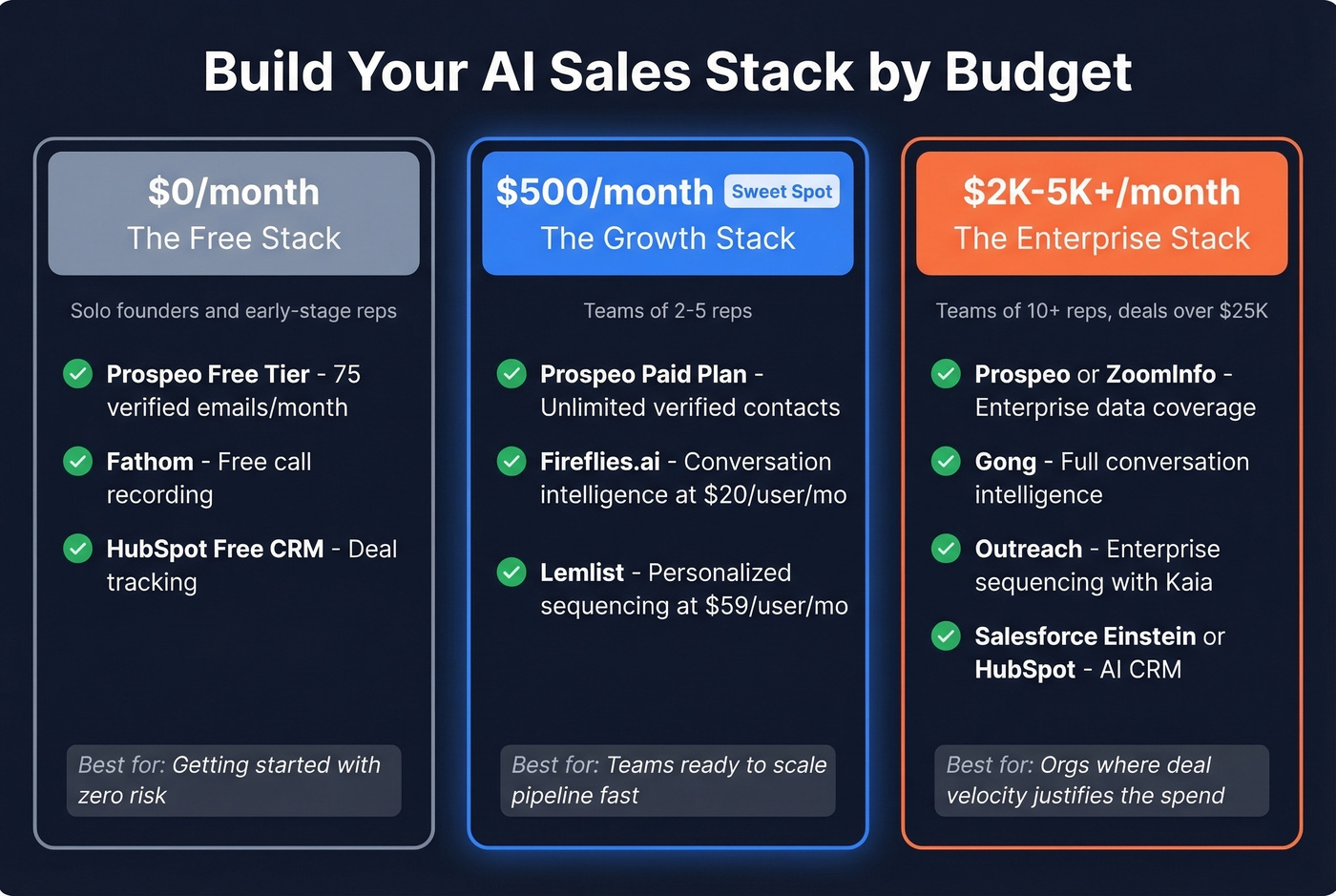
~$500/month - The Growth Stack A paid data plan for unlimited verified contacts, Fireflies.ai for conversation intelligence (~$20/user/mo), Lemlist for sequencing (~$59/user/mo). This is the sweet spot for teams of 2-5 reps. One practitioner on r/sales described a similar stack - Apollo plus a prospecting AI tool plus Avoma - that books 1-2 meetings per week consistently. ~$2,000/month - The Scale Stack Verified data with intent signals, Gong for coaching and deal intelligence, Outreach for enterprise sequencing, Clay for enrichment workflows. This is where 45% of teams are running a hybrid AI-SDR model - AI handles research, personalization, and initial qualification while human reps handle conversations and closing. At this tier, AI-assisted workflows start delivering compounding returns because every tool feeds cleaner data to the next.
$10,000+/month - The Enterprise Stack Full Gong deployment, Outreach or Salesloft, Salesforce Einstein, ZoomInfo or Cognism for supplementary data, Clari for forecasting, plus a verification layer for email enrichment. At this level, the challenge isn't tool selection - it's integration and change management.
Outreach That Still Gets Replies
Let's be honest: the consensus on r/copywriting is blunt. Most of what worked last year is dead. Inboxes are a war zone. But signal-personalized outreach still pulls 15-25% reply rates when done right.
The format that works: 40-60 words. Not 40-60 words of personalization tokens - 40-60 words of genuine value. Here's the structure:
[Name], noticed [specific signal - funding round, job change, tech adoption]. We helped [similar company] [specific result]. Worth a quick conversation?
That's roughly 30 words. You can add one more sentence of context and still stay under 50. The key isn't personalization - it's specificity. "I read your blog post" isn't specific. "You just hired three SDRs and your team is still running Outreach on a ZoomInfo list with a 12% bounce rate" is specific.
Value-first approaches work even better: send a free audit, a 90-second Loom showing something broken on their site, or a competitor heads-up they haven't seen. Soft CTAs only - "Worth a look?" or "Interested?" outperform "Let's book 30 minutes" every time. The goal is a reply, not a calendar link.
Here's the thing nobody in SaaS wants to hear: the most productive sales channel in 2026 isn't AI-powered at all. Reddit threads and experienced sellers keep saying the same thing - events, face-to-face meetings, and personal branding on social platforms are pulling better results than any automated sequence. AI should handle the research and data grunt work so your reps can show up to those conversations prepared. If you're using these tools to avoid human interaction, you're using them backwards.
One enterprise seller reports a 6-month lead time before cold outreach converts to a meeting - which means your data needs to stay fresh for months, not days. Weekly data refresh cycles aren't a nice-to-have; they're the difference between a live prospect and a bounced email.
Five Mistakes That Kill AI Sales Initiatives
1. Bad Data Quality
This is the #1 killer and it's not close. 67% of Agentforce rollouts fail because of CRM data quality issues. Your AI sequencer can't personalize outreach to a contact who left the company eight months ago. Your intent signals are worthless if the email bounces.
2. Volume Over Relevance
The saturation paradox: AI makes it trivially easy to send 10,000 emails. So everyone does. And now 91% of cold emails get no reply. The teams winning aren't sending more - they're sending better. Signal-based targeting, shorter emails, genuine value propositions.
3. Over-Automation Without Oversight
AI-generated messages without human review produce tone-deaf, context-missing outreach that damages your brand. One bad automated email to a VP who just lost their biggest customer can burn a relationship permanently. Always have a human in the loop for high-value accounts.
4. Tools Before Process
We've seen teams buy Gong, Outreach, Clay, and an intent data provider in the same quarter - then spend six months figuring out how they connect. Define your sales process first. Map where the bottlenecks are. Then buy the tool that fixes the biggest one.
5. Ignoring Change Management
Only 19% of reps actually use the AI features built into their existing tools. You don't have a tool problem. You have an adoption problem. Training, incentives, and manager enablement matter more than feature lists.
Meritt tripled pipeline to $300K/week. Snyk's 50 AEs dropped bounce rates from 35% to under 5% and grew pipeline 180%. The difference wasn't a better AI sequencer - it was accurate data at $0.01/email instead of $1/lead.
Your AI stack is only as good as the data underneath it.
How AI Is Reshaping Sales Leadership
Gartner's guidance for 2026 boils down to three priorities: build a sales-centric AI portfolio roadmap, transform GTM motions to align with buyer preferences, and increase the impact of sales managers through enablement and role clarity.
The roadmap piece is critical. Most sales orgs have accumulated AI tools organically - a rep bought Lavender, marketing added intent data, RevOps implemented Clay - with no coherent strategy connecting them. The result is overlapping tools, fragmented data, and reps toggling between six tabs. Before adding another tool, involve IT and legal in procurement decisions. AI tools touch customer data, CRM integrations, and compliance boundaries that sales leaders alone shouldn't be navigating.
The intersection of AI and sales is evolving fast, but the fundamentals haven't changed. AI should make your team faster at what they already do well - not become a project that needs its own project manager. The teams that win in 2026 aren't the ones with the most tools. They're the ones with clean data, clear processes, and AI deployed at the specific points where it removes friction from the buyer's experience.
The best AI sales stack in 2026 costs under $500/month and starts with data you can actually trust. Everything else is optional.
FAQ
What is AI in sales?
AI in sales uses machine learning, NLP, and automation to help teams prospect, personalize outreach, coach reps, and forecast pipeline. It augments human sellers by handling repetitive data tasks - enrichment, scheduling, lead scoring - so reps focus on relationships and closing deals.
Do AI sales tools increase revenue?
Teams using AI report 83% revenue growth versus 66% without. But results depend entirely on data quality and implementation - buying a tool alone guarantees nothing. Layer AI on top of verified data and a defined process for real impact.
What's the best free tool for small teams?
Prospeo's free tier (75 verified emails/month), Fathom for call recording, and HubSpot free CRM give you a complete prospecting-to-pipeline stack at $0/month. Add Lemlist at ~$59/month when you're ready to scale sequences.
Will AI replace salespeople?
By 2028, AI agents will outnumber sellers 10x, but fewer than 40% of sellers will report productivity gains. AI handles research, data entry, and scheduling; humans handle relationships and complex negotiations. Roles are reshaping, not disappearing.
How much do AI sales tools cost?
Free tiers exist for data verification, call recording, and CRM. Mid-market teams build effective stacks for $500-2,000/month. Enterprise platforms with forecasting and full coaching suites run $50K+/year.