

Contact-Level Intent Data: What It Is, What It Costs, and How to Use It
Your intent data platform just flagged 47 accounts as "surging" on your core topic. Great. Now your SDR opens one of those accounts and sees 83 contacts - from the intern to the CTO. Who's actually researching? Nobody knows, so the rep sends a generic sequence to the top five titles and hopes for the best.
That's the account-level intent trap, and it's where a lot of the value in this $4.49 billion market disappears. Contact-level intent data fixes this by telling you which person is researching, not just which company.
The Short Version
Contact-level intent identifies the individual - name, role, topics they're engaging with - turning 1-3% account-level conversion into 10-15%. Expect to pay $7K-$150K+/year for standalone intent platforms, and budget 15-25% above the license for implementation and integration. But here's the catch that trips up most teams: intent signals without verified contact data don't convert. You need accurate emails and direct dials to reach the people showing intent, or you're just watching signals you can't act on.
What Contact-Level Intent Actually Means
The average B2B sales buying group involves 14-23 people, and roughly 3% ever fill out a form. That means 97% of your buying committee is invisible to traditional demand gen.
Contact-level intent data tracks which specific individuals - not just companies - consume content related to your solution category. Where account-level intent says "Acme Corp is researching CRM software," person-level intent says "Sarah Chen, VP of Revenue Operations at Acme Corp, has been reading CRM comparison content for the past 10 days." One is a vague signal. The other is a qualified outreach opportunity. The intent data market is projected to hit $20.89 billion by 2035 precisely because companies are desperate to close that gap.
Account-Level vs. Contact-Level Intent
| Dimension | Account-Level | Contact-Level |
|---|---|---|
| What you learn | A company is researching | A specific person is researching |
| Typical output | List of "surging" accounts | Named contacts + topics + recency |
| Rep action | Guess who to email | Personalize to the right person |
| Conversion benchmark | 1-3% of accounts | 10-15% of targeted accounts |
| Trade-off | "Who do I actually call?" | Worth the premium, fewer vendors |
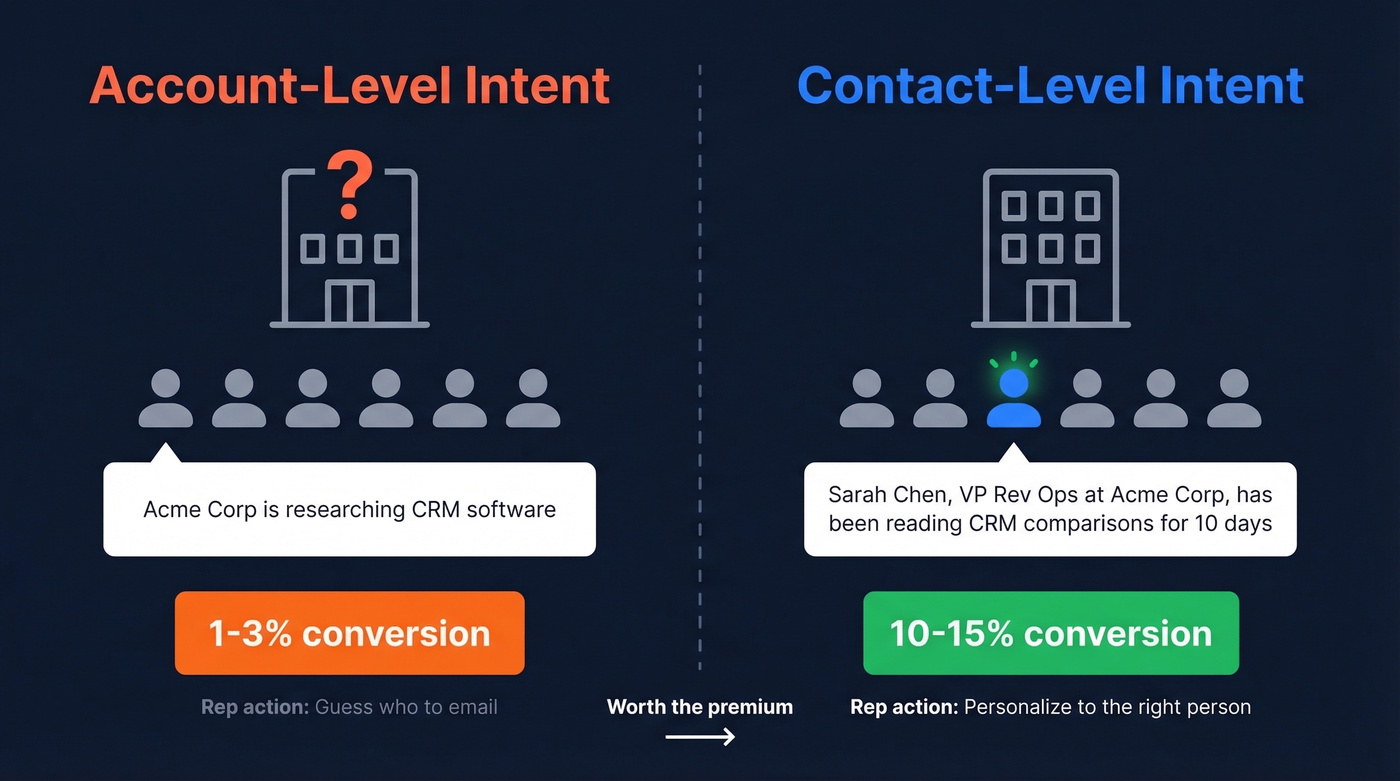
Let's be honest: account-level intent isn't worthless. It's a decent starting filter for account-based selling programs. But the failure mode is predictable. Reps get a "hot accounts" list, see dozens of contacts, don't know who triggered the spike, and either blast everyone or ignore the signal entirely. We've watched this play out at multiple companies. Person-level signals eliminate the guessing by attributing research activity to a named individual.
How These Signals Are Collected
Four signal types, each with different accuracy and scale trade-offs:
First-party intent comes from your own properties - website visits, product usage, content downloads. Highest accuracy, smallest scale.
Second-party intent comes from partner platforms like G2 and TrustRadius. Dreamdata found 12% of closed-won deals had a G2 signal in the buyer journey, those deals were 2x larger, and buyer journeys starting with a review-site touch closed 63% faster.
Third-party intent comes from publisher co-op networks. Bombora's network tracks 17 billion interactions monthly across 5,000+ sites. Scale is massive, but noise increases proportionally.
Derived intent is AI-synthesized, combining multiple signal types including job-change signals that flag when a past buyer lands at a new company.
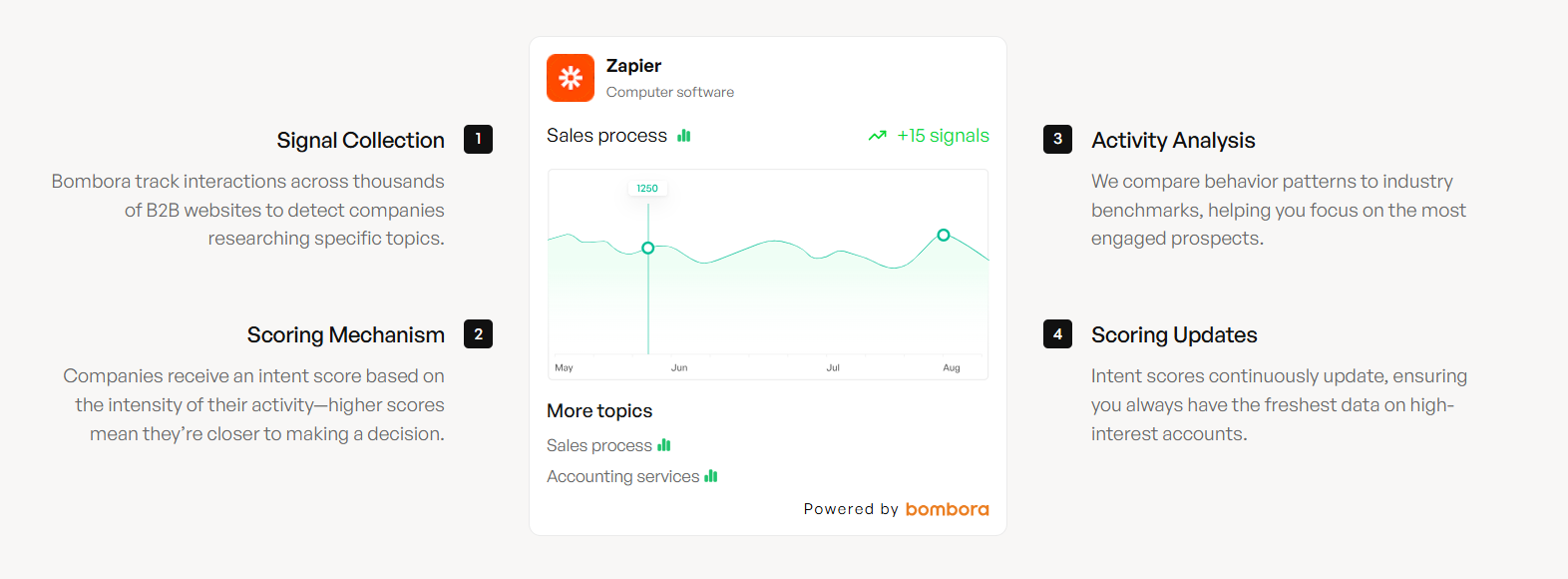
The technology underneath all of this is identity resolution. Deterministic matching like form fills and content syndication is accurate but limited in scale. Probabilistic matching - IP-to-company lookups, device graphs - covers more ground but introduces noise. HubSpot's buyer intent feature, for example, uses IP-to-company matching: useful for identifying companies, but it won't tell you which person visited your pricing page. That's exactly why teams investing in individual-level intent see stronger conversion rates.

You just read it: intent signals without verified contact data don't convert. Prospeo layers 15,000 Bombora intent topics directly onto 300M+ profiles with 98% email accuracy - so you reach the person showing intent, not just their company. No annual contracts. Starts at $0.01/email.
Stop watching intent signals you can't act on.
How to Activate Intent Signals
Roughly two-thirds of teams struggle to make intent data actionable. The fix isn't more data. It's prioritization.
Signal Hierarchy
Tier 1 - Act within 48 hours. Pricing page visits, demo/trial research, competitor evaluations. These are bottom-funnel signals that decay fast.
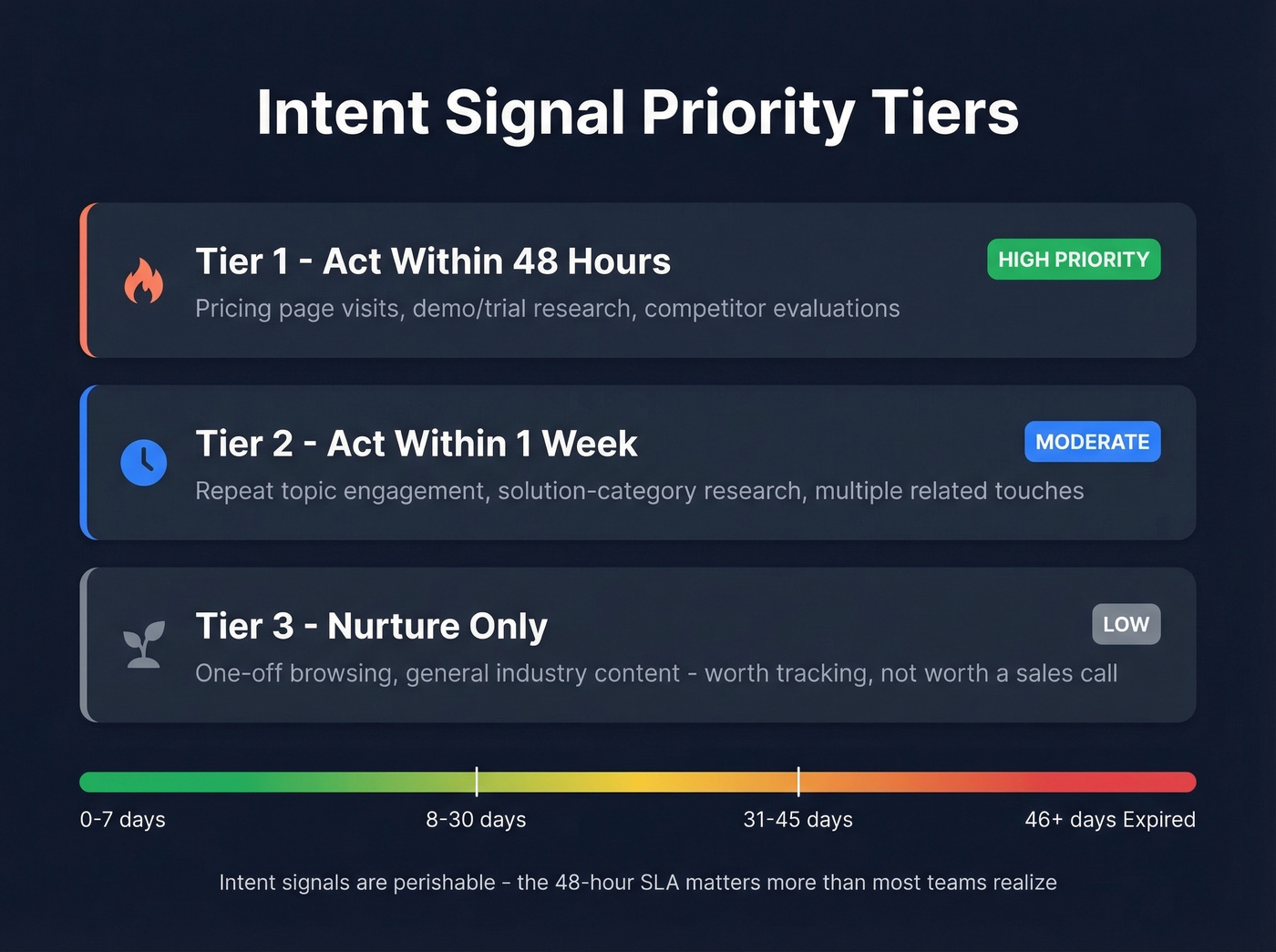
Tier 2 - Act within 1 week. Repeat topic engagement, solution-category research, multiple touches across related content.
Tier 3 - Nurture. One-off browsing, general industry content. Worth tracking, not worth a sales call.
Time-Decay Model
| Days Since Signal | Priority | Action |
|---|---|---|
| 0-7 | High | Immediate personalized outreach |
| 8-30 | Moderate | Sequence enrollment, ad targeting |
| 31-45 | Cooling | Nurture only |
| 46+ | Expired | Remove from active lists |
We treat Tier 1 signals like perishable goods - the 48-hour SLA matters more than most teams realize. Practitioners on Reddit consistently ask for API-based intent delivery because they want real-time activation, not weekly CSV exports. If your workflow can't route a signal to a rep within two days, you're leaving money on the table.
What It Costs in 2026
No vendor publishes pricing openly. These ranges come from community discussions and published benchmarks. Budget 15-25% above the license for implementation and integration.
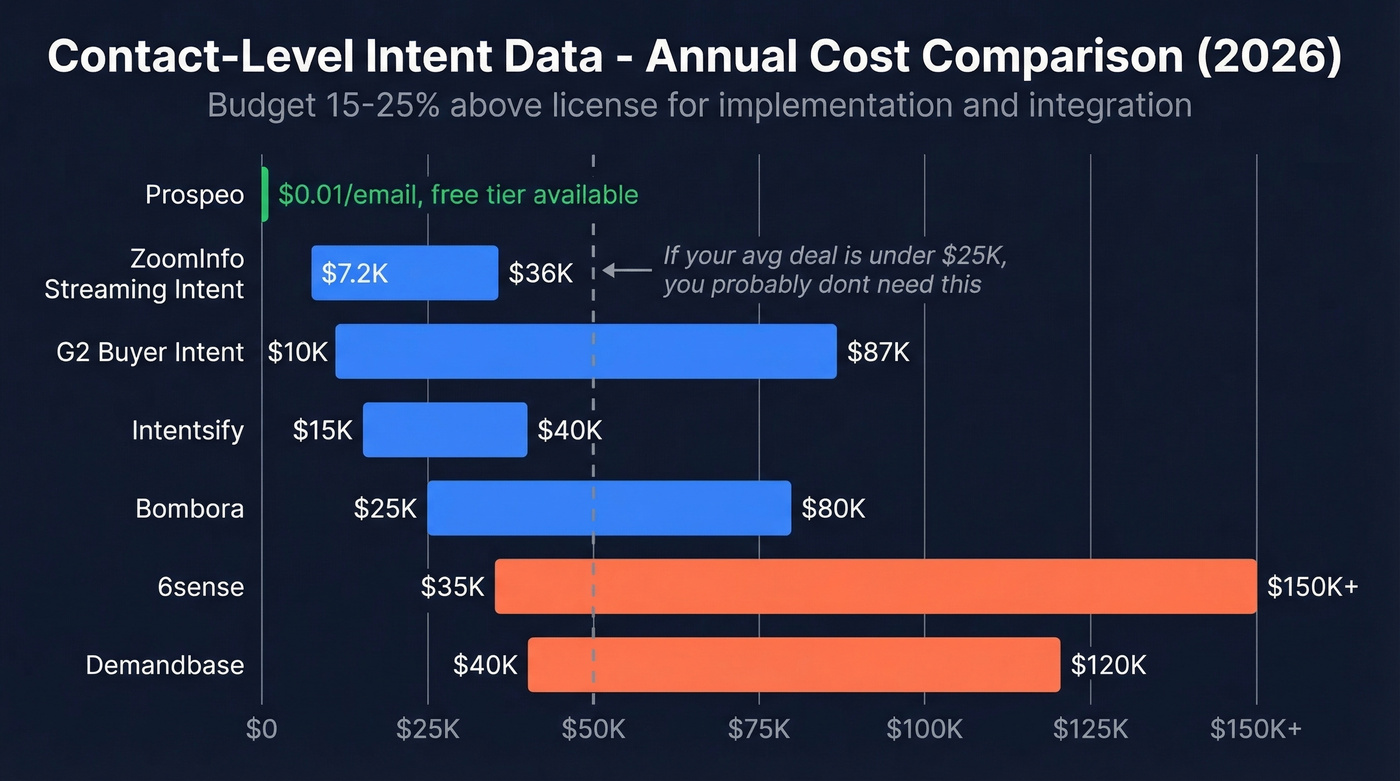
| Provider | Annual Cost Range | Notes |
|---|---|---|
| Prospeo | ~$0.01/email, free tier | Verified contacts + 15,000 Bombora intent topics; self-serve, no contracts |
| ZoomInfo Streaming Intent | $7.2K-$36K | Varies by ZoomInfo package tier |
| G2 Buyer Intent | $10K-$87K+ | Add-on for existing G2 customers |
| Intentsify | ~$15K-$40K | Buying-group focus; Contact Data add-on US-only |
| Bombora | $25K-$80K | Third-party co-op network |
| 6sense | $35K-$150K+ | Full ABM platform; 3-6 month implementation |
| Demandbase | $40K-$120K | ABM platform with intent layer |
Look - if your average deal size is under $25K, you almost certainly don't need a six-figure intent platform. A mid-market 6sense contract typically starts around $35K/year and still doesn't include verified emails. For teams that need to act on buyer intent without a long implementation or annual lock-in, the math favors lighter-weight tools that combine signals with verified contact data in one workflow.
Mistakes That Kill Intent ROI
Only 24% of teams report exceptional ROI from intent data. Here's why most fall short:
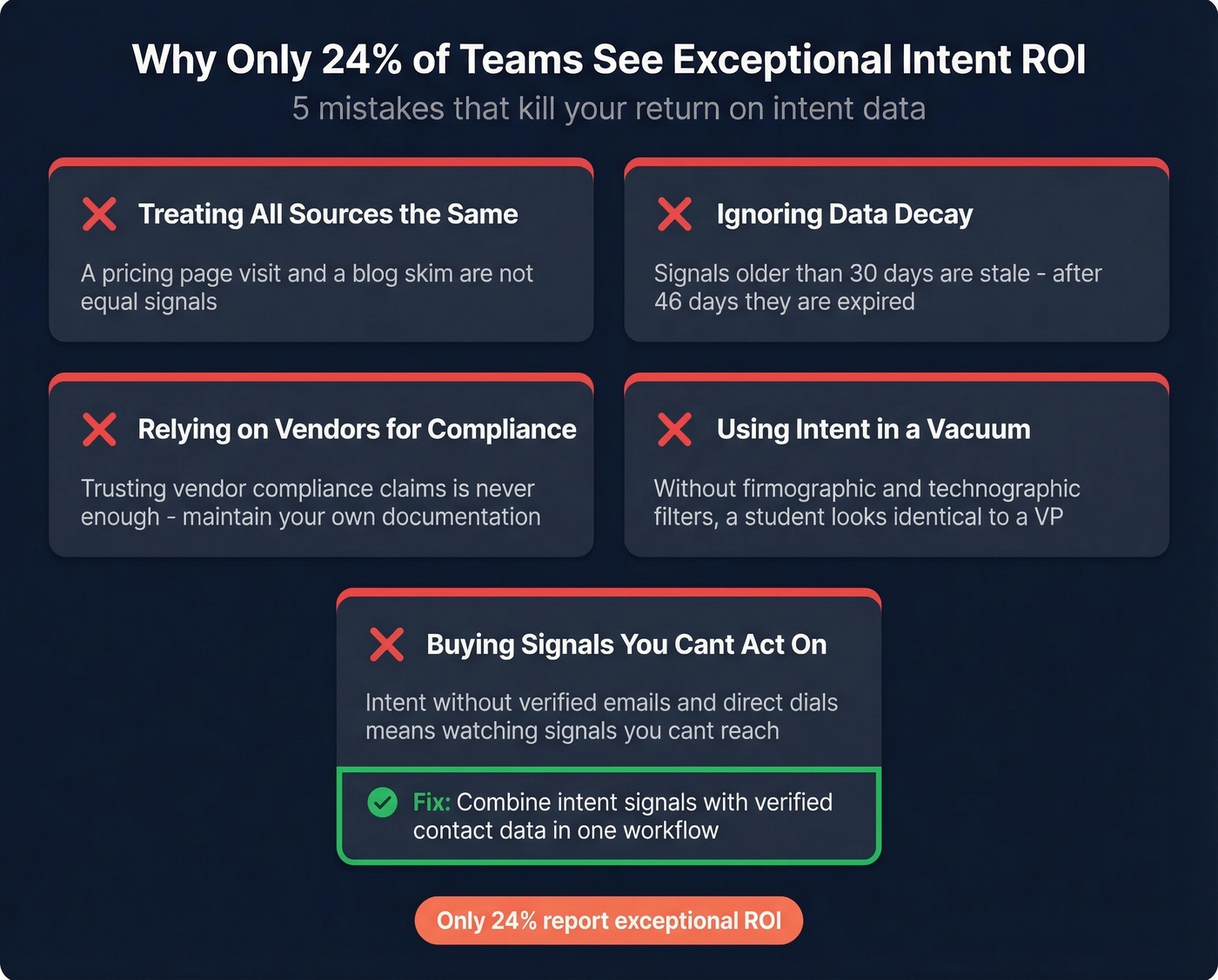
Treating all sources the same. A pricing page visit and a blog skim aren't equal signals. Without a lead scoring hierarchy, reps waste time on noise.
Ignoring data decay. Intent signals cool fast. If you're still prioritizing signals after 30 days, you're late. By 46+ days, they're effectively expired.
Relying on vendors for compliance. Forrester is explicit - trusting your vendor's compliance claims is "never enough." You need your own lawful basis documentation.
Using intent in a vacuum. Intent without firmographic and technographic context produces false positives. A student researching "CRM software" looks identical to a VP evaluating vendors if you don't layer in additional filters.
Buying signals you can't act on. The consensus on r/LeadGeneration is blunt: "most intent data solutions are trash." The frustration isn't with the concept - it's with platforms that surface signals without giving you verified contact data to do anything about them. This is the core limitation of account-level tools and the reason individual-level intent matters so much.
Privacy and Compliance in 2026
Privacy regulation is accelerating. The US now has 20 states with comprehensive privacy laws, and California's updated CCPA regulations took effect January 1, 2026, including new risk-assessment duties and requirements to honor opt-out preference signals. Skip any vendor that can't clearly explain where their data comes from and how consent is handled. And maintain your own compliance documentation - vendor compliance alone is never sufficient.
From Intent Signal to Booked Meeting
The "last mile" problem is simple: knowing who's interested doesn't help if you can't reach them. You need verified emails and direct dials, refreshed frequently enough that the data is still accurate when the signal fires. A platform that costs $50K/year but can't give you a working email for the person showing intent is a worse investment than one that does both at a fraction of the cost.
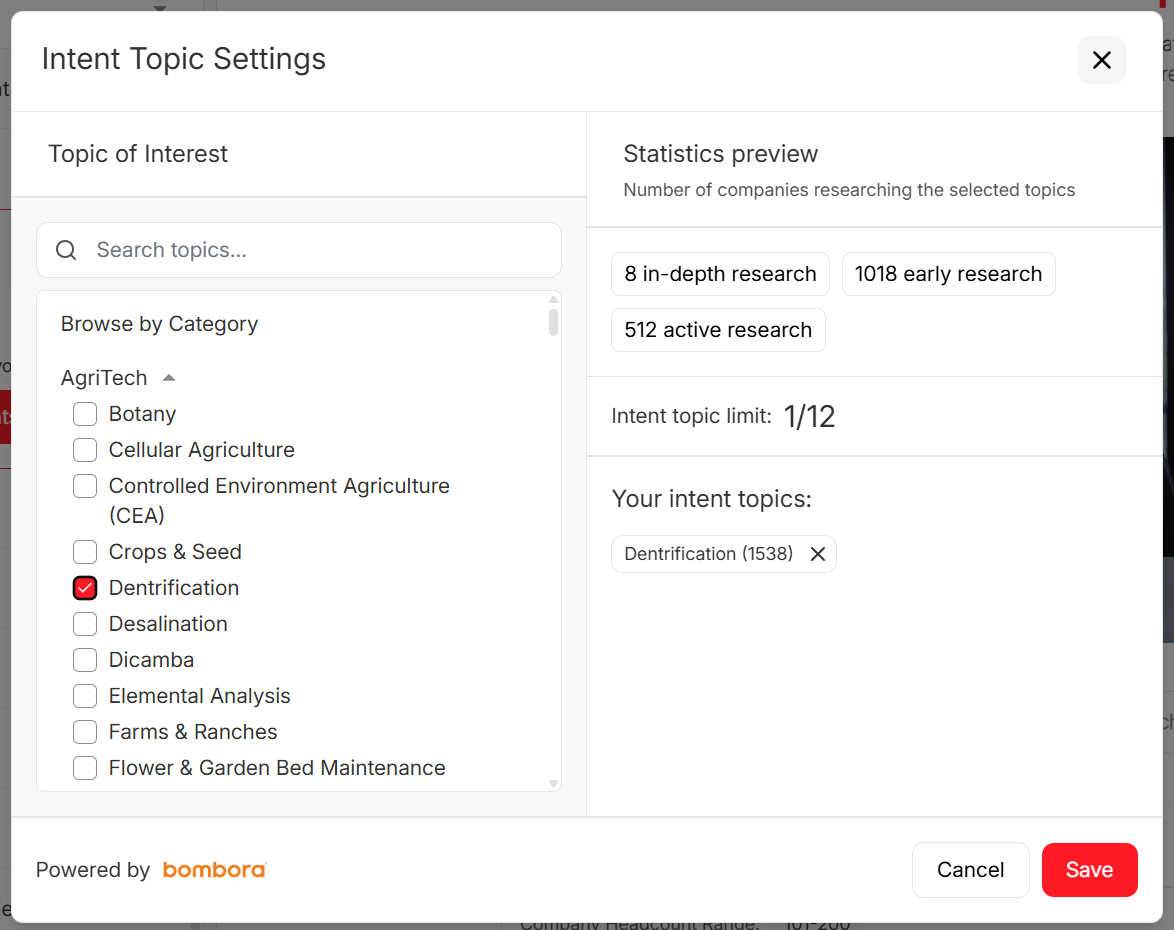
Prospeo combines both sides of that equation - 15,000 Bombora intent topics layered with 300M+ professional profiles and 98% email accuracy on a 7-day refresh cycle versus the 6-week industry average. Filter by intent topic, layer in job role and company signals, and export verified contacts ready for outreach. No six-month implementation, no annual contract.
If you want to operationalize this inside your stack, start with a clean lead generation workflow and add data enrichment so your CRM records stay usable for routing and personalization.
Most intent platforms cost $35K-$150K/year and still don't give you verified emails or direct dials. Prospeo combines buyer intent, 143M+ verified emails, and 125M+ mobile numbers in one self-serve platform - with a 7-day data refresh so you're never acting on stale signals.
Turn contact-level intent into booked meetings for $0.01 per lead.
FAQ
What's the difference between contact-level and account-level intent data?
Account-level tells you a company is researching a topic. Contact-level tells you which specific person is doing the research - their name, role, and topics consumed. This lets reps personalize outreach to the right buyer instead of blasting an entire org chart with generic sequences.
How accurate is contact-level intent data?
Deterministic signals like form fills are highly accurate, while probabilistic signals from IP matching produce more false positives. The bigger issue is freshness - signals decay within 7-14 days, so stale data creates false positives regardless of how the signal was originally collected.
Is contact-level intent data GDPR compliant?
It can be, but compliance depends on the vendor's data sourcing and your own processing basis. Forrester warns against relying solely on vendor claims. Verify data provenance, honor opt-out preference signals, and note that California's updated CCPA regulations added new risk-assessment requirements effective January 1, 2026.
What's a good affordable alternative to enterprise intent platforms?
For teams with average deal sizes under $50K who need both intent signals and verified contact data in one workflow, self-serve platforms with credit-based pricing are the sweet spot. They avoid the six-figure commitments and multi-month implementations of full ABM suites while still giving you actionable person-level signals paired with verified emails and phone numbers.