

How to Build an AI Sales Funnel That Actually Works in 2026
Every sales team is being told to "add AI to the funnel." Most of them bolt on a chatbot, watch it hallucinate pricing details to a prospect, and quietly turn it off two weeks later. The gap between hype and real results is wide - but the outcomes are undeniable when the implementation is right.
Here's the thing: opportunities closed within 50 days carry a 47% win rate. Deals that drag past that threshold drop to 20% or lower. AI-assisted selling shaves 11 days off sales cycles and boosts win rates by up to 10 percentage points on deals over $50K. That's not a marginal improvement. That's a different business.
The broader picture backs it up. 83% of AI-using sales teams saw revenue growth last year, compared to 66% without. The productivity opportunity across sales and marketing sits at $0.8-1.2 trillion. The real question isn't whether AI works - it's whether it improves deal velocity and close rates, or just reduces busywork. The answer is both, but only if you build the funnel in the right order.
The Short Version
- Clean your contact data. Bad emails break everything downstream. Verify your list before anything touches a sequence. 98% email accuracy and a 7-day refresh cycle are the baseline you should demand.
- Automate speed-to-lead. Responding in under 5 minutes makes you 21x more likely to qualify a lead. Set up instant routing before you buy anything fancy.
- Layer in scoring and nurturing. Only after the foundation works. HubSpot or Salesforce for CRM + AI scoring, Instantly or Outreach for sequences.
Everything else - intent data, agentic workflows, predictive churn models - comes after these three are running.
What Is an AI Sales Funnel?
An AI sales funnel is a standard sales funnel where AI handles the repetitive, data-heavy work at each stage - scoring leads, personalizing outreach, routing conversations, predicting churn - while humans focus on relationship-building and complex selling. It's not a different funnel. It's the same funnel with fewer manual bottlenecks.
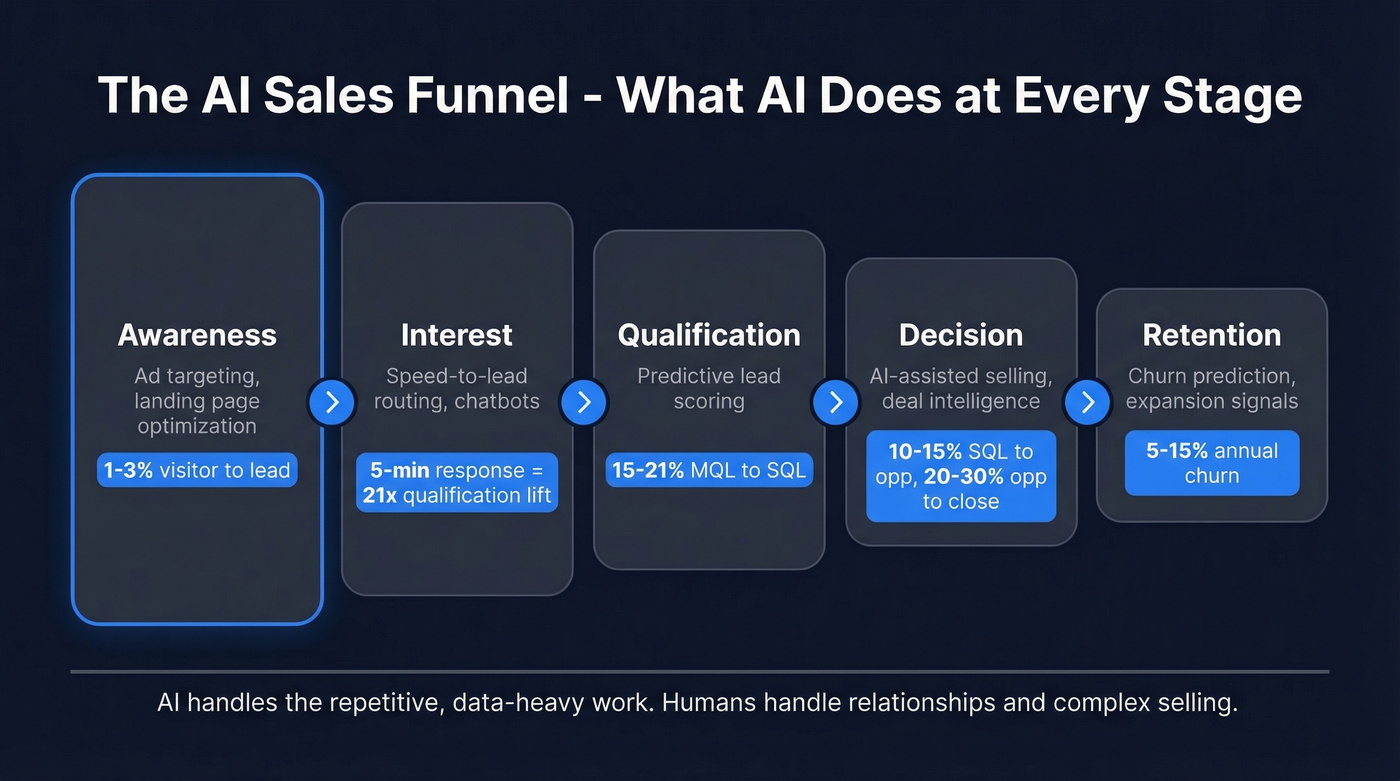
Here's what AI does at each stage, along with baseline conversion benchmarks you should measure against:
| Funnel Stage | AI Capability | Baseline Conversion |
|---|---|---|
| Awareness | Ad targeting, landing page optimization | 1-3% visitor to lead |
| Interest | Speed-to-lead routing, chatbots | 5-min response = 21x qualification lift |
| Qualification | Predictive lead scoring | 15-21% MQL to SQL |
| Decision | AI-assisted selling, deal intelligence | 10-15% SQL to opp; 20-30% opp to close |
| Retention | Churn prediction, expansion signals | 5-15% annual churn (typical B2B SaaS) |
The compounding effect matters most. Improving each stage by even a few percentage points changes your output dramatically - we'll show the math below.
Funnel Optimization by Stage
Awareness: AI-Optimized Landing Pages
The Unbounce Conversion Benchmark Report puts the median landing page conversion rate at 6.6%. World of Wonder hit 29.7% on their streaming page using AI optimization tools.
AI earns its keep through dynamic copy testing, audience segmentation, and real-time bid optimization. But don't expect it to fix a bad offer. If your value prop doesn't resonate, no amount of optimization saves the page.
Interest: Speed-to-Lead
This is where most funnels leak hardest.
A lead fills out a form at 2 PM, and a rep follows up at 10 AM the next day. By then, the prospect has booked a demo with your competitor. And 92% of B2B buyers enter the process with at least one vendor already in mind, which means your funnel needs to reach them before they're "in-market," not after.
Responding within 5 minutes makes you 21x more likely to qualify a lead. AI-powered routing - chatbots, instant Slack notifications, automated meeting booking - closes this gap without adding headcount. Personalized outreach drives 142% higher reply rates than generic templates, so the speed and the quality of that first touch both matter. We've seen teams go from 18-hour average response times to under 3 minutes just by wiring up a Slack alert and a Calendly link. No fancy AI required for that first win.
Qualification: Predictive Lead Scoring
Reps spend 2-3 hours daily on manual CRM entry - roughly 15 hours a week that AI could eliminate. Predictive scoring uses behavioral signals like page visits, content downloads, email engagement, and firmographic fit to rank leads by likelihood to convert. Lead scoring improves qualification accuracy by 39%.
The catch: AI scores are only as good as the data feeding them. Garbage CRM data produces garbage scores. Full stop.
Decision: AI-Assisted Selling
45% of teams already run a hybrid AI-SDR model. AI handles research, personalization, and follow-up sequencing. Humans handle discovery calls, objection handling, and the nuanced relationship work that closes deals. Modern B2B deals involve 13 stakeholders across multiple departments - AI deal intelligence tools track engagement across all of them so nothing slips through the cracks when your champion goes quiet for two weeks.
AI-assisted teams cut research and personalization time by 90%. On deals over $50K, win rates climb by up to 10 points. That doesn't mean AI replaces the rep. It means the rep spends time selling instead of prepping.
Retention: Churn Prediction and Expansion
Most teams focus AI on the top of the funnel and ignore retention entirely. That's a mistake. One case study reported a 23% attrition reduction using predictive churn analysis that flags at-risk accounts before they cancel. The ROI math on retention AI is often better than acquisition AI - you're protecting revenue you've already earned.
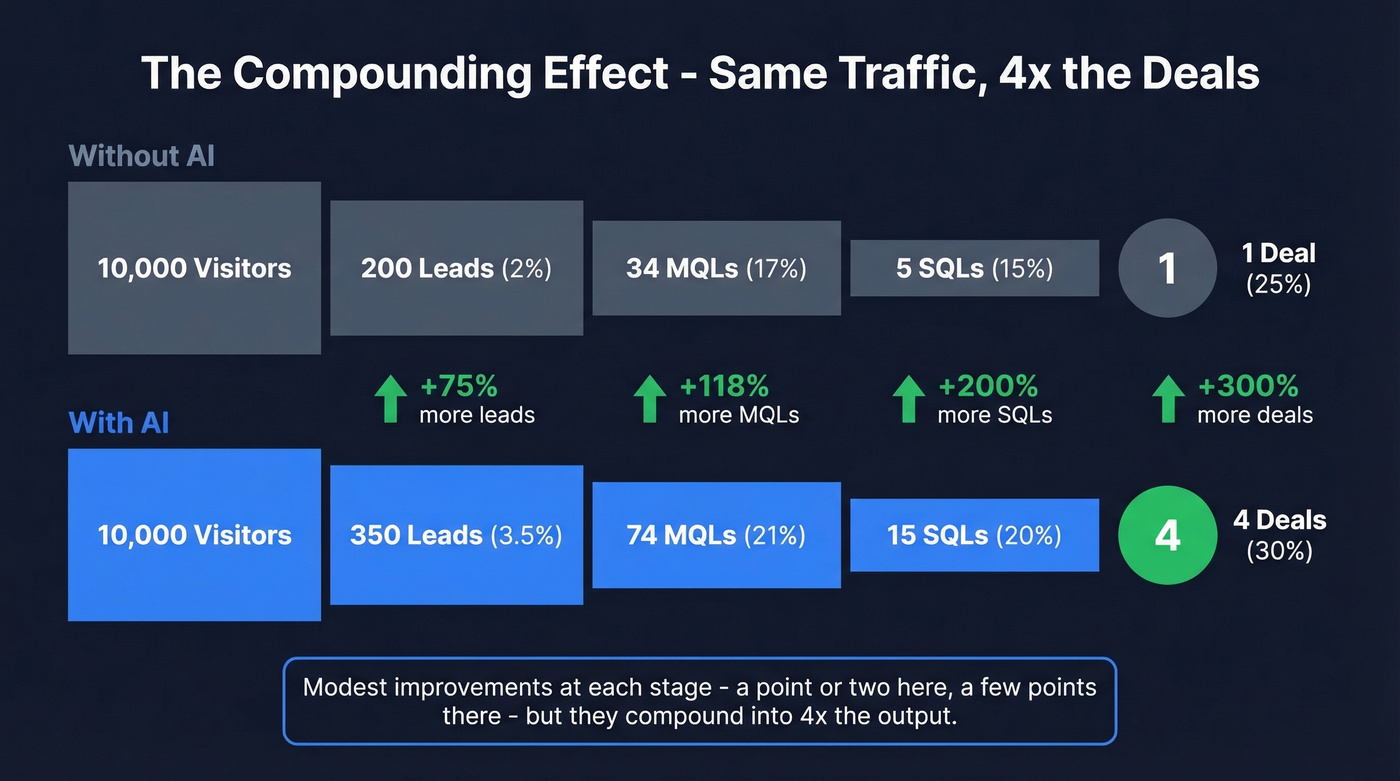
Let's break down what the compounding effect looks like with real numbers. Take 10,000 website visitors through a standard funnel vs. an AI-powered one:
Without AI: 10,000 visitors produce 200 leads (2%), which become 34 MQLs (17%), then 5 SQLs (15%), then 1 closed deal (25%). One deal from 10,000 visitors.
With AI: 10,000 visitors produce 350 leads (3.5%), which become 74 MQLs (21%), then 15 SQLs (20%), then 4 closed deals (30%). Four deals from the same traffic.
The improvements at each stage are modest - a point or two here, a few percentage points there. But they compound. That's the real argument for layering intelligence into every stage rather than dumping your budget into top-of-funnel alone.

The article says it plainly: garbage CRM data produces garbage AI scores. Prospeo's 5-step verification delivers 98% email accuracy on 300M+ profiles - refreshed every 7 days, not every 6 weeks. Your predictive scoring, your sequences, your speed-to-lead routing all depend on contact data that's actually real.
Fix the foundation before you layer on the AI.
AI Funnel Tool Stack + Pricing
You don't need 15 tools. You need 2-3 that integrate well and cover your biggest gaps.
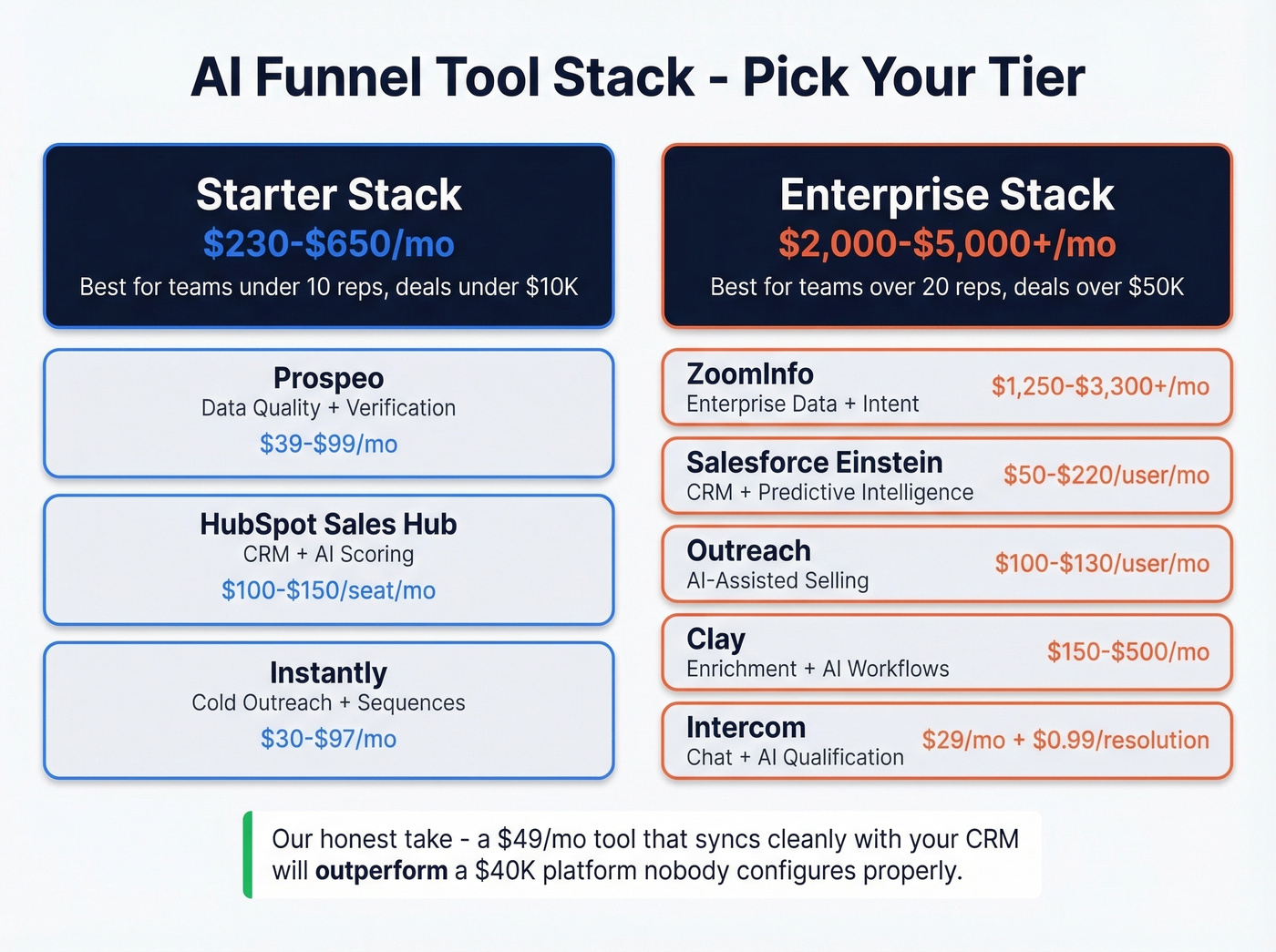
| Tool | Funnel Stage | What It Does | Pricing |
|---|---|---|---|
| HubSpot Sales Hub | CRM + scoring | AI scoring, sequences, pipeline | $100-$150/seat/mo |
| Salesforce Einstein | CRM + intelligence | Predictive scoring, deal insights | $50-$220/user/mo |
| Outreach | Sequences + AI | AI-assisted selling, cycle acceleration | ~$100-$130/user/mo |
| Instantly | Cold outreach | Email sequences, deliverability | ~$30-$97/mo |
| Clay | Enrichment + workflows | Data waterfall, AI personalization | ~$150-$500/mo |
| Intercom | Chat + qualification | Fin AI Agent + routing | $29/mo + $0.99/resolution |
| Apollo | Prospecting + sequences | Database, outreach, scoring | Free; paid ~$49-$99/mo |
| ZoomInfo | Enterprise data + intent | Full GTM platform | $15K-$40K+/year |
A 2-3 person mid-market team running a verified data tool, HubSpot Professional, and Instantly is looking at roughly $230-$650/month total. That's a fraction of what a single ZoomInfo contract costs, and it covers data quality, CRM intelligence, and outbound sequences.
Here's our honest take: if your average deal size is under $10K, you almost certainly don't need a $40K/year data platform. We've built AI funnels for teams ranging from 5 to 500 reps, and the pattern is always the same - a $49/month tool that syncs cleanly with your CRM will outperform a $40K platform that nobody configures properly. The consensus on r/sales backs this up - thread after thread of teams paying enterprise prices for tools their reps refuse to use.
How to Build Your Funnel Step by Step
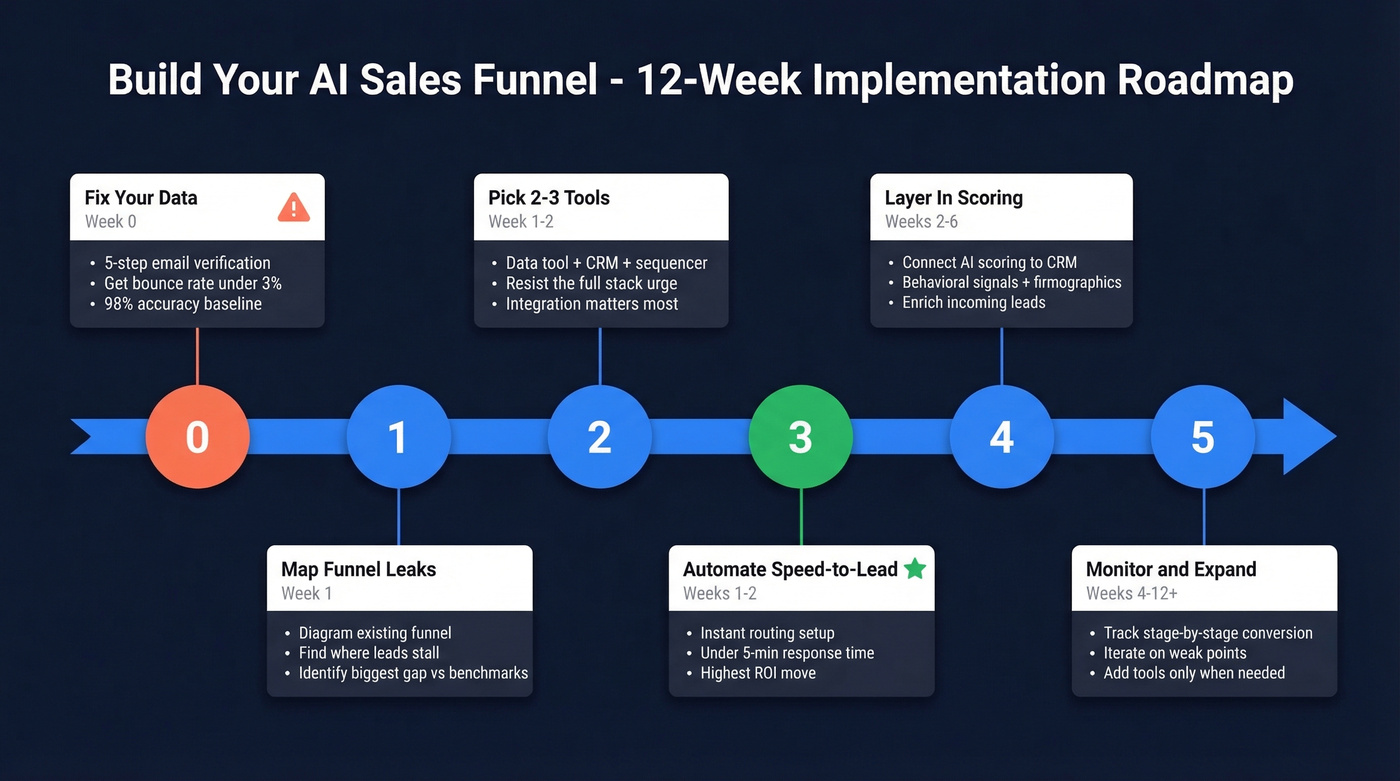
Step 0: Fix Your Data
Every AI funnel guide jumps straight to tools and workflows. They skip the part that determines whether any of it works.
Prospeo's where we'd start for data quality. Upload your existing list or build a new one using 30+ search filters - job title, industry, headcount growth, buyer intent, technographics. Every email runs through a 5-step verification process with catch-all handling, spam-trap removal, and honeypot filtering. Snyk cut bounce rates from 35-40% to under 5% across 50 AEs after switching to verified data, driving 180% more AE-sourced pipeline and 200+ new opportunities per month.
Skip this step if your existing bounce rate is already under 3% and you're refreshing contacts at least monthly. Otherwise, this is where your money goes first.

Step 1: Map Your Funnel Leaks
Before you buy anything, diagram your existing funnel. Where do leads stall? Where do reps spend the most manual time? Map first, then automate the biggest leak. If your MQL-to-SQL conversion is 8% when the benchmark is 15-21%, that's where AI goes first - not wherever the flashiest vendor demo pointed you.
Step 2: Pick 2-3 Tools Max
Start lean. A data quality tool, a CRM with AI scoring (HubSpot or Salesforce), and a sequencing tool (Instantly or Outreach) covers 80% of what most teams need. Add Clay for enrichment workflows or Intercom for chat later. Resist the urge to buy the full stack on day one - we've watched teams spend three months configuring tools instead of sending emails.
Step 3: Automate Speed-to-Lead
This is your highest-ROI move in weeks 1-2. Set up instant routing: form fill, AI lead score, Slack notification to the right rep, automated meeting link. One agency saved 40+ hours per month and nearly doubled conversion rates just by automating follow-up timing with Zapier and OpenAI. The workflow isn't complicated. The discipline to actually set it up is.
Step 4: Layer In Scoring and Enrichment
Weeks 2-6. Connect your CRM's AI scoring to behavioral signals - page visits, email opens, content downloads. Enrich incoming leads with firmographic and technographic data so scoring models have something real to work with. For teams that already have clean data flowing in, this is where things start to feel like a real AI funnel instead of a glorified email blaster.
Step 5: Monitor, Iterate, Expand
Weeks 4-12 and beyond. Track conversion rates at every stage and compare them to the benchmarks above. When a stage plateaus, that's where you add the next layer - intent data, multi-channel sequences, agentic workflows. Don't expand until the foundation produces measurable results. Patience here separates the teams that get ROI from the ones that churn through tools every quarter.
Every stage of your AI funnel leaks revenue when emails bounce and phone numbers are dead. Prospeo gives you 143M+ verified emails and 125M+ verified mobiles with a 30% pickup rate - at $0.01 per email. Teams using Prospeo book 26% more meetings than ZoomInfo users and 35% more than Apollo users. That's the compounding effect applied to your data layer.
Stop feeding your AI funnel bad data. Start with Prospeo's free tier today.
Five Ways AI Funnels Fail
Bad data at scale. AI doesn't fix bad data - it amplifies it. Send 10,000 unverified emails through an AI sequence and you'll torch your domain reputation in a week. Every email you send afterward lands in spam.
Automating a broken process. If your funnel leaks at qualification because reps don't follow a consistent framework, AI will just qualify bad leads faster. BANT or MEDDIC first, AI second.
AI hallucinations in outreach. Large language models make things up. An AI that tells a prospect your product integrates with a tool it doesn't support creates a worse experience than no personalization at all. Always QA AI-generated copy before it goes live - every single time.
Over-personalization that feels creepy. "I noticed you visited our pricing page three times this week" isn't a good opening line. Keep personalization to professional context: role, company, industry challenges.
No human escalation path. AI chatbots that can't hand off to a human when the conversation gets complex will frustrate your best prospects. Build escalation triggers into every automated touchpoint. AI should augment your team, not replace the moments that require judgment.
FAQ
How much does an AI sales funnel cost?
Most mid-market teams spend $200-$500/month on 2-3 tools covering data quality, CRM intelligence, and outbound sequences. Enterprise stacks with ZoomInfo, 6sense, and Salesforce Revenue Intelligence typically run $40K-$150K+/year. Prospeo's free tier (75 verified emails/month) lets you validate the approach at $0 before scaling.
How long does it take to set up?
Basic outreach automation takes 1-2 weeks. Scoring and enrichment workflows need 2-6 weeks. Multi-channel agentic workflows with behavioral triggers and cross-platform orchestration take 4-12 weeks.
Can AI replace SDRs entirely?
Not yet. 45% of teams run hybrid AI-SDR models where AI handles research, personalization, and follow-up sequencing while humans handle relationship-building and complex objection handling. Expect AI to absorb 60-70% of SDR admin work, not the role itself.
What's the ROI of automating a sales funnel with AI?
Revenue operations teams report 15-25% pipeline uplift, with ROI typically achieved in 3-12 months. The biggest gains come from speed-to-lead improvements and reduced cycle length - AI-assisted selling cuts 11 days off average deal timelines.
How do I prevent automated outreach from damaging sender reputation?
Verify every email before it enters your sequences. Teams using verified data with 5-step verification consistently keep bounce rates under 5%, compared to 35-40% on unverified lists. A 7-day data refresh cycle prevents decay between campaigns - the industry average is six weeks, which means your list is already rotting by the time you use it.