

Anonymous Website Visitor Tracking: What Actually Works in 2026
You've got 10,000 monthly visitors. Maybe 50 fill out a form. The other 9,950 browse your pricing page, read two case studies, and vanish - that's not a leaky funnel, it's a ghost funnel. 97% of B2B website visitors are anonymous. The market for anonymous website visitor tracking has exploded to address this gap - $3.55B in 2024, projected to hit $9.99B by 2032 at a 12.4% CAGR. But the tools promising to unmask those visitors vary wildly in what they actually deliver.
The Short Version
- Company-level identification hits 30-65% of traffic. You'll know "someone from Acme Corp visited your pricing page."
- Person-level identification drops to 5-20%. Getting an actual name, title, and email is much harder.
- Most tools pull from overlapping upstream data sources. The real differentiator isn't identification - it's what happens after.
- A lightweight ID tool ($39-$149/mo) paired with an enrichment platform gets you from "Company X visited" to "here's the VP's verified email" without enterprise pricing.
Identification alone is interesting. Enrichment makes it actionable.
How Anonymous Visitor Identification Works
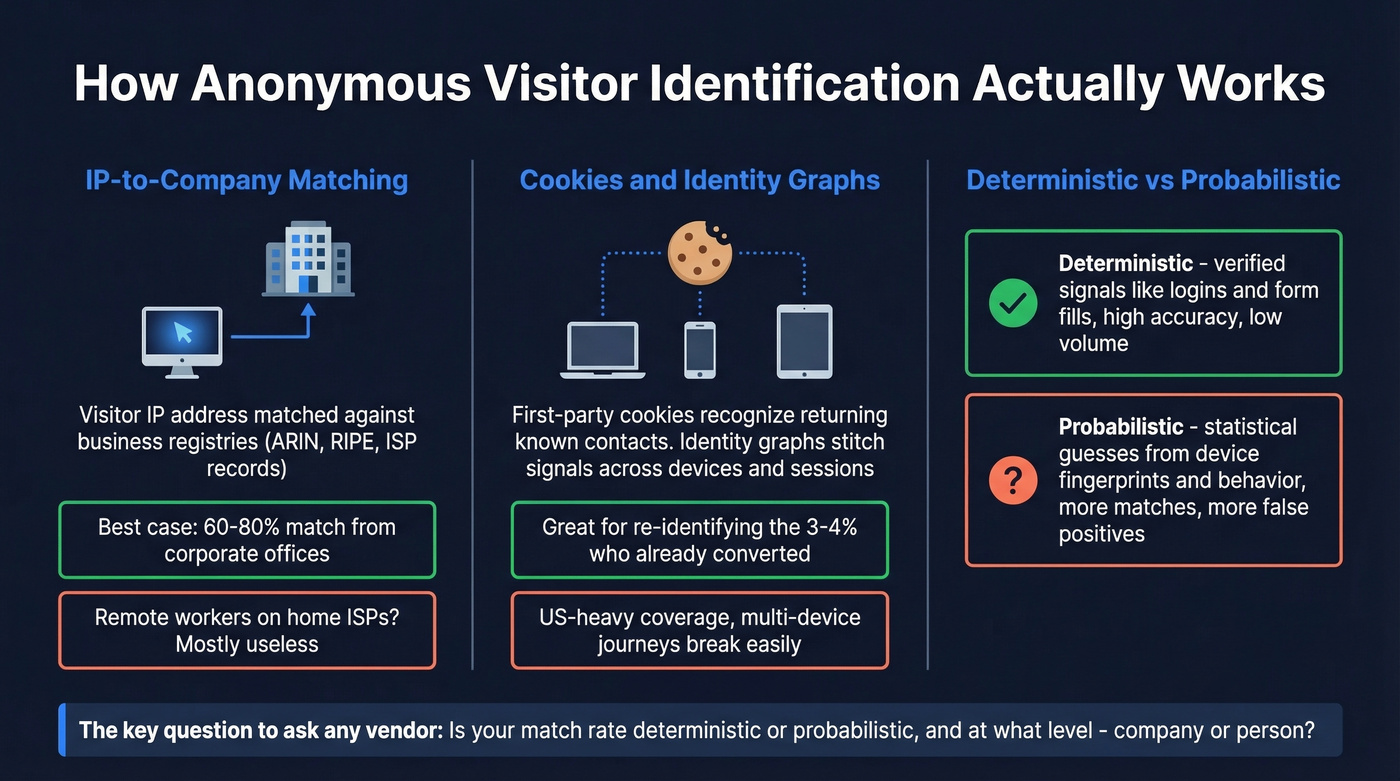
The Reddit skeptics aren't wrong - a lot of these tools share upstream data sources. Here are the three core methods so you understand what you're actually buying.
IP-to-Company Matching
Every website visit exposes an IP address. Visitor ID tools match that IP against databases compiled from registries like ARIN and RIPE, business network registrations, and ISP allocation records. When someone visits from a corporate office with a static IP, the match is straightforward - you get the company name, sometimes the industry and size.
The problem? Over 60% of knowledge workers are now remote or hybrid. Your prospect is browsing from a home Comcast connection, not a Cisco corporate network. That IP resolves to an ISP, not a company. This single shift has gutted the reliability of pure IP matching for the majority of B2B traffic.
Cookies and Identity Graphs
First-party cookies work well for known contacts - someone who filled out a form, clicked an email, or logged in. When they return, you can recognize them. But that only helps with the 3-4% who already converted.
For everyone else, identity graphs stitch together signals across devices and sessions, aggregating data from publishers, data co-ops, and opt-in panels to build probabilistic profiles. Coverage is US-heavy, which is why most tools struggle with international traffic. Multi-device journeys compound the problem: the same buyer researching on a laptop at work and a phone at home looks like two separate visitors.
Deterministic vs. Probabilistic Matching
This distinction matters more than most vendors let on. Deterministic matching relies on verified first-party signals - a known email, a login event, a form submission. It's accurate but low-volume. Probabilistic matching uses statistical inference to guess who a visitor might be based on device fingerprints, behavioral patterns, and IP signals. More matches, more false positives.
When a vendor claims "80% match rate," ask which type. A probabilistic company-level match is a very different thing from a deterministic person-level match.
The question to ask any vendor: "Is your 80% match rate deterministic or probabilistic, and at what level - company or person?"
Accuracy Reality Check
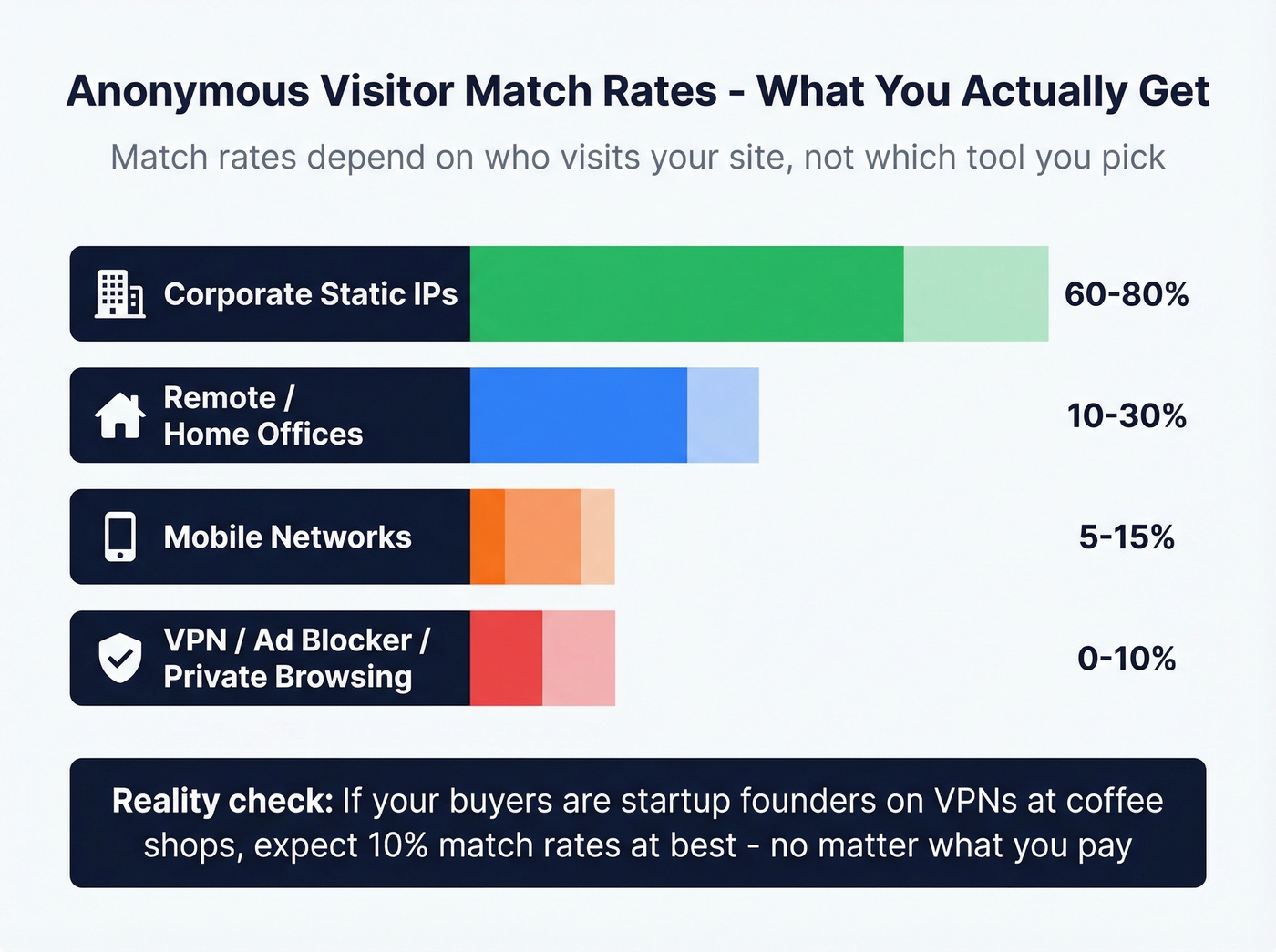
Here's the thing most vendor pages won't show you: match rates depend almost entirely on who's visiting your site, not which tool you pick.
| Traffic Source | Expected Match Rate |
|---|---|
| Corporate static IPs | 60-80% |
| Remote / home offices | 10-30% |
| Mobile networks | 5-15% |
| VPN / ad blocker / private browsing | 0-10% |
If your audience is enterprise buyers sitting in corporate offices, you'll see decent results from almost any tool. Selling to startup founders working from coffee shops on VPNs? Expect 10% match rates at best - regardless of what you're paying. Ad blockers and private browsing modes further reduce effectiveness by stripping the cookies and fingerprints these tools depend on.
Any vendor promising 80%+ person-level identification is either counting company-level matches, blending deterministic and probabilistic numbers, or inflating results with test traffic.
The Cookie Situation in 2026
You'll still see guides claiming Google killed third-party cookies. That's outdated. Chrome shifted to a user-choice model rather than blanket deprecation, continuing to roll out Privacy Sandbox APIs alongside opt-in controls. Safari and Firefox block cross-site tracking by default.
The practical impact is real. Early Chrome testing with just 1% of users showed -34% programmatic revenue for publishers on Google Ad Manager. Fewer durable identifiers means a higher premium on first-party data - and more pressure on visitor ID tools to find alternative matching methods.

Knowing 'someone from Acme Corp visited' doesn't book meetings. Prospeo turns company-level IDs into verified contacts - 83% enrichment match rate, 98% email accuracy, 125M+ direct dials. Pair any visitor tracking tool with Prospeo and go from anonymous traffic to real pipeline.
Stop tracking ghosts. Start emailing real buyers.
Is This Legal?
Yes, with guardrails.
- GDPR treats IP addresses and cookie identifiers as personal data. If you're tracking EU visitors, you need a legal basis.
- Explicit consent is required before placing non-essential cookies. No pre-checked boxes, no cookie walls.
- Legitimate interest can work, but it requires a documented balancing test - and individuals can object.
- CCPA gives California residents the right to know what data you're collecting and opt out of its sale.
- Minimum requirements: a clear privacy policy, a consent banner that allows granular accept/reject, and data processing records.
The fact that a tool is "GDPR compliant" doesn't mean your use of it is compliant. You still need proper consent mechanisms on your site.
Best Tools for Tracking Anonymous Visitors
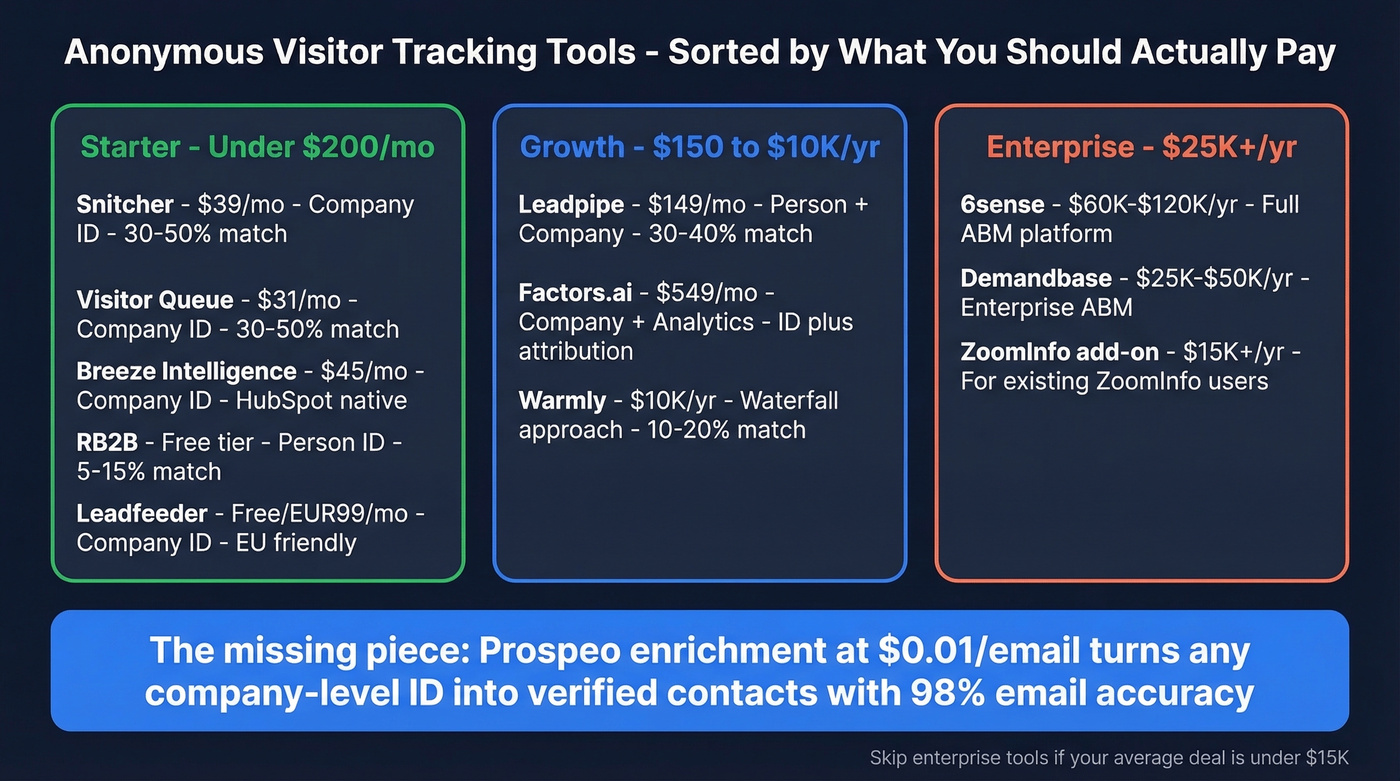
Here are the tools, organized by budget. One rule of thumb we've learned the hard way: if you have to "book a demo" to learn what something costs, budget 3x what you'd expect.
| Tool | Type | Starting Price | Match Rate | Best For |
|---|---|---|---|---|
| Prospeo | Enrichment | Free / ~$0.01/email | 83% enrichment* | Turning IDs into contacts |
| RB2B | Person | Free (150 IDs/mo) / $495/mo Pro | 5-15% | Testing person-level |
| Snitcher | Company | $39/mo | 30-50% | SMB company ID |
| Visitor Queue | Company | $31/mo | 30-50% | Traffic-based scaling |
| Leadfeeder | Company | Free / EUR99/mo (annual) | 10-15% | EU + CRM integration |
| Leadpipe | Person + Co. | $149/mo | 30-40% | Agencies needing volume |
| Warmly | Waterfall | $10,000/yr+ | 10-20% | Mid-market match rates |
| Factors.ai | Company + analytics | $549/mo | Varies | ID + attribution combo |
| Breeze Intelligence | Company | $45/mo (100 credits) | 15-20% | HubSpot-native teams |
| 6sense | ABM platform | ~$60K-$120K/yr | Varies | Large ABM programs |
| Demandbase | ABM platform | ~$25K-$50K/yr | Varies | Enterprise targeting |
| ZoomInfo (visitor add-on) | Company | $15,000+/yr | Varies | Existing ZoomInfo users |
*Prospeo's 83% is an enrichment match rate - the percentage of leads that come back with contact data - not a visitor identification rate.
A few things worth calling out. RB2B's free tier is genuinely useful for testing, but Reddit threads flag payment issues outside the US and near-nonexistent support. Leadfeeder's free plan caps at 100 companies with only 7 days of data retention - fine for a trial, frustrating long-term. Warmly's waterfall approach across 20+ data providers with confidence scoring is clever, but $10,000/year is a lot before you've proven the channel works.
Skip the enterprise platforms if your average deal size is under $15K. The math on a six-figure visitor tracking contract will never pencil out at that level. A $39/mo ID tool paired with enrichment at $0.01/email can beat those contracts for teams under 50 reps - we've seen it happen repeatedly. The enterprise tools add intent scoring and ABM orchestration, which matters at scale, but most teams aren't there yet.
From Identified to Contacted
Knowing that Company X visited your pricing page is interesting. Knowing the VP of Engineering's verified email and direct dial is actionable. That gap between identification and outreach is where most teams stall.
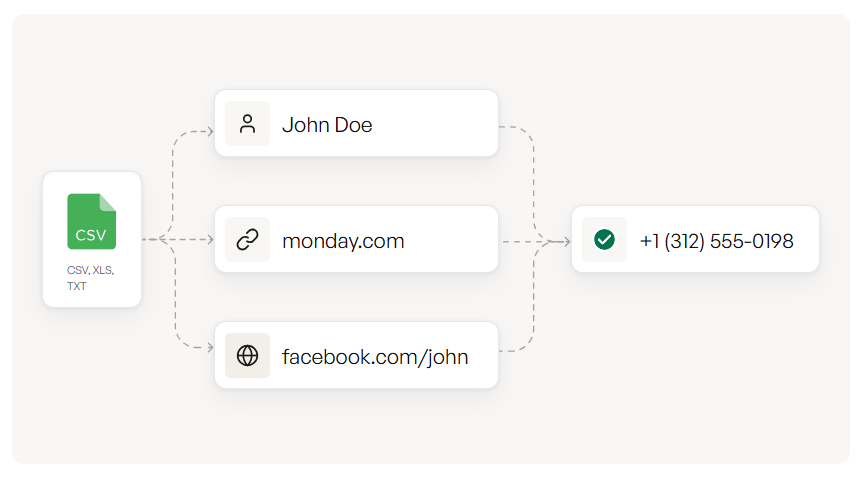
The workflow is simple: your visitor ID tool surfaces company names, you enrich those companies with contact data for the right buyers, and you route verified contacts to your sequencer or CRM. Speed matters here - the consensus on r/sales is that waiting even 48 hours after an intent signal cuts response rates dramatically, and in our experience that's accurate.
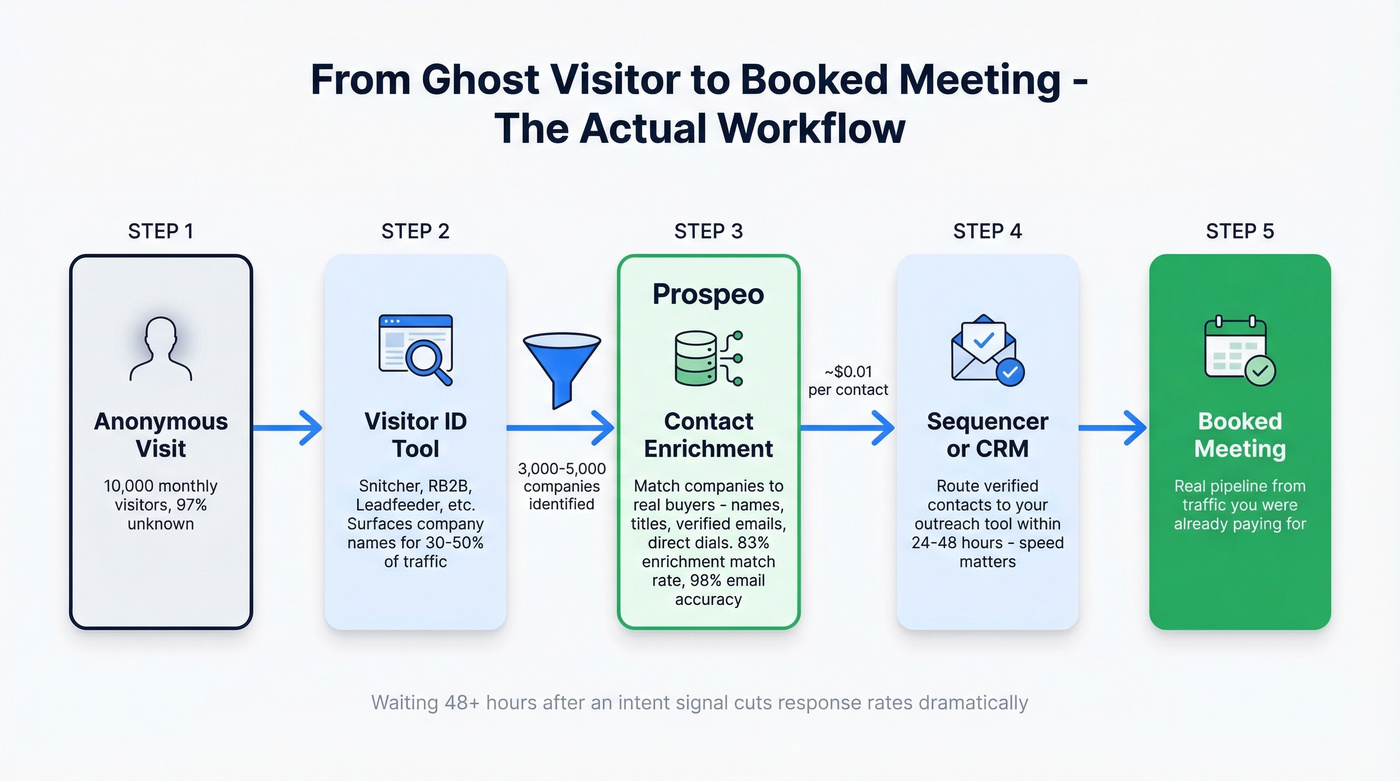
Prospeo covers 300M+ professional profiles with 143M+ verified emails and 98% email accuracy, all refreshed on a 7-day cycle versus the 6-week industry average. Upload your list of identified companies, and you get verified emails and direct dials back - typically within seconds via API or CSV enrichment. At ~$0.01 per email with a free tier, it costs less than a single month of most visitor ID tools on this list.
Most visitor ID tools top out at 30-50% company matches. The gap between 'Company X visited your pricing page' and 'here's the VP of Engineering's verified email' is where deals die. Prospeo bridges that gap with 300M+ profiles, 30+ filters, and a 7-day data refresh - at $0.01 per email.
Turn anonymous visitors into booked meetings for a penny each.
When Visitor ID Isn't Worth It
Not every team should invest here.
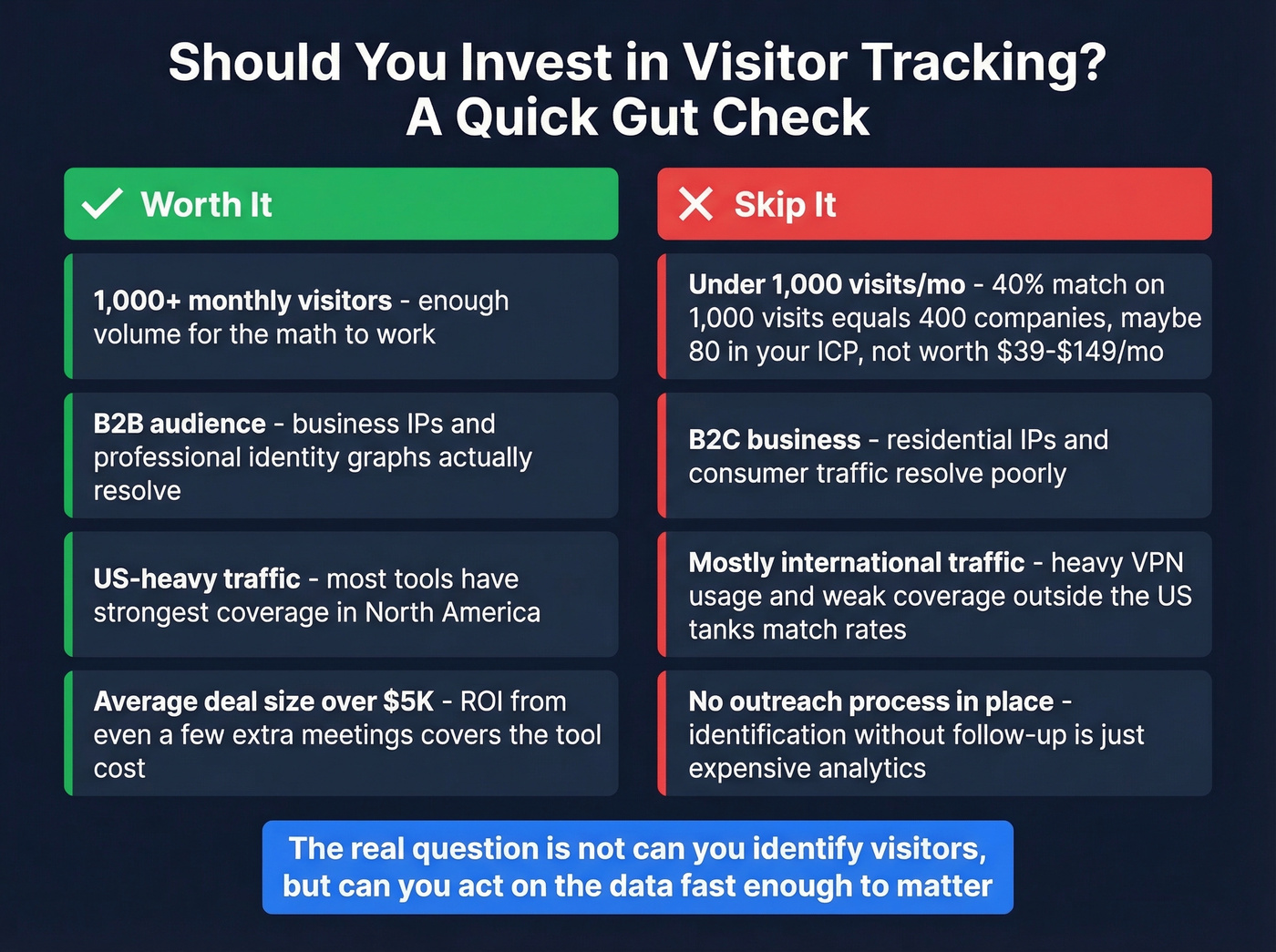
If your site gets under 1,000 visits per month, the math collapses. Even a generous 40% company-level match gives you 400 company names, and maybe 20% of those are in your ICP. You're spending $39-$149/mo to surface a handful of leads you could find manually.
B2C companies won't get much value either. These tools are built around business IP registries and professional identity graphs. Consumer traffic from residential IPs and mobile networks resolves poorly. And if your audience is predominantly outside the US - especially in regions with heavy VPN usage - expect match rates to drop significantly. Most tools are US-centric by design.
Let's be honest: for some teams, the best "visitor tracking" investment is just better landing pages that convert more of those anonymous visitors into form fills. If your conversion rate is 0.5% and the industry average is 2-3%, fix the page before buying a tracking tool.
FAQ
How accurate is anonymous visitor identification?
Company-level identification hits 30-65% of traffic, while person-level drops to 5-20%. Accuracy depends on your audience - corporate office traffic identifies at 3-4x the rate of remote workers on home networks. Ad blockers and private browsing reduce rates further. Any vendor claiming 80%+ person-level matches is likely blending company-level numbers into the figure.
Is tracking anonymous visitors legal under GDPR?
Yes, with conditions. GDPR classifies IP addresses and cookie identifiers as personal data, so you need explicit consent before placing non-essential cookies. Your privacy policy must disclose the tracking, and legitimate interest requires a documented balancing test. Cookie walls are generally prohibited under current guidance.
Can I identify website visitors without forms?
Yes - that's the entire premise. IP-to-company matching and identity graphs let you identify companies and sometimes individuals without requiring form fills. Match rates are lower than gated content, but you capture intent from the 97% of visitors who'd never fill out a form in the first place.
What's a good affordable alternative to enterprise visitor tracking platforms?
Pair a budget-friendly ID tool like Snitcher ($39/mo) or Visitor Queue ($31/mo) with Prospeo for enrichment at ~$0.01/email. You get company identification plus verified contacts for a fraction of what 6sense or Demandbase charge. The 83% enrichment match rate and 98% email accuracy mean the contacts you get are actually usable for outreach.
What should I do after identifying which companies visit my site?
Enrich the company names with specific buyer contacts - verified emails and direct dials for decision-makers. Route those contacts into your sequencer or CRM and act fast. The faster you follow up on intent signals from anonymous visitors, the higher your conversion rate. Waiting even 48 hours cuts response rates dramatically.