

Apollo Email Verification: What the 91% Accuracy Claim Actually Means
You exported 2,000 contacts from Apollo, every one wearing that blue "Verified" badge. Day one of your sequence: 18% hard bounce. A quarter of replies say "I left that company eight months ago." Your sender reputation just took a hit that'll take weeks to recover from - and you're realizing Apollo's email verification isn't what the badge promised.
For context, under 2% bounce is safe, above 5% means throttling, and 10% is effectively blacklisted](https://cotera.co/articles/email-verification-cold-outreach-playbook).
What You Need (Quick Version)
- Trust Apollo alone - fine for low-volume, non-critical sends. Expect 7-18% bounces.
- Add a second-pass verifier - use Apollo Waterfall enrichment with a validator like ZeroBounce. One real-world example dropped consolidated failures from 7.4% to ~4.1%.
- Switch your data source - Prospeo delivers 98% email accuracy with catch-all handling built in, at ~$0.01/email. No second verifier needed.
If you're sending more than 50 emails/day, option one isn't viable.
How Apollo Verifies Emails
Apollo's 7-step verification process layers SMTP checks with signals from its contributory network - data from Apollo-connected inboxes, CRMs, and CSV uploads - plus public web crawling and vetted third-party providers. The system monitors delivery stats and bounce patterns across its user base to confirm whether an email is actively receiving mail.
Apollo says this lets it differentiate valid from invalid emails even on catch-all domains. The published accuracy figure is 91%, and if a Verified email bounces, Apollo refunds the credit within 30 days.
Sounds solid on paper. The numbers tell a different story.
What Users Actually Report
We've seen these numbers play out across dozens of campaigns, and the r/coldemail subreddit confirms it. One user exported 787 Apollo records - all Verified - and found over 11% were invalid. Another ran ~900 Verified leads through MillionVerifier: 19% Valid, 21% Invalid, and a staggering 60% catch-all/risky. One SDR running 20 emails/day still hit a 7.4% consolidated failure rate on Verified-only contacts.
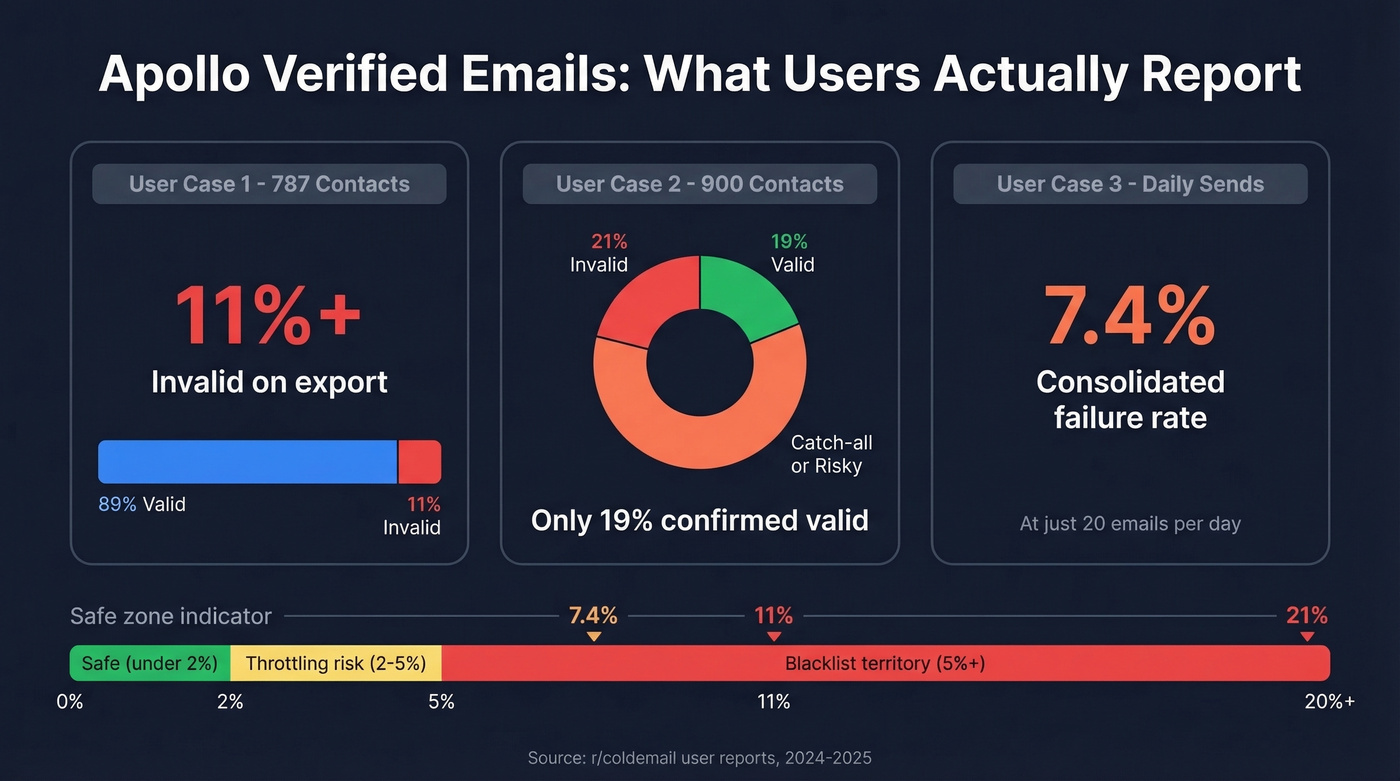
The worst case we came across: someone ran Apollo data assuming verification was solid and sat around 15% bounce for roughly three months before anyone told them anything above 5% was destroying deliverability. That's three months of domain damage they didn't know was happening. By the time they figured it out, their primary sending domain was toast.

Your Apollo exports are bouncing because catch-all handling is broken. Prospeo's 5-step verification with proprietary catch-all resolution delivers 98% email accuracy - no second verifier, no stacked costs. Every record refreshes every 7 days, not every 6 weeks.
Stop paying twice for data you still can't trust.
The Catch-All Problem
Here's the thing: catch-all domains break every verifier, not just Apollo's. A catch-all server accepts mail sent to any address at that domain, so SMTP checks return "valid" even for nonexistent mailboxes. Apollo says its network signals solve this. A Hunter benchmark testing 15 verifiers against 3,000 real business emails says otherwise - the best overall accuracy across catch-all domains was 70%.
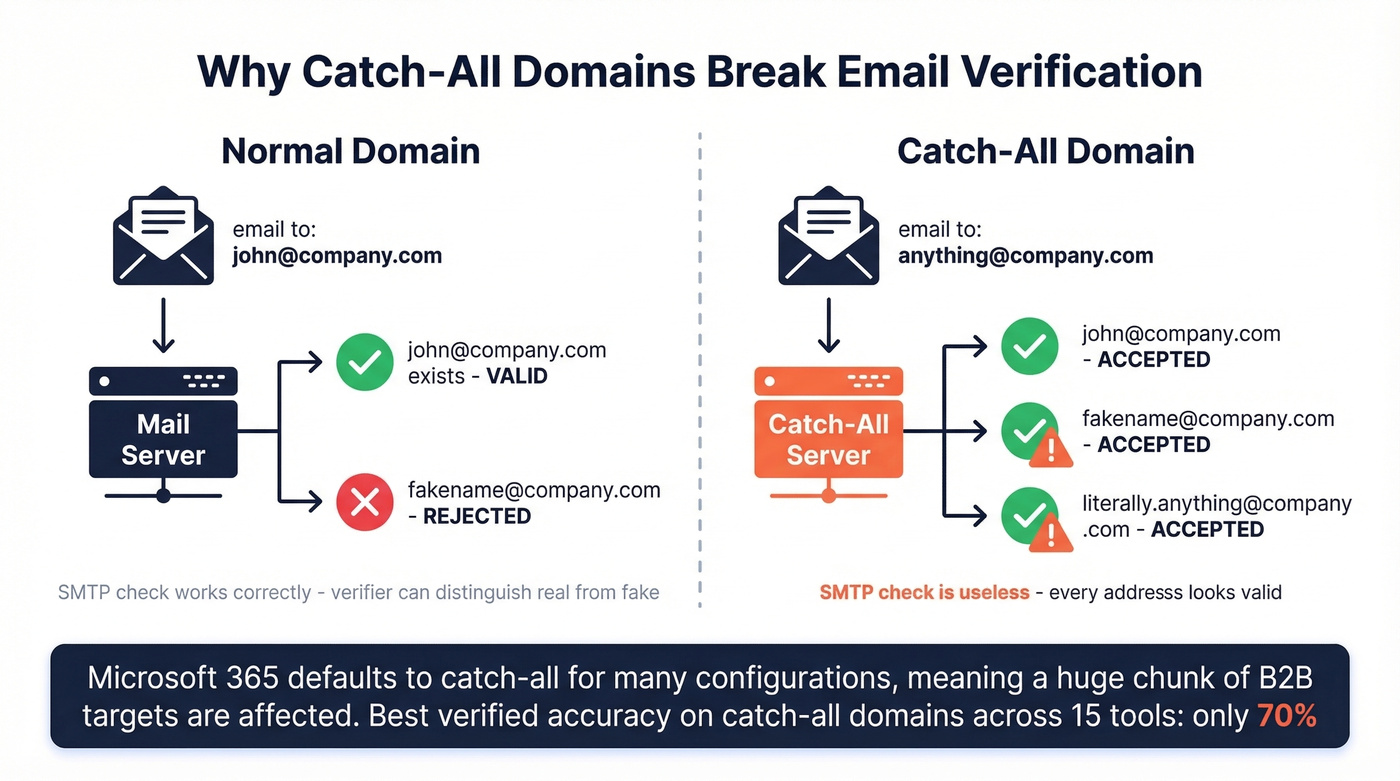
No verifier, network-powered or not, has cracked catch-all reliably. And catch-all domains are everywhere in B2B - Microsoft 365 defaults to catch-all for many configurations, which means a huge chunk of your target accounts are affected.
How to Supplement Apollo's Verification
If you're sticking with Apollo as your data source, Waterfall enrichment with a validator is the best available fix. Enable a validator like ZeroBounce as your email validation source, and set enrichment to end only when a "verified email" is found. One practitioner reported their failure rate dropped from 7.4% to roughly 4.1% - meaningful, but still above the 2% safe zone.
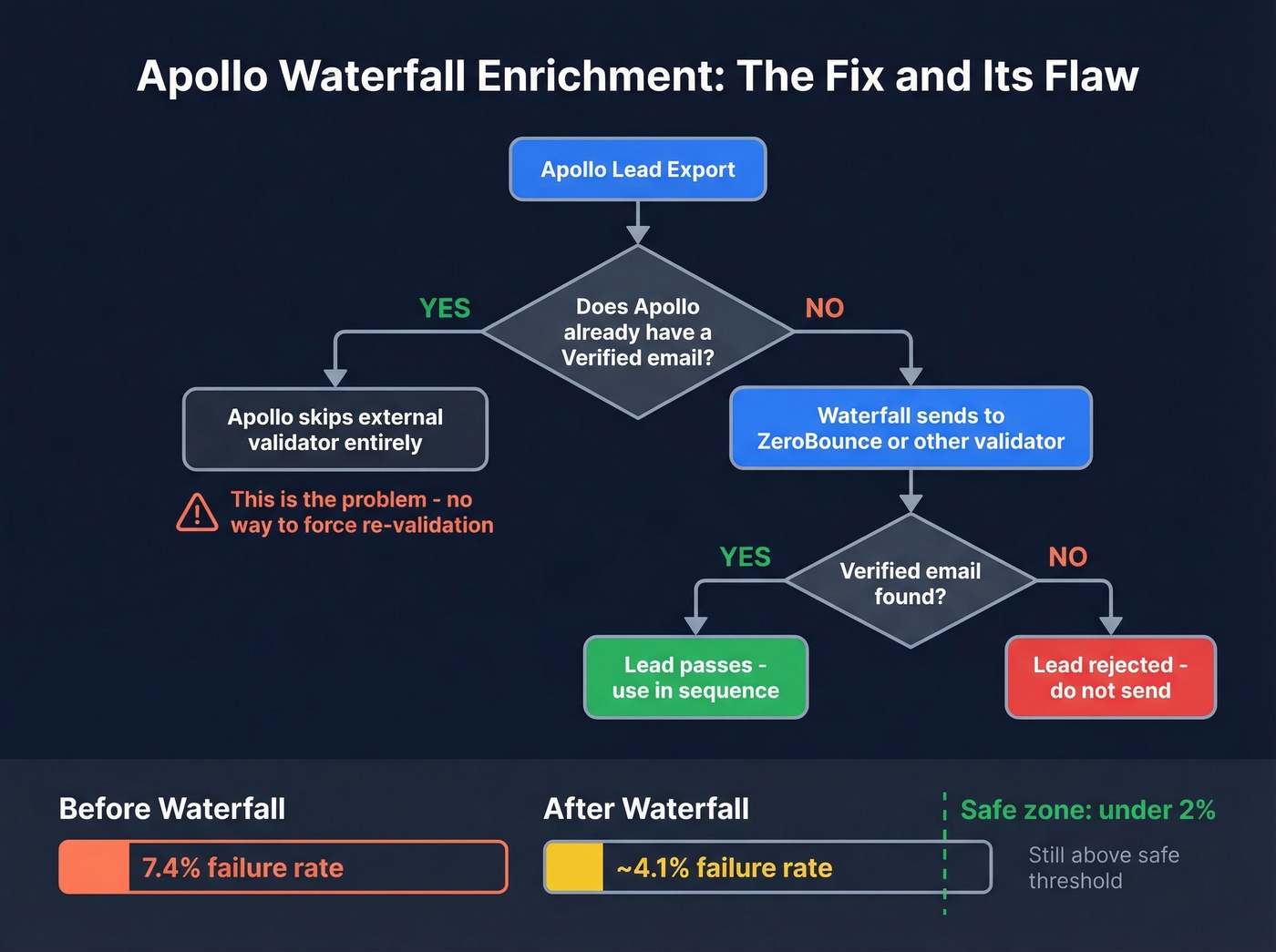
The catch: when Apollo already has a Verified email internally, Waterfall skips the external validator entirely. There's no setting to force validation on every lead.
For teams that just want a cheap bulk second pass, here's what the popular options cost:
| Tool | Free Tier | Per 1,000 Emails |
|---|---|---|
| MillionVerifier | - | ~$2.90 |
| Bouncer | Free trial: 1,000 credits | $7 |
| ZeroBounce | 100 credits/mo | ~$7.50 |
| NeverBounce | Free trial: 1,000 credits | $8 |
| BriteVerify | None | $10 |
Skip BriteVerify unless you're already in the Validity ecosystem. MillionVerifier gives you the best bang for your buck if all you need is a bulk pass.
Fix the Source, Not the Export
Let's be honest: most teams don't need a better verifier - they need better data. Paying for Apollo credits plus a separate verification tool means paying twice for data you still can't fully trust.
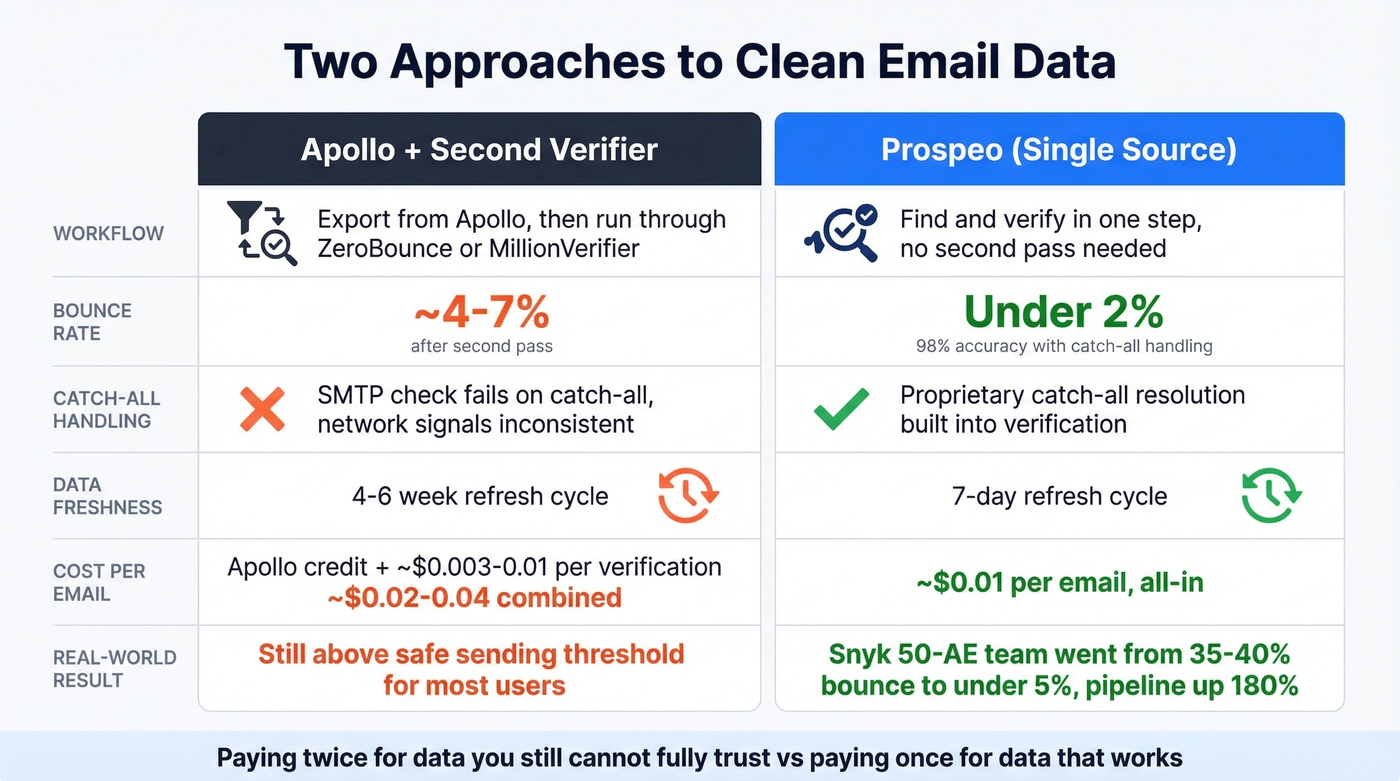
In our testing, Prospeo's 5-step verification with catch-all handling eliminated the need for a second pass entirely. Its proprietary email-finding infrastructure doesn't rely on third-party providers, and every record refreshes on a 7-day cycle compared to the 4-6 week average at competitors. Snyk's 50-AE sales team saw bounce rates drop from 35-40% to under 5% after switching, and AE-sourced pipeline jumped 180%.
That's the difference between a verification badge and actual verification.

Snyk's 50 AEs went from 35-40% bounce rates to under 5% after switching from legacy data to Prospeo. At ~$0.01/email with catch-all verification built in, you eliminate the second-pass tax entirely. Free tier included - no contracts, no sales calls.
Replace your Apollo + ZeroBounce stack with one source that actually verifies.
FAQ
Is Apollo's verification included free?
Verification is bundled with the credit you spend to reveal a contact - 1 credit per reveal. If a Verified email bounces, Apollo refunds the credit within 30 days. You aren't paying extra for verification, but you are paying for contacts that bounce at 7-18% rates depending on your list composition.
How accurate is Apollo email verification in practice?
Apollo publishes 91% accuracy, but practitioners consistently report 7-18% bounce rates on Verified exports depending on list composition and catch-all domain density. The gap between the published number and real-world results comes down to how catch-all domains are counted - Apollo marks them as Verified, but many of those addresses don't actually have a human behind them.
How do I keep bounce rates under 2% with Apollo data?
Enable Waterfall enrichment with a validator like ZeroBounce to add a second verification layer - this typically cuts failure rates from the high single digits down into the ~4% range. For a cleaner approach, switch to a higher-accuracy data source that handles catch-all verification natively, eliminating the second pass entirely.