


Artisan Pros and Cons: Honest Review (2026)
Try finding honest reviews of Artisan AI from actual users. Good luck. One Reddit thread in r/SaaS put it bluntly: it's "very hard to track down any reviews of people actually using these services." The AI SDR market grew from $4.27B in 2025 to a projected $18.19B by 2032, and the hype is outpacing the evidence.
Here's what we could actually verify about Artisan's strengths and weaknesses heading into 2026.
30-Second Verdict
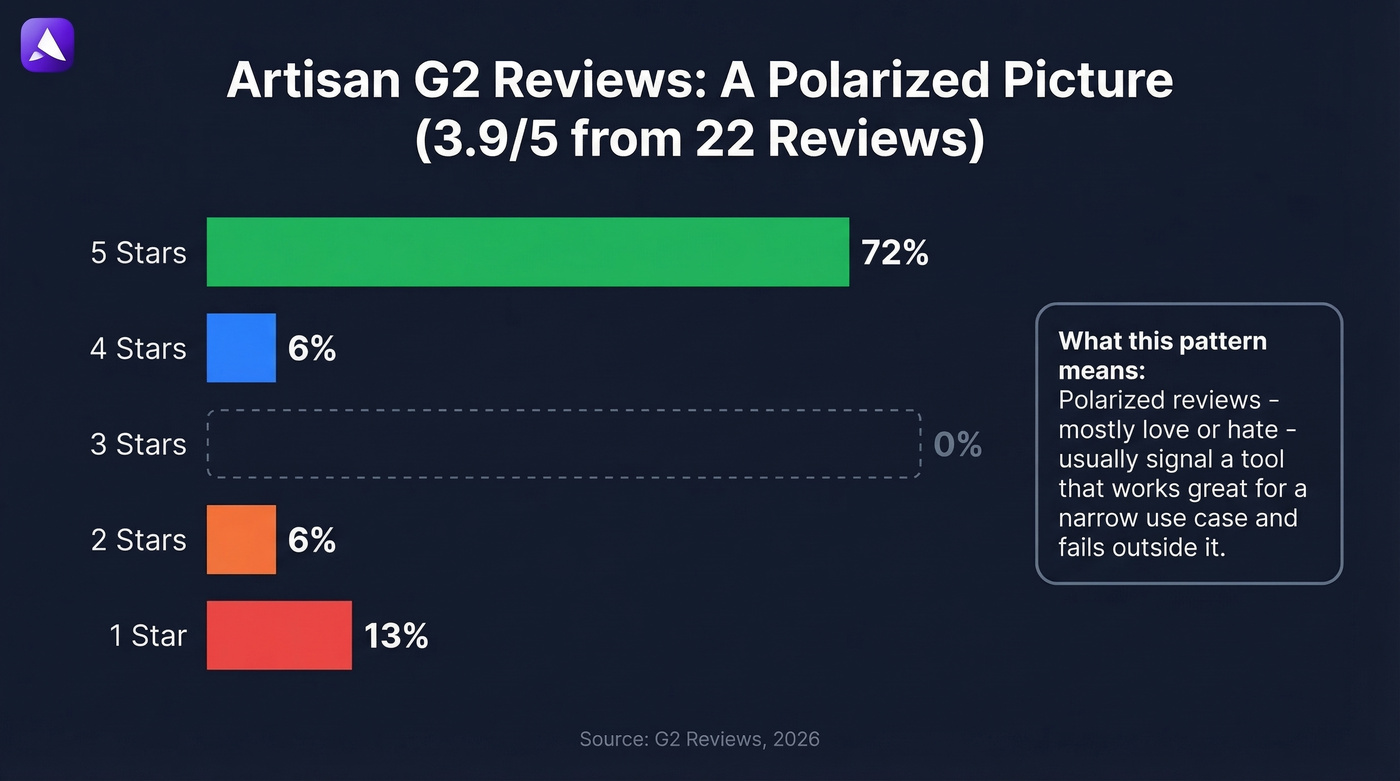
Artisan holds a 3.9/5 on G2 from 22 reviews - but that average hides a polarized split: 72% five-star, 13% one-star, and 0% three-star, with only small slices of four-star and two-star reviews. We've seen this pattern before. Polarized reviews usually mean the tool works for a narrow use case and fails outside it.
Pricing begins around $24,000/year on an annual contract, with many estimates putting entry plans around $2,000/month. Don't let FOMO drive a $24K commitment.
Good for: Teams with 10+ reps, dedicated ops support, and budget for a $24K-$80K+/year bet on autonomous outbound.
Skip if: You're under 10 reps, need transparent pricing, or your real problem is data quality - not automation. In that case, pair a sequencing tool with a verified data provider and keep control of your messaging.
What Artisan Actually Does
Artisan's core product is Ava, an AI BDR that handles lead discovery, prospect research, personalized email and professional social network outreach, and deliverability management. The pitch is consolidation: replace your prospecting stack with one platform that runs autonomously. Artisan claims access to 300M+ B2B contacts across 200+ countries, built-in email warmup, and A/B testing. It's ambitious. The question is whether execution matches the vision.
Where Artisan Shines
Support is genuinely strong. Artisan's Trustpilot score sits at 4.6 from 28 reviews, and the recurring theme is dedicated account management. Multiple reviewers call out their CSMs by name. G2 reviewers echo this - ease of setup and responsive support are the most consistent positives.
Consolidation saves tool spend. If you're currently paying for a data provider, a sequencing tool, email warmup, and deliverability monitoring separately, Artisan bundles all of that. For larger teams juggling five or six subscriptions across different vendors with different billing cycles and different support channels, the consolidation math can genuinely work out.
Some users report real results. One Trustpilot reviewer reports over 1% reply rate on cold email, and several G2 reviewers mention reduced manual work. A 1% reply rate won't blow anyone away, but it's credible for fully automated outbound.

Artisan's 1% reply rate runs on data you can't verify. Prospeo gives you 300M+ profiles with 98% email accuracy on a 7-day refresh cycle - at $0.01/lead with no annual contract. Pair it with any sequencer and keep full control of your messaging.
Fix the data first. The automation works better when emails actually land.
Where Artisan Falls Short
Here's where it gets rough. The negative reviews aren't just "meh" - they're alarming.
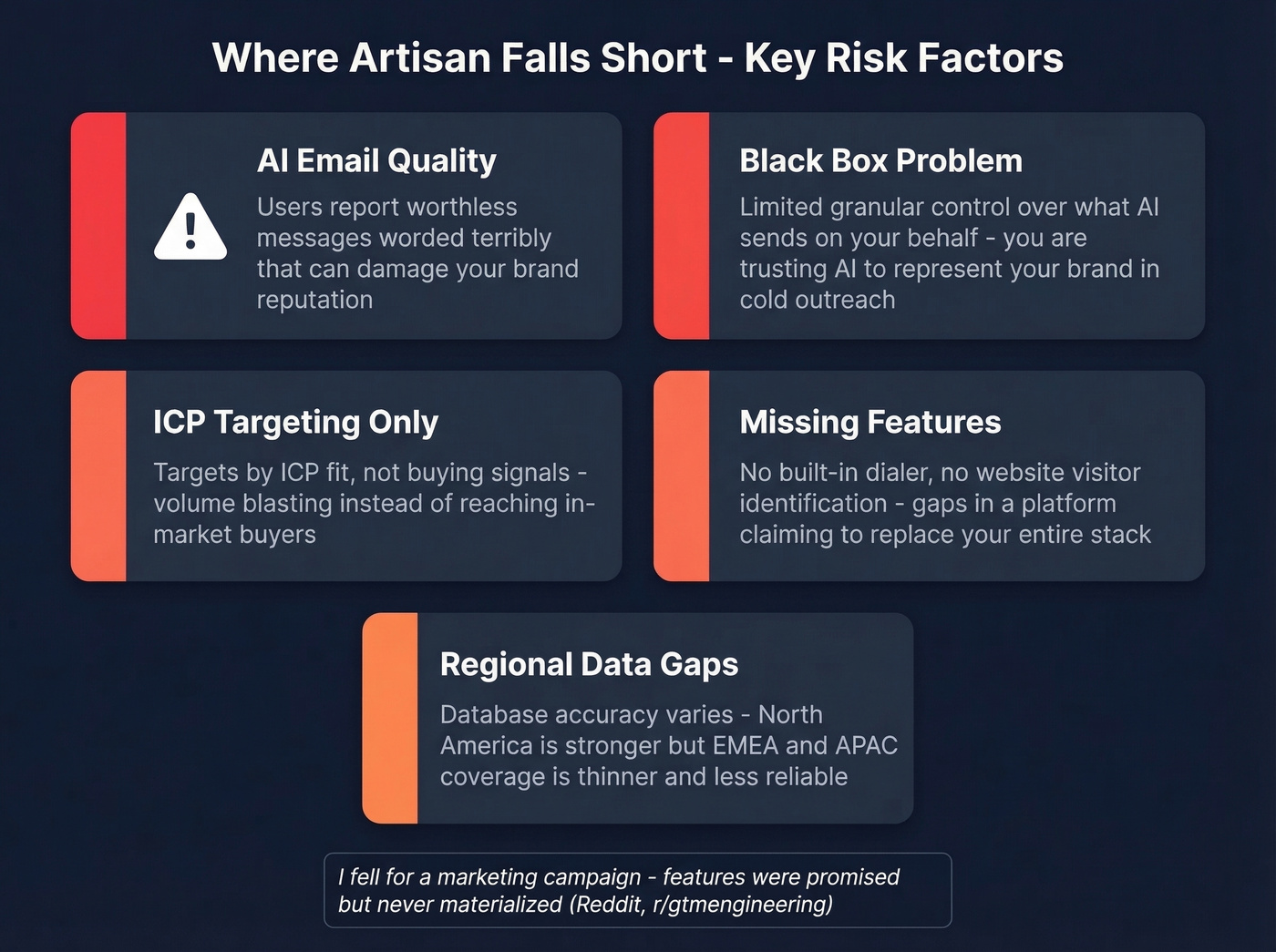
One G2 reviewer gave it 0.0 out of 5 stars and titled their review "Product doesn't perform. The AI doesn't work. It's not improving. And can damage your brand." They described the AI output as "worthless messages... worded terribly." Another wrote "Selling dreams, underdelivering on results," citing "super poor quality emails" that required "a ton of handholding."
Reddit sentiment is equally blunt. One user in r/gtmengineering said they "fell for a marketing campaign" - features were promised but never materialized. Multiple threads flag FOMO-driven purchasing as the primary reason teams sign up.
Then there's the targeting problem. Ava targets prospects based on ICP fit rather than buying signals, which means you're volume-blasting rather than reaching in-market buyers. Database accuracy varies by region - North America is stronger, but EMEA and APAC coverage is thinner.
And the black-box issue is real. You're trusting AI to represent your brand in cold outreach with limited granular control over what gets sent. Artisan also lacks a built-in dialer and website visitor identification - features you'd expect from a platform claiming to replace your entire prospecting stack.
Artisan Pricing Breakdown
Artisan doesn't publish pricing. Based on multiple third-party estimates, pricing is annual and scales with outreach volume.
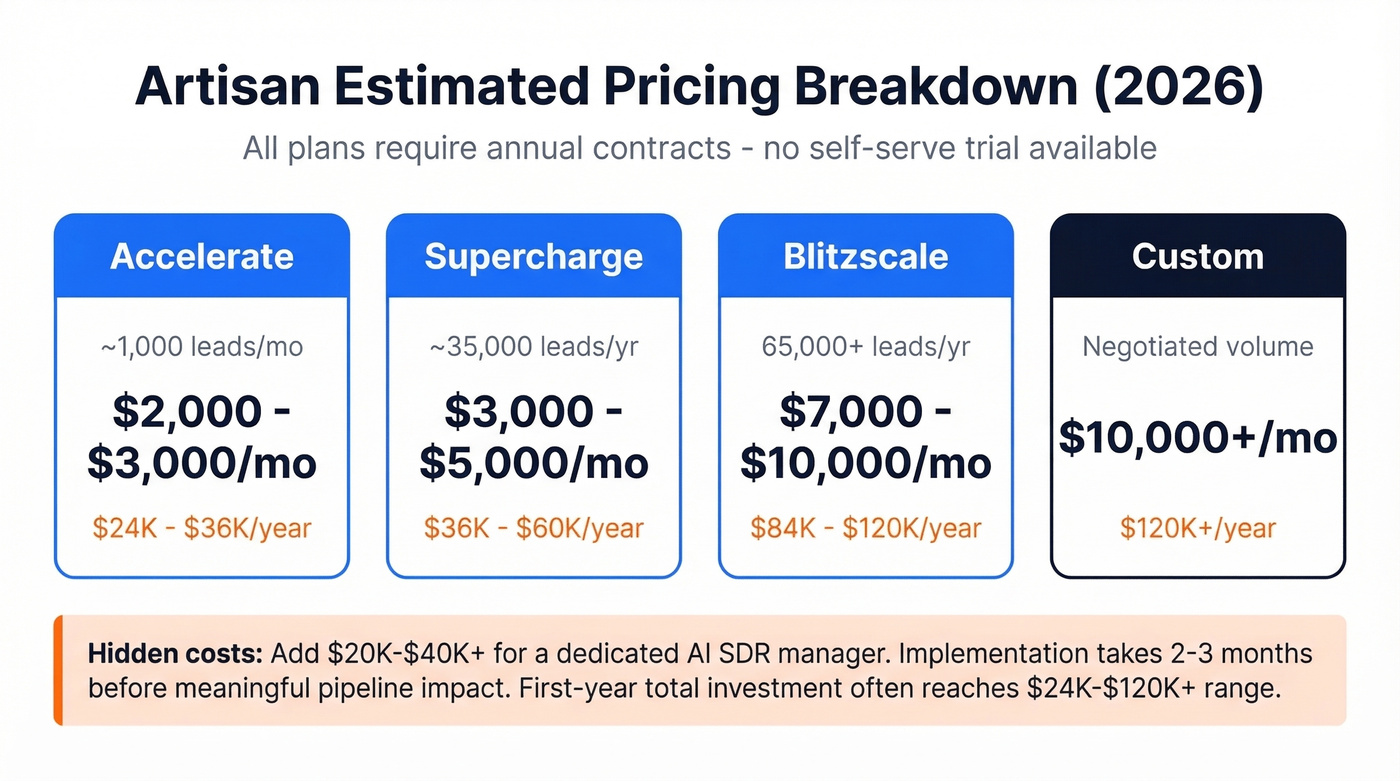
| Tier (estimated) | Est. Leads/Year | Est. Monthly Cost |
|---|---|---|
| Accelerate | ~12,000 (~1,000/mo) | $2,000-$3,000 |
| Supercharge | ~35,000 | $3,000-$5,000 |
| Blitzscale | 65,000+ | $7,000-$10,000 |
| Custom | Negotiated | $10,000+ |
All plans require annual contracts with no self-serve trial. Total cost can rise above $80,000/year if you add a dedicated AI SDR manager. Implementation takes 2-3 months for full configuration and optimization, so your first-year investment is often in the $24K-$120K+ range before you see meaningful pipeline impact. That's a long runway before ROI shows up.
Alternatives Worth Considering
Let's be honest: most teams buying AI SDRs don't have an automation problem. They have a data problem. If your emails bounce at 15%+ or you're reaching the wrong people, no amount of AI fixes that. Fix the foundation first.
Prospeo
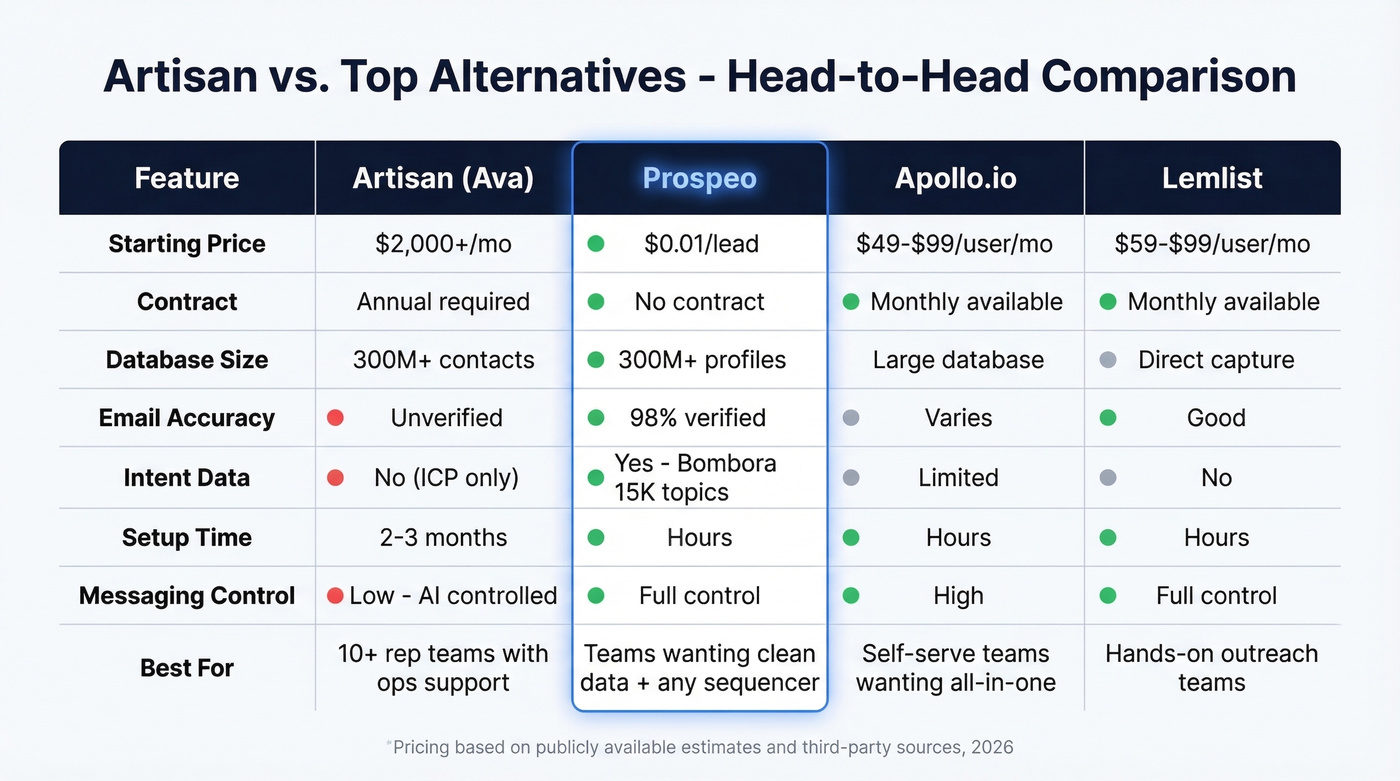
We built Prospeo to solve the data quality gap that makes tools like Artisan underperform. It covers 300M+ profiles with 98% email accuracy and 125M+ verified mobiles, all on a 7-day refresh cycle. At roughly $0.01 per lead with no annual contract, you build verified prospect lists and push them into any sequencing tool your team already uses - full control of messaging, clean data underneath. Intent data powered by Bombora tracks 15,000 topics, so you're reaching in-market buyers instead of volume-blasting cold lists.

Apollo.io
One Reddit user called Apollo "low-key an AI SDR" - and they're not wrong. Apollo bundles a large contact database with built-in sequencing, AI-assisted email writing, and a usable free tier. Paid plans run $49-$99/mo per user. Self-serve, transparent, and gets reps moving in hours rather than months.
Lemlist
Lemlist focuses on outreach execution with fresher data via direct lead capture. Plans run $59-$99/mo per user. It's a better fit for teams that want hands-on control over every touchpoint rather than handing the keys to an AI. No annual lock-in.
Artisan targets by ICP fit, not buying signals - so you're volume-blasting cold lists. Prospeo layers Bombora intent data across 15,000 topics with 125M+ verified mobiles and 98% accurate emails. Reach in-market buyers for $0.01/lead instead of $2,000/month.
Stop paying $24K/year to blast unverified contacts. Start with data that connects.
FAQ
Is Artisan worth the investment in 2026?
At $24K+/year with a 2-3 month ramp, Artisan demands significant budget and patience. Teams with 10+ reps and dedicated ops support can justify it. Smaller teams get better ROI from self-serve tools like Apollo or pairing Prospeo's verified data with a sequencer - total cost under $200/month.
Does Artisan's AI write good emails?
Reviews are sharply divided. Some users report solid reply rates above 1%. Others describe AI output as "worthless" and "worded terribly" on G2. Expect real time investment in prompt tuning - it's not the hands-off experience the marketing suggests.
What's the best alternative for data quality?
Prospeo offers 98% email accuracy and 125M+ verified mobiles on a 7-day refresh cycle at roughly $0.01 per lead. Pair it with any sequencing tool for full outbound coverage without the black-box risk of autonomous AI outreach.
How do Artisan pros and cons compare to a DIY stack?
Artisan saves time on setup but costs $24K-$120K+/year with limited messaging control. A DIY stack - verified data provider plus sequencer plus warmup tool - typically runs $200-$500/month, gives you full control, and avoids annual lock-in. The tradeoff is more manual configuration upfront, but in our experience, that control pays for itself within the first quarter.