


AtData vs Lusha: Different Tools, Different Jobs
This comparison is misleading from the start. One validates data you already have; the other finds new contacts you don't. They're built for different buyers, different workflows, and different problems. Here's what actually matters.
30-Second Verdict
Use AtData if you're a marketing ops or fraud team that needs to clean, validate, and score existing email lists. It's enterprise email intelligence, not a prospecting tool.
Use Lusha if you're a sales rep who needs to find emails and phone numbers for outbound. It's a self-serve contact database with a Chrome extension.
Why This Comparison Exists (and Shouldn't)
In our experience, the teams searching for this matchup are almost always trying to solve a prospecting problem, not a validation one. AtData is an email identity intelligence platform for marketing and fraud teams. Lusha is a B2B contact database for sales reps. They don't compete. They don't even share the same buyer persona.
Let's figure out which problem you're actually solving.
What Each Tool Actually Does
AtData
AtData has been validating emails for decades - long before "data enrichment" became a buzzword. It's an enterprise platform that validates, scores, and enriches email data you already own.
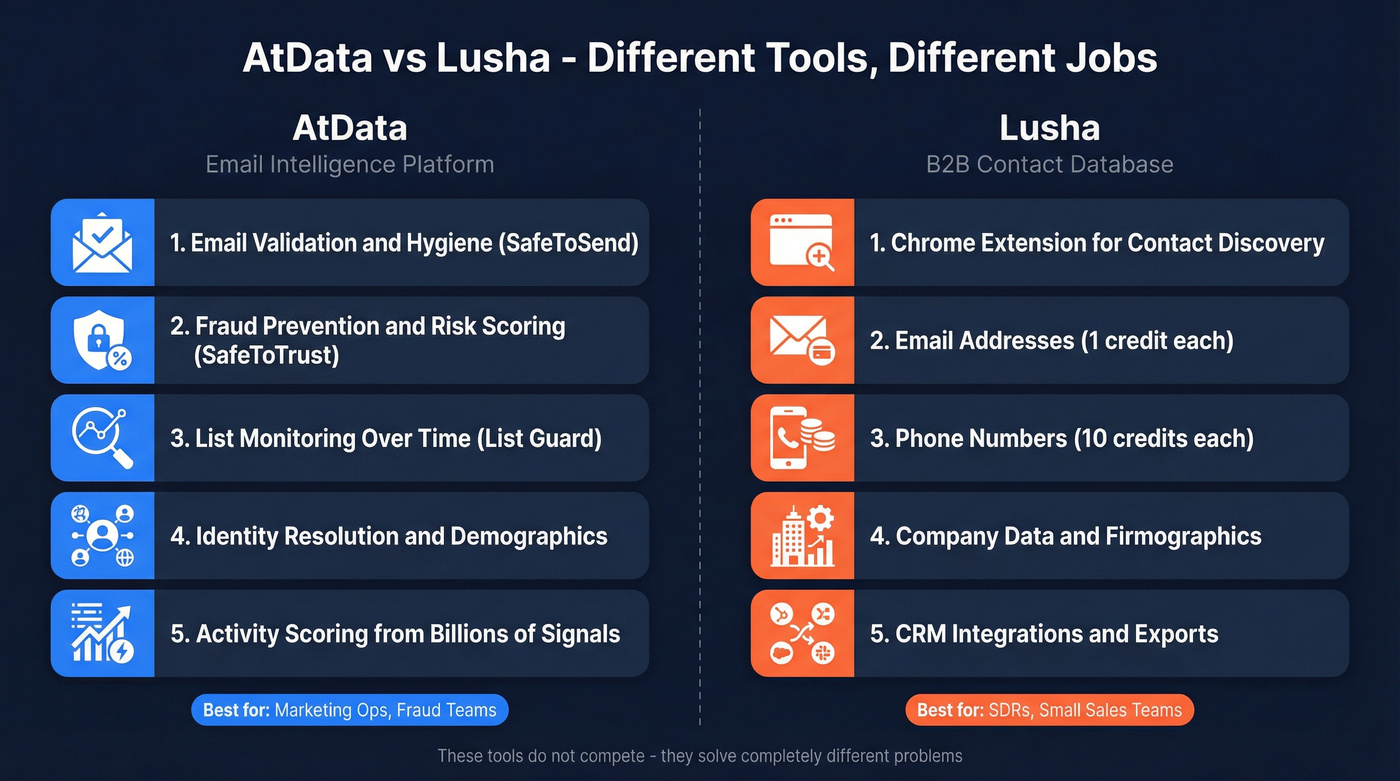
Its core products break down clearly: SafeToSend handles email validation and hygiene, SafeToTrust powers fraud prevention and risk scoring, and List Guard monitors lists over time. AtData also offers identity resolution, demographic enrichment, and activity scoring built on billions of monthly email activity signals. On G2, it holds a 4.4/5 rating across 26 reviews. Reviewers praise its deliverability improvements and responsive support, though some note the UI takes time to learn.
It's SOC 2 Type II compliant and ISO 27001-secured. The tradeoff? Enterprise onboarding, not self-serve signup. Monthly subscriptions start at $100, with batch validation at $0.01/email (25,000 inputs). For teams that need enrichment and fraud modules, expect enterprise deals in the $500-$5,000+/month range depending on volume.
Lusha
Lusha is the opposite end of the spectrum: a self-serve B2B contact database for reps who need emails and phone numbers fast. The Chrome extension is the main draw - pull contact info while you're researching prospects, then move on.
The credit system looks straightforward: 1 credit per email, 10 credits per phone number. Free gives you 70 credits/month. Pro runs $29.90/user/month (annual) with 250 credits. Premium bumps to $52.45/user/month (annual) with 800 credits. The Scale plan is custom-priced and marketed as unlimited, though it's governed by fair-use caps in practice.
Here's the thing about accuracy. Lusha highlights a 95% deliverability testimonial on its site, but MarketBetter pegs the actual data accuracy rate at 81%. On Reddit, the top complaint is phone numbers that are outdated or flat-out wrong. We've seen teams burn through Lusha credits in a week when phone-heavy - 250 Pro credits gets you just 25 phone numbers. That math catches people off guard.

Lusha's 81% accuracy means 1 in 5 emails bounce. AtData validates but doesn't find contacts. Prospeo finds and verifies in one step - 98% accuracy, 125M+ mobile numbers, 7-day data refresh. No duct-taping two tools together.
Get verified contacts at $0.01/email - no second tool required.
Side-by-Side Comparison
| Category | AtData | Lusha | Prospeo |
|---|---|---|---|
| Primary use | Email validation, fraud | B2B contact discovery | Discovery + verification |
| Data type | Email hygiene + identity | Emails, phones, company | Emails, phones, company |
| Entry price | $100/mo (free trial: 100) | Free (70 credits/mo) | Free (75 emails/mo) |
| Email accuracy | Activity-based scoring | 81% (per MarketBetter) | 98% (5-step verified) |
| Self-serve | No (enterprise onboarding) | Yes (Chrome extension) | Yes (extension + platform) |
| Compliance | SOC 2 Type II, ISO 27001 | GDPR, CCPA, SOC 2, ISO 27701 | GDPR compliant |
| Ideal buyer | Marketing ops, fraud teams | Sales reps, small teams | Sales, agencies, RevOps |
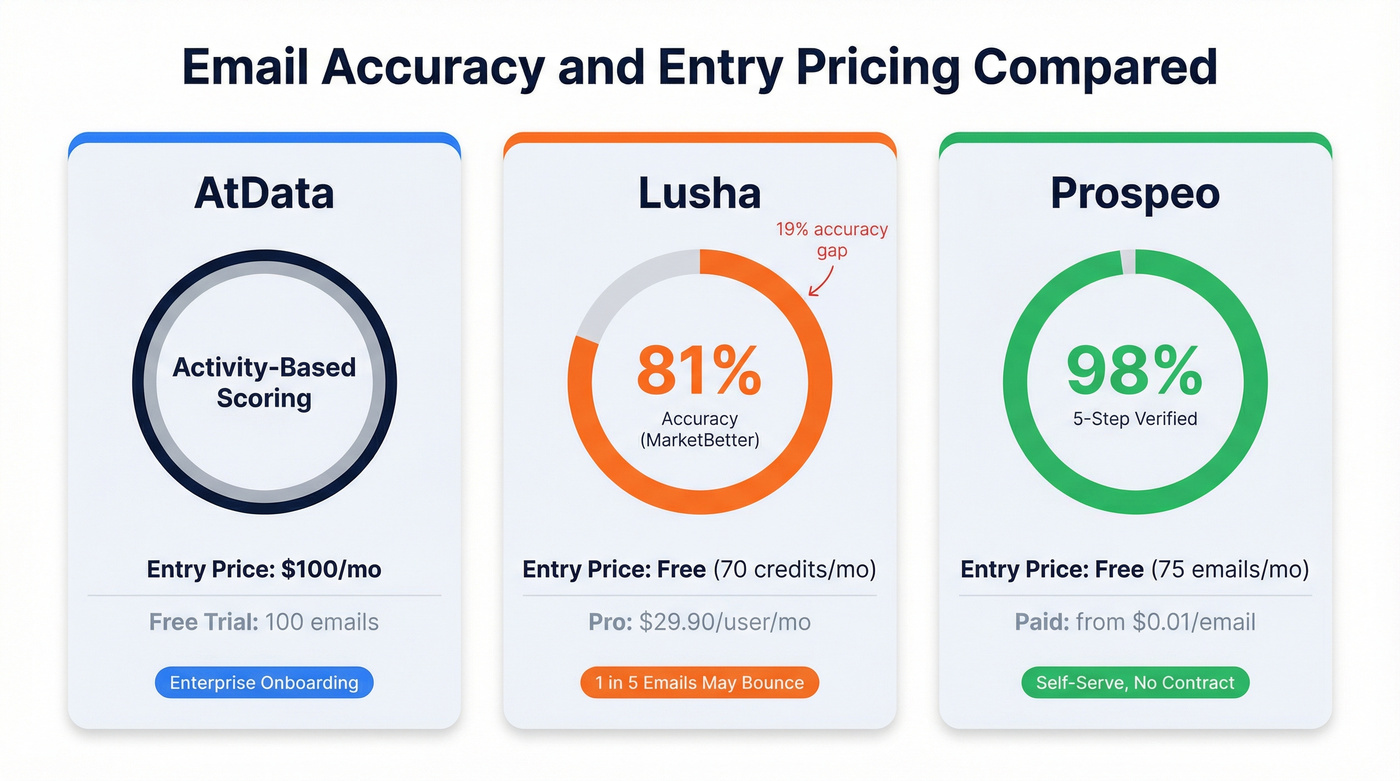
The category gap is obvious. These two platforms don't overlap on a single core use case.
When to Use Which
Use AtData if you're sitting on large email lists that need hygiene, scoring, or fraud detection. Marketing teams running re-engagement campaigns, ecommerce platforms fighting account fraud, or any org where keeping bounces below 2% is a deliverability requirement. AtData makes existing data trustworthy - it doesn't find new data.
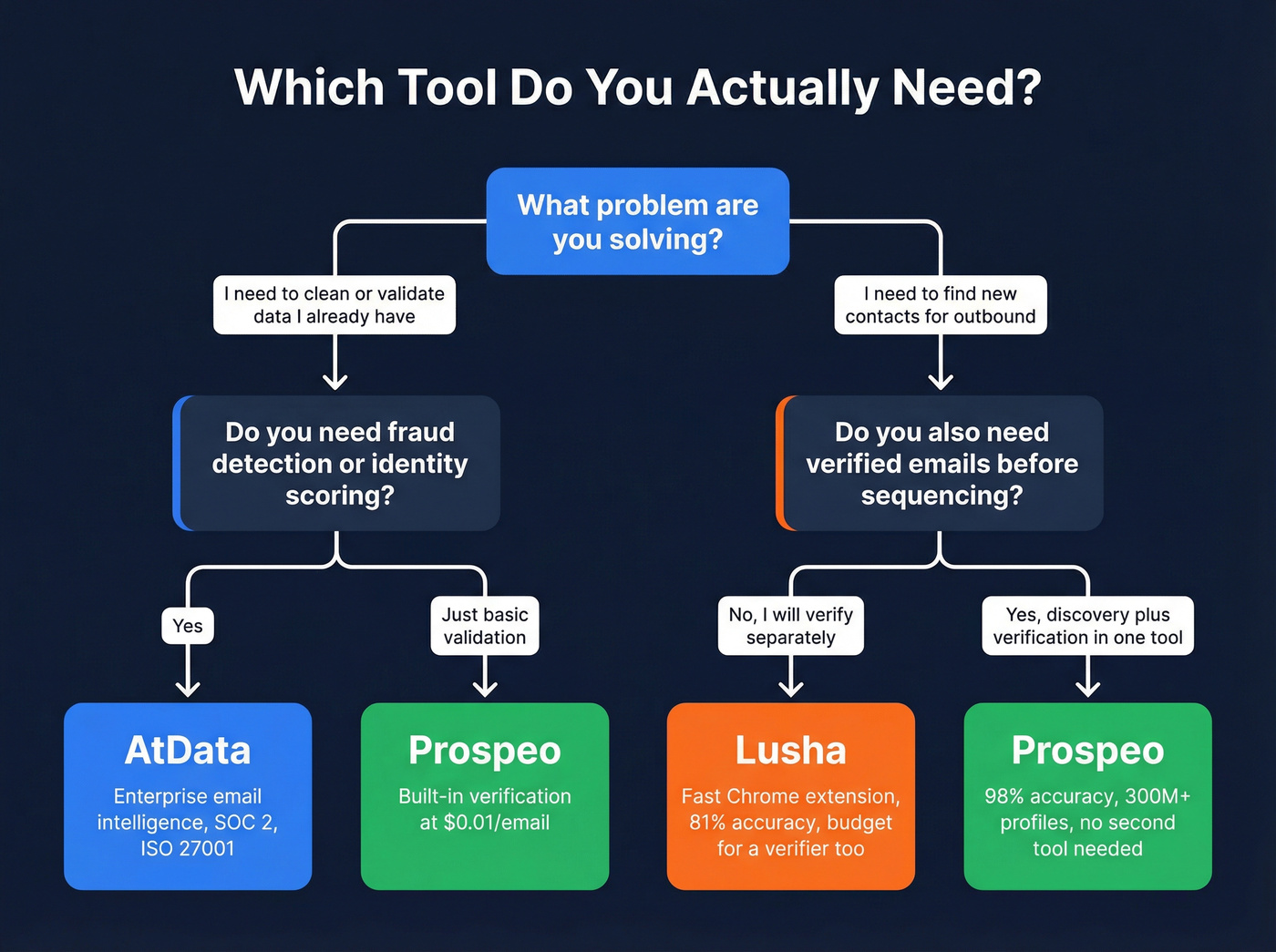
Use Lusha if you're an SDR or small team that needs new contacts quickly without an enterprise contract. The Chrome extension workflow is genuinely fast. Just know the 10:1 phone credit ratio adds up fast for calling-heavy teams, and you'll want a separate verifier to catch that 19% accuracy gap before emails hit your sequences.
Look, if you're comparing these two tools, you probably need neither. Most outbound teams need a prospecting tool with built-in verification - not an enterprise validator or a database with 81% accuracy.
What If You Need Both?
Most outbound teams need both capabilities: find contacts and verify them before they hit a sequence. Running Lusha exports through a separate validator works, but it's two tools, two bills, and extra friction that slows reps down.
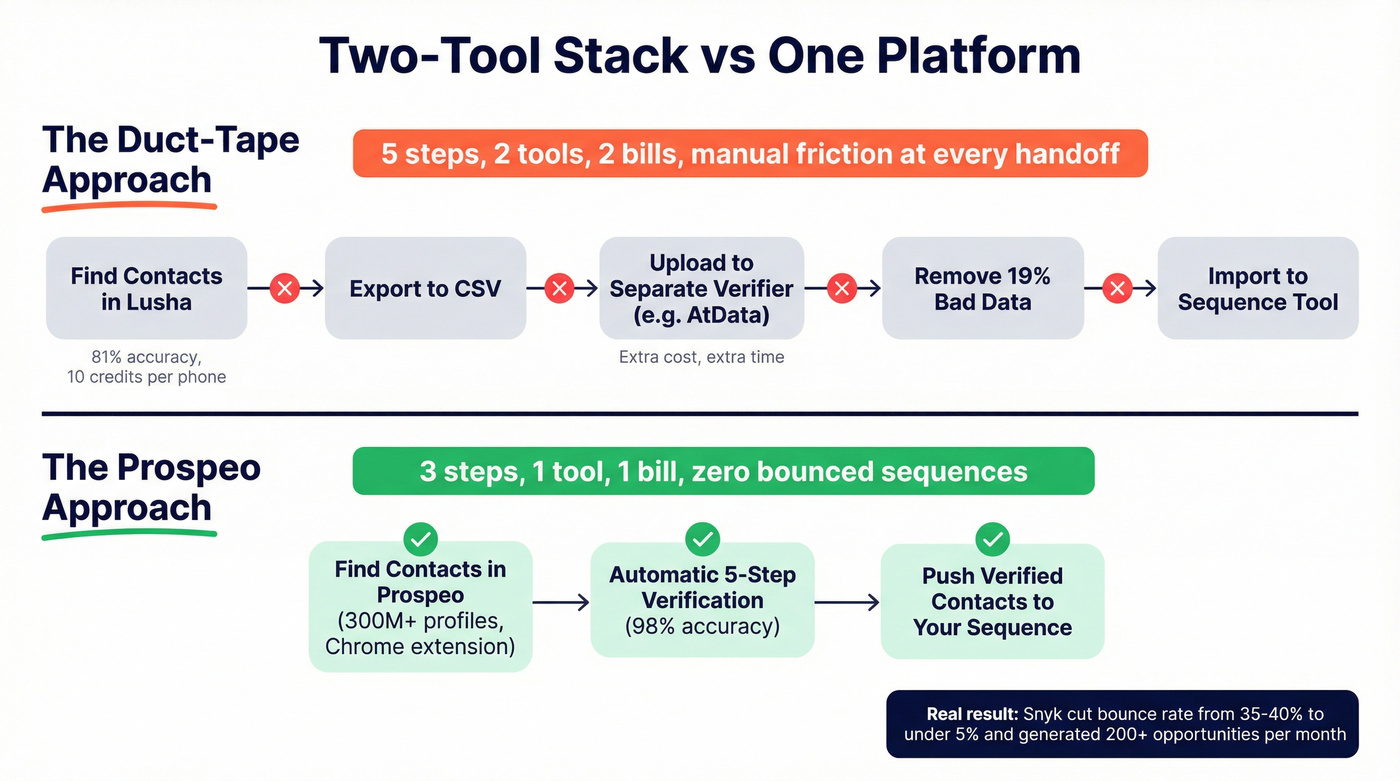
Prospeo eliminates that gap. Every email is verified through a proprietary 5-step process at the point of discovery - there's no separate validation step. 98% accuracy, 125M+ verified mobile numbers with a 30% pickup rate, and data refreshed on a 7-day cycle instead of the 6-week industry average. The free tier gives you 75 verified emails per month plus 100 Chrome extension credits, no contracts, no sales calls required.
For teams running real outbound volume, the numbers speak for themselves: Snyk's 50 AEs cut their bounce rate from 35-40% to under 5% and generated 200+ new opportunities per month after switching. That's the difference between bolting two tools together and using one platform built to handle both jobs.
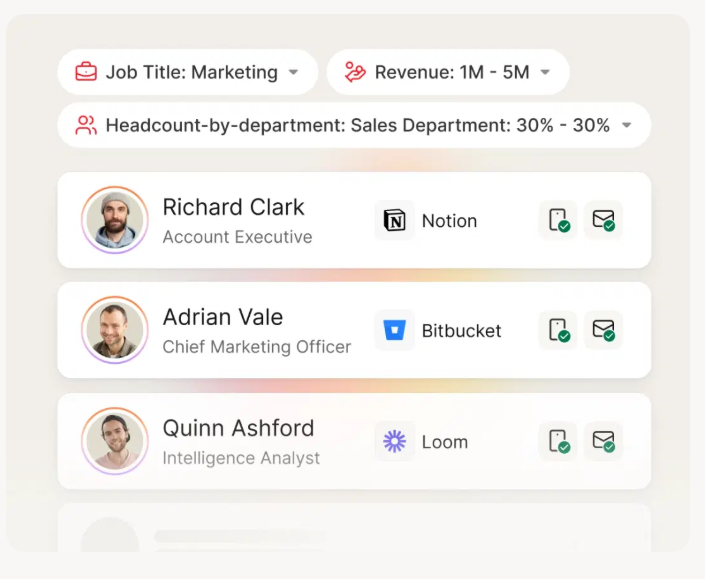
Burning 10 Lusha credits per phone number adds up fast - and you still need a separate verifier. Prospeo gives you 300M+ profiles, verified mobiles with a 30% pickup rate, and built-in 5-step email verification. One platform, one bill, zero bounced sequences.
Find contacts and verify them before they ever hit your sequence.
FAQ
Are AtData and Lusha competitors?
No. AtData validates and scores existing email data for marketing and fraud teams. Lusha finds new B2B contacts for sales reps. They serve different buyers solving entirely different problems - there's zero feature overlap between them.
What's a good alternative if neither tool fits?
If you need both contact discovery and verification in one platform, Prospeo covers both with 300M+ profiles, 98% email accuracy, and a free tier of 75 emails per month. It's self-serve with no enterprise onboarding required - built for sales teams, agencies, and RevOps.