

How to Automate Outreach Without Destroying Your Domain
A RevOps lead we know ran a 500-email sequence last quarter. Four replies. Two were "please remove me." The sequencing tool worked exactly as designed - it just automated failure at scale.
B2B buyers receive 100+ sales emails per week. Volume isn't the problem. Everyone has volume. The problem is automating outreach without the infrastructure to make that volume productive - verified data, real signals, proper deliverability, and a sequencer that doesn't torch your sender reputation on day three.
What You Need (Quick Version)
Outreach automation requires four layers. Skip any one and you're scaling a broken process.
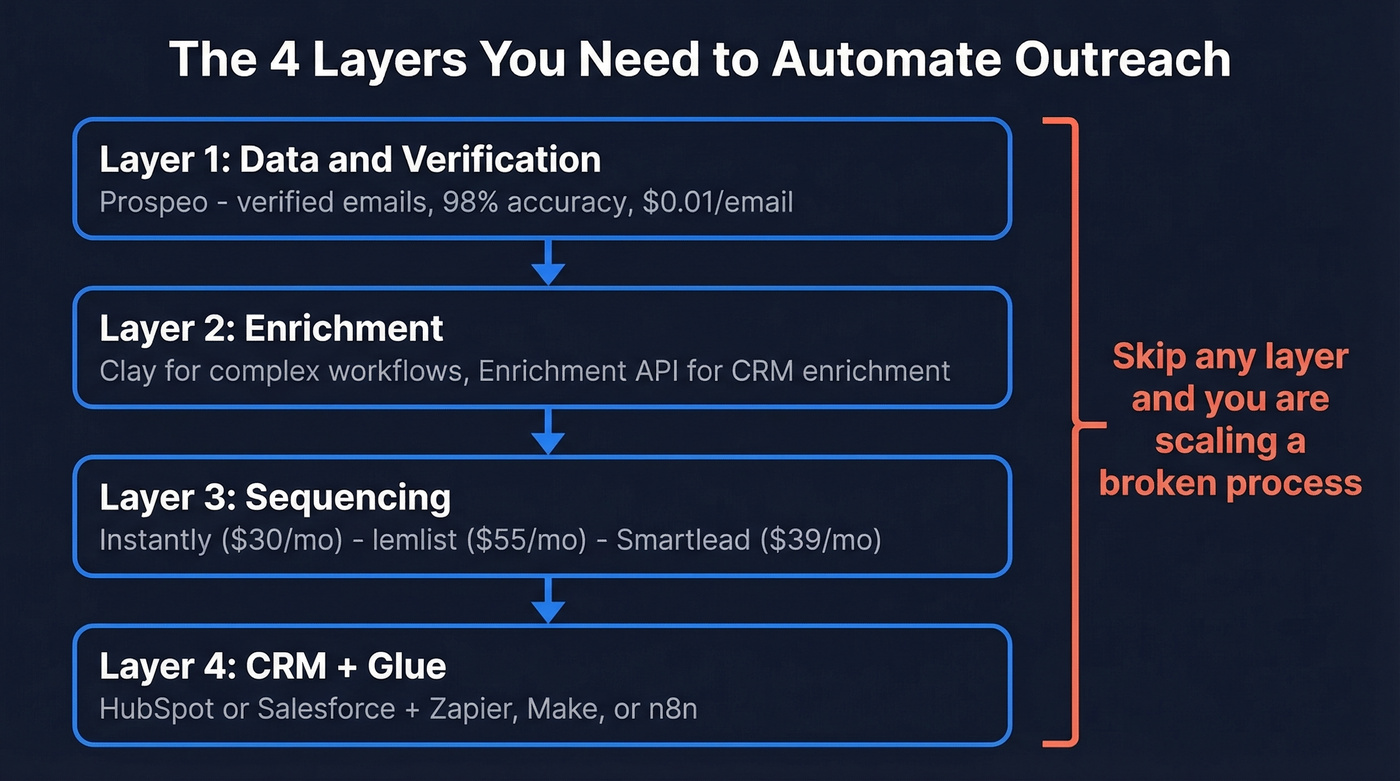
- Enrichment: Clay for complex workflows, or a direct enrichment API for straightforward CRM enrichment
- Sequencing: Instantly ($30/mo) for email-first, lemlist ($55/user/mo) for multichannel, Smartlead ($39/mo) for teams managing lots of campaigns
- CRM + glue: HubSpot or Salesforce as the system of record, with Zapier, Make, or n8n connecting the layers

Outreach Benchmarks in 2026
Let's ground this in real numbers. Instantly analyzed billions of cold email interactions across thousands of workspaces for their 2026 benchmark report:
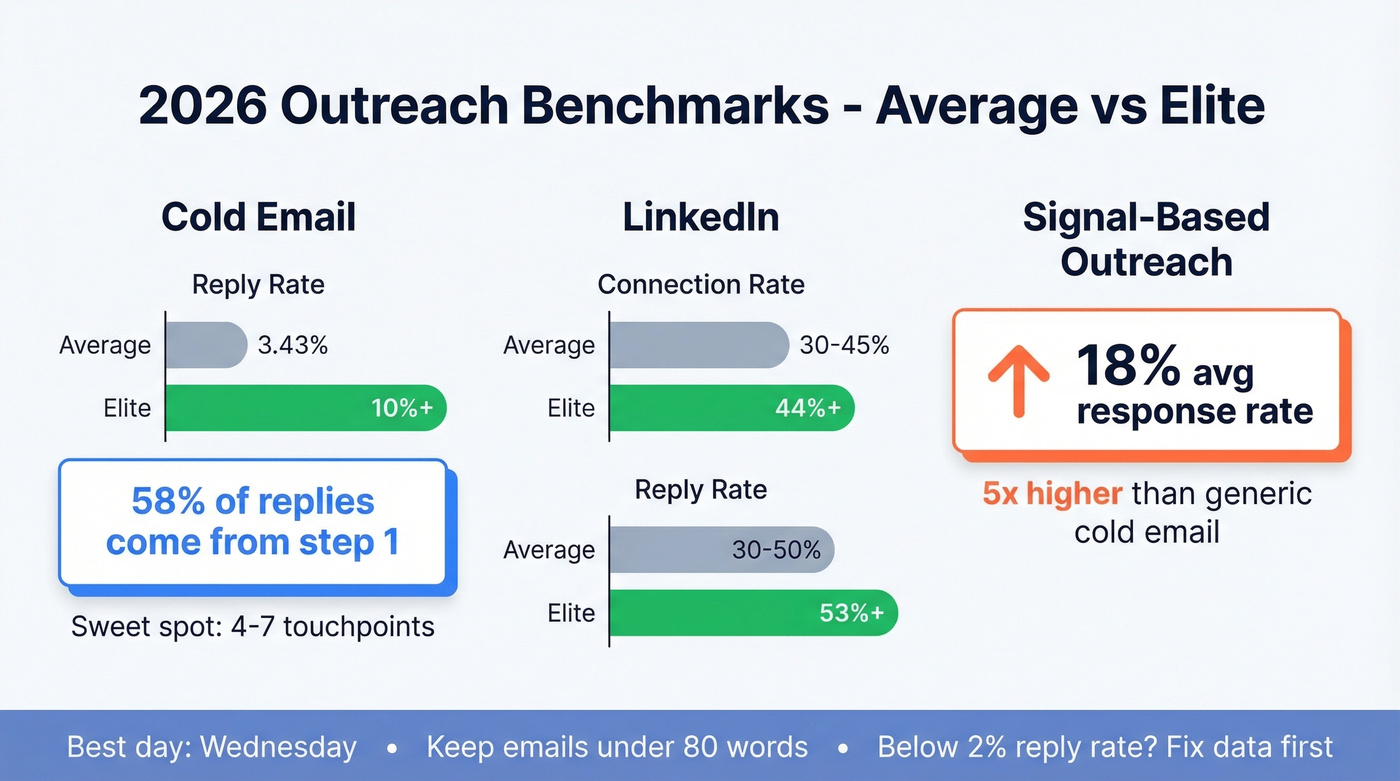
| Channel | Metric | Average | Elite |
|---|---|---|---|
| Cold email | Reply rate | 3.43% | 10%+ |
| Cold email | Replies from step 1 | 58% | - |
| Cold email | Optimal touchpoints | 4-7 | - |
| Connection rate | 30-45% | 44%+ | |
| Reply rate | 30-50% | 53%+ | |
| Signal-based | Response rate | 18% | 25%+ |
Signal-based outreach - where you anchor each touch to a real business trigger - hits 18% response rates vs. 3.4% for generic cold sends. That's a 5x multiplier from better targeting, not better copy.
Wednesday is the highest-performing send day. Emails under 80 words consistently outperform longer messages. If you're below a 2% reply rate, fix your data quality and deliverability before touching your messaging.
The Signal-First Framework
Most teams approach outreach automation backwards. They export 20,000 leads from a database, dump them into a sequence, and pray. Fully automated AI outbound sounds appealing, but without signal-based targeting, you're just automating irrelevance faster.
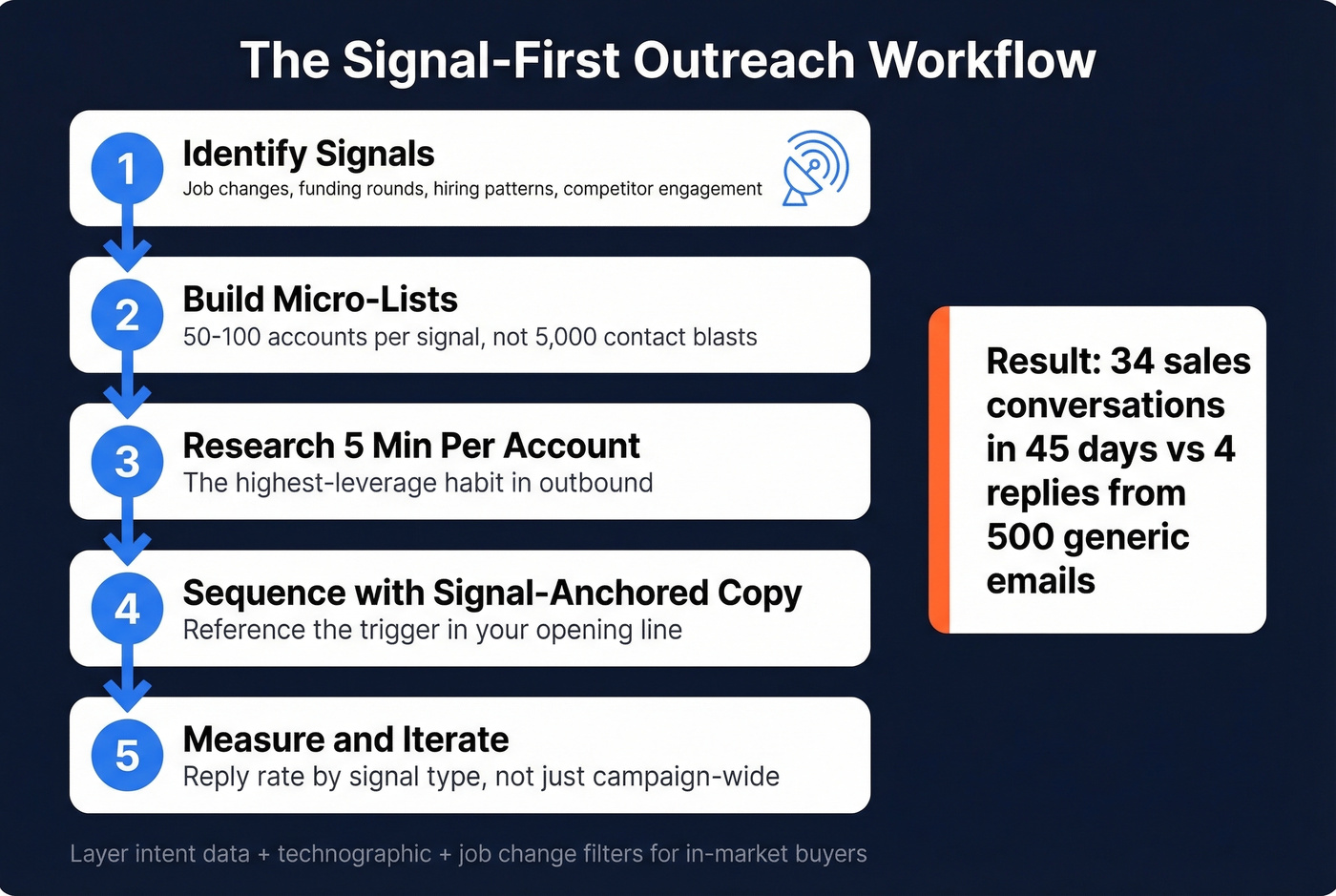
One practitioner on r/coldemail described ditching the blast approach entirely - mining post commenters and event attendees as "live intent pools." The result: 34 sales conversations in 45 days.
The average B2B deal involves 13 stakeholders, which means signal-based targeting helps you identify and reach the right people, not just the loudest title in a department. AI should handle the research inputs - tech stack analysis, funding history, buying committee mapping - not just generate email copy. As one practitioner on r/DigitalMarketing put it, "Personalization becomes the real bottleneck when scaling volume." Signals solve that bottleneck.
Here's the workflow we've seen work best:
- Identify signals - job changes, funding rounds, hiring patterns, competitor engagement
- Build micro-lists - 50-100 accounts per signal, not 5,000-contact blasts
- Research 5 min/account - the highest-leverage habit in outbound
- Sequence with signal-anchored copy - reference the trigger in your opening line
- Measure and iterate - reply rate by signal type, not just campaign-wide
Layer intent data with technographic and job-change filters and you're building lists of people who are actually in-market - not just people who match a job title.

Signal-first outreach only works when the data behind it is accurate. Prospeo layers intent data across 15,000 topics with job change, technographic, and headcount growth filters - so every micro-list you build targets buyers who are actually in-market. 98% email accuracy means your sequences hit real inboxes, not spam traps.
Stop automating failure. Automate outreach on verified data.
How to Build the Full Stack
Data and Verification
Every other layer depends on this one. Bad data doesn't just lower reply rates - it damages your sender reputation, which compounds over time and takes months to recover.
We've seen teams recover from 35%+ bounce rates to under 5% within weeks of switching to verified data. One agency, Stack Optimize, built from $0 to $1M ARR with 94%+ client deliverability and zero domain flags across all clients. At ~$0.01 per email with a 7-day refresh cycle vs. the 6-week industry average, the economics are hard to argue with.
Enrichment
Clay is the go-to for complex enrichment workflows - waterfall lookups, multi-source chains, AI-powered research. For straightforward CRM enrichment, a direct enrichment API that returns 50+ data points per contact with a 92% match rate keeps things simpler and faster.
Apollo works as a dual-role option (paid plans start around $49-59/user/mo) for teams that want database + basic enrichment in one tool. Watch the credit overages at $0.20 per extra credit, though - those add up fast on high-volume campaigns.
Sequencing
Instantly ($30/mo, unlimited email accounts) is the pick if you're email-first and need horizontal scaling across multiple inboxes. lemlist ($55/user/mo) is better for multichannel SMB sequences coordinating email and LinkedIn touches. Smartlead ($39/mo) fits teams managing lots of campaigns across clients or inboxes. Saleshandy ($25/mo) is the budget option that gets the job done without frills.
Skip Smartlead if you're a solo founder running one campaign - it's built for agency-scale complexity you don't need yet.
CRM and Workflow
HubSpot or Salesforce as the system of record. Zapier, Make, or n8n handle the glue between layers. Many connections work natively; use middleware when you need custom routing, enrichment logic, or multi-step syncing.
Deliverability Infrastructure
Here's the thing: automation at scale means nothing if your emails land in spam. This is the non-negotiable checklist.
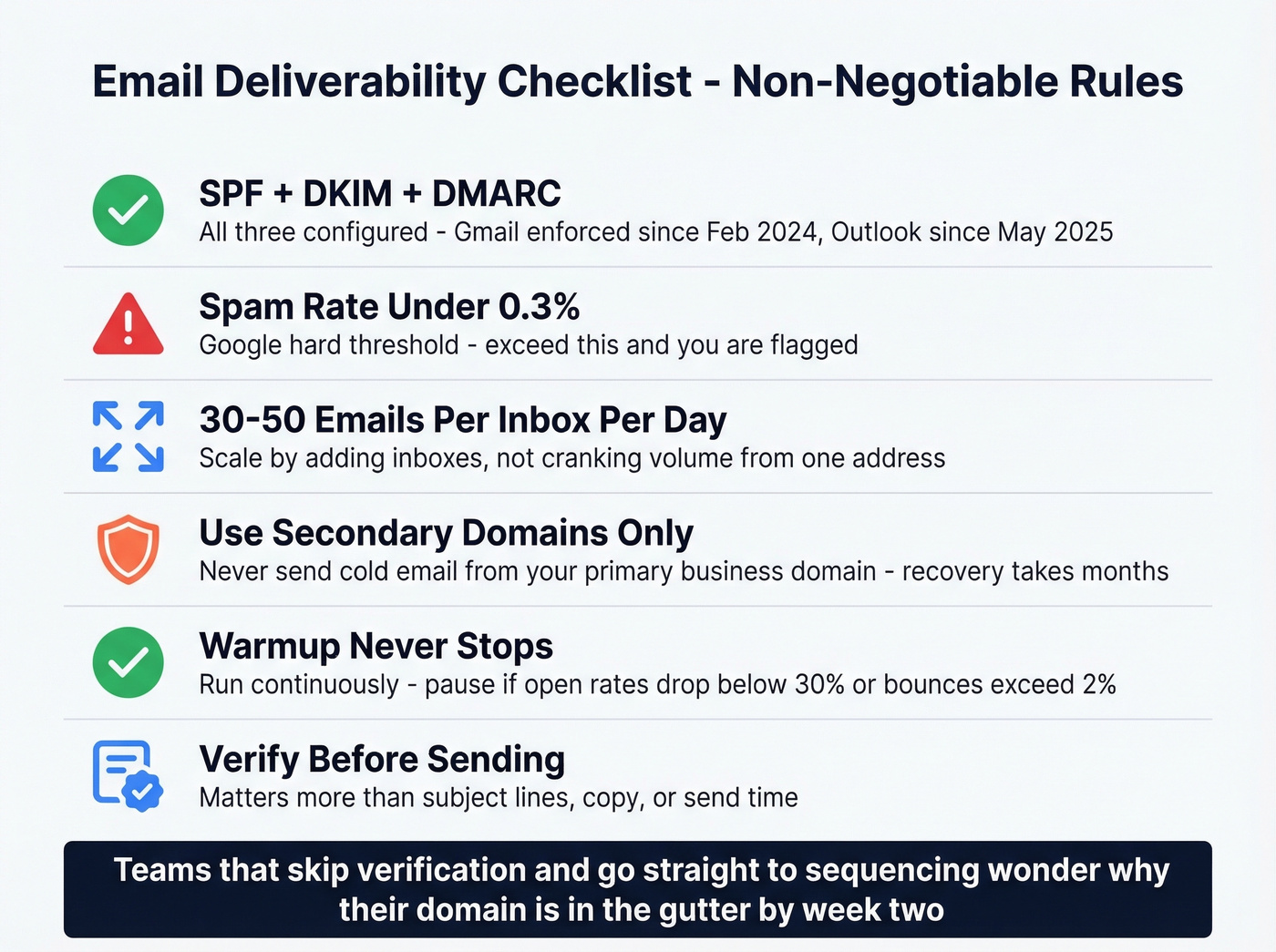
SPF/DKIM/DMARC - all three must be configured. Gmail has enforced bulk sender authentication since February 2024. Outlook followed in May 2025. Start DMARC at p=none, then tighten to quarantine or reject.
Spam rate - stay under 0.3%. That's Google's hard threshold.
Horizontal scaling - 30-50 emails per day per inbox. Scale by adding inboxes and secondary domains, not by cranking volume from one address. Most teams running 5-10 inboxes can sustain 200-400 sends/day without deliverability issues.
Secondary domains - always use lookalike domains for cold outreach. Never send from your primary business domain. We've seen teams lose entire quarters of pipeline from a flagged primary domain. Recovery takes months.
Warmup never stops. Run warmup continuously to offset negative signals from cold sends. If open rates drop below 30% or bounce rates creep above 2%, pause and diagnose before you do more damage.
Verification before sending matters more than your subject line, your copy, or your send time. In our experience, the teams that struggle most are the ones who skip verification and go straight to sequencing - then wonder why their domain reputation is in the gutter by week two.
Bad data is the fastest way to torch your sender reputation. Prospeo's 5-step verification and 7-day refresh cycle keep bounce rates under control - Stack Optimize built a $1M agency with sub-3% bounces and zero domain flags. At $0.01/email, scaling to thousands of sends costs less than one bad domain recovery.
Protect your domain. Verify every contact before it hits a sequence.
Mistakes That Kill Automated Outreach
Do this: Personalize with real signals - job changes, funding, hiring patterns. Space touchpoints 3-4 days apart. Bring new value each touch. Keep emails under 80 words with a single low-friction CTA. Set daily send limits per inbox and monitor bounce rates in real time. The moment metrics slip, pause the campaign before your domain takes the hit.
Not that: Blast 500 contacts from a stale list with the same AI-generated template. As one practitioner on r/SaaS noted, "AI-generated emails are easy to spot in 2026." In that same sequence, 80% of replies came after the 3rd touchpoint. If you're sending one email and moving on, you're leaving most of your pipeline on the table.
LinkedIn automation has its own risk profile. Safe limits sit around 100 connections/day and 150 messages/day. Push past those and you're inviting account restrictions.
Compliance Quick-Reference
| Regulation | Scope | Max Penalty | Key Requirement |
|---|---|---|---|
| CAN-SPAM | US | $50,120/email | Physical address + opt-out |
| GDPR | EU/EEA | €20M or 4% revenue | Legitimate interest + opt-out |
| CASL | Canada | $10M | Consent + 60-day unsubscribe |
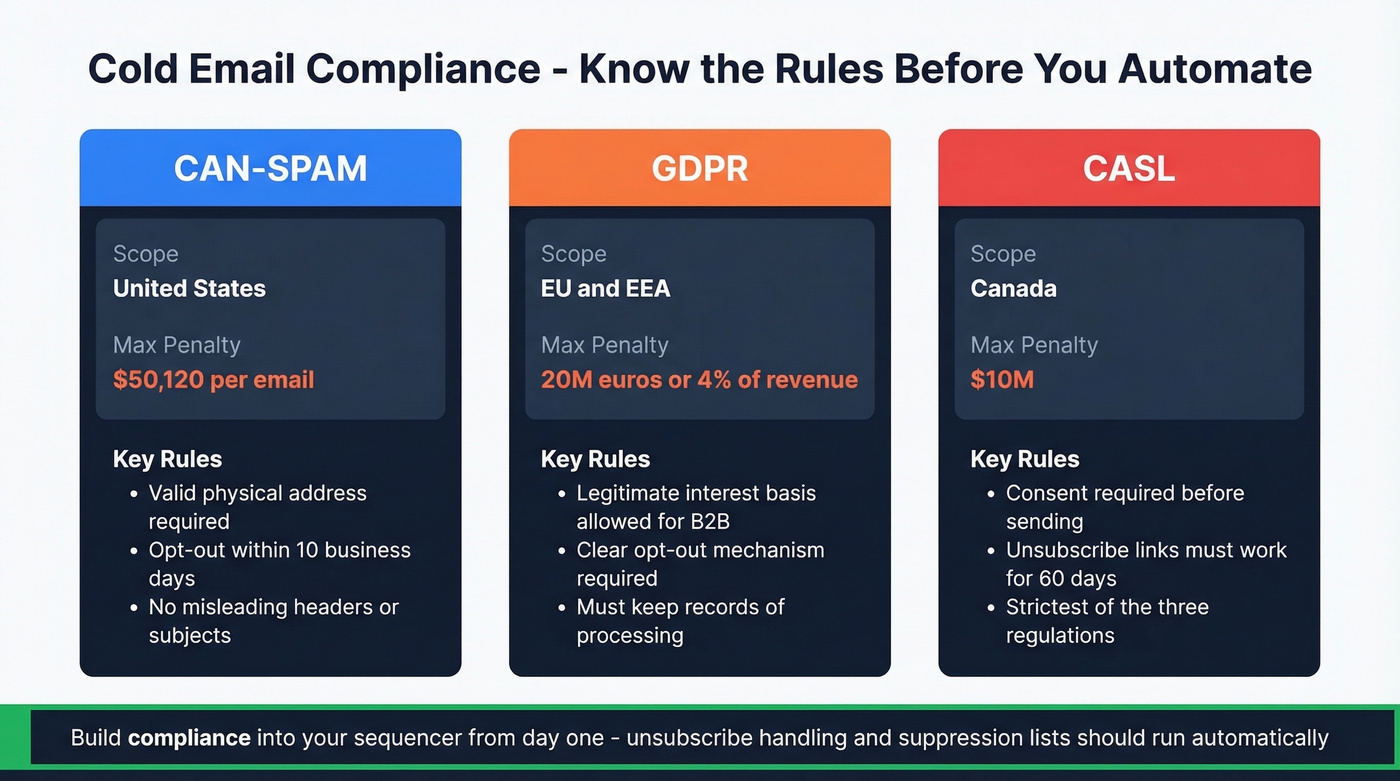
CAN-SPAM requires a valid physical address and opt-out processing within 10 business days. GDPR allows B2B cold outreach under legitimate interest, but you need a clear opt-out mechanism and records. CASL is the strictest - unsubscribe links must remain functional for 60 days. Build compliance into your sequencer from day one: unsubscribe handling and suppression lists should run automatically, not manually.
FAQ
How many cold emails should I send per day?
30-50 per inbox is the safe ceiling. Scale horizontally by adding inboxes and secondary domains rather than increasing volume from a single address.
What's a good cold email reply rate in 2026?
The average is 3.43%. Top signal-based campaigns hit 10%+. Below 2% means your data quality or deliverability needs work before you tweak copy.
Do I need separate domains for cold outreach?
Yes. Always use secondary or lookalike domains to protect your primary domain's sender reputation. A flagged primary domain can cost you months of pipeline recovery.
What's a good free option to start?
A free tier that gives you 75 verified emails per month paired with Instantly's trial is enough to run a real micro-campaign and validate your workflow before spending anything. Saleshandy ($25/mo) is the cheapest paid sequencer if you need to scale past the trial.
Is automated cold email legal?
Yes, with compliance. CAN-SPAM requires an opt-out mechanism and physical address. GDPR allows B2B outreach under legitimate interest with clear opt-out. Penalties reach $50,120 per email under CAN-SPAM or €20M under GDPR - so don't cut corners on suppression lists.