

B2B Competitor Analysis: A Data-Backed Guide (2026)
Your sales team rates its own competitive preparedness 3.8 out of 10. That's the average self-score across B2B organizations, and 68% of deals involve at least one direct competitor. The gap between "we kinda know what they do" and "we have a plan to beat them" costs companies $2-10M per year in winnable deals.
Most competitive analysis fails not because teams skip it, but because they turn it into busywork - screenshots, feature grids, and decks that never touch a deal. This guide fixes that. Three phases, real benchmarks, a filled-in scorecard, and the actual tool stack you need with pricing.
The Framework in 30 Seconds
If you're short on time:
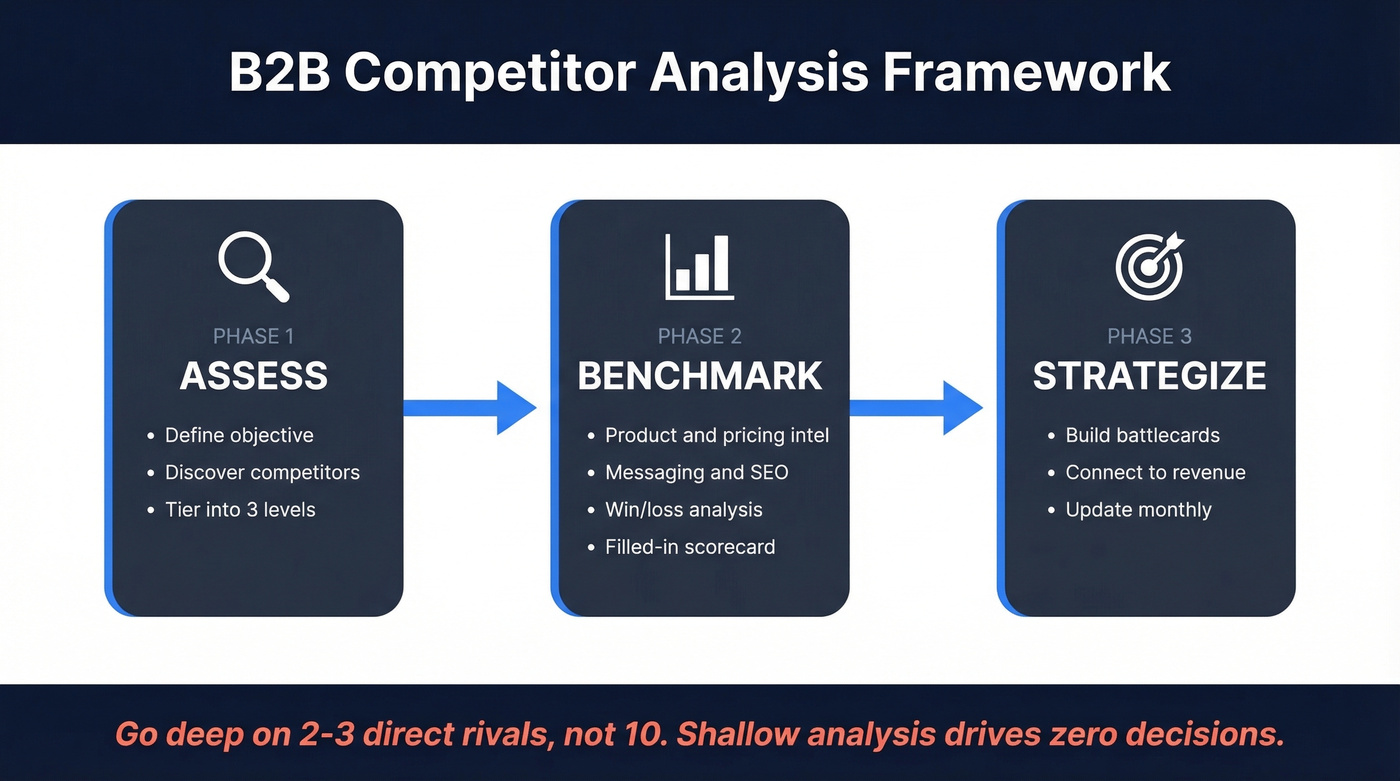
- Three phases: Assess (scope your competitive field) -> Benchmark (deep analysis on the ones that matter) -> Strategize (turn insights into battlecards and revenue actions).
- Tier 3 competitors, not 10. Go deep on 2-3 direct rivals. Tracking a dozen equally guarantees shallow analysis that drives zero decisions.
- Your tool stack needs three layers: one SEO/digital tool (Semrush or Ahrefs), one CI monitoring platform (Crayon, Klue, or Kompyte depending on budget), and one data quality layer so your competitive outreach actually lands.
That's the skeleton. Let's put muscle on it.
What B2B Competitive Analysis Actually Is
There's a distinction worth making early. Competitive analysis is a point-in-time exercise - you pick a rival, dissect their product, pricing, positioning, and go-to-market motion, and produce a deliverable. Competitive intelligence is the ongoing program that feeds those analyses into decisions continuously. Analysis is a snapshot. CI is the surveillance system.
You need both, but most teams only do the snapshot, usually triggered by losing a big deal.
The CI tools market is projected to hit $1.46B by 2030, growing roughly 20% annually. Gartner predicts that by 2026, 40% of technology and service providers will use commercial CI tools - up from under 15% just a few years ago. AI adoption in competitive intelligence has surged 76% year-over-year, with 60% of CI practitioners now using AI tools daily. This isn't hype. It's companies realizing that ad-hoc Googling before a demo isn't a competitive strategy.
Here's the thing: competitive analysis done right is a revenue lever, not a reporting exercise. If your last analysis lives in a slide deck nobody opens, you don't have a program. You have a file.
Phase 1 - Assess
This is where most teams either go too broad (tracking 15 competitors superficially) or too narrow (obsessing over one rival while an indirect competitor eats their lunch). The Assess phase has three steps: define your objective, discover competitors, and tier them.
Define Your Objective
Before you open a single competitor's website, answer three questions. What's the objective - are you preparing for a product launch, responding to a lost deal pattern, or building an annual strategy? What's the scope - which product lines, geographies, and market segments matter? And what's the time horizon - is this a snapshot for next quarter's battlecards or a three-year strategic outlook?
Skipping this step is how you end up with a 40-page deck that answers questions nobody asked.
Discover Competitors
Six sources that consistently surface competitors your team hasn't thought about:
- G2 and Capterra category pages - sort by your category and see who's gaining reviews fastest.
- Customer and prospect interviews - ask "who else did you evaluate?" in every deal, won or lost.
- Sales team input - reps hear competitor names daily. Formalize the collection so competitive research becomes a shared responsibility, not a one-person project.
- Community research - industry subreddits (the consensus on r/sales is that competitor mentions in deal reviews are the most honest intel you'll find), Slack groups, and conference hashtags reveal emerging players.
- Technographic tools - BuiltWith and Wappalyzer show what prospects are actually running.
- Job postings - a competitor hiring 12 enterprise AEs tells you more about their strategy than their press release does.
Tier Your Competitors
Not every competitor deserves the same attention.
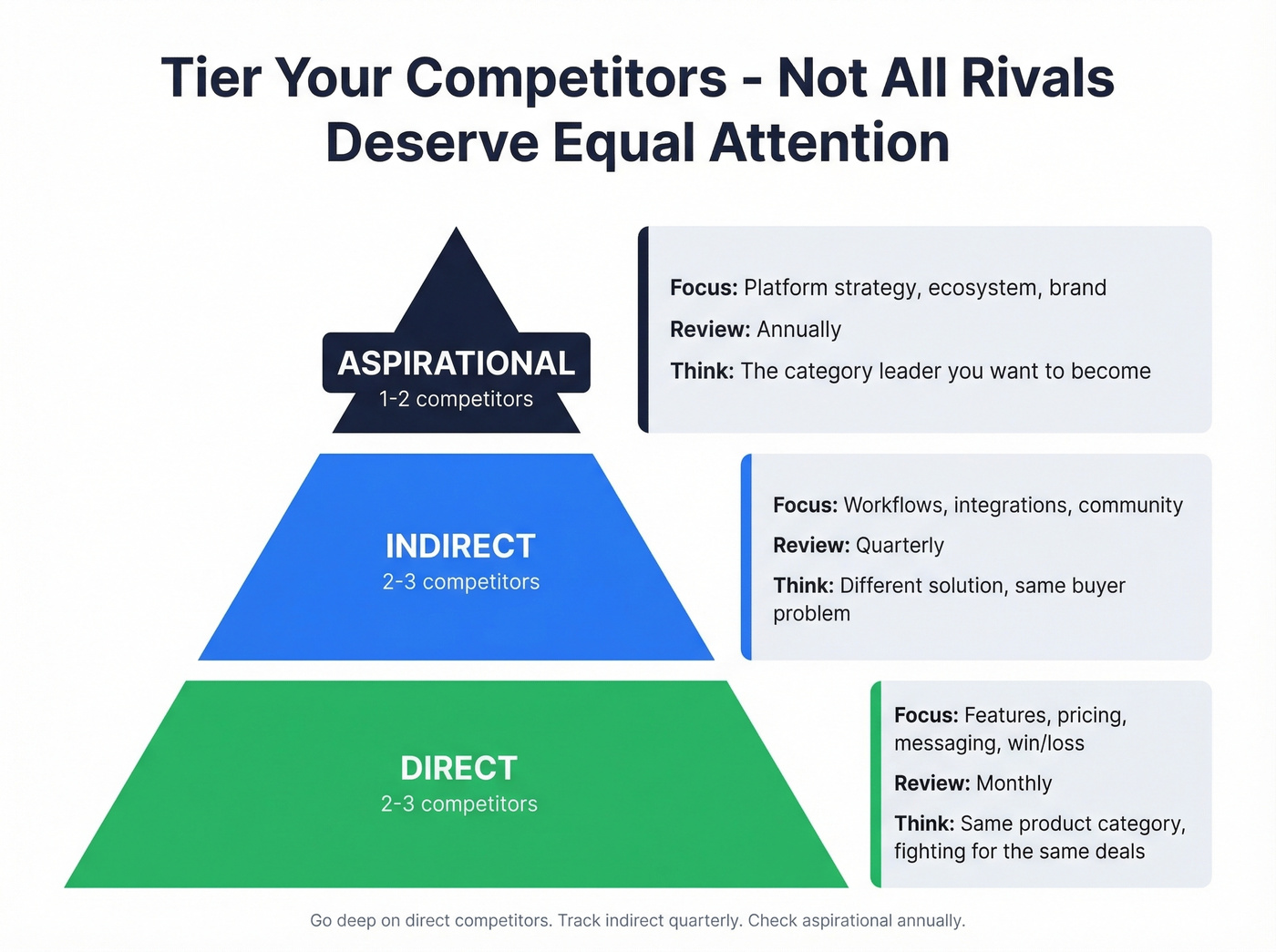
| Tier | Focus Areas | Review Cadence | Key Metrics |
|---|---|---|---|
| Direct (2-3) | Features, pricing, messaging, win/loss | Monthly | Win rate, deal overlap |
| Indirect (2-3) | Workflows, integrations, community | Quarterly | Market share shifts |
| Aspirational (1-2) | Platform strategy, ecosystem, brand | Annually | Category direction |
Porter's Five Forces still works for framing market-level dynamics - supplier power, buyer power, substitutes, new entrants, and rivalry intensity. But for day-to-day competitive selling, the tiering table above is what actually gets used.
Phase 2 - Benchmark Your Rivals
This is where analysis either becomes actionable or dies as busywork. The Benchmark phase covers four areas: product and pricing intelligence, messaging and content, win/loss analysis, and a synthesized scorecard.
Product and Pricing Intelligence
Feature comparison is the easy part - most teams already do this. Pricing intelligence is harder and more valuable. Three methods consistently produce results.
First, procurement document requests through friendly customers who've evaluated competitors recently. Second, published pricing pages, which are increasingly rare for enterprise tools but SMB-focused competitors often still publish. Third, G2 and Capterra reviews that mention pricing frustrations - "we switched because they raised prices 30% at renewal" is gold.
Don't just list features side by side. Map them to buyer priorities. A feature your competitor has but your buyers don't care about isn't a threat - it's noise.
Messaging, Content, and SEO
Run your top 3 competitors through Semrush or Ahrefs. You're looking for which keywords they're investing in (this reveals strategic priorities), which content pieces drive their organic traffic (this shows what resonates with shared buyers), and where they're gaining or losing ground month over month.
Check their homepage messaging quarterly. When a competitor changes their tagline from "all-in-one platform" to "enterprise-grade security," that's a positioning shift worth noting.
Win/Loss Analysis
Look, your CRM data is lying to you. 60% of sellers are partially or completely wrong about why they lost a deal. CRM disposition codes are fiction. "Lost on price" usually means "lost on value articulation" or "lost because the champion left mid-cycle."
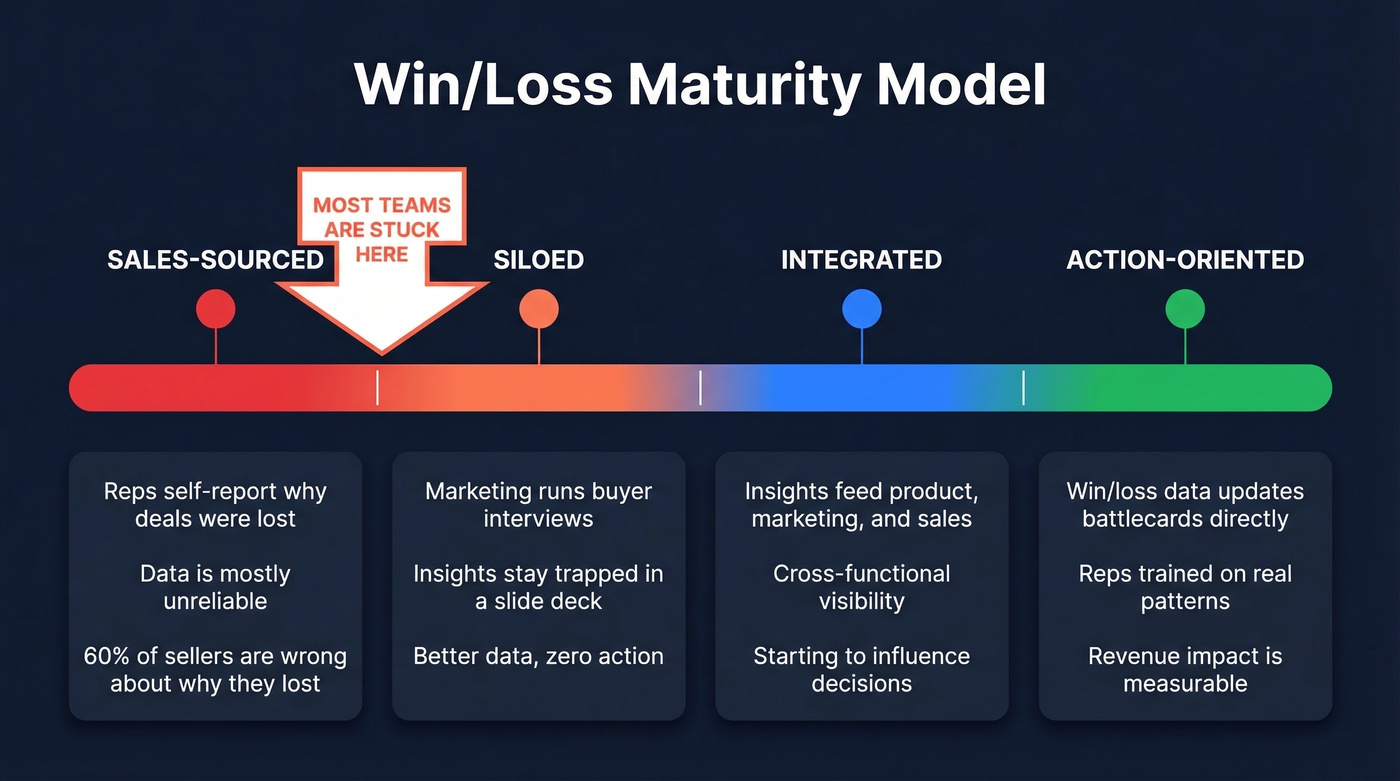
Klue outlines a four-stage win/loss maturity model:
- Sales-sourced - reps self-report and the data is mostly unreliable.
- Siloed - marketing runs interviews but insights stay in a deck.
- Integrated - insights feed product, marketing, and sales enablement.
- Action-oriented - win/loss data directly updates battlecards and training.
Most teams are stuck at stage one or two. The real breakthrough is buyer interviews - structured conversations with people who chose you and people who didn't, conducted by someone other than the rep who ran the deal. When you identify a competitive threat through win/loss and need to reach the decision-maker at a target account, bad contact data kills the play before it starts. Prospeo's 98% email accuracy and 7-day refresh cycle mean your competitive win-back campaigns actually reach inboxes instead of bouncing.
The Filled-In Scorecard
Let's make this concrete. Here's a simplified scorecard for a fictional mid-market project management SaaS evaluating two direct competitors:
| Dimension | Our Product | Competitor A | Competitor B |
|---|---|---|---|
| Core strength | Workflow automation | Enterprise reporting | Free tier adoption |
| Pricing (mid-market) | $15/user/mo | $22/user/mo | Freemium + $9/user |
| Win rate (H1 2026) | 34% | 28% | 31% |
| Top loss reason | "Missing Gantt view" | "Too expensive" | "Not enterprise-ready" |
| SEO traffic trend | +18% QoQ | Flat | +42% QoQ |
| Key messaging shift | "Automate busywork" | "Single pane of glass" | "Free forever for small teams" |
This scorecard isn't a spreadsheet you fill once. It's a living document that gets updated monthly for direct competitors and quarterly for indirect ones. The moment it goes stale, it becomes the deck nobody opens.

Your battlecards are only as good as the data behind your outreach. Prospeo gives you 30+ filters - including technographics, buyer intent across 15,000 topics, and headcount growth - so you can target the exact accounts your competitors are winning and reach their decision-makers with 98% email accuracy.
Stop analyzing competitors and start stealing their deals.
Phase 3 - Strategize
Analysis without action is a book report. The Strategize phase converts benchmarks into two things: battlecards reps use in deals, and revenue-connected metrics that justify the CI program's existence.
Build Battlecards Reps Actually Use
71% of businesses using battlecards report higher win rates. And here's the stat that should change your update cadence: teams that refresh battlecards monthly see up to a 59% win-rate lift versus those that update quarterly or less.
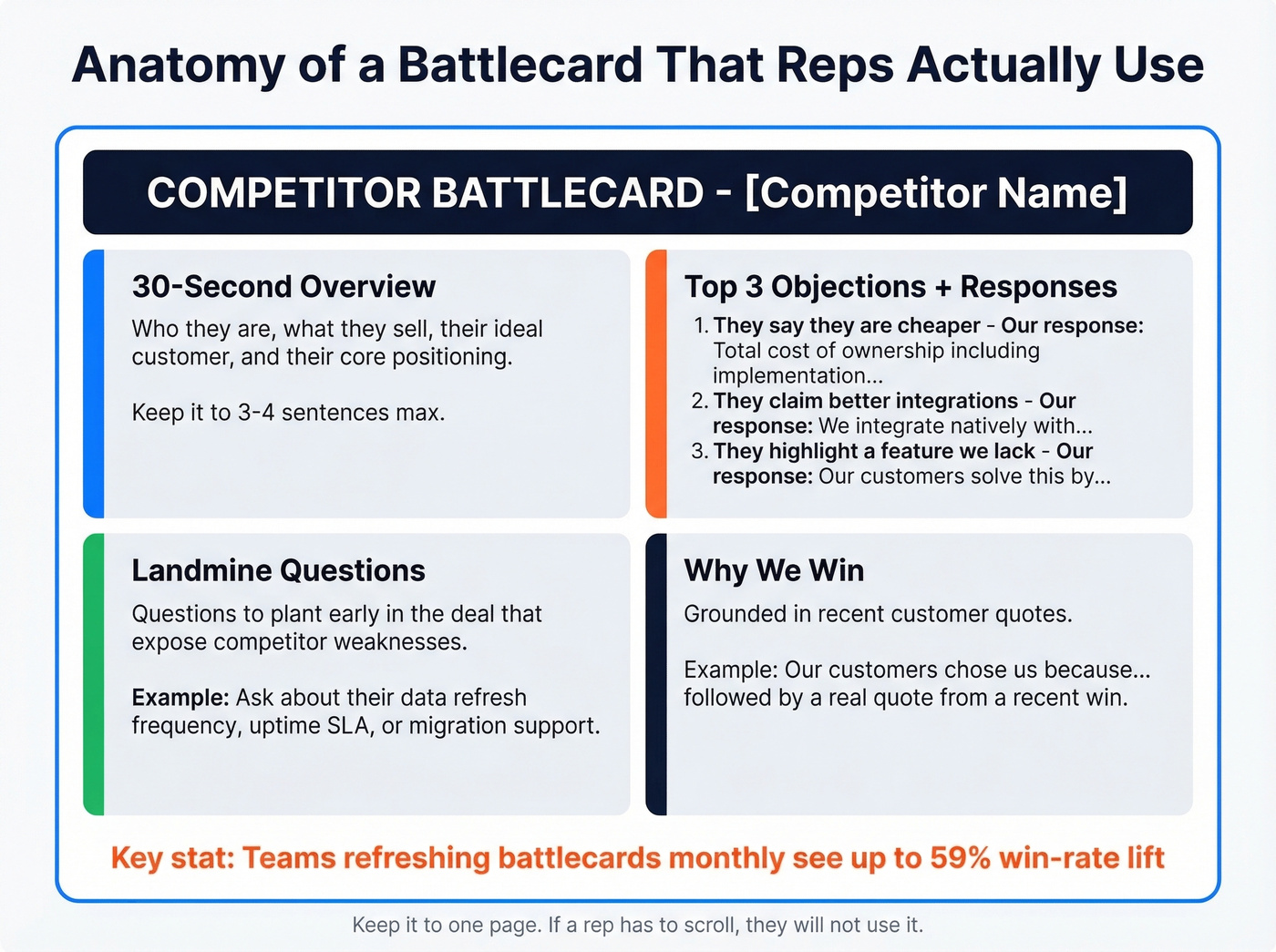
A battlecard that works has four sections: a 30-second competitor overview, the top 3 objections reps will hear with responses, landmine questions to plant early in the deal, and a "why we win" narrative grounded in recent customer quotes. Keep it to one page. If a rep has to scroll, they won't use it.
In our experience, the teams that win competitively aren't the ones with the most data - they're the ones who act on it fastest. Reps using well-maintained CI programs save 8-12 hours per month on manual research, and organizations report an 85-95% reduction in time spent gathering competitive information manually.
Connect Analysis to Revenue
Deals closed within 50 days have a 47% win rate. After 50 days, win rates drop to 20% or lower. Competitive intelligence shortens cycles by giving reps the ammunition to handle objections in real time instead of stalling while they "check with product."
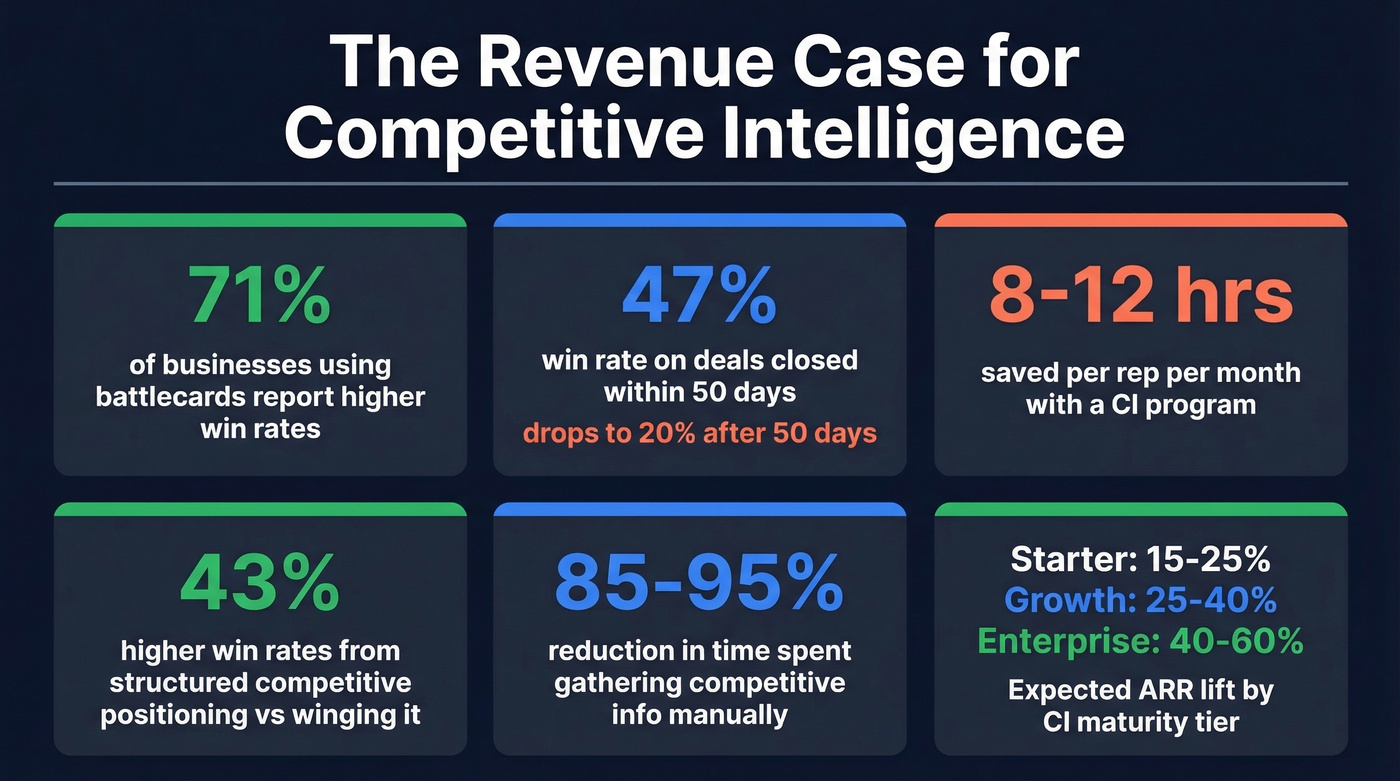
82% of sales teams measure win rate, but only 23% understand what's driving performance. Structured opportunity management - which includes competitive positioning - yields 43% higher win rates than winging it. The CI program isn't a marketing project. It's a revenue lever, and expected ARR lift by maturity tier tells the story clearly: starter programs drive 15-25% improvement, growth-stage programs hit 25-40%, and enterprise programs with fully integrated CI see 40-60% ARR lift.
How to Research Competitors Without Demos
Not every competitor offers trials, walkthroughs, or public documentation. Six methods that work when the front door is locked.
Review mining on G2, Capterra, and TrustRadius surfaces feature descriptions, pricing complaints, and implementation timelines that competitors would never publish voluntarily. Technographic tools like BuiltWith and Wappalyzer reveal a competitor's tech stack, telling you about their infrastructure, integrations, and engineering priorities.
Job posting analysis is criminally underused. A competitor posting for "Senior Product Manager, AI/ML" or "Enterprise Account Executive, DACH region" is broadcasting their roadmap and expansion plans. Customer and prospect interviews fill the gaps - buyers who evaluated competitors will tell you things no website ever will. Offer a $50 gift card and a 20-minute call.
Procurement document requests work in enterprise contexts where buyers sometimes share RFP responses or vendor comparison matrices. Ask your champions. Sales call intelligence is the sleeper hit - if you use Gong or Chorus, search your own call recordings for competitor mentions. We've seen teams discover that reps hear a competitor's name 3x more often than leadership realizes, simply by running a keyword search across recorded calls.
How Often to Update
The question comes up constantly in product marketing communities: weekly monitoring or event-driven? The data says both.
Visualping's usage data shows 68% of competitor monitors run on 1-24 hour cycles, while 32% check every 5-60 minutes. Nobody doing serious CI checks daily or less frequently.
Here's the cadence that works for most B2B teams: automated website and pricing page monitoring runs continuously - tools like Visualping or Panoramata handle this affordably. Monthly deep dives update your scorecard and battlecards for direct competitors. Quarterly strategic reviews reassess your tiering and look for emerging threats. For fast-moving tech categories, compress the quarterly review to monthly.
Common Mistakes That Kill Your Analysis
Eight patterns we see repeatedly.
Ignoring indirect competitors. The company that solves your buyer's problem differently is more dangerous than the one with a similar feature set. Relying only on public data. Websites and press releases are curated. Customer interviews and sales call recordings are real.
Focusing solely on features. Buyers don't buy feature lists. They buy outcomes, trust, and ease of implementation. Neglecting brand perception. Your competitor's G2 rating and Glassdoor reviews shape buyer perception before your rep ever gets on a call.
Forgetting the customer perspective. Internal analysis without buyer input is guesswork wearing a suit - this is also why competitive customer profiling matters, since understanding who your rivals sell to reveals gaps in your own targeting. Overlooking timing and trends. A competitor's funding round, leadership change, or acquisition changes the game overnight.
Not benchmarking performance. If you aren't tracking win rates, deal velocity, and competitive overlap over time, you can't measure improvement. Treating it as a one-time exercise. Markets move. Competitors ship. Your analysis from six months ago is already wrong.
One more: check with legal before you start. CI has ethical and legal boundaries - scraping proprietary data, misrepresenting yourself to get competitor demos, or accessing confidential information crosses lines that create real liability. Build your program on publicly available and ethically sourced intelligence.
CI Tools With Pricing
You don't need 15 tools. You need 3-4 that cover different layers of the analysis.
| Tool | Category | Starting Price | Best For |
|---|---|---|---|
| Prospeo | Sales Intel / Data | Free (75 emails/mo) | Verified contacts at $0.01/email |
| ZoomInfo | Sales Intel | ~$15K/yr | Enterprise sales intel |
| Crayon | Dedicated CI | ~$20-40K/yr | Automated competitor tracking |
| Klue | Dedicated CI | ~$20-40K/yr | Battlecards + win/loss |
| Kompyte | Dedicated CI | From $300/yr | Entry-level CI automation |
| Panoramata | Monitoring | From EUR79/mo | Cross-channel ad/email tracking |
| Semrush | SEO / Digital | From ~$140/mo | SEO competitive analysis |
| Ahrefs | SEO / Digital | From ~$129/mo | Backlink-focused SEO intel |
| Similarweb | Digital Intel | From $125/mo (annual) | Traffic benchmarking |
| Gong | Conversation Intel | ~$1,600/user/yr + platform fee | Win/loss from call recordings |
| Visualping | Monitoring | Free-$100/mo | Website change alerts |
| Brand24 | Social Listening | From ~$199/mo | Brand mention tracking |
| SparkToro | Audience Intel | Free-~$150/mo | Audience research |
Monitoring Tools
Need to know when a competitor changes their pricing page at 2 AM? Visualping handles that from $14/month, monitoring websites on cycles as frequent as every five minutes. Panoramata goes wider - it tracks competitor emails, ads, SMS campaigns, and landing page changes across channels.
Dedicated CI Platforms
Crayon is the enterprise standard for automated competitive intelligence. SoftwareOne acquired Crayon for $1.4B in July 2025, which signals where the market is heading. G2 reviewers consistently praise its breadth of data sources but flag the learning curve during onboarding. Expect $20-40K/year for a meaningful deployment.
Klue focuses specifically on win/loss analysis and battlecard creation, making it the tightest fit for the Strategize phase. G2 users rate Klue's battlecard builder highly but note that getting full value requires dedicated admin time. If your primary goal is arming reps with competitive content, Klue is the more focused bet versus Crayon's broader monitoring. Similar price range.
For growth-stage teams that need automated competitor tracking without a five-figure commitment, Kompyte starts at $300/year. It won't match Crayon or Klue on depth, but it covers the basics well. Skip this if you're already above $10M ARR - you'll outgrow it fast.
SEO and Digital Intel
Semrush is the default for SEO competitive analysis - keyword gap analysis, content audits, backlink comparisons, and traffic estimates at ~$140/month. Ahrefs goes deeper on backlinks, though most teams don't need that depth unless SEO is their primary competitive battleground. Similarweb handles traffic benchmarking at a higher level from $125/month on annual billing. Brand24 tracks social mentions from ~$199/month. SparkToro does audience intelligence for understanding where competitors' buyers hang out.
Conversation Intelligence
Gong deserves a different conversation entirely. At ~$1,600/user/year plus a platform fee, it isn't cheap. But searching your own sales calls for competitor mentions, objections, and loss patterns is the single most underused source of competitive intelligence. If you already have Gong, you're sitting on a goldmine you're probably not mining.
Budget benchmarks by company maturity: under $1M ARR, spend less than $5K/year - free tiers of Semrush, Visualping, and Prospeo plus manual research. Growth-stage teams at $1-10M ARR typically invest $10-25K/year on dedicated CI tools. Enterprise programs at $10M+ ARR run $50K+ annually.
Competitive intel from job postings and technographic signals is Phase 1. Phase 2 is actually reaching those accounts before your rivals do. Prospeo's 7-day data refresh means you're working with current contacts - not the 6-week-old records that bounce at 35% and torch your domain reputation.
Win the deals your competitor analysis uncovers - starting at $0.01 per email.
FAQ
What's the difference between competitive intelligence and competitor analysis?
Competitor analysis is a point-in-time exercise - researching specific rivals to understand their positioning, pricing, and go-to-market motion. Competitive intelligence is the ongoing program that feeds analysis into decisions continuously. Most B2B teams need both: snapshots for battlecards, plus a system for real-time updates.
How many competitors should I track?
Go deep on 2-3 direct competitors with monthly updates. Monitor 2-3 indirect competitors quarterly and 1-2 aspirational competitors annually. Spreading attention across 10+ rivals equally guarantees shallow insights that change zero deals.
What's the minimum budget for a CI program?
Under $5K/year if you're below $1M ARR. Free tiers of Semrush, Visualping, and tools like Prospeo cover the basics alongside manual research. Growth-stage teams typically spend $10-25K/year, while enterprise programs run $50K+.
Can I run competitor analysis without expensive CI platforms?
Yes. Combine G2 review mining, BuiltWith for technographics, job posting analysis, and Gong recordings for win/loss patterns. Dedicated platforms like Crayon or Klue add automation and scale, but manual methods work well for teams under $5M ARR.
How do I measure whether my CI program is working?
Track competitive win rate, deal velocity on competitive deals, battlecard adoption rate, and rep confidence scores quarterly. If win rates on competitive deals aren't climbing within two quarters, your insights aren't reaching reps or they aren't actionable enough.