

Customer Profiling: The Complete Guide for 2026
Your team spent two weeks building customer profiles. Detailed ones - demographics, pain points, buying triggers, the works. Three months later, nobody can find the document. The profiles never made it into your CRM, never shaped a single outbound sequence, and never changed how reps prioritize accounts.
That's the activation gap, and it kills more customer profiling efforts than bad data ever will.
You need two or three profiles, not ten. Each one needs a scoring rubric so your sales team can prioritize accounts in 30 seconds flat. More than three and none get operationalized - we've seen this pattern play out dozens of times across teams of every size. This guide covers everything from building your first profile to scoring, activating, and keeping it current.
What Is Customer Profiling?
Customer profiling is the process of defining the attributes, behaviors, and motivations of your best customers - then using that definition to find more of them. It's not a demographic snapshot. It's a working document that tells your sales and marketing teams who to pursue, what to say, and when to say it.
The business case is straightforward. Zendesk's 2026 CX Trends Report found that 61% of consumers want businesses to use collected data to personalize experiences with AI, and 74% say hyper-personalization improves their experience when using AI agents. Teams that prioritize profiling-driven nurturing generate 50% more sales-ready leads while cutting acquisition costs by 33%. Personalization requires knowing who you're talking to. Profiling is how you get there.
Here's a quick test for whether your profiles are working: if a profile describes everyone in your TAM, it describes no one. We call this the horoscope test. "Mid-market companies that want to grow revenue" could be literally any company. But "Series B SaaS companies with 50-200 employees, running Salesforce and Outreach, hiring their first SDR team" - that's a profile you can act on. If yours reads like a horoscope, start over.
Profile vs. Persona vs. ICP vs. Segment
These four terms get used interchangeably, and the confusion causes real problems. As HubSpot puts it: "Personas tell you who you're speaking to. ICPs tell you which companies are worth speaking to in the first place." The failure mode? Teams build detailed personas but still target startups that can't afford the product or enterprises that don't have the problem. Right people, wrong companies.
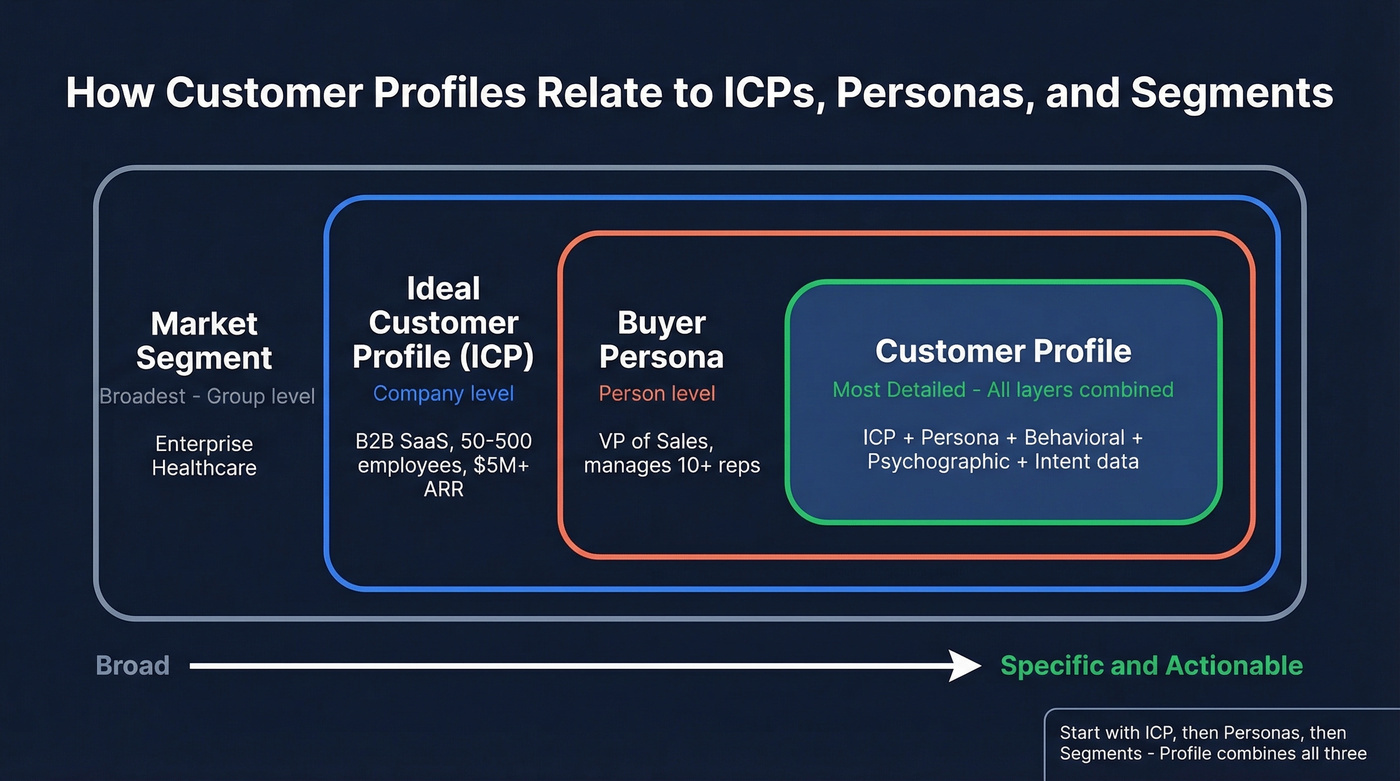
| Term | What It Describes | Scope | Example |
|---|---|---|---|
| ICP | Company type | Org-level | B2B SaaS, 50-500 employees, $5M+ ARR |
| Buyer Persona | Individual decision-maker | Person-level | VP of Sales, 5+ yrs experience, manages 10+ reps |
| Market Segment | Broad group with shared traits | Group-level | "Enterprise healthcare" |
| Customer Profile | Data-rich composite of ideal customer | Detailed | ICP + persona + behavioral + psychographic data combined |
The sequence matters. Define your ICP first - which companies are worth pursuing. Then identify the buying-decision participants within those companies and build personas for each. Finally, identify the market segments where your ICPs cluster. A customer profile is the most detailed artifact in this hierarchy, combining elements from all three.
Types of Customer Profiles
Most guides cover four types and call it a day. That's incomplete for B2B teams in 2026. Here are the six that matter.
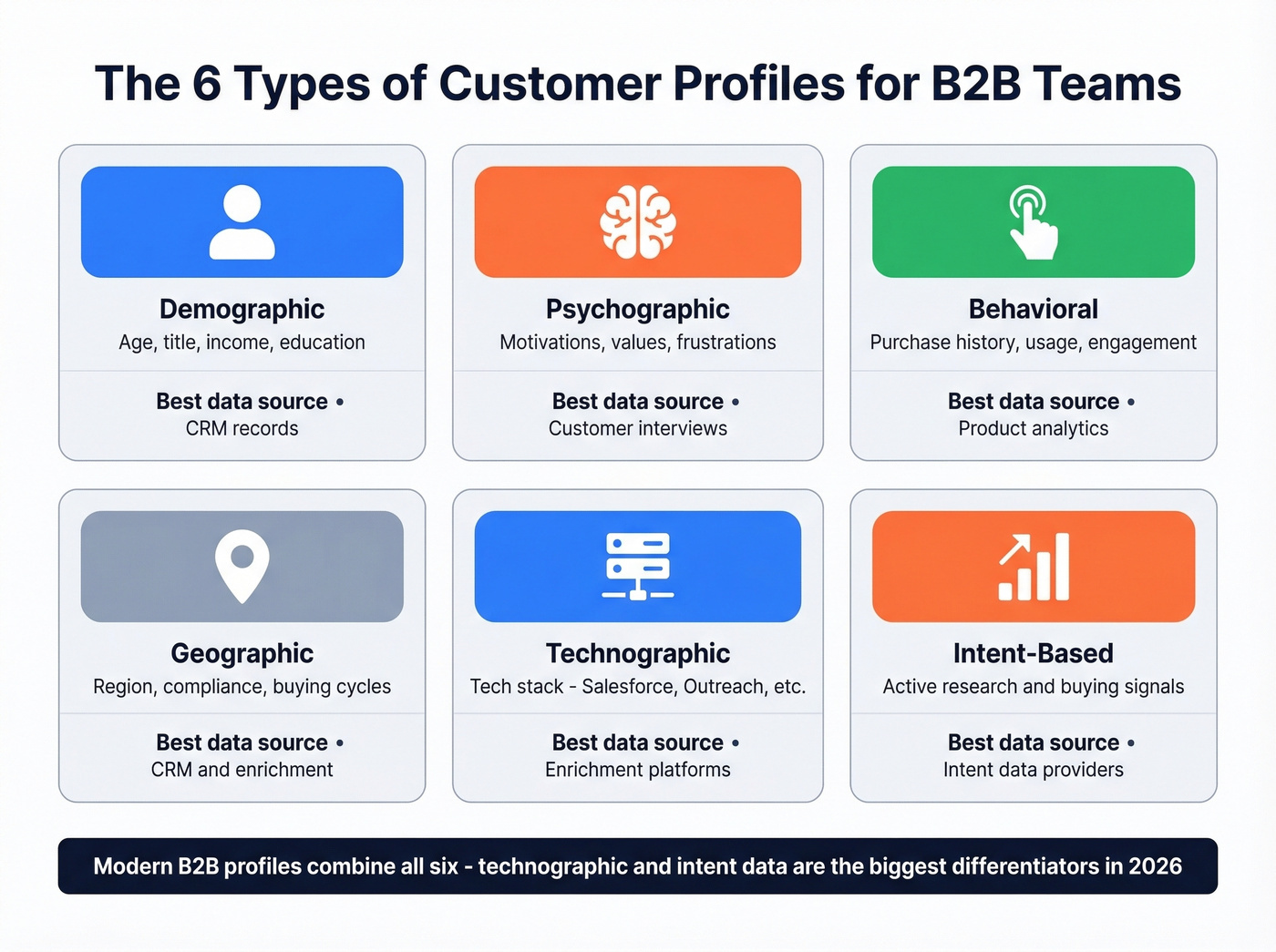
Demographic Profiles
The basics - age, gender, income, education, job title. Table stakes. Every CRM stores this. But demographics alone tell you almost nothing about buying intent.
Psychographic Profiles
Motivations, values, and attitudes. Why does this buyer care about your category? What frustrates them about the status quo? This is where survey data and customer interviews earn their keep.
Behavioral Profiles
What customers actually do - purchase history, engagement patterns, product usage, content consumption. Behavioral data is the most predictive signal you have, because actions don't lie.
Geographic Profiles
These matter more than people think. A SaaS company selling into EMEA has fundamentally different compliance requirements, buying cycles, and decision-making structures than one selling into North America.
Technographic Profiles
This is where modern B2B profiling separates from the generic advice. What's in their tech stack? Are they running Salesforce or HubSpot? Do they use Outreach or Salesloft? Knowing a prospect runs Salesforce plus Outreach tells you they've already invested in outbound infrastructure - which reveals budget, sophistication, and integration requirements that predict fit far better than company size alone.
Intent-Based Profiles
Layer buying signals on top of everything else. A company researching "CRM migration" on G2 and Gartner is signaling active buying intent. B2B profiles without technographic and intent data are flying blind.
How Does Customer Profiling Work?
The process works by combining internal CRM data with external enrichment sources, layering qualitative insights on top, and distilling everything into a scored, actionable document your team uses daily.
Step 1: Audit Your Existing Data
Start with what you already have. Pull 50-100 closed-won deals from the last 12 months and look for patterns. In our experience, 70-80% of wins share three to five traits - industry, company size, tech stack, buying trigger, or deal champion title. Those shared traits are the skeleton of your profile.
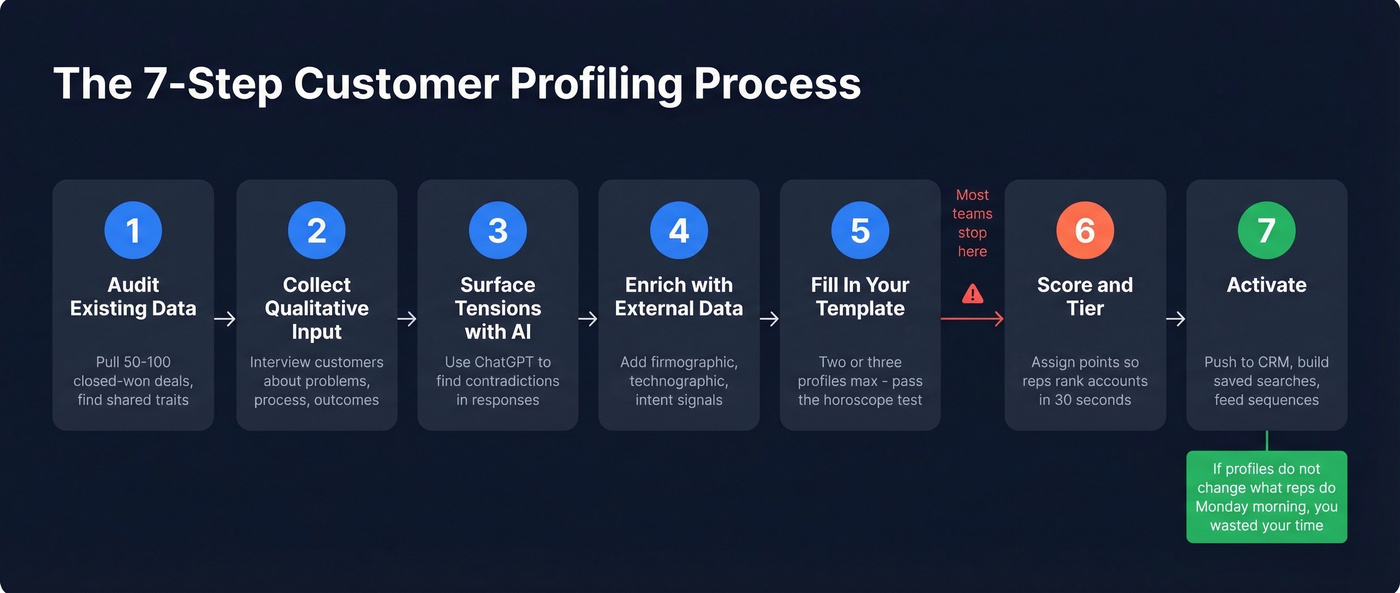
Export your CRM data, sort by deal size and close rate, and highlight commonalities. You're looking for the "of course" patterns that your best reps already know intuitively but nobody's documented.
Step 2: Collect Qualitative Input
Numbers tell you what happened. Conversations tell you why. Interview customers and internal stakeholders using questions grouped around three themes.
About the problem: What's the biggest problem they faced before buying? What's the cost of inaction? What's the biggest mistake they made before finding you?
About the buying process: What obstacles almost stopped them from buying? Who else did they consider? What features mattered most?
About outcomes: What's the biggest result customers get? What's their desired outcome in their own words?
These questions surface the emotional drivers and objections that demographic data never captures.
Step 3: Surface Tensions with AI
Take the qualitative answers from Step 2 and paste them into ChatGPT with this prompt:
"Summarize the motivations, objections, and emotional drivers in these responses. Highlight any contradictions or tensions between what respondents say they want and what they describe doing."
Here's the thing: this method fails when teams give safe, surface-level answers that confirm existing assumptions. The value comes from surfacing friction - the gap between what customers say they want and what they keep doing. If your AI summary reads like your existing marketing copy, you didn't dig deep enough in Step 2.
Step 4: Enrich with External Data
Your internal data has gaps. Every company's does. External enrichment turns a profile into something you can actually target with. Upload a CSV of your best customers to a data enrichment platform, run it against firmographic, technographic, and intent databases, and you'll see patterns in tech stack, company growth, and buying signals that your CRM never captured.
Get creative with enrichment, too. One analytics team we know joined shipping addresses to UK housing transaction data and extrapolated household income as a proxy for spending power. That kind of lateral thinking separates useful profiles from generic ones.
Step 5: Fill In Your Template
Take everything from Steps 1-4 and pour it into a structured template (covered below). Resist the urge to build ten profiles. Two or three is the right number. Each one should be specific enough to fail the horoscope test.
Step 6: Score and Tier
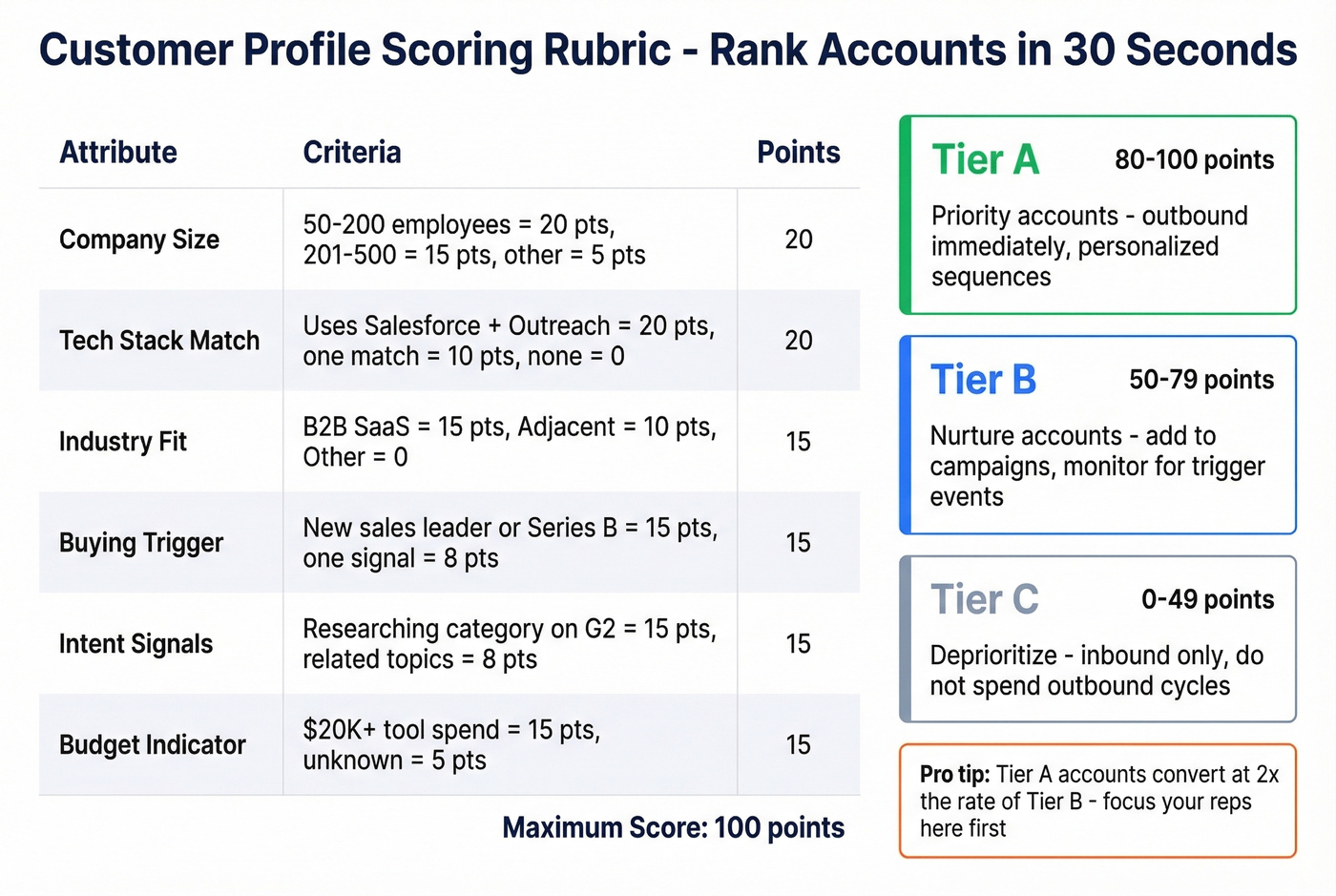
A profile without a scoring system is just a description. Assign point values to each attribute so your team can rank accounts in seconds. Full scoring rubric below.
Step 7: Activate
This is where most profiling efforts die. The profile sits in a Google Doc nobody opens.
Instead, push your scored profiles directly into your CRM. Build saved searches and lead views that surface Tier A accounts first. Feed profile criteria into your outbound sequences. If your profiles don't change what your reps do on Monday morning, you wasted your time.
The r/analytics community flags this exact gap - practitioners build feature-rich customer tables and then hit a wall on what to do next. Activation is the answer.
Customer Profile Templates
B2B Template
| Field | Example Entry |
|---|---|
| Industry | B2B SaaS |
| Company Size | 50-200 employees |
| Geography | North America, UK |
| Decision-Makers | VP Sales, RevOps Lead |
| Pain Points | Low outbound reply rates, stale CRM data |
| Goals | 3x pipeline in 12 months |
| Buying Triggers | New sales leadership, Series B funding |
| Tech Stack | Salesforce, Outreach, Gong |
| Budget Range | $20K-$50K/year for data tools |
| Value Potential | $45K ACV, 18-month LTV |
B2C Template
| Field | Example Entry |
|---|---|
| Demographics | Women, 28-42, household income $80K+ |
| Lifestyle | Health-conscious, values sustainability |
| Geography | Urban, West Coast US |
| Pain Points | Time-poor, overwhelmed by options |
| Goals | Simplify healthy eating |
| Buying Triggers | New Year, post-pregnancy, doctor recommendation |
| Purchase Behavior | Subscribes monthly, avg order $65 |
| Preferred Channels | Instagram, email, podcast ads |
| Price Sensitivity | Medium - pays premium for convenience |
| Value Potential | $780/year, high referral rate |
Worked Example: Profiling in Practice
Here's what this looks like end-to-end. A Series B marketing automation company analyzed 80 closed-won deals and found that 72% shared three traits: the buyer was a VP of Marketing at a SaaS company with 100-500 employees, running HubSpot and Drift, and had recently hired a demand gen manager. They built one profile around this cluster, scored it using the rubric below, and filtered a B2B database for matching accounts. The result: Tier A accounts converted at 2.1x the rate of Tier B, and average deal size jumped 34% because reps stopped wasting cycles on poor-fit companies.
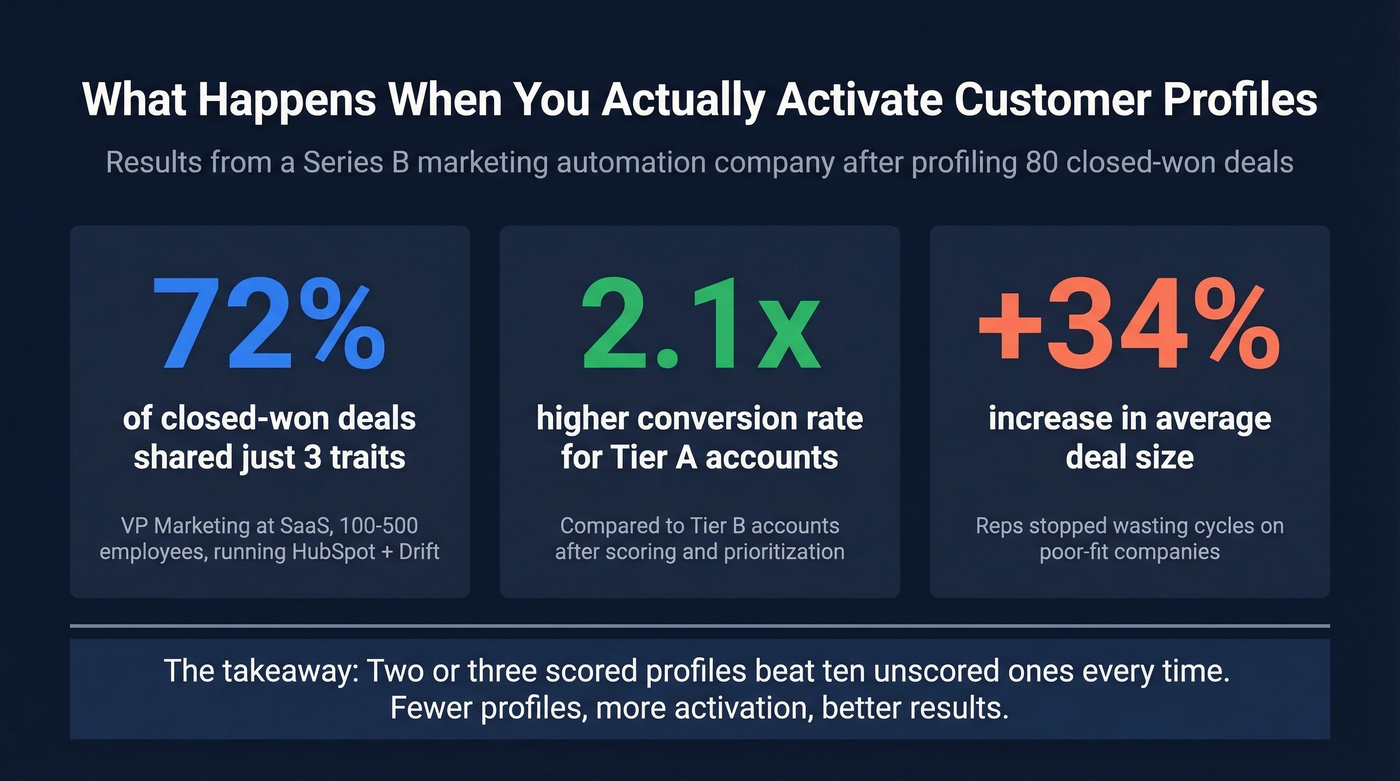
Stop building ten profiles. Start with two or three, prove the model works, then expand.

Your customer profiles are only as good as the data behind them. Prospeo gives you 30+ search filters - technographics, buyer intent, headcount growth, funding, job changes - so every profile maps to real, targetable accounts. Layer in intent data across 15,000 topics to know which companies are actively in-market.
Stop profiling in spreadsheets. Start profiling with live data.
How to Score and Prioritize Profiles
A profile tells you who to target. A scoring rubric tells you who to target first. Build a 100-point ICP scoring model across four categories:
| Category | Weight | Example Criteria |
|---|---|---|
| Firmographics | 30 pts | Industry match (10), size (10), geography (10) |
| Technographics | 25 pts | Uses key tools (15), integration fit (10) |
| Behavioral Signals | 25 pts | Website visits (10), content engagement (10), demo request (5) |
| Trigger Events | 20 pts | New funding (10), leadership change (5), hiring signal (5) |
Set tier thresholds: Tier A is 80-100 points, Tier B is 50-79, Tier C is 0-49. Then validate. Top-performing teams see Tier A win rates 1.5-2x higher than Tier B, with 15-20% shorter sales cycles. In one case study roundup, nurtured leads made purchases 47% larger than non-nurtured leads. If your Tier A accounts aren't converting meaningfully better than Tier B, your scoring criteria need recalibration.
Let's be honest: most teams skip scoring because it feels like extra work. It's not extra work - it's the work that makes everything else efficient. Without scoring, your reps treat every account the same, and your best-fit prospects get the same generic sequence as accounts that'll never close.
One caveat: if your deals typically close under $15K, you probably don't need a 100-point scoring model. A simple three-question checklist - right industry, right size, right tech stack - gets you 80% of the way there. Scoring sophistication should match deal complexity. Don't build a Ferrari scoring system for a bicycle sale.
Benefits of Customer Profiling
Why invest the time? The benefits compound across every revenue function.
Reps stop wasting cycles on poor-fit accounts, focusing outreach on prospects most likely to close. Marketing campaigns get sharper because messaging maps to real pain points instead of generic value props. Customer success teams can predict churn earlier by comparing active accounts against the ideal profile.
Pipeline forecasting improves because conversion rates stabilize when you're consistently targeting the right accounts. Acquisition costs drop - teams that prioritize profiling-driven nurturing cut cost per lead by up to 33% while increasing deal size. And the downstream effect is a feedback loop: better profiles attract better customers, who stay longer and refer more, which gives you richer data to refine your profiles further.
Best Tools for Building Profiles
You don't need a six-figure CDP to build effective profiles. Here's what actually works across budget levels.
CRMs
HubSpot is the default starting point. The free CRM tier handles contact management, deal tracking, and basic reporting. Paid plans start at $50/user/mo. For most teams under 50 people, HubSpot's free-to-mid tier covers profiling needs without much fuss.
Salesforce runs $25-$300/user/mo depending on the plan. It's overkill for early-stage teams but essential once you need deep customization, advanced reporting, and enterprise integrations.
Data Enrichment
Prospeo bridges the gap between knowing your ideal customer and actually reaching them. The platform covers 300M+ professional profiles with 30+ search filters - buyer intent across 15,000 topics powered by Bombora, technographic data, job changes, headcount growth, funding signals, and revenue. Email accuracy sits at 98%, with 143M+ verified emails and 125M+ verified mobile numbers. Data refreshes every 7 days versus the 6-week industry average. Pricing starts free, with paid plans at roughly $0.01 per email - no annual contracts, cancel anytime, and self-serve onboarding with no sales calls required.

UpLead at $99/user/mo offers B2B contact data with email verification. Solid if you need a simpler interface with fewer filters.
Mid-Tier Platforms
Zoho CRM starts at $14/user/mo and handles profiling basics well for budget-conscious teams. Segment starts at $120/mo and works as a go-to CDP for teams that need to unify customer data across multiple touchpoints. Klaviyo with its free tier and paid plans from $20/mo excels at behavioral profiling for e-commerce - purchase patterns, email engagement, and lifecycle segmentation.
Skip These Unless You're Enterprise
Adobe Experience Cloud starts around $2,000/mo. Unless you're managing millions of customer records across dozens of touchpoints, you're paying for complexity you won't use. Pipedrive at $14.90/user/mo and Freshsales at $15/user/mo do the job for small sales teams that need basic contact profiling without CRM bloat.
| Tool | Category | Starting Price | Best For |
|---|---|---|---|
| HubSpot | CRM | Free ($50/user/mo paid) | All-in-one CRM + automation |
| Prospeo | Data Enrichment | Free (~$0.01/email) | Verified prospect lists + intent data |
| Salesforce | CRM | $25/user/mo | Enterprise profiling |
| Zoho CRM | CRM | $14/user/mo | Budget CRM |
| Segment | CDP | $120/mo | Data unification |
| Klaviyo | Marketing | Free ($20/mo paid) | E-commerce profiling |
| Pipedrive | CRM | $14.90/user/mo | Small sales teams |
| UpLead | Data | $99/user/mo | B2B contact data |
| Google Analytics | Analytics | Free | Web behavior tracking |
The article says it: B2B profiles without technographic and intent data are flying blind. Prospeo enriches every contact with 50+ data points at a 92% match rate - tech stack, company signals, verified emails at 98% accuracy - so your profiles translate directly into pipeline, not PowerPoint.
Turn customer profiles into scored, enriched prospect lists in minutes.
How AI Changes Customer Profiling
The practical shift is from static, manually-built profiles to continuously updated ones.
| Dimension | Traditional Profiling | AI-Driven Profiling |
|---|---|---|
| Data ingestion | Manual CRM exports, quarterly | Automated omnichannel, continuous |
| Deduplication | Manual matching, error-prone | Real-time, automated |
| Analytics | Descriptive, backward-looking | Predictive, forward-looking |
| Personalization | Segment-level messaging | Individualized experiences |
The numbers back this up. One case-study roundup attributes AI-powered segmentation with a 77% boost in lead generation ROI and 2.5x higher CTR versus generic efforts. That's not because AI is magic - it's because AI processes behavioral signals at a speed and scale that humans can't match. The next frontier is agentic AI that reduces redundant, outdated, and trivial data while turning unstructured inputs into actionable workflows automatically.
The ethical dimension matters too. Differential privacy frameworks, bias auditing, and transparent data practices aren't optional anymore. AI that ingests biased training data produces biased profiles, which produces biased targeting. Build bias checks into your profiling workflow the same way you'd build QA into your product.
Profiling Mistakes That Kill Results
Treating your ICP as a wishlist. Your ideal customer profile should describe your actual best customers, not the Fortune 500 logos you wish you had. Analyze closed-won deals, not aspirations. If you need a starting point, use an Ideal Customer Profile Template to document assumptions before you validate them.
Waiting for "enough data." You'll never have perfect data. Start with 50 closed-won deals and iterate. Teams that wait for statistical perfection never ship a profile at all.
Relying only on firmographics. Industry and company size are necessary but insufficient. Add technographic data and behavioral signals - firmographics-only profiles miss buying intent entirely. If you want a practical breakdown of what to capture, see firmographic and technographic data.
Building in a marketing bubble. If sales and customer support aren't involved in profiling, you're missing the most valuable qualitative input. Reps know which accounts close fast. Support knows which customers churn. I've watched teams spend months on profiles that their own sales floor ignored because nobody asked the people actually closing deals.
Over-segmenting into micro-groups. Every additional profile requires its own messaging, sequences, and content. If you can't resource the activation, the segmentation is worthless.
Never updating. Profiles go stale. Markets shift. Review every 6-12 months minimum, quarterly if you're in a high-growth market. The 80/20 rule applies: 20% of your customers generate 80% of revenue. Make sure your profiles still describe that 20%.
Creating profiles and never operationalizing them. The r/AskMarketing community calls this out directly - teams produce outputs that sound smart but never change messaging or performance. If it sits in a Google Doc nobody opens, you wasted your time.
Customer Profiling and Data Privacy
A Cisco survey found that 81% of consumers believe how an organization treats personal data reflects how it respects them as customers. Profiling requires data. Data requires trust.
GDPR requires a lawful basis for processing, specific purpose statements, data minimization, granular consent options, and easy withdrawal. Penalties reach EUR 20M or 4% of global turnover.
CCPA/CPRA operates on an opt-out model. Display a "Do Not Sell or Share My Personal Information" link, honor Global Privacy Control browser signals automatically, and define data retention timeframes. Penalties run $7,500 per intentional violation.
These aren't suggestions. Build compliance into your profiling workflow from day one, not as an afterthought.
FAQ
How often should you update customer profiles?
Every 6-12 months minimum, quarterly for high-growth companies. Stale profiles lead to wasted spend on audiences that no longer match your best customers. Set a calendar reminder and re-run your closed-won analysis each cycle.
What's the difference between a customer profile and a buyer persona?
A customer profile is a data-driven composite of ideal customer attributes across firmographic, behavioral, and psychographic dimensions. A buyer persona is a semi-fictional representation of an individual decision-maker. You need both - the profile identifies target accounts, the persona shapes messaging.
How many customer profiles should a company have?
Start with two or three. More than that and none get operationalized - each profile requires dedicated messaging, sequences, and content. Prove the model drives pipeline results first, then expand.
How do you turn a customer profile into a prospect list?
Score your profiles using a weighted rubric, then use a data enrichment platform to filter by matching attributes - industry, company size, tech stack, intent signals - and export verified emails and direct dials. That's the activation step most teams skip.