

7 B2B Lead Generation Case Studies With Actual Numbers
$15,000 in ad spend, 2,000 MQLs, and sales still missed the quarter. Sound familiar? 37.7% of B2B marketers say they're pressured to deliver lead volume regardless of quality - and it's destroying pipeline. The buying cycle changed. AI changed how buyers research. The old playbook of gating a whitepaper and calling it a lead is dead.
Every B2B lead generation case study worth reading proves the same thing: what actually works comes down to sales execution quality and data accuracy, not channel hype.
For context on scale: Belkins analyzed 16.5M cold emails, 20M+ LinkedIn messages, and 5M+ cold calls across their client base. Email alone couldn't carry the load anymore. 88% of B2B teams use email and 97% of social-using teams rely on LinkedIn - but the channel mix matters far less than how well you execute within each one.
2026 B2B Lead Gen Benchmarks
Here's what "good" looks like right now.
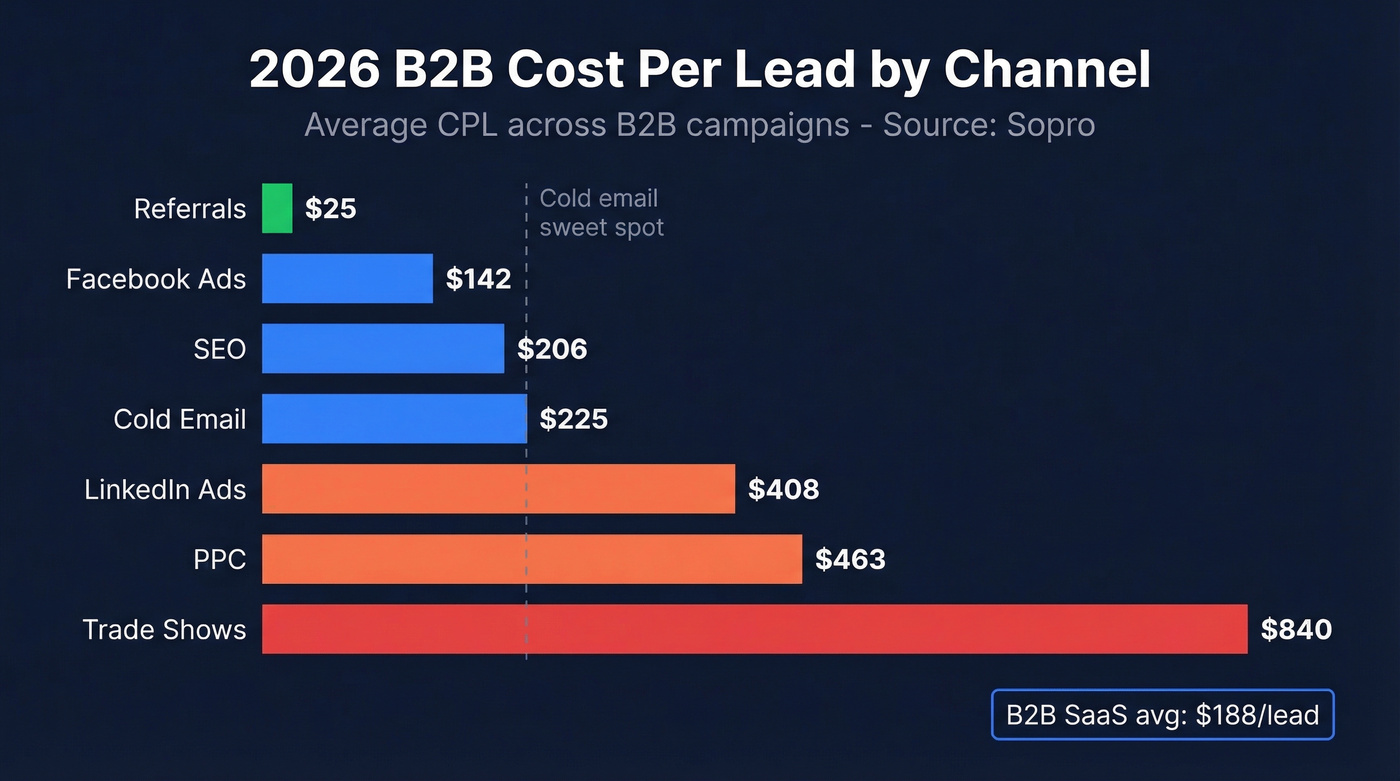
| Channel | Avg CPL |
|---|---|
| Referrals | $25 |
| Facebook Ads | $142 |
| SEO | $206 |
| Cold Email | $225 |
| LinkedIn Ads | $408 |
| PPC | $463 |
| Trade Shows | $840 |
Industry matters just as much as channel. B2B SaaS averages $188 per lead while Legal runs $650. For email outreach specifically, Way2Connect's aggregate across 100+ campaigns puts healthy benchmarks at 36-48% open rates, 6-10% reply rates, and 3-6% lead-to-meeting conversion. Across all channels, Ruler Analytics pegs the average qualified lead conversion rate at 2.9% based on 100M+ data points.
7 Real-World Case Studies
1. Cold Email With Intent Signals (732 Emails, 3 Conversions)
A recruitment agency shared this one on Reddit, and it's one of the most granular B2B lead generation case studies we've come across. Over 4 weeks, they targeted companies showing high-intent signals - active hiring, recent funding, headcount growth - and sent 732 emails with a 1+3 follow-up sequence.
Results: 33 replies (4.2% reply rate), 19 positive replies, 14 call bookings, 3 paid conversions. That 4.2% reply rate looks low against the 6-10% benchmark, but this was a fully cold list with no prior touchpoints. The positive reply ratio of 57.6% is exceptional and speaks directly to targeting quality. Hyper-personalization drives 22%+ more replies than generic outreach, and campaigns like this live or die on whether emails actually land in the inbox. Snyk's outbound team saw their bounce rate drop from 35-40% to under 5% after switching to Prospeo for verified contact data, and AE-sourced pipeline jumped 180%.
2. BoFu SEO Content (3 Posts, 24 Leads)
Concurate published just 3 bottom-of-funnel blog posts for a B2B FinTech client and generated 24 high-intent leads with zero ad spend. The content types: alternatives pages, comparison posts, and best-in-class roundups - the exact formats buyers search when they're close to a decision.
The keyword strategy was surgical. Low-difficulty, high-intent terms like "revenue based financing companies" (search volume 150, keyword difficulty 4) and "capchase competitors" (search volume 20, keyword difficulty 0). Posts ranked #2, #2, and #3.
Here's the thing: 3 BoFu posts targeting buying-intent keywords will outperform 50 top-of-funnel articles almost every time. Most content teams have the ratio backwards.
3. Channel Comparison ($1,300 Normalized Per Channel)
An Econsultancy case study ran one of the cleanest channel tests we've seen - $1,300 normalized spend across Twitter, Facebook, LinkedIn, and two third-party publishers, all promoting the same eBook.
Social channels produced cheap downloads but almost no qualified B2B leads. Publishers and LinkedIn won on qualified CPL by a wide margin. The campaign influenced $50,000+ in pipeline, roughly a 700% first-year ROI.
Cheap leads aren't cheap if none of them convert.
4. Website + SEO Long Game (338% Revenue Increase)
Madison Marketing's work with an FDA consulting firm shows what compounding looks like. By Q2 post-launch versus the prior 1-year quarterly average, leads and SQLs were both up 92%. By Q6, organic traffic had jumped 108%, leads were up 167%, and SQLs had surged 367%.
The long-term numbers are staggering: 2,005% more leads generated per quarter on average, an 89% decrease in CPL, and 412% more website-generated revenue per quarter. By the end of the engagement, average quarterly web-generated sales revenue was up 338%. A key tactical move - they cut ineffective Google Ads spend and reinvested into targeted LinkedIn ads. Not every channel deserves more budget. Sometimes the win is killing what isn't working.
5. Meta Ads Messaging (99 Conversations, 20 Meetings)
"Meta leads are junk" is the default B2B take, and it's usually right. But this campaign for garment manufacturers and healthcare professionals used the messaging objective instead of lead forms, which changes the dynamic entirely.
Total spend: roughly Rs 2,500. Results: 99 conversations, 20 meetings, only 3 junk leads. Cost per messaging conversation was Rs 24.19 - absurdly cheap. The messaging objective acts as a natural filter because people who start a conversation have more intent than people who auto-fill a form. It won't work for every ICP, but if your audience is active on Meta, this is worth a $50 test before you write the channel off.
6. AI-Assisted Community Distribution (70K Views/Post)
A finance SaaS client posted AI-drafted analysis in relevant online communities - not generic promotional content, but genuinely useful analysis tailored to each community's interests. Posts averaged around 70,000 views each. One post reaching 11,000 people generated 7 qualified leads.
The workflow: build a target community list, run a data pipeline to collect relevant inputs, use AI to generate a useful deliverable like an analysis or benchmark, then have a human review and edit before posting. The key insight is worth repeating - use AI to scale value, not volume. The consensus on r/sales is that community members can smell low-effort AI content instantly, and they'll torch your brand for it.
7. Omnichannel Outreach at Scale (Belkins Aggregate)
The Belkins dataset stands out for sheer scale. Across their client base, they tracked 16.5M cold emails, 20M+ LinkedIn messages, and 5M+ cold calls. The takeaway isn't that any single channel dominates - it's that the highest-performing campaigns layered all three.
Cold email drove initial awareness. LinkedIn built familiarity. Phone calls closed the gap. Teams running all three channels together consistently outperformed single-channel teams on qualified pipeline. If you're only doing email, you're leaving pipeline on the table. Skip this approach if your team doesn't have the bandwidth to maintain quality across all three - a mediocre omnichannel play is worse than a great single-channel one.
The Common Thread
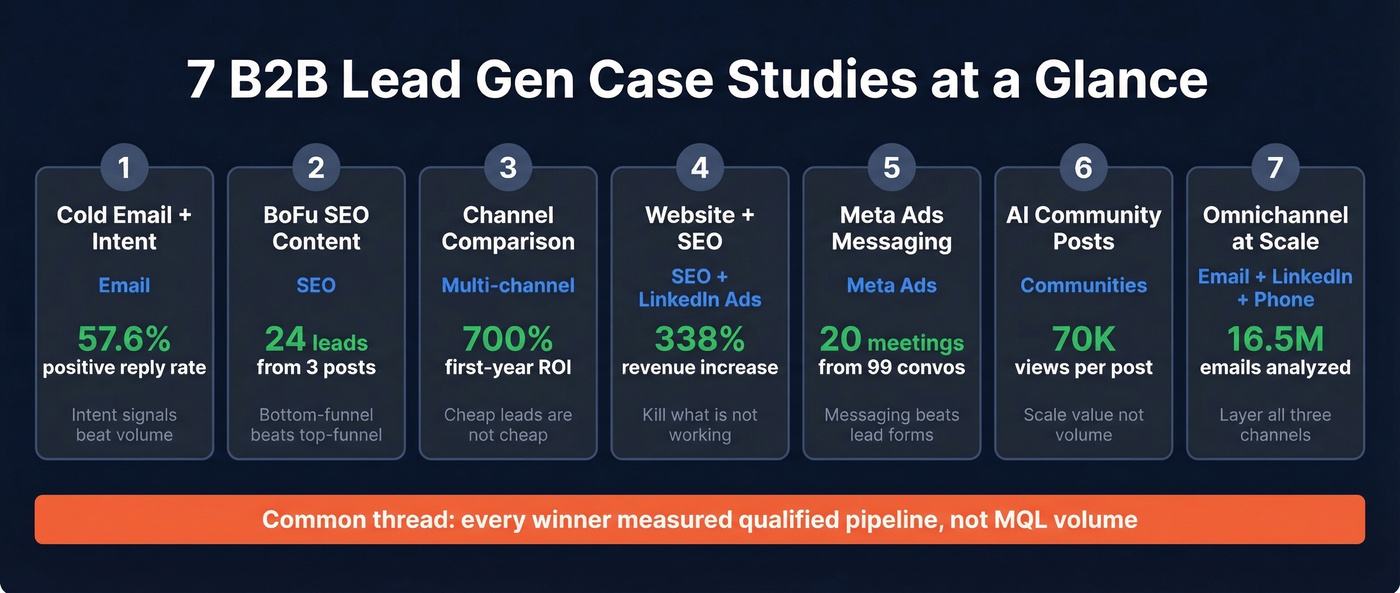
Every winning case study measured qualified pipeline, not MQL volume. Every one started with accurate targeting data - whether that meant intent signals, keyword research, or audience qualification. None relied on a single channel.

Snyk's case study above isn't an outlier. Their bounce rate dropped from 35-40% to under 5% and AE-sourced pipeline jumped 180% - all because verified data reached real buyers. Prospeo's 98% email accuracy and 7-day refresh cycle give every cold email campaign the data foundation these case studies prove matters most.
Stop building campaigns on bad data. Start with 75 free verified emails.
Why Most Lead Gen Programs Fail
Let's be honest about the failure modes we see over and over again in our work with outbound teams.
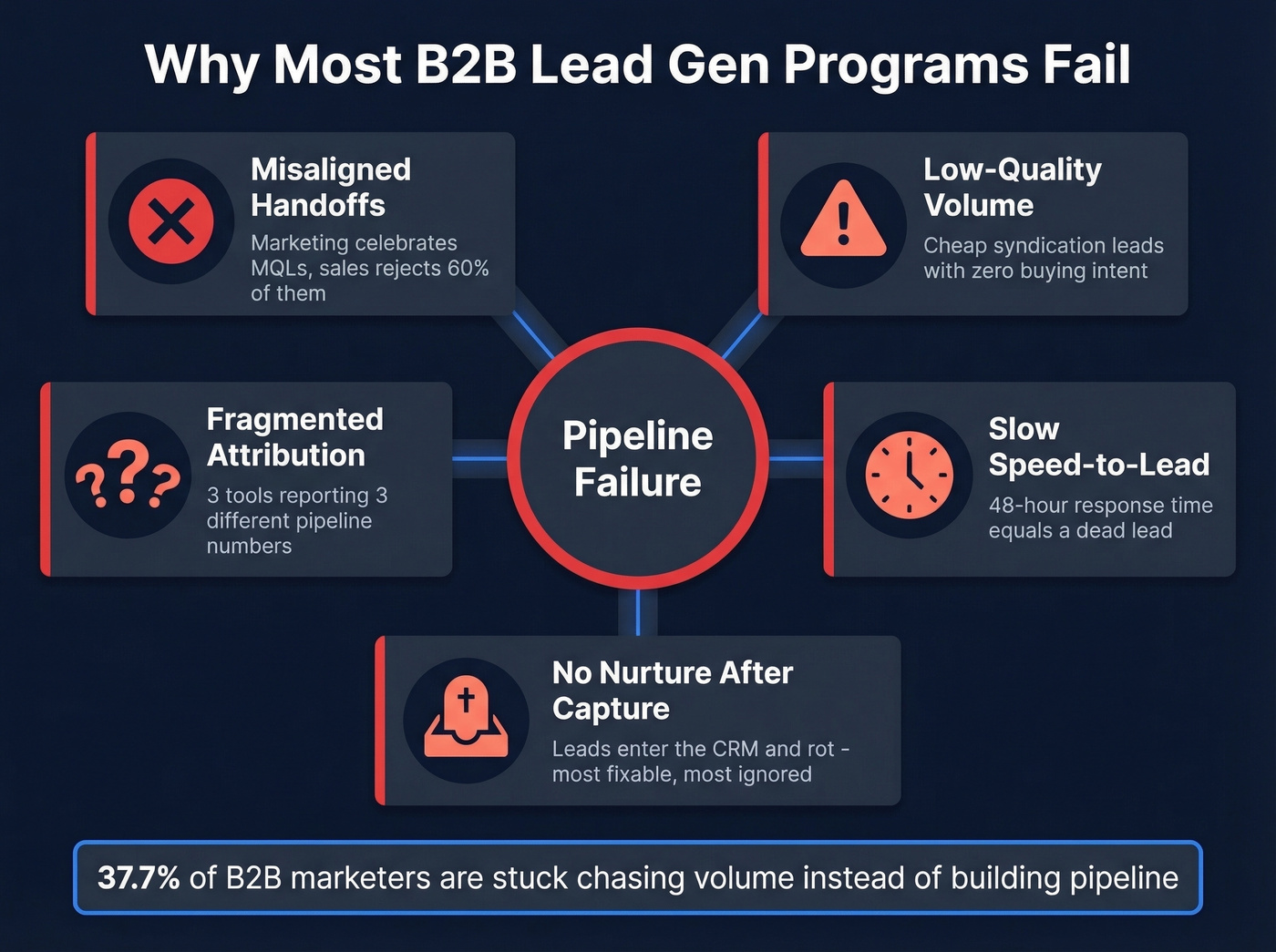
Misaligned handoffs. Marketing celebrates MQLs. Sales rejects 60% of them. Nobody fixes the disconnect, and the finger-pointing becomes a quarterly ritual.
Low-quality placements inflating volume. Cheap syndication partners deliver thousands of "leads" that never had buying intent. We've watched teams burn entire quarters chasing these ghosts.
Fragmented attribution. Contradictory dashboards mean nobody knows what's actually working. One team we spoke with had three different tools reporting three different pipeline numbers for the same campaign.
Slow speed-to-lead. A 48-hour response time on an inbound lead is a dead lead. Period.
No nurture after capture. Leads enter the CRM and rot. No sequences, no retargeting, no follow-up. This is the most fixable problem on the list and the one most teams ignore the longest.
These aren't edge cases. They're the norm - and they're why 37.7% of marketers are stuck chasing volume instead of building pipeline.
Build Your Own B2B Lead Generation Case Study
Every case study above follows the same skeleton: Situation, Trigger, Barrier, Solution, Results. Where was the customer, what forced them to act, what stood in the way, what they did, and what happened.
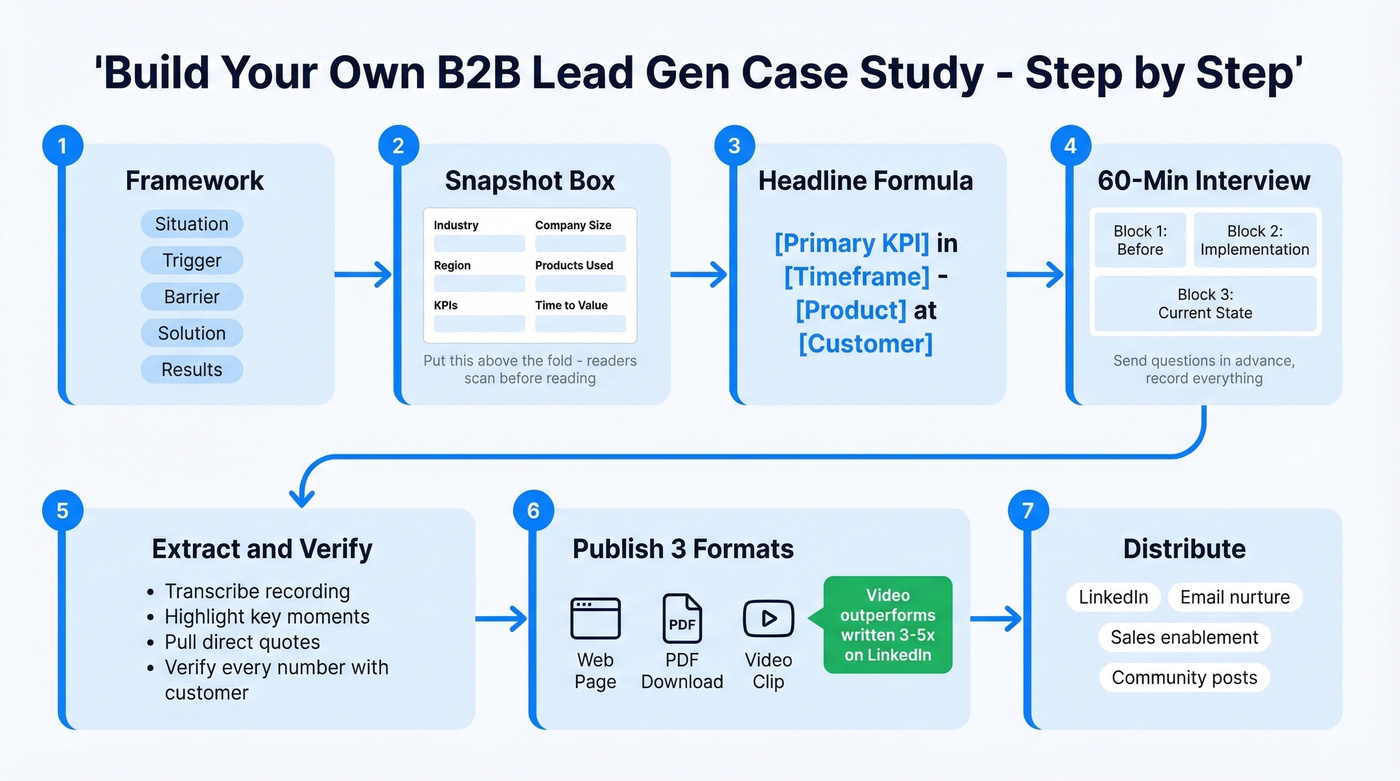
Put a snapshot box above the fold with industry, company size, region, products used, KPIs measured, and time-to-value. Readers scan this before deciding whether to read the full story - if they don't see themselves in the snapshot, they bounce.
For the headline, lead with the outcome: "[Primary KPI] in [Timeframe] - [Product] at [Customer]."
Schedule a 60-minute interview split into three blocks: before, implementation, and current state. Send questions in advance and record everything. Then transcribe, highlight key moments, extract direct quotes, verify every number with the customer, and publish as a web page, downloadable PDF, and short video clip for social. The video clip alone will outperform the written version on LinkedIn by 3-5x in our experience - don't skip it.
The Belkins dataset makes it clear: omnichannel wins, but only when every touchpoint reaches a real person. Prospeo combines 143M+ verified emails and 125M+ verified mobiles with intent signals across 15,000 topics - so you can layer email, LinkedIn, and phone like the top-performing teams in these case studies.
Build your own case study. Verified emails, mobiles, and intent data in one platform.
FAQ
What's a good cost per lead in B2B?
Sopro's benchmarks put SEO at $206, cold email at $225, and LinkedIn ads at $408. B2B SaaS averages $188 per lead while Legal runs $650. Compare your CPL against both your channel and your vertical to set realistic targets.
How many case studies does a B2B company need?
Start with 2-3 covering your top use cases - one per ICP segment is the minimum. A VP of Engineering and a VP of Marketing need different stories. Three detailed case studies with real numbers outperform twenty vague testimonials every time.
What makes a strong lead generation case study?
Real numbers, a clear before-and-after, and specificity. The best examples name the channel, the spend, the timeline, and the qualified pipeline generated - not just vanity metrics like impressions or raw lead counts. Follow the Situation, Trigger, Barrier, Solution, Results structure and let the data do the convincing.
How do you ensure data quality for outbound campaigns?
Bounce rates above 5% tank deliverability and kill campaigns before they start. Use a provider with real-time verification - Prospeo's 5-step process delivers 98% email accuracy on a 7-day refresh cycle, compared to the 6-week industry average. Stack Optimize built to $1M ARR while keeping client bounce rates under 3% using this approach.