

B2B Marketing Automation: Strategy, Platforms, and What Actually Works in 2026
You ran your first automated nurture campaign last quarter. Open rates looked great - 28%, maybe 32% on the best segment. Pipeline impact: zero. Sales didn't follow up on half the MQLs, and the other half turned out to be students downloading your ebook for a class project.
That's not a software problem. That's a strategy problem amplified by B2B marketing automation.
This category of software orchestrates demand generation at scale - lead capture, scoring, nurture sequences, multi-channel engagement, and attribution - so marketing can systematically feed qualified pipeline to sales. When it works, it's a compounding engine. When it doesn't, it compounds mistakes just as efficiently.
What You Need Before Evaluating Platforms
Before you look at a single vendor demo, nail three things:
Strategy first. Define your MQL and SQL criteria. Write down the exact handoff rules between marketing and sales. If you can't explain in one sentence what makes a lead "sales-ready," you aren't ready for automation.
Clean your data. Automation amplifies whatever you feed it - garbage in, garbage out at scale. Run your database through a verification tool like Prospeo before building a single workflow. Stale emails and wrong job titles will tank every sequence you build.
Match platform to team size. Enterprise orgs with dedicated marketing ops should look at Marketo or Salesforce Account Engagement. Mid-market teams do well with HubSpot Professional or ActiveCampaign. SMBs can start with ActiveCampaign or Mailchimp.
Get those right and the software choice becomes a lot less stressful.
What Marketing Automation Actually Does
A modern B2B MAP handles six core functions:
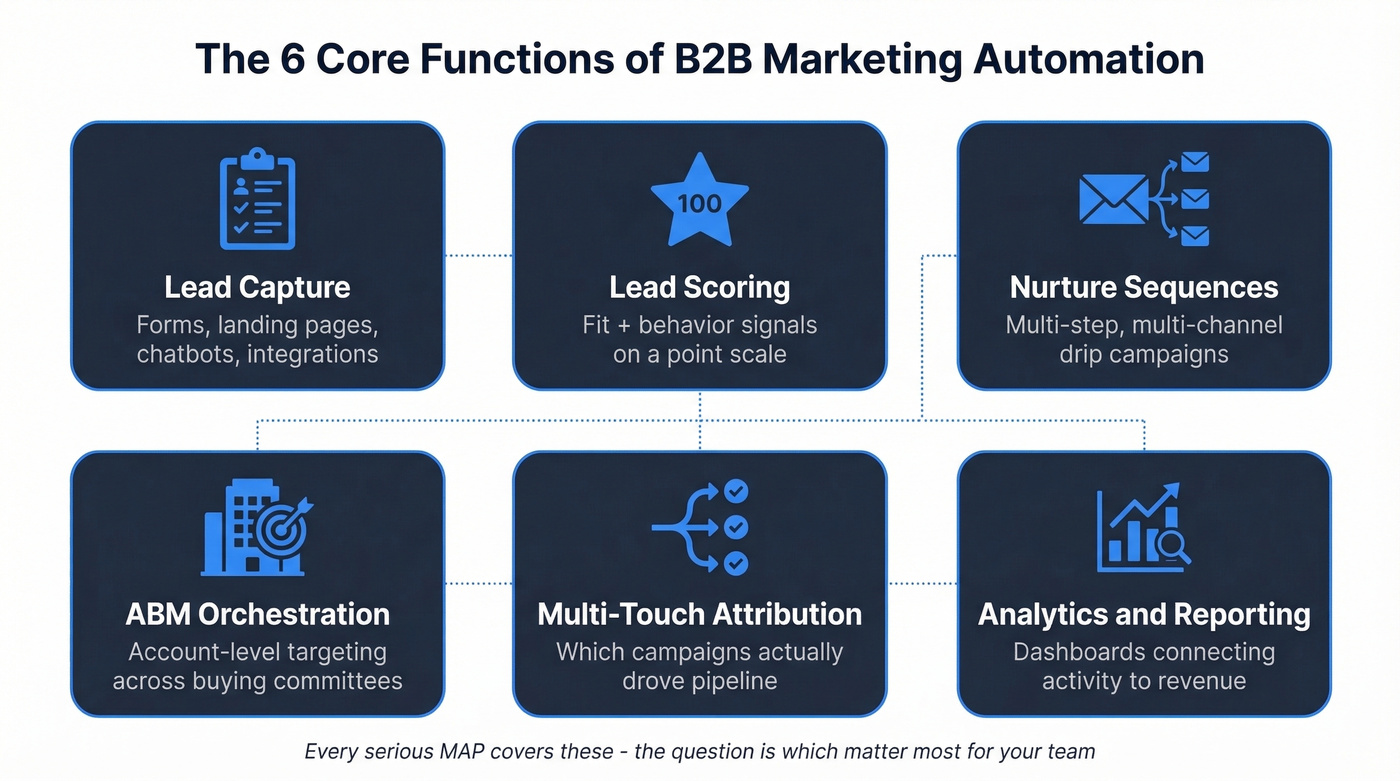
- Lead capture - forms, landing pages, chatbots, and third-party integrations that pull contacts into your system
- Lead scoring - assigning point values based on fit (job title, company size) and behavior (pricing page visits, content downloads)
- Nurture sequences - multi-step, multi-channel campaigns that move leads through the funnel with relevant content at each stage
- ABM orchestration - account-level targeting that coordinates touches across buying committees, not just individual contacts
- Multi-touch attribution - tracking which campaigns and channels actually influenced pipeline and revenue
- Analytics and reporting - dashboards connecting marketing activity to revenue outcomes so you can prove ROI and optimize spend
Every serious MAP covers this framework. The real question is which capabilities matter most for your team size, sales cycle, and budget.
Why Strategy Comes Before Software
Here's the thing: the majority of marketing leads never convert to sales. That gap isn't a technology failure. It's a strategy failure.
The most common version of this problem is the MQL definition. If your MQL definition is "downloaded one ebook," of course sales ignores it. That's not a qualified lead - that's someone who wanted a PDF. A real MQL definition combines fit criteria (right title, right company size, right industry) with behavioral signals like pricing page visits, demo webinar attendance, and engagement with bottom-of-funnel content.
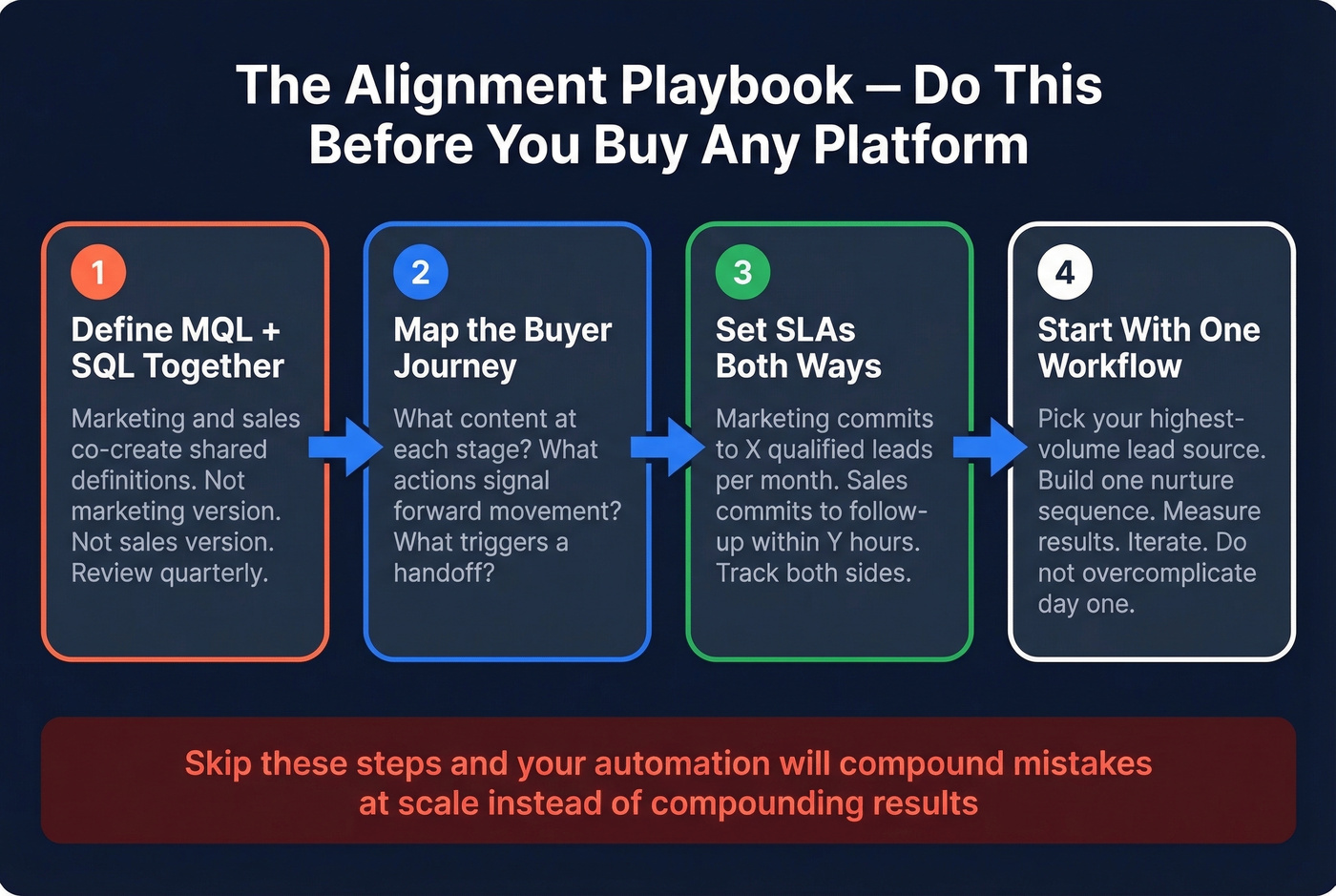
Before you buy anything, build this alignment playbook:
Define MQL and SQL criteria jointly with sales. Not marketing's version. Not sales' version. A shared definition both teams sign off on, reviewed quarterly. Then map your buyer journey stages - what content does a prospect consume at each stage, what actions signal forward movement, and what triggers a handoff?
Agree on SLAs too. Marketing commits to X qualified leads per month. Sales commits to following up within Y hours. Track both sides.
And start with one workflow. Pick your highest-volume lead source, build one nurture sequence, measure results, iterate. We've seen teams spend three months evaluating platforms when they haven't even agreed on what a qualified lead looks like. Overcomplicated workflows on day one cause errors and make debugging a nightmare. The platform doesn't matter if the strategy is broken.
How to Build a Lead Scoring Model
Lead scoring is where automation earns its keep - or where it falls apart. A good model separates the students downloading your ebook from the VP of Engineering who just visited your pricing page three times this week.
If your average deal size is under $10K, you probably don't need a complex scoring model. A simple two-tier system (engaged vs. not engaged) will outperform a 100-point model that nobody maintains. Save the sophistication for deal sizes that justify it.
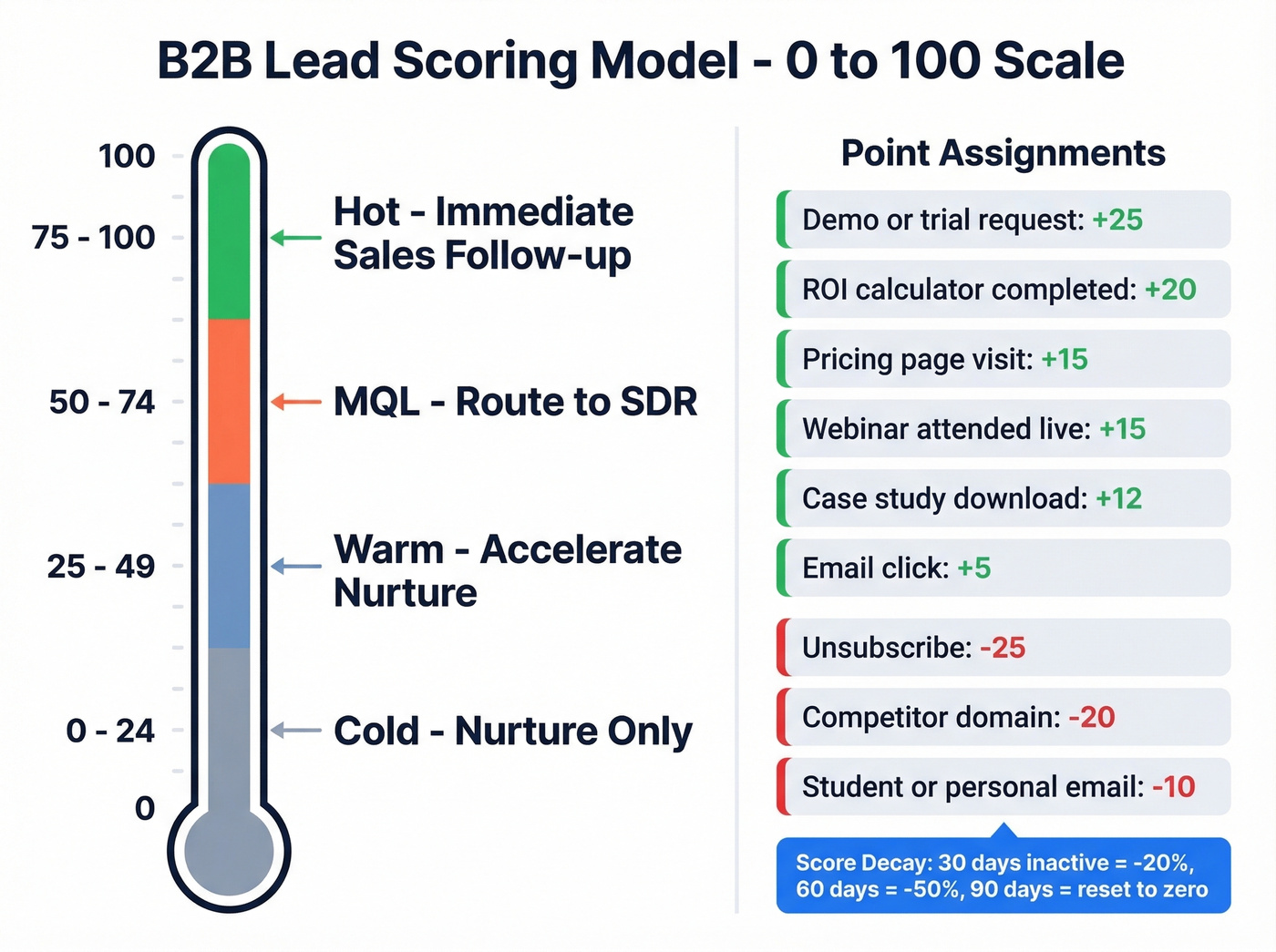
For teams that do need a full model, use a 0-100 point scale with clear bands:
| Score Range | Label | Action |
|---|---|---|
| 0-24 | Cold | Nurture only |
| 25-49 | Warm | Accelerate nurture |
| 50-74 | MQL | Route to SDR |
| 75-100 | Hot | Immediate sales follow-up |
Weight scoring across four categories: Demographic fit (30 points max), Role fit (20 points max), Behavioral engagement (35 points max), and Sales activity (15 points max). The behavioral bucket carries the most weight because actions reveal intent better than titles do.
Point assignments that work well in practice: pricing page visit (+15), demo or trial request (+25), ROI calculator completed (+20), case study download (+12), webinar attended live (+15, registered but no-show: +5), email click (+5), unsubscribe (-25), competitor domain (-20), personal or student email (-10).
Score decay matters just as much as accumulation. A lead who was hot 90 days ago and has gone silent isn't hot anymore. At 30 days of inactivity, reduce behavioral score by 20%. At 60 days, reduce by 50%. At 90 days, reset behavioral score to zero and move to re-engagement. At 180 days, archive or suppress.
Enterprise teams are also moving beyond individual MQLs toward buying-group qualification - tracking engagement across entire committees rather than single contacts. If your sales cycle involves 5+ stakeholders, score at the account level, not just the contact level.

You just read it: automation amplifies whatever you feed it. Prospeo's 5-step email verification delivers 98% accuracy, and our 7-day data refresh means your nurture sequences hit real inboxes - not dead ends. Enrich your entire CRM with 50+ data points per contact at 92% match rate.
Fix the data before you automate the mistakes.
Best Platforms in 2026
The 2026 Gartner Magic Quadrant for B2B Marketing Automation Platforms includes Oracle as a Leader, and industry summaries of the Leaders group commonly list Salesforce, Adobe, HubSpot, and Oracle alongside it. Leaders are Leaders for a reason - they're also priced like Leaders.
| Platform | Best For | Peer Rating | Starting Price | Key Strength |
|---|---|---|---|---|
| Marketo Engage | Enterprise orchestration | 4.4/5 (599 reviews) | From $895/mo | Multi-channel ABM |
| Salesforce Acct. Engagement | Salesforce shops | 4.2/5 (694 reviews) | $1,250/mo | CRM-native |
| HubSpot Marketing Hub | Mid-market growth | 4.4/5 (2,180 reviews) | $20/mo (Starter) | Ease of use |
| ActiveCampaign | Value-conscious teams | N/A | $49/mo (Plus) | Price-to-feature ratio |
| Oracle Eloqua | Large enterprise | 4.4/5 (256 reviews) | Custom ($30K-$100K+/yr) | Complex journeys |
| Zoho CRM | Budget mid-market | 4.3/5 (831 reviews) | Varies by edition | All-in-one suite |
Enterprise Tier
Marketo Engage is the gold standard for enterprise orchestration. Multi-channel campaigns, sophisticated ABM, revenue attribution - it does everything. But if you don't have a dedicated marketing ops person, you'll use 20% of what you're paying for. Annual commitments run $15K-$100K+ depending on database size, and implementation costs $10K-$50K+ through a partner. These platforms are built for organizations managing complex, multi-division buyer journeys with dedicated ops teams - not for lean startups looking for a quick win.
Salesforce Account Engagement (formerly Pardot) makes sense if you're already deep in the Salesforce ecosystem. The CRM integration works out of the box because it's the same company, with entry at $1,250/mo billed annually. The tradeoff: it's less flexible than Marketo for non-Salesforce workflows.
Oracle Eloqua targets large enterprises running complex, multi-stage buyer journeys across global teams. Expect annual contracts in the $30K-$100K+ range. Powerful but heavy.
Mid-Market: HubSpot vs. ActiveCampaign
This is where most teams land, and the choice comes down to one question: do you value ecosystem or value?
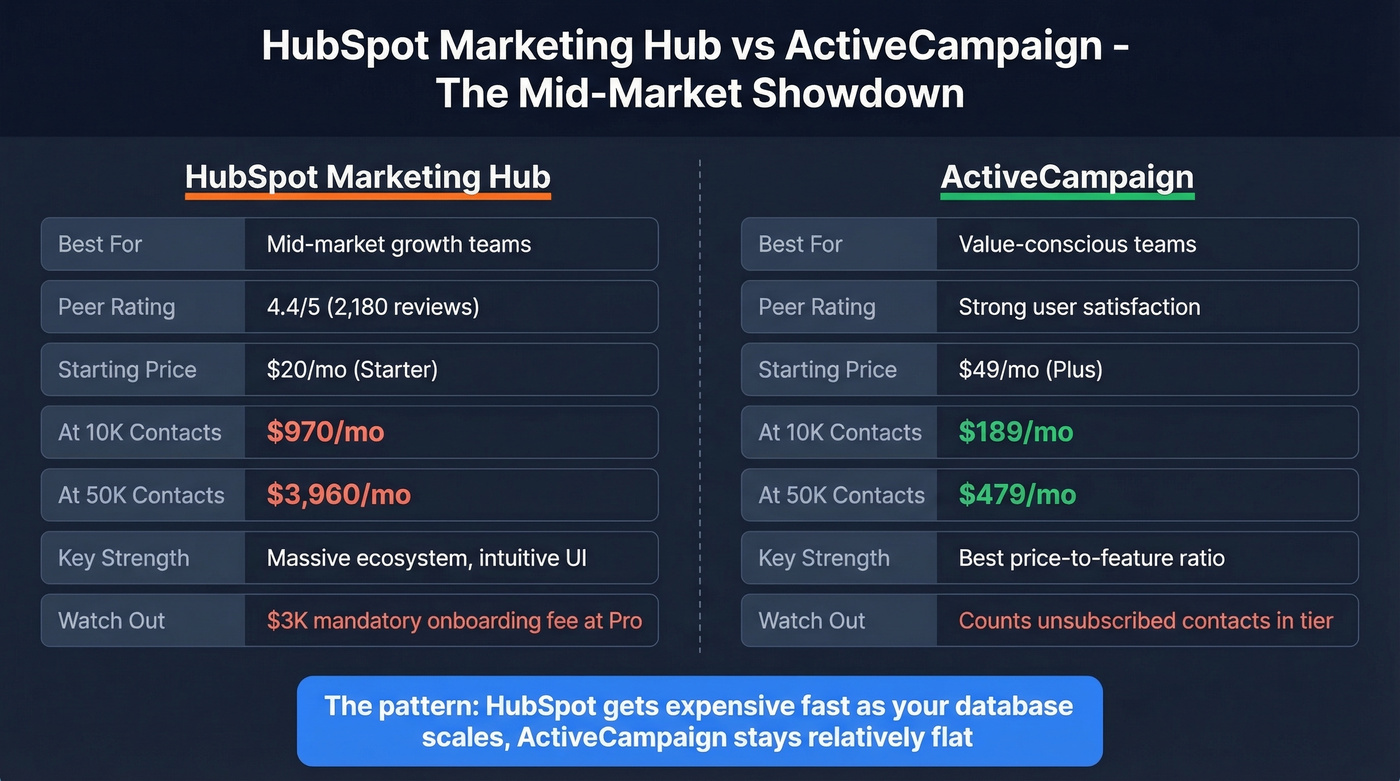
HubSpot Marketing Hub is the default mid-market choice, and for good reason. The UI is intuitive, the ecosystem is massive, and 2,180 peer reviews averaging 4.4/5 reflect genuine user satisfaction. The catch: most teams outgrow Starter in six months and get sticker shock on Professional. Starter at $20/mo doesn't include multi-step workflows - the real automation starts at Professional, and the normalized cost at 10K contacts is $970/mo with a mandatory $3,000 onboarding fee.
ActiveCampaign is the value pick, and it's not close. At $49/mo for 1K contacts on the Plus plan, it delivers lead scoring, multi-step automations, and CRM functionality at a fraction of HubSpot Professional's cost. At 50K contacts, you're paying $479/mo - compare that to HubSpot's $3,960/mo at the same scale. One caveat: ActiveCampaign counts unsubscribed contacts toward your tier, so prune regularly.
SMB / Startup Tier
Skip this tier if you're generating more than 500 leads per month - you'll outgrow it within a quarter. Mailchimp starts at $10/mo and offers a free plan but lacks real scoring. Brevo (formerly Sendinblue) offers a free tier and paid plans from about $9/mo. GetResponse starts at $15.60/mo on annual billing and includes landing pages and webinar hosting, which is unusual at this price point.
What It Actually Costs
The "starting at" numbers on vendor websites are designed to get you in the door. Here's what you'll actually pay as your database grows:
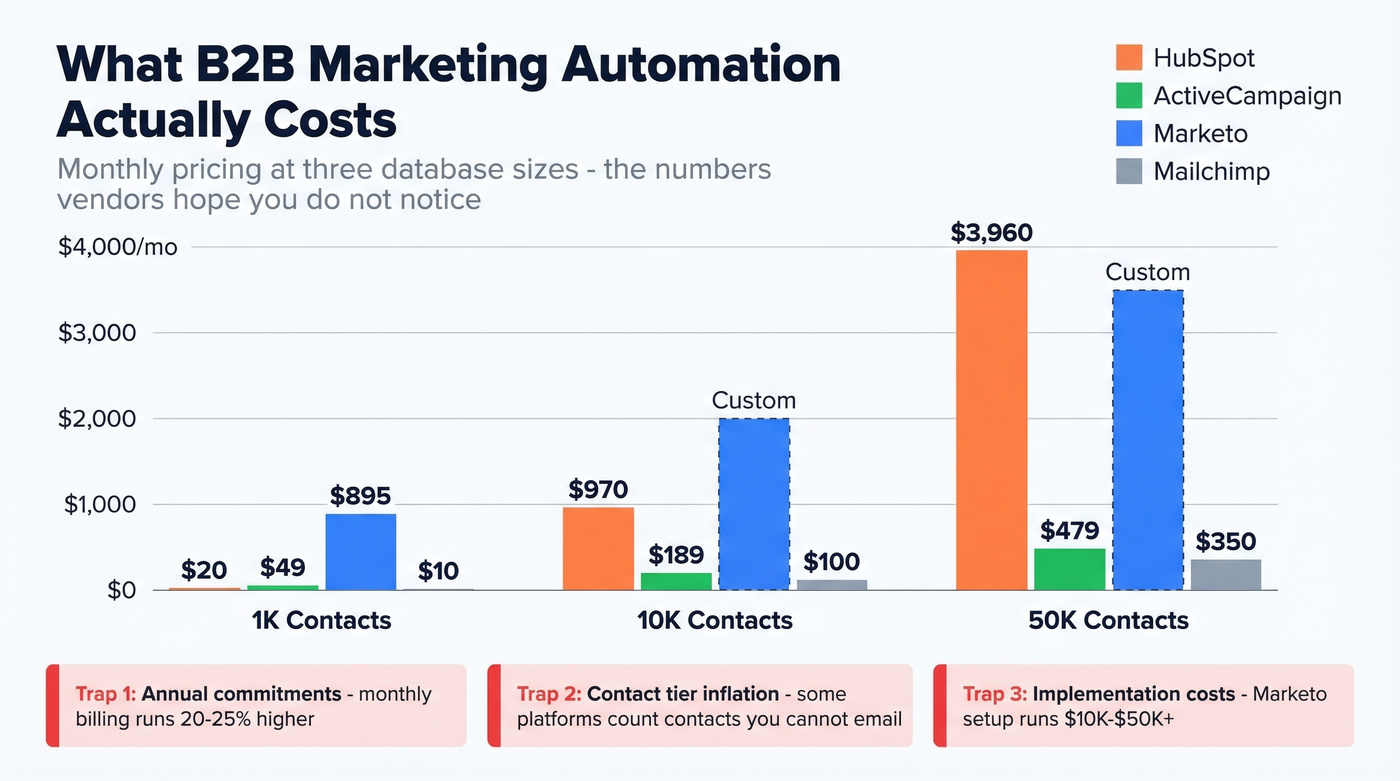
| Platform | 1K Contacts | 10K Contacts | 50K Contacts | Watch Out For |
|---|---|---|---|---|
| HubSpot | $20/mo | $970/mo | $3,960/mo | $3K onboarding (Pro) |
| ActiveCampaign | $49/mo | $189/mo | $479/mo | Counts unsubscribes |
| Marketo | From $895/mo | Custom | Custom | $10K-$50K+ setup |
| Salesforce AE | $1,250/mo | $1,250/mo+ | Custom | Annual commitment |
| Mailchimp | $10/mo | ~$100/mo | ~$350/mo | Limited automation |
The pattern is clear: HubSpot gets expensive fast as your database scales, while ActiveCampaign stays relatively flat.
Three cost traps to watch for. First, annual commitments - most enterprise and mid-market platforms require 12-month contracts, and the discount for annual billing is often baked into the "starting at" price. Monthly billing runs 20-25% higher. Second, contact tier inflation - your database grows, your bill grows, and some platforms count contacts you can't even email. Third, implementation costs - Marketo implementations routinely run $10K-$50K+ through certified partners, and even HubSpot's Professional tier requires a $3,000 mandatory onboarding fee.
The AI Shift in 2026
The real question isn't "should we use AI?" It's "how autonomous should we let it get?"
Automated customer interactions via AI agents are projected to grow from 3.3 billion in 2025 to 34 billion+ by 2027. That's not incremental growth - that's a category transformation.
Daily AI usage among knowledge workers increased 233% in six months per the Slack Workforce Index, with daily users reporting 64% higher productivity. But only about a third of B2B organizations have implemented agentic AI at scale. The gap between early adopters and everyone else is widening fast.
What's actually changing: the shift from copilots to autonomous orchestration. Salesforce's Agentforce and Einstein are early examples - AI that doesn't just suggest next steps but executes them. Build a campaign, route leads, adjust send times, reallocate budget across channels. Even the Leaders in this space are balancing AI investments with core demand gen improvements - AI augments the fundamentals, it doesn't replace them.
Integration protocols like MCP (Model Context Protocol) are emerging to standardize how AI agents access marketing tools and data. Expect this to become a platform selection criterion by late 2026. And as AI takes on more execution, human QA becomes more important, not less. Review AI-generated campaigns before they ship.
The privacy dimension matters too. With third-party cookies largely phased out, the competitive advantage shifts to zero-party and first-party data. Teams that invested in building their own verified contact databases are now better positioned for AI-driven personalization than those relying on third-party data brokers.
Mistakes That Kill Automation ROI
Dirty data. The #1 killer and it's not close. Duplicate records, outdated job titles, invalid emails - automation amplifies all of it. One team we worked with discovered a small form-field change had silently broken an automation connection and lost dozens of leads before anyone noticed.
Set-and-forget mentality. Building a workflow and walking away is like planting a garden and never watering it. Review and optimize quarterly at minimum.
Automated follow-ups that feel obviously automated. A Zapier case study documented teams whose post-webinar follow-ups were so clearly templated they hurt the brand more than they helped. Automate the list sync and initial thank-you, but keep the real follow-up human-written.
UTM overwrites breaking attribution. Auto-adding UTM parameters without conditional logic can overwrite existing parameters and destroy your attribution data. Always check if UTMs already exist before appending.
Skipping deliverability basics. If you haven't configured SPF, DKIM, and DMARC for your sending domain, your nurture sequences are landing in spam. The consensus on r/emailmarketing is that authentication issues cause more deliverability problems than content ever does.
No CRM integration. If your MAP and CRM aren't synced, you're creating data silos that guarantee sales-marketing misalignment. Configure this before you launch your first campaign.
Choosing the Right Tools for Your Stack
Let's be honest: every guide on this topic assumes you already have clean data. Most B2B teams don't have an automation problem - they have a data quality problem. Industry benchmarks suggest B2B contact databases decay at roughly 30% per year as people change jobs, companies merge, and email addresses go stale. If you're automating on a database you haven't verified in six months, a meaningful chunk of your workflows are targeting ghosts.
The MAP is only one piece of the stack. You also need a verified data source feeding it and a CRM capturing the output. The best setup connects all three layers - data, automation, and CRM - without manual CSV exports bridging the gaps.
Before you build a single workflow, run your contact database through a verification and enrichment tool. Prospeo verifies emails with 98% accuracy and enriches records with 50+ data points on a 7-day refresh cycle, which means your scoring models and nurture sequences are working with current information rather than six-month-old snapshots. If you're comparing vendors, start with data enrichment services and work backward into your MAP requirements.
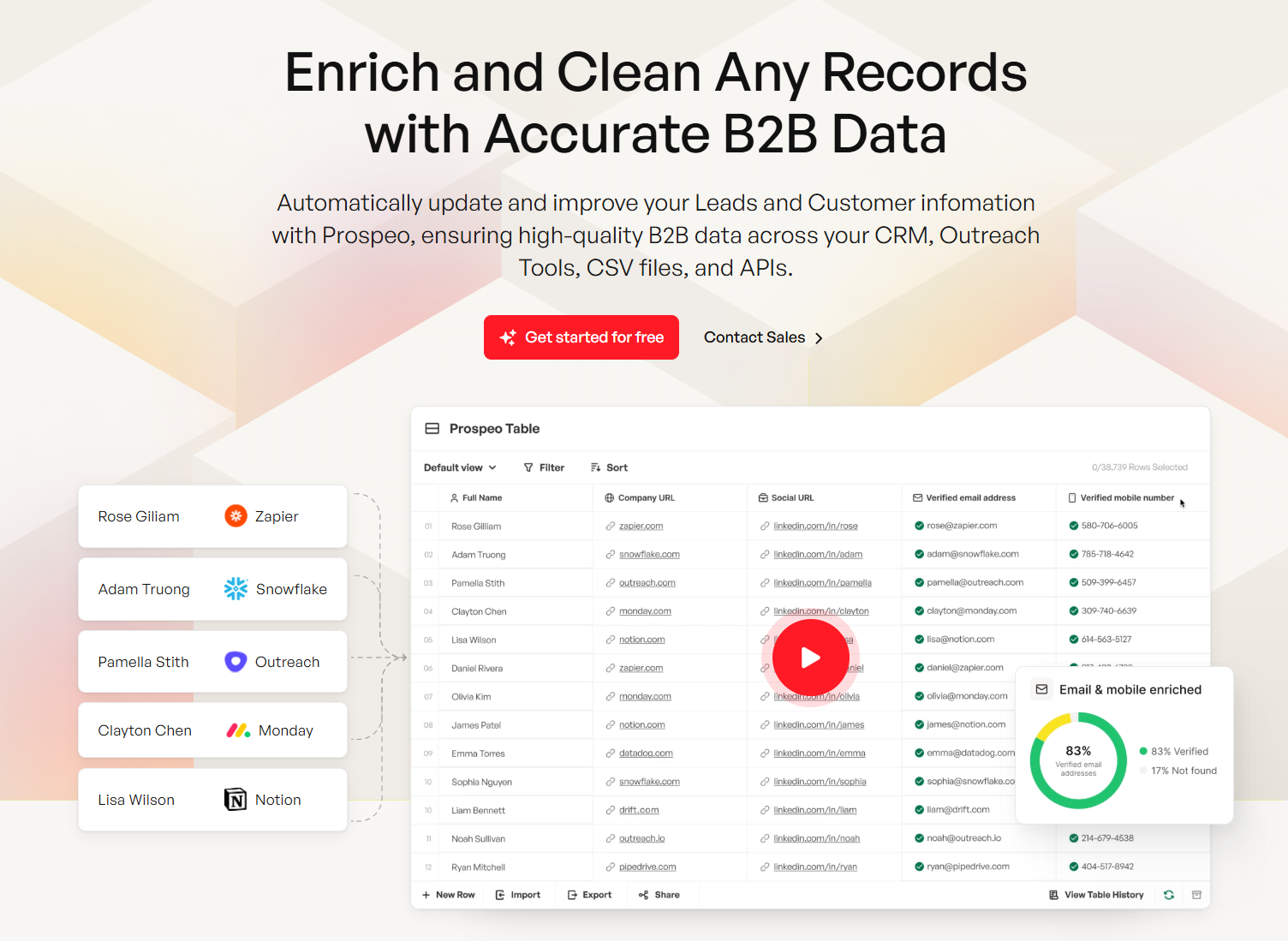
Clean data means higher deliverability, more accurate lead scoring, better segmentation, and fewer wasted sales touches. Dirty data means bounced emails, misrouted leads, and a sales team that stops trusting marketing's output. Fix the foundation before you build the house. For a deeper scoring framework, see our lead scoring guide.
Lead scoring only works when job titles, company data, and emails are accurate. Prospeo gives you 300M+ verified profiles with 30+ filters - including buyer intent, technographics, and headcount growth - so your scoring model reflects reality, not stale CRM records.
Score leads on real data, not last year's spreadsheet.
FAQ
What's the difference between marketing automation and CRM?
CRM stores contact records and tracks deals. Marketing automation orchestrates campaigns - email sequences, scoring, nurture workflows - that feed qualified leads into the CRM. Most teams need both, connected via native integration or middleware like Zapier.
How long does implementation take?
SMB tools take days. HubSpot Professional needs 4-8 weeks including mandatory onboarding. Enterprise platforms like Marketo or Eloqua need 60-90 days minimum, often with $10K-$50K+ in implementation costs through certified partners.
What's the minimum team size to justify it?
Even a solo marketer benefits from basic automation. The real question is lead volume - most tools become worthwhile above 500 new leads per month, where manual follow-up becomes physically impossible.
How do I keep contact data clean for automation?
Validate emails before they enter your workflows, remove duplicates quarterly, and suppress contacts inactive for 180+ days. Data hygiene is ongoing, not a one-time project.
Is marketing automation the same as email marketing?
No. Email marketing is one channel. B2B marketing automation orchestrates the full buyer journey - scoring, multi-channel nurture, CRM sync, attribution, ABM - with email as one component alongside ads, landing pages, and sales handoffs.