

The 9 B2B Marketing Channels That Actually Drive Pipeline in 2026
Only 15% of marketing leaders are satisfied with their channel ROI. That means 85% of B2B marketing teams are pouring real money into channels that aren't pulling their weight - and the problem isn't a lack of options. It's that most teams spread budget across too many of them and end up mediocre at everything.
Marketing budgets flatlined at 7.7% of company revenue through 2025, and 59% of CMOs say that's not enough to execute their strategy. Here's the thing: teams focused on 3-5 channels consistently outperform those running 10+. Concentration beats dilution when budgets are tight.
The Short Version
If you're building a channel stack from scratch, start here:
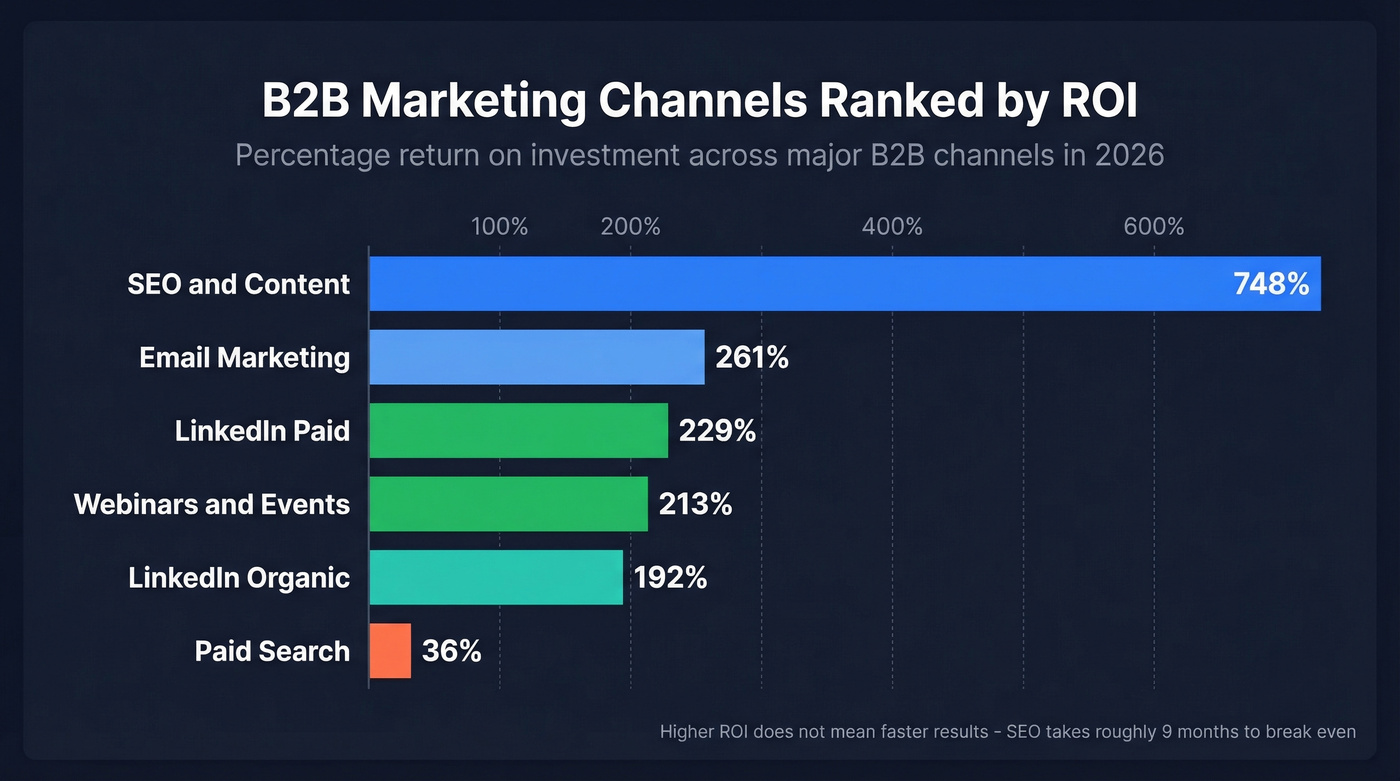
- SEO & content marketing - 748% ROI, roughly 9-month break-even. Best long-term pipeline channel by a wide margin.
- Email marketing - 261% ROI, roughly 7-month break-even. Fastest path to measurable pipeline if your contact data is clean.
- LinkedIn (organic + paid) - 2.74% visitor-to-lead conversion rate, about 4x what Twitter and Facebook deliver.
Add paid search when you need pipeline this quarter, not next year. Add webinars when your average deal size justifies the cost per attendee. Everything else is noise until these four are working.
If your average deal is under $15K, you probably don't need more than three of these channels. Most pipeline problems aren't channel problems - they're focus problems.
Best B2B Marketing Channels Ranked by ROI
SEO & Content Marketing
SEO delivers 748% ROI over three years with a 9.1 ROAS - the highest of any channel by a wide margin. The catch is patience: expect roughly 9 months before you break even. That timeline scares off teams with quarterly pressure, which is exactly why it compounds so well for those who stick with it.
Organic search accounts for 26% of total website traffic in Contentsquare's 2025 benchmark, making it one of the biggest non-paid traffic sources for most B2B sites. Small businesses are 23% more likely to see ROI from blog content specifically, while enterprises are 24% more likely to see ROI from ebooks. The teams winning right now build content that answers specific questions with data, not generic thought leadership written by committee.
When evaluating SEO vs PPC for B2B, the answer is usually both - SEO for compounding returns, PPC for immediate demand capture. We've found that the AI disruption angle is real (more on that below), but SEO isn't dying. It's evolving.
Email Marketing
Email's 261% ROI and 7-month break-even make it the best balance of speed and return for most B2B teams. The channel converts at 2.4% on average - behind only referral traffic and organic search.
Cold email can be a top-ROI outbound channel, but only when deliverability stays high and your list quality is tight. Treat email as a data-quality channel first. If your bounce rate is above 5%, you're not just losing sends - you're damaging domain reputation. Once your sender score tanks, every future campaign suffers.
Let's be honest: email's ROI is entirely theoretical if your contact data is bad. We've seen teams with 35% bounce rates wonder why their sequences aren't converting. The channel isn't broken - the data feeding it is. Prospeo's 98% email accuracy and 7-day refresh cycle across 143M+ verified emails addresses this at the source. One customer, Meritt, dropped their bounce rate from 35% to under 4% and tripled their pipeline from $100K to $300K per week. That wasn't an email strategy change - it was a data quality change.

LinkedIn (Organic + Paid)
LinkedIn's numbers are hard to argue with. A 2.74% visitor-to-lead conversion rate versus 0.69% for Twitter and 0.77% for Facebook makes it the clear winner for B2B social. Organic LinkedIn content delivers 192% ROI; paid campaigns push that to 229%.
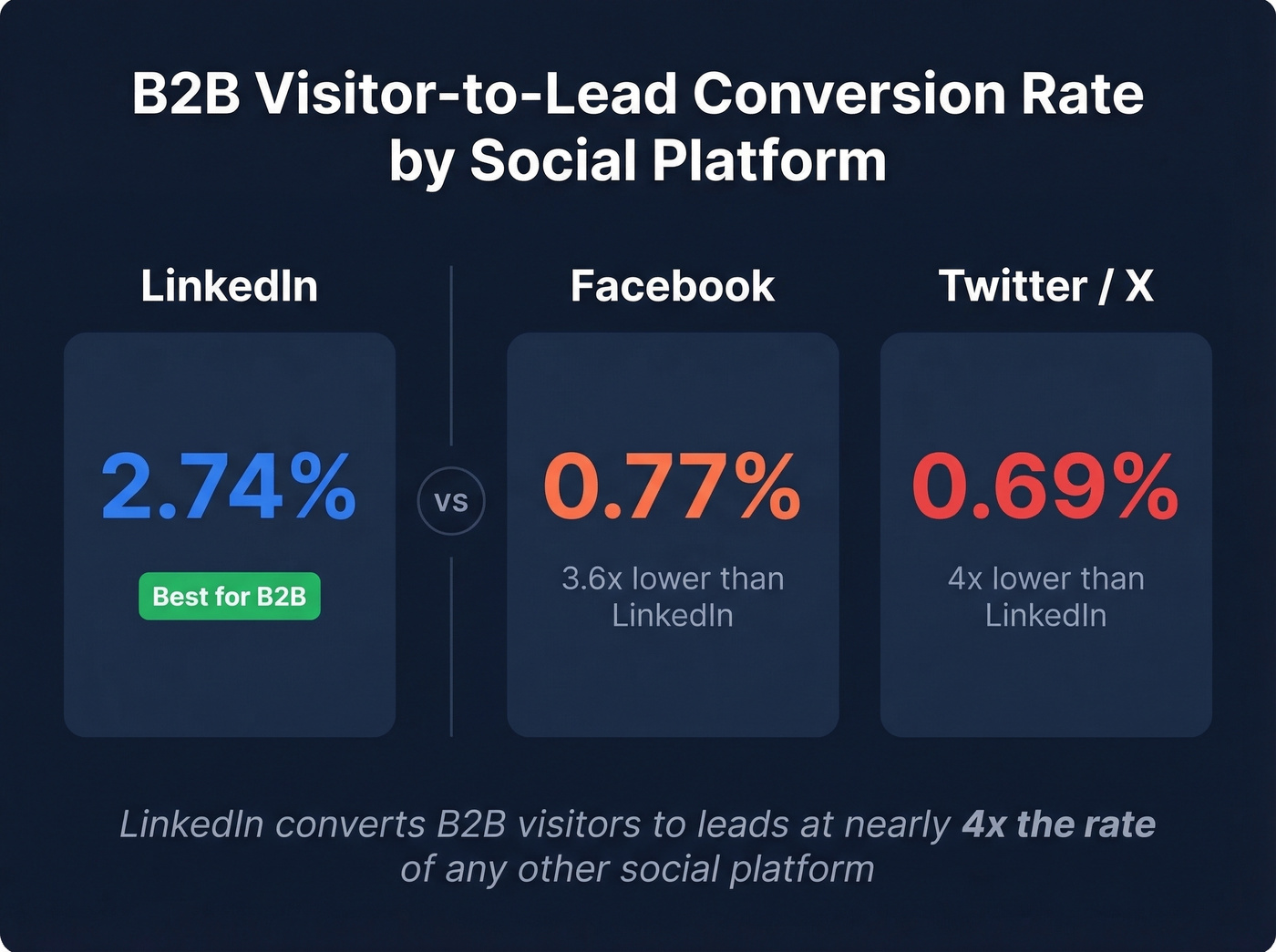
The platform works because the targeting is unmatched - you can reach VP-level buyers at companies of a specific size, in a specific industry, using specific technology. No other social platform gets that granular. It's crowded and getting more expensive, but it's still one of the strongest channels for pipeline.
Executive thought leadership is the highest-leverage play here. A founder or VP posting consistently builds trust in ways that brand accounts simply can't replicate. Repurpose podcast clips, customer stories, and data-driven takes into LinkedIn posts, and you've got a content engine that feeds itself.
Paid Search (Google Ads)
Paid search is the fastest path to pipeline. A roughly 4-month break-even means you can prove ROI within a single quarter, and you're capturing high-intent buyers who are actively searching for solutions like yours.
The tradeoff is a lower ROI ceiling at 36%, and B2B CPCs typically run $2-$20+ depending on your category. Competitive keywords in SaaS or cybersecurity can push well above that. You're also renting attention, not building an asset - the moment you stop spending, the leads stop. Use paid search to capture demand while your organic content ramps up, then shift budget as organic traffic compounds.
Webinars & Events
Webinars deliver 213% ROI, which puts them solidly in the top tier. The tradeoff is resource intensity - a single webinar requires speakers, promotion, a landing page, follow-up sequences, and someone to actually run the thing. Live events are even heavier, with budgets ranging from $10K for a small hosted dinner to $250K+ for a major conference presence.
Pipeline quality tends to be excellent. Webinar attendees have self-selected into your topic, which means they're usually more engaged than a typical top-of-funnel click. For teams selling deals above $25K, the math usually works. For lower-ticket sales cycles, skip this one until your ACV justifies the cost per attendee.
Video Marketing
78% of B2B marketers already use video, and more than half plan to increase investment. Brands combining video with creator or SME partnerships are 2.2x more likely to be trusted and 1.8x more likely to be recognized.
Short-form video under 90 seconds works for awareness. Long-form product walkthroughs and customer stories work for mid-funnel and late-funnel. The mistake most teams make is treating video as a standalone channel instead of a format that amplifies every other channel on this list.
Podcasting
Podcasting isn't really a channel. It's a content engine that feeds LinkedIn, SEO, and email simultaneously.
One 45-minute episode generates LinkedIn clips, a blog post, email newsletter content, and a relationship with the guest - who's often a potential partner or customer. A mid-market SaaS RevOps team we know launched a podcast expecting it to be a brand play. Six months later, it was their highest-ROI content investment, not because of listener numbers, but because of the derivative content it produced. Think of podcasting as a force multiplier, not a standalone play. It also contributes to dark funnel channels - the conversations, recommendations, and word-of-mouth that never show up in your attribution model but heavily influence buying decisions.
Account-Based Marketing (ABM)
The average B2B deal now involves 13 decision-makers, and 80% of buyer interactions happen digitally. You can't reach a buying committee of 13 with a single email sequence - you need coordinated touches across multiple contacts at the same account.
ABM is most effective for enterprise deals where the revenue justifies dedicating $500-$5,000+ in marketing spend per target account. It's also where multi-channel orchestration becomes essential, aligning email, ads, direct mail, and sales outreach into a unified sequence for each target account.
Partnerships & Co-Marketing
Referral traffic converts at 2.9% - the highest of any channel in most B2B benchmark studies. Partnerships are also one of the lowest-cost pipeline sources when structured well, because you're tapping into someone else's audience and trust. Start with technology partners whose tools integrate with yours and agency partners who recommend tools to their clients. Co-webinars and co-authored content are the easiest first moves.
You'll see CTV, influencer marketing, and community channels (Slack groups, forums) on other lists. They have a place in enterprise stacks, but for most B2B teams in 2026, they're experiments - not core pipeline drivers.
The real strategic question is balancing inbound and outbound. Outbound channels produce pipeline faster, but at higher marginal cost. Inbound channels like SEO and organic social take longer to ramp but compound over time with lower CAC. The best stacks blend both.
Channel ROI Comparison
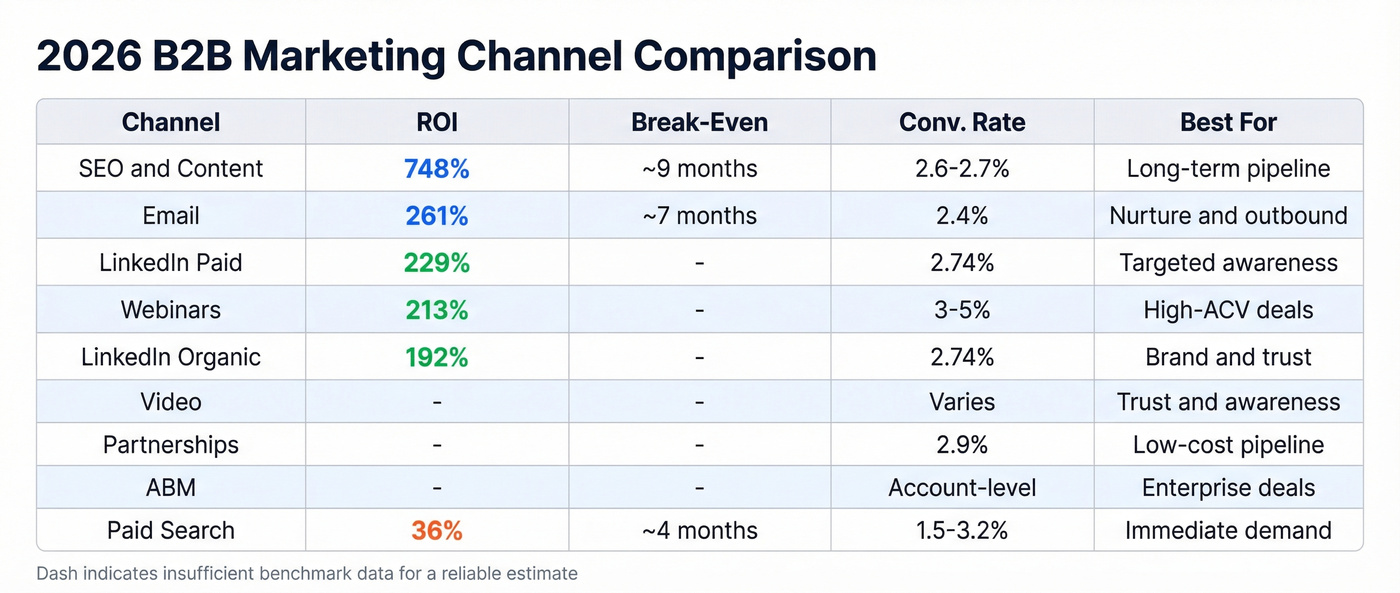
| Channel | ROI % | Break-Even | Conv. Rate | Best For |
|---|---|---|---|---|
| SEO & Content | 748% | ~9 months | 2.6-2.7% | Long-term pipeline |
| 261% | ~7 months | 2.4% | Nurture + outbound | |
| LinkedIn (Paid) | 229% | - | 2.74% | Targeted awareness |
| Webinars | 213% | - | 3-5% | High-ACV deals |
| LinkedIn (Organic) | 192% | - | 2.74% | Brand + trust |
| Video | - | - | Varies | Trust + awareness |
| Partnerships | - | - | 2.9% | Low-cost pipeline |
| ABM | - | - | Account-level | Enterprise deals |
| Paid Search | 36% | ~4 months | 1.5-3.2% | Immediate demand |

Email marketing delivers 261% ROI - but only if your contacts are real. Meritt dropped their bounce rate from 35% to under 4% and tripled weekly pipeline to $300K using Prospeo's 143M+ verified emails with 98% accuracy. Bad data doesn't just kill one channel. It kills every channel on this list that depends on email.
Stop feeding bad data into your highest-ROI channel.
Which Channels by Company Stage
Early-stage (pre-Series B): Your job is to prove repeatable pipeline creation. Focus on email, LinkedIn organic, and one SEO bet. You don't have the budget or team to run seven channels. Pick three, get them working, and resist the temptation to add more until you've hit consistent MQL targets. Apply the 70/20/10 model - 70% of budget on the two channels already producing, 20% scaling the third, 10% testing something new.
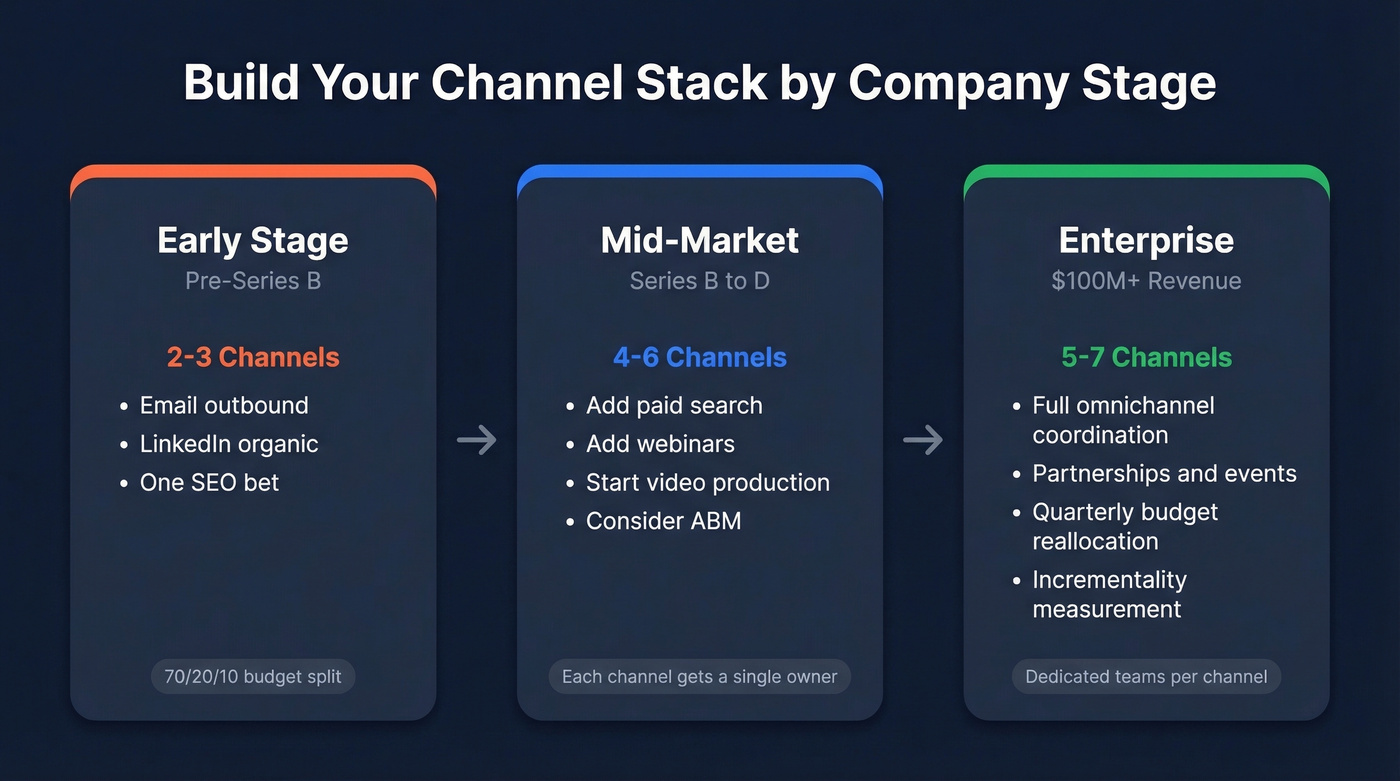
Mid-market (Series B-D): Layer in paid search and webinars. Hire or contract for video production. ABM starts making sense when your deal sizes support it. This is the stage where you diversify deliberately - expanding your mix to 4-6 channels, but each one should have a single accountable owner measuring to SQLs and pipeline created.
Enterprise ($100M+ revenue): You're running 5-7 channels with dedicated teams, sophisticated attribution, and quarterly budget reallocation based on incrementality data - what actually moved the needle versus what would've happened anyway. Partnerships and events become major pipeline sources at this stage because your brand carries enough weight to attract co-marketing partners. Enterprise teams also benefit from omnichannel coordination, aligning messaging across digital channels so buyers encounter a consistent narrative whether they're on LinkedIn, Google, or attending a webinar.
How to Allocate Budget
The 70/20/10 model is the most practical framework we've found: 70% to proven channels, 20% to channels you're scaling, 10% to experiments. It prevents the dilution problem while leaving room to discover what's next.
Despite flat budgets, 83% of B2B marketing decision-makers expect investments to grow in 2026, with 40% expecting 5%+ increases. The money is loosening - the question is where to put it. A 10Fold survey found that 90% of B2B tech companies with $100M+ revenue spend at least $1M annually on marketing, with brand awareness as the top investment priority at roughly 15-17% of total spend. SEO captures about 9% of digital marketing budgets - the largest owned/earned share of any channel.
On the brand versus performance split, Google and WARC research suggests 50-60% toward brand building and 40-50% toward performance. Most B2B teams over-index on performance because it's easier to measure, but brand investment compounds in ways that reduce CAC over time.
The typical budget breakdown runs 42% to programs (campaigns, content, events), 35% to personnel, and 23% to technology. That technology number is worth scrutinizing - Gartner reports 60% of MarTech spend goes underutilized. If you're paying for tools your team doesn't use, that's budget you could redirect to channels that are actually working.
One trend worth watching: 46% of B2B teams plan a hybrid in-house/agency model in 2026, up from 36% in 2025. Agencies are increasingly handling channel execution while in-house teams own strategy and measurement.
AI Is Reshaping Every Channel
This is the section that matters most for 2026 planning.
A Seer Interactive study of 3,119 informational queries found that organic CTR dropped 61% - from 1.76% to 0.61% - when AI Overviews appeared. Semrush data shows 58.5% of US searches now end without a click. Similarweb tracked zero-click searches rising from 56% to 69% between May 2024 and May 2025. Gartner predicted traditional search volume would drop 25% by 2026 - and that's already playing out.
For B2B marketers, this means two things. First, SEO isn't about ranking #1 anymore - it's about being one of the 5-7 sources that AI models cite in their answers. This is Answer Engine Optimization (AEO), and it rewards data-dense, clearly structured content over generic blog posts. Second, 72% of B2B buyers already see AI Overviews, and 89% use generative AI tools at every stage of the buying journey. Your content needs to be consumable by both humans and machines.
The channels themselves aren't changing. How buyers find and consume content within those channels is changing fast.
How to Measure Channel Performance
Attribution in B2B is broken by design. Buying committees of 13 people interact across dozens of touchpoints over months. No model captures that perfectly, but some are less wrong than others.
| Model | How It Works | Best For | Weakness |
|---|---|---|---|
| Linear | Equal credit, all touches | Simple reporting | Overvalues noise |
| Time-Decay | More credit near close | Late-stage focus | Undervalues awareness |
| U-Shaped | Weights first + last | Lead gen teams | Misses mid-funnel |
| W-Shaped | First + lead + opp creation | Most B2B teams | Complex to implement |
W-shaped attribution is the right starting point for most B2B teams because it weights the three moments that actually matter: first touch, lead creation, and opportunity creation. Pair it with media mix modeling for quarterly budget decisions - attribution tells you what's working this week, MMM tells you what's working this quarter. The consensus on r/sales and r/b2bmarketing is that most teams over-invest in last-touch attribution and systematically undervalue the channels that create awareness in the first place.
The biggest funnel leak is MQL to SQL conversion, which runs about 15% for most teams. That's where 85% of your marketing-qualified leads die. Before blaming the channel, check your data. If your email bounce rate is above 5%, the problem is contact quality, not the channel.
Build a three-layer measurement stack: unified first-party data from your CRM, marketing automation, and ad platforms; an attribution layer for weekly optimization; and an MMM/incrementality layer for quarterly planning. That combination gives you both tactical speed and strategic clarity.
Every channel on this list converts better when you reach the right people. Prospeo's 300M+ profiles with 30+ filters - buyer intent, technographics, headcount growth, funding - let you build targeted lists at $0.01/email. Data refreshed every 7 days, not the 6-week industry average.
Your channel stack is only as strong as your contact data.
FAQ
What's the highest-ROI B2B marketing channel?
SEO delivers 748% ROI over three years but takes roughly 9 months to break even. Email marketing at 261% ROI with a 7-month break-even offers the best speed-to-return balance. Choose based on whether you need pipeline this quarter or next year.
How many channels should a B2B company use?
Three to five focused channels consistently outperform broader strategies. Use the 70/20/10 model - 70% budget to proven channels, 20% to scaling channels, 10% to experiments. Add channels only after existing ones produce consistent results.
How do I measure channel performance in B2B?
W-shaped attribution works best for most B2B teams - it weights first touch, lead creation, and opportunity creation. Pair it with media mix modeling for quarterly budget decisions. Watch MQL-to-SQL conversion closely; that's where the biggest drop-off occurs at roughly 15%.
How is AI changing B2B marketing channels in 2026?
AI Overviews cut organic CTR by 61% on informational queries, and 58.5% of US searches now end without a click. The shift demands Answer Engine Optimization - data-dense, structured content that AI models cite. Every channel still works; how buyers discover content within them is what's changing.