

B2B Telemarketers: The 2026 Guide (Costs, Scripts, ROI)
Your SDR team made 200 dials yesterday and booked zero meetings. Before you blame the reps, check the data they're calling. The #1 reason B2B telemarketers fail isn't bad callers - it's bad contact lists, disconnected numbers, and prospects who left the company six months ago.
What You Need (Quick Version)
B2B telemarketing costs between $2 and $10 per call, with $5 as a reasonable midpoint. Agency retainers typically run $2K-$10K+/month depending on volume and caller seniority. Good performance looks like a 2.3-2.5% dial-to-meeting conversion rate, which translates to roughly one meeting per 40-45 dials. Top teams hit 5-8%.
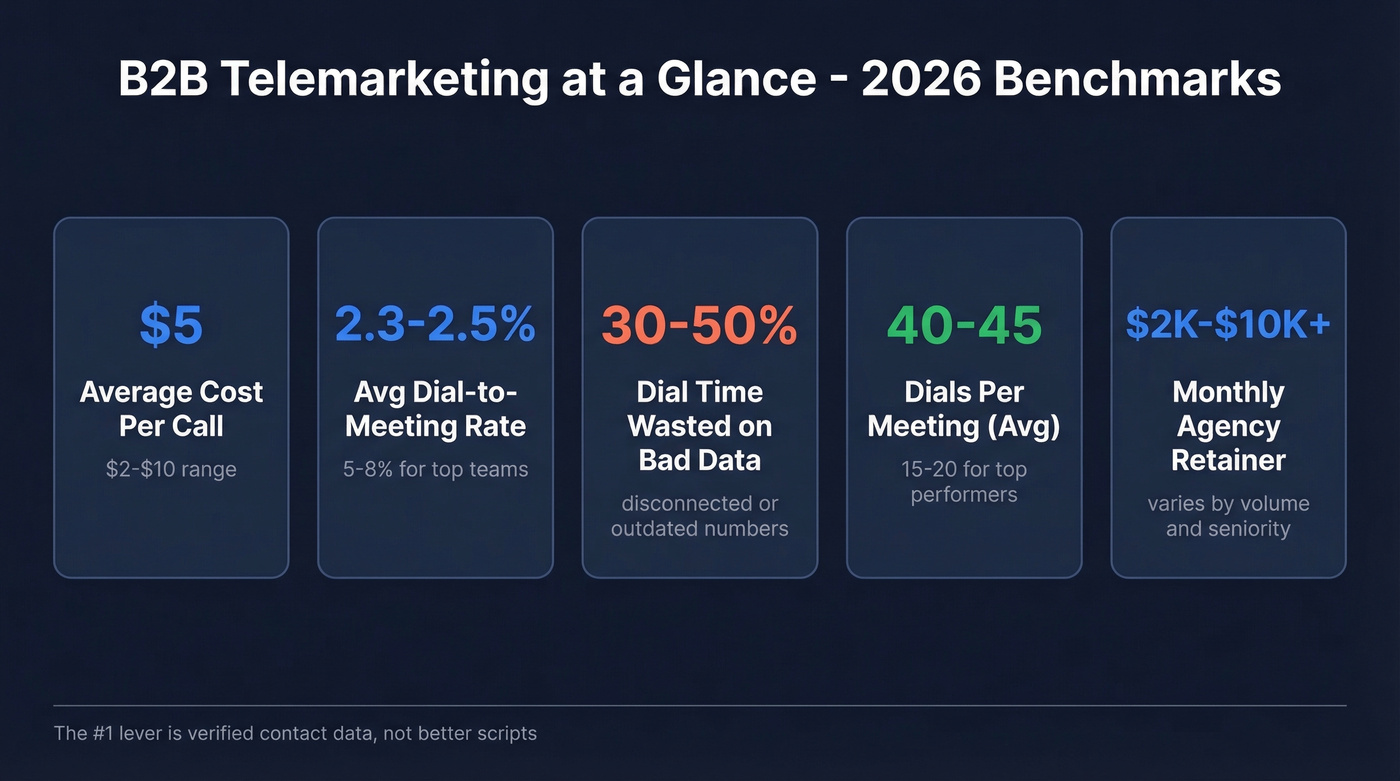
The single biggest lever you can pull isn't a better script or a fancier dialer - it's verified contact data. Bad numbers waste 30-50% of your agents' dial time. Before you spend a dollar on telemarketing, make sure your list runs through a platform with a 7-day data refresh and verified mobile numbers that actually get picked up.
What B2B Telemarketing Actually Is
B2B telemarketing is outbound phone outreach to business decision-makers - not the consumer robocall nightmare most people picture. The goal isn't to close a deal on the phone. It's to start a conversation, qualify interest, and book a meeting that moves a prospect into your pipeline.
The B2B vs. B2C distinction matters more than people think. B2C telemarketing is high-volume, low-value, and increasingly restricted by regulation. B2B targets specific people at specific companies with specific pain points. The calls are shorter, the conversations are more substantive, and the deal values justify the cost per dial.
Why Outbound Calling Still Works
The "telemarketing is dead" narrative is pushed almost exclusively by companies selling email automation. Meanwhile, inboxes are saturated. Messages get ignored. A well-timed phone call still cuts through.
Average dial-to-meeting rates sit at 2.3-2.5%, but that's the average - which includes teams calling garbage lists with untrained reps. Top-performing teams consistently hit 5-8%, needing just 15-20 dials per meeting. The difference isn't talent. It's process: verified data, optimized calling windows, and scripts that open conversations instead of triggering hang-ups.
Here's the thing - it takes 8+ attempts to reach a single prospect. Most reps give up after 2-3. The teams that win build multi-touch cadences and actually follow through, running phone as part of a 5-7 touch sequence: call, voicemail, email, social touch, call, follow-up email, spaced over 2-3 weeks. Phone outperforms email-only outreach by 2-3x on pipeline conversion when you commit to that activity volume.
If your average contract value sits below $10K-$15K, you probably don't need a dedicated telemarketing program. Email and social sequences will get you 80% of the way there at a fraction of the cost. Telemarketing's ROI really kicks in when deal sizes justify $50-$150 in customer acquisition cost per meeting.
How Much B2B Telemarketers Cost
Cost is the #1 question, and the answer depends on three variables: where your callers sit, how the agency charges, and whether you're building in-house or outsourcing.
Cost Per Call by Region
The math is straightforward - hourly rate divided by calls per hour. But the range is enormous depending on geography.
| Region | Hourly Rate | Calls/Hr | Cost Per Call |
|---|---|---|---|
| Offshore | $8-$18/hr | 10-15 | $0.50-$1.80 |
| Nearshore (LATAM) | $12-$25/hr | 8-12 | $1.50-$3.10 |
| Onshore (US/UK) | $28-$65/hr | 6-10 | $3.00-$11.00 |
The $5 per call benchmark is a useful planning number for blended teams. Offshore gets you volume. Onshore gets you callers who understand your buyer's industry, speak the language natively, and can handle objections without a script. You get what you pay for.
How Agencies Charge
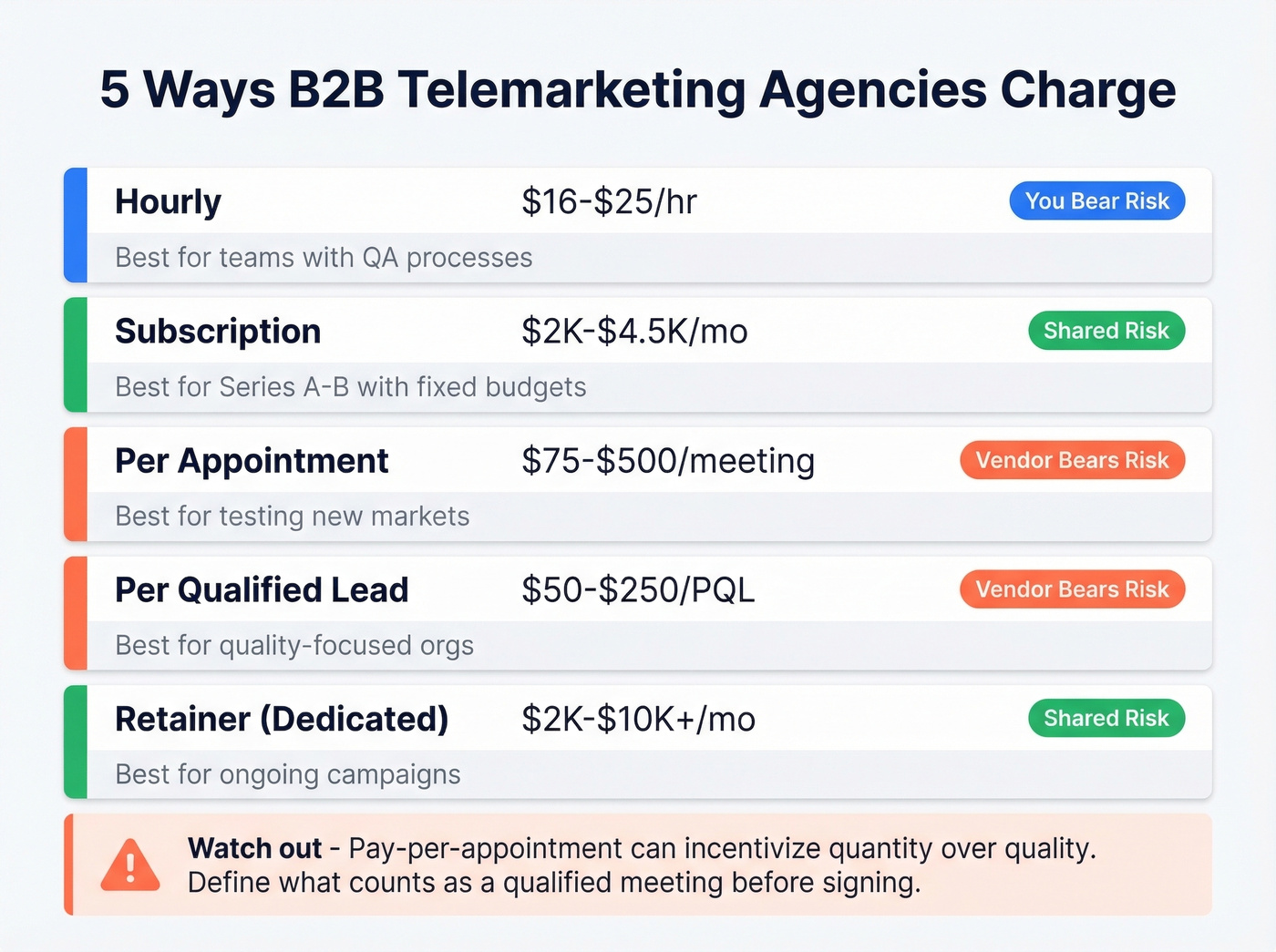
Agencies use five primary pricing models, and each one shifts risk differently between you and the vendor.
| Model | Price Range | Risk Profile | Best For |
|---|---|---|---|
| Hourly | $16-$25/hr | You bear risk | Teams with QA processes |
| Subscription | $2K-$4.5K/mo | Shared risk | Series A-B with fixed budgets |
| Per appointment | $75-$500/mtg | Vendor bears risk | Testing new markets |
| Per qualified lead | $50-$250/PQL | Vendor bears risk | Quality-focused orgs |
| Retainer (dedicated) | $2K-$10K+/mo | Shared risk | Ongoing campaigns |
A word of caution on pay-per-appointment: it incentivizes quantity over quality unless your qualification criteria are airtight. We've seen agencies book "meetings" that are barely disguised discovery calls with people who have zero buying authority. If you go this route, define what counts as a qualified meeting before signing anything.
In-House vs. Outsourced Economics
The cost difference is significant enough to drive your entire go-to-market staffing strategy.
| Line Item | In-House SDR | Outsourced SDR |
|---|---|---|
| Annual cost | ~$125K fully loaded | ~$65K equivalent |
| Monthly cost | $10K-$14K | ~$5,400 |
| Hidden costs | Recruiting, onboarding, turnover, tech | Included in retainer |
| Ramp time | 3-6 months | 2-4 weeks |
| Savings | Baseline | ~48% less |
Outsourcing runs roughly 48% cheaper than in-house when you factor in recruitment, onboarding, management overhead, tech licenses, and the inevitable turnover. But in-house reps know your product deeply and build institutional knowledge over time.
The smart play is a hybrid 70/30 model: staff about 70% of your calling capacity in-house and use an external partner for the remaining 30% - surge capacity, new market testing, or coverage during ramp periods. If you're running fewer than 5 reps and generating under $50K/month in pipeline, outsource entirely. Once you're past 10 reps, build the core team in-house and keep an agency for overflow.
Benchmarks - What Good Looks Like
| Funnel Stage | Metric | Average | Top Performers |
|---|---|---|---|
| Daily dials | Volume | 40-50/day | 60-80/day |
| Connect rate | Dials to live conversation | 3-10% | 10-15% |
| Dial-to-meeting | Dials to booked meeting | 2.3-2.5% | 5-8% |
| Show rate | Booked to attended | 60-70% | 80%+ |
| Dials per meeting | Efficiency | 40-45 | 15-20 |
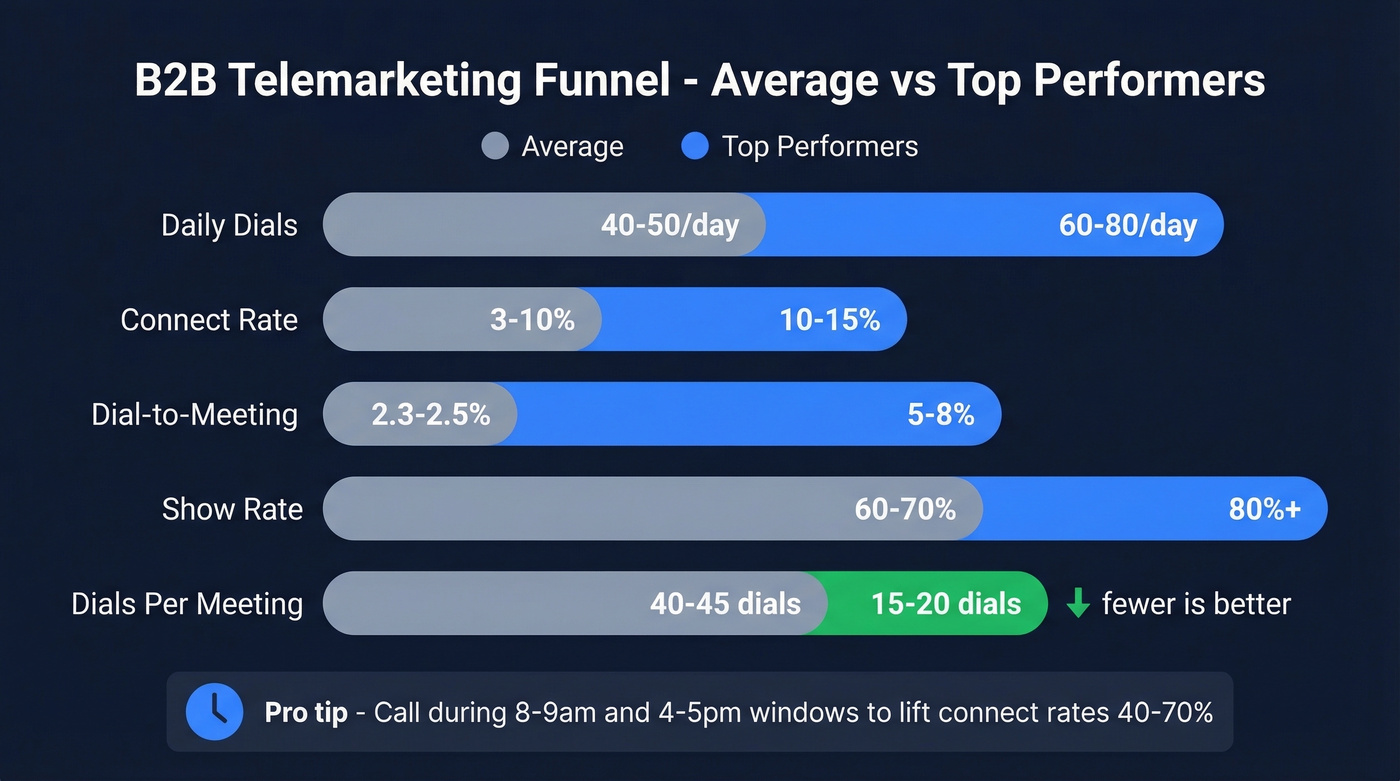
Calling windows matter more than most teams realize. Dialing during the 8-9am and 4-5pm windows lifts connect rates 40-70% compared to random mid-day calling. That's not a marginal improvement - it's the difference between 3% and 5% connect rates.
Once you get a prospect into a sales call, conversion rates vary dramatically by industry:
| Industry | Sales Call Conversion |
|---|---|
| Business services | 24.47% |
| Printing & publishing | 26.82% |
| Technology/software | 9.39% |
| Industrial equipment | 8.37% |
Technology companies see lower close rates because deal cycles are longer and buying committees are larger. That doesn't mean telemarketing doesn't work for SaaS - it means you need more meetings in the funnel to hit the same revenue target.

Bad numbers eat 30-50% of your agents' dial time. Prospeo's 125M+ verified mobile numbers deliver a 30% pickup rate - nearly 3x the industry average. Every number is refreshed every 7 days, so your reps stop calling people who left the company six months ago.
Stop paying $5/call to reach a disconnected number.
Your Data Is the Foundation
Let's break down what actually happens during those 200 wasted dials. Forty hit disconnected numbers. Thirty went to people who left the company months ago. Twenty reached the wrong department entirely. Your reps burned half their day on contacts that never had a chance of converting.
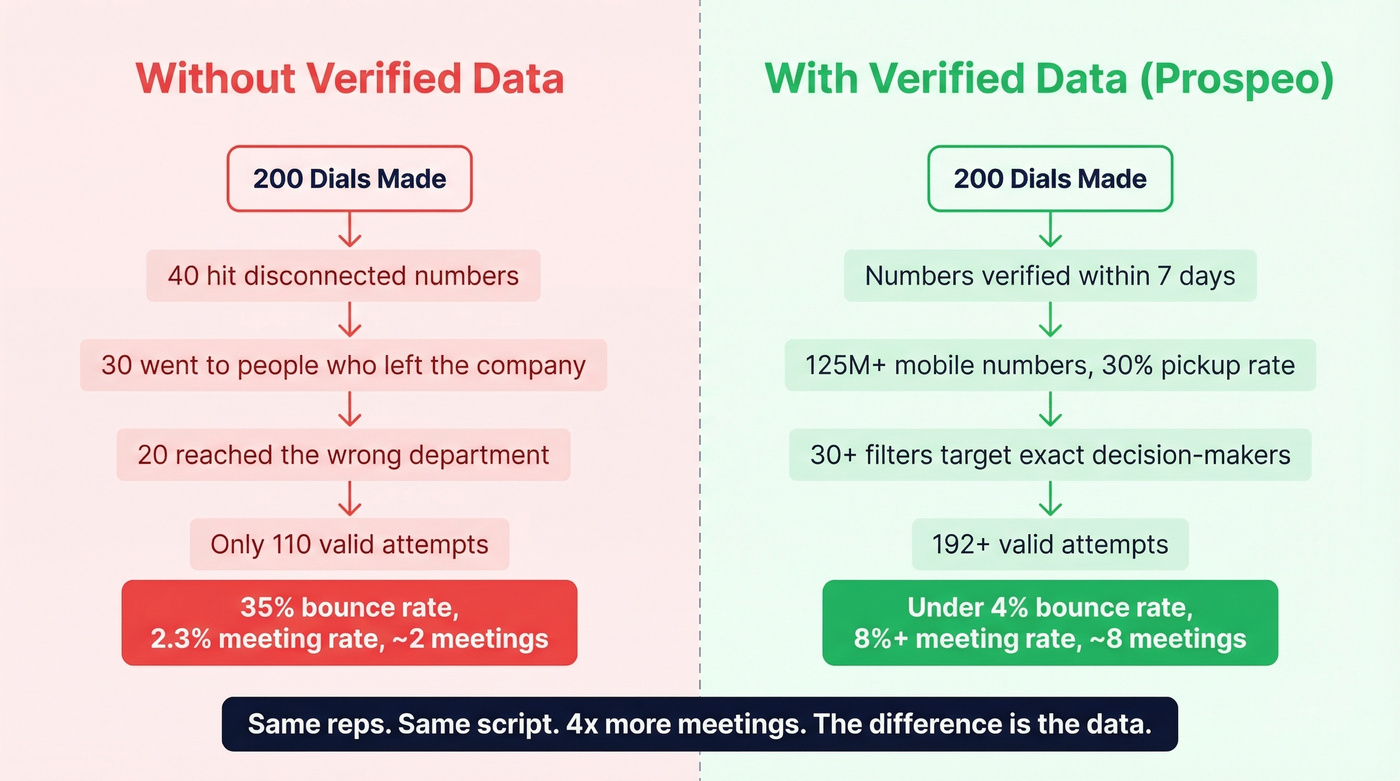
The manager pulls call recordings and the reps sound fine - decent openers, good energy, reasonable objection handling. The data was the problem, not the people.
This is the norm, not the exception. Bad data wastes 30-50% of agent dial time across the industry. One sales team we've tracked - Meritt - saw their connect rate triple to 20-25% after switching to verified mobile data through Prospeo, going from a 35% bounce rate to under 4%. That's the difference between a team that books meetings and a team that burns budget.

With 300M+ professional profiles, 143M+ verified emails, and 125M+ verified mobile numbers delivering a 30% pickup rate, the data quality gap between verified and unverified lists is massive. A 7-day refresh cycle means your reps aren't calling numbers that went stale last month. You can upload an existing list for enrichment or build a new list from scratch using 30+ filters including buyer intent signals, technographics, job changes, headcount growth, and funding events.
The difference between 2.3% and 8% dial-to-meeting isn't your script - it's your data. Prospeo gives your telemarketers direct dials verified within the last 7 days, with 30+ filters to target the exact decision-makers worth calling. At $0.01 per email and 10 credits per mobile, your cost per contact stays under $0.10.
Give your reps numbers that actually ring.
Scripts That Actually Convert
Scripts are guides, not straitjackets. The best callers internalize the structure and adapt in real time based on what the prospect says.
The Pattern-Interrupt Opener
The most effective cold call opener isn't a pitch - it's a pattern interrupt. Cold-calling benchmarks show that starting with "How have you been?" can generate a 6.6x higher success rate than standard openers. It breaks the prospect's expectation of a sales pitch and creates a momentary opening for genuine dialogue.
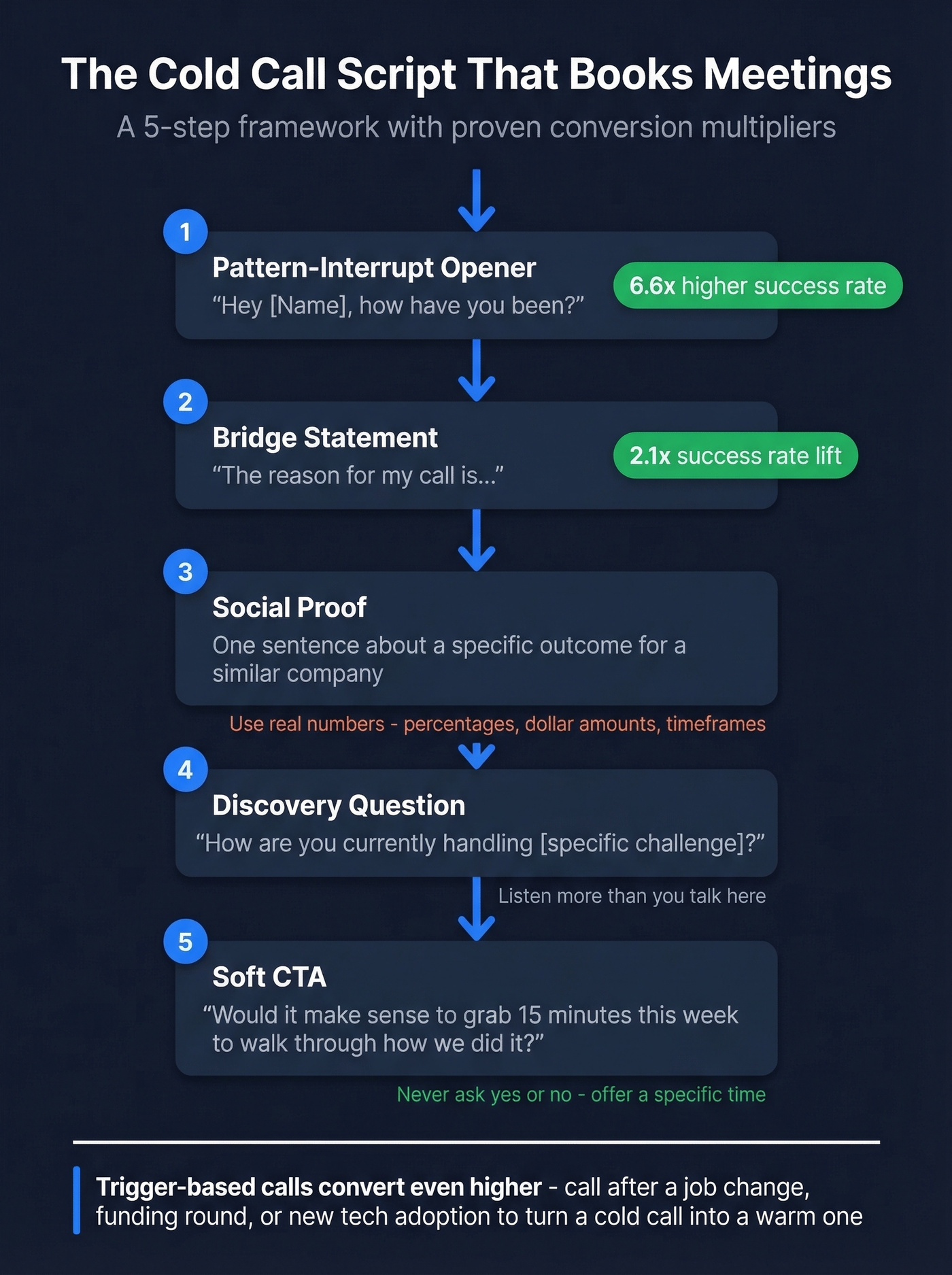
Opener: "Hey [Name], how have you been?"
Bridge into "The reason for my call is..." - this phrase alone drives a 2.1x success rate lift. Follow with one sentence about a specific outcome you've delivered for a similar company. Then ask a discovery question: "How are you currently handling [specific challenge]?" Close with a soft CTA: "Would it make sense to grab 15 minutes this week to walk through how we did it?"
Trigger-Based Scripts
Trigger-based calls convert at significantly higher rates because you're calling with a reason - a job change, a funding round, a new tech implementation. These give you a natural opening that transforms a cold call into a warm one. Open with congratulations on the specific event, bridge into how you've helped companies going through a similar transition, and ask what their biggest priority is as they scale.
If you know the prospect's company just adopted Salesforce and you sell Salesforce integrations, that's not a cold call anymore. Personalization using firmographic and intent signals is the single fastest way to lift conversion rates without changing anything else about your process.
The Referral Opener
Nothing opens a door faster than a mutual connection. Lead with "[Mutual contact] suggested I reach out," share the specific result you delivered for that person's team, and ask if the same challenge is on their radar. Keep it under 30 seconds before the first question. Even a loose connection - a shared investor, a conference panel, a group you're both in - works better than no connection at all.
Real talk: the script matters less than the data behind it. The best opener in the world won't save a call to a disconnected number or a prospect who left the company.
Compliance Rules in 2026
Compliance rules have shifted dramatically, and ignoring them is genuinely dangerous. TCPA lawsuits surged 95% year-over-year in 2025, with class actions spiking 285% in September alone. This isn't theoretical risk.
The June 2025 Supreme Court decision in McLaughlin v. McKesson changed the game. District courts now interpret TCPA provisions independently rather than deferring to FCC guidance, which means enforcement is less predictable and more aggressive. The FCC also clarified that AI-generated voices qualify as "artificial/prerecorded" under TCPA - so if you're experimenting with AI-powered calling, you need explicit consent.
Starting April 2026, the FCC's consent revocation rules take full effect: prospects can revoke consent by "any reasonable method," and you must honor it immediately. At least 15 jurisdictions now enforce state mini-TCPA statutes, with Texas SB 140 adding expanded scope and registration requirements.
Your compliance checklist:
- Scrub every list against the National DNC Registry and your internal DNC list
- Get prior express written consent before using autodialers or prerecorded messages to cell phones - even for B2B
- Restrict calling to 8am-8pm in the prospect's local time zone
- Honor opt-outs immediately, regardless of how they're communicated
- Treat ringless voicemail as a prerecorded message (it requires consent)
- Track state-level regulations - Florida, Maryland, Oklahoma, Washington, and Texas all have stricter rules than federal TCPA
- Never use AI-generated voices without explicit consent
The frustrating part? Most of this is straightforward to implement. The companies getting sued aren't running sophisticated operations - they're cutting corners on list hygiene and consent tracking. The FCC's TCPA resource page is worth bookmarking, and TCPA World tracks case law updates in near real-time.
How to Choose an Agency
You shouldn't need a 45-minute discovery call to find out if an agency charges $2,000 or $20,000 a month. Yet that's the norm. Here's what actually matters when evaluating telemarketing partners.
Non-negotiable criteria:
- Call recordings shared - if they won't let you listen to calls, walk away
- Recognized qualification framework - BANT or SPICED, not "we'll know a good lead when we see one"
- Weekly reporting dashboards with dials, connects, meetings, show rates, and downstream conversion
- Senior callers - entry-level reps reading scripts won't cut it for enterprise B2B
- Multichannel integration - phone-only campaigns underperform phone + email + social sequences
Skip any agency promising "25 qualified appointments a day." They're either lying about the qualification criteria or redefining "qualified" to mean "answered the phone."
One common agency complaint from the r/sales community: some vendors front-load senior callers during the pilot period, then quietly swap in junior reps once the contract is signed. Ask for caller continuity guarantees in writing.
A few agencies worth evaluating: Callbox for global reach across APAC and EMEA, Belkins for multichannel campaigns using Orum and Reply.io, SalesHive for US-based SDR teams with an AI-powered cold calling platform, Intelemark for mid-market B2B, and MarketReach for pipeline-building campaigns. Use Clutch as a vetting resource - Martal Group, for example, carries a 4.8/5 rating across 106 reviews with common project sizes in the $10K-$49K range. Ask for three client references in your industry and actually call them.
The Essential Tech Stack
You don't need 10 tools. You need a dialer, a CRM, and a verified contact database. Everything else is optional.
- Dialer: Orum for multi-line parallel dialing. It lets reps talk to more humans per hour, which is the entire game. If you're comparing options, start with predictive dialer software and work backward from your call volume.
- CRM: Salesforce or HubSpot. Pick whichever your team already uses. Don't switch CRMs for a telemarketing program.
- Contact data: Prospeo for verified emails at 98% accuracy and direct dials on a 7-day refresh cycle. For multi-week campaigns, data decay is real - weekly refresh keeps your list clean throughout the entire run.
- Reporting: Looker Studio or native CRM dashboards. Track dials, connects, meetings, shows, and pipeline generated.
That's it. Four tools. If you're spending more time configuring your tech stack than actually making calls, you've already lost.
FAQ
Is B2B telemarketing still effective in 2026?
Yes. Average dial-to-meeting rates run 2.3-2.5%, and top-performing teams hit 5-8%. Phone outreach outperforms email-only campaigns by 2-3x on pipeline conversion. The channel works best when combined with email and social touches in a multi-step cadence rather than as a standalone tactic.
How many calls does it take to book a meeting?
Roughly 40-45 dials at average performance, dropping to 15-20 for top teams. It takes 8+ attempts to reach a single prospect, which is why most reps give up too early. Consistent follow-through across multiple attempts separates high performers from the rest.
What's the difference between B2B and B2C telemarketing?
B2B targets specific decision-makers at companies with longer sales cycles and higher deal values - typically $5K+ contracts. B2C is volume-based consumer outreach with simpler transactions and lower price points. B2B calls require industry knowledge, objection handling, and the ability to navigate buying committees.
How do I build a list that doesn't waste dials?
Use a data platform that verifies contacts on a short refresh cycle and provides direct mobile numbers with high pickup rates. Bad data wastes 30-50% of agent time on disconnected numbers. Layer intent signals and firmographic filters to prioritize prospects actively in-market.
Does TCPA apply to B2B calls?
Yes. TCPA applies to calls to cell phones regardless of B2B context. Lawsuits surged 95% year-over-year in 2025, and 15+ states enforce their own mini-TCPA statutes. Scrub against DNC lists, get written consent for autodialers to cell phones, and track state-level regulations - especially in Texas, Florida, and Maryland.
The math on B2B telemarketers is simple: verified data x consistent activity x multichannel cadences = pipeline. Everything else is noise.