

Calling Lists: The Complete Guide to Building Lists That Actually Convert
Your reps made 500 dials last week and booked two meetings. Before you blame their pitch, look at what they're dialing. The quality of your calling lists determines everything, and purchased lists ship with 30-40% outdated data. Disconnected numbers, wrong contacts, people who left the company eighteen months ago.
That's not a rep problem. That's a data problem.
The fix isn't complicated, but it does require ditching the "buy a CSV and start dialing" playbook that most teams still run.
What You Need (Quick Version)
If your connect rate sits below 10%, your list is the bottleneck:
- Define your ICP - analyze your best customers, pull common titles, industries, and company sizes (use an Ideal Customer Profile Template if you need a starting point)
- Source verified mobile numbers from a self-serve data platform instead of buying static CSVs (see Best Sales Prospecting Databases for more options)
- Validate before dialing - check line type, carrier, and validity to avoid wasting dials on landlines and dead numbers (this is part of a broader lead enrichment workflow)
- Scrub against the DNC registry every 31 days - compliance protects your caller ID reputation as much as it protects you legally
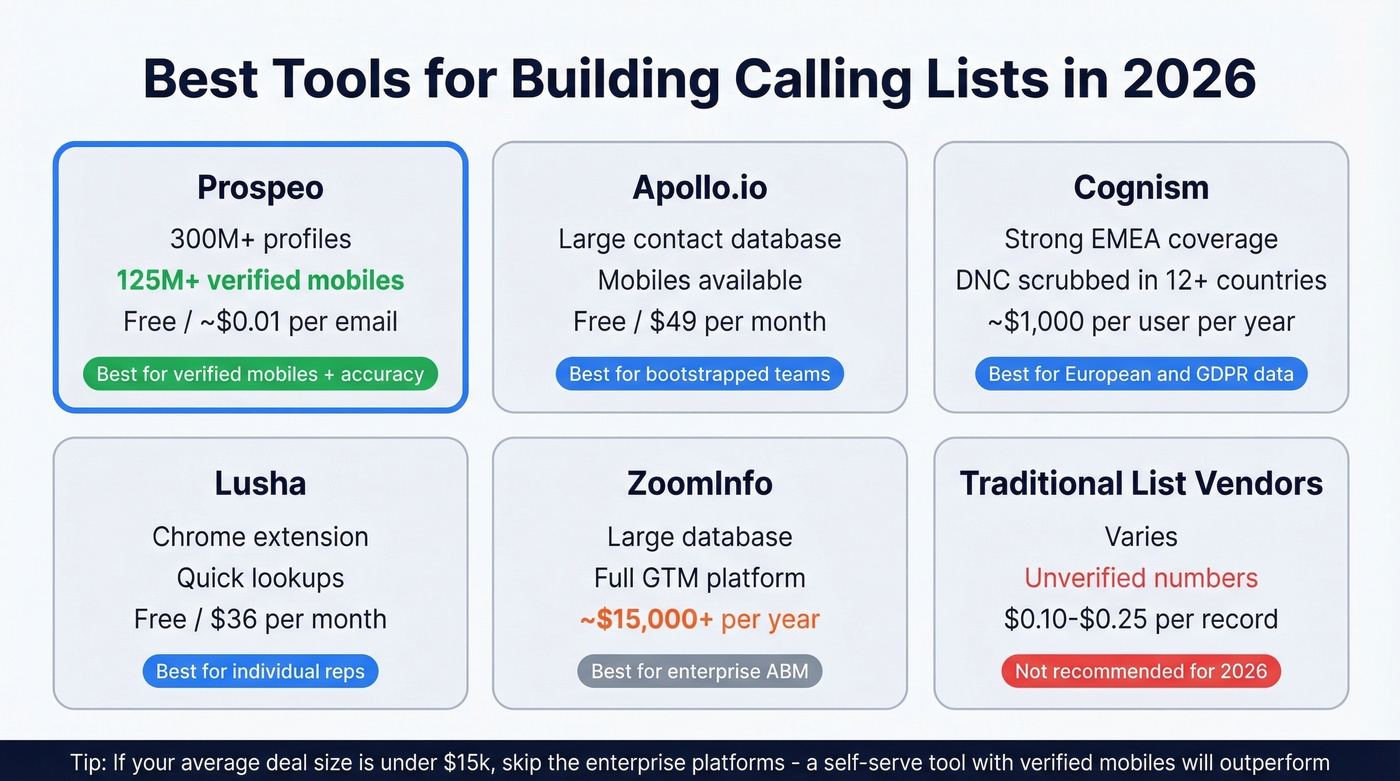
Top tool picks: Prospeo for verified mobiles and accuracy, Apollo for the best free tier, and Cognism for European data. Details on each below, plus a compliance checklist and the template your team needs.
Cold Calling Benchmarks for 2026
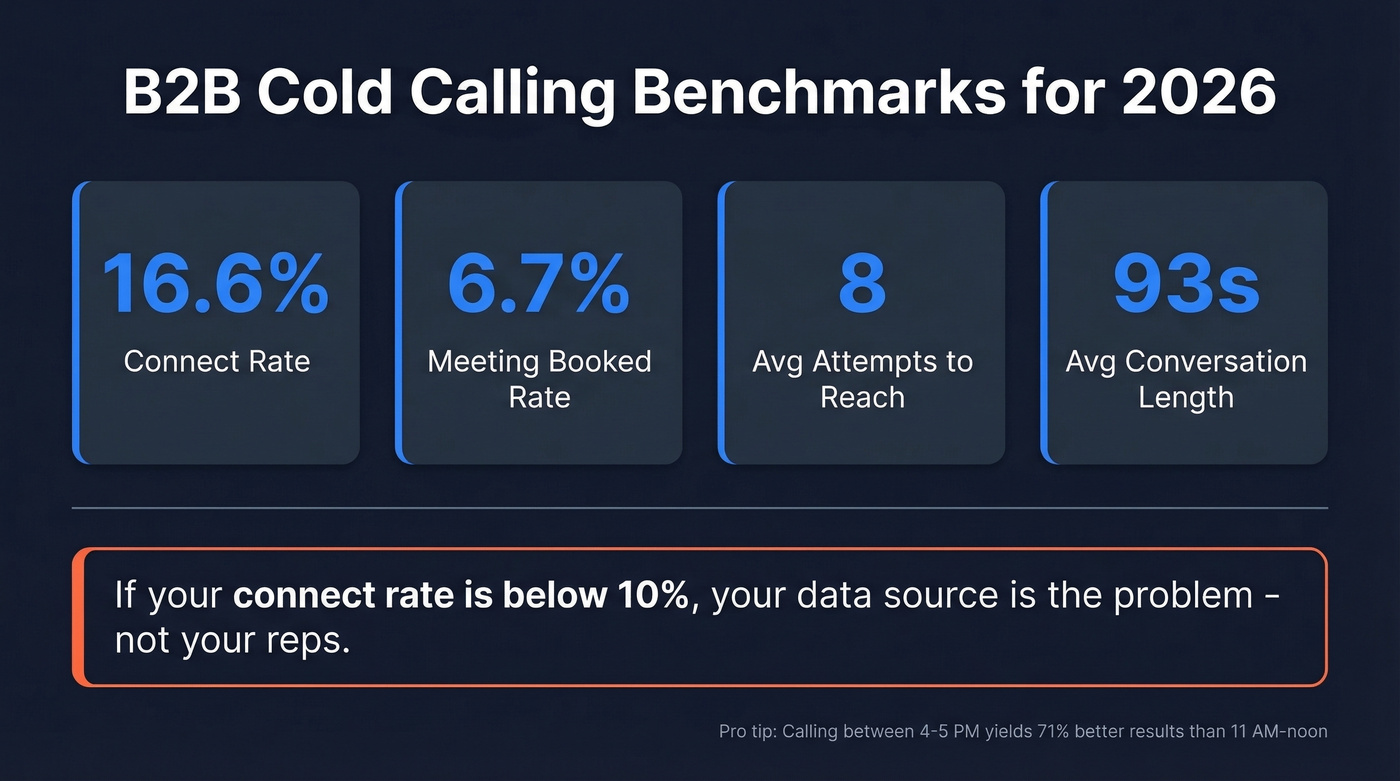
Before building anything, you need to know what "good" looks like. Here are the B2B cold calling benchmarks that matter:
| Metric | Benchmark |
|---|---|
| Connect rate | 16.6% |
| Meeting-booked rate | 6.7% |
| Avg attempts to reach | 8 |
| Avg conversation length | 93 seconds |
Calling between 4-5 PM yields 71% better results than the 11 AM-noon window. That's a free optimization most teams ignore.
Here's the diagnostic we use internally: if your connect rate is below 10%, your data source is the problem, not your reps. List quality is the single biggest lever you can pull before touching scripts, cadences, or coaching. Fire the data provider before you fire the SDR.
How to Build Calling Lists Step by Step
Define Your ICP
Start with your best customers - the ones who closed fastest, retained longest, and expanded. Export your closed-won deals from the last 12 months and look for patterns: industry, company size, geography, job titles, and the challenges your product solves. This isn't a brainstorming exercise. It's a data exercise. (If you want a tighter process, borrow a few sales prospecting techniques that map to your ICP.)
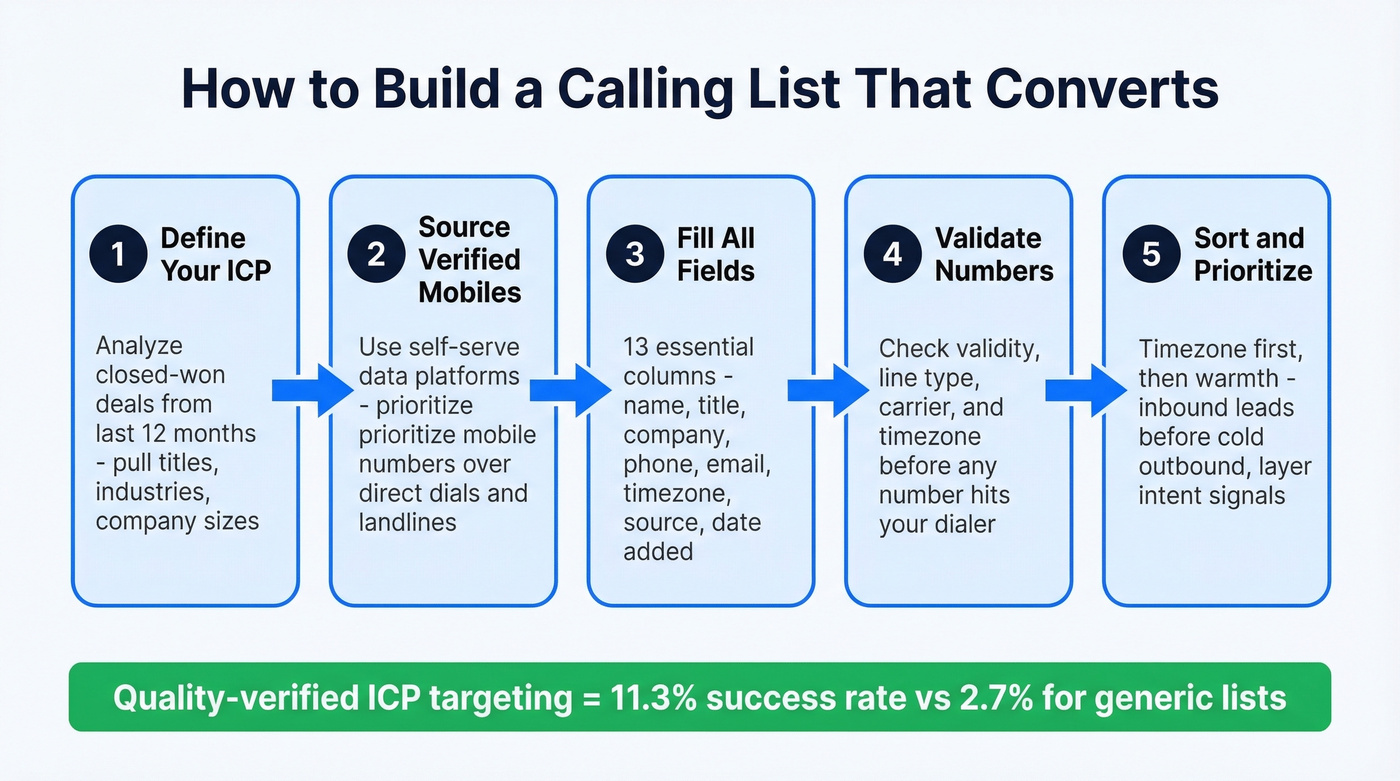
Teams using quality-verified data with precise ICP targeting see an 11.3% success rate versus 2.7% for teams dialing generic lists. That gap is entirely about who you're calling, not how many times you call.
Source Verified Numbers
Once your ICP is defined, you need actual phone numbers. The best sources, ranked by reliability:
- Self-serve data platforms like Prospeo, Apollo, or Cognism - search by your ICP filters, export verified contacts with mobile numbers attached
- Company websites and online professional profiles - slower but useful for niche verticals
- Inbound leads - anyone who's filled out a form or attended a webinar already raised their hand
- Event and trade show lists - follow up within 48 hours or the lead goes cold
Cell phones beat direct dials every time. Direct dials ring at a desk that might be empty. Mobiles reach the person regardless of where they're working.
Essential Fields Template
Don't start dialing until your list has these columns. Missing fields mean you can't segment, can't personalize, and can't comply with calling-hours rules.
| Field | Why It Matters |
|---|---|
| First Name | Personalization |
| Last Name | Personalization |
| Job Title | Persona targeting |
| Company | Context for the call |
| Company Size | ICP qualification |
| Industry | Segmentation |
| Phone | The whole point |
| Multi-channel follow-up | |
| Profile URL | Pre-call research |
| Location | Compliance + timezone |
| Time Zone | Calling hours compliance |
| Source | Attribution tracking |
| Date Added | Data freshness tracking |
Validate Before You Dial
Raw phone numbers aren't enough. Run every number through validation before it hits your dialer. You're checking four things: validity (is the number active?), line type (mobile, landline, or VoIP), carrier, and timezone. (If you're building a repeatable process, this fits neatly into most data enrichment services.)
Line type detection alone saves massive time. If your ICP is remote-first tech companies, calling landlines is pointless - nobody's sitting at a desk phone. Prioritize verified mobiles and skip the rest.
Sort and Prioritize
Don't dump your entire list into a power dialer and let it rip. Sort by timezone first so you're calling during legal hours, 8 AM-9 PM local time. Then prioritize by warmth: inbound leads and event contacts first, cold outbound second.
Layer in intent signals if your data platform supports it. A VP of Sales who's actively researching your category is a fundamentally different call than one who isn't. Treat them differently. (More on this in our guide to intent based segmentation.)

Your calling list is only as good as the numbers on it. Prospeo gives you 125M+ verified mobile numbers with a 30% pickup rate - not landlines, not disconnected lines, not desk phones nobody answers. Filter by ICP with 30+ search criteria, layer in Bombora intent data, and export numbers that actually ring.
Stop burning dials on dead data. Build calling lists that connect.
Build vs. Buy: Which Approach Works?
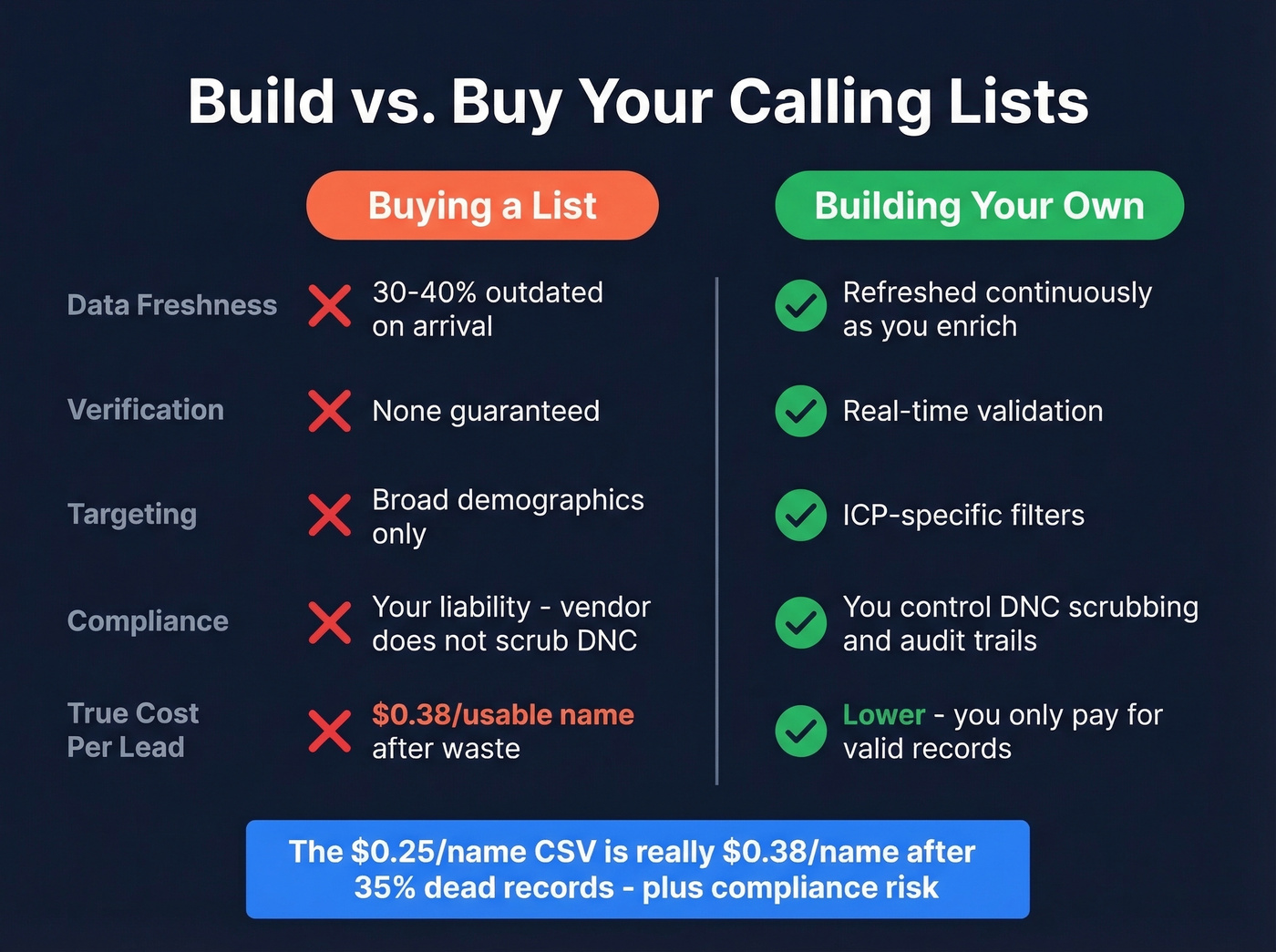
The traditional model is simple: pay a list vendor $0.10-$0.25 per record, buy a minimum of 2,500 names, and start dialing. Reps regularly get pitched these exact terms - $0.25/name with a 2,500 minimum for an unverified CSV that ships with no data refresh guarantee and no real-time validation.
| Factor | Buying a List | Building Your Own |
|---|---|---|
| Data freshness | 30-40% outdated | Refreshed continuously as you enrich and re-verify |
| Verification | None guaranteed | Real-time validation |
| Targeting | Broad demographics | ICP-specific filters |
| Compliance | Your liability | You control DNC scrubbing and audit trails |
| Cost per usable lead | High after waste | Lower since you pay for valid records |
The math doesn't work for purchased telemarketing lists. If 35% of your records are dead on arrival, that $0.25/name is really $0.38/usable name - and you've still got compliance risk because the vendor isn't scrubbing against the DNC registry for you.
Self-serve platforms let you search by ICP filters, export verified contacts, and keep your data fresh. It's a fundamentally different model than the 2010-era list vendor approach. (If you're building lists inside a workflow tool, see our breakdown of Clay list building.)
Let's be honest: if your average deal size is under $15k, you almost certainly don't need a $30,000/year data platform. A self-serve tool with verified mobiles will outperform an enterprise suite you'll never fully configure.
Best Tools for Building Calling Lists
Prospeo
Prospeo's database covers 300M+ professional profiles with 143M+ verified emails and 125M+ verified mobile numbers - and those mobiles actually ring, with a 30% pickup rate across all regions. Email accuracy sits at 98%, which matters if you're running multi-channel sequences alongside your calling campaigns.
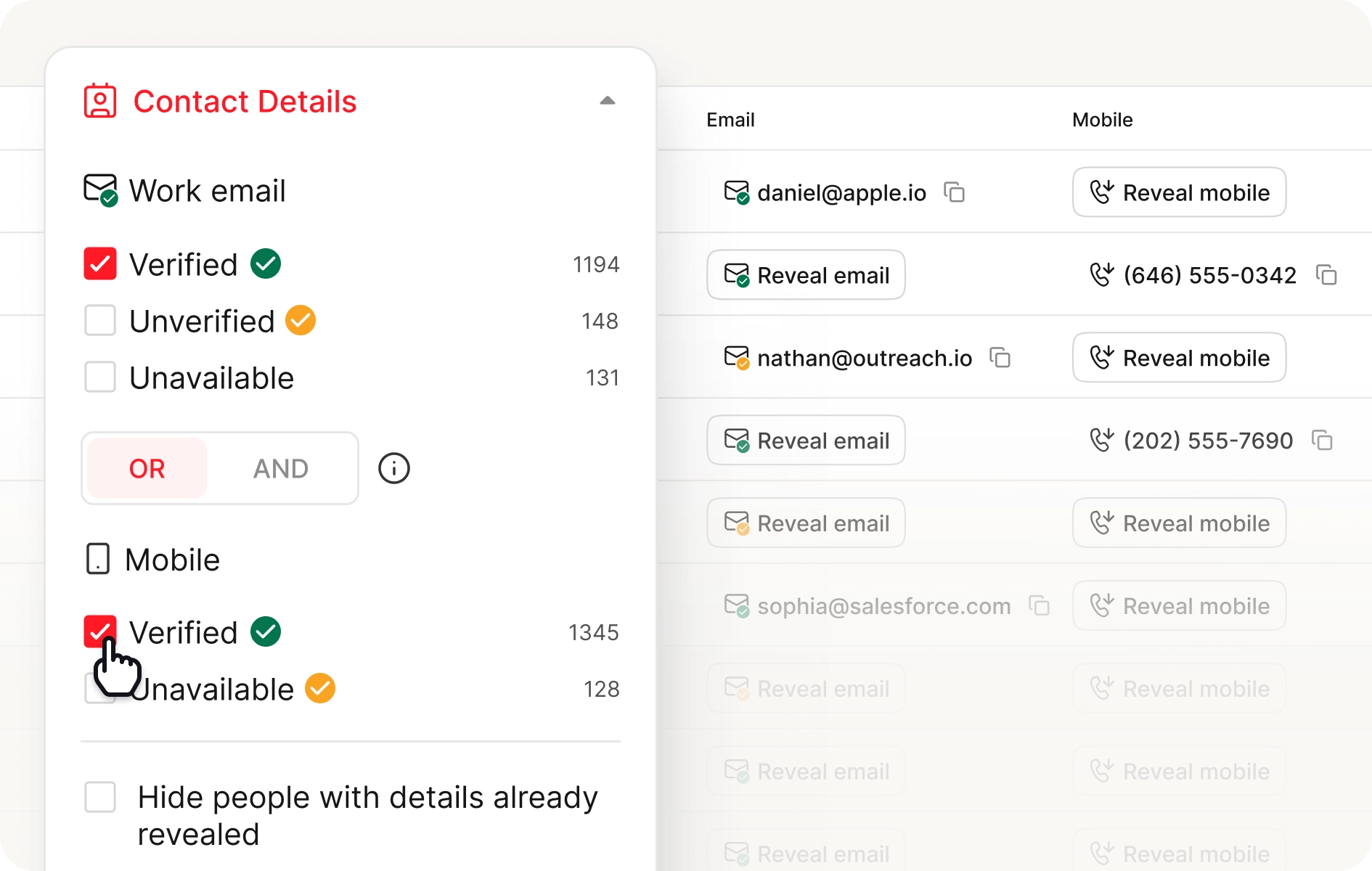
The search interface gives you 30+ filters including buyer intent data powered by Bombora intent data across 15,000 topics, technographics, job changes, and headcount growth signals. You're not just building a phone list - you're building a prioritized prospecting list of people who are actively in-market.
Data refreshes every 7 days, which is the real differentiator. The industry average is 6 weeks. That gap is the difference between calling a VP of Sales who's still at the company and calling a number that's been reassigned. Pricing runs about $0.01 per email; mobile numbers cost 10 credits each, roughly $0.10 per number on standard plans. The free tier gives you 75 emails and 100 Chrome extension credits monthly - no contracts, no sales calls required. For context, Meritt tripled their pipeline from $100K to $300K/week after switching, and their connect rate jumped to 20-25%.
Apollo.io
Apollo is the obvious starting point for bootstrapped teams. The free tier is genuinely generous, and paid plans start at $49/mo. For a team just getting started with outbound calling, the price-to-access ratio is hard to beat.
The tradeoff is data freshness. Apollo's refresh cycle runs slower, and we've seen accuracy rates dip on mobile numbers specifically. Phone coverage for director+ roles in North America runs about 60-70% match rate in our experience.
Use this if you're a small team with more time than budget and need a starting point. Skip this if your connect rate is already a problem - cheaper data won't fix data quality issues.
Cognism
Cognism's strength is European data and GDPR compliance. They scrub numbers against DNC lists in 12+ countries, which is table stakes if you're selling into EMEA. Coverage in the UK, DACH, and Nordics is strong.
Pricing runs ~$1,000/user/year. For US-only teams, Cognism doesn't make sense - ZoomInfo has deeper domestic coverage. For teams with European territory, it's worth a serious look. Cognism is the only tool on this list where EMEA compliance is baked in rather than bolted on.
Lusha
Simple Chrome extension, free tier, $36/mo for paid plans. The UI is clean and the learning curve is basically zero. Best for individual reps who need a number fast, not for building large-scale lists.
ZoomInfo
The enterprise incumbent. ZoomInfo does everything - intent data, workflow automation, chat, ABM orchestration. A typical contract runs $15,000-$40,000+/year depending on seats and modules.
Here's the thing: if all you need is phone numbers, ZoomInfo is dramatically overpriced. You're paying for an entire GTM platform when you need a data layer. One pattern we see repeatedly - teams buy ZoomInfo for the database, then realize they're paying for intent, chat, and workflow features they never turn on.
Traditional List Vendors
Exact Data, Salesgenie, US Data Corp - these vendors sell telemarketing lists and phone append services, typically delivered as CSV exports for dialers and CRMs. The core issue is the model itself: no real-time verification, no modern enrichment workflow, and no intent signals. If you're still buying CSVs from a list broker in 2026, you're leaving connect rate on the table.
Comparison Table
| Tool | Database | Verified Mobiles | Starting Price | Best For |
|---|---|---|---|---|
| Prospeo | 300M+ profiles | 125M+ | Free / ~$0.01/email | Verified mobiles + accuracy |
| Apollo.io | Large contact database | Available | Free / $49/mo | Bootstrapped teams |
| Cognism | Not public | Available | ~$1,000/user/yr | European/GDPR data |
| Lusha | Not public | Available | Free / $36/mo | Quick lookups |
| ZoomInfo | Large database | Available | ~$15,000/yr | Enterprise ABM |
| List vendors | Varies | Unverified | $0.10-$0.25/record | One-time dumps |
Compliance Checklist for 2026
Compliance isn't a burden - it's a competitive advantage. Teams that scrub properly get fewer spam flags from carriers, which means higher answer rates. The consensus on r/sales is that most "my connect rate tanked" posts trace back to caller ID reputation damage from sloppy DNC hygiene.
Pre-dial checklist:
- Scrub your list against the National DNC Registry every 31 days - there are 241M+ numbers on it
- Maintain an internal DNC list and add opt-outs immediately
- Honor opt-out requests within 10 business days
- Only call between 8 AM-9 PM in the prospect's local timezone
- Check state-level DNC lists (11 states maintain their own: CO, FL, IN, LA, MA, MO, OK, PA, TN, TX, WY)
Consent requirements by call type:
| Call Type | Consent Needed |
|---|---|
| Live call to landline | None if not on DNC |
| Live call to cell phone | Prior express consent |
| Robocall/prerecorded | Prior express written consent |
| Call to DNC number | EBR or express consent |
EBR (Existing Business Relationship) windows: 18 months from last transaction, 3 months from last inquiry. After that, you need fresh consent.
What changed in 2025: As of April 2025, consumers can revoke consent by any reasonable means - not just texting "STOP." You've got 10 business days to comply. You're allowed one confirmation message after a text opt-out, but it must go out within 5 minutes and contain zero marketing content.
What's changing in 2026: A broader FCC provision taking effect April 2026 requires opt-outs to apply across all message types and business units. This is a significant operational change - your marketing SMS opt-outs will need to flow through to your sales calling team. If your marketing and sales stacks don't share opt-out data today, fix that before April.
Penalties are real: $500-$1,500 per TCPA violation, up to $43,792 per call under the TSR. This isn't theoretical risk.
Optimize for Higher Connect Rates
We've audited dozens of outbound operations, and the same mistakes show up over and over. Here's what kills connect rates:
Skipping DNC scrubs. Beyond the legal exposure, calling DNC-registered numbers gets your outbound numbers flagged by carriers. Once you're flagged as spam, your connect rate craters across your entire calling operation. Not just that number - all your numbers.
Dialing stale, unvalidated data. If 30-40% of your list is outdated, nearly a third of your reps' time is wasted on disconnected numbers. Validate before loading into your dialer, every single time.
Ignoring line types. Calling landlines at companies where everyone works remotely is a zero-return activity. Filter for mobile numbers and skip the rest.
No segmentation. Dumping an unsegmented list into a power dialer means you're calling the wrong timezone, the wrong persona, or both. Segment by geography, then by warmth, then by intent signals.
Buying irrelevant third-party lists. Generic purchased lists with broad targeting increase complaint rates and carrier flagging. A tighter, ICP-matched list of 500 numbers will outperform a generic list of 5,000 every time. We've seen this play out with our own outbound - smaller, cleaner lists consistently win. (If you're rebuilding your outbound motion, start with a cold calling system that includes data hygiene.)
FAQ
How often should I update my calling list?
Scrub against the DNC registry every 31 days. Re-validate phone numbers quarterly - B2B contact data decays 30-40% per year. Platforms with weekly data refresh handle freshness automatically, so you're not manually chasing stale records.
Are mobile numbers better than landlines for cold calling?
Yes. Mobiles reach the person directly regardless of location. With remote work now the default, landlines at company HQs ring in empty rooms. Teams using verified mobiles see connect rates of 20-25% versus single digits on landline-heavy lists.
Can I buy a calling list legally?
You can, but the list must be DNC-scrubbed, and you still need prior express consent to call cell phones. The vendor won't handle compliance for you - that liability stays with the caller. Budget $0.25-$0.38 per usable record after accounting for 30-40% data decay.
What's a good connect rate for a B2B calling list?
The B2B average is about 16.6%. Below 10% means your data quality is the problem. Teams using verified, ICP-targeted data regularly hit 20-25%. The gap is almost entirely a data quality story, not a script or cadence issue.
Where can I get free calling list data?
Apollo.io offers a generous free tier. Company websites, industry directories, and chamber of commerce sites are also free sources - but you'll still need to validate numbers before dialing.
Purchased CSVs ship with 35% dead records and zero refresh guarantees. Prospeo refreshes every 7 days - not 6 weeks - so your reps dial current numbers for people who still hold the title you're targeting. At roughly $0.01 per verified contact, the math crushes any list vendor charging $0.25 for unverified names.
Replace your list vendor with data that's verified weekly.