

B2C Go-to-Market Strategy: A Practical 2026 Plan With Real Numbers
$15,000 in ad spend, zero repeat customers, and a Slack thread full of finger-pointing. That's what happens when a B2C go-to-market strategy runs on vibes instead of numbers.
This plan replaces vibes with CAC benchmarks, channel ROI data, pricing psychology, and a launch checklist you can execute this quarter.
Before You Spend a Dollar
Nail five deliverables before you touch ads or influencers:
- Buyer persona - one page, not a novel. Demographics, triggers, objections.
- Price point - tested, not guessed. Anchored against competitors.
- Primary channel - the one you'll win on first, with a backup.
- Budget number - a real CAC target tied to your LTV, not "whatever's left."
- Launch date - with a 90-day sprint plan and weekly review cadence.
Get these five right and the rest follows.
What a Consumer GTM Plan Actually Covers
A B2C go-to-market strategy takes a consumer product from "built" to "bought" - first impression through repeat purchase. It's not B2B. Cycles are shorter (minutes to days, not months), decisions are emotion-led, and buyers self-serve.
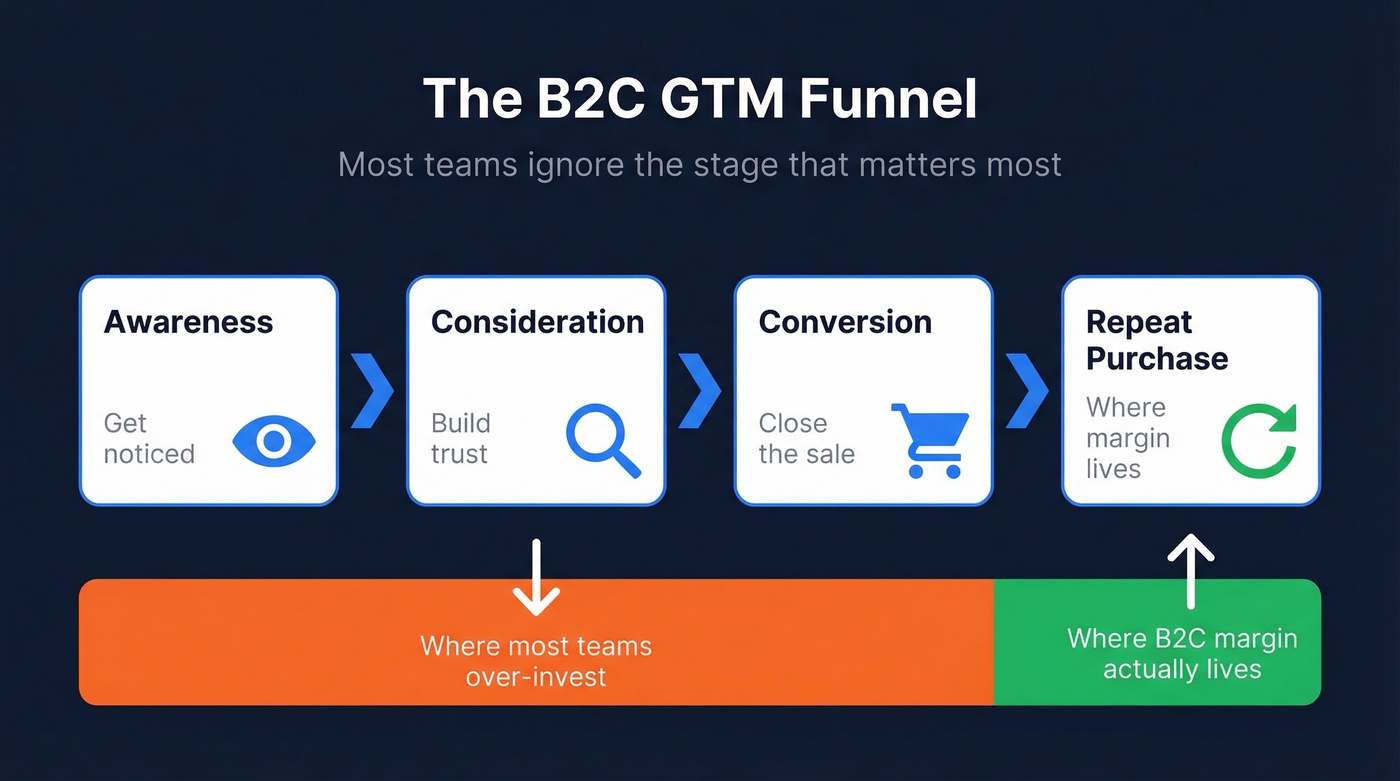
The funnel is simple: awareness, consideration, conversion, repeat. Most teams over-invest in awareness and completely ignore repeat purchase rate, which is where B2C margin actually lives. Your GTM plan needs to account for retention from day one - not as an afterthought bolted on six months post-launch.
Before you pick channels or set budgets, lock in your positioning: what problem you solve, for whom, and why you're different from the five competitors already in the market.
Start With Market Truth
Skip this step and you'll build a plan for a customer who doesn't exist.
- Demand signals - Google Trends for trajectory; SEMrush for competitor keyword gaps. 55% of product searches start on Amazon, so check Amazon search volume and reviews too.
- Behavior data - GA4 for on-site patterns; Hotjar for session recordings. Watch what people do, not what they say.
- Voice of customer - SurveyMonkey or Typeform for quick surveys; Brandwatch for social listening.
- Competitive positioning - map 5-7 competitors on price vs. feature axes. Find the gap they're ignoring.
The goal isn't a 40-page report. It's enough conviction to bet your first 90 days of budget on a specific customer, channel, and price.
Pricing: Your Highest-Leverage GTM Decision
Here's the thing - pricing is the single highest-leverage decision in your consumer launch plan. Get it wrong and no amount of marketing spend fixes it.
Use charm pricing for anything under $100. Prices ending in 9 or 99 lift sales by at least 24%, and some studies show up to 60%. There's a reason 60.7% of retail prices end in 9.
Use price anchoring if you have multiple tiers. Showing a higher "anchor" price next to your target increases perceived value by 32%. Put your most expensive option first. And don't sleep on launch discounts - 67% of consumers have made an impulse purchase based solely on a deal, and 80% will try a new brand because of a temporary price cut. That's your launch window right there.
Intelligems tested 811 price runs across DTC brands and found the median brand saw a 6% gross profit lift from pricing optimization alone. We've seen the same pattern across teams we work with: brands that nail pricing early spend half as much on acquisition. Run A/B price tests in your first 30 days. The data pays for itself.
Pick Channels by ROI, Not by Hype
Most teams spread budget across five channels and win on none. Pick one primary, one secondary, and ignore everything else until those two are profitable.
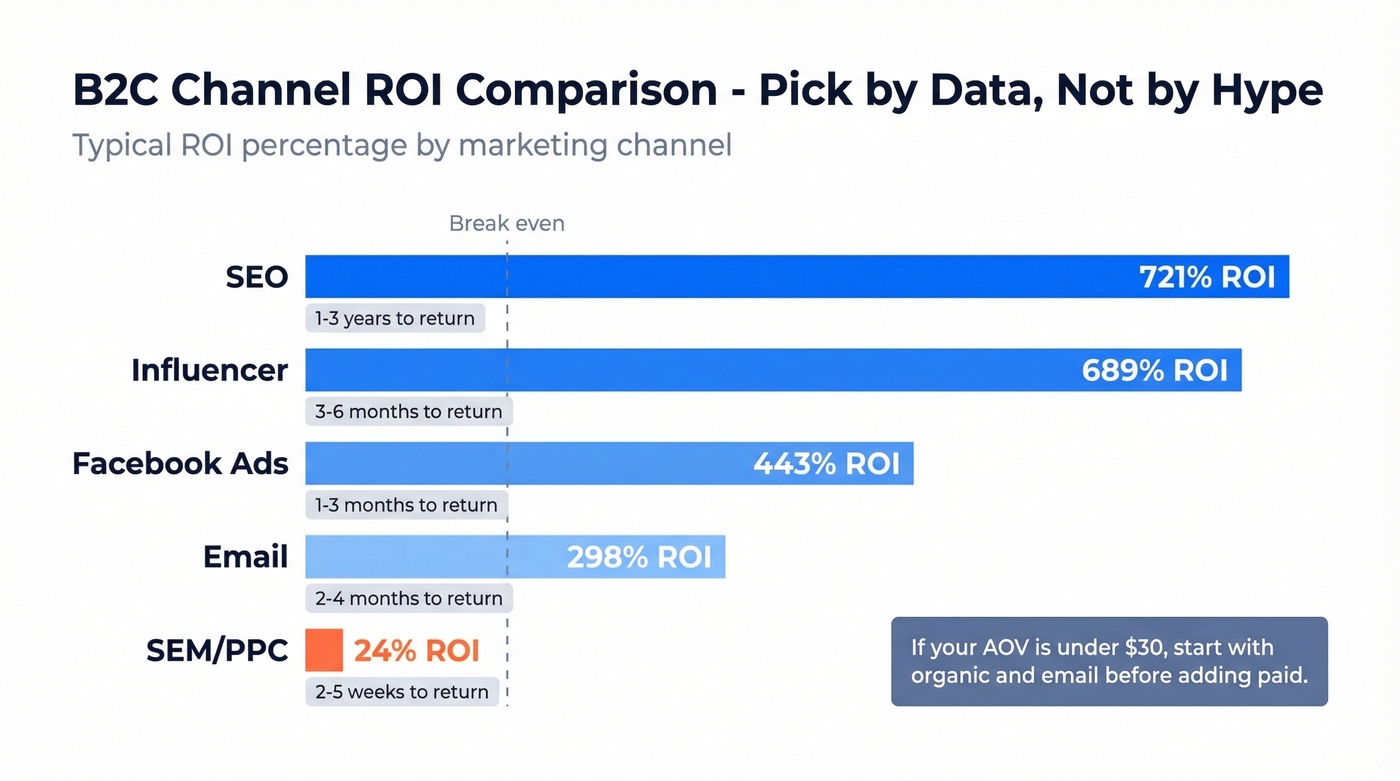
| Channel | Typical ROI | Time to Return | Monthly Cost | Best For |
|---|---|---|---|---|
| SEO | 721% | 1-3 years | $2k-$15k | Long-term compounding |
| Influencer | 689% | 3-6 months | ~$12k | Brand launch + trust |
| Facebook Ads | 443% | 1-3 months | ~$5k | Fast testing + scale |
| 298% | 2-4 months | $0.5k-$3k | Retention + repeat | |
| SEM/PPC | 24% | 2-5 weeks | $3k-$30k | Immediate demand capture |
Look at that spread. SEO and influencer crush PPC on long-term ROI, but PPC gets you data in weeks. If you've got 18+ months of runway, invest in SEO early. Need revenue this quarter? Start with Facebook Ads and layer in influencer.
If your average order value is under $30, you probably can't afford paid acquisition at all. Build organic and email first, then add paid once unit economics are proven.
For influencer and retail partnerships where you need verified contact data for outreach, Prospeo's free tier of 75 verified emails per month is a rounding error compared to your ad budget - useful for reaching retail buyers, influencers, or wholesale contacts directly.

Influencer outreach and retail partnerships drive the highest ROI in B2C launches - but only if you reach the right people. Prospeo gives you 98% accurate emails for influencers, retail buyers, and wholesale contacts at $0.01 per lead.
Stop DMing into the void. Get verified contact data for your GTM outreach.
Distribution Reality Check
"Shopify store + Meta ads" isn't a distribution strategy anymore. It's a starting point.
The brands winning B2C in 2026 run connected commerce - unifying DTC, Amazon, retail, and social into one system. A challenger beauty brand ran an integrated TikTok Shop campaign and saw retail sales jump 26% and Amazon conversions climb 29%. The halo effect across channels was the real win, not any single storefront.
Rising CAC, higher shipping costs, and fast category crowding mean single-channel DTC is a losing game. Build your GTM plan assuming you'll need at least two distribution channels within six months.
Set a CAC Budget That Holds Up
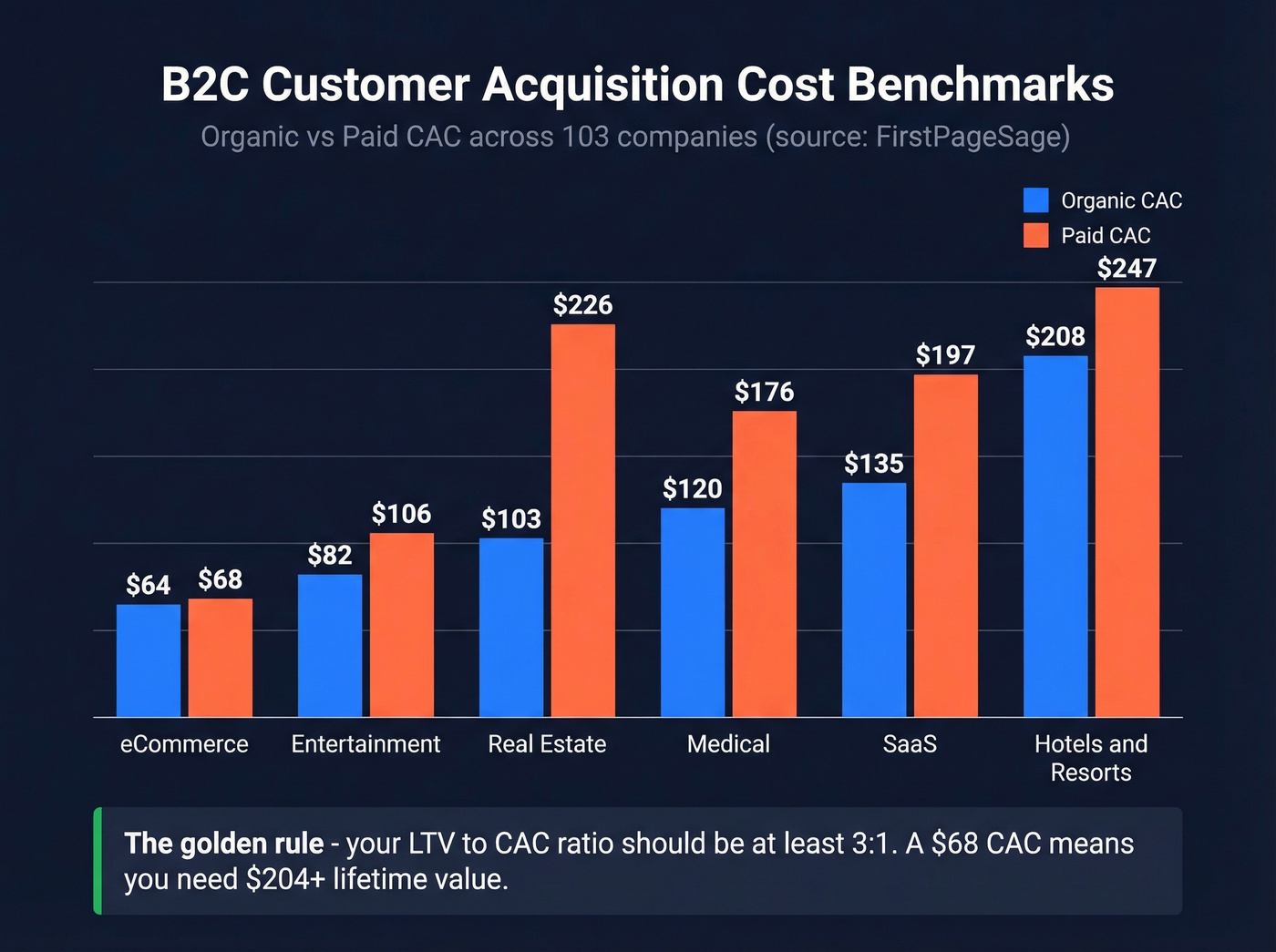
You can't manage what you don't measure. Here are real CAC benchmarks from FirstPageSage's study of 103 B2C companies:
| Industry | Organic CAC | Paid CAC |
|---|---|---|
| eCommerce | $64 | $68 |
| Entertainment | $82 | $106 |
| Hotels & Resorts | $208 | $247 |
| Real Estate | $103 | $226 |
| Medical | $120 | $176 |
| SaaS | $135 | $197 |
The rule of thumb: your LTV:CAC ratio should be at least 3:1. Spending $68 to acquire an eCommerce customer means that customer needs to be worth $204+ over their lifetime. If the math doesn't work, fix your retention or your pricing before you scale spend.
We've seen teams pour money into paid acquisition with a 1.5:1 ratio and wonder why they're bleeding cash. The CAC table tells you whether your unit economics are real or imaginary.
Launch, Measure, Iterate
Your launch isn't a moment. It's a 90-day sprint.
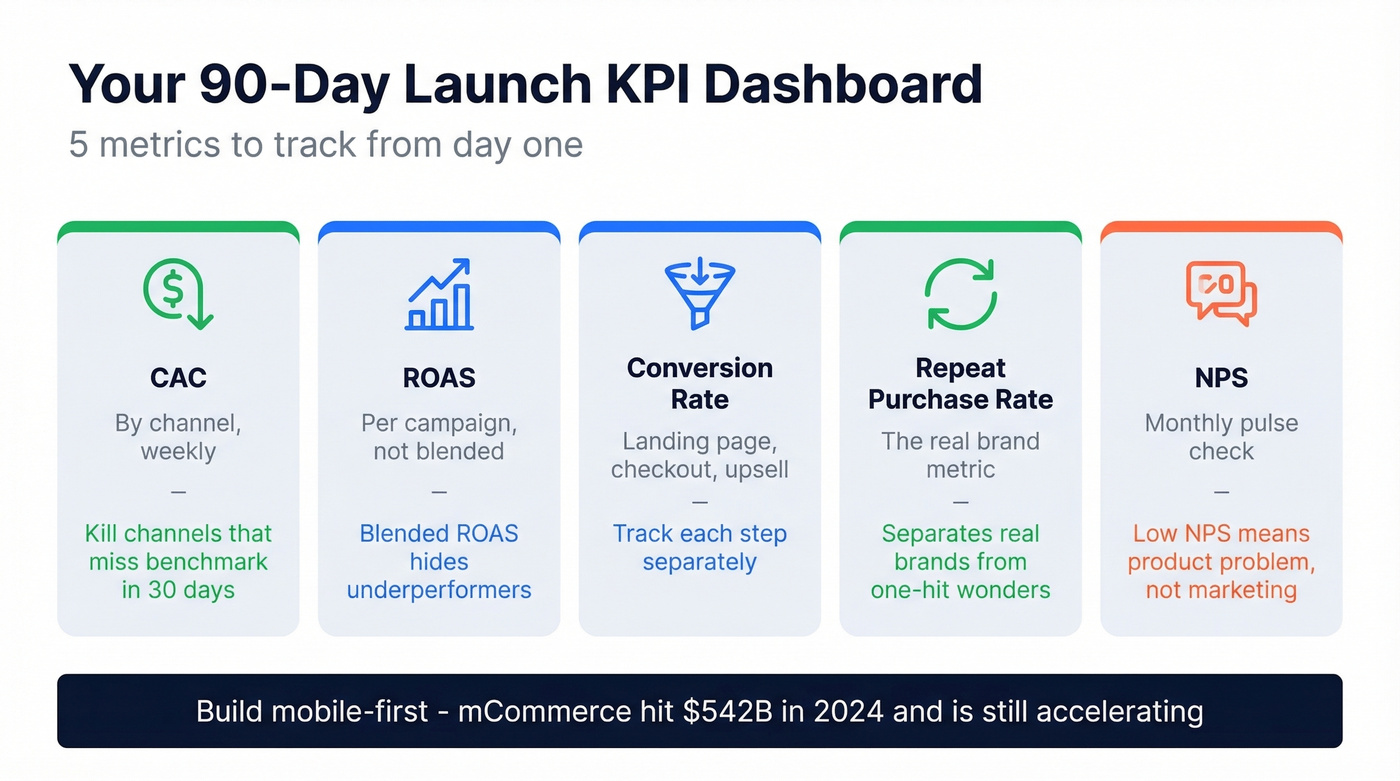
Track these KPIs from day one:
- CAC - by channel, weekly. Kill channels that don't hit your benchmark within 30 days.
- ROAS - per campaign, not blended. Blended ROAS hides underperformers.
- Conversion rate - landing page, checkout, and upsell separately.
- Repeat purchase rate - the metric that separates real brands from one-hit wonders.
- NPS - monthly pulse. If it's consistently low, you've got a product problem, not a marketing problem.
Build mobile-first. mCommerce passed $542B in 2024 and it's still accelerating. If your checkout isn't optimized for a phone screen, you're leaving money on the table.
Your GTM Plan Template
Don't build from scratch. The GTM Strategy Blueprint on Miro includes 14 guided boards covering strategy and context (Power Hour kickoff, product roadmap, ICP definition, competitive analysis), GTM planning (positioning, pricing, customer journey mapping, campaign planning), and execution (growth loops, KPI tracking, sprint meetings). Use it as a completeness audit - if your plan doesn't address all 14 components, you've got gaps. Miro's startup program offers $500-$1,000 in credits, so tooling cost is minimal.
Mistakes That Kill a B2C Launch
"Do it all" syndrome. Focus on 1-3 initiatives that drive revenue. Everything else is a distraction.
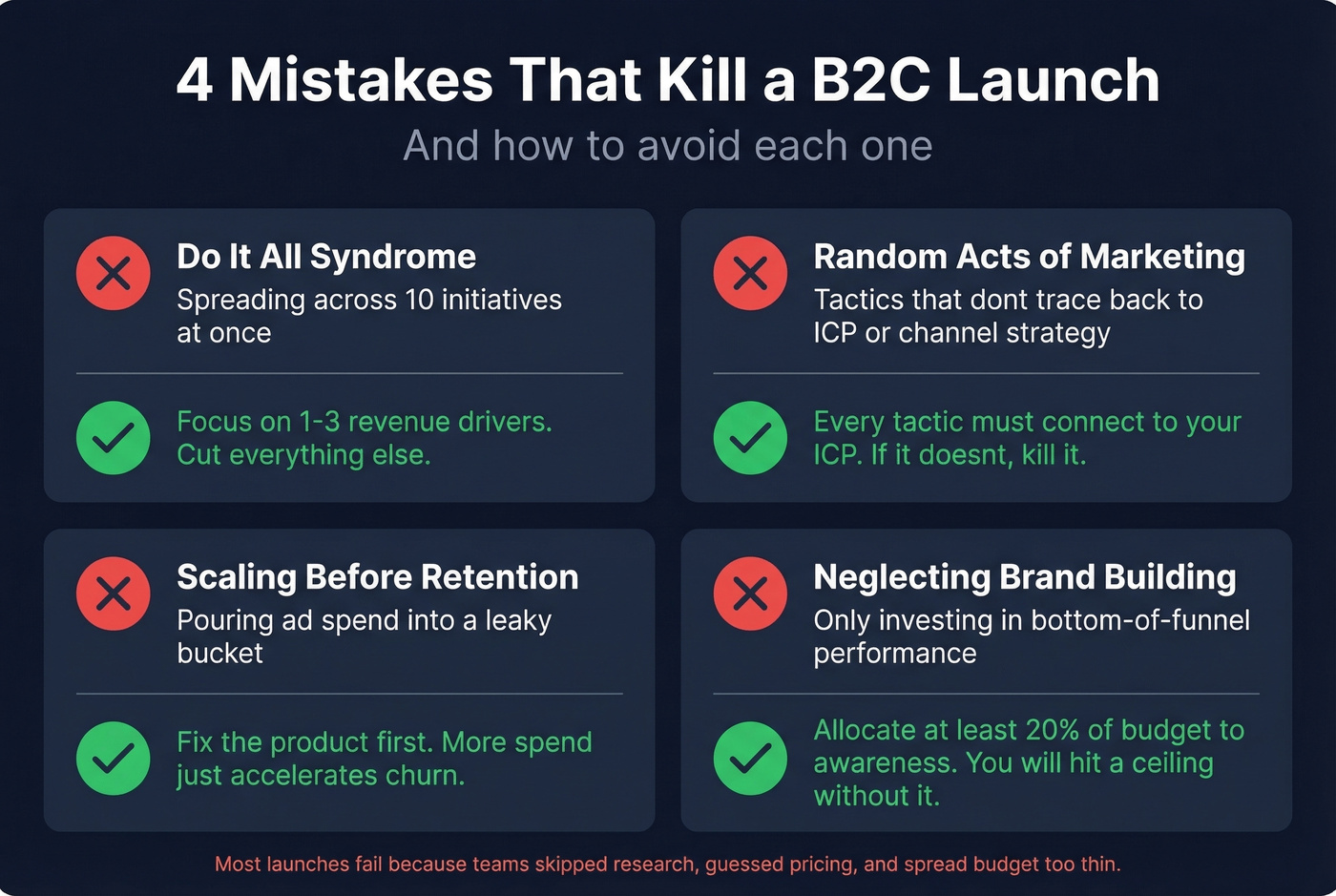
Random acts of marketing. Every tactic should trace back to your ICP and channel strategy. If it doesn't, cut it. Let's be honest - most marketing calendars are wish lists, not strategies.
Scaling before retention. If your product isn't retaining users, more spend just accelerates churn. Fix the product first.
Neglecting brand building. Bottom-of-funnel is measurable and addictive. But brands that skip top-of-funnel hit a ceiling fast. Allocate at least 20% of budget to awareness.
Most B2C launches don't fail because of bad marketing. They fail because the team skipped research, guessed at pricing, and spread budget across too many channels. Go back to the five deliverables at the top. If you can fill in each one with a real number and defend it, your go-to-market strategy is ready to execute.
If you can't, you're not ready to launch. And that's fine - better to know now than after the $15K is gone.
Your CAC budget is tight enough without wasting spend on bounced outreach. Prospeo's 5-step email verification keeps bounce rates under 4% - so every dollar of your B2C launch budget actually reaches a real person.
75 free verified emails per month. Zero risk to your sender reputation.