

BANT Qualification: What Every Rep Gets Wrong (and How to Actually Use It)
You've been on the call for 45 minutes. Discovery questions are flowing. The prospect sounds engaged. Then you ask about next steps and hear: "Oh, I'd need to run this by my VP. And honestly, we don't have budget allocated for this yet."
You just spent the better part of an hour qualifying an individual contributor who can't buy anything. Salesforce research shows 84% of reps missed quota last year, and a big chunk of that waste traces back to exactly this moment - qualifying the wrong person, at the wrong time, with the wrong questions.
BANT qualification isn't the problem. The way most teams use it is.
The Short Version
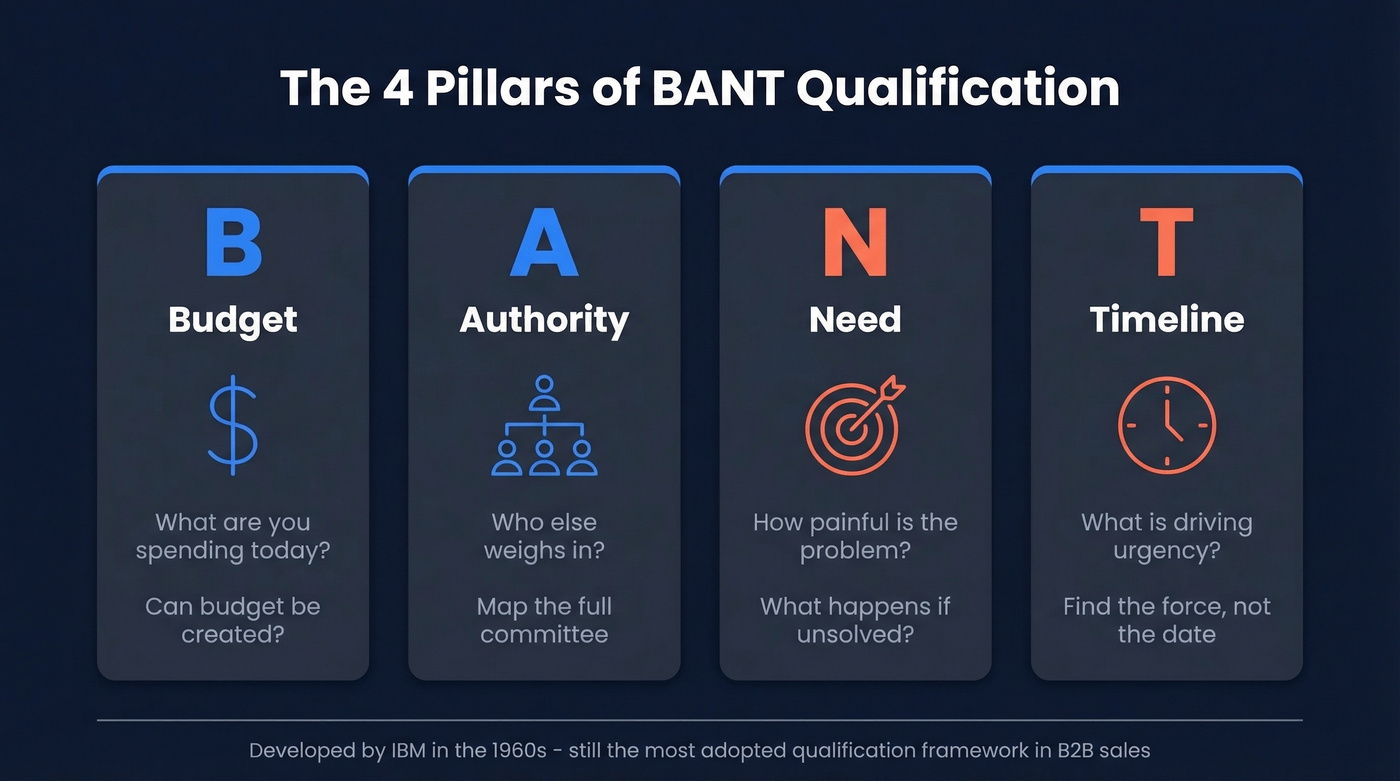
BANT is a lead qualification framework - Budget, Authority, Need, Timeline - developed at IBM in the 1960s. It's a strong fit for transactional and SMB deals under $25K with sub-60-day cycles. For enterprise deals north of $50K with 3+ month cycles, switch to MEDDIC.
The real issue isn't the framework itself. It's using BANT as an interrogation script instead of a research-and-validate workflow. What follows is the scorecard template, the comparison matrix, and the modern implementation playbook that actually moves pipeline.
What Is the BANT Framework?
BANT stands for Budget, Authority, Need, and Timeline. IBM developed it in the 1960s as a way to quickly qualify leads before passing them to account executives. Six decades later, the core logic hasn't changed. The framework remains one of the most widely adopted methods for separating real opportunities from time-wasters - and for good reason.
Why BANT Still Matters in 2026
The B2B buying environment has gotten dramatically more complex. Gartner projected that 80% of B2B sales interactions would happen in digital channels by 2025, and that trajectory has held. Buyers spend just 17% of their buying time meeting with suppliers. The rest is independent research, internal alignment, and committee deliberation. The average buying committee for a mid-sized firm runs about 7 people across multiple functions.
In this environment, qualification isn't optional - it's survival. SQLs convert to opportunities at 20-30%, while MQLs limp along at 5-15%. The difference? Proper lead qualification before a deal enters the pipeline.
Every qualification methodology - MEDDIC, CHAMP, SPIN, GPCTBA/C&I - boils down to the same fundamentals: need, budget, stakeholders, timeline. BANT just got there first. And here's the adoption principle most teams ignore: a simple framework used by 100% of the team beats a sophisticated framework used by 30%. BANT's simplicity is its superpower. Four pillars, easy to remember, easy to coach, easy to enforce in a CRM.
Here's the thing: if your average deal closes under $15K, you almost certainly don't need MEDDIC-level complexity. BANT used consistently will outperform a sophisticated framework that half your team ignores.
The Four Pillars of BANT
Budget: Beyond "What's Your Budget?"
Asking "What's your budget?" point-blank is the fastest way to get a non-answer or a lie. The modern approach is to uncover spending behavior, not a dollar amount.
Try these instead:
- "How are you handling this problem today, and what's that costing you?"
- "Have you invested in a solution like this before? What did that look like?"
- "If we could show a 3x ROI, is there a process to get budget allocated?"
Listen for references to existing vendor spend, mentions of budget cycles like Q4 planning, or language about building a business case. These signals tell you whether budget is real, possible, or fictional - without putting the prospect on the spot.
Authority: Map the Committee, Not the Contact
Single-threading a deal through one contact is the most common way to lose it. We've seen it kill more deals under $50K ACV than any other mistake. Modern B2B purchases involve committees, not individuals. Your job is to identify the decision-maker, the influencer, and the budget holder - they're often three different people.
Questions that actually work:
- "Who else would need to weigh in on a decision like this?"
- "Walk me through how your team evaluated the last tool you bought."
- "What does the approval process look like once you've decided to move forward?"
Multi-threading isn't just a nice-to-have. It's insurance against your champion leaving the company mid-deal. Use a B2B data platform like Prospeo to find verified direct dials for every stakeholder in the buying committee, so you're never one departure away from a dead deal.
Need: Earn the Right to Ask
Here's what the worst implementations get wrong: they treat Need as a checkbox. "Do you have a need? Yes/No." That's useless.
The subtler mistake is jumping straight into need-probing questions before you've delivered any value. You earn the right to ask deep questions by demonstrating you've done your homework first. Pre-call, you should already know the prospect's tech stack, recent funding, headcount growth, and competitive landscape. The discovery call isn't where you learn they have a problem - it's where you learn how painful that problem is and whether it's painful enough to act on.
Lead with an insight about their business, then go deeper:
- "You mentioned [specific pain]. How is that affecting your team's numbers?"
- "What happens if you don't solve this in the next 6 months?"
- "What's the cost of doing nothing?"
A prospect who's tried to solve this problem and failed is far more qualified than one who's "just exploring." Listen for emotional language, specific metrics about the problem's impact, and evidence of previous attempts.
Timeline: Find the Driver, Not the Date
"When are you looking to make a decision?" gets you a polite fiction. Timelines are driven by forces, not calendar dates. Your job is to find the driver.
| Driver Type | Example | What It Tells You |
|---|---|---|
| Budget cycle | Fiscal year-end in 6 weeks | Hard deadline - real urgency |
| Competitive threat | Rival just launched a feature | Emotional urgency - may accelerate |
| Implementation bandwidth | Team has capacity in Q2 only | Logistical constraint - shapes timing |
| Leadership change | New VP wants quick wins | Political urgency - strong but volatile |
Surface these with questions like "What's pushing this to the top of the priority list right now?" and "Is there an event or deadline that makes this time-sensitive?" When a prospect says "we're looking at Q3," dig into why Q3. The driver tells you whether the timeline is real or aspirational.

BANT qualification falls apart when you can't reach the full buying committee. Prospeo gives you verified emails (98% accuracy) and direct dials for every stakeholder - decision-makers, influencers, and budget holders - so you never single-thread a deal again.
Multi-thread every deal with contacts that actually connect.
How to Build a BANT Scorecard
Every guide tells you to build a scorecard. None of them show you one that works.
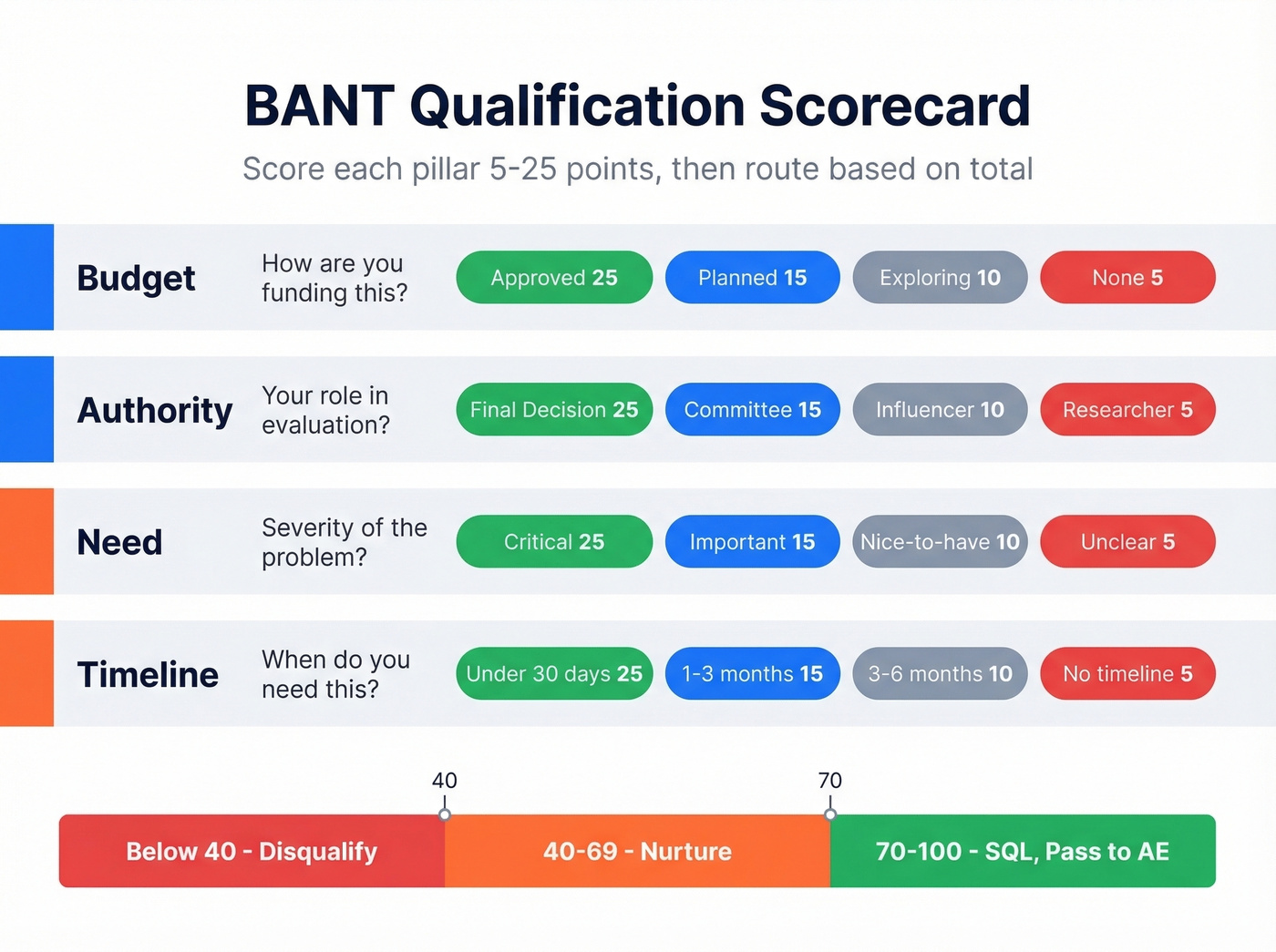
Most teams have $2M in "pipeline" where half the opportunities have "TBD" in the budget field and a single contact who hasn't responded in three weeks. A scorecard fixes this by forcing honest answers and routing leads based on evidence, not vibes.
| Pillar | Sample Question | Answer Options | Points |
|---|---|---|---|
| Budget | How are you funding this? | Approved: 25 / Planned: 15 / Exploring: 10 / None: 5 | 5-25 |
| Authority | Your role in evaluation? | Final decision: 25 / Committee: 15 / Influencer: 10 / Researcher: 5 | 5-25 |
| Need | Severity of the problem? | Critical: 25 / Important: 15 / Nice-to-have: 10 / Unclear: 5 | 5-25 |
| Timeline | When do you need this? | <30 days: 25 / 1-3 mo: 15 / 3-6 mo: 10 / No timeline: 5 | 5-25 |
Threshold bands: 70+ = SQL (pass to AE), 40-69 = nurture (keep in sequence), below 40 = disqualify (recycle to marketing). This scoring approach replaces gut feelings with repeatable data.
For Salesforce teams, the cleanest implementation uses Custom Metadata Types for your questions and answer options, a BANT Score child object on Opportunity to store responses, and a record-triggered Flow that auto-creates score records when an opportunity is created. The beauty of this approach is that you can update questions and scoring without touching automations - just edit the metadata.
Ship it, use it for 30 days, then adjust the weights based on which scores actually correlate with closed-won deals. Perfection on day one isn't the goal. Adoption is.
BANT vs. MEDDIC vs. CHAMP
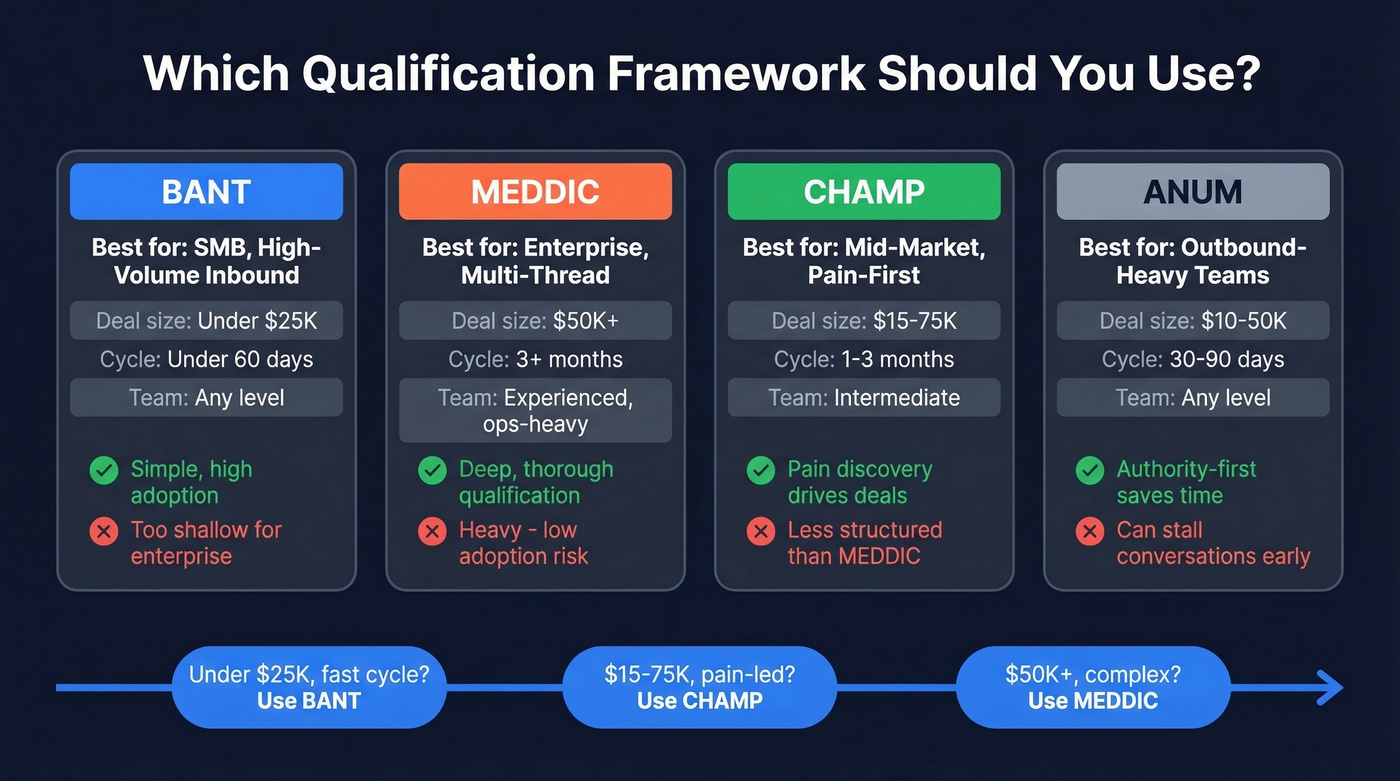
Match the framework to the deal, not to what your VP read on a blog last week.
| Framework | Best For | Deal Size / Cycle | Team Maturity | Key Weakness |
|---|---|---|---|---|
| BANT | SMB, high-velocity inbound | <$25K / <60 days | Any level | Too shallow for complex deals |
| MEDDIC | Enterprise, multi-thread | $50K+ / 3+ months | Experienced, ops-heavy | Heavy; low adoption risk |
| CHAMP | Mid-market, pain-first | $15-75K / 1-3 months | Intermediate | Less structured than MEDDIC |
| ANUM | Outbound-heavy teams | $10-50K / 30-90 days | Any level | Authority-first can stall |
BANT shines in high-volume environments where reps need to triage fast - inbound leads, SDR qualification, transactional sales. It breaks down when deals involve multiple stakeholders, budgets that get created after a business case, and timelines that shift mid-cycle. That's where MEDDIC earns its complexity.
CHAMP flips the order to Challenges first, which works well for mid-market teams where pain discovery drives the conversation. ANUM puts Authority first, which makes sense for outbound motions where you don't want to waste time on non-buyers.
Let's be honest: most teams overthink framework selection. If your average deal is under $25K and closes in under two months, use BANT. Over $50K with 3+ month cycles? MEDDIC. Everything in between? Pick one and commit. The framework matters less than whether your team actually uses it consistently.
Five Mistakes That Kill Deals
1. Running it as an interrogation. If your discovery call sounds like a survey - "Do you have budget? Who's the decision-maker? What's your timeline?" - the prospect checks out. BANT is a research framework, not a script.
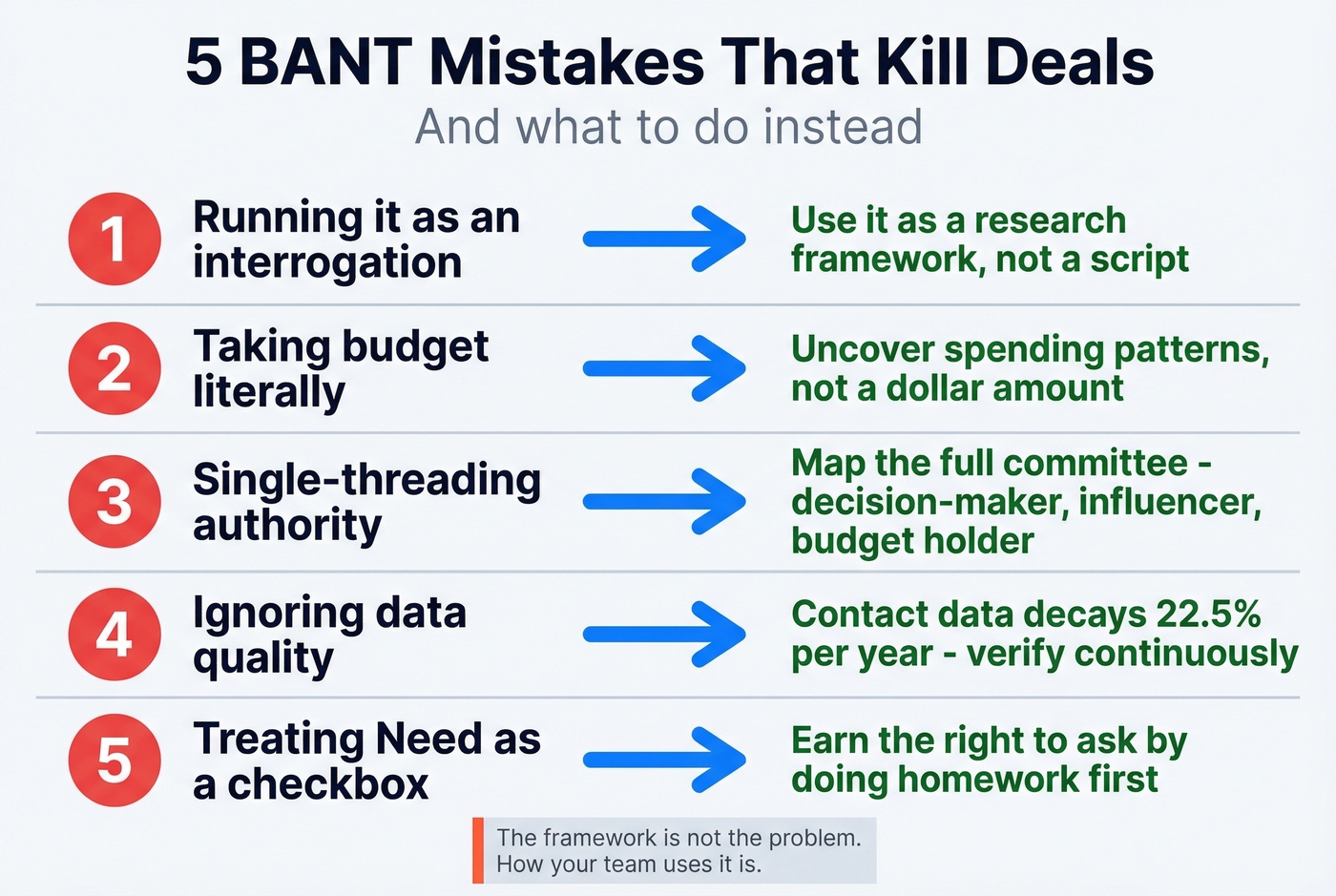
2. Taking budget literally. Asking "What's your budget?" in the first 10 minutes is a rookie move. Budget often doesn't exist until you've built the business case. Uncover spending patterns and willingness to invest, not a pre-approved number.
3. Single-threading authority. You found the VP. Great. But the VP has a CFO who controls budget, a director who'll own implementation, and a legal team that'll review the contract. One contact isn't a deal - it's a single point of failure.
4. Ignoring data quality. Your scorecard is only as good as the data feeding it. Contact data decays roughly 22.5% annually - that's nearly a quarter of your database going stale every year. Reps end up qualifying ghosts: bounced emails, disconnected numbers, people who left the company six months ago. Prospeo verifies emails with 98% accuracy on a 7-day refresh cycle, so your reps aren't wasting discovery calls on dead data.
5. Forcing answers that create fiction. When you require budget and timeline fields on top-of-funnel forms, buyers guess. Your team then treats those guesses as facts, and qualification turns into fiction. Use budget ranges instead of open text, role-in-evaluation dropdowns instead of free-form title fields, and timeline ranges instead of specific dates. And don't treat BANT as a one-call event - budget changes, champions leave, timelines slip. Progressive qualification means revisiting your scorecard at every major deal stage.
Your scorecard is only as good as the data behind it. Pre-call research on tech stack, funding, and headcount growth takes hours - unless you use Prospeo's 30+ filters and intent data across 15,000 topics to qualify leads before the first conversation even starts.
Qualify leads with real data, not discovery call guesswork.
Modernizing BANT for 2026
Pre-Call Research Beats Live Interrogation
The biggest shift in modern qualification is when it happens. The old model: get on a call, ask questions, score the lead. The modern model: research accounts before the call, validate hypotheses during the conversation, confirm post-call with CRM enrichment.
Before you dial, you should already know whether the company shows budget signals like recent funding or headcount growth, who the likely stakeholders are, what their pain points probably look like based on industry and stage, and whether a timeline driver exists. The discovery call then becomes a confirmation conversation, not a fishing expedition. In our experience, this approach cuts discovery call time significantly while improving qualification accuracy.
AI Signal Mapping
The next evolution is mapping behavioral signals directly to BANT dimensions. A prospect visiting your pricing page three times is a Budget signal. Multiple stakeholders from the same company engaging with your content is an Authority signal - the committee is forming. ROI calculator downloads map to Need. Competitive comparison page visits suggest Timeline urgency.
AI-powered tools can now extract these signals from emails, calls, and product usage data, writing structured, confidence-scored fields directly into your CRM. Standardize your fields - Budget status, Authority map, Need severity, Timeline milestones - and attach confidence scores so reps know which signals need human validation. Teams that layer these signals into their qualification process see meaningfully higher SQL-to-opportunity conversion rates because reps enter calls already knowing which pillars are strong and which need probing.
Skip this approach if your team runs fewer than 50 qualified calls per month. The setup cost won't justify itself at low volume. For high-velocity teams, though, it's a force multiplier.
FAQ
Is BANT qualification outdated?
No. The fundamentals of need, budget, stakeholders, and timeline are universal to every B2B sale. What's outdated is using BANT as a rigid checklist where you interrogate prospects on a single call. Modernize it into a research-and-validate workflow with CRM scoring and it's as relevant in 2026 as ever.
How many BANT criteria must be met to qualify?
Most teams require 3 of 4 pillars satisfied, but a weighted scorecard with point thresholds - say, 70 out of 100 - is more reliable than binary yes/no checks. A prospect with strong Need, clear Authority, and a real Timeline but no formal budget yet often converts better than one who checks all four boxes weakly.
Can you combine BANT with MEDDIC?
Yes. Use BANT for initial triage at the SDR level for inbound leads and high-volume motions, then graduate deals that clear the threshold into MEDDIC for enterprise-level discovery. BANT handles "should we pursue this?" while MEDDIC handles "how do we win this?" Most hybrid teams see faster top-of-funnel velocity without sacrificing deal depth.
What's the biggest reason BANT fails?
Bad data. If 22.5% of your contacts go stale every year and reps can't reach the right stakeholders, no framework saves your pipeline. A 7-day data refresh cycle and 98% email accuracy - the kind of numbers we see with Prospeo - ensure reps actually connect with the people who matter. That's the prerequisite for every qualification question you'll ask.
What tools help automate BANT scoring?
CRMs like Salesforce and HubSpot support custom scoring objects and automation flows. For the data layer, enrichment APIs that return 50+ data points per contact feed your scorecard with verified titles, departments, and direct dials so reps score against real information instead of stale records.