

BATNA Negotiation: How to Calculate, Strengthen, and Use Your Best Alternative
You got an $85K offer. It's decent - not great, not insulting. But you don't have a competing offer in hand, and the hiring manager knows it. You're about to negotiate from the weakest possible position: no alternative.
That's a BATNA problem, and it's the single most common reason people leave money on the table.
Here's the short version. BATNA stands for Best Alternative to a Negotiated Agreement - the best thing you can do if this deal falls apart. Your alternative is only worth what the math says: EV = S(pi x outcomei) - switching costs. And the #1 mistake? Impasse aversion. In one study, framing a worse deal as "Agreement" made 24.55% of participants choose it over a better option labeled "Impasse." Only 3.99% took the bad deal in the control group. People hate walking away so much they'll accept terrible terms to avoid it.
What Is BATNA?
BATNA stands for Best Alternative to a Negotiated Agreement. It's the strongest option available to you if the current negotiation fails. Not your dream outcome, not a vague backup plan - your best realistic alternative to saying yes.
Roger Fisher, William Ury, and Bruce Patton introduced the concept in Getting to Yes, published in 1981 through the Harvard Negotiation Project. The book has been translated into 30+ languages and was moving roughly 3,500 copies per week in the U.S. as of a 2006 retrospective.
Think of it this way: replaceability equals power. Whichever side can be more easily replaced has less leverage. If you're a buyer with three qualified vendors, you're hard to replace - the vendor needs you more than you need them. If you're a job candidate with zero competing offers, you're easy to replace. The hiring manager's alternative (other candidates) is stronger than yours (unemployment or staying put). Every negotiation tactic, script, and framework traces back to this asymmetry.
Why Your Best Alternative Matters
BATNA isn't a backup plan you hope you'll never need. It's your primary strategy, and it serves three distinct functions.
Decision benchmark. Your BATNA sets the accept/reject threshold. Any offer worse than your best alternative should be rejected. A seller whose alternative is $18K from another buyer shouldn't accept $16K. A candidate with a $95K offer elsewhere shouldn't take $82K unless non-monetary terms close the gap.
Walk-away power. A strong alternative gives you credible leverage - and the other side can feel it. Procurement teams with multiple vendor bids negotiate harder because they genuinely can walk. A real estate buyer with a cash offer and fast close becomes less replaceable, shifting the dynamic entirely.
Automatic trigger. When the deal on the table drops below your BATNA's value, you leave. No agonizing, no "let me think about it." The math already decided. This is where most people fail - they know their best alternative but can't pull the trigger because walking away feels like losing. It isn't. Accepting a bad deal is losing.
BATNA vs. WATNA vs. MLATNA
Smart negotiators evaluate three scenarios before sitting down.
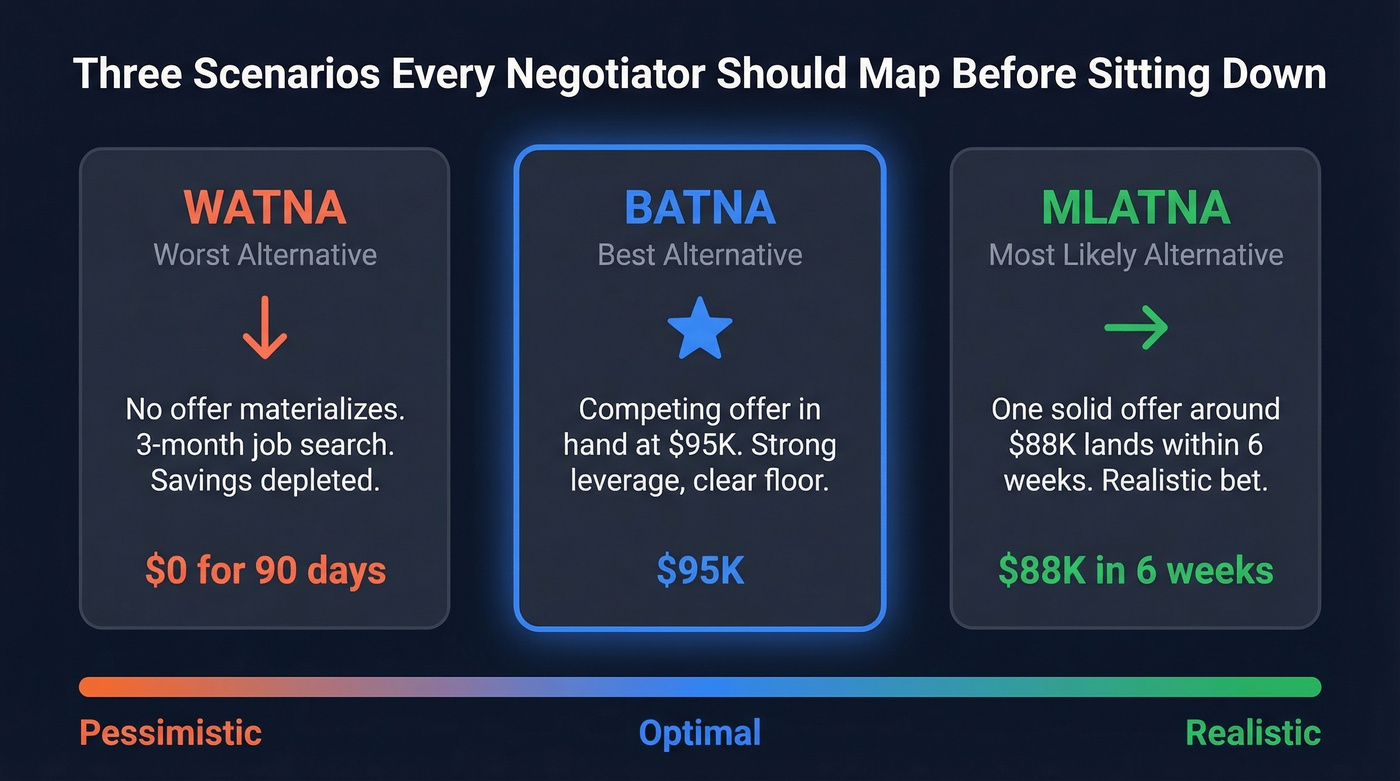
| Term | Definition | When to Use | Example |
|---|---|---|---|
| BATNA | Best alternative if you walk | Setting your floor | Another job offer at $95K |
| WATNA | Worst alternative if you walk | Stress-testing risk | No offer, 3-month job search |
| MLATNA | Most likely alternative | Realistic planning | One offer at $88K within 6 weeks |
WATNA forces you to confront the downside. If your BATNA is "take the other offer," your WATNA might be "that offer falls through and I'm unemployed for three months." MLATNA sits between the two - the outcome you'd bet on if you had to pick one.
Running all three prevents negotiations from drifting on unrealistic beliefs about what happens if you walk away. We've seen teams overestimate their alternatives so badly that they torpedoed a solid deal chasing a fantasy. Don't be that team.
How to Calculate Your BATNA
Identify Alternatives in 4 Steps
Step 1: List every alternative. Not just the obvious ones. If you're negotiating a vendor contract, your alternatives include other vendors, building in-house, doing nothing, or renegotiating scope with the current vendor. Cast a wide net.
Step 2: Evaluate each on equivalent terms. This is where most people get sloppy - and in our experience, it's the step that gets skipped most often. A PON analysis of insurance negotiations shows the trap clearly: an insurer raised rates 7% and 10% annually over three years. An alternative policy looked 30% cheaper - until the buyer compared exclusions, definitions, and coverage limits. The "cheaper" option was actually weaker. Always translate alternatives into apples-to-apples terms before comparing.
Step 3: Select the best. You have one BATNA - the single strongest alternative. You might have five options, but only the best one counts.
Step 4: Convert to a reservation range. Don't anchor on a single number. Your BATNA-driven floor is the minimum you'd accept; your optimistic ceiling reflects the best realistic interpretation. A reservation range gives you flexibility without losing discipline.
Calculate Expected Value
For straightforward alternatives, the math is simple: Initial Result - Costs = Final Outcome. If your alternative is a $100K job offer that requires relocating ($15K in moving costs), your BATNA's value is $85K in year-one terms.
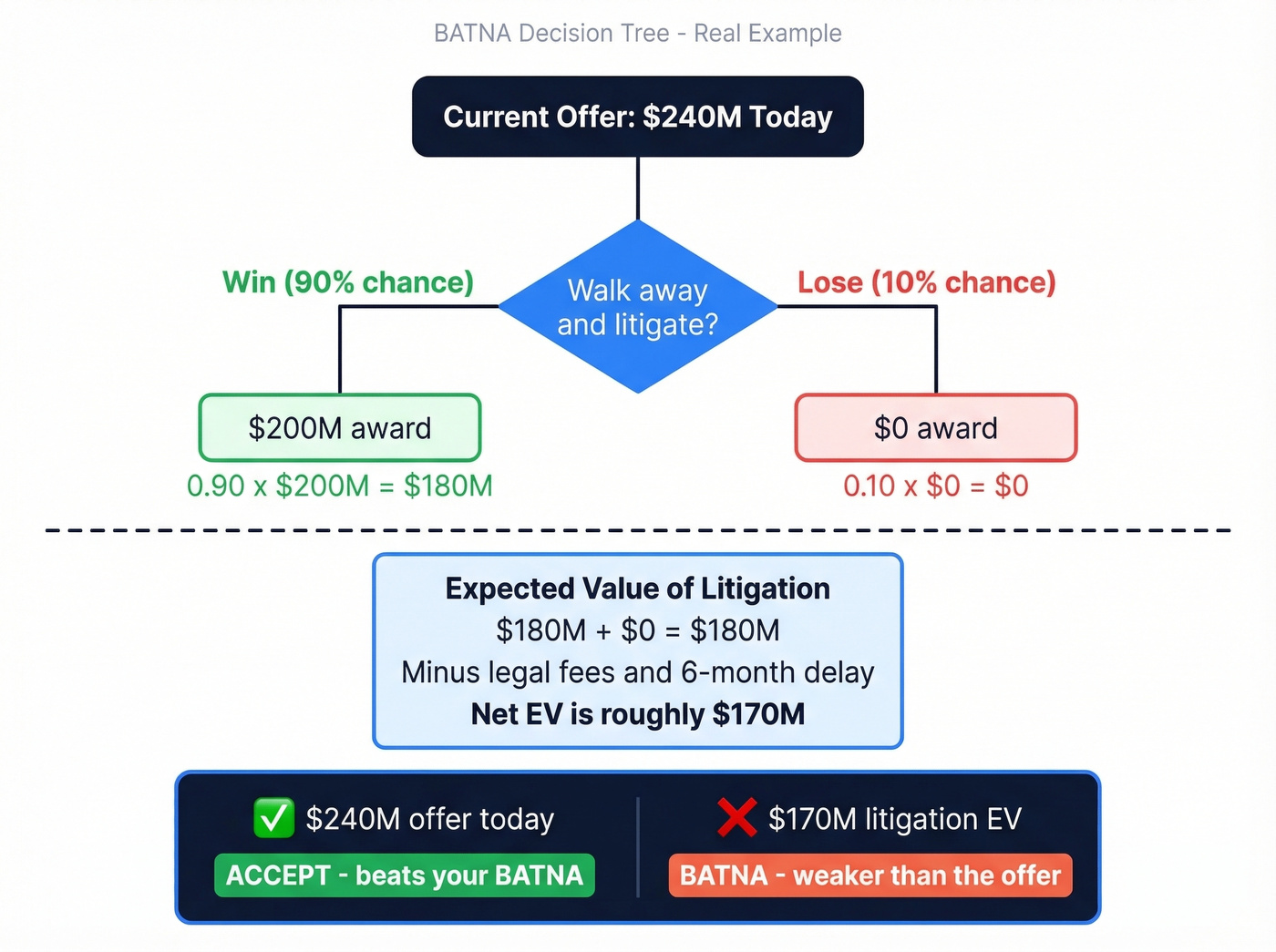
For uncertain alternatives, use expected value: EV = S(pi x outcomei) - switching costs
Here's a worked example from PON's decision-tree framework: you're offered $240M today. Your alternative is litigation with a 90% chance of winning $200M in six months. The expected value of litigation is (0.90 x $200M) = $180M. Suddenly $240M today is the obvious choice - even with a 90% win probability.
Your best alternative is only as strong as the math behind it. Gut feelings about alternatives are how people end up rejecting good deals for fantasies.

The best BATNA in sales is a pipeline full of qualified buyers. Prospeo gives you 300M+ profiles with 98% email accuracy and 30+ filters - so you always have alternatives when a deal stalls.
Stop negotiating from desperation. Start prospecting with data that connects.
Reservation Price and ZOPA
Your BATNA determines your reservation price, which defines the boundaries of the ZOPA (Zone of Possible Agreement).
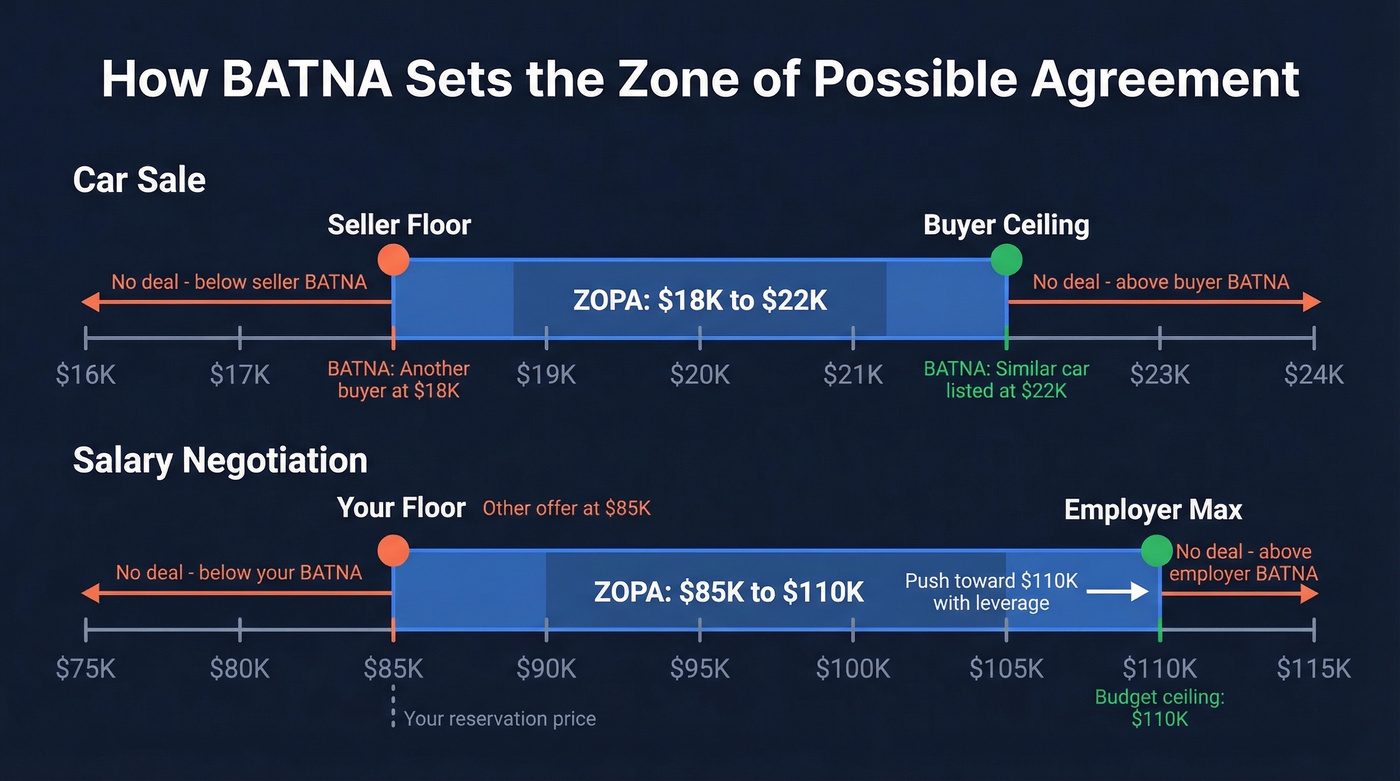
Say you're selling a car. Your best alternative is another buyer willing to pay $18K, making your reservation price roughly $18K - you won't accept less because you have a better option. The buyer's alternative is a similar car listed at $22K elsewhere, so their reservation price is $22K. The ZOPA exists between $18K and $22K. Any price in that range makes both parties better off than their alternatives. If the seller's BATNA were $23K, there'd be no ZOPA - the deal can't happen, and both sides should walk.
Now apply this to salary. An employer budgets $80K-$110K for a role. If your alternative values at $85K, your reservation price is around $85K, and the ZOPA is $85K-$110K. Everything above $85K beats your alternative; everything below $110K is within the employer's range. Your job is to push toward $110K using leverage - not to settle at $85K just because it clears your floor.
How to Strengthen a Weak BATNA
Build Real Alternatives
Create options proactively. The most obvious tactic and the one people skip most often. In a salary negotiation, get a competing offer before you negotiate. Period. Apply widely, keep interviews moving in parallel so timelines overlap, and don't let one opportunity become your only option. In procurement, talk to multiple suppliers before the contract renewal date.
Form coalitions. When Disney demanded that theaters end matinee discounts at 5 p.m. instead of 6 and set minimum ticket prices tied to a national average, individual theaters had weak alternatives - screening other films meant less revenue. But theaters organized through their trade association and pushed back collectively. Disney secured up to 60% of box-office revenue for top films, but the coalition prevented even more aggressive terms. One theater alone? Powerless. A coalition? That's a different conversation.
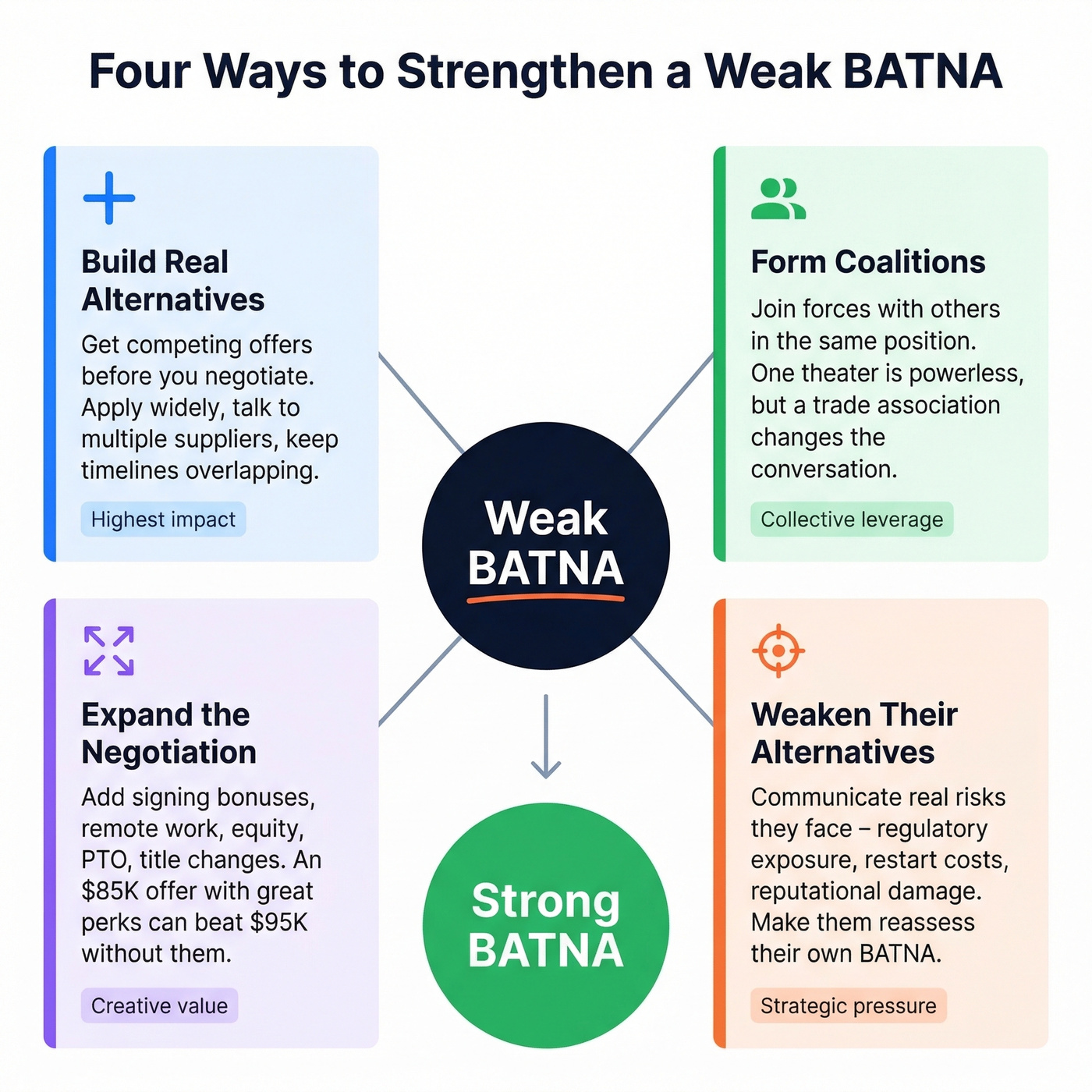
Expand the negotiation. When your walk-away option on salary is weak, stop negotiating salary alone. Add signing bonuses, remote work, title changes, professional development budgets, equity, or scope adjustments. An $85K offer with a $10K signing bonus, four weeks PTO, and a six-month review for promotion might beat a $95K offer with none of those.
Weaken the other side's alternatives. You can't always strengthen your own position, but you can make the other side reconsider theirs. Communicate legitimate risks - regulatory exposure, reputational damage, the cost of restarting a vendor search. This isn't bluffing; it's making sure they've done their own alternative-analysis math honestly. More aggressive versions include exclusive negotiation windows, strategic timing when their alternatives are weakest, and technical lock-in that raises switching costs.
Scripts for Signaling Walk-Away Power
Signal Without Revealing
The best move is often a signal, not a disclosure. From Kellogg's negotiation research:
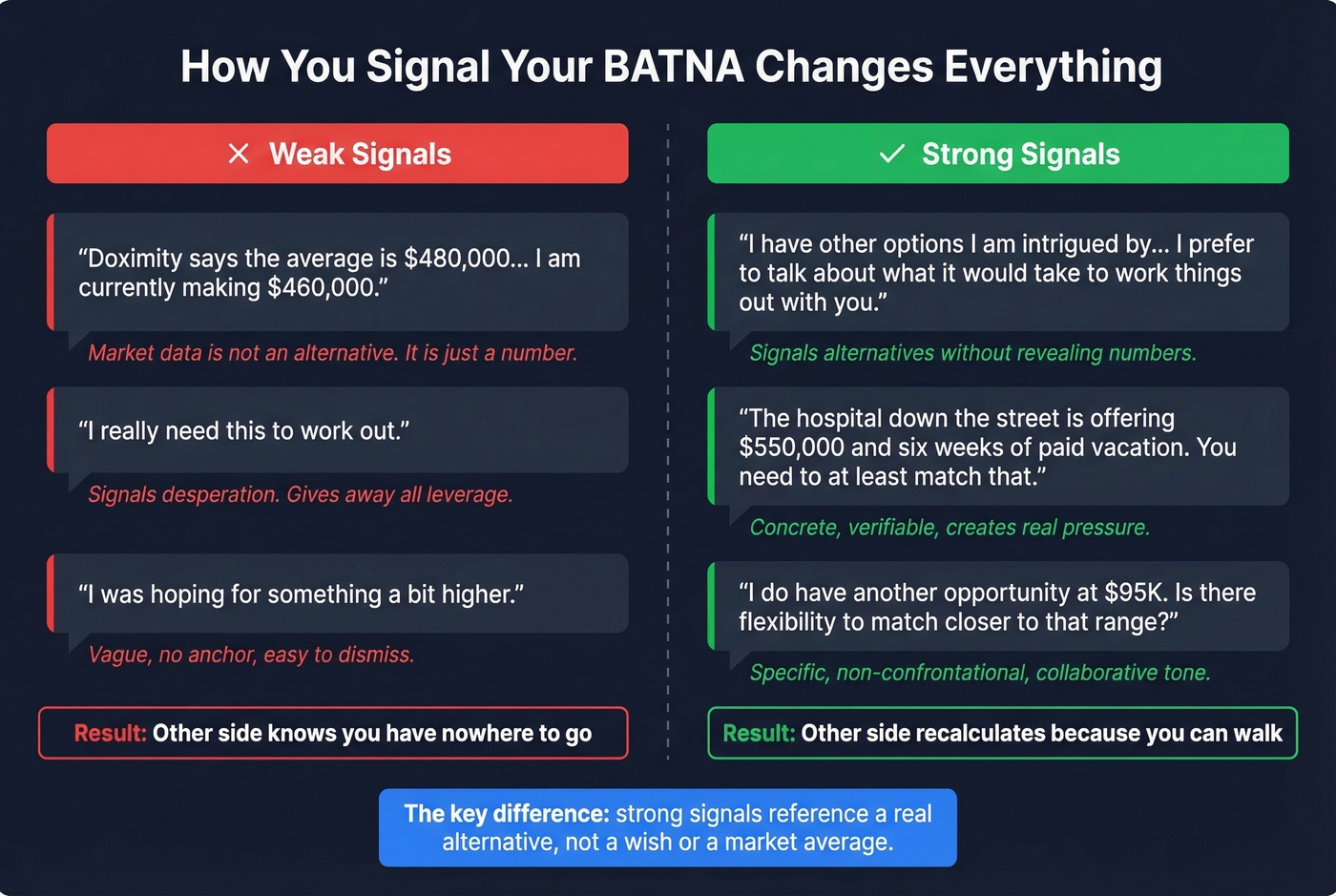
"I have other options I'm intrigued by... I prefer to talk about what it would take to work things out with you."
This communicates walk-away power without giving the other side specific numbers to anchor against. It keeps the conversation collaborative while establishing that you aren't desperate.
Use a Concrete Alternative
When you have a real competing offer, use it directly:
"The hospital down the street is offering $550,000 and six weeks of paid vacation. You need to at least match what they're offering for me."
Compare that to the weak version: "Doximity says the average is $480,000... I'm currently making $460,000." Market averages aren't alternatives. They're data points. A credible competing offer is leverage.
A more conversational approach, from a Reddit thread on salary negotiation:
"I do have another opportunity at $95K. Is there flexibility to match closer to that range?"
Clean, specific, non-confrontational. It works because it's true and verifiable.
Don't Fabricate
Let's be honest: the temptation to invent a competing offer is real. Don't. Kellogg documents a case where a candidate's offer was rescinded after attempting a fake bidding war. A fabricated alternative that gets called destroys your credibility permanently. Vague truthful statements outperform specific lies every time.
Common Mistakes
Impasse aversion. The biggest one by far. In that Harvard study, labeling a worse-for-self option as "Agreement" versus a better option as "Impasse" made 24.55% of participants choose the bad deal - compared to 3.99% in the control. In an MBA negotiation exercise, roughly 75% of pairs who reached agreement had one party accept terms detrimental to their economic interest. People would rather make a bad deal than no deal. Fight this instinct.
Treating the floor as a target. Your BATNA is a floor, not a goal. If your alternative is $88K, you should be negotiating for $100K+ - not anchoring at $88K and feeling grateful when you get $90K. One negotiation trainer calls this a "wimp-win mentality."
Sunk cost contamination. Six months into a negotiation, walking away feels like wasting all that time. Your BATNA doesn't care. It only cares about what's ahead.
Apples-to-oranges comparison. Remember the insurance example - a policy that looks 30% cheaper but covers less isn't a stronger alternative. Time, risk, non-monetary benefits, and switching costs all factor in.
Failing to reassess. Your best alternative isn't static. We've seen teams enter a negotiation with a strong position in January and close a bad deal in March because they never updated their analysis. Competing offers expire, market conditions shift, new alternatives emerge. Reassess at every major milestone.
Here's the thing most people miss: bad negotiation outcomes aren't usually caused by weak tactics or poor scripts. They're caused by people who walk into the room with one option and pretend that's enough. If you only remember one thing from this article, make it this - the negotiation is won or lost before it starts, based on the alternatives you built beforehand.
Applying BATNA in Sales
In B2B sales, your BATNA is your pipeline. If you're negotiating with one prospect and no alternatives, you've already lost. The procurement team across the table knows it - they can feel the desperation in your discounting.
Procurement teams use this instinctively. They solicit multiple bids specifically to strengthen their walk-away power. Every additional vendor in the RFP process improves the buyer's position and weakens yours. We've watched this dynamic play out across dozens of deal cycles, and the pattern is always the same: the side with more options sets the terms.
The counter-strategy is straightforward: build a deep, verified pipeline so no single deal is make-or-break. Tools like Prospeo help here - 300M+ professional profiles with 98% email accuracy on a 7-day refresh cycle means you're always working current data, not stale lists. When your pipeline is full, you negotiate from strength. You can walk away from bad terms because you genuinely have somewhere else to go. That's BATNA applied to every deal in your quarter.
Skip this approach if you're in a market with fewer than 50 potential buyers - in that case, account-based strategies matter more than pipeline volume. But for most B2B teams, the math is simple: more qualified alternatives equals more power at the table.
Before every negotiation, ask two questions: What's our best alternative if this deal dies? and What's theirs? When the answers are clear, the strategy writes itself.
Walk-away power comes from knowing your next deal is already lined up. With 143M+ verified emails at $0.01 each and a 7-day refresh cycle, Prospeo keeps your pipeline full enough that no single prospect holds all the leverage.
Replace any lost deal in minutes, not months.
FAQ
What is BATNA in negotiation?
BATNA stands for Best Alternative to a Negotiated Agreement - the strongest option available if the current deal fails. Introduced by Fisher, Ury, and Patton in Getting to Yes (1981), it serves as your accept/reject threshold: any offer worse than your best alternative should be rejected.
What's the difference between BATNA and reservation price?
Your BATNA is your best outside option; your reservation price is the least favorable deal you'd accept, derived from that alternative's value. If your BATNA is a $95K competing offer, your reservation price is roughly $95K - the point below which you walk.
How do you strengthen a weak BATNA?
Create competing alternatives before negotiating - apply to multiple jobs, solicit several vendor bids, or form coalitions. Expand the issues on the table (equity, PTO, scope) so a weak salary alternative doesn't sink the entire deal. More options always equal more power.
Can you bluff about your BATNA?
No. Fabricating alternatives risks permanent credibility damage. Kellogg research documents a candidate whose offer was rescinded after a fake bidding war was exposed. Signal that you have options without lying - vague truthful statements outperform specific fabrications every time.
How do you build a stronger pipeline as your sales BATNA?
Use verified B2B data tools to source qualified prospects quickly. A deeper pipeline means less dependence on any single deal, giving you genuine walk-away power in every negotiation. The consensus on r/sales is that reps who prospect consistently - even when deals are flowing - close on better terms because they're never desperate.