

How to Set a Walk-Away Point That Actually Holds Under Pressure
Most negotiation advice tells you to set a walk-away point. Almost none tells you how to calculate one that survives a real room. Your walk-away point in negotiation is the difference between a disciplined exit and a regretful signature.
Charles Yeboah was about to sign a $20 million investment deal. After lunch, he walked away. "The deal is off. We can't do this deal." As Stanford GSB professor Margaret Neale puts it, if you've got a strong alternative, the other side has to "pay a premium for me to stay and play."
We've watched negotiators accept terms they'd never have agreed to cold - because they didn't have a number written down before they sat down.
What Is a Walk-Away Point?
Your walk-away point is the specific threshold below which you reject a deal - the number or set of conditions where "no deal" beats "this deal."
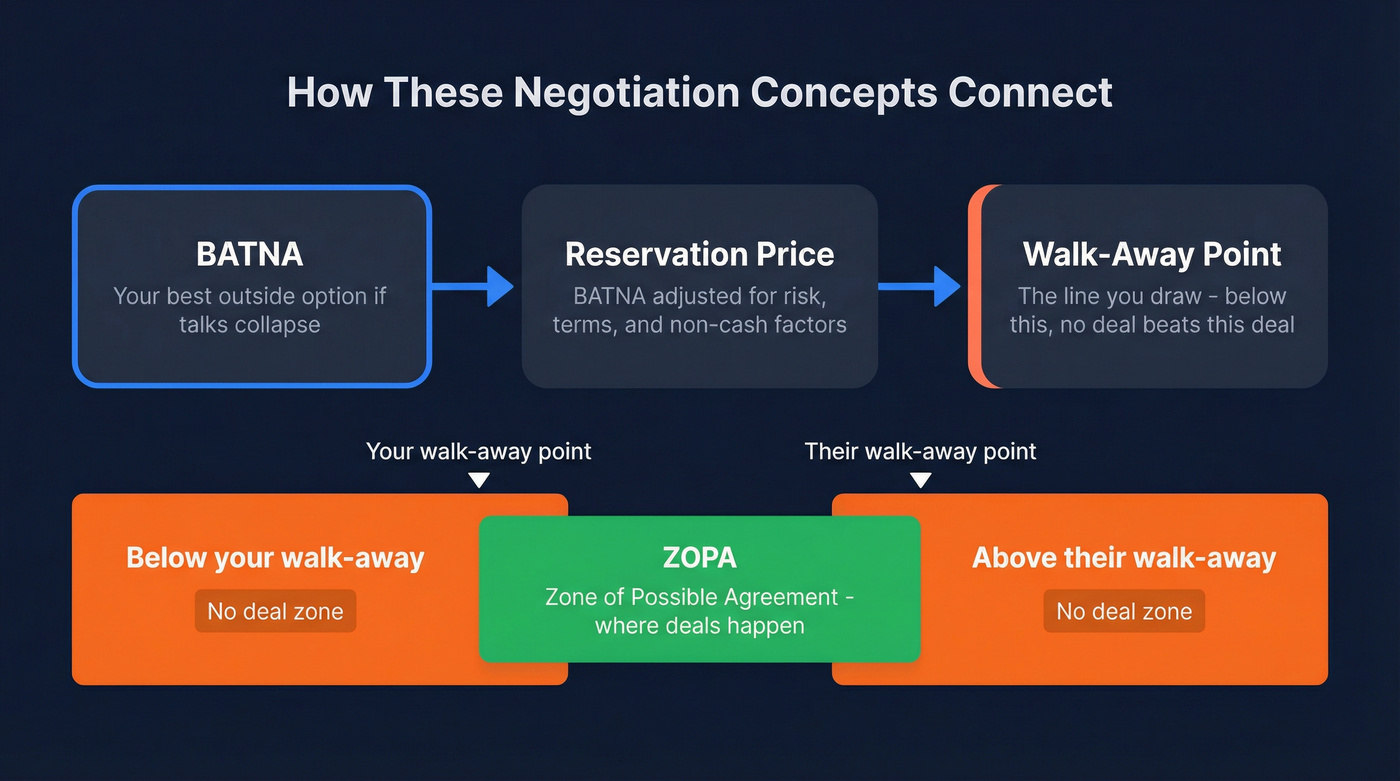
Three terms get tangled here. Your BATNA (Best Alternative to a Negotiated Agreement, from Fisher, Ury, and Patton's Getting to Yes) is your best outside option if talks collapse. Your reservation price is the concrete number derived from that BATNA, adjusted for risk, terms, and non-cash factors. Your walk-away point is the line you draw based on that reservation price.
The ZOPA - zone of possible agreement - is the overlap between your walk-away point and theirs. No overlap, no deal.
A walk-away point you haven't written down doesn't exist. It's just a feeling, and feelings shift under pressure.
How to Calculate Your Reservation Price
Most people guess their threshold. That's how you end up accepting terms you regret. Follow this chain instead.
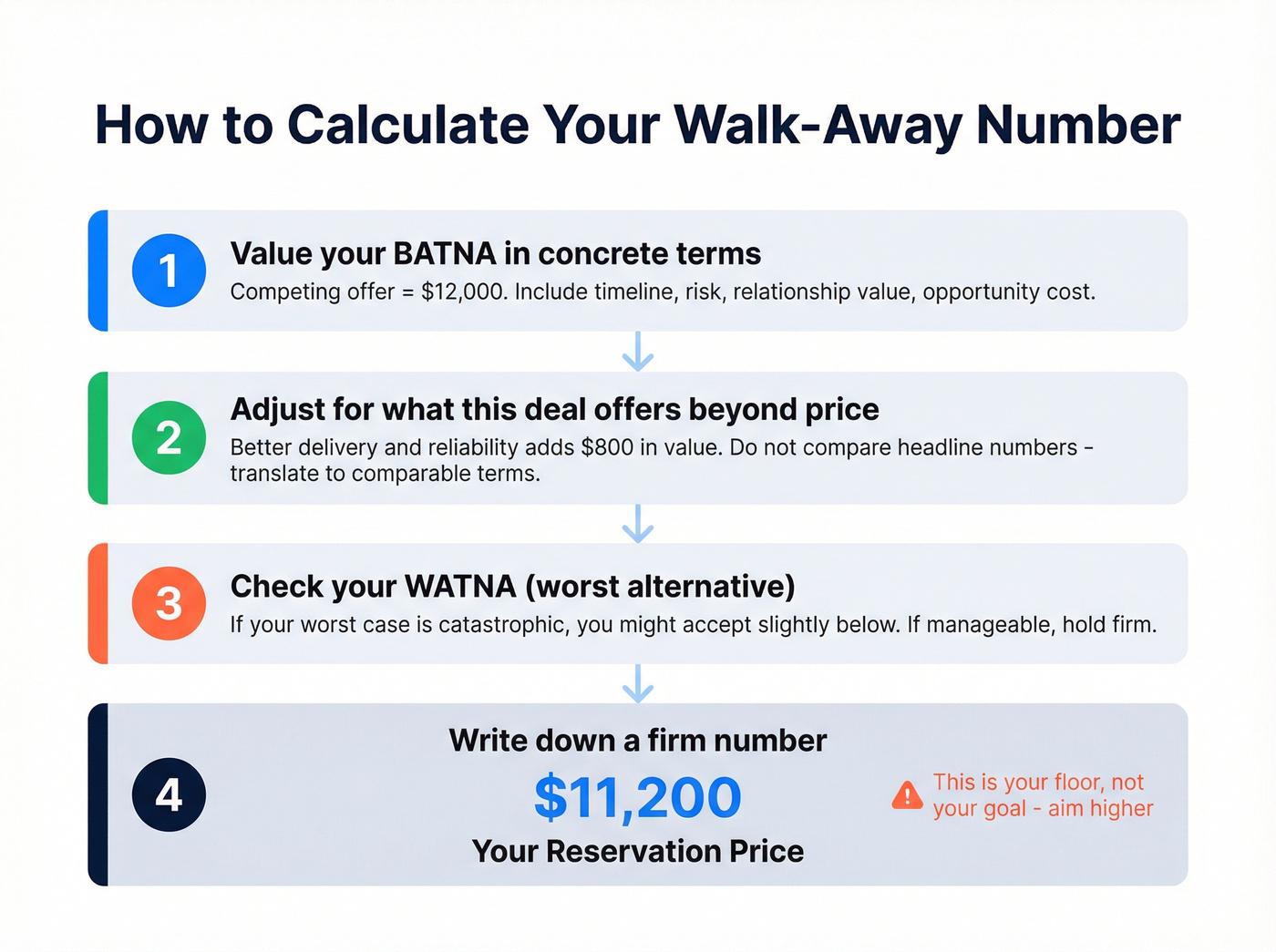
| Factor | Your BATNA Value | Adjusted Value | Walk-Away Threshold |
|---|---|---|---|
| Cash terms | $12,000 (competing offer) | - | - |
| Delivery/reliability | +$800 value in current deal | - | - |
| Risk adjustment | -$600 (higher counterparty risk) | - | - |
| Reservation price | - | $11,200 | Walk away below this |
Step 1: Value your BATNA in concrete terms. If your best alternative is a competing offer worth $12,000, that's your starting anchor. Include non-cash factors like timeline, risk, relationship value, and opportunity cost.
Step 2: Adjust for what the current deal offers beyond price. A Harvard PON analysis illustrates this well - a homeowner's insurance alternative looked 30% cheaper, but coverage limits and exclusions made it objectively worse. Don't compare headline numbers. Translate your BATNA into truly comparable terms.
Step 3: Check your WATNA. Your Worst Alternative to a Negotiated Agreement clarifies downside risk. If your WATNA is catastrophic, you'll accept a deal slightly below your reservation price. If it's manageable, hold firm.
Step 4: Write down a firm number. Using the table above, your BATNA is worth $12,000, the current deal offers better delivery and reliability, but counterparty risk is higher. Your reservation price lands at $11,200. Anything below it, you leave.
One warning from Inkovema's negotiation research: your BATNA can become your target if you fixate on it. The walk-away point is a floor, not a goal. Aim higher.
The Psychology That Stops You
Knowing your number isn't enough. Three biases will try to override it.
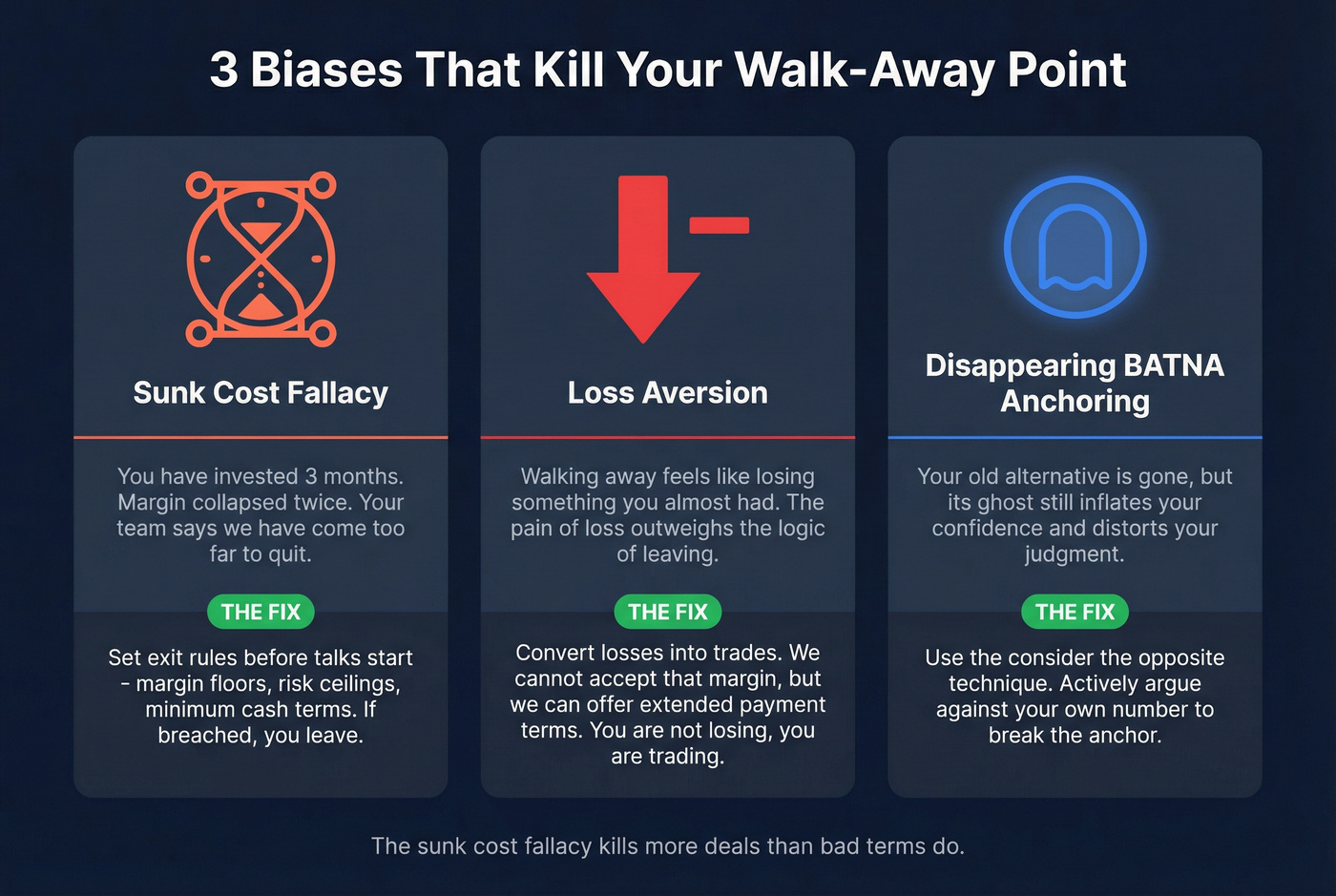
Sunk cost fallacy. You're three months into a deal. Margin has collapsed twice. Your team pushes to sign because "we've invested too much to walk away now." This is textbook sunk cost - continuing because of past investment, not future value. Arkes and Ayton's 1999 research in Psychological Bulletin confirmed the pattern is deeply wired, and in our experience, it catches even seasoned negotiators more often than any other bias.
The fix: set exit rules before talks start. Margin floors, risk ceilings, minimum cash terms. If the deal breaches them, you leave - regardless of time invested.
Loss aversion. Walking away feels like losing. Convert perceived losses into explicit trades: "We can't accept that margin, but we can offer extended payment terms." You're not losing. You're trading.
Disappearing-BATNA anchoring. A 2021 study by Brady, Inesi, and Mussweiler found something surprising: negotiators who had a BATNA that disappeared still set higher aspirations than those who never had one at all. The ghost of a dead alternative distorts your judgment. The debiasing technique is simple - actively generate reasons you might be overvaluing your position. The researchers call it "consider the opposite," and it works because it forces you to argue against your own anchored number, which breaks the spell of a BATNA that no longer exists.
The sunk cost fallacy kills more deals than bad terms do.

Your walk-away point only matters if you have alternatives. Prospeo gives you 300M+ verified contacts so your BATNA is never empty. Build a pipeline deep enough that no single deal holds you hostage.
The best leverage in any negotiation is a full pipeline behind you.
When to Walk Away from a Deal
Not every bad moment means you should leave. But these red flags signal it's time:
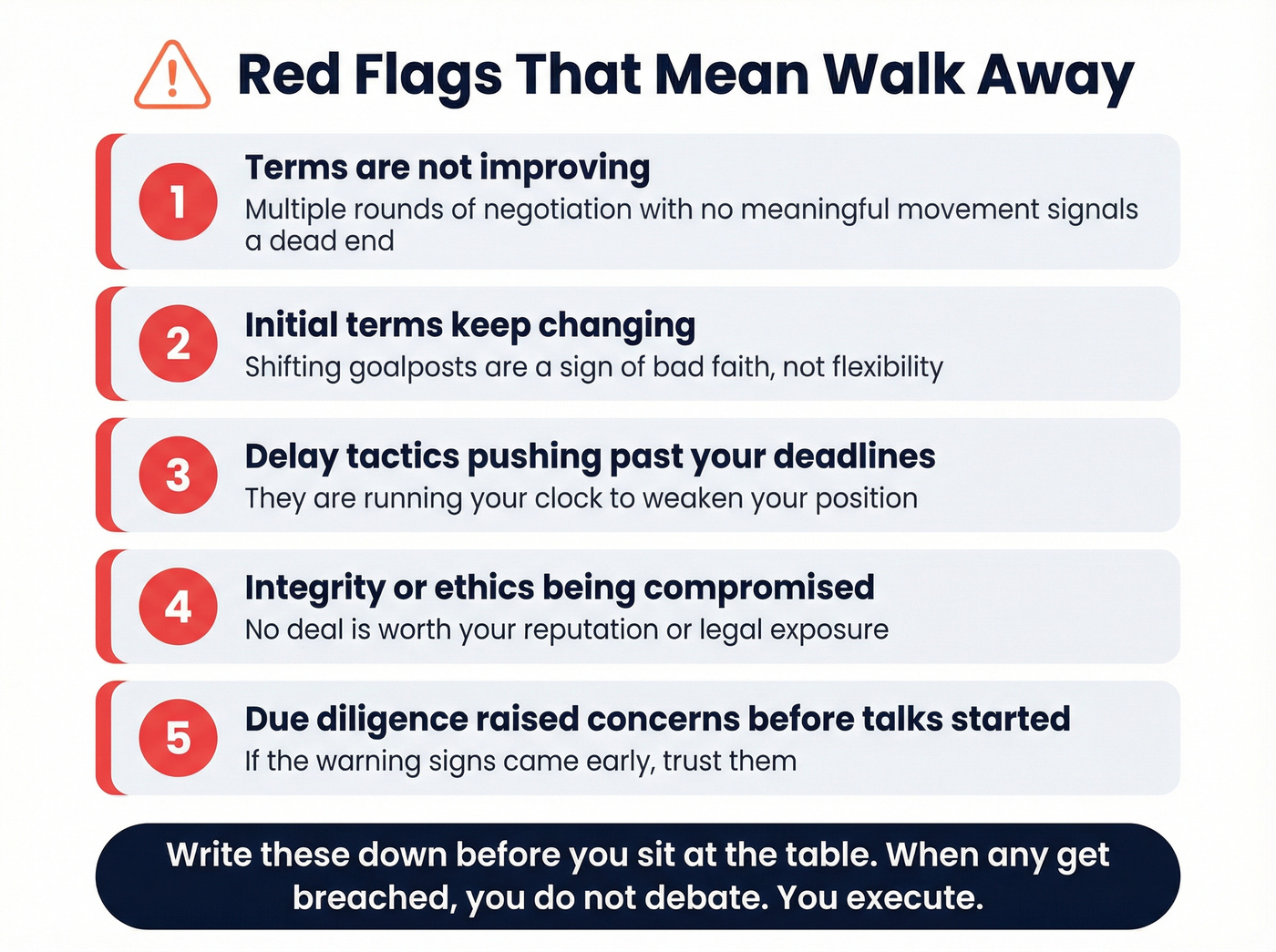
- Terms aren't improving despite multiple rounds
- Initial terms keep changing - a sign of bad faith
- The counterparty uses delay tactics to push you past your deadlines
- Integrity or ethics are being compromised
- Due diligence raised concerns before negotiations even started
Even billion-dollar deals fall through when the numbers don't work. SoftBank pulled its WeWork stock deal. Sycamore abandoned Victoria's Secret. Having a walkaway strategy isn't a failure - it's the mechanism that prevents one.
Define your walk-away criteria before talks begin. Write down your margin floor, risk ceiling, and minimum cash terms. When any get breached, you don't debate. You execute.
How to Exit Gracefully
Walking away doesn't mean burning the bridge.
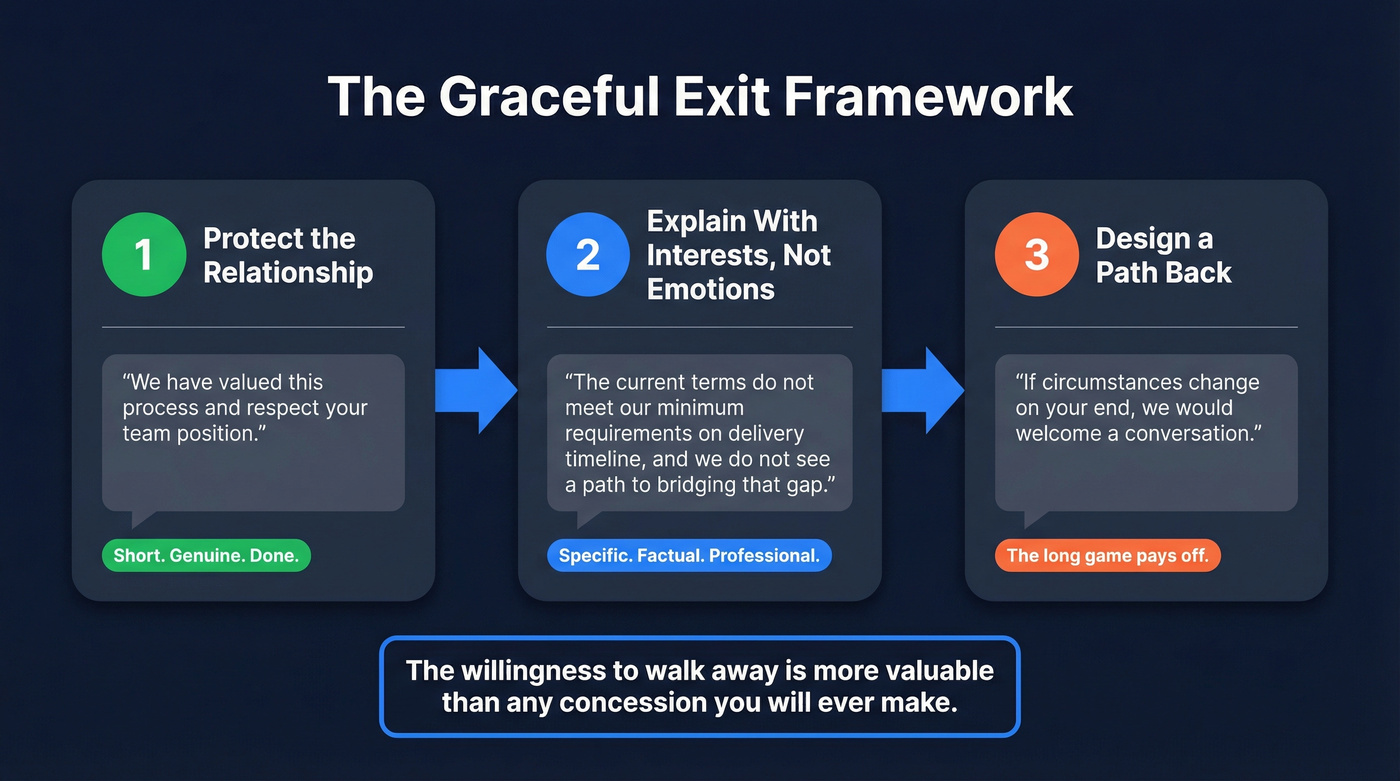
Protect the relationship. Acknowledge what worked. "We've valued this process and respect your team's position." Short, genuine, done.
Explain your reasons tied to interests, not emotions. "The current terms don't meet our minimum requirements on [specific issue], and we don't see a path to bridging that gap." This works for job offers too - "I appreciate the offer, but the compensation doesn't align with my market research. If the range changes, I'd love to revisit."
Design a path to future deals. "If circumstances change on your end, we'd welcome a conversation." MWI Consultancy reports losing a nationwide contract to a low bidder, staying professional, and getting retained six months later at favorable terms when the chosen vendor failed. That's the long game paying off.
Here's the thing: the willingness to walk away from a deal is more valuable than any concession you'll ever make. One r/sales poster described telling a discount-seeking customer, "If you're this unhappy, we can just go ahead and cancel your upcoming orders." The customer immediately backtracked - "No, no - we love the products." A credible willingness to leave the table exposes bluffing every time.
When You Can't Walk Away
Sometimes leaving isn't an option. High switching costs, internal stakeholders pushing continuity, no immediate alternatives. The consensus on r/negotiation is blunt - this is a real constraint, not a failure of preparation.
When you're locked in, trade, don't give. Every concession should come with a counter-ask. And start building future alternatives even while you're stuck, so next time you've got real options. Part of that preparation means knowing exactly who you're negotiating with - verified contact data from tools like Prospeo ensures you're reaching the actual decision-maker, not a gatekeeper who can't approve anything.
There's a contrarian school of thought that says you should set your walk-away point late, after exhausting all available information. I think the synthesis is more useful: set a provisional threshold early, then refine it as you learn. Rigid thresholds kill creative deals, but no number at all is worse.
If you're negotiating in a sales context, it also helps to understand anchor dynamics, keep your pipeline health strong, and use repeatable sales prospecting techniques so your BATNA stays real.
Walking away from a bad deal requires confidence - and confidence comes from knowing you can reach the next buyer in minutes. With 98% email accuracy and 125M+ verified mobiles, Prospeo keeps your alternatives real.
Stop clinging to bad deals because your prospect list is thin.
FAQ
What's the difference between a walk-away point and a BATNA?
Your BATNA is your best outside option if talks fail. Your walk-away point is the specific threshold - derived from your BATNA and adjusted for risk, switching costs, and non-cash terms - below which you reject the deal. Think of BATNA as the input and the walk-away point as the output.
Should you reveal your walk-away point?
Almost never. Disclosing it caps your upside and anchors the counterparty to your floor. Instead, signal willingness to leave through behavior - packing up notes, proposing a pause, referencing alternative timelines - without sharing the actual number.
How do you find the right decision-maker to negotiate with?
Start by identifying who actually has signing authority. Prospeo verifies emails and direct dials across 300M+ professional profiles with 98% accuracy, so you skip gatekeepers and reach the person who can approve terms. The free tier includes 75 email credits per month - enough to prep for most negotiations.