

The 5 Best Nurture Campaigns Every B2B Team Needs in 2026
Most B2B teams think they're running great nurture campaigns. They're not - they're running drip sequences wearing a better name. The same five emails fire at every lead regardless of behavior, and then everyone wonders why pipeline looks thin. 74% of B2B teams report longer sales cycles than a year ago, and generic nurture isn't going to close that gap.
We've narrowed this to five campaign types, not eleven. Multi-channel beats email-only because email-only reach is capped by open rates, and other channels bring incremental conversions. Behavioral segmentation matters more than fancy copy. And clean contact data is the prerequisite nobody talks about - a nurture sequence sent to bounced emails is just burning your sender reputation.
Why Most Nurture Sequences Fail
73% of generic nurture campaigns fail to generate qualified pipeline. Not "underperform." Fail. Sales teams using traditional nurture waste roughly 11 hours per week managing unqualified leads - nearly 30% of selling time gone.
The gap between teams that get nurture right and everyone else is staggering: 69% of high-performing organizations rate themselves excellent at lead nurturing, compared to just 10% of low performers. That's a 59-point gap. It's not a marginal difference - it's a completely different operating reality.
On r/marketing, practitioners describe their nurture workflows as a "graveyard" for cold leads. Everyone builds the sequence, nobody revisits it, and the leads rot. The root cause is almost always the same: one-size-fits-all content, email-only delivery, and no behavioral triggers. You're broadcasting when you should be responding.
What Makes Great Nurture Campaigns Work
Here's the thing: most teams don't need better copy or a fancier marketing automation platform. They need better segmentation and cleaner data. 52% of B2B marketers cite data-driven personalization as the top factor for improving lead nurturing, and segmented campaigns can drive up to a 760% increase in revenue over batch-and-blast.
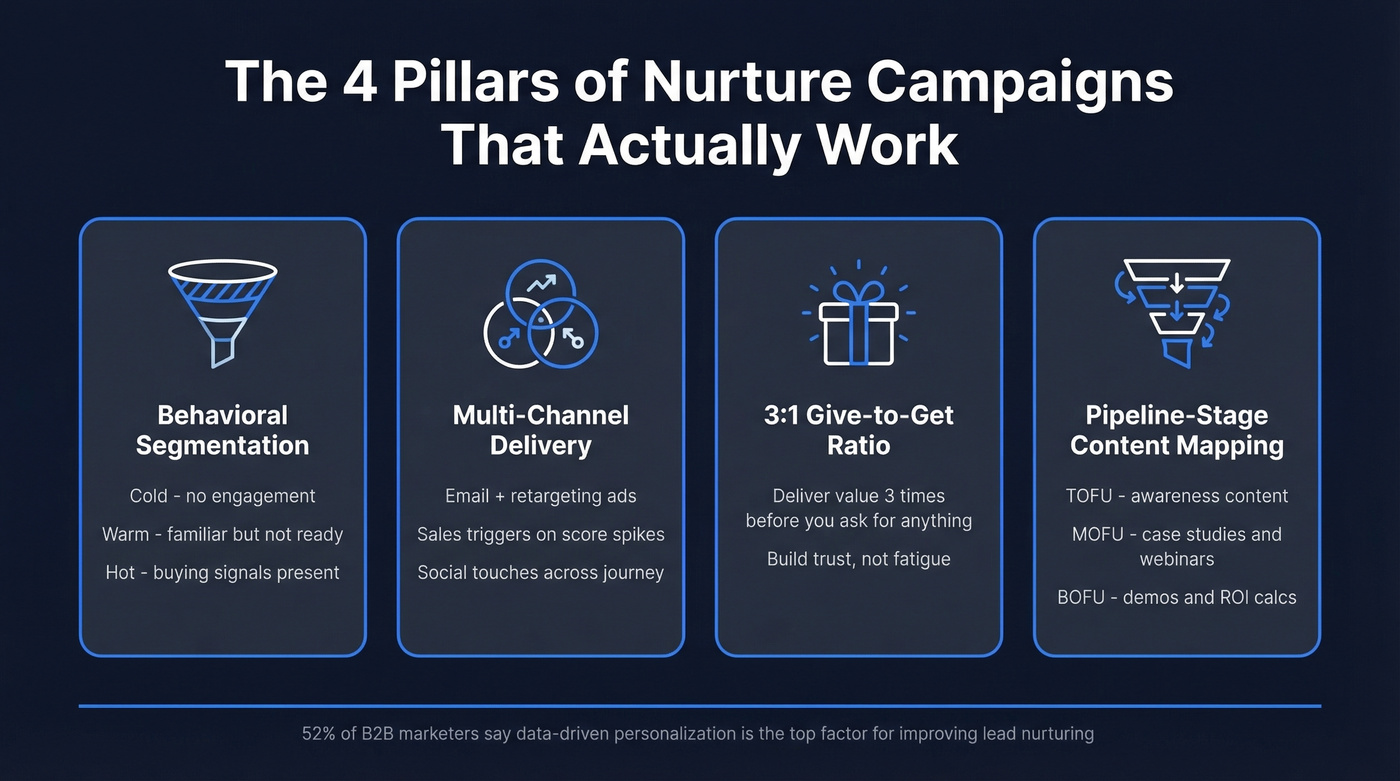
Before you build anything, nail these four things:
- Behavioral segmentation - bucket leads into Cold (no engagement), Warm (familiar but not sales-ready), and Hot (buying signals present).
- Multi-channel delivery - email plus retargeting ads, sales triggers, and social touches across the buyer journey.
- 3:1 give-to-get ratio - deliver value three times before you ask for anything.
- Pipeline-stage content mapping - TOFU, MOFU, and BOFU content matched to where the lead actually sits.
The 5 Campaigns That Build Pipeline
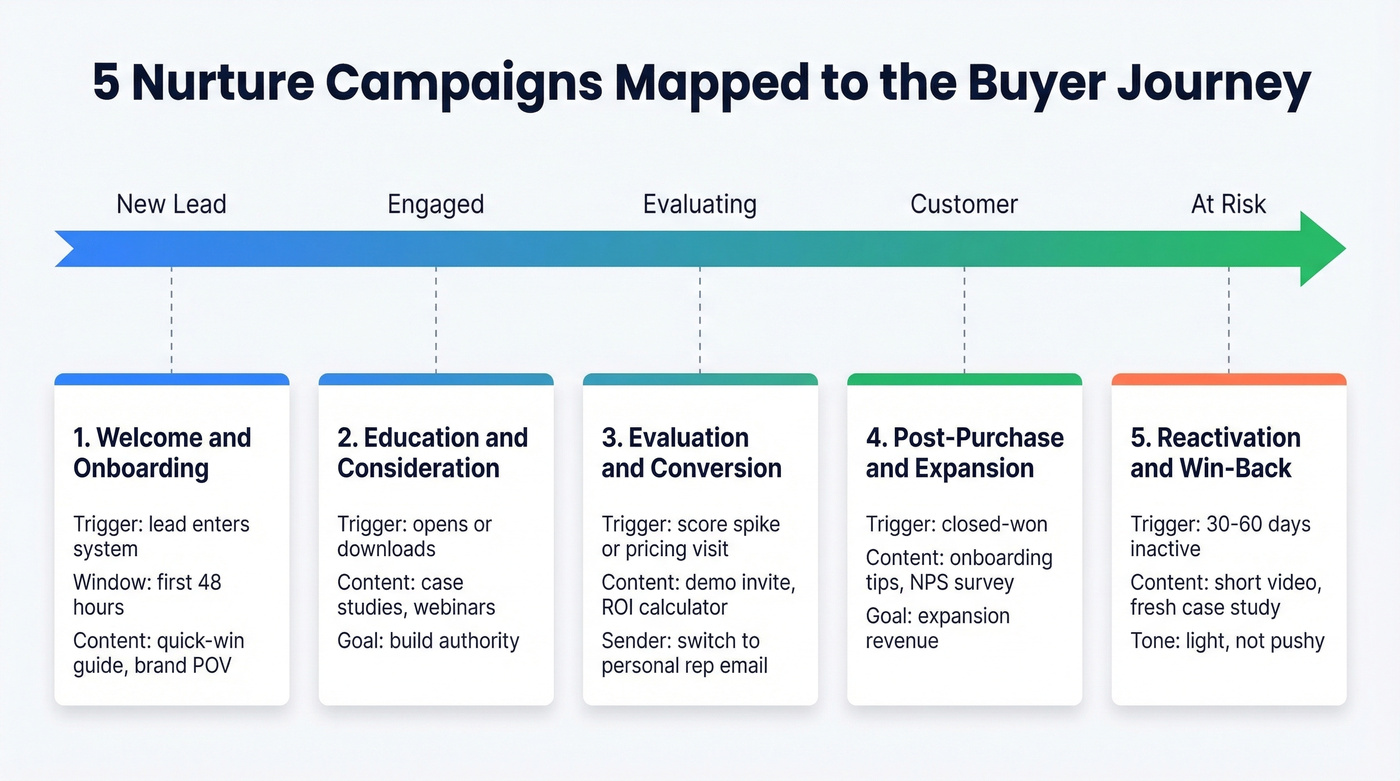
1. Welcome & Onboarding
Trigger this the moment a new lead enters your system. The 48-hour window after entry is critical - waiting longer kills conversion rates. Deliver the promised asset, set expectations for what's coming next, and introduce your brand's point of view. Think a quick-win guide like "5 Ways to Cut Onboarding Time by 40%" - something immediately useful, not a product pitch.
2. Education & Consideration
This campaign targets leads who've engaged but aren't sales-ready. They've opened emails or downloaded something, but they haven't hit your pricing page. Build authority and address objections with MOFU content: case studies, webinar invites, comparison guides.
A mid-market SaaS company running this exact playbook - educational content plus webinars plus retargeting - saw a 40% increase in qualified leads over six months. A strong content piece here is a comparison guide like "Platform A vs. Platform B: What Your Team Actually Needs," because it positions you as the objective expert rather than another vendor pushing features.
3. Evaluation & Conversion
When a lead's engagement score spikes or they visit your pricing page, shift to BOFU. Send a direct demo invite, share an ROI calculator showing cost-per-lead savings, and provide pricing clarity. This isn't the time for another blog post.
One tactic that works surprisingly well: shift the sender from your branded marketing address to a personal sales-rep email. The tone change signals "this is real now" and conversion rates jump. Be specific, be direct, and make it easy to say yes.
4. Post-Purchase & Expansion
Closed-won isn't the finish line. Onboard with product tips (a "Getting Started in 15 Minutes" video works well), surface expansion offers at the right moment, and run NPS surveys to catch churn signals early. Expansion revenue is cheaper than new revenue, and this campaign is how you capture it.
5. Reactivation & Win-Back
For leads or accounts that go dark for 30-60 days. Short video snippets of 30-60 seconds work surprisingly well here - practitioners on r/b2bmarketing report they've helped reopen dormant deals. Pair the video with a fresh case study or a "what's changed since we last talked" update. Keep it light. You're reigniting interest, not restarting the whole funnel.

You just read that 73% of generic nurture campaigns fail to generate pipeline. The #1 reason nobody talks about? Bad contact data. Bounced emails torch your sender reputation and kill deliverability for every sequence that follows. Prospeo's 98% email accuracy and 7-day data refresh mean your nurture campaigns land in real inboxes - not spam folders.
Stop nurturing bounced emails. Start nurturing real buyers.
Cadence Blueprint
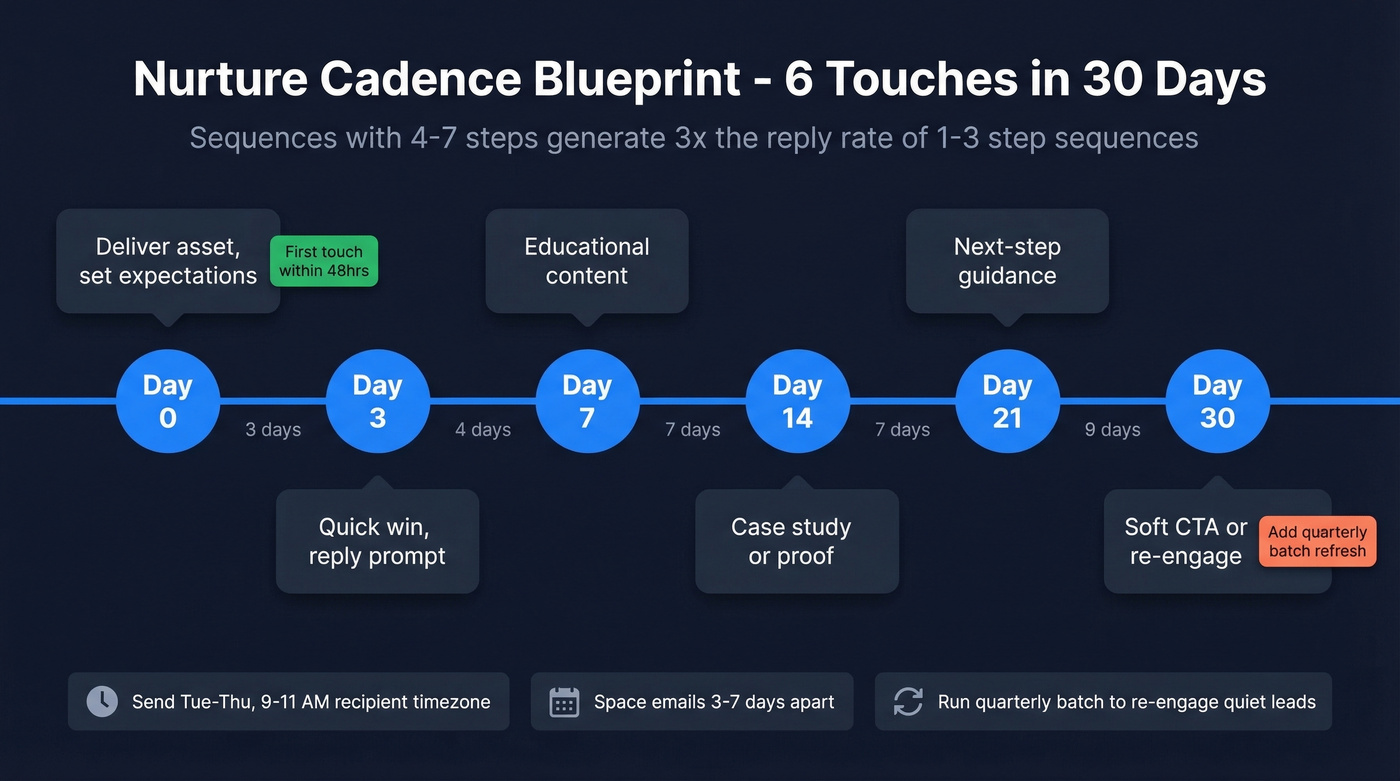
Sequences with 4-7 steps generate 3x the reply rate of 1-3 step sequences (9% vs. 27%). Here's the interval framework we've seen work consistently:
| Day | Purpose | |
|---|---|---|
| 1 | 0 | Deliver asset, set expectations |
| 2 | 3 | Quick win, reply prompt |
| 3 | 7 | Educational content |
| 4 | 14 | Case study or proof |
| 5 | 21 | Next-step guidance |
| 6 | 30 | Soft CTA or re-engage |
Send Tuesday through Thursday, 9-11 AM in the recipient's timezone. That first touch needs to land within 48 hours of the trigger event. Space subsequent emails 3-7 days apart to stay present without annoying people.
On top of automated sequences, run a quarterly batch campaign - a "state of the industry" email or fresh benchmark report - to re-engage leads who've gone quiet but haven't fully churned. Even well-built nurture email campaigns lose momentum without these periodic refreshes.
Lead Scoring Cheat Sheet
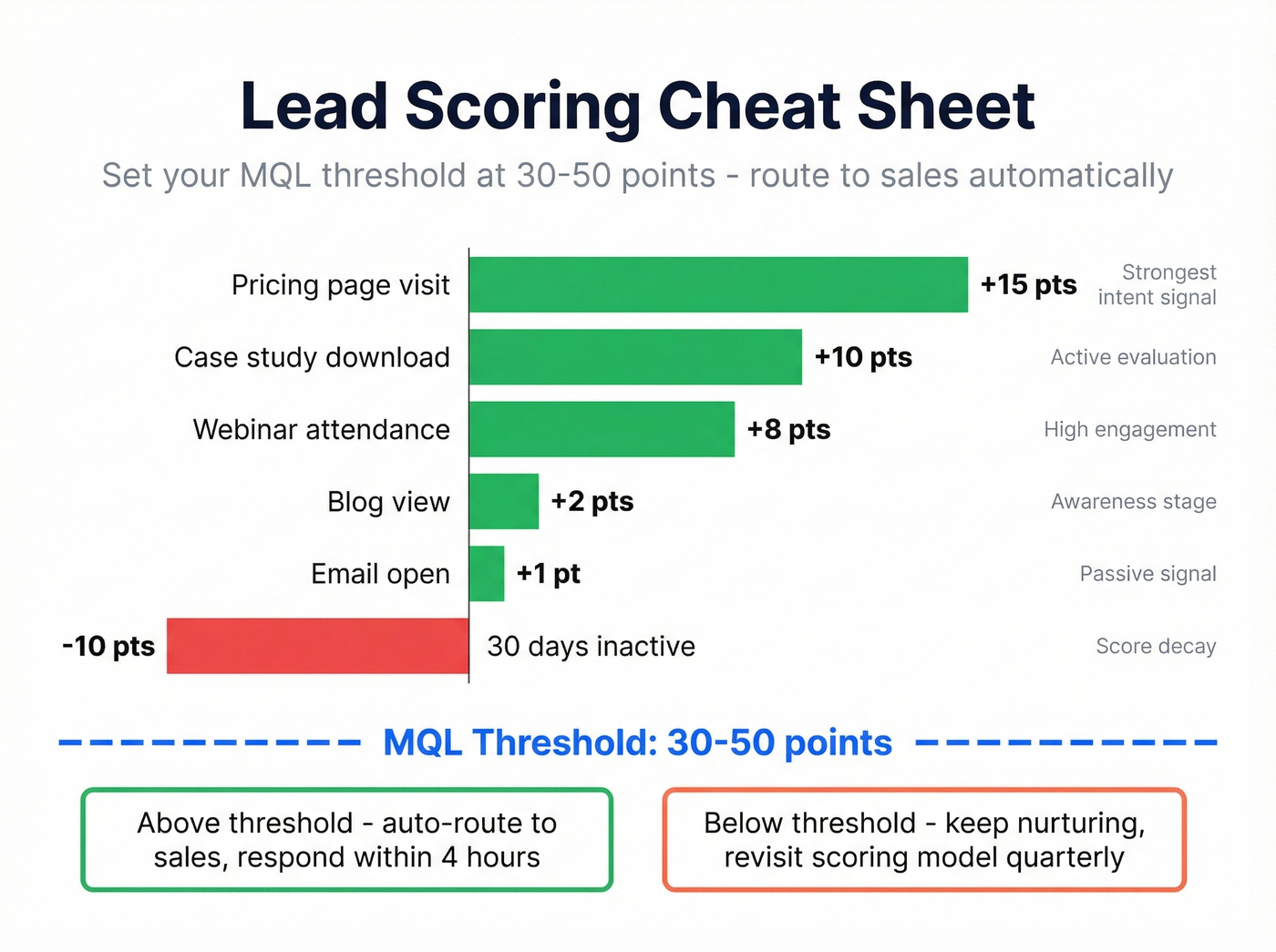
Without scoring, your sales team chases every lead equally. Which means they chase nobody effectively.
| Action | Points | Notes |
|---|---|---|
| Pricing page visit | +15 | Strongest intent signal |
| Case study download | +10 | Active evaluation |
| Webinar attendance | +8 | High engagement |
| Blog view | +2 | Awareness-stage |
| Email open | +1 | Passive signal |
| 30 days inactive | -10 | Score decay |
Set your MQL threshold where it makes sense for your volume - typically 30-50 points. When a lead crosses that line, route them to sales automatically. The SLA matters: sales should respond within four hours of an MQL firing. Revisit your scoring model quarterly and adjust weights based on what's actually converting.
Channels Beyond Email
Email-only nurture caps at 20-30% open rates. That means 70-80% of your leads won't see the message. Here's how channels compare on hard conversions:
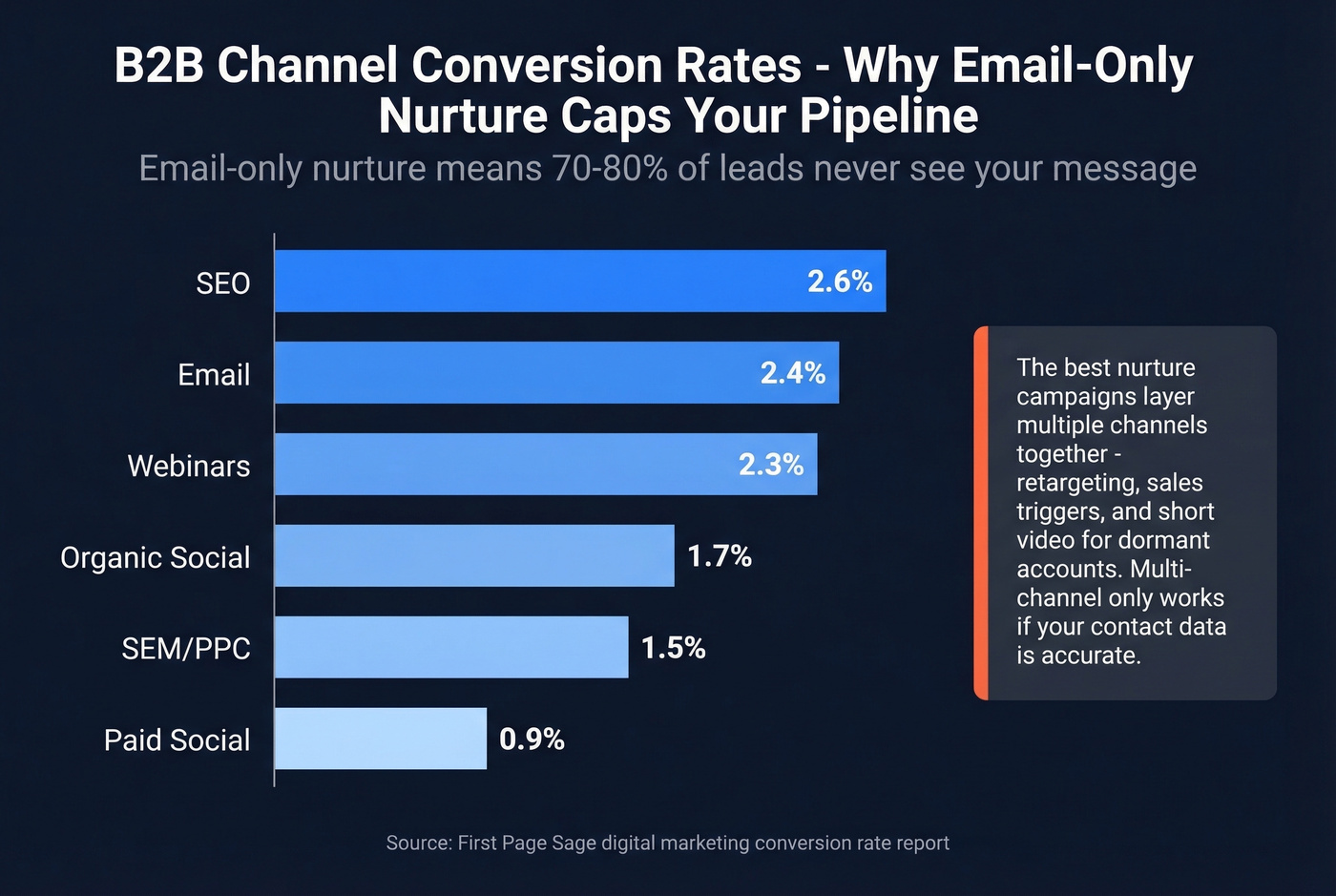
| Channel | B2B Conversion Rate |
|---|---|
| SEO | 2.6% |
| 2.4% | |
| Webinars | 2.3% |
| Organic social | 1.7% |
| SEM/PPC | 1.5% |
| Paid social | 0.9% |
The best nurture campaigns layer retargeting (refresh creative quarterly, no hard CTA), sales call triggers when engagement scores spike, and short video for dormant accounts.
Multi-channel only works if your contact data is accurate. We've seen teams launch carefully planned sequences only to watch bounce rates spike on the first send - sometimes 35%+ if the list is old. That destroys your sender reputation and tanks deliverability for every future campaign. A verification layer like Prospeo, with 98% email accuracy and a 7-day data refresh cycle, keeps your lists clean across every touchpoint instead of letting them decay between sends.
Tools for Running Nurture Campaigns
The marketing automation platform gets all the attention, but the data quality layer underneath it matters more. Let's be honest - nobody talks about list hygiene at conferences because it's boring. But it's the thing that determines whether your beautifully crafted six-email sequence actually reaches anyone.
| Tool | Starting Price | Best For |
|---|---|---|
| HubSpot Marketing Hub | ~$800/mo (Pro) | All-in-one CRM + nurture |
| ActiveCampaign | $145/mo | Advanced automation |
| Brevo | Free + $9/mo | Budget-friendly |
| Customer.io | $100/mo | Event-driven sequences |
Enterprise platforms like Marketo and Pardot typically run $1,000-$3,000+/mo depending on contacts and modules. Skip them if you're a mid-market team - they're overkill and the implementation timeline alone will stall your campaigns for months.
Before you plug leads into any of these platforms, verify your list. Meritt, a Prospeo customer, dropped their bounce rate from 35% to under 4% after switching their verification workflow - and tripled their pipeline from $100K to $300K per week. That's the difference between a nurture campaign that builds pipeline and one that gets your domain flagged.
If you need a repeatable process, use an email verification list SOP before every send.

Your lead scoring model is only as good as the contacts behind it. A pricing-page visit worth +15 points means nothing if the email on file bounces. Prospeo gives you 143M+ verified emails, 125M+ direct dials, and 50+ enrichment data points per contact - so every lead in your nurture funnel is reachable and scoreable from day one.
Clean data is the prerequisite. Build your nurture on it.
FAQ
How many emails should a nurture sequence have?
Four to seven emails spaced 3-7 days apart generate 3x the reply rate of shorter sequences. The first touch needs to land within 48 hours of the trigger event - waiting longer drops conversion rates significantly.
What's the difference between drip and nurture campaigns?
A drip campaign is time-based - every lead gets identical emails on the same schedule. A nurture campaign adapts based on engagement, lead scoring, and funnel stage, so no two leads receive an identical experience. Behavioral triggers plus multi-channel delivery are what separate the two.
Why do my nurture emails keep bouncing?
Bad contact data is almost always the cause. If your list hasn't been been verified recently, 20-35% of emails can bounce, destroying your sender reputation. Run your list through a verification tool before launching any sequence - even a small percentage of bounces compounds fast across a multi-step campaign.
What makes the best B2B nurture campaigns different?
Top-performing teams combine behavioral segmentation, multi-channel delivery, and clean data - not just better copywriting. They score leads, trigger sequences based on actions, and verify contacts before every campaign. The 59-point performance gap between high and low performers comes down to these operational fundamentals, not creative talent.