

Bidstream Intent Data: What It Is, Why It's Dying, and What to Use Instead
Your SDR pulls the weekly intent report. Fifty accounts are "surging" on cloud migration. She starts dialing. By Friday, half those signals traced back to someone scrolling past a display ad on a news site - and three competitors got the same list. We've watched teams burn through entire intent lists in a week with nothing to show for it. That's bidstream intent data in practice: high volume, low signal, zero competitive advantage.
The Intent Quality Hierarchy
From best to worst:
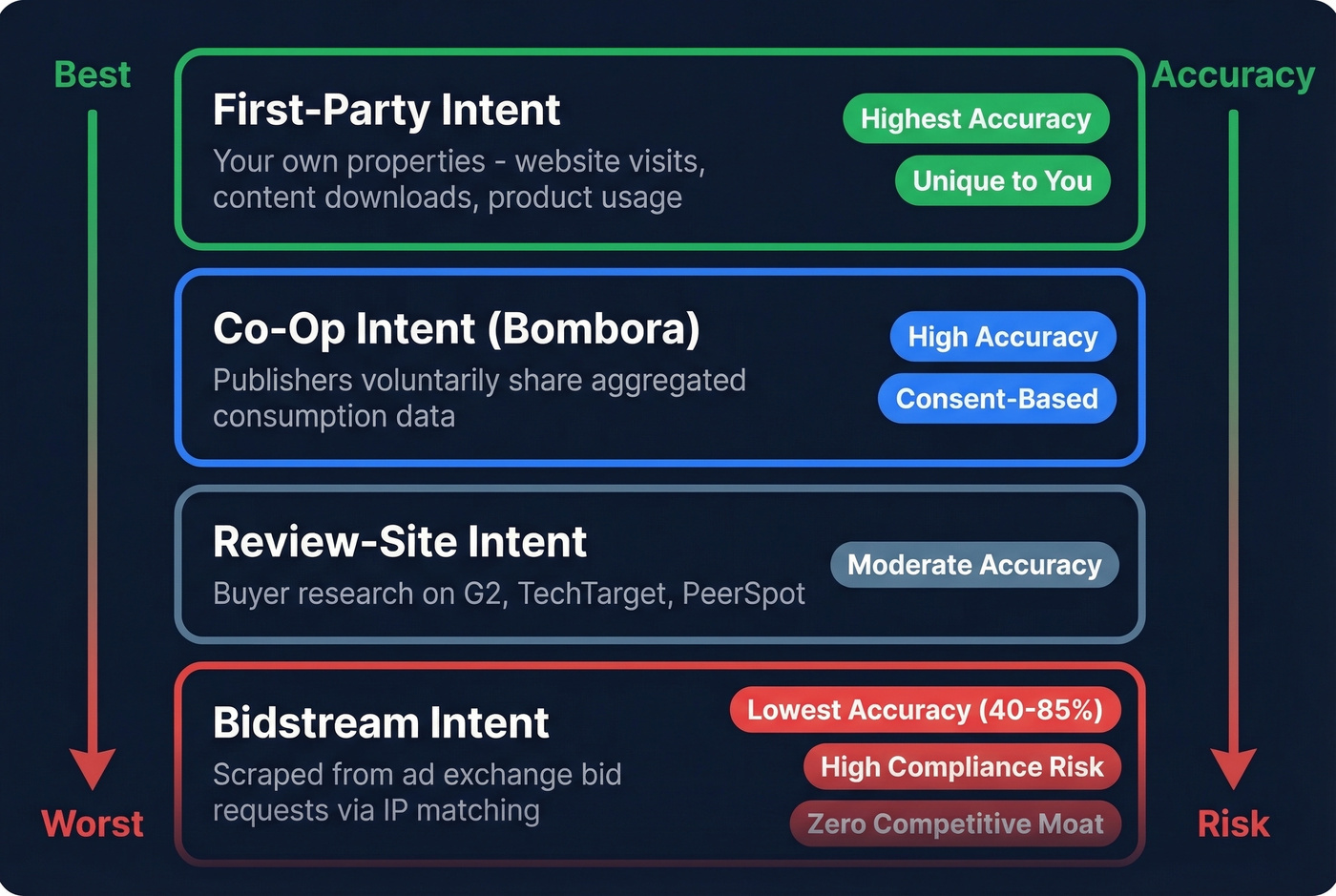
- First-party intent - signals from your own properties, highest accuracy, unique to you
- Co-op intent - publishers voluntarily sharing aggregated consumption data
- Review-site intent - buyer research on G2, TechTarget, PeerSpot
- Bidstream intent - collected from ad exchange bid requests, lowest accuracy, highest compliance risk
What Is Bidstream Intent Data?
Every time a webpage loads an ad, a real-time bidding (RTB) auction fires. The publisher's supply-side platform sends a bid request to an ad exchange, which broadcasts it to dozens of demand-side platforms. That bid request can include inventory details like site and ad slot metadata, device information, and user location signals derived from IP - the kind of fields standardized in the OpenRTB v3.0 spec.
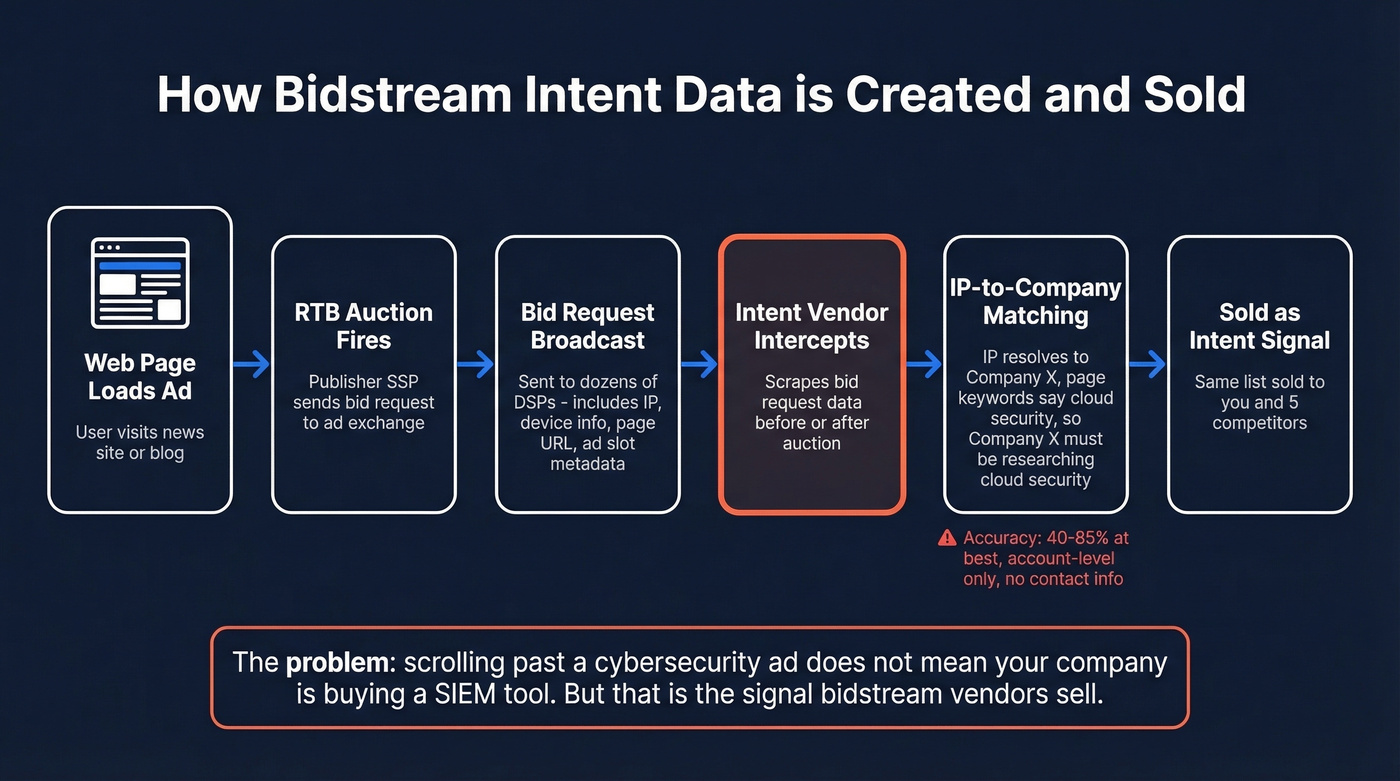
Bidstream intent vendors intercept these requests and infer purchase intent. The logic: if an IP resolves to Company X and the page contains keywords about "cloud security," Company X must be researching cloud security. Intent is inferred from ad/content adjacency and NLP keyword matching - not from any deliberate action the person took.
Accidentally loading a page with a cybersecurity display ad doesn't mean your company is buying a SIEM tool. But that's the signal bidstream vendors sell.
Why Bidstream Intent Is Dying
Regulators Are Closing In
The Brussels Court of Appeal ruled that the Transparency and Consent Framework - the consent mechanism underpinning much of programmatic advertising - is inadequate under GDPR, putting TCF-based tracking at serious legal risk across Europe.
In the US, the FTC settled with a data broker that had collected RTB auction data and retained it even after losing bids. From 2018 to mid-2020, roughly 60% of that broker's consumer data came from RTB exchanges, including over 2 billion unique mobile advertising IDs paired with location data. Meanwhile, nearly 20 business publishers - including Questex and Bombora - signed an open letter calling out "audience data breaches" caused by RTB data leakage. The publishers themselves are saying the system is broken.
The Accuracy Problem
Commonly cited IP-to-company match accuracy ranges from 40% to 85% depending on traffic patterns, methodology, and VPN usage. Even at the high end, you get account-level signals only. You know "someone at Company X" visited a page. You don't know who, what role they hold, or whether they have buying authority.
Here's the thing: there's no widely cited, transparent benchmark comparing bidstream conversion rates against co-op or first-party intent. For a data category that vendors charge thousands for, that absence should make every buyer uncomfortable.
Signal Saturation Kills Performance
A user on r/LeadGeneration described ZoomInfo intent for commercial solar lead gen: it "was fire" initially, then "fell off" over months. The consensus on r/B2bGotomarket is that most intent providers resell the same RTB-derived signals. When five competitors buy the same "surging accounts" list, the competitive advantage evaporates on day one.
Bidstream vs. Co-Op and First-Party Intent
Google canceled Chrome's forced cookie phase-out in July 2024. As of 2026, third-party cookies remain enabled by default - but 41% of the bidstream is already cookieless per Adform's data, and the trend is accelerating.
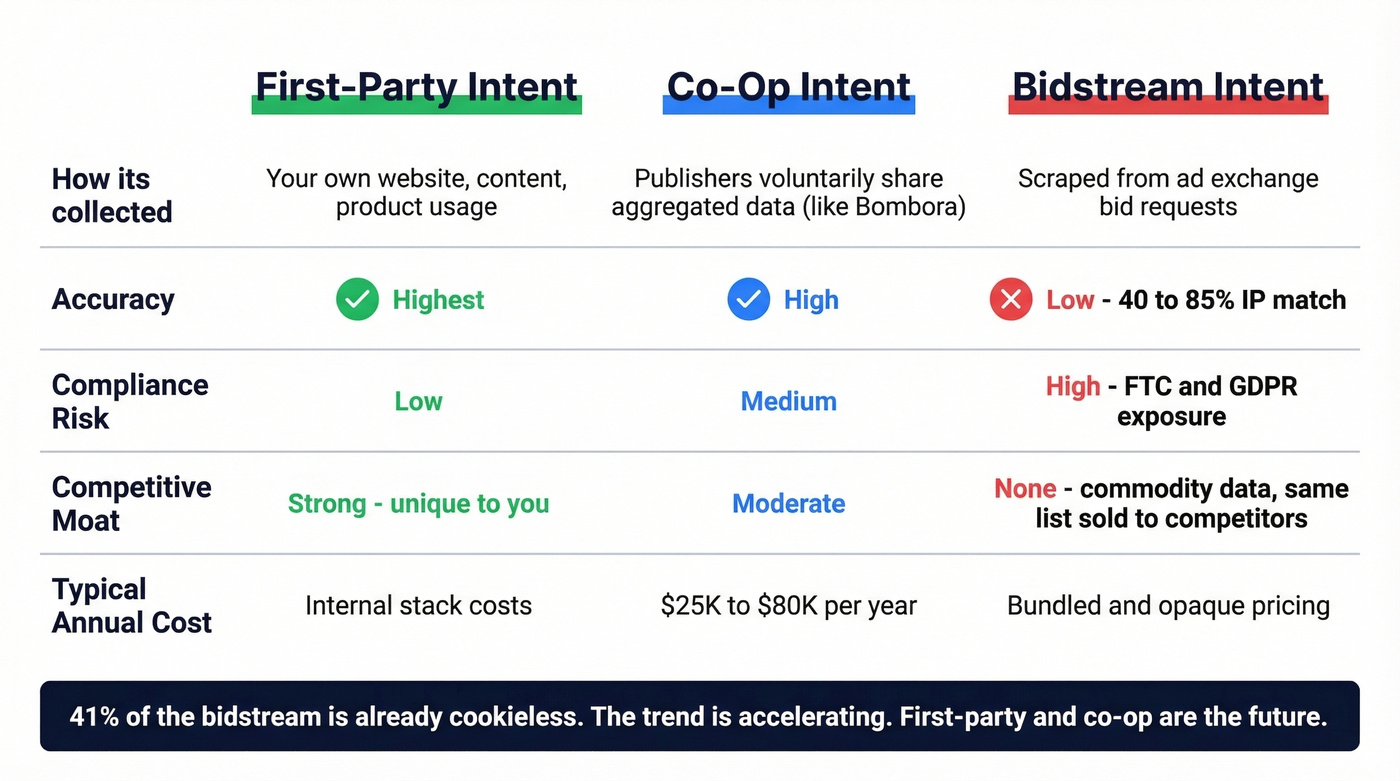
| Dimension | First-Party | Co-Op (Bombora) | Bidstream |
|---|---|---|---|
| Collection | Your own properties | Publisher opt-in network | Ad exchange bid requests |
| Accuracy | Highest | High | Low (40-85% IP match) |
| Compliance risk | Low | Medium | High (FTC, GDPR) |
| Typical cost | Internal stack | $25K-$80K/yr | Bundled - opaque |
| Competitive moat | Strong (unique) | Moderate | None (commodity) |
First-party intent is the gold standard because it's unique to you. Co-op intent - where publishers voluntarily share aggregated content consumption signals through networks like Bombora's Company Surge - sits in the middle. Bidstream is the bottom of the barrel: commodity data with no moat and rising legal risk.
Understanding these limitations matters before committing budget to any provider that won't disclose its sourcing methodology.

Bidstream intent gives you anonymous, commodity signals. Prospeo layers Bombora co-op intent across 15,000 topics with 143M+ verified emails at 98% accuracy - so you reach actual buyers, not IP-matched ghosts. Starting at $0.01/email with no annual contract.
Replace bidstream guesswork with intent signals tied to real, verified contacts.
Which Vendors Use Bidstream?
Most vendors won't give you a straight answer, which tells you something.
ZoomInfo lists a "variety of sources" for its Streaming Intent product, and Bombora has alleged ZoomInfo relies on bidstream as part of its intent approach. 6sense runs a custom DSP and says it doesn't use bidstream for intent. Bombora built Company Surge on publisher consent and a co-op model, not scraped ad-auction traffic, which is why it remains one of the leading co-op standards. Demandbase uses its publisher and advertising network to observe what content company employees are reading. TechTarget runs first-party publisher intent through Priority Engine using opted-in buyer activity across its 140+ owned sites. G2 captures buyer intent from product research behavior on its review platform.
Let's be honest: if your average deal size is under $15K, you almost certainly don't need a $50K+ intent platform. A focused co-op intent layer paired with verified contact data will outperform an enterprise ABM suite that your team uses at 20% capacity.
If your vendor won't tell you what percentage of their intent data is proprietary versus sourced from external exchanges, you're paying for commodity data. Ask directly. The ones with nothing to hide answer it.
What Intent Data Costs
| Provider | Annual Range | Model |
|---|---|---|
| Bombora | $25,000-$80,000 | Standalone co-op intent |
| 6sense | $35,000-$150,000+ | Enterprise platform |
| Demandbase | $40,000-$120,000 | Enterprise ABM + intent |
| ZoomInfo Streaming Intent | $7,200-$36,000 | Add-on to core platform |
| G2 Buyer Intent | $10,000-$87,000+ | Add-on to seller profiles |
| TechTarget | $30,000-$60,000 | First-party publisher intent |
| Prospeo | Free tier; ~$0.01/email | Intent + verified contacts |
Budget 15-25% above license cost for implementation and integration. These figures reflect community-reported mid-market contracts.
How to Evaluate Any Intent Provider
Before you sign anything, ask five questions:
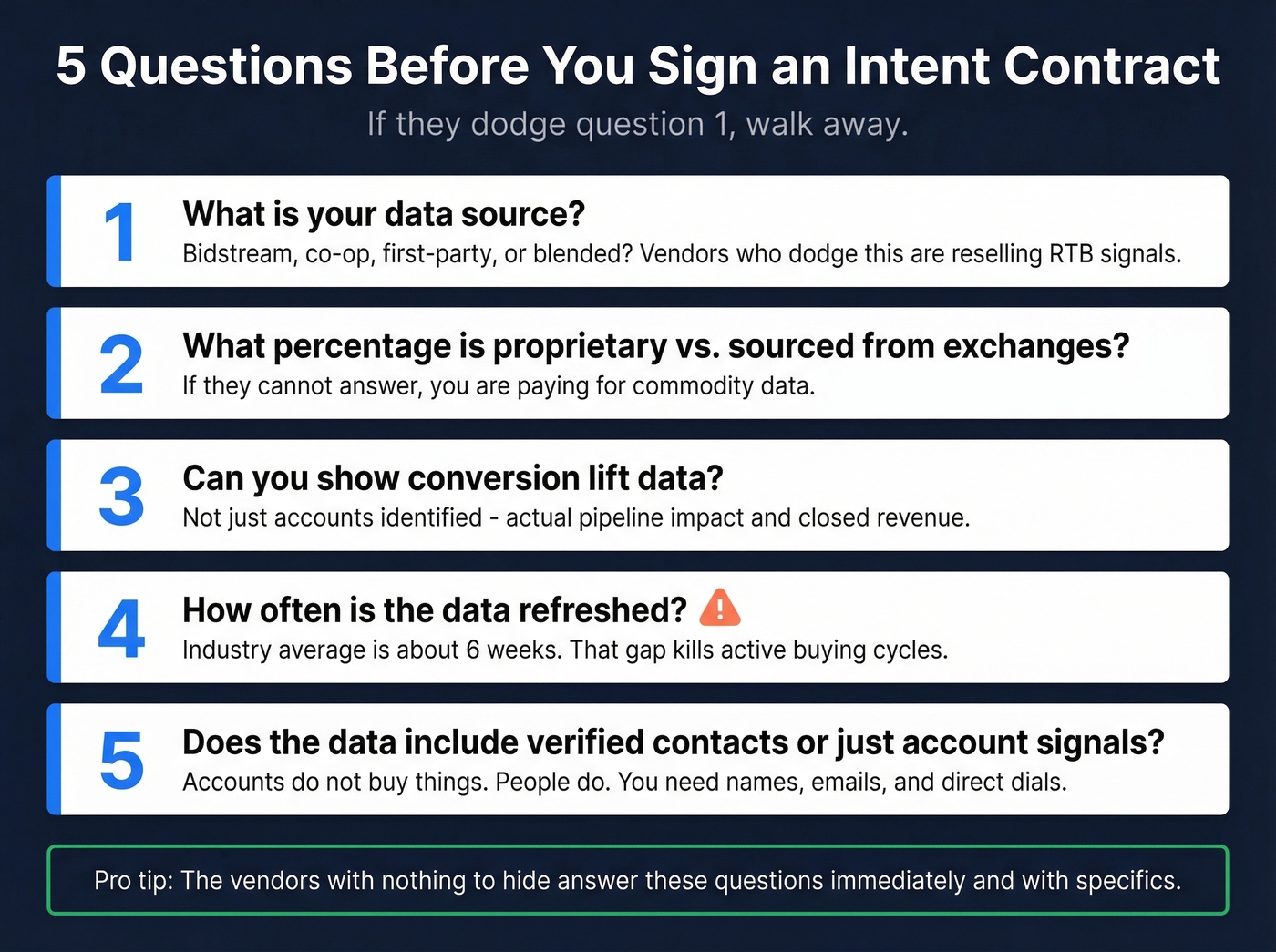
- What's your data source - bidstream, co-op, first-party, or blended?
- What percentage is proprietary vs. sourced from external exchanges?
- Can you show conversion lift data - not just "accounts identified," but pipeline impact?
- How often is the data refreshed? Industry average refresh is about six weeks. That gap matters when you're chasing active buying cycles.
- Does the data include verified contact information, or just account-level signals?
In our experience, vendors who dodge question one are always reselling RTB-derived signals. Walk away.
What to Use Instead of Bidstream
Start with first-party intent from your own website, content downloads, and product usage signals. Layer co-op intent for broader market coverage - Bombora's Company Surge is a standard because it's built on publisher consent, not scraped ad-auction traffic.
Then - and this is where most teams drop the ball - pair intent signals with verified contact data. The gap between "Company X is surging on your topic" and "here's the VP of Engineering's verified email and direct dial" is where deals die. Accounts don't buy things. People do.
Skip this step if you want to keep exporting account lists into a spreadsheet and manually hunting for contacts. But if you'd rather go from intent signal to direct dial in one workflow, Prospeo tracks 15,000 intent topics via Bombora's co-op network and pairs surging accounts with 143M+ verified emails and 125M+ mobile numbers on a 7-day refresh cycle. We've seen teams waste months stitching together separate intent and contact data tools - that duct-tape workflow is exactly what a unified platform eliminates.
You don't need a $50K intent platform to outsell competitors buying the same bidstream lists. Prospeo combines Bombora-powered buyer intent with 30+ filters, 125M+ verified mobiles, and 7-day data refresh - at 90% less than ZoomInfo.
Skip the commodity data. Build intent-driven lists your competitors can't replicate.
FAQ
Is bidstream intent data legal?
Legality varies by jurisdiction, and the trend is toward stricter enforcement. The Brussels Court of Appeal ruled the TCF consent model inadequate under GDPR, and the FTC has settled with US brokers misusing RTB data. Any team relying on bidstream-sourced signals should audit vendor compliance disclosures before renewing contracts.
What's the difference between bidstream and co-op intent?
Bidstream data is scraped from ad auction bid requests and modeled into "intent" using IP-to-company matching. Co-op intent comes from publishers who voluntarily share aggregated content consumption signals through a consent-based network - delivering higher accuracy and lower compliance risk at the cost of a smaller but cleaner signal pool.
Can I get intent data without a $25K+ annual contract?
Yes. Prospeo includes Bombora-powered intent tracking across 15,000 topics alongside 143M+ verified emails and 125M+ mobile numbers, starting with a free tier at roughly $0.01 per email. No annual contracts - self-serve signup, cancel anytime.
Why do multiple vendors sell the same intent signals?
Most bidstream-derived intent originates from the same RTB exchanges, so vendors buying that data end up reselling near-identical "surging account" lists. When your competitors purchase from the same pool, every team contacts the same accounts simultaneously - destroying any first-mover advantage and tanking response rates.