

Biscred vs Lusha: CRE Data vs General B2B (2026)
You're 45 minutes into manually filtering a Lusha export, trying to separate industrial warehouse owners from multifamily operators - because Lusha doesn't know the difference. That's not a Lusha bug. It's a category mismatch. Comparing Biscred vs Lusha reveals two tools solving fundamentally different problems, and picking the wrong one wastes more than credits.
30-Second Verdict
- Biscred wins if you sell into commercial real estate and need CRE-specific filters like asset class, property count, and ownership roles.
- Lusha wins if you sell into general B2B industries and want a quick, credit-based contact lookup with a free tier.
- Skip both if you need general B2B data with better accuracy and lower cost than Lusha - Prospeo covers 300M+ profiles with 98% email accuracy and a 7-day data refresh, starting free.
What Each Tool Actually Does
Biscred
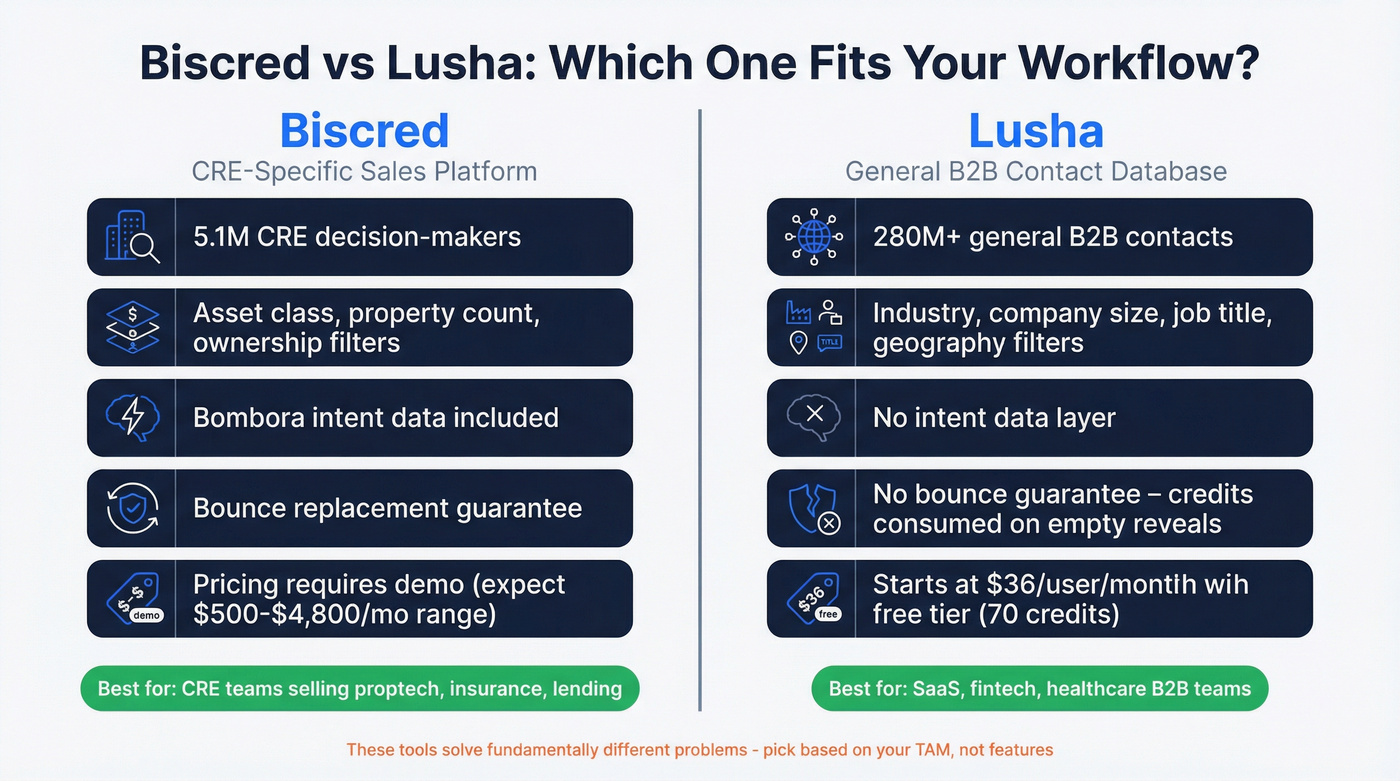
Biscred is a CRE-specific sales platform built on Bisnow's 14-year data foundation. The database covers 5.1M verified CRE decision-makers across 584K+ companies, with a broader pool of 6M+ CRE professionals.
A 120+ person team - researchers, data scientists, technologists - adds and validates roughly 10K contacts weekly. That's a serious investment in a narrow vertical.
The real differentiator is the taxonomy. Biscred filters by asset class (industrial, multifamily, office, retail), property count, and contact-level asset specialization, meaning you can see that a specific VP at a firm focuses on industrial, not multifamily. It also includes a Bombora-powered intent layer, an AI News Digest for trigger-based outreach, and CRM integrations with Salesforce, HubSpot, and Microsoft Dynamics. One SDR on Glassdoor described filtering by "company, location, seniority, asset class" - the kind of granularity that simply doesn't exist in general B2B tools.
Lusha
Lusha is a general B2B contact database with 280M+ contacts and a straightforward credit model: 1 credit reveals a verified email, 10 credits reveal a phone number. It holds a 4.3/5 on G2 across 1,619 reviews, and the free tier gives you up to 70 credits per month - enough to test before committing.
Filters are standard B2B: industry, company size, job title, geography, plus Boolean and AI-powered "Flex search." Fast to onboard, easy to use. But there's no asset class, no property count, no building-level data, no CRE taxonomy of any kind.
This Is a Category Decision
Here's the thing - this isn't really a "vs" comparison. Choosing between Biscred and Lusha is like choosing between a CRE broker and a general recruiter. They operate in different universes.
In our experience, the biggest mistake CRE teams make is trying to force a general B2B tool into a CRE workflow. You can search Lusha for "Real Estate" as an industry and "VP" as a title, but you'll never distinguish between someone managing Class A office buildings and someone running a residential brokerage. Biscred's entire taxonomy exists to make that distinction.
Conversely, Biscred is useless outside CRE. That's the point. If you sell proptech, CRE insurance, or construction services, Biscred is the obvious choice. If you sell SaaS to marketing teams, don't even look at it.
If your total addressable market isn't at least 60% commercial real estate, Biscred's price tag won't pencil out. Use a general B2B tool and build a manual CRE filter layer instead (start with a clear TAM definition).

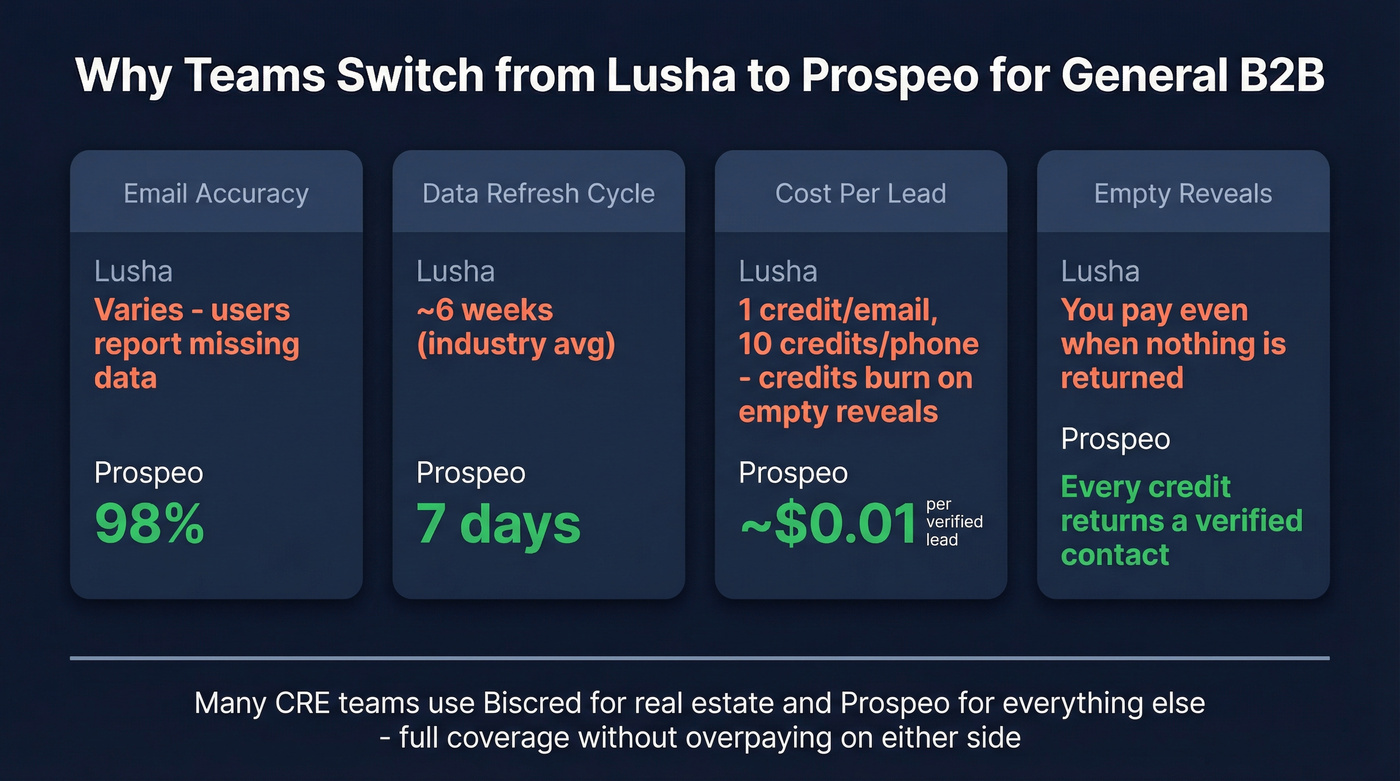
If CRE isn't your whole TAM, you need a general B2B tool that doesn't waste credits on dead emails. Prospeo covers 300M+ profiles with 98% verified email accuracy and refreshes every 7 days - not every 6 weeks. At ~$0.01/email with no contracts, you stop subsidizing Lusha's empty reveals.
Get verified contacts for every vertical Biscred doesn't cover.
Feature & Pricing Breakdown
| Feature | Biscred | Lusha | Winner |
|---|---|---|---|
| Database size | 5.1M CRE decision-makers | 280M+ general B2B contacts | Lusha (volume) |
| CRE filters | Asset class, property count, ownership roles | None | Biscred |
| Pricing | Not public (demo required) | Credit-based, free tier | Lusha (transparency) |
| CRM integrations | Salesforce, HubSpot, Dynamics | Salesforce, HubSpot | Biscred (Dynamics) |
| Intent data | Bombora partnership | Not included | Biscred |
| Data quality guarantee | Bounce replacement | Not included | Biscred |
| Compliance | Not highlighted publicly | GDPR, CCPA, ISO 27701, SOC 2 | Lusha |
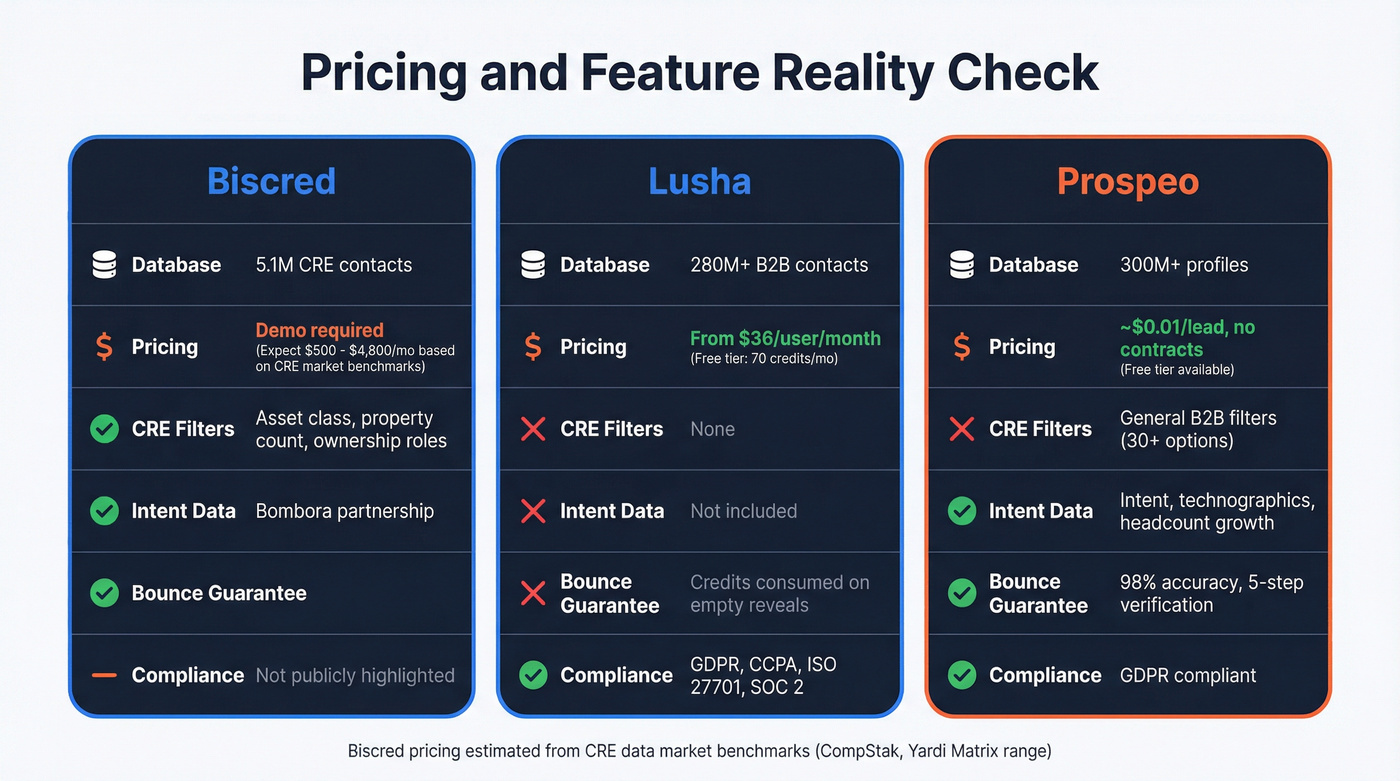
Lusha's paid plans start around $36/user/month, scaling to custom enterprise pricing. Biscred doesn't publish pricing - you'll need a demo. For context, CRE data tools typically range from $499/month for 4 users (CompStak) to $4,800/user/year (Yardi Matrix). Expect Biscred to land somewhere in that corridor depending on seats and download volume.
When to Choose Biscred

Biscred is the right call when your entire pipeline lives in commercial real estate. Specifically:
- You're prospecting owners, operators, developers, or property managers by asset class - not just by job title
- You sell proptech, CRE insurance, lending, construction, or building materials into the commercial real estate vertical
- You need filters like asset experience, property count, and CRE-specific intent signals that don't exist anywhere in general B2B tools
- Data quality is non-negotiable - the bounce-replacement guarantee means you're not burning credits on dead emails, and one customer reportedly generated $600K in new business within three months
Skip Biscred if CRE is less than half your target market. The ROI math just won't work.
When to Choose Lusha

Lusha makes sense for general B2B prospecting - SaaS, fintech, healthcare - where CRE specificity is irrelevant. The free tier and self-serve onboarding mean you can be running searches within an afternoon.
But let's be honest about the friction. One Reddit user reported that Lusha "often can't find the email address or phone number" after initial success, and flagged a HubSpot integration bug that overrides deal ownership. Credits also get consumed on empty reveals - you pay even when Lusha comes back with nothing. For teams scaling outbound past a few hundred contacts per week, those gaps compound fast (especially without a solid lead generation workflow).
A General B2B Alternative Worth Considering
If Lusha's accuracy frustrates you or you need a general B2B tool alongside Biscred for non-CRE verticals, we've found Prospeo to be the stronger pick. The database covers 300M+ profiles with 98% email accuracy and a 7-day data refresh - compared to the industry average of six weeks. Pricing runs about $0.01 per lead with no contracts. Some teams pair Biscred for CRE with a general platform like Prospeo for everything else, getting full coverage without overpaying on either side.

Teams pairing a CRE tool with a general B2B platform need the general side to actually deliver. Prospeo's 5-step verification keeps bounce rates under 2%, and 30+ filters - intent data, technographics, headcount growth - let you build targeted lists without burning credits on blanks.
Stop paying for empty reveals. Every Prospeo credit returns a verified contact.
FAQ
Can Lusha work for CRE prospecting?
Only at a surface level. You're limited to generic industry and job title filters - no asset class, property count, or building-level data. For dedicated CRE prospecting, Biscred or another CRE-specific platform is the right call.
Does Biscred work outside commercial real estate?
No. The entire database and taxonomy are CRE-specific. For non-CRE industries, you need a general B2B platform with broad coverage - something like Prospeo or another contact database built for cross-industry outbound.
Is Biscred or Lusha more accurate?
Different domains, different benchmarks. Biscred offers bounce replacement for CRE contacts and validates roughly 10K records weekly. Lusha is solid for general B2B, but users report missing data and diminishing returns over time - especially on phone reveals at 10 credits each. If general B2B accuracy is your priority, tools with higher verification standards and faster refresh cycles tend to outperform credit-based models where you pay regardless of results.