

Bottom of Funnel Content: A Benchmark-Driven Guide That Closes Deals
Your CEO just asked why 50,000 monthly visitors only produced 12 demos last quarter. You already know the answer - your content calendar is packed with awareness posts nobody reads twice and thought leadership that generates LinkedIn likes, not pipeline. Only 21% of the average content program targets buyers who are actually ready to act. The other 79% sits outside bottom of funnel content, mostly TOFU and MOFU.
That gap is the single biggest revenue opportunity most marketing teams ignore.
The Short Version
- Start with comparison and alternatives pages. They convert at 8.43% on average - nearly double the 4.85% rate of broader category keywords.
- Build three BOFU assets first: a competitor comparison page, a metrics-backed case study, and a transparent pricing page. These cover the three questions every buyer asks before signing.
- Measure BOFU by pipeline impact, not traffic. A page with 200 visits and 15 demos beats a blog post with 10,000 visits and zero.
What Is BOFU Content?
Bottom of funnel content targets buyers who've already identified their problem, evaluated categories, and narrowed their shortlist. You're not educating them. You're confirming a decision they're already leaning toward - clarifying rather than persuading.
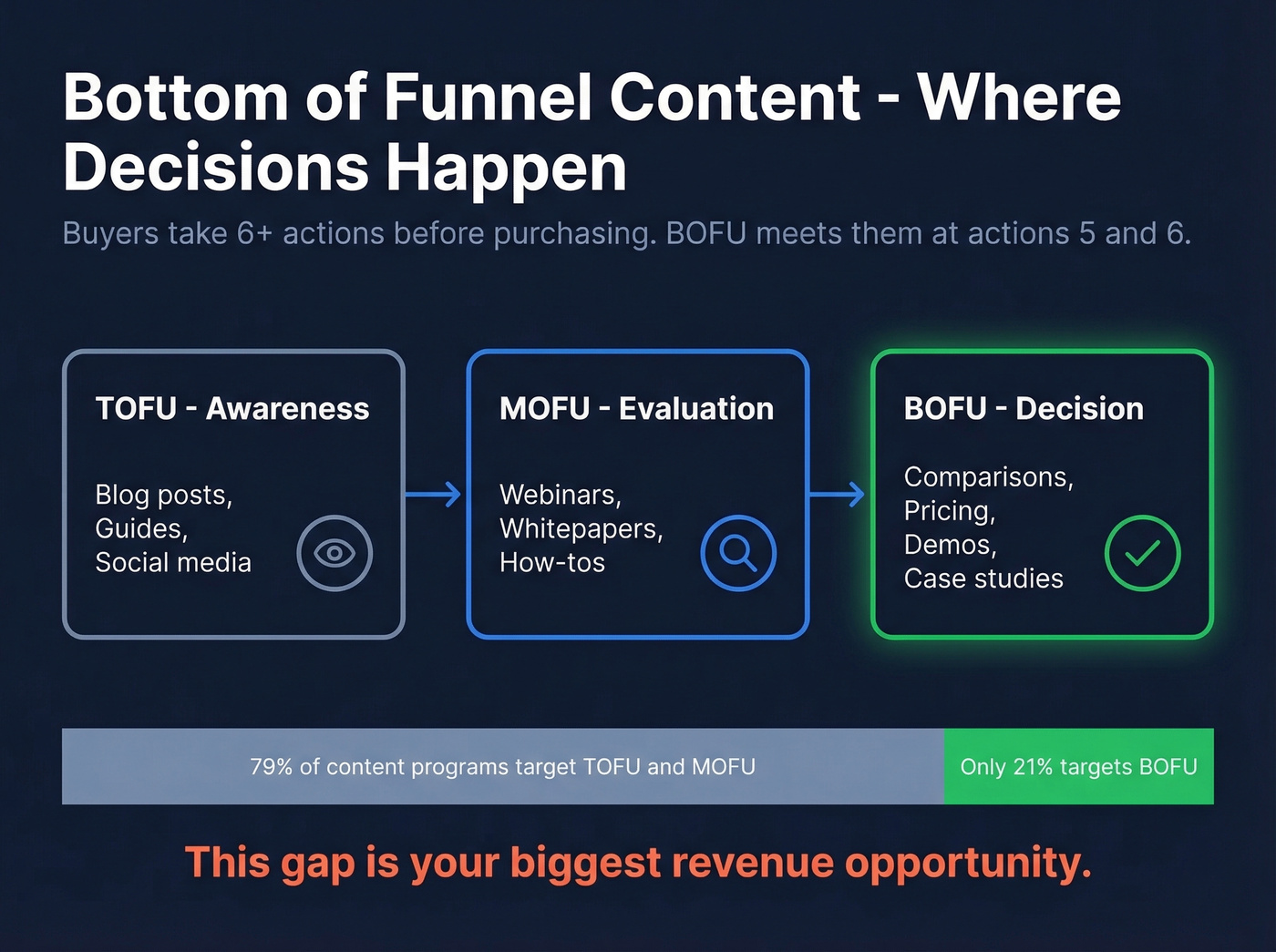
Google's own consumer research shows 60% of consumers take six or more actions before buying from a new brand. BOFU content meets them at action five or six - not action one.
| Stage | Goal | Content Examples |
|---|---|---|
| TOFU | Awareness | Blog posts, guides, social |
| MOFU | Evaluation | Webinars, whitepapers, how-tos |
| BOFU | Decision | Comparisons, pricing, demos, cases |
Why Decision-Stage Content Deserves Priority
Most content teams have the ratio backwards. They over-invest in TOFU and under-invest in decision-stage pages, which is why traffic grows while pipeline stays flat.
The data is unambiguous. Grow & Convert found that for their client Geekbot, BOFU posts converted 2,400% better than TOFU posts. Not 24%. Twenty-four hundred percent. Let's be honest: if you're still cranking out awareness content while your comparison pages don't exist, you're optimizing for vanity metrics.
SEO-sourced leads progress from MQL to SQL at 51%, compared to 26% for PPC. Organic content that catches a buyer mid-decision is one of the highest-leverage assets in your marketing stack. Yet only about a fifth of the average content program is BOFU - a massive misallocation and an opportunity for any team willing to flip the ratio.
Here's the thing: if your average deal size is above $5k and you don't have a comparison page for every named competitor, you're leaving pipeline on the table every single day. I'd build those before writing another blog post.
BOFU Content Types That Convert
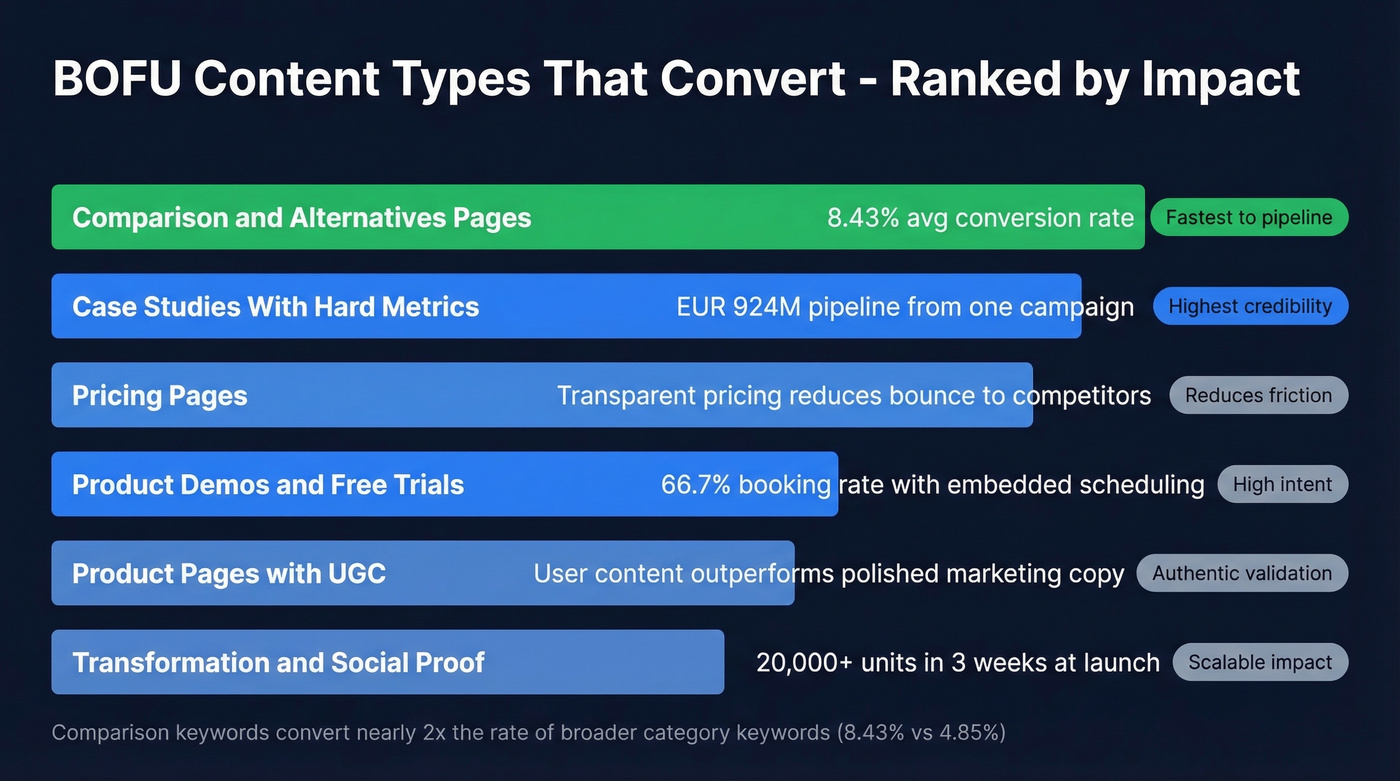
Not all decision-stage formats perform equally. Here are the six that consistently drive pipeline, ranked by how quickly we've seen them generate results.
Comparison & Alternatives Pages
Use this when you compete in a category with a dominant incumbent - think ZoomInfo, HubSpot, Salesforce. Skip this if you're creating a new category with no established alternatives.
Comparison keywords convert at 8.43% on average, the highest of any BOFU keyword type. Target modifiers like "vs," "alternatives," and "[Brand] vs [Brand]." In our experience, the first BOFU page a team should build is a competitor comparison. It's the fastest path to pipeline because the buyer has already decided they need a solution and is just picking which one. The consensus on r/sales backs this up - reps consistently say comparison pages are the content they share most with prospects who are "evaluating options."
Case Studies With Hard Metrics
Vague "we helped them grow" case studies don't close deals. Metrics-backed ones do. SAP's "Inspire the Future" campaign generated EUR 924.4M in pipeline and EUR 266.15M in projected revenue - and those numbers are what made the write-up worth reading. Lead with the outcome, not the process. If your case study doesn't have a number in the first sentence, rewrite it.
Pricing Pages
If your pricing page says "Contact Sales," you're filtering out buyers, not qualifying them. Transparent pricing is decision-stage content. Buyers who land on your pricing page are the closest to a purchase - don't make them jump through hoops to find out if they can afford you. We've watched prospects bounce from "Contact Sales" pages and sign with a competitor who showed numbers upfront.
Product Demos & Free Trials
Chili Piper analyzed roughly 4 million form submissions and found that 66.7% of qualified prospects book a meeting when scheduling is embedded directly into the form flow. The industry average without embedded scheduling sits around 30%. That's a 2x conversion lift from a single UX change. They also found 14.1% of form submissions are unqualified - spam, personal emails, or failing criteria - before your sales team even touches them.
Product Pages (eCommerce)
For eCommerce, the product detail page is your BOFU content. REI uses polished manufacturer imagery; Amazon layers in user-generated content for the same products. The UGC approach typically wins because shoppers at the decision stage want answers from other buyers, not marketing copy.
Transformation & Social Proof Stories
Bouf Haircare sold 20,000+ units in three weeks at launch, driven by having strong transformation stories ready before the product hit shelves. Koala's 120-night trial works as risk reversal - a BOFU format that says "we're so confident you'll love this, we'll eat the risk." Both reduce perceived risk at the moment of decision.

You just read that comparison pages convert at 8.43%. Now imagine yours backed by 300M+ verified profiles, 98% email accuracy, and case studies where teams tripled pipeline. Prospeo is the data platform that gives your BOFU content real numbers - not fluff.
Stop writing decision-stage content with unreliable data behind it.
How to Find BOFU Keywords
The BOFU modifier checklist from Content Harmony is the fastest starting point: vs, alternatives, competitors, reviews, pricing, best, top, near me, and use-case modifiers like "[tool] for [industry]." Append these to your product category and you'll surface dozens of pages worth building.
Check the SERP before building. Some BOFU queries show split intent, requiring both a landing page and an informational asset to capture the full opportunity.
Don't ignore zero-volume keywords. Many of the highest-converting BOFU terms show zero search volume in Ahrefs or Semrush because the queries are too specific for their models. The exact phrases prospects use on sales calls are your best keyword seeds - attach a keyword after you've identified the real question. Then cross-reference Slack communities, relevant subreddits, People Also Ask boxes, and autosuggest to validate the language buyers actually use.
How to Measure BOFU Impact
Traffic is the wrong metric for bottom of funnel content. Pipeline velocity is the right one:
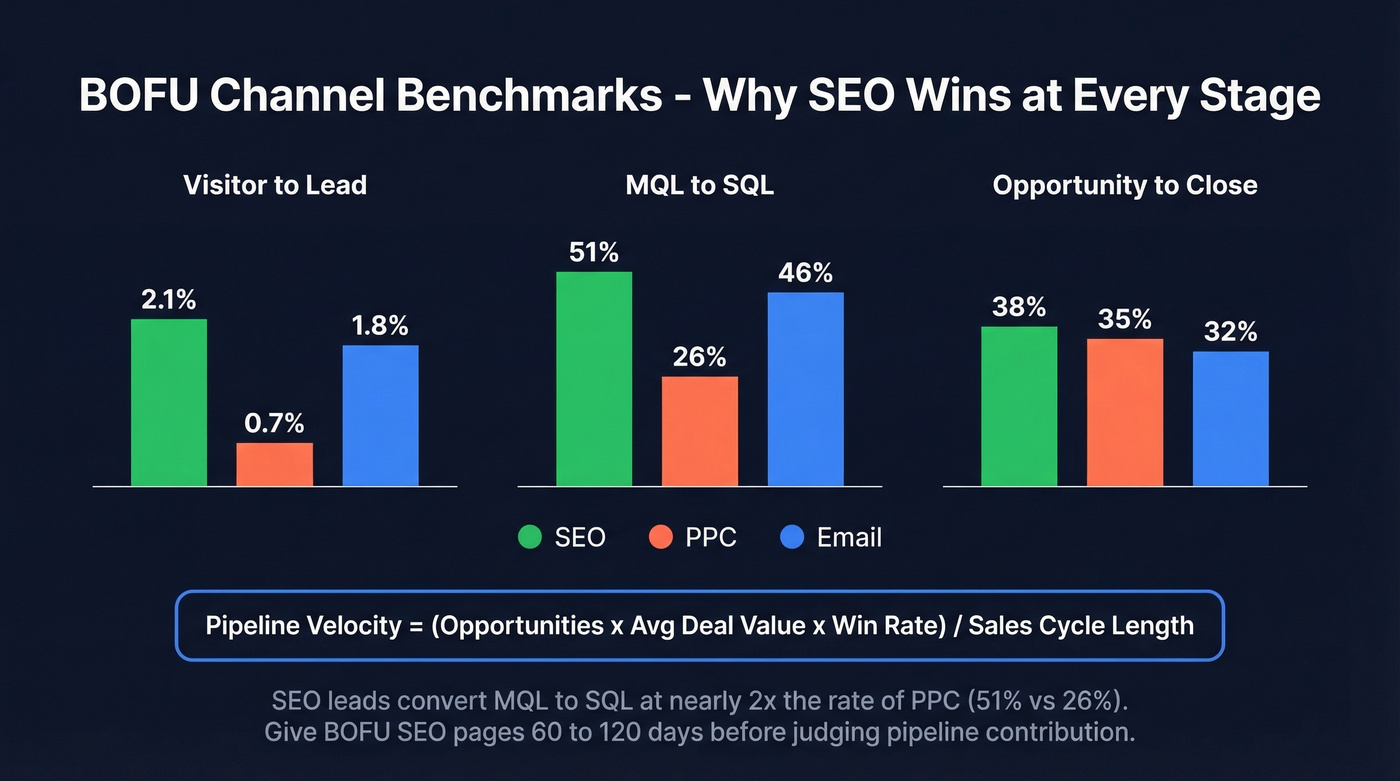
(Opportunities x Avg Deal Value x Win Rate) / Sales Cycle Length
This formula tells you how fast your funnel generates revenue. BOFU content should move at least one of those four variables.
Attribution matters. Last-click models inflate BOFU's credit; first-click models ignore it entirely. Multi-touch attribution is the most honest approach. Close attribution gaps further with server-side conversion tracking via Conversion API - it captures touchpoints that browser-based pixels miss.
Here's what "good" looks like by channel:
| Channel | Visitor to Lead | MQL to SQL | Opp to Close |
|---|---|---|---|
| SEO | 2.1% | 51% | 38% |
| PPC | 0.7% | 26% | 35% |
| 1.8% | 46% | 32% |
Set realistic timeline expectations. We've seen teams expect results in week two and kill pages that would've converted by month three. Give BOFU SEO pages 60-120 days before judging their pipeline contribution.
BOFU Content Audit Checklist
Before building new decision-stage assets, audit what you already have. It'll save you from duplicating effort:
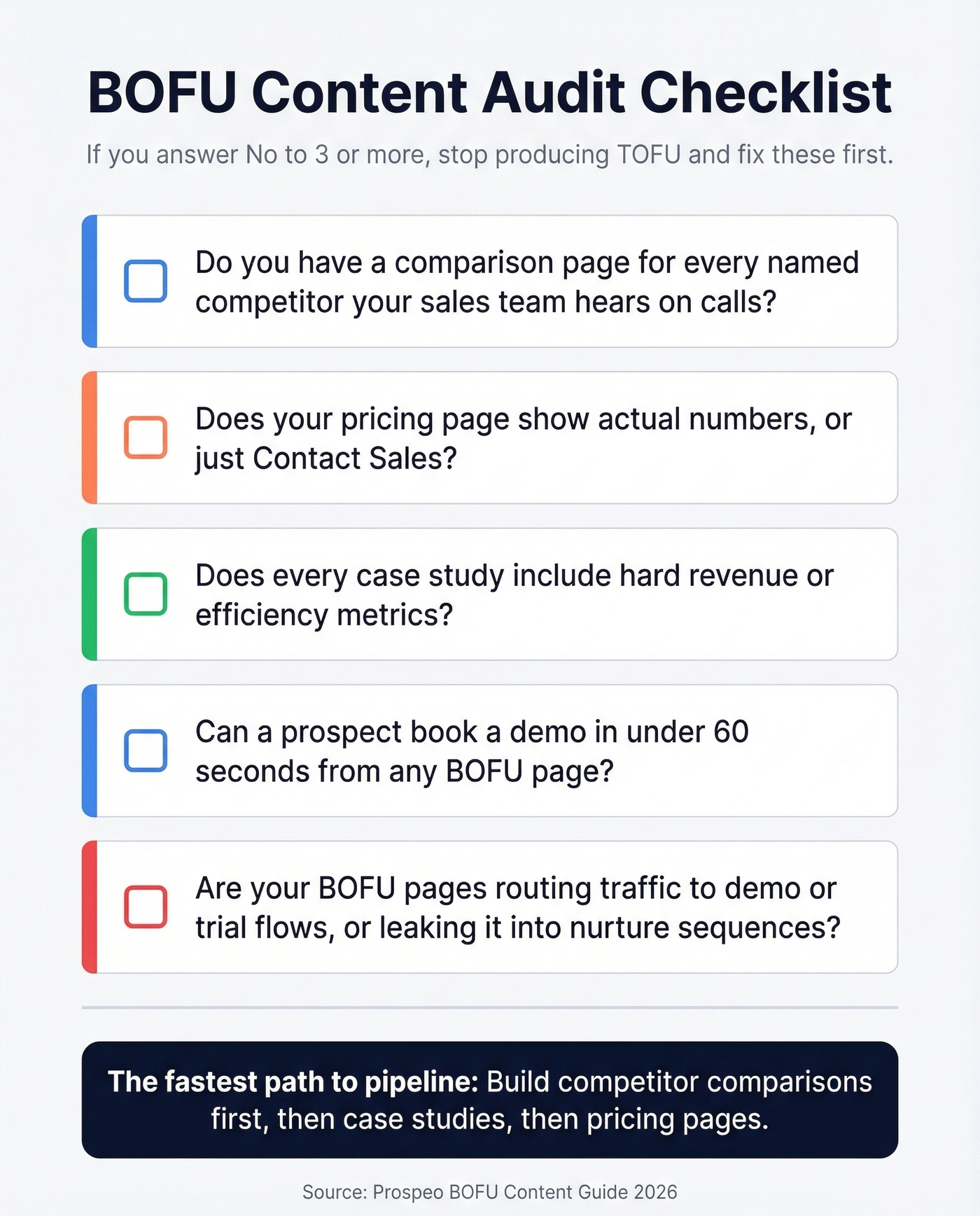
- Do you have a comparison page for every named competitor your sales team hears on calls?
- Does your pricing page show actual numbers - or just "Contact Sales"?
- Does every case study include hard revenue or efficiency metrics?
- Can a prospect book a demo in under 60 seconds from any BOFU page?
- Are your BOFU pages routing traffic to demo/trial flows - or leaking it into nurture sequences?
If you answered "no" to three or more, stop producing TOFU and fix these first.
Optimize What You've Built
Small copy changes on BOFU pages produce outsized results because the visitor is already convinced. You're removing friction, not building desire.
Go A/B tested their CTA copy - "Sign up for free" versus "Trial for free" - and saw a 104% increase in premium trial starts. That's a single word change. Place social proof directly adjacent to your CTA, not buried in a separate section. Speed-to-lead matters too: embed scheduling tools so a demo request turns into a booked meeting in the same session.
But speed-to-lead only works if the data behind the handoff is clean. If your reps chase bounced emails after a hot demo request, the BOFU page did its job and the data didn't. Prospeo verifies emails in real time with 98% accuracy and refreshes its database every 7 days, so the handoff from content to sales doesn't break at the last mile.
Mistakes That Kill BOFU Conversions
Gating BOFU content behind email capture. Someone reading your comparison page is ready to talk to sales. Send them to a demo, not a drip campaign.
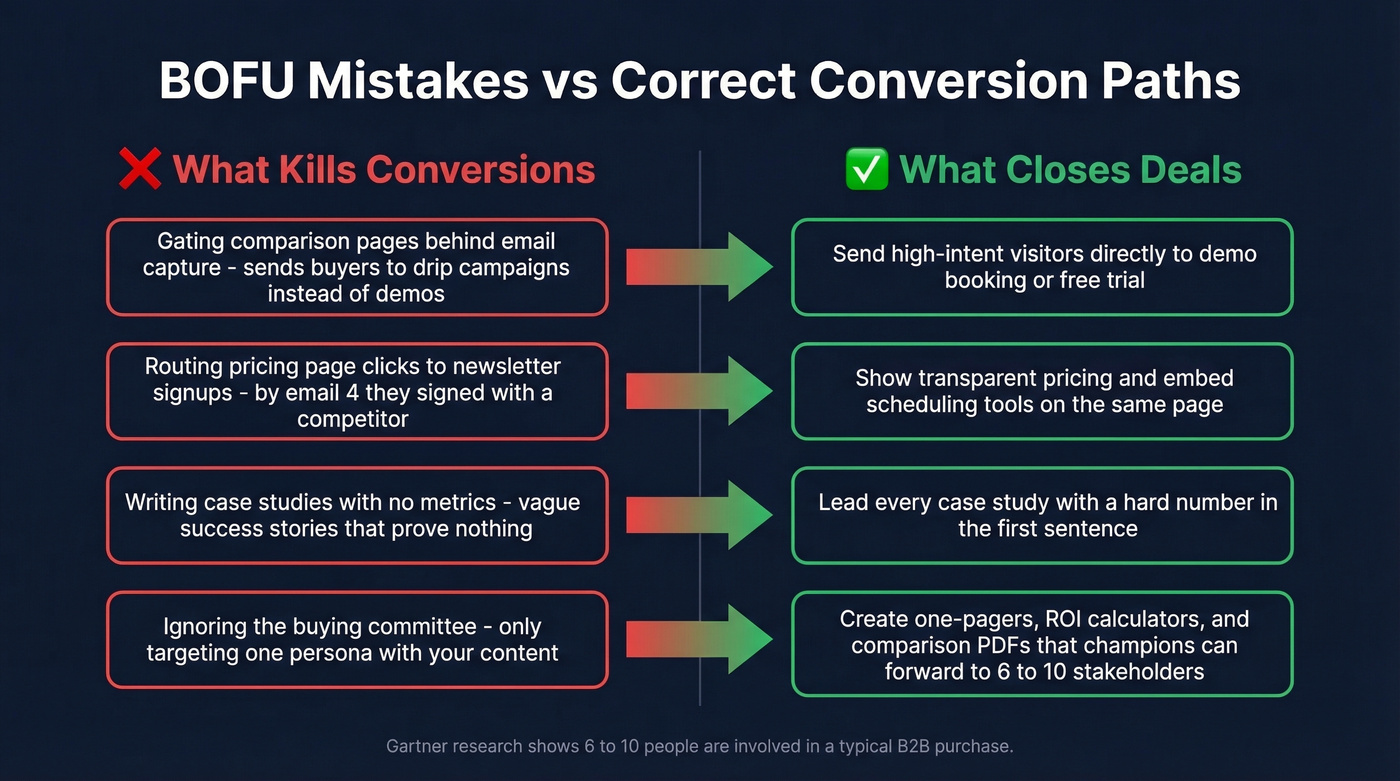
Routing BOFU traffic to nurture sequences. If a buyer clicks "see pricing" and lands on a newsletter signup, you've lost them. This one drives us crazy - we've audited sites where the highest-intent page on the domain funneled visitors into a 12-email nurture sequence. By email four, they'd already signed with a competitor.
Ignoring the buying committee. Gartner's research shows 6-10 people are involved in a typical B2B purchase. Your decision-stage content needs to arm the champion with material they can forward - one-pagers, ROI calculators, and comparison PDFs that survive an email chain.
Not aligning content with sales objections. If your SDRs handle the same five objections on every call, those objections should each have a dedicated BOFU page.
Letting bad data waste good content. Your BOFU content converts a visitor into a hand-raiser. But if your sales team works with stale data - bounced emails, disconnected numbers - that conversion dies before the first call. For teams that run into this, tools like Prospeo that refresh on a weekly cycle instead of the 6-week industry average can close that gap.

Transparent pricing is BOFU content that closes. Prospeo starts at $0.01/email with no contracts, no 'Contact Sales' gates - exactly the kind of buying experience you'd want your own prospects to have. 15,000+ companies already use it to fuel the metrics in their case studies.
Give your sales team comparison-ready data that actually converts.
FAQ
What's the difference between MOFU and BOFU content?
MOFU content educates prospects evaluating solutions - webinars, whitepapers, how-to guides. BOFU content targets buyers ready to purchase: comparison pages, pricing pages, case studies, and demos. If the content doesn't drive a specific buying action, it's not BOFU.
How much of my content budget should target BOFU?
Most teams sit around 21% BOFU. If traffic is growing but pipeline isn't, shift to 40-50% BOFU until you've covered every competitor comparison, use case, and objection your sales team handles. Fix the bottom of the funnel before pouring more into the top.
What's a good BOFU conversion rate?
Comparison keywords convert at roughly 8.43% on average. Demo pages with embedded scheduling convert qualified visitors at 66.7%. If your BOFU pages convert below 3%, start with CTA copy tests and speed-to-lead improvements - those two changes alone can double your rate.
How do I keep BOFU leads from going stale after conversion?
Route hand-raisers to verified contact data so reps connect on the first attempt. Pair real-time email verification with embedded scheduling and you close the gap between "interested" and "booked." The faster a verified email hits your CRM, the less likely that hot lead cools off in someone's queue.