


BriteVerify vs Lusha: They Overlap in Your Budget, Not Their Category
BriteVerify verifies email lists you already have. Lusha finds new contacts you don't. Comparing BriteVerify vs Lusha makes sense because they sit in the same outbound pipeline budget - but they're rarely true substitutes. Most teams eventually need both jobs done. The real question is whether you pay two vendors or one.
Side-by-Side: BriteVerify vs Lusha
| Lusha | BriteVerify | |
|---|---|---|
| Category | Sales intelligence | Email/phone/address verification |
| Core job | Find new contacts | Verify existing lists |
| G2 rating | 4.3/5 (1,618 reviews) | 4.2/5 (74 reviews) |
| Starting price | $29.90/mo | ~$0.01/email (up to 250k) |
| Free tier | Up to 70 credits/mo | None |
| Key integrations | HubSpot, Salesforce, CRM connectors | Salesforce app, Zapier, Marketo, API |
| Pricing model | Credits: 1/email, 10/phone | Pay-per-verification |
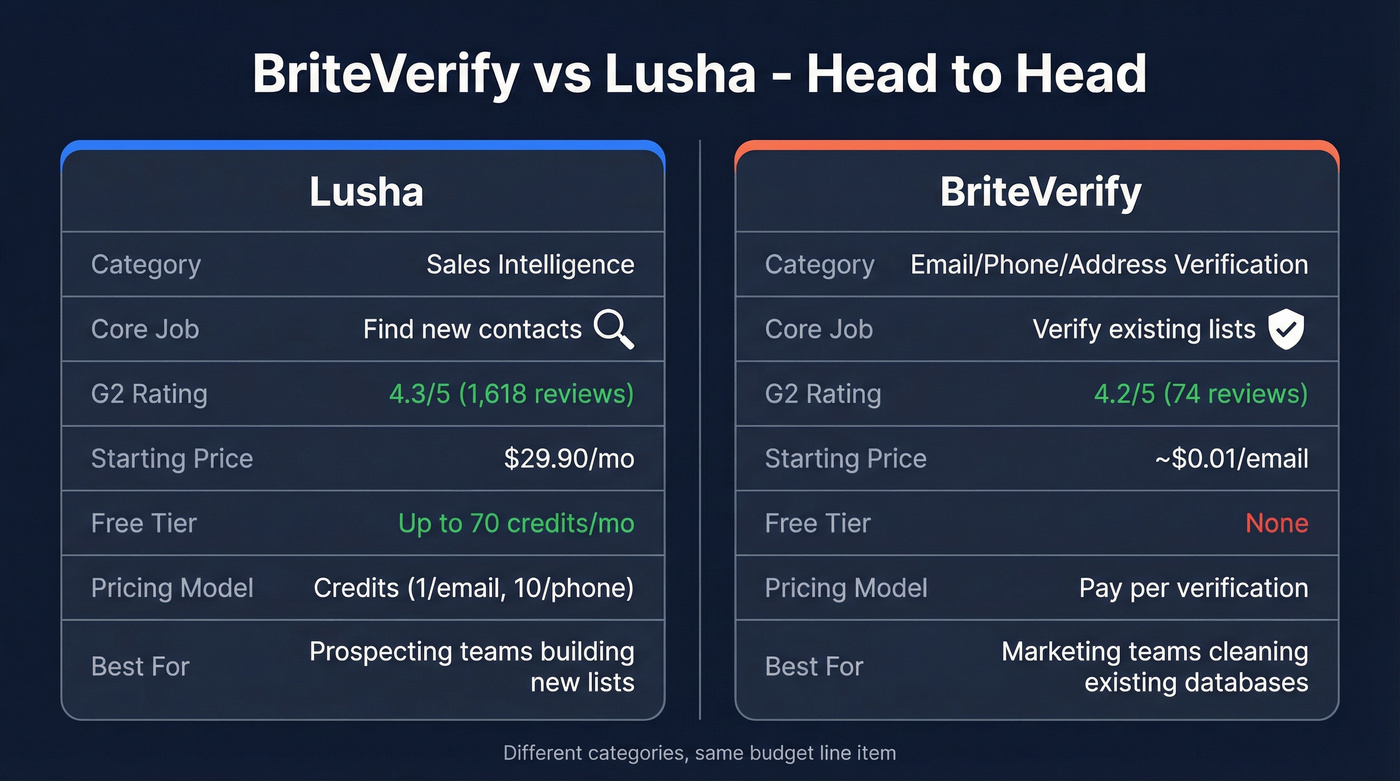
These two tools sit in entirely different software categories. One is prospecting, the other is list hygiene. If you need both, you're building a stack, not picking a winner.
What Each Tool Actually Does
Lusha: Prospecting and Contact Discovery
Lusha gets you net-new contact data. The browser extension reveals emails and phone numbers while you browse professional profiles or company websites, and the platform lets you build targeted lists with filters.
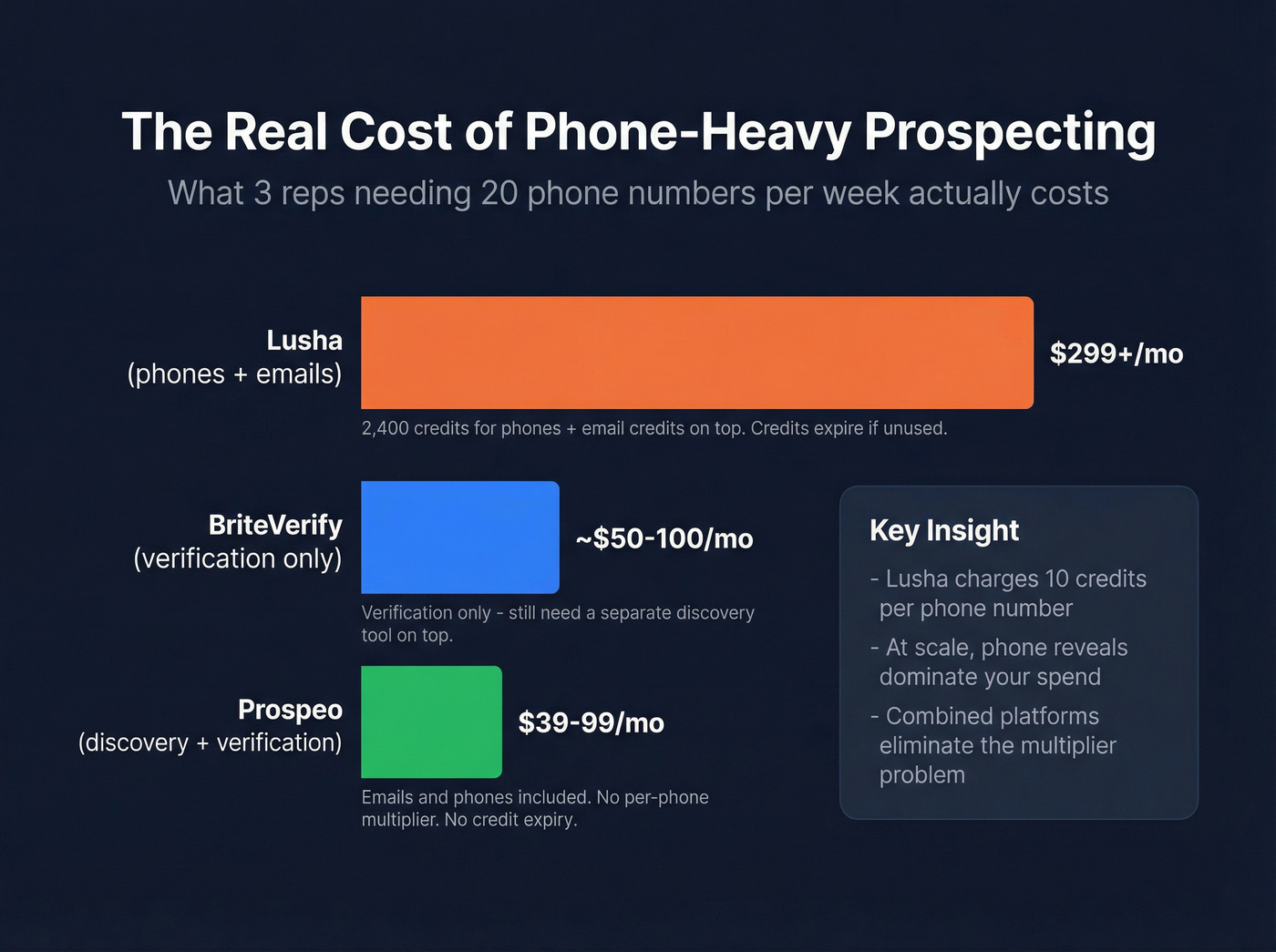
The credit math matters more than the sticker price. One credit gets you an email. A phone number costs 10 credits. That free plan with up to 70 credits/month? It gets you exactly 7 phone numbers if that's all you reveal. Paid plans start at $29.90/mo, but phone-heavy teams burn through credits fast.
We've seen teams underestimate how quickly 10-credits-per-phone eats a budget. A squad of 3 reps each needing 20 phone numbers per week consumes 600 credits weekly - well beyond the free tier and into territory where you're doing mental math every time someone clicks "reveal." Monthly plans let unused credits roll over up to 2x your cap, though annual plans reset at cycle end. For more than 5 users, Lusha routes you to sales.
Here's the thing about Lusha's data quality: the consensus on r/coldemail isn't great. One post describes phone numbers as "outdated or wrong" often enough to slow down call blocks. Another thread comparing Apollo and Lusha puts email validity around 60-70% and phones closer to 50/50. Don't treat those as hard benchmarks - treat them as a warning to verify everything before you send.
BriteVerify: Verification and List Hygiene
BriteVerify handles email verification, plus phone and address validation via its API. Real-time validation at point of capture, bulk list cleaning, and recurring database hygiene are the three core use cases. The free Salesforce app is genuinely useful - it adds a Lightning component showing verification status right on the contact record.
Integrations run deeper than most verification tools: API access for real-time and bulk verification, Zapier workflows, and marketing/CRM connectors including Salesforce, Marketo, HubSpot, Pardot, and Mailchimp.
Validity advertises throughput of ~4,000 emails per minute. One third-party writeup reports closer to ~200/min in practice. That's a big gap. Throughput depends on workload, but if you're cleaning 100k+ records on a deadline, this becomes a real ops constraint. Run a 10k pilot list and time it before committing.

Lusha finds contacts at ~60-70% accuracy. BriteVerify cleans them after the fact. Prospeo verifies at the point of discovery - 143M+ emails at 98% accuracy, refreshed every 7 days. One platform, one credit system, zero bounced emails slipping through.
Replace two tools with one that does both jobs better.
Pricing Reality Check
Lusha's pricing is transparent up to a point. The $29.90/mo starting price is clear, and credit mechanics are documented on their pricing page. The pain hits at scale: enterprise volumes push costs up quickly, and phone-heavy workflows multiply spend by 10x per reveal.
BriteVerify's pricing is more frustrating. Validity pulled public pricing behind a "contact sales" wall. The ~$0.01/email anchor holds for up to 250k verifications based on G2 pricing data, but anything beyond basic needs requires a conversation. Credits reportedly expire after 12 months - confirm that in your order form before signing.
Let's be honest: if your average deal size is under five figures, neither tool's enterprise tier makes financial sense. You'll get better ROI from a self-serve platform that doesn't gate features behind sales calls.
When You Need Both - and How to Decide
Here's the real workflow most outbound teams run: a prospecting tool feeds contacts into a list, then a verification layer catches bad emails before sequences go live. If your bounce rate exceeds 2% - and especially if hard bounces top 1% - you need that second layer. In our experience, verification is non-negotiable once you're scaling cold email past a few hundred sends per week.
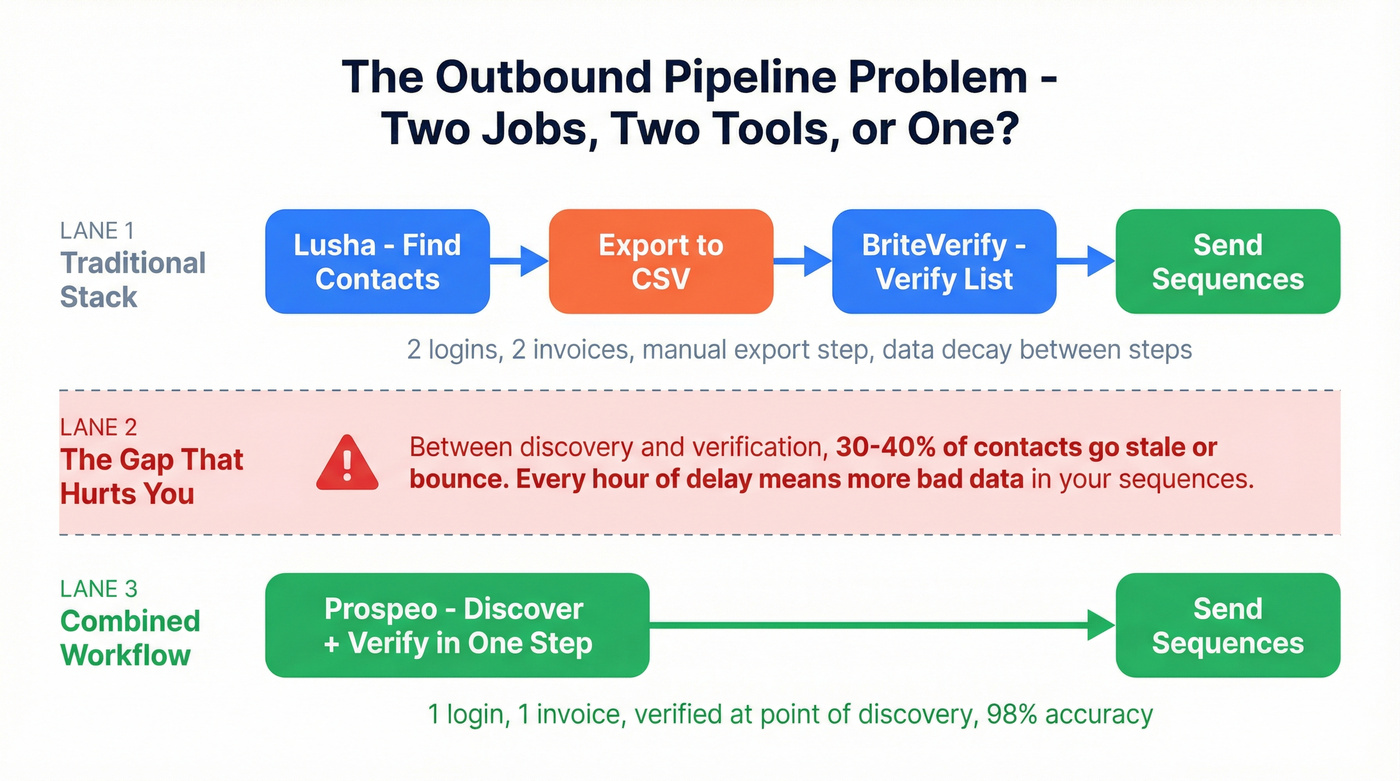
Stacking Lusha plus BriteVerify works, but you're paying two vendors for two logins solving one pipeline problem. Prospeo collapses discovery and verification into one workflow - 143M+ verified emails at 98% accuracy, 125M+ verified mobile numbers with a 30% pickup rate, all refreshed on a 7-day cycle. Self-serve pricing starts free with 75 emails and 100 Chrome extension credits per month. No contracts, no credit expiry.
Quick Decision Tree
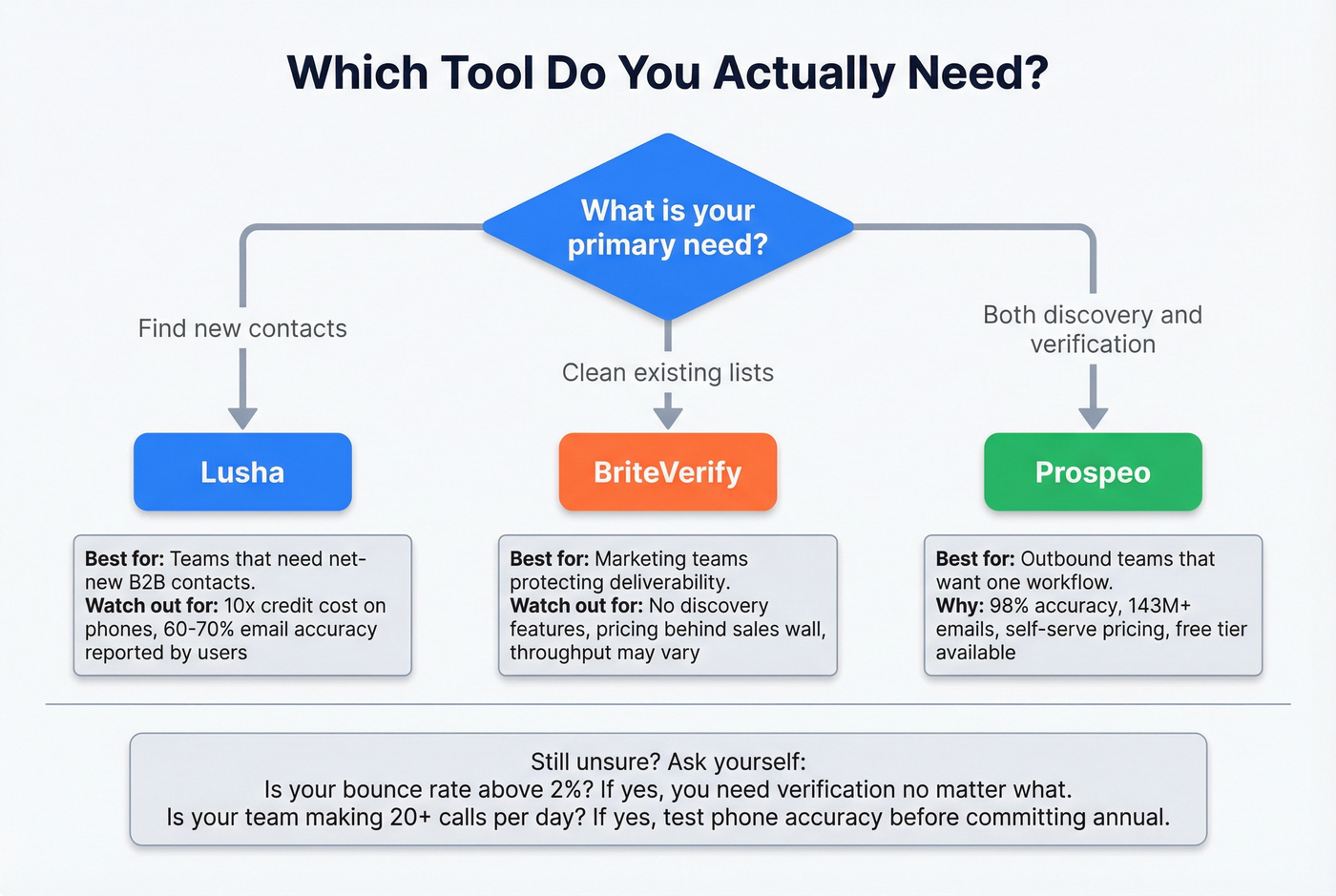
- Need net-new contacts? Lusha.
- Already have a list and need to protect deliverability? BriteVerify.
- Need both discovery and verification in one workflow? Prospeo.
- Phone-heavy calling team? Prioritize direct-dial hit rate. Test before committing annual.
How to Evaluate in 30 Minutes
- Export 100 contacts from your CRM that bounced or went unanswered last quarter. Run them through BriteVerify's API or a free verification tool to see how dirty your current data really is.
- Reveal 20 contacts in Lusha's free tier. Send to those emails. Track bounce rate and reply rate against your baseline. If bounces exceed 5%, you need a verification layer on top.
- Compare cost-per-verified-contact. Divide your monthly spend by the number of contacts that actually resulted in a delivered email or answered call. That's the number that matters - not sticker price.
At 10 credits per phone number, Lusha's costs spiral fast. Prospeo gives you 125M+ verified mobile numbers with a 30% pickup rate - plus verified emails at ~$0.01 each. No contracts, no credit expiry, no sales calls required.
Get discovery and verification in one workflow for 90% less.
FAQ
Can Lusha Replace BriteVerify?
No. They serve different functions. Lusha finds new contacts; BriteVerify verifies existing ones. Using Lusha alone means sending to unverified emails, which risks your sender reputation. A platform that verifies at the point of discovery eliminates the need to manage two separate tools.
Do I Need Both a Data Provider and a Verifier?
If your bounce rate exceeds 2%, yes. Sales intelligence tools like Lusha deliver roughly 60-70% valid emails based on community reports from real workflows. A verification layer catches the rest before you damage deliverability. The alternative is a platform that verifies during discovery so you never export a bad address in the first place.
What Bounce Rate Is Acceptable for Cold Outreach?
Keep total bounces below 2% and hard bounces under 1%. Anything above that signals to ESPs that your list hygiene is poor, which tanks inbox placement rates across your entire sending domain - not just the bad campaign.
Is There a Single Tool That Handles Both Discovery and Verification?
Yes. Prospeo combines a 300M+ contact database with built-in 5-step email verification, returning only validated addresses. At ~$0.01 per email with a free tier of 75 emails/month, it's significantly cheaper than running Lusha and BriteVerify side by side - and eliminates the workflow gap between finding and verifying contacts.