

How to Build a B2B Database That Doesn't Decay in 6 Months
You spend three weeks building a contact list. You load it into your sequencer, hit send, and nearly 10% of your emails bounce on the first campaign. Your domain reputation takes a hit, deliverability craters, and you're back to square one - except now Gmail doesn't trust you.
This is the default outcome when you build a B2B database without a verification and maintenance plan. Poor data quality costs businesses $12.9M annually on average, and sales reps lose roughly 500 hours per year validating and correcting contact information. That's a quarter of their selling capacity, gone. The hard part isn't assembling contacts. It's keeping them alive.
What You Need Before You Start
A functional B2B database has three components:
- A data source - where you find contacts matching your ICP
- A verification layer - ensuring emails and phones actually work before you reach out
- A CRM - where you store, segment, and maintain everything
Your budget range runs from $0/month to $5,000+/month depending on team size and data volume. Bootstrapped founders can start with a free data source plus HubSpot's free CRM and pay nothing. Teams with budget layer in intent data, enrichment tools, and workflow automation.
When evaluating data sources, prioritize accuracy, filtering depth, and CRM integration - these are the three criteria that come up most in buyer conversations. Raw database size matters far less than whether the contacts you pull are real, reachable, and relevant.
Here's our hot take: most teams don't need a $30K/year data platform. They need 500 verified contacts that match their ICP, a clean CRM, and the discipline to maintain both. Start there.
How to Build a B2B Database From Scratch
Define Your ICP From Closed-Won Data
Don't start with job titles. Start with your last 12 months of closed-won deals and reverse-engineer who actually bought.
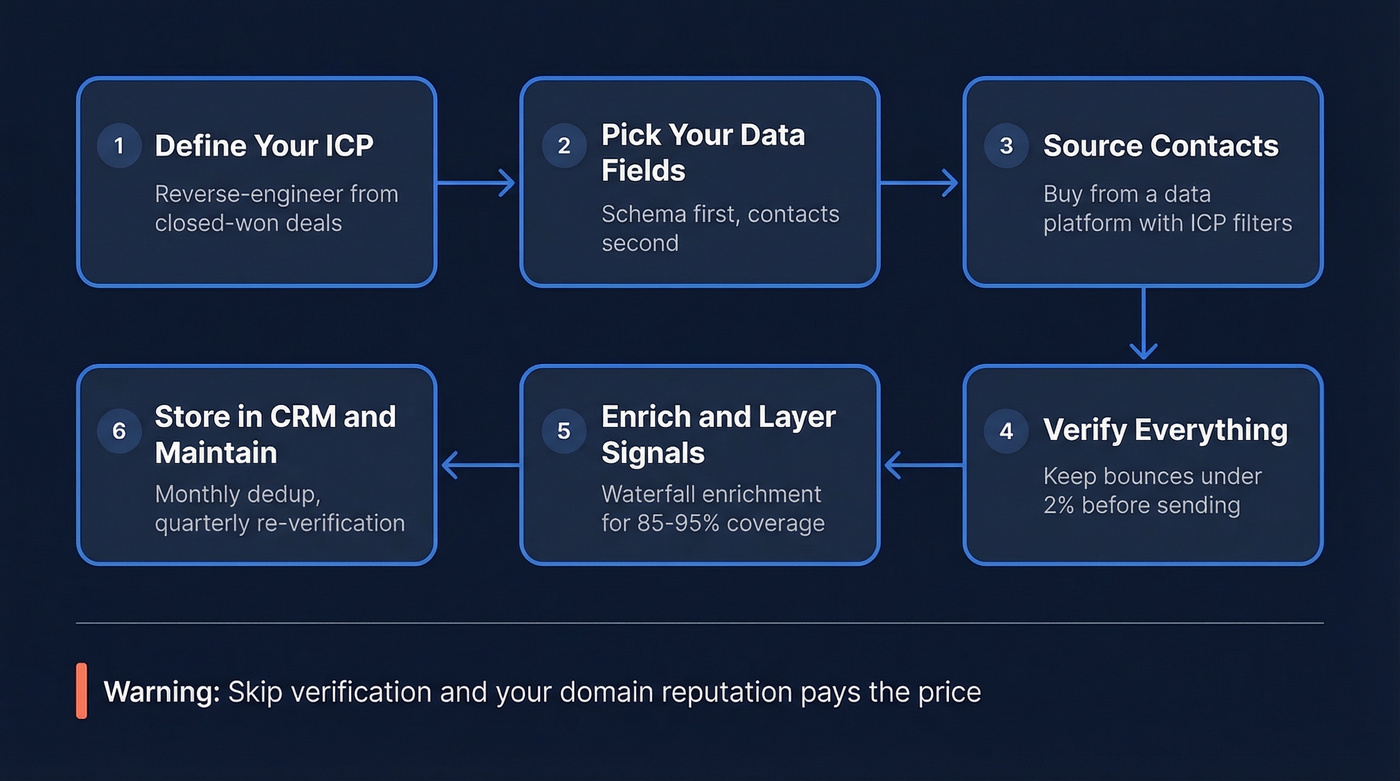
Pull every closed deal and look for patterns across company size (headcount and revenue range), industry and sub-vertical, tech stack, funding stage, headcount growth trajectory, and geographic concentration. The average B2B deal now involves 13 decision-makers, and 80% of buyer interactions happen digitally. Your ICP isn't just "VP of Sales at mid-market SaaS." It's a buying committee spread across multiple departments, and you need data on all of them.
Define your ICP at the account level first, then map the roles within each account that show up in your closed-won data.
Pick Your Data Fields
Before you source a single contact, decide what fields you actually need. This prevents the "dump everything into the CRM and sort it out later" approach that creates unmaintainable databases.
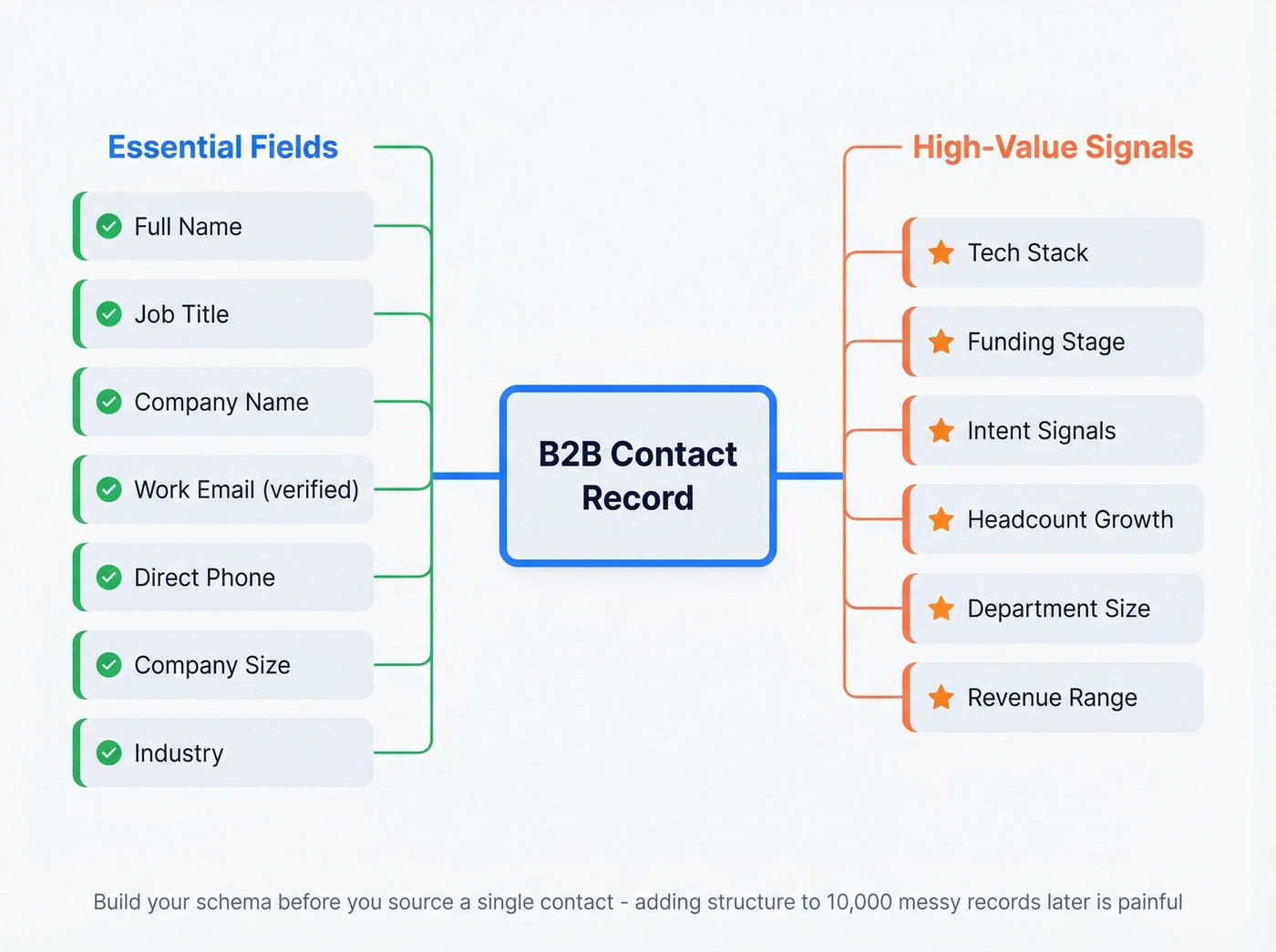
| Essential Fields | Optional But Valuable |
|---|---|
| Full name | Tech stack |
| Job title | Funding stage |
| Company name | Intent signals |
| Work email (verified) | Headcount growth |
| Direct phone | Department size |
| Company size | Buying triggers |
| Industry | Revenue range |
Build your schema around these fields from day one. Adding structure later - after 10,000 messy records are already in your CRM - is painful.
Source Your Contacts
This is where the build-vs-buy decision matters most. You can manually research contacts (free but slow), scrape public sources (legally gray and unverified), or use a data platform that gives you filtered, verified contacts on demand.
For most teams, buying makes sense. The question is from whom.
ZoomInfo is the enterprise default - 260M+ professional profiles, deep intent data, and broad workflow features. But a typical contract runs $15,000-$45,000/year depending on tier, and renewals climb 10-20% annually. That's real money for a team that just needs verified emails and phone numbers.
Apollo.io is the SMB favorite with a generous free tier and paid plans from $49-$119/user/month. It's a strong option for list-building and outbound workflows, but you should still run exports through a verifier before sending.

Let's be honest - if you're spending $15K+ a year on ZoomInfo and still running exports through a third-party verifier, something's broken. We've seen teams cut that cost by 90% and get better deliverability. The math isn't complicated.
Verify Everything
Even if you trust your data source, verify before you send. The benchmark is clear: keep total bounces below 2%, with top performers targeting hard bounces under 1%. Anything above that and you're risking your sender reputation.
Email verification works in three stages. A syntax check confirms the format is valid. A DNS/domain check confirms the mail server exists. An SMTP mailbox check confirms the inbox is real. No email gets sent during verification - it's all handshake-level validation.
If you sourced contacts from a platform with built-in verification (like Prospeo's 5-step process with catch-all handling, spam-trap removal, and honeypot filtering), you're already covered. If you sourced from elsewhere, run your list through a standalone verifier before loading it into any sequencer.
| Tool | Cost per 1,000 | Accuracy | Free Credits |
|---|---|---|---|
| Bouncer | $7 | 99.5% | 1,000 |
| NeverBounce | $8 | 99.9% | 1,000 |
| ZeroBounce | $7.50 (2K min) | 96-98% | 100 |
| BriteVerify | $10 | 97% | None |
These are pay-as-you-go rates - volume discounts apply at scale. For a 10,000-contact database, you're looking at $70-$100 for a full verification pass. That's cheap insurance against domain blacklisting.
Enrich and Layer Signals
A name and email address isn't enough. You need context - what technology does their company use? Are they hiring? Did they just raise a round?
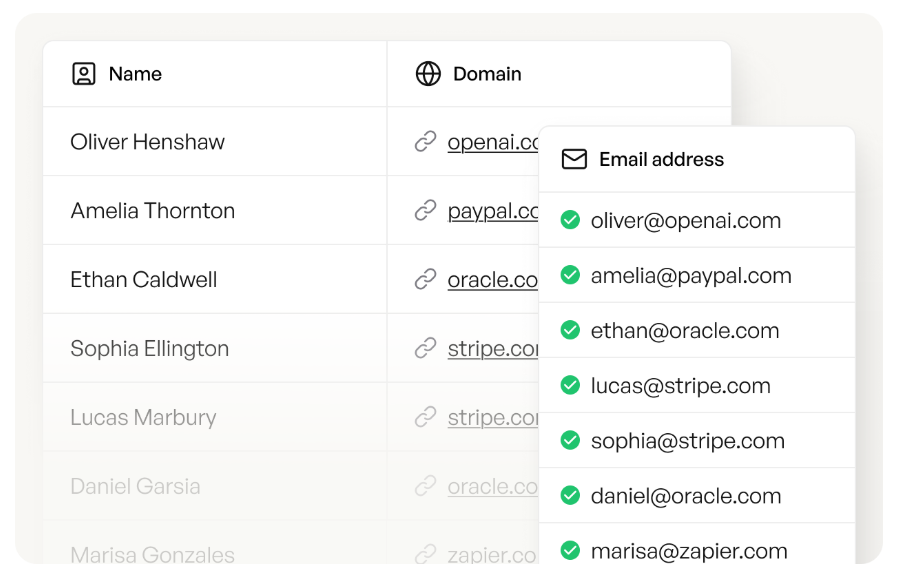
Use waterfall enrichment - running contacts through multiple providers sequentially rather than relying on a single source. Single-source enrichment typically hits 50-60% find rates. Waterfall workflows push that to 85-95%. LeadMagic (from $59.99/mo) and Databar (from $39/mo) handle enrichment at scale. For intent signals, Prospeo tracks 15,000 topics powered by Bombora.
B2B contact data decays 25-30% annually. People change jobs, companies get acquired, phone numbers rotate. Enrichment isn't a one-time step - it's ongoing.
Store and Organize in Your CRM
Your CRM is the single source of truth. Pick one and commit.
HubSpot's free CRM is the obvious choice for bootstrapped teams - it functions as a web-based contact database your entire team can access from anywhere. Pipedrive starts at $19/seat/month and offers a cleaner sales-focused interface. Salesforce is the enterprise standard at $150+/user/month depending on edition and add-ons - often overkill for teams under 20 reps.
Whatever you choose, establish a tagging taxonomy from day one. Segment contacts by ICP tier (A/B/C), engagement status (new, contacted, replied, qualified), and compliance geography (GDPR, CCPA, other). This structure makes maintenance possible later. Without it, your database becomes a junk drawer within six months.
Maintain or Watch It Die
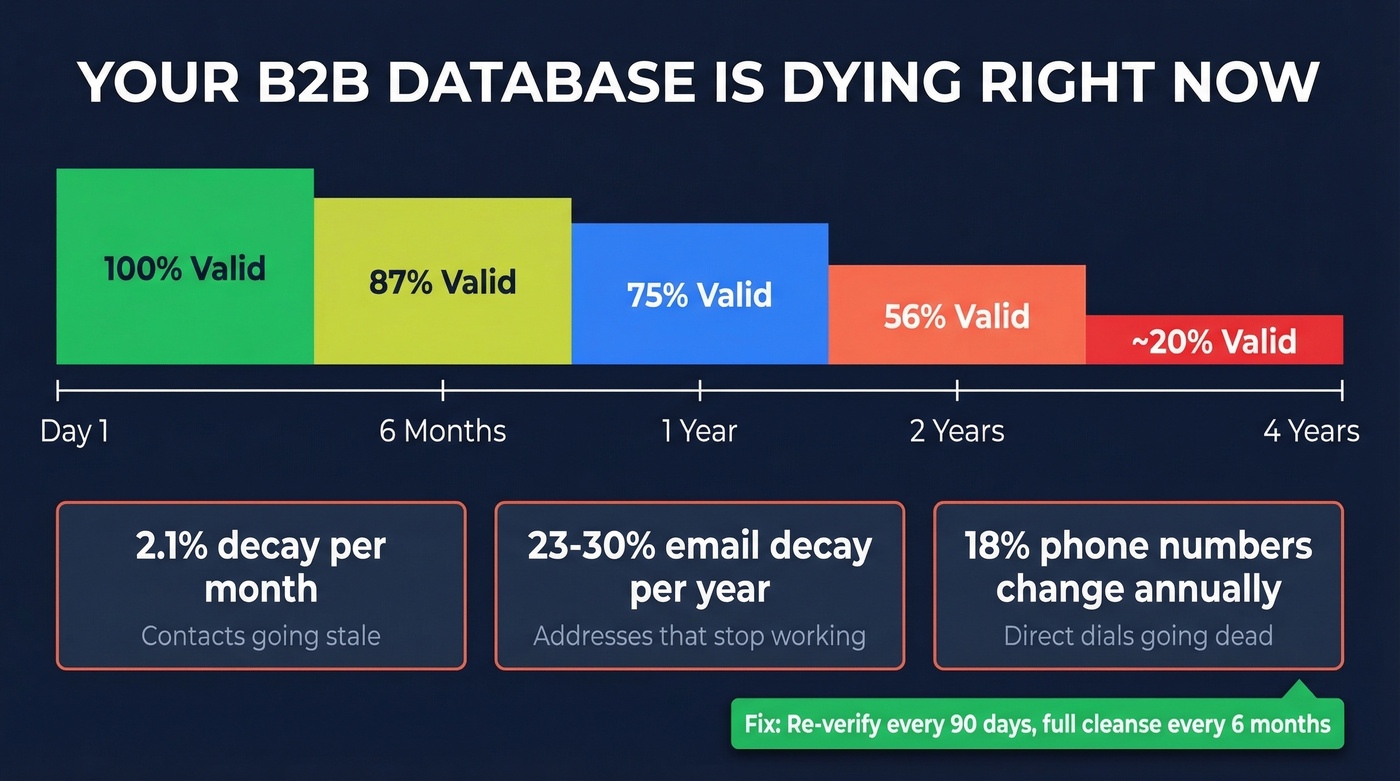
B2B contact data decays at 2.1% per month. That's 22.5% annually. Email addresses specifically decay 23-30% per year, and 18% of phone numbers change annually. Sopro found that if people change roles every three years on average, your database becomes roughly 80% obsolete in four years.
| Frequency | Action |
|---|---|
| Monthly | Dedup review + bounce analysis |
| Monthly | Remove hard bounces, flag soft bounces |
| Quarterly | Segment audit - is ICP fit still valid? |
| Quarterly | Re-verify stale contacts at 90+ days |
| Bi-annually | Full database cleanse + re-enrichment |
Watch for early warning signs: rising bounce rates, increasing "wrong number" responses on cold calls, and declining reply rates on sequences that used to perform. These are symptoms of decay, not messaging problems.
Quick health check: If your bounce rate is above 3% and your last full cleanse was more than 6 months ago, your database is already costing you deals. Run a verification pass this week.

You don't need to spend $15K/year on ZoomInfo or run exports through a third-party verifier. Prospeo gives you 300M+ profiles with 30+ ICP filters, 98% verified email accuracy, and a 5-step verification process built in - at roughly $0.01 per email. Teams using Prospeo book 26% more meetings than ZoomInfo users.
Build a verified B2B database in minutes, not weeks.
Mistakes That Kill Your Database
Skipping verification before outreach. One bad campaign can tank your domain reputation for weeks. Verify every list before it touches a sequencer. No exceptions.
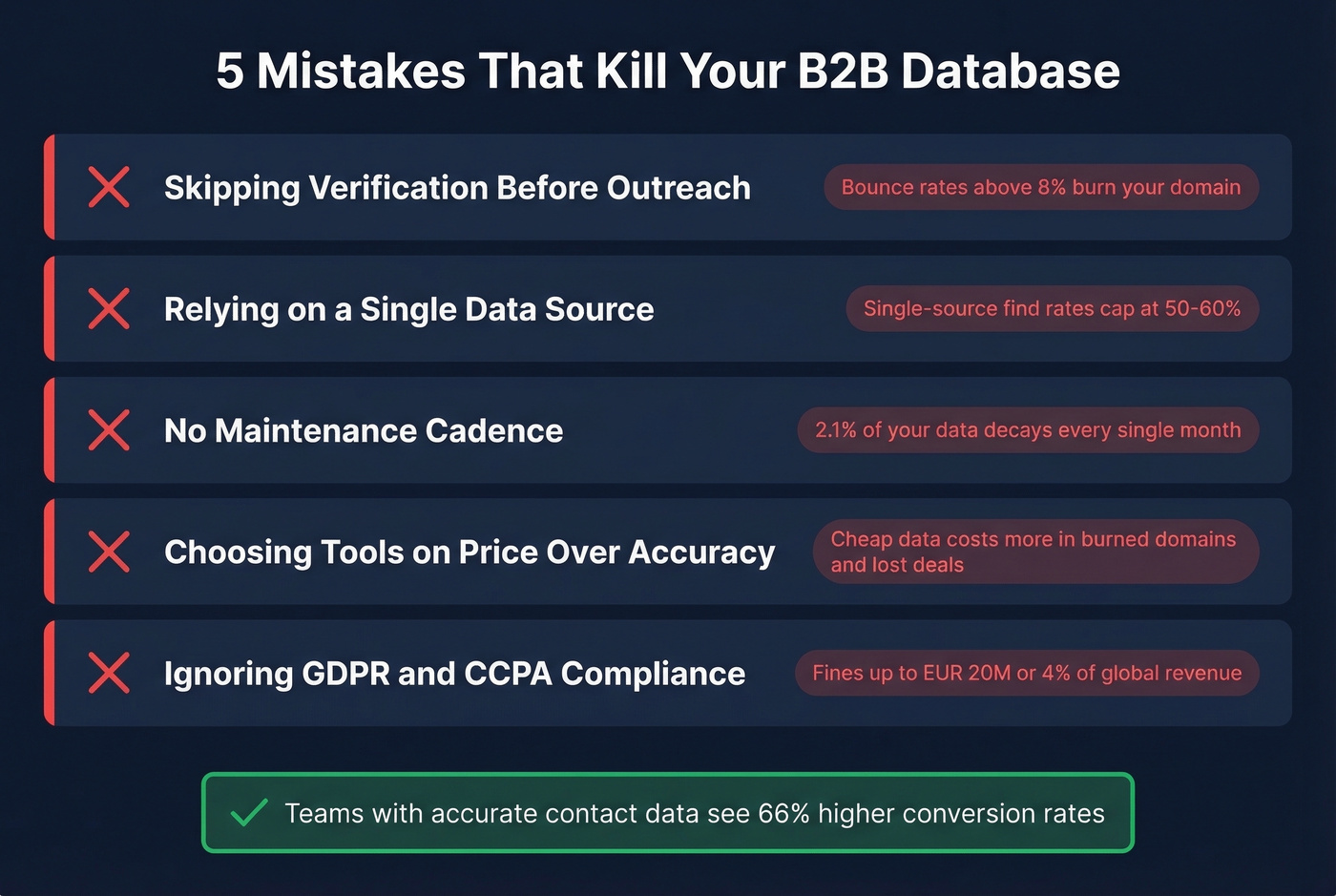
Relying on a single data source. No provider covers every contact. Single-source databases have gaps you won't notice until reply rates drop. Use waterfall enrichment or cross-reference two providers.
No maintenance cadence. "We'll clean it up later" means "we'll never clean it up." Schedule monthly dedup and bounce reviews. Put them on the calendar like a team meeting.
Choosing tools on price over accuracy. The consensus on r/b2bmarketing is telling - users are consistently unimpressed with data freshness from cheaper providers, especially for email. A tool that delivers 8% bounce rates costs you more in burned domains and lost deals than a pricier tool with 2% bounces. Run a 500-contact bake-off before committing to any annual contract.
Ignoring compliance. GDPR fines can hit EUR 20M or 4% of global turnover. This isn't theoretical risk. Vet your data provider's sourcing practices and segment by compliance geography.
Teams with accurate contact data see 66% higher conversion rates versus those working with outdated records. The database isn't just a list - it's the foundation your entire revenue engine sits on.
Recommended Stacks by Budget
A bootstrapped founder on Reddit recently asked for tools under $300/month. That's a real constraint, and it's completely workable. A complete outbound stack has six layers: data, verification, enrichment, intent, CRM, and workflow automation.
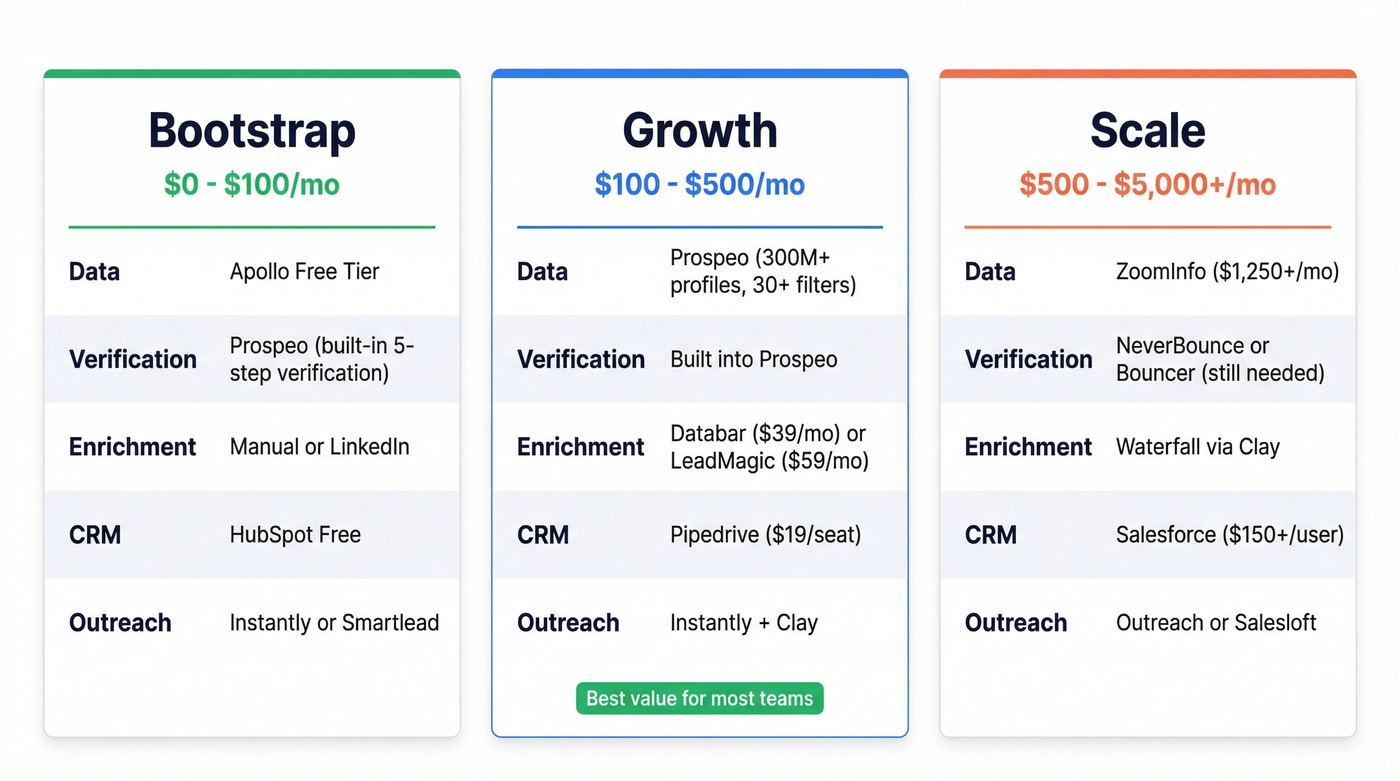
| Stack | Tools | Monthly Cost |
|---|---|---|
| Bootstrapped | Prospeo Free + HubSpot Free | $0 |
| Growth | Paid data + HubSpot Starter + Zapier | ~$150-250 |
| Enterprise | ZoomInfo + Salesforce + Clay | $2,000-5,000+ |
The free tier gives you 75 verified emails per month - enough to test your ICP hypothesis before spending a dollar. On the growth tier, paid credits at $0.01/lead plus HubSpot Starter ($15/seat) and Zapier ($29.99/mo) gets you a fully functional outbound stack for under $250/month.
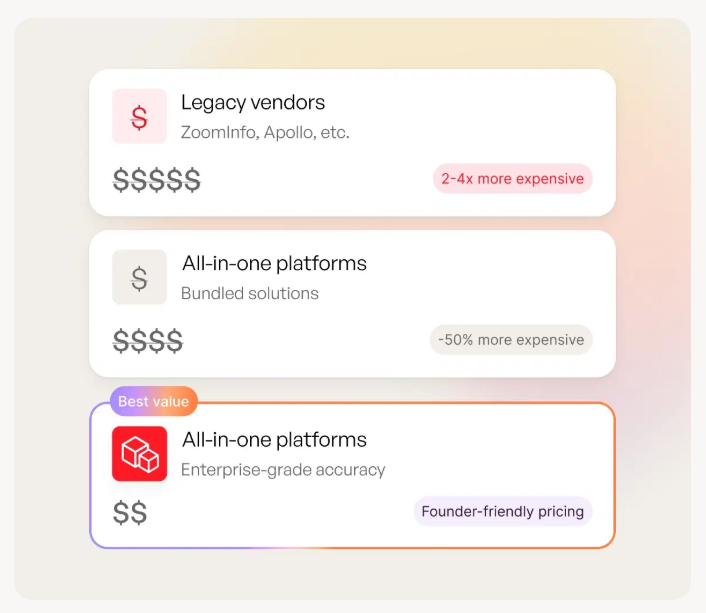
For enterprise teams, ZoomInfo or Cognism (both $15K+/year, custom pricing) provide breadth, while Clay starts around $150/month and scales with usage. It's more expensive, but the data quality at scale justifies it.
B2B data decays 25-30% per year. Prospeo refreshes every record on a 7-day cycle - 6x faster than the industry average. Layer in intent data across 15,000 Bombora topics, enrich contacts with 50+ data points at a 92% match rate, and push everything to HubSpot or Salesforce automatically. Your database stays alive without manual maintenance.
Stop rebuilding your database every quarter. Keep it fresh automatically.
Compliance That Matters
GDPR (EU/UK): Business contact data falls under GDPR when it identifies a person - and a work email does. B2B outreach can rely on legitimate interest as a lawful basis, meaning you don't always need explicit consent for direct marketing. But you must honor opt-outs, handle data subject access requests within 30 days, and maintain records of your processing activities. The fine ceiling is EUR 20M or 4% of annual turnover, whichever is higher.
CCPA/CPRA (California): Applies if your business hits $25M revenue, processes 100,000+ California consumers' data, or derives 50% of revenue from selling/sharing personal information. Many companies unknowingly "share" data via retargeting pixels, triggering opt-out requirements.
Before you buy data from any provider, ask three questions: What's your lawful basis for collecting this data? Can you show DSAR logs and suppression handling? Are you registered as a data broker where required? If a vendor can't answer clearly, walk away. Compliance isn't optional - it's the cost of maintaining a prospecting database your team can trust long-term. For a deeper framework, see our guide to B2B compliance.
FAQ
How much does it cost to build a B2B database?
Anywhere from $0 to $45,000+/year. A free data source plus free CRM costs nothing. Most growing teams spend $100-500/month on paid contacts and tooling. Enterprise stacks with ZoomInfo or Cognism run $15,000-$45,000/year before add-ons.
How often should I clean my B2B database?
Monthly dedup and bounce reviews, quarterly segment audits, bi-annual full cleanse. Data decays at 2.1% per month - waiting longer than a quarter means you're already sending to dead addresses and burning sender reputation.
What's the difference between a data provider and an enrichment tool?
Data providers give you net-new contacts matching your ICP filters. Enrichment tools fill in missing fields on contacts you already own - phone numbers, tech stack data, intent signals. Some platforms do both; standalone tools like Clearbit focus on enrichment only.
Is it legal to buy B2B contact data?
Yes, in most jurisdictions. Under GDPR, B2B outreach operates under legitimate interest as a lawful basis. You must honor opt-outs, handle data subject access requests within 30 days, and vet your vendor's sourcing practices. CCPA adds opt-out requirements for California residents.
How many contacts do I need to start outbound?
Two hundred to five hundred verified contacts is enough to test your ICP and messaging. In our experience, 200 verified emails with accurate titles will outperform 2,000 unverified records every time. Start small, measure reply rates, then scale what works.