

Best Bulk Email Verification APIs in 2026 (Tested)
Your email list loses roughly 22.5% of its value every year to job changes, domain shutdowns, and abandoned inboxes. That's not just wasted data - businesses lose about $12.50 per invalid email annually when you factor in failed sends, reputation damage, and re-acquisition costs. Cross the 2% bounce threshold and ISPs start throttling your domain or blacklisting it outright. For any team running outbound at scale without a bulk email verification API in the stack, that's a normal Tuesday.
Our Top 3 Picks
Use Prospeo if you're sourcing contacts and verifying them in one workflow. Its 5-step verification with catch-all handling runs before emails ever hit your CRM, so you skip the standalone verification step entirely. 98% email accuracy, 7-day data refresh, free tier included.
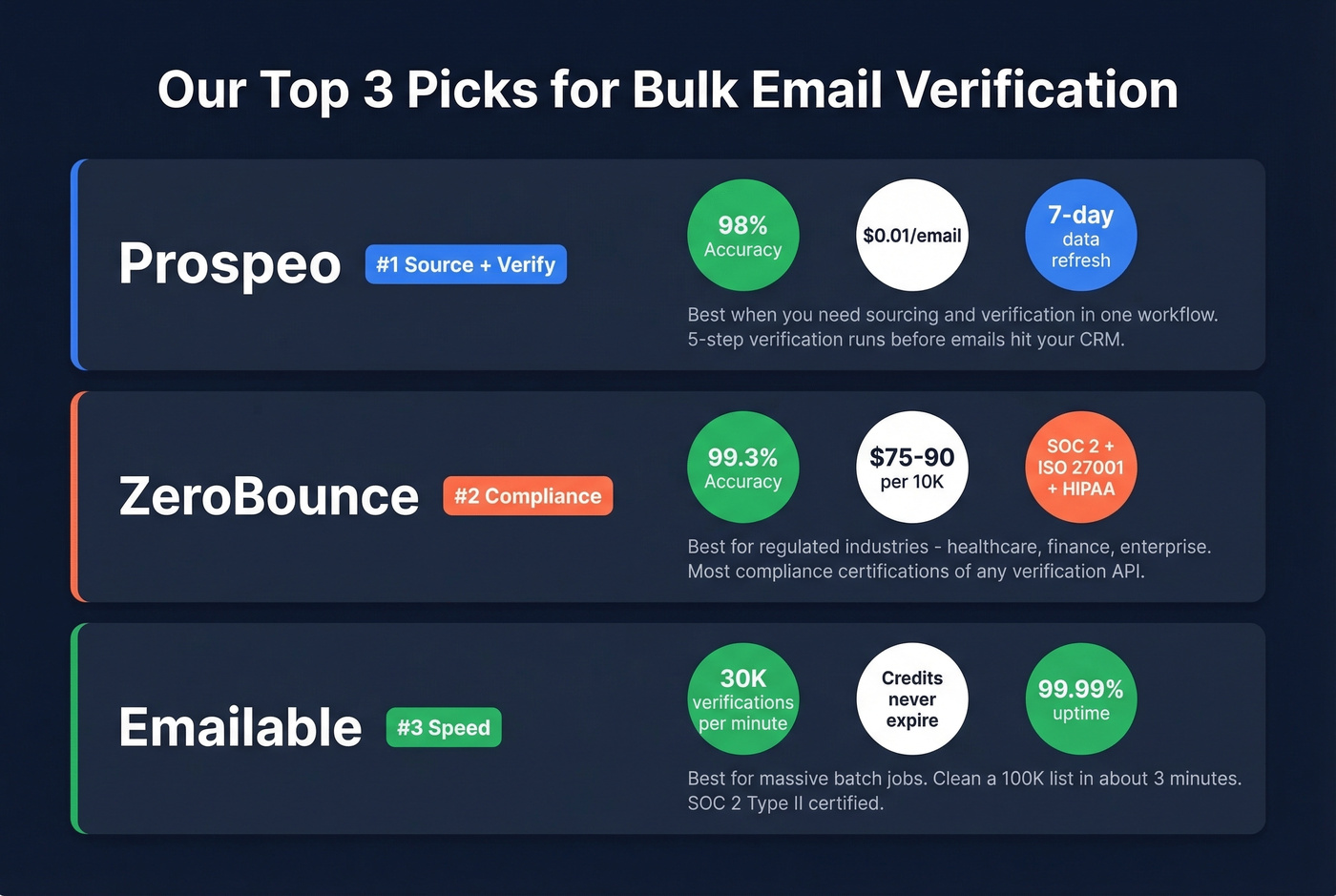
Use ZeroBounce if you're in a regulated industry. SOC 2 Type II, ISO 27001, HIPAA, GDPR, CCPA - no other verification API stacks that many compliance checkboxes in one place. You'll pay more, but your legal team will sleep better.
Use Emailable if you need raw throughput on massive lists. 30,000 verifications per minute, SOC 2 Type II compliant, and credits that never expire. Pure bulk verification, done fast.
API Comparison Table
We compared these APIs side by side on the metrics that matter at the API level. We excluded BriteVerify/Validity because self-serve API pricing isn't clearly published.
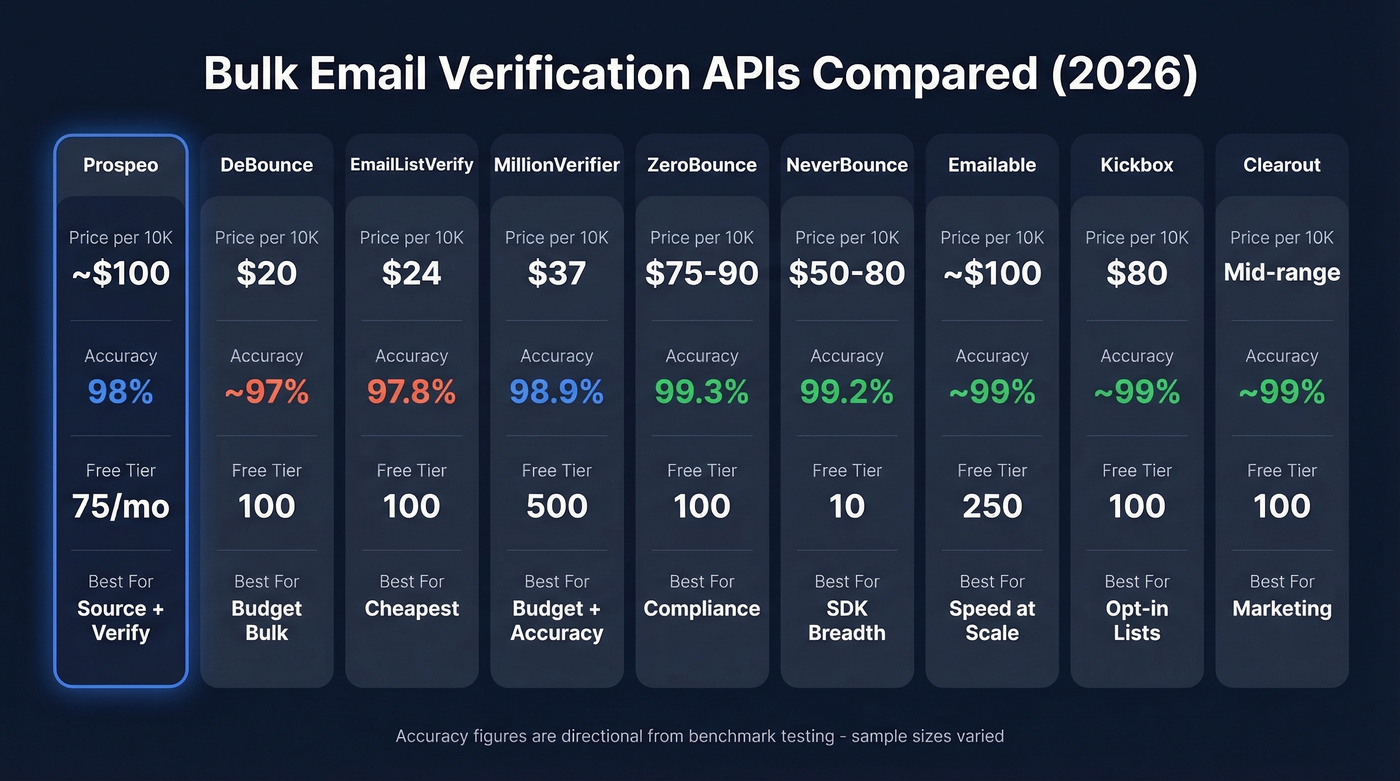
| Tool | Price / 10K | Speed | Free Tier | Accuracy | Best For |
|---|---|---|---|---|---|
| Prospeo | ~$100 (incl. sourcing) | Pre-verified | 75 emails/mo | 98% | Sourcing + verify |
| DeBounce | $20 | ~400ms | 100 credits | ~97% | Budget bulk |
| EmailListVerify | $24 | ~500ms | 100 credits | 97.8% | Cheapest standalone |
| MillionVerifier | $37 | ~300ms | 500 credits | 98.9% | Budget + accuracy |
| ZeroBounce | $75-90 | ~450ms | 100 credits | 99.3% | Compliance-heavy orgs |
| NeverBounce | $50-80 | ~500ms | 10 credits | 99.2% | SDK breadth |
| Emailable | ~$100 | Sub-second | 250 credits | ~99% | Speed at scale |
| Kickbox | $80 | ~350ms | 100 credits | ~99% | Opt-in list hygiene |
| Clearout | Mid-range | Sub-second | 100 credits | ~99% | Marketing integrations |
Accuracy figures come from a dev.to benchmark - sample sizes varied, so treat them as directional rather than absolute. Prospeo's per-10K cost looks higher because it includes prospecting and sourcing. For teams already buying leads elsewhere, the standalone APIs under $50/10K are where the value sits.

Every standalone verification API on this list solves a problem that shouldn't exist. Prospeo's 5-step verification - syntax, domain, mailbox, catch-all, spam-trap - runs before emails ever reach your pipeline. 143M+ verified emails, 98% accuracy, 7-day refresh, $0.01 per email.
Stop cleaning bad data. Start with clean data.
The Best Verification APIs Reviewed
Prospeo
Most verification APIs solve a downstream problem: you've already got bad data, and now you need to clean it. Prospeo solves the upstream one. Its 5-step verification process - syntax check, domain validation, mailbox ping, catch-all handling, spam-trap removal - runs before emails enter your pipeline. The database covers 143M+ verified emails across 300M+ professional profiles, all refreshed on a 7-day cycle, which is roughly six times faster than the industry average.
The API match rate sits at 92%, and email accuracy hits 98%. At roughly $0.01 per email, it's priced for volume. The free tier gives you 75 verified emails per month with full API access - enough to test the workflow before committing. For outbound teams already using Prospeo to source contacts, bolting on a separate verification service is redundant. You're paying twice to solve a problem that's already handled.
ZeroBounce
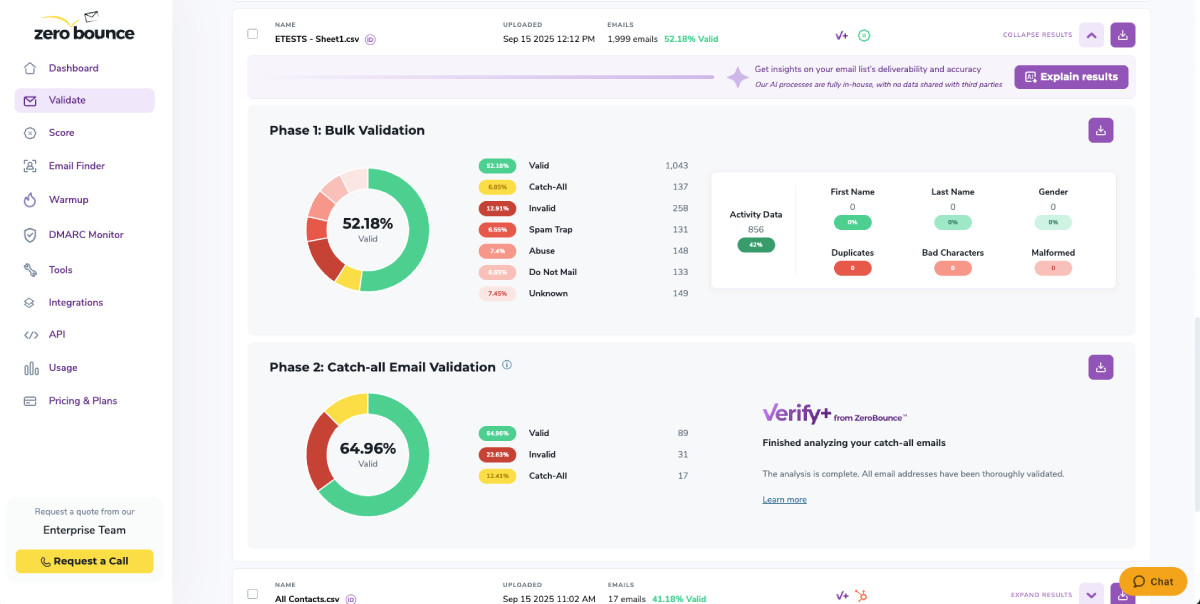
Why it wins: Compliance depth that no other verification API matches. SOC 2 Type II and ISO 27001, plus HIPAA, GDPR, and CCPA compliance. If your legal or infosec team has a checklist, ZeroBounce checks every box. Uptime sits at 99.9%.
Key tradeoff: You're paying for that compliance overhead. At $75-90 per 10K, it's the priciest pure-play verifier on this list. Response time averages ~450ms with a standard 5 req/sec rate limit. SDKs cover six languages - PHP, Python, Java, C#, Ruby, and JavaScript. 100 free monthly credits to start.
Skip this if you're a startup burning through lists and optimizing for cost-per-verification. The compliance premium doesn't justify itself until you're in healthcare, finance, or enterprise sales.
Emailable
Emailable is the speed play. Processing hits 30,000 verifications per minute - that's cleaning a 100K list in about 3.3 minutes. SOC 2 Type II certified, 99.99% uptime, and credits never expire. Buy 100K credits during Black Friday, use them through Q2. No pressure, no waste.
SDKs for Node.js, Ruby, and Python. Not as broad as NeverBounce, but those are the three languages most integration teams actually use. At ~$100 per 10K with 250 free credits to start, it's mid-range on price but top-tier on throughput. Best for teams running large batch jobs on a regular cadence.
Kickbox
Kickbox delivers the fastest single-email response time in this group - ~350ms average - with 99.99% uptime. It refunds credits for unknown results automatically, which saves real money when catch-all domains eat into your budget. Rate limit is 10 req/sec, with SDKs for PHP, Ruby, Python, Node.js, and Java.
Here's the catch: Kickbox explicitly doesn't support cold or purchased lists. At $80/10K, that's premium pricing for a tool with usage restrictions. If you're verifying opt-in subscriber lists, it's excellent. If you're running cold outbound, look elsewhere. 100 free credits to test.
NeverBounce
| Strength | Detail |
|---|---|
| SDK coverage | Node.js, PHP, Python, Ruby, Go, Java, .NET - one of the broadest in this roundup |
| Uptime | 99.95% |
| Rate limit | 8 req/sec standard |
| Pricing | $50-80/10K |
| Free tier | 10 credits - the stingiest here |
| Credit expiry | 1 year |
If your engineering team works in Go or .NET, NeverBounce might be the deciding factor purely on integration speed. Response time averages ~500ms. We've seen teams pick NeverBounce over technically superior options just because the Go SDK saved a week of integration work. That said, buy only what you'll use within the year - those credits expire.
Clearout
Clearout carries a 4.6/5 rating across 507 G2 reviews - the strongest social proof signal in this category by a wide margin. Users consistently praise accuracy and ease of use, while the complaints center on a restrictive credit system at scale and bulk verification slowing during peak hours. Clearout also offers AI-powered validation using machine learning and 20+ checks, which goes beyond a simple valid/invalid binary.
Good for marketing teams with platform integrations. Less ideal for high-volume API-first workflows where you need predictable throughput.
MillionVerifier
The budget pick. At $37/10K with credits that never expire, MillionVerifier appeals to cost-conscious teams. But accuracy isn't flawless: a hands-on test of 2,000 emails found 3 bounces from addresses marked "good." That's not catastrophic, but it's not near-perfect either. MillionVerifier refunds credits for catch-all and risky results, which partially offsets the risk. Support can be slow per G2 reviewers. Fine for newsletter lists; I'd think twice before trusting it with high-stakes outbound.
EmailListVerify
The cheapest option at $24/10K. Basic verification that gets the job done for non-critical lists. Accuracy sits at 97.8% in benchmarks - serviceable, but the lowest in this set. You get what you pay for. Fine for newsletter hygiene, risky for cold outbound where every bounce counts against your domain reputation.
How Catch-All Detection Works
Catch-all domains are the single biggest source of disagreement between verification APIs. A catch-all server accepts any address at its domain - send to randomgarbage@company.com and the server says "sure, I'll take it." Verifiers detect this by probing a random nonexistent address via SMTP. If the server accepts it, every address at that domain gets flagged as "unknown" or "risky."
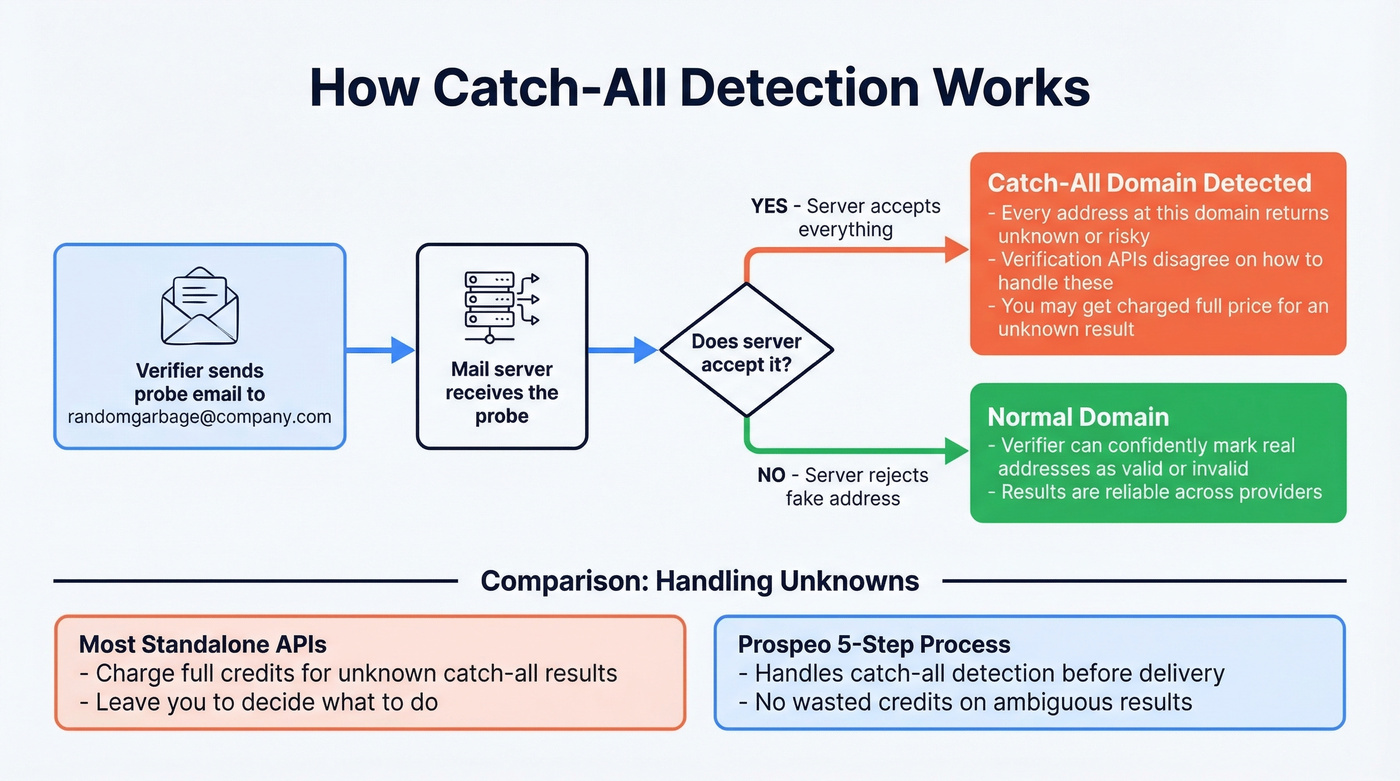
This is why you'll see the same email marked "valid" by one API and "unknown" by another. Verification results vary wildly between providers, and catch-all handling is the reason. Many standalone APIs charge full price and return "unknown" for catch-all addresses, leaving you to decide what to do with them. Prospeo's 5-step process handles catch-all detection before delivery, so you don't burn credits on ambiguous results.

Let's be honest: if your average deal size is under five figures, you probably don't need the most expensive verification service on this list. A mid-tier option like MillionVerifier or DeBounce paired with good list hygiene practices will get you 95% of the way there. Save the premium spend for when your sending volume and domain reputation actually demand it.
Paying $20-100 per 10K for verification on top of what you already spent sourcing leads? Prospeo's API delivers pre-verified emails at a 92% match rate with catch-all handling and spam-trap removal built in. One API call, one cost, zero bounces.
Replace two API calls with one - source and verify in a single request.
Run Your Own Benchmark
Don't trust any single vendor's accuracy claims - including ours. In our experience, the only way to know which bulk email validation API works best for your data is to test it yourself.
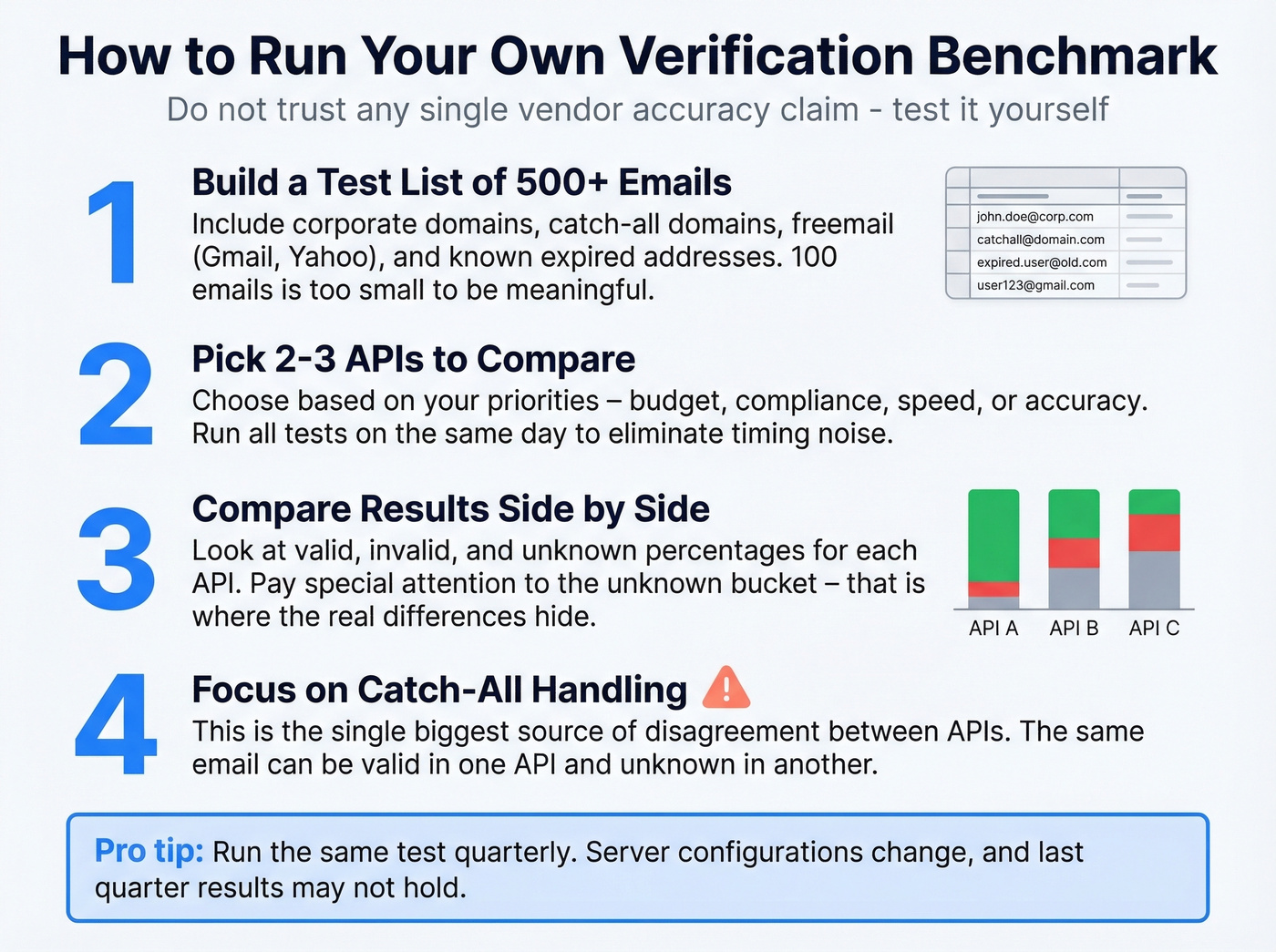
Curate at least 500 test emails across diverse domains: corporate, catch-all, freemail, expired. A 100-email sample is too small to be statistically meaningful. Run them through 2-3 APIs on the same day, because verification results shift as servers change configurations and same-day testing eliminates timing noise.
Compare valid/invalid/unknown percentages side by side. Pay special attention to how each API handles the "unknown" bucket - that's where the real differences hide. One vendor-run benchmark sent to all 20,000 found emails and measured actual hard bounces, which is the gold standard for accuracy testing, though it's resource-intensive for most teams. The consensus on r/sales and r/coldemail threads tends to confirm what we've found: accuracy claims from vendors are optimistic, and your mileage will vary based on your specific list composition.
A dev.to benchmark post links to reproducible test scripts on GitHub. Fork one and run it against your own data. For context on throughput differences, real-time verification typically handles ~7 requests/sec while bulk endpoints can process 350+/sec - so benchmark both modes if your workflow uses them.
If you're also evaluating your outbound stack end-to-end, pair this with a cold email API review and a quick check of your email bounce rate benchmarks.
FAQ
What's the difference between real-time and bulk verification modes?
Real-time verification checks a single email on form submission in sub-second response time. Bulk mode processes thousands asynchronously - you upload a file or hit a batch endpoint, and results come back via webhook or polling. Most APIs support both, but pricing and rate limits differ. Choose real-time for sign-up forms, bulk for list cleaning.
Do verification API credits expire?
Emailable and MillionVerifier credits never expire. NeverBounce credits expire after one year. ZeroBounce credits don't expire per current terms. Always check fine print before buying large credit packs - a 100K credit purchase with a 12-month expiry is a liability if your cadence is quarterly.
Can I skip verification if my data source already validates emails?
Yes - if your prospecting tool runs verification at the point of sourcing, a separate API is redundant for that data. Re-checking already-verified emails just wastes credits. Only re-verify if data is older than 30 days or sourced from a provider without built-in validation.
Which free tier is best for testing?
MillionVerifier offers 500 free credits - the most generous for pure verification testing. Emailable gives 250 credits with no expiry. Prospeo's free tier includes 75 verified emails per month with full API access, which is best if you also need sourcing. Start with whichever matches your workflow, then benchmark accuracy before committing to a paid plan.