

Business Development Pipeline Stages: What They Are and What to Expect at Each One
68% of companies don't identify or even attempt to measure a sales funnel. That's not a data problem - it's a pipeline design problem. Teams skip the architecture, jump straight to "more leads," then wonder why nothing converts.
Most CRM pipelines default to AE execution stages: demo, proposal, contract, signature. That's the back half. A real BD pipeline starts earlier and extends past the close, covering new markets, partnerships, and long-term growth. We're going to walk through each stage with conversion benchmarks and pipeline velocity formulas - the numbers most pipeline guides skip entirely.
The 7 BD Pipeline Stages at a Glance
Here's the thing: overall lead-to-customer conversion in B2B SaaS runs 2-5%. If you don't know your numbers at each stage, you're managing a wish list, not a pipeline.
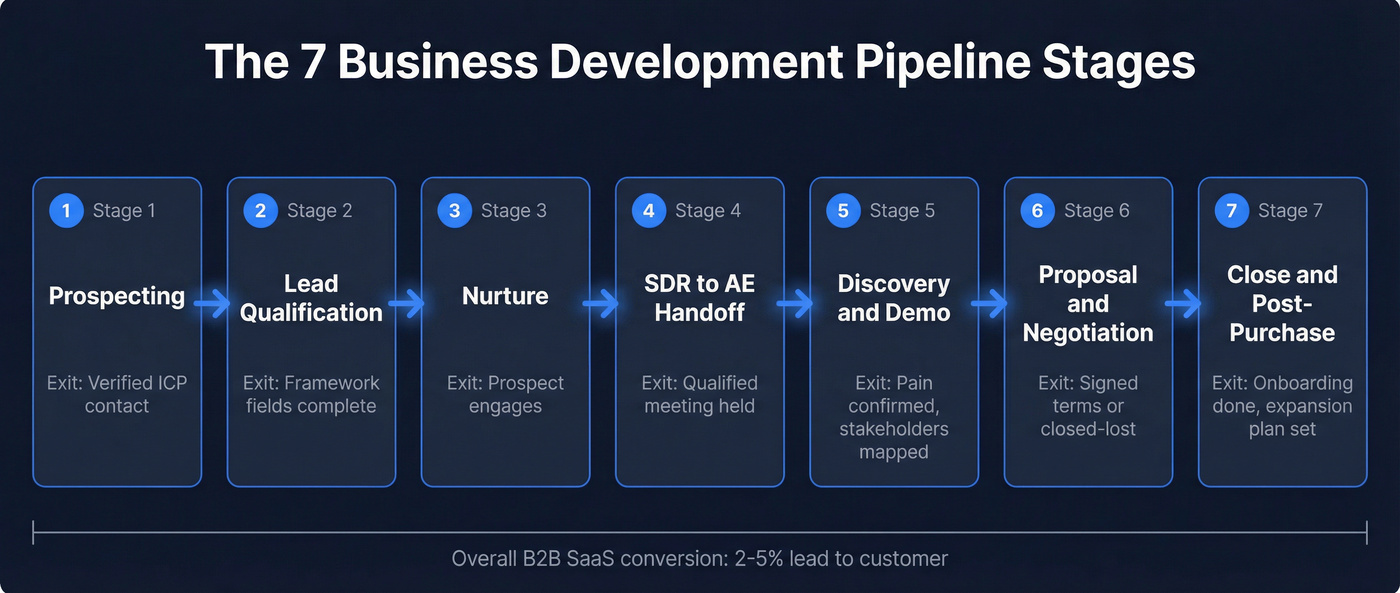
- Prospecting - build a targeted list of verified contacts
- Lead Qualification - apply a framework (BANT, MEDDIC, CHAMP)
- Nurture - repeated exposure before the ask
- SDR-to-AE Handoff - structured transfer with context
- Discovery & Demo - confirm pain and map stakeholders
- Proposal & Negotiation - terms on the table
- Close & Post-Purchase - win the deal, then own the relationship
Each Stage in Detail
Prospecting
79% of marketing leads never convert into sales. One major cause is data quality - wrong emails, stale titles, contacts who already left the company. Bad data at the top poisons every stage below it.
The exit criterion here is simple: a verified contact that fits your ICP. Prospeo handles this with 300M+ profiles, 98% email accuracy, and a 7-day data refresh cycle, so reps aren't burning sequences on dead addresses. If your bounce rate is above 5%, your prospecting stage is broken before anything else gets a chance to work.
Lead Qualification
BANT works for high-velocity deals under $25K - it's fast and easy to teach. MEDDIC belongs in enterprise deals above $50K where you need to map the decision process. CHAMP sits in the middle for consultative mid-market sales, leading with challenges instead of budget.
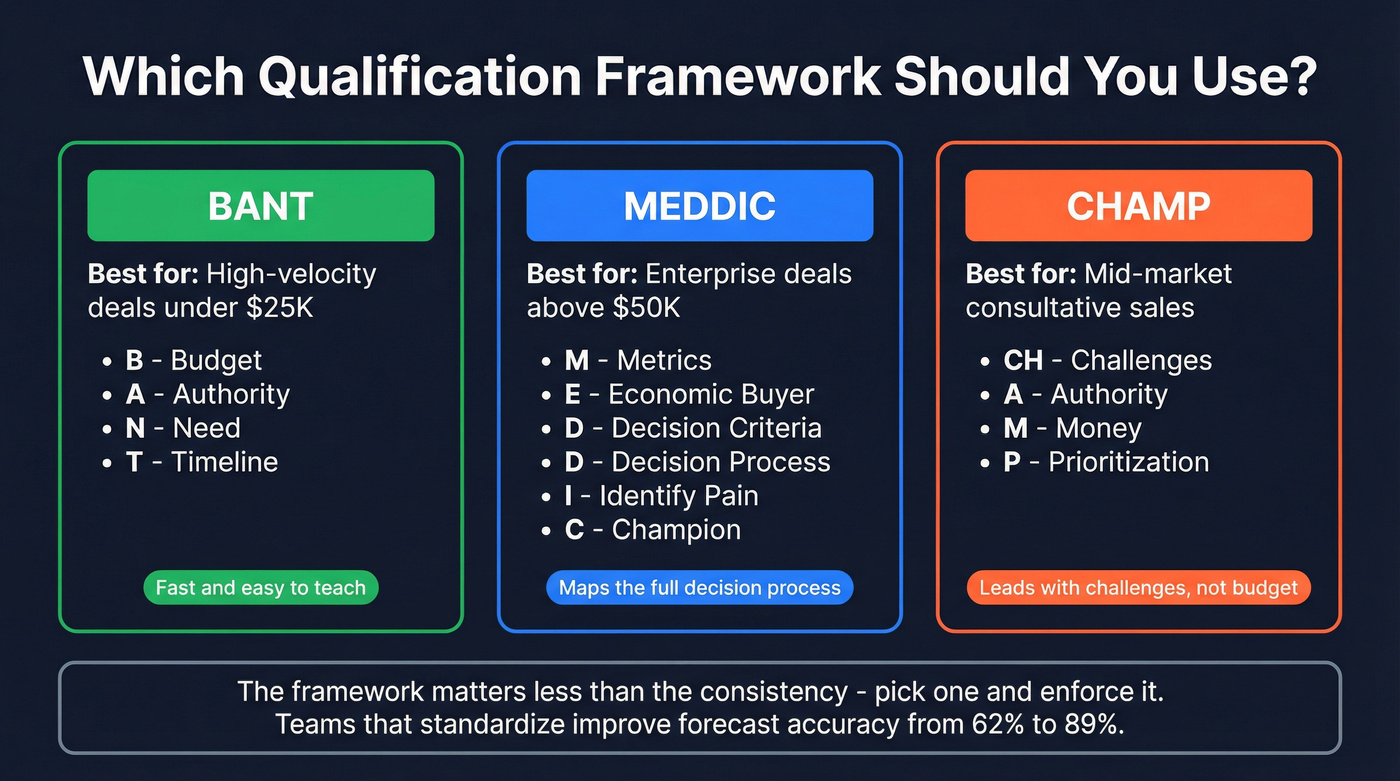
Pick one and enforce it. We've seen teams improve forecast accuracy from 62% to 89% just by standardizing on a single framework and requiring reps to fill in every field before advancing a deal. The framework matters less than the consistency.
Nurture
It takes seven marketing exposures before a prospect is ready to buy. Meanwhile, 80% of sales require five follow-ups, but 44% of reps quit after one. Multi-touch sequences, content shares, and warm introductions close that gap before you ever ask for a meeting.
Exit criterion: the prospect engages with content or responds to outreach. Silence after seven touches means they go back to cold storage, not into a meeting request.
SDR-to-AE Handoff
This is where most pipelines leak.
The model that works: SDRs create an opportunity at Stage 0 when a meeting is scheduled. If the meeting happens and qualifies, it moves to Stage 1. No-shows get recycled. Disqualified deals get closed-lost with a reason code. AEs need pain, urgency, stakeholders identified, and a clear next step - not just a calendar invite. The average appointment-to-opportunity conversion rate sits around 38% for SaaS, and teams with structured handoffs beat that consistently.
Discovery & Demo
Practitioners on r/sales split this into two CRM stages - Demo Booked and Demo Completed - and that distinction matters for forecasting. The exit criterion isn't "demo went well." It's confirmed pain plus a stakeholder map showing who else needs to say yes.
Proposal & Negotiation
Terms are on the table. The exit criterion is binary: signed terms or closed-lost with a reason code. No deal should sit here for more than 2x your average cycle length without a hard conversation about whether it's real.
Close & Post-Purchase
This is what separates BD from pure sales. BD owns renewals, upsells, referrals, and expansion into adjacent business units. If your pipeline ends at "Closed Won," you're leaving high-margin revenue on the table.
Exit criterion: onboarding complete and an expansion/renewal plan is in place.

79% of marketing leads never convert - and bad data at the top is the biggest reason. Prospeo gives your pipeline a clean foundation: 300M+ profiles, 98% email accuracy, and a 7-day refresh cycle so reps never burn sequences on dead addresses.
Stop poisoning your pipeline at the prospecting stage.
Stage-by-Stage Conversion Benchmarks
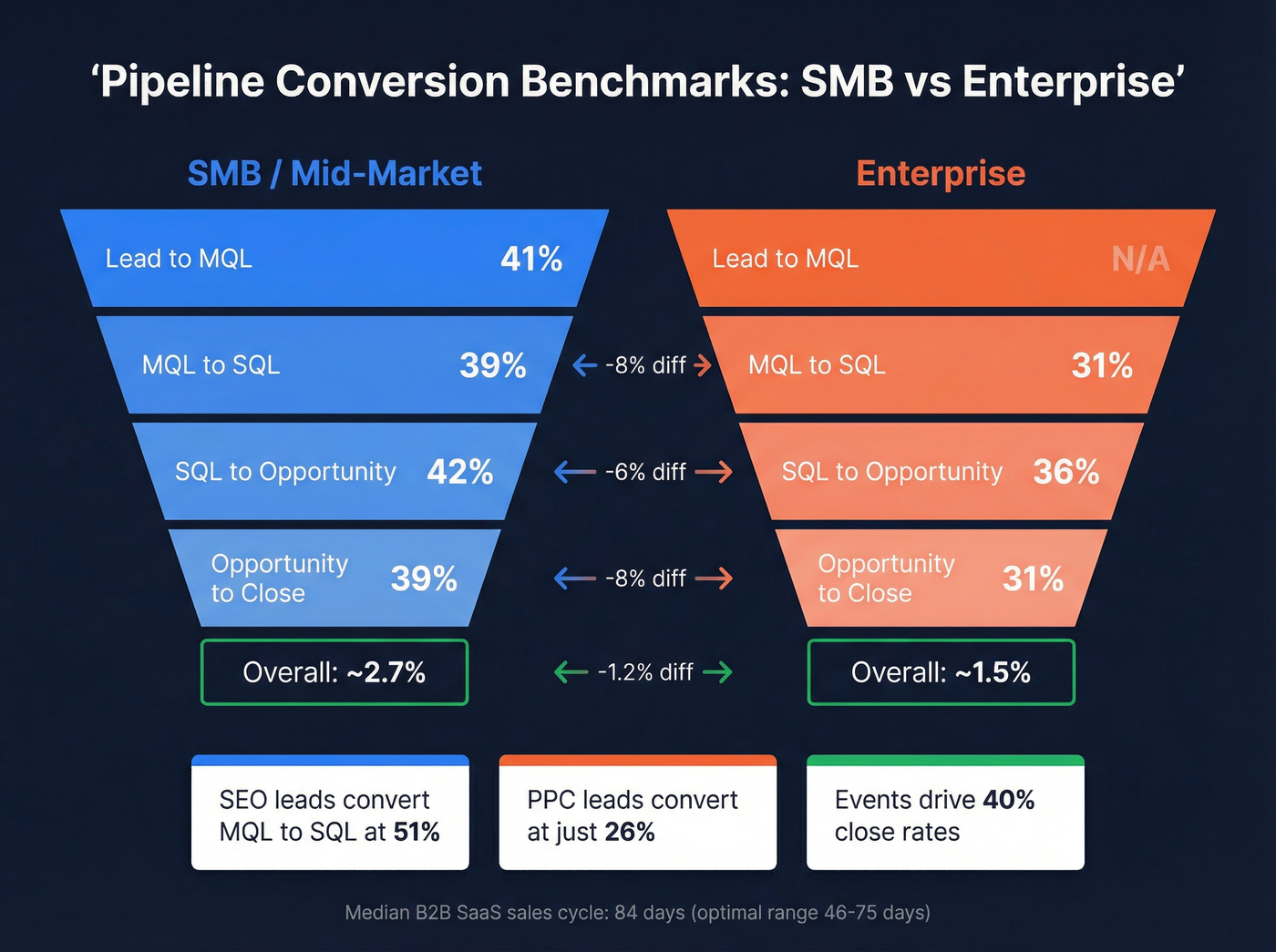
Stage conversion rates tell you where deals stall. Here's what healthy B2B SaaS funnels look like:
| Stage Transition | SMB/Mid-Market | Enterprise |
|---|---|---|
| Lead to MQL | 41% | N/A |
| MQL to SQL | 39% | 31% |
| SQL to Opportunity | 42% | 36% |
| Opportunity to Close | 39% | 31% |
| Overall Lead to Customer | ~2.7% | ~1.5% |
Channel matters too. SEO-sourced leads convert MQL-to-SQL at 51%, while PPC leads convert at just 26%. Events drive the highest close rates at 40% but generate modest top-of-funnel volume. Median sales cycle across B2B SaaS: 84 days, with an optimal range of 46-75.
Measuring Pipeline Health
Pipeline velocity tells you how much revenue moves through your pipeline daily:
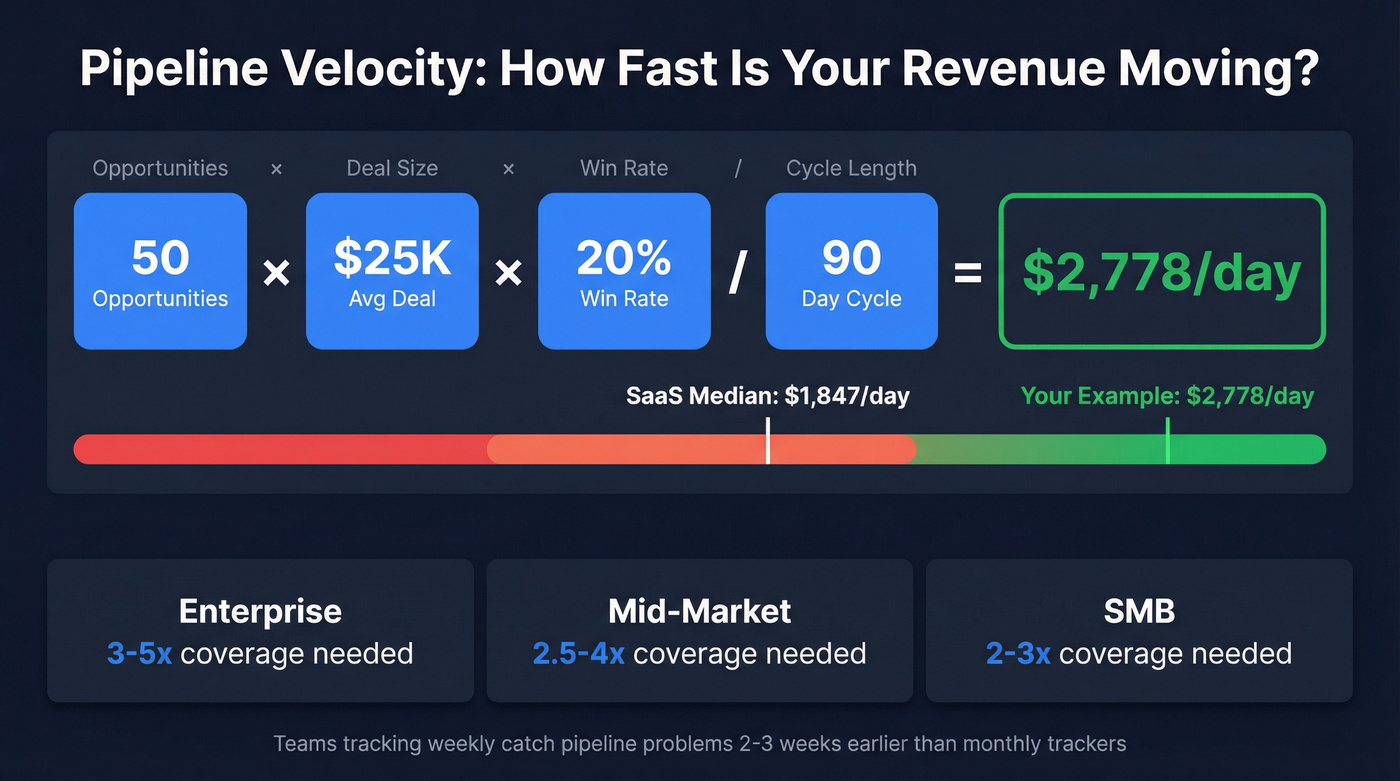
(Number of Opportunities x Avg Deal Size x Win Rate) / Sales Cycle Length
Worked example: 50 opportunities x $25K x 20% / 90 days = $2,778/day. The SaaS & Technology median is $1,847/day, so that hypothetical team is ahead of the curve. For monthly benchmarks, early-stage companies typically run $5K-$25K/month, growth-stage $50K-$200K/month, and enterprise $200K-$1M+.
Pipeline coverage ratio tells you whether you have enough pipeline to hit quota:
Total Pipeline Value / Sales Target = Coverage Ratio
| Segment | Target Coverage |
|---|---|
| Enterprise | 3-5x |
| Mid-Market | 2.5-4x |
| SMB | 2-3x |
In our experience, teams that track both metrics weekly catch pipeline problems 2-3 weeks earlier than monthly trackers. Remove stale opportunities that haven't progressed in 2-3x your average sales cycle - they inflate your coverage ratio and make forecasts unreliable.
Common Pipeline Mistakes
Most pipeline problems aren't strategy problems. They're hygiene problems.
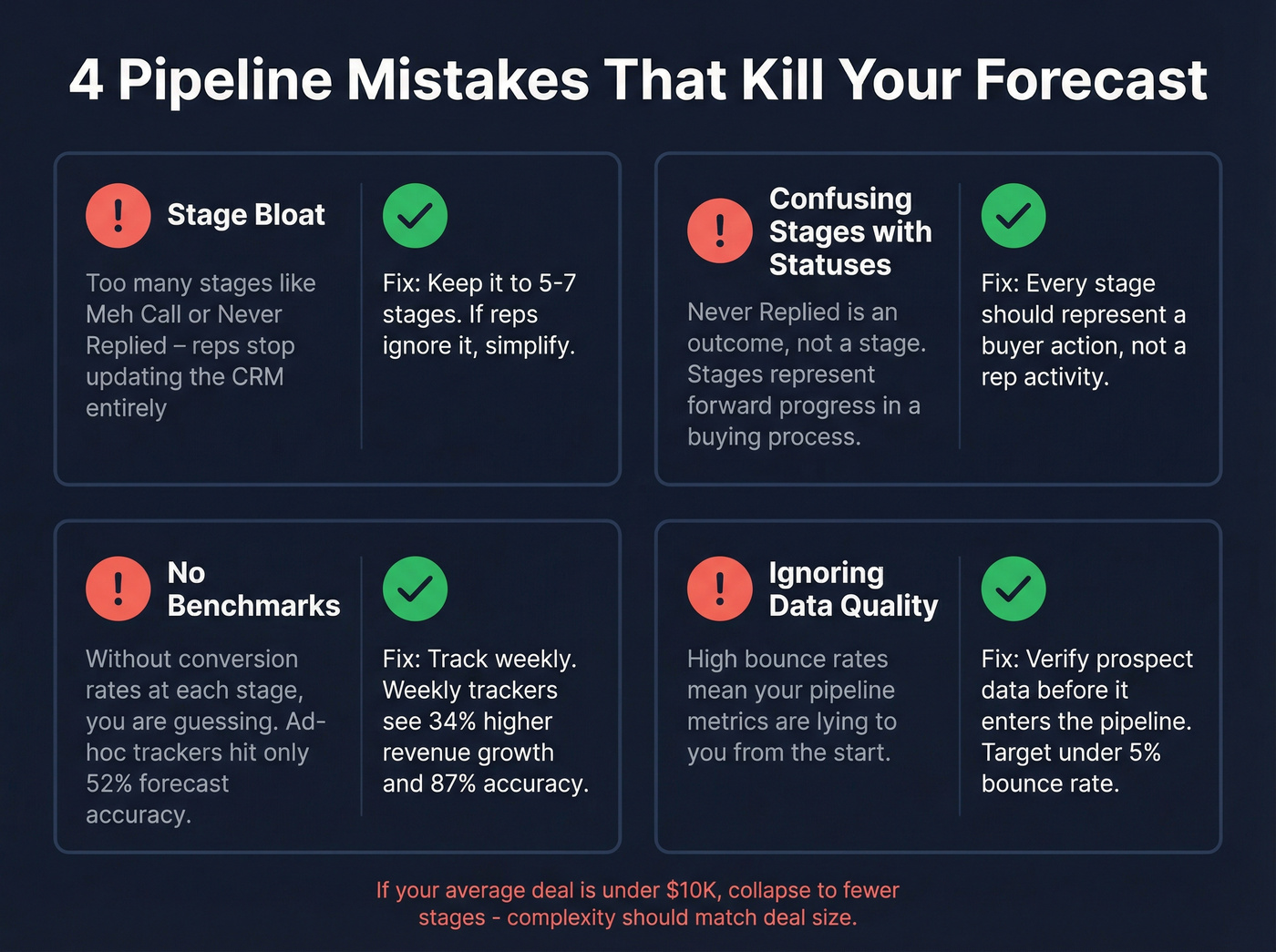
Stage bloat. One agency owner on r/agency shared a pipeline with 11 stages including "Meh Call" and "Never Replied." They called it overkill themselves. If reps stop updating the CRM, you have too many stages.
Confusing stages with statuses. "Never Replied" isn't a stage - it's an outcome. Stages represent forward progress in a buying process, not a log of what happened.
No benchmarks. Without conversion rates at each stage, you're guessing. Teams that track weekly see 34% higher revenue growth and 87% forecast accuracy vs. 11% and 52% for ad-hoc trackers.
Ignoring data quality. If bounce rates are high, your pipeline metrics are lying to you. Verify prospect data before it enters the pipeline - a 98% accuracy rate and a 7-day refresh cycle keep bad data from infecting every stage after it.
Let's be honest: if your average deal size is under $10K, you don't need a 7-stage pipeline. Collapse nurture and qualification into one stage, skip the formal handoff, and let reps run the full cycle. Complexity should match deal size.
If you want a deeper view of pipeline health, track leading indicators weekly - not just closed-won.
Pipeline velocity depends on real opportunities, not inflated numbers from bad contact data. Teams using Prospeo cut bounce rates below 4% and book 26% more meetings - because every stage converts higher when the data entering stage one is verified.
Clean data in, closed deals out. At $0.01 per verified email.
FAQ
How many stages should a BD pipeline have?
Five to seven stages is the sweet spot for most B2B teams. Fewer and you lose visibility into where deals stall; more and reps stop updating the CRM. Start with six, then add a stage only when data shows a specific bottleneck that needs its own tracking.
What's a healthy conversion rate between stages?
For B2B SaaS at the SMB/mid-market level, expect roughly 39-42% conversion at each transition from MQL through close. Enterprise deals convert lower - 31-36% per stage - but carry higher deal values and longer cycle times averaging 84+ days.
What tools help fill the top of a BD pipeline?
Prospeo gives you verified contact data - 98% email accuracy across 300M+ profiles - so reps spend time selling instead of chasing bounces. Pair it with your CRM (Salesforce, HubSpot) for pipeline tracking and a sequencer like Instantly or Lemlist for multi-touch outreach.
How do you calculate pipeline velocity?
Multiply your number of open opportunities by average deal size and win rate, then divide by sales cycle length in days. The formula: (Opportunities x Deal Size x Win Rate) / Cycle Days. The SaaS median is roughly $1,847/day - anything above that means your pipeline is moving faster than most.