

Business Phone Numbers Lookup: The Complete 2026 Guide
You're an SDR staring at a list of 200 "verified" direct dials, and 80 of them ring to disconnected lines or front desks. Or you're a small business owner who just missed a call from a number you don't recognize, and every "free lookup" site wants your credit card before showing you a name. Every business phone numbers lookup falls into one of these two camps. Let's solve both.
What You Need (Quick Version)
- Identifying an unknown business caller? Truecaller (free caller ID) or NumLookup (fast web lookup, no signup). A quick Google search of the number in quotes works more often than people expect.
- Enterprise team with budget for a full platform? ZoomInfo has the largest database in this comparison at 321M professionals and 104M companies, but you're looking at $15K+/year minimum - and you'll still want a verification layer on top.
Why Most Business Phone Numbers Are Wrong
B2B contact data decays at roughly 2.1% per month. That's 22.5% annually. People change jobs, companies switch phone systems, direct lines get reassigned. If nobody's refreshing records, accuracy craters over a single year.
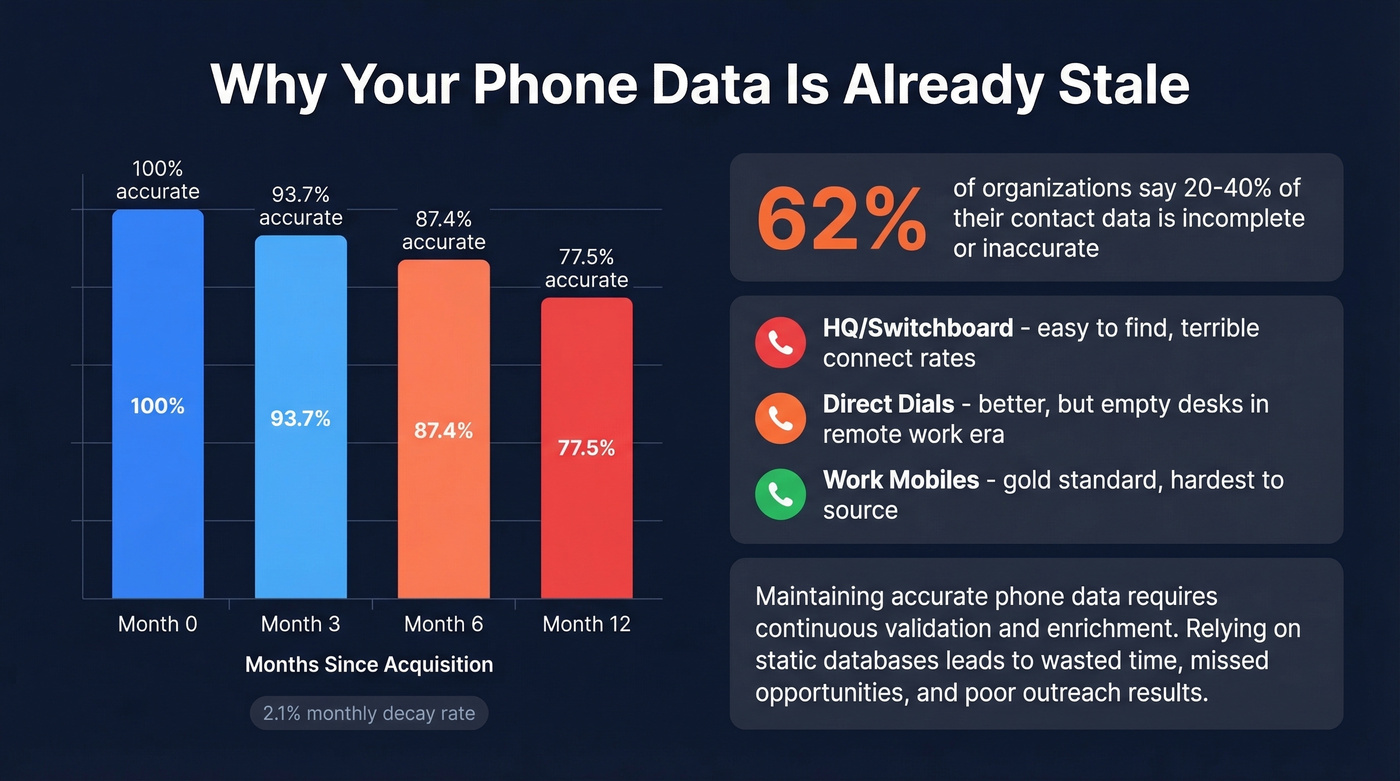
The problem compounds because 62% of organizations report that 20-40% of their contact data is incomplete or inaccurate. That's not a fringe issue.
Not all phone numbers are equal, either. There's a hierarchy that directly impacts whether someone picks up:
- HQ/switchboard numbers - easy to find, terrible connect rates. You're talking to a receptionist who'll route you to voicemail.
- Direct dials - office lines tied to a specific person. Better, but still often ring empty desks in a remote-work world.
- Work mobiles - the gold standard. These are the numbers people actually answer, and they're the hardest to source.
The gap between "having a phone number" and "having a number someone answers" is where most outbound teams lose weeks of productivity.
Reverse Lookup: Identify Unknown Callers
Best Free Options
Truecaller gives you instant caller ID on your phone. The free tier is ad-supported and requires an account. Premium runs $9.99/mo for ad-free use plus advanced blocking.
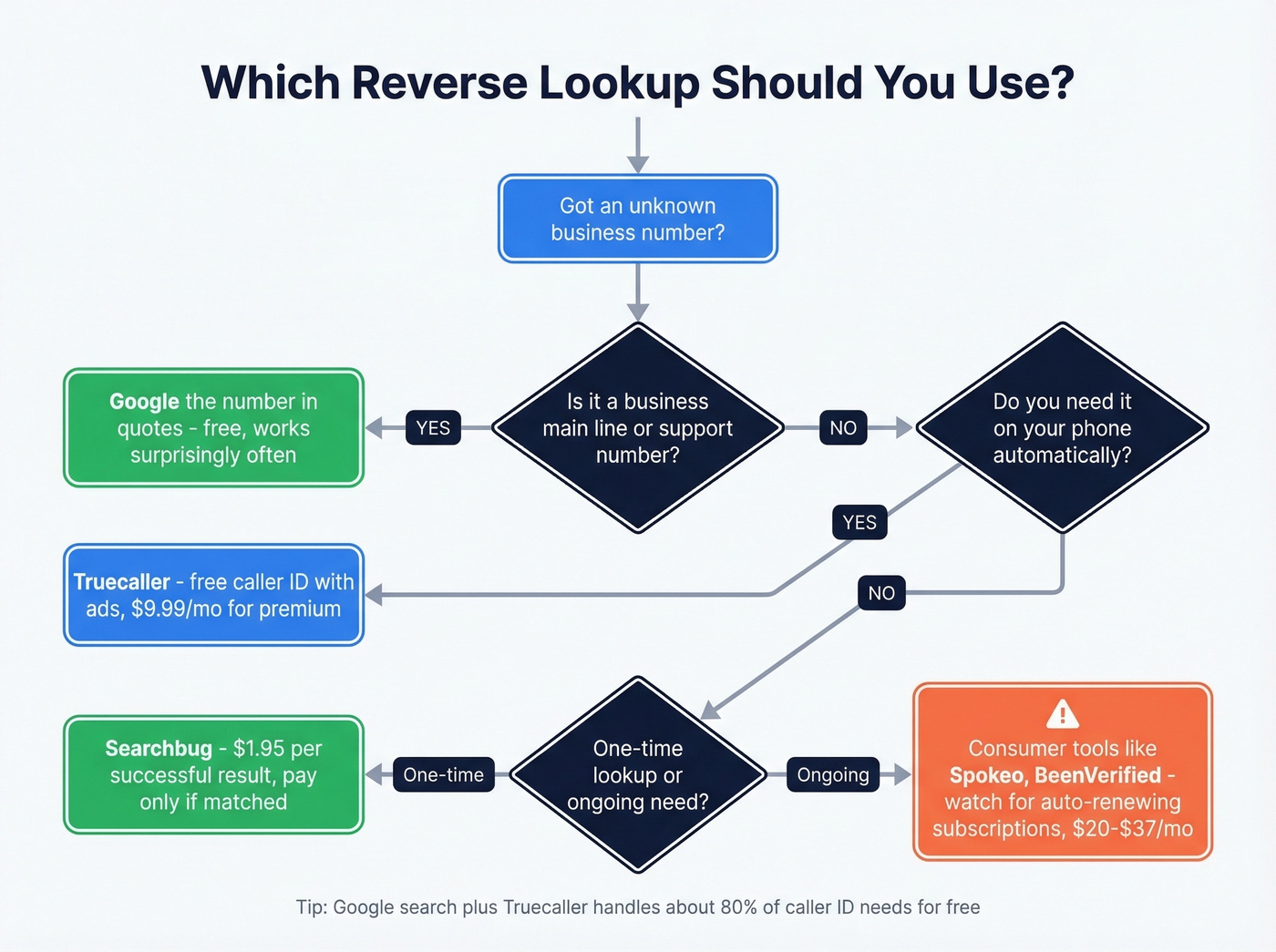
NumLookup is a fast web-based option - no registration or credit card needed to try it. It can return the owner name (when available), carrier info, and line type. Your first few lookups are free, then it pushes you toward a subscription.
Or just Google the number. Paste it into Google with quotes. Company phone numbers, support lines, and even some direct dials surface in search results, press releases, and directory listings. Zero cost, zero signup.
Best Paid Options
Searchbug is the standout for one-off detailed lookups without a subscription trap. It charges $1.95 per successful lookup - you only pay when they find a match. Bulk pricing drops to $0.30-$0.77 per lookup at high volume.
Here's the thing: skip Spokeo, Intelius, Social Catfish, and BeenVerified unless you fully understand the billing. All four use the same playbook - a cheap trial that auto-converts to a monthly subscription. Spokeo does offer a $1.95 one-time report and a $19.95/mo option on a 3-month plan, which is more reasonable than its competitors. But data quality across these consumer tools is roughly comparable; the difference is mostly in how aggressively they bill you.
Reverse Lookup Pricing
| Tool | Free Tier | Paid Price | Subscription Trap? | Best For |
|---|---|---|---|---|
| Truecaller | Yes, with ads | $9.99/mo premium | No | Mobile caller ID |
| NumLookup | First few lookups free | Monthly plan (varies) | Yes | Quick web lookup |
| Google Search | Yes | Free | No | Business main lines |
| Searchbug | No | $1.95/lookup | No | One-off deep lookups |
| Spokeo | No | $1.95 report / $19.95-$24.95/mo | Yes | Background checks |
| Social Catfish | No | $6.48 trial then $28.97/mo | Yes | Identity verification |
| Intelius | No | $0.95 trial then $35.30/mo | Yes | People search |
| BeenVerified | No | $36.89/mo | Yes | Comprehensive reports |
The pattern is clear: "free" consumer tools are either ad-supported or trial-to-subscription funnels. Truecaller or a Google search handles 80% of caller identification. For the other 20%, Searchbug's pay-per-result model is the most honest pricing in this space.

Data decays at 2.1% per month - which means the phone numbers you bought last quarter are already rotting. Prospeo refreshes 125M+ verified mobile numbers every 7 days, not every 6 weeks. The result: a 30% pickup rate across all regions, roughly 2.4x what ZoomInfo and Apollo deliver.
Replace disconnected lines with numbers people actually answer.
How to Find Business Phone Numbers for Outreach
Now we're talking about pipeline, not caller ID. The tool you pick here directly impacts connect rates, rep productivity, and revenue. When evaluating any business phone number finder, look for four things: carrier detection to confirm mobile vs. landline, active-status verification, spam-flag checking, and CRM integration for bulk workflows.
If your average deal size is under $10K, you probably don't need ZoomInfo-level data. A lighter tool with higher accuracy will outperform a massive database full of stale numbers every time.
Prospeo
Prospeo's 300M+ profiles include 125M+ verified mobile numbers running on a 7-day data refresh cycle, compared to the 6-week industry average. That freshness pairs with a 30% pickup rate across all regions - roughly 2.4x the industry benchmark.
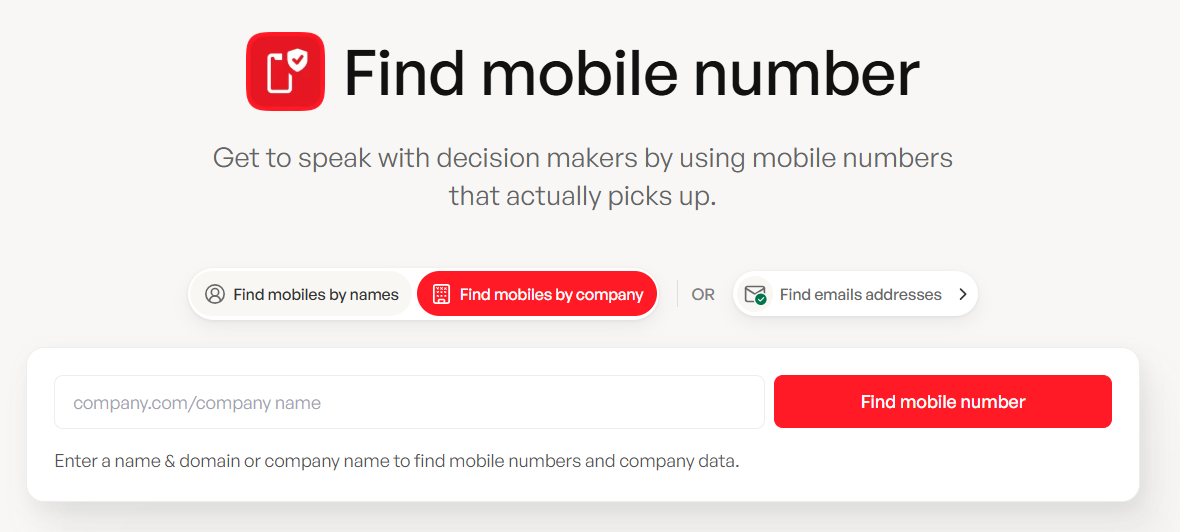
Pricing is credit-based and transparent: about $0.01 per email and 10 credits per mobile number, with a free tier offering 75 emails and 100 Chrome extension credits monthly. No annual contracts.
The Chrome extension with 40,000+ users works on company websites, professional profiles, and CRMs, pulling verified contact data in one click. Native integrations include Salesforce, HubSpot, Smartlead, Instantly, Lemlist, Salesloft, Outreach, Clay, Zapier, and Make - so it slots into whatever stack you're already running.
ZoomInfo
ZoomInfo's 321M professionals across 104M companies is the largest database in this comparison. For 50+ rep organizations that need intent data, workflow automation, and deep US coverage under one roof, ZoomInfo's breadth is hard to match.
The math gets brutal fast, though. Professional plans start at $15K+/year, Advanced at $24K+, and Elite at $40K+. Add-ons like extra credits and global data push real-world contracts to $25K-$50K. ZoomInfo also pushes 2-3 year contracts with tight auto-renewal windows - miss your cancellation window and you're locked in again. We've talked to teams under 20 reps who signed up and regretted it within three months because the ROI simply didn't pencil out at that scale.
Apollo, Cognism, Lusha, RocketReach, ContactOut
Apollo has the best free tier in B2B data - generous credits and a database around 275M+ contacts. The catch, per Reddit feedback from recruiting teams: personal emails are often wrong, and phone number accuracy runs inconsistent. Paid plans start around $49-$99/mo per user.
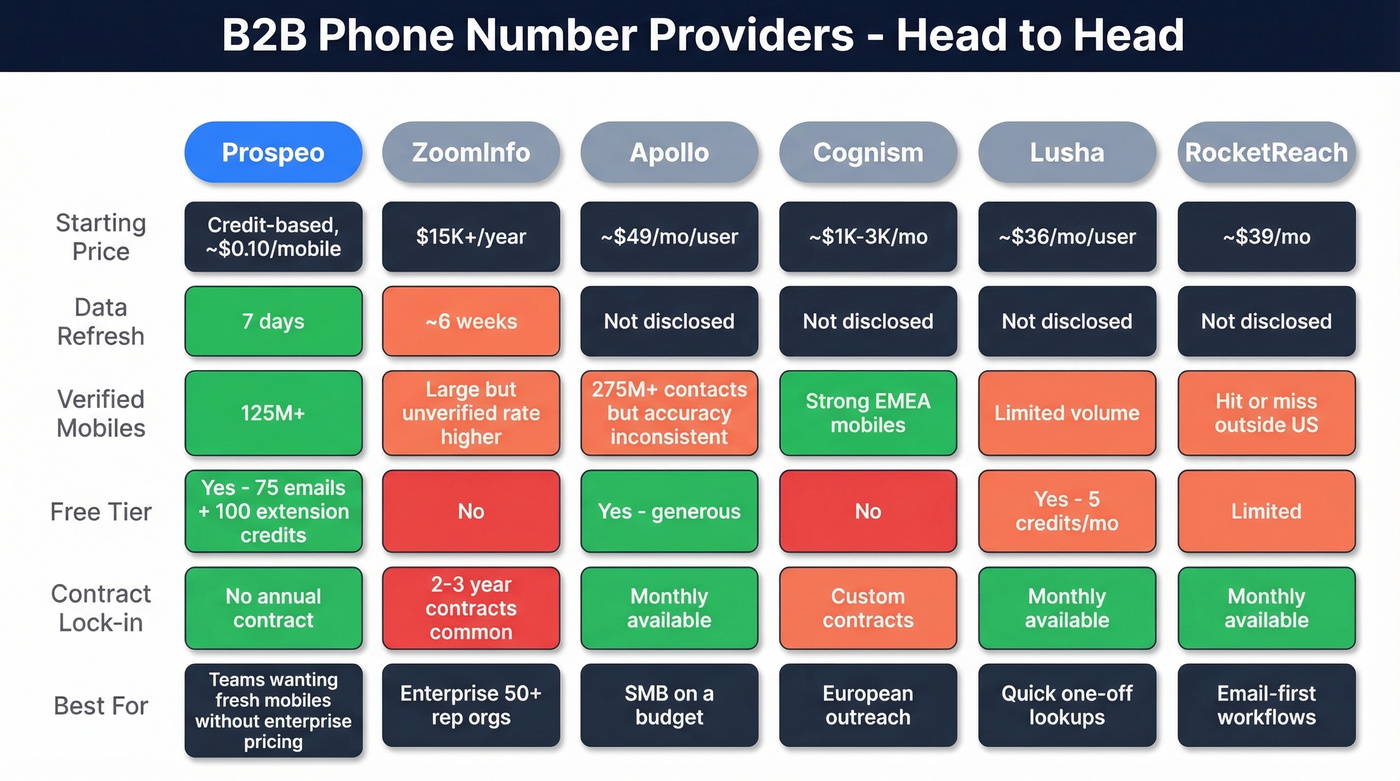
Cognism is the clear winner for European direct dials. Their EMEA mobile coverage is genuinely strong, and they handle GDPR compliance natively. Custom pricing typically lands at $1K-$3K/mo for small teams.
Lusha gives you around 5 free credits/month - enough to test, not enough to prospect. Paid plans often land around $36-$59/user/mo. Solid for quick lookups, less useful for bulk list building.
RocketReach typically runs around $39-$249/mo depending on volume. Decent email coverage; phone numbers are hit-or-miss outside the US.
ContactOut is worth a look - one recruiting team on r/Recruitment ultimately chose it over Apollo after testing multiple providers. Plans often land around $29-$99/mo per user.
No single provider covers everything. The teams with the best connect rates stack multiple sources, which brings us to waterfall enrichment below.
B2B Tools Pricing
| Tool | Starting Price | Database Size | Free Tier | Best For |
|---|---|---|---|---|
| ZoomInfo | $15K+/year | 321M pros | No | Enterprise teams |
| Apollo | ~$49/mo/user | ~275M+ contacts | Yes | SMB prospecting |
| Cognism | ~$1K-$3K/mo | Not public | No | EMEA coverage |
| Lusha | ~$36/mo/user | Not public | Yes, ~5/mo | Quick lookups |
| RocketReach | ~$39/mo | Not public | Limited | Email finding |
You don't need a $25K ZoomInfo contract to get direct dials that connect. Prospeo gives you 125M+ verified mobiles at ~10 credits per number - roughly $0.10/mobile - with no annual lock-in. Native integrations with Salesforce, HubSpot, and 8 other tools mean bulk lookups flow straight into your workflow.
Enterprise-grade phone data at 90% less than ZoomInfo. No contract required.
Advanced Methods Most Teams Miss
Government and Public Records
These are the most stable phone numbers you'll find, because businesses are legally required to keep them current. Start with Secretary of State business registration databases - the registered agent's contact info is public record and rarely changes. Professional licensing boards for medical, legal, and real estate practitioners often publish direct contact numbers too.
For companies doing government work, SAM.gov lists federal contractor records including TPOC (Technical Point of Contact) numbers and contract administrator details. Municipal permit databases are another underused source - emergency contacts and site supervisor numbers are filed with building permits and stay current because inspectors need to reach someone.
None of these sources scale like a B2B database, but when you need a verified number for a single high-value prospect, public records are often more reliable than any paid tool.
Google Maps Scraping
Tools like Outscraper and Targetron can extract publicly visible business listing data from Google Maps at scale - names, addresses, phone numbers, websites, reviews. One case study from a marketing agency scraped 2,000 businesses and converted roughly 500 into verified leads. It's a viable way to search for numbers in a specific geography or industry vertical.
The legal situation: the data itself is public, but Google's Terms of Service prohibit automated collection. It's a widely used gray area. Know the risk before you build a workflow around it.
Waterfall Enrichment and API Verification
The concept is simple: run your contact list through multiple data providers in sequence, filling gaps that each individual tool misses. A thread on r/Recruitment highlighted Airscale's model, which waterfalls across providers including RocketReach, Apollo, and others. In our experience, the teams with the best connect rates don't rely on one tool - they stack three or four and deduplicate the results.
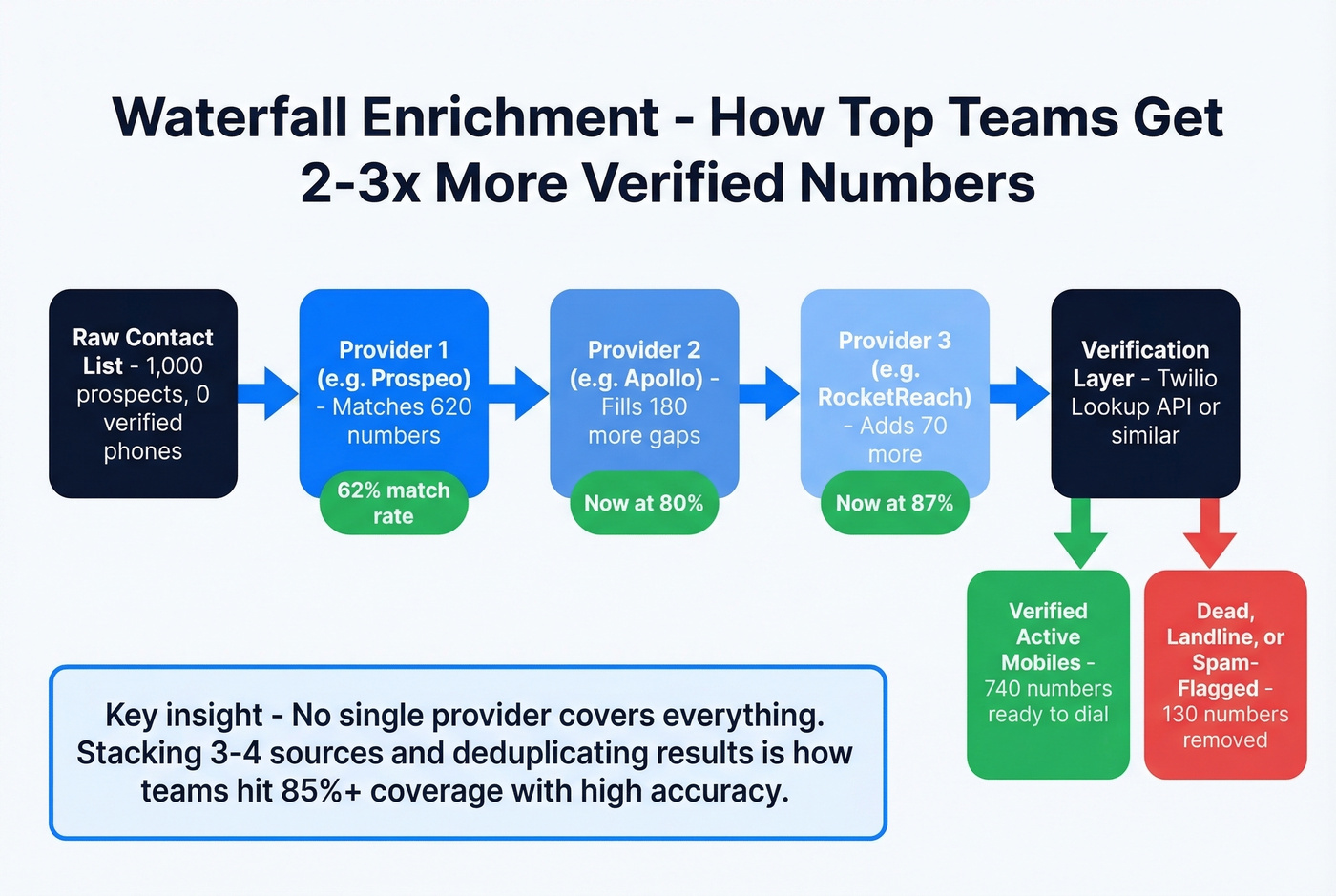
For programmatic verification, the Twilio Lookup API lets you check carrier type, line status, and caller name in real time. It's a strong option for teams building custom enrichment pipelines or verifying numbers before they hit a dialer.
Avoid Wasting Budget on Lookups
Before you commit to an annual contract or burn through credits on a massive database, audit your actual needs. Most teams overspend on phone number lookup tools because they buy enterprise-tier platforms when they only need 200-500 verified numbers per month. If that's you, skip ZoomInfo and start with a credit-based tool where you pay for what you use.
Check whether your own outbound numbers have been flagged, too. Carriers assign caller ID reputation scores on a 0-100 scale - think of it like a credit score for your phone number. A score below 40 means your calls are getting labeled "Spam Likely" before they even ring.
Use Truecaller or Hiya to look up your own numbers. You might discover that community-sourced labels have tagged your number as "telemarketer" or "debt collector" - even if you're neither. These labels are error-prone, but they tank your pickup rates just the same. We've seen teams troubleshoot low connect rates for weeks before realizing the problem wasn't their data - it was their own flagged caller ID.
Legal Rules You Can't Ignore
DNC Registry and TCPA Basics
The National Do Not Call Registry is managed by the FTC and enforced by the FTC, FCC, and state officials. Violations carry fines up to $53,088 per call. That's not a typo - per call.
Exemptions exist for political organizations, charities calling on their own behalf, and surveys without a sales pitch. But if you're doing cold calling to sell a product or service, you're covered by the TSR. Scrub your lists against the DNC registry before every campaign.
What Changed in 2025-2026
The biggest shift is the FCC's TCPA Revocation Rule, effective April 11, 2025. Consumers can now revoke consent "in any reasonable manner" - a text saying "stop calling me" counts, even if it doesn't follow your formal opt-out process. You must honor opt-outs within 10 business days, and you're allowed one additional message to confirm the revocation.
The FCC's one-to-one consent rule was vacated by the Eleventh Circuit before taking effect, so that's off the table for now. But the revocation rule is live and enforceable - make sure your compliance team has updated call disposition workflows accordingly.
FAQ
Is there a truly free business phone number lookup?
Yes. Truecaller and NumLookup offer free basic lookups for identifying unknown callers, and Google search surfaces publicly listed numbers surprisingly often. For B2B direct dials, Prospeo's free tier includes 75 email credits and 100 Chrome extension credits monthly - enough to test data quality on real prospects before committing.
How do I find direct dials for sales prospecting?
Define your ideal customer profile and monthly volume first. For under 500 contacts/month, a credit-based tool like Prospeo or Apollo's free tier covers most needs. Enterprise teams with 50+ reps typically need ZoomInfo or Cognism for workflow automation alongside the data.
What's the difference between reverse and forward lookup?
Reverse lookup identifies who owns a number you already have - consumer tools like Truecaller handle this well. Forward lookup finds a number when you have a person's name or company. B2B platforms like ZoomInfo, Apollo, and Prospeo handle forward lookup for sales outreach, returning verified direct dials and mobiles.
How accurate are business phone number databases?
Most databases are 70-90% accurate at best because B2B contact data decays at roughly 2.1% per month. The key differentiator is refresh frequency - tools with weekly refresh cycles maintain significantly higher accuracy than those refreshing monthly or quarterly. Always verify before dialing at scale.
What are the penalties for calling Do Not Call numbers?
The FTC can fine up to $53,088 per violation. The FCC's 2025 TCPA Revocation Rule adds operational requirements: honor opt-outs within 10 business days, regardless of how the consumer communicates the request. Scrub every outbound list against the DNC registry before dialing.