

How to Write a Go-to-Market Strategy for Your Business Plan
70% of failed product launches trace back to poor GTM planning, according to Gartner. The fix isn't another strategy framework - it's writing a go-to-market section with real numbers, real channel economics, and a sales model you've actually tested.
What You Need (Quick Version)
Your GTM section needs five things investors actually read: a defined ICP, channel strategy with CAC estimates, a sales model, unit economics (LTV:CAC ≥ 3:1), and stage-appropriate traction targets. We've broken down the structure and benchmarks so you can write it tonight.
Where GTM Fits in Your Business Plan
A practical business plan flows like this: Executive Summary → Market Analysis → Product → GTM Strategy → Operating Plan → Financial Projections.
Harvard Business School's Diamond-Square framework positions GTM as one of eight business model components, sitting between your value proposition and your profit formula. Your value proposition experiments inform your GTM assumptions, and those assumptions lay the foundation for your revenue model. Write GTM before you finalize financial projections, not after - otherwise you're building a spreadsheet on guesses.
What Your GTM Section Must Cover
Miss one of these and your financial model has a hole in it:
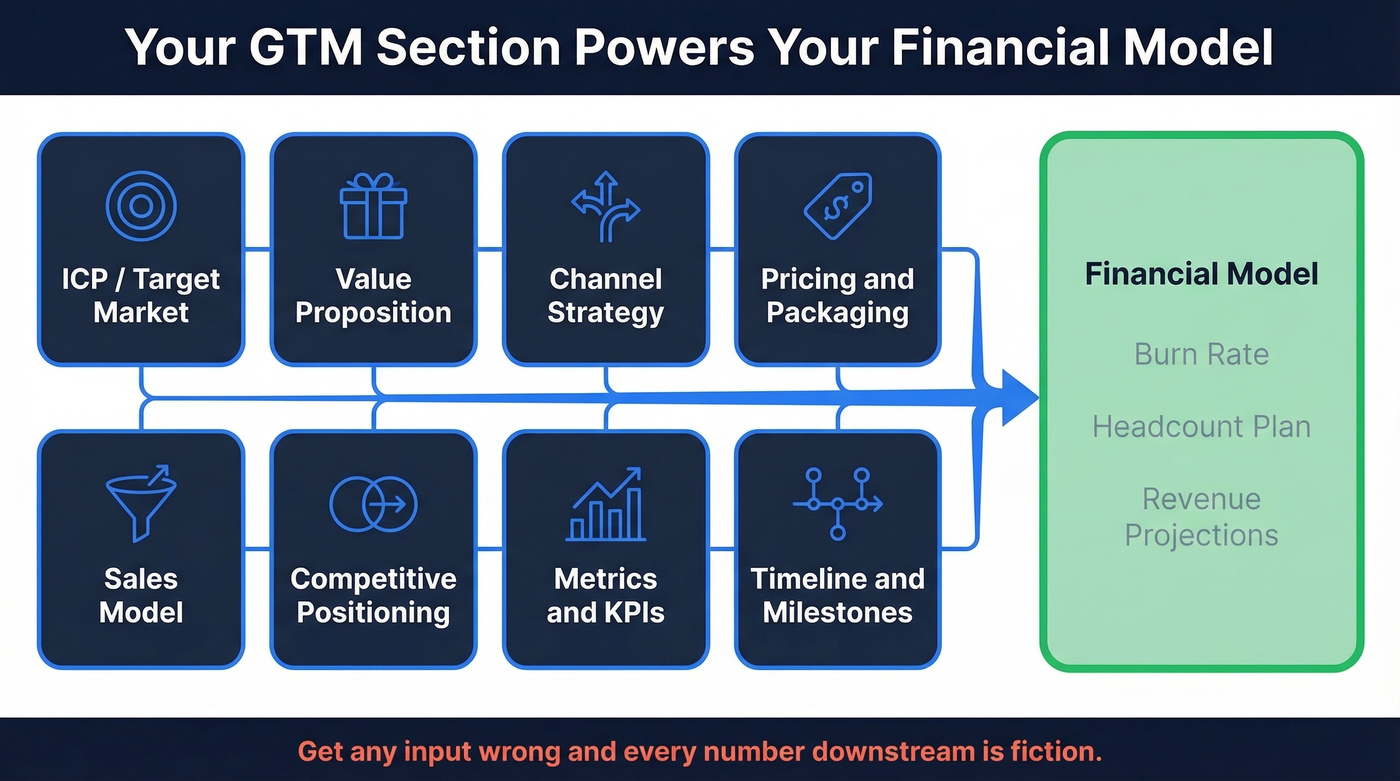
- ICP / target market - who you're selling to, specifically
- Value proposition - why they'd buy from you vs. the alternative, including doing nothing
- Channel strategy - how you'll reach them, with cost assumptions per channel
- Pricing and packaging - tiers, annual vs. monthly, expansion levers
- Sales and enablement model - founder-led, PLG, inside sales, field sales
- Competitive positioning - where you win and where you don't
- Metrics and KPIs - what you'll measure and what "good" looks like
- Timeline - 90-day, 6-month, and 12-month milestones
These aren't decorative. They're inputs to your financial model. Your CAC assumption drives your burn rate. Your channel mix drives your headcount plan. Get them wrong and every number downstream is fiction.
Pick Your GTM Model
Your sales model choice shapes everything downstream - team structure, burn rate, time to revenue.
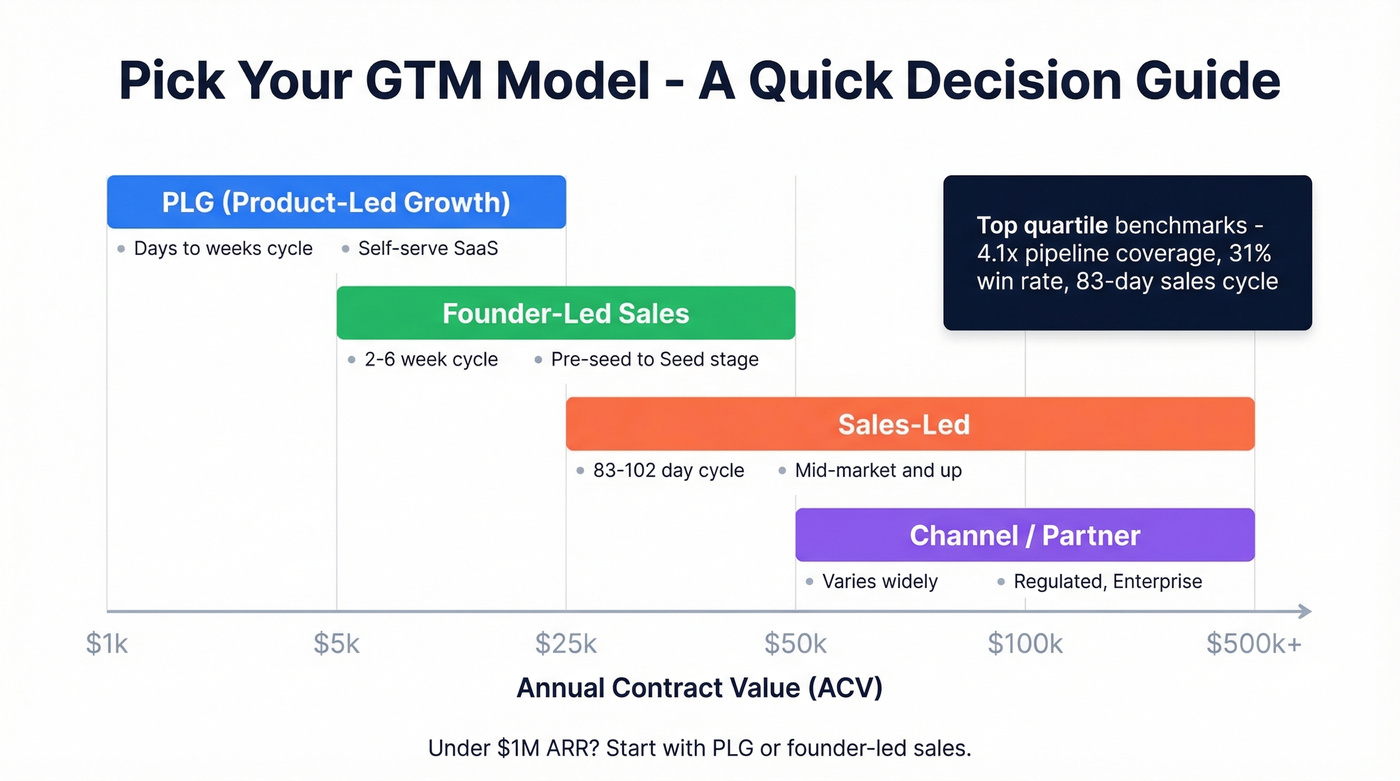
| Model | Best For | Avg Sales Cycle | Typical ACV |
|---|---|---|---|
| PLG | Self-serve SaaS, <$5k ACV | Days to weeks | <$5k |
| Founder-led sales | Pre-seed to seed | 2-6 weeks | $5k-$50k |
| Sales-led | Mid-market+ | 83-102 days | $25k-$500k+ |
| Channel/partner | Regulated, enterprise | Varies widely | $50k+ |
Benchmark data from Ebsta and Pavilion paints a clear picture: median pipeline coverage sits at 2.5x quota, but top-quartile teams run 4.1x. Win rates average 23% vs. 31% for top performers. Sales cycles average 102 days vs. 83 for the best teams.
If you're a SaaS company under $1M ARR, start with PLG or founder-led sales. Founder selling isn't a stopgap. It's how you build the pattern recognition you'll need to hire and scale the right motion later.
Here's what "repeatable motion" looks like once the fundamentals click: Snyk scaled to 50 AEs prospecting 4-6 hours per week and generated 200+ new opportunities per month, while cutting bounce rates from 35-40% to under 5% and increasing AE-sourced pipeline by 180%.

Outbound CAC averages $1,980 - and bad data is a huge driver. Prospeo cuts that cost with 98% email accuracy at ~$0.01 per lead, giving you a real number to put in your business plan's unit economics section.
Build your GTM financial model on data that actually connects.
Set Your Unit Economics
This is where most GTM sections fall apart. Investors don't want "we'll do content marketing and outbound." They want channel-level acquisition costs.
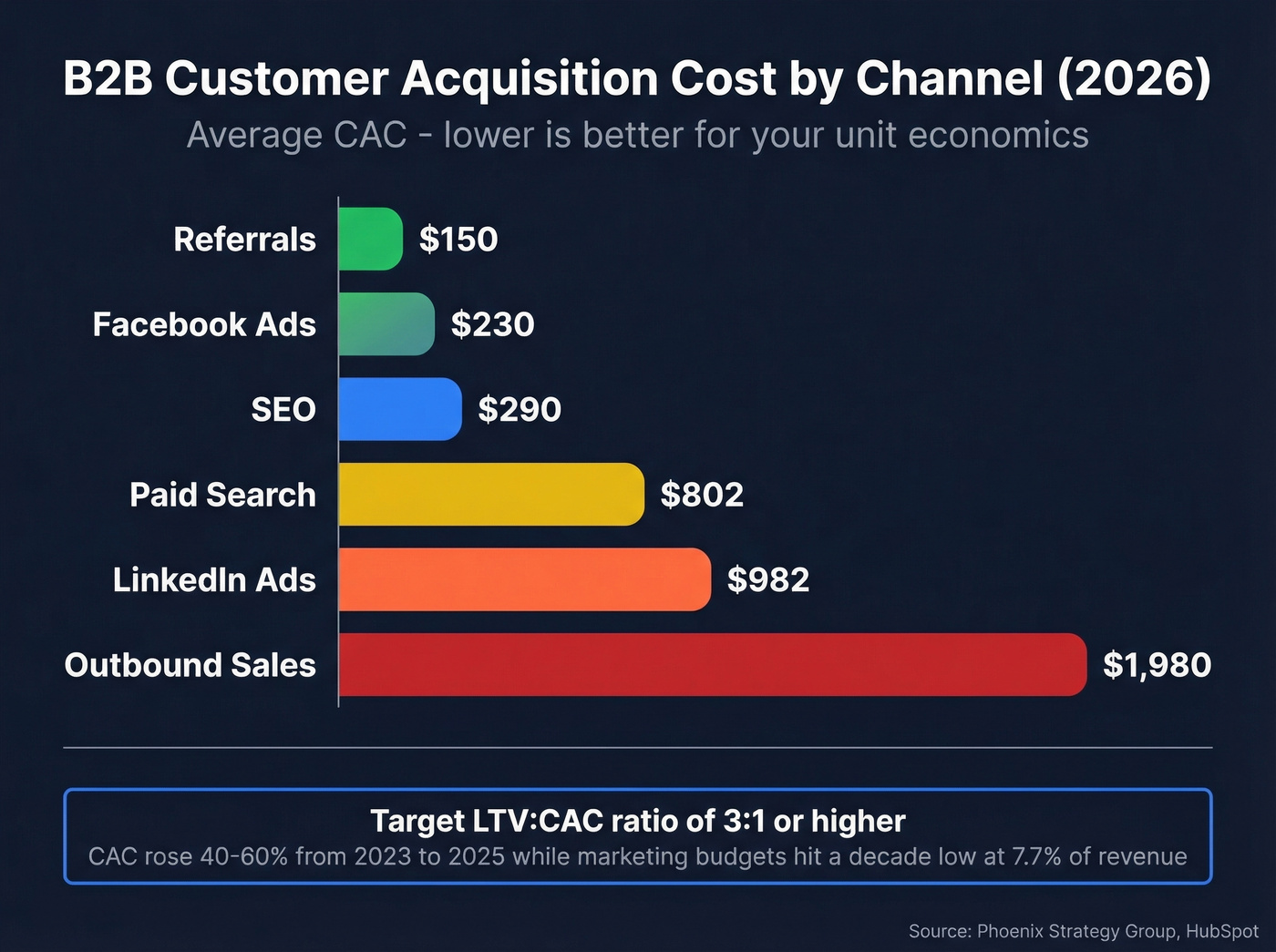
The formula: CAC = (Sales Costs + Marketing Costs) / Customers Acquired. Here's what those numbers look like in 2026:
CAC by Channel (B2B)
| Channel | Avg CAC |
|---|---|
| Referrals | $150 |
| Facebook Ads | $230 |
| SEO | $290 |
| Paid Search | $802 |
| LinkedIn Ads | $982 |
| Outbound Sales | $1,980 |
CAC by Industry
| Industry | Combined Avg CAC |
|---|---|
| Ecommerce | $86 |
| B2B SaaS | $239 |
| Cybersecurity | $387 |
| Financial Services | $784 |
CAC rose 40-60% from 2023 to 2025. Meanwhile, marketing budgets sit at 7.7% of company revenue - the lowest in a decade per Gartner's 2025 CMO Spend Survey. You're spending more per customer with less budget. That's why channel efficiency matters more than channel volume, especially since only about 10% of your target market is in-market at any given time.
Look at outbound: $1,980 average CAC. A big driver of that cost is bad contact data - bounced emails, wrong numbers, dead-end sequences. Tools like Prospeo compress that cost by verifying emails at 98% accuracy for roughly $0.01 per lead, a concrete line item you can plug into your CAC model.
Your target ratio: LTV:CAC ≥ 3:1. Anything below that and your unit economics don't work at scale. Put this ratio in your business plan.
Write GTM for Investors
Investors review 10-15 pitches a day. Specificity is how you survive the stack. They evaluate three things in your go-to-market section:
A precisely defined target audience. Not "SMBs" but "B2B SaaS companies, 50-200 employees, Series A-B, using Salesforce, with an outbound sales motion." The more specific your ICP, the more credible your channel assumptions become.
Identified channels with economics. Which channels, what they cost, and why you believe they'll work for your specific audience. "We'll run LinkedIn ads" isn't a strategy. "LinkedIn ads at $982 CAC targeting VP Sales titles, converting at 2.1% based on our pilot" is.
Evidence of a repeatable sales process. Even early evidence counts. At seed, investors want $5k-$20k MRR with 10-20% month-over-month growth. At Series A, you need $100k+ MRR, scalable channels, and data-backed unit economics.
For market sizing, use bottom-up math. Let's be honest - top-down TAM slides are lazy, and founder communities on Reddit are blunt about this. Calculate number of potential customers times your price. "3,000 target companies x $12,000 ACV = $36M serviceable market" beats a Gartner TAM slide every time. Frame your ask around outcomes: "Raising $50,000 to hit $150k revenue in 12 months."
Adapt GTM by Company Stage
Your go-to-market plan should reflect where you actually are, not where you want to be.

| Element | Startup | Scale-up | Enterprise |
|---|---|---|---|
| Sales motion | Founder-led | Repeatable playbook | ABM + channel |
| Hiring | Validate before hiring | Specialist roles | Full GTM org |
| Planning | Lean experiments | Revenue-based headcount | Multi-stakeholder |
| Key risk | Premature scaling | AE overload | Org complexity |
At scale-up, don't just plan for AEs. Salesforce Ventures flags that ignoring supporting roles - sales engineers, customer success, sales ops - overloads reps and tanks productivity. Anything beyond 20% AE turnover signals deeper GTM problems, not just a hiring issue. We've seen teams burn through their Series A by hiring ten AEs before building the infrastructure to support even five.
GTM Mistakes That Kill Business Plans
Here's what actually sinks GTM sections:
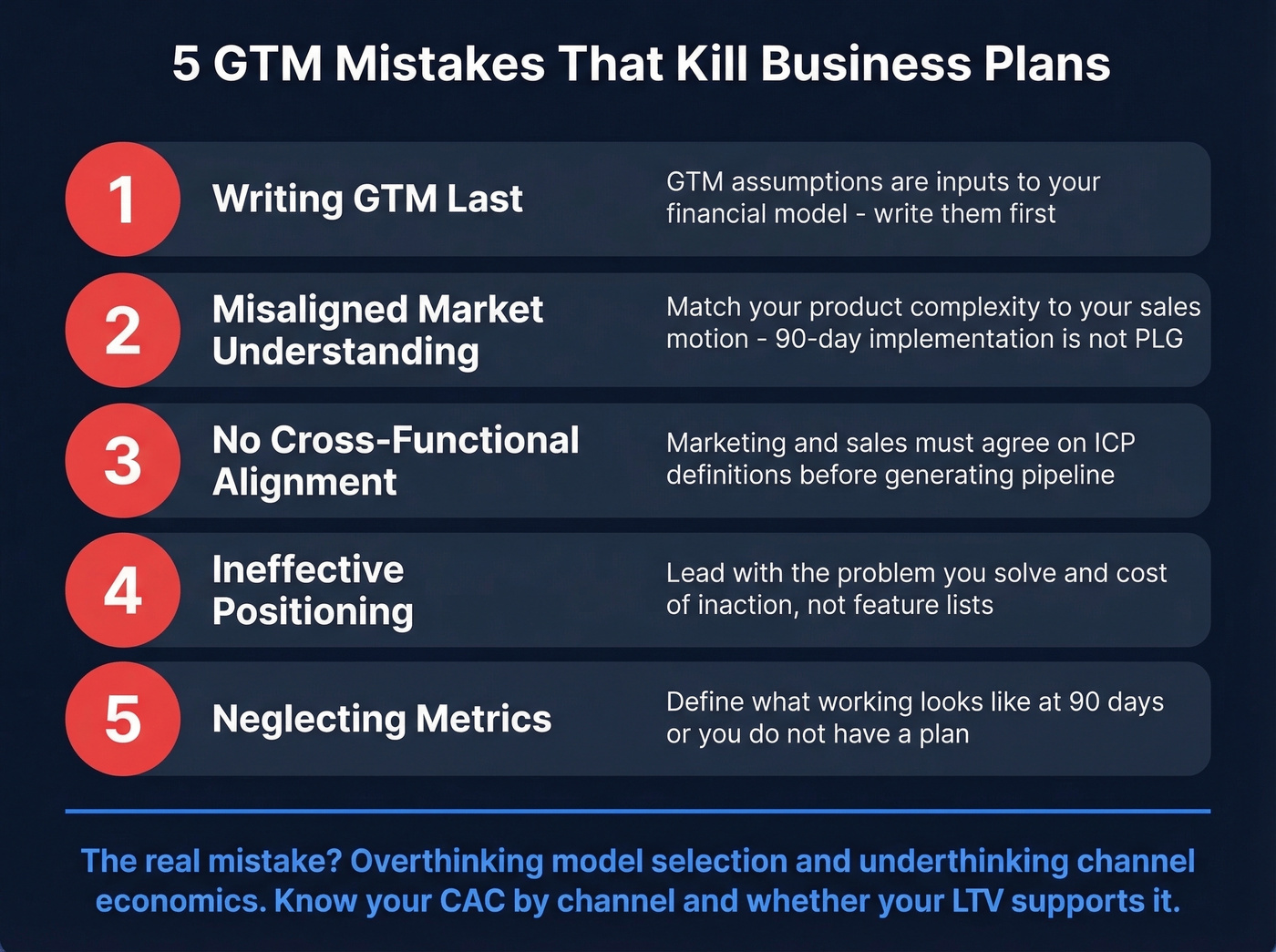
Writing GTM last. Your CAC and channel assumptions are inputs to your financial model. GTM last means fictional revenue projections. Full stop.
Misaligned market understanding. You built for enterprise but your GTM targets SMBs - the product-market-motion fit isn't there. This one's frustrating because it's so common and so avoidable. If your product requires a 90-day implementation, don't write a PLG motion into your business plan.
No cross-functional alignment. Marketing generates leads that sales can't convert because nobody agreed on ICP definitions. In our experience, this single disconnect causes more wasted pipeline than any other GTM failure.
Ineffective positioning. Talking features when buyers care about outcomes. Skip the feature matrix in your pitch - lead with the problem you solve and the cost of inaction.
Neglecting metrics. A GTM plan without KPIs is a wish list. If you can't define what "working" looks like at 90 days, you don't have a plan.
Most founders overthink GTM model selection and underthink channel economics. Picking "sales-led" vs. "PLG" matters far less than knowing your CAC by channel and whether your LTV supports it. If your deal size is below $10k, a full sales team usually isn't the first hire - and your business plan should reflect that conviction.
Snyk scaled 50 AEs to 200+ opportunities per month with under 5% bounce rates using Prospeo. That's the kind of repeatable sales motion investors want to see in your go-to-market strategy.
Turn your GTM section from theory into investor-ready proof.
FAQ
How long should the GTM section be?
Aim for 2-4 pages with numeric specificity: ICP definition, channel-level CAC estimates, sales model, and 3-5 KPIs you'll track. Investors skim, so dense tables and bullet points outperform narrative paragraphs every time.
GTM strategy vs. marketing plan - what's the difference?
A GTM strategy covers your entire path to market: ICP, sales model, channels, pricing, and metrics. A marketing plan is one component focused on demand generation tactics. Your business plan needs the full GTM strategy; the marketing plan sits inside it.
How do I build a prospect list once my GTM plan is done?
Define your ICP filters - industry, company size, job title, intent signals - then use a B2B data platform to find verified contacts matching those criteria. With 30+ search filters including buyer intent and technographics, you can push targeted lists directly into your sequencer or CRM and start testing your channel assumptions the same week.
What's a good LTV:CAC ratio for my business plan?
Target 3:1 or higher. Below that, your unit economics won't sustain growth at scale. Top-performing SaaS companies often reach 5:1 or above by optimizing retention and expansion revenue alongside acquisition costs.