

Buyer Intent Keywords: Find & Use Them in 2026
You're burning $8K/month on Google Ads, and half your clicks come from people who'll never buy. CPC increased for 87% of industries in the latest WordStream Google Ads benchmarks, which means every misaligned keyword costs more than it did twelve months ago. The fix isn't spending less - it's targeting buyer intent keywords instead of broad matches.
What You Need (Quick Version)
Buyer intent keywords are search queries that signal someone is actively evaluating or ready to purchase - not just browsing. Here's the 20-minute version of everything below:
- One-sentence definition: A buyer intent keyword reveals that the searcher is comparing, evaluating, or ready to buy - not just learning.
- Do this today: Open Google Search Console, filter by pages that drive conversions, and reverse-engineer the query patterns. You'll find intent signals you're currently ignoring. Takes 20 minutes, costs nothing.
- The stat that matters: Intent-based ads are 2.5x more efficient than broad targeting. That's not a marginal improvement - it's the difference between a campaign that works and one that drains budget.
- Bridge the gap: Once you know which keywords signal buying intent, pair that research with intent data platforms to see which companies are actively researching those topics - so you're building outbound lists around live demand.
What Are Buyer Intent Keywords?
A buyer intent keyword is any search query where the person typing it is closer to a purchase decision than to a Wikipedia rabbit hole. The distinction matters because it's the difference between traffic and revenue.
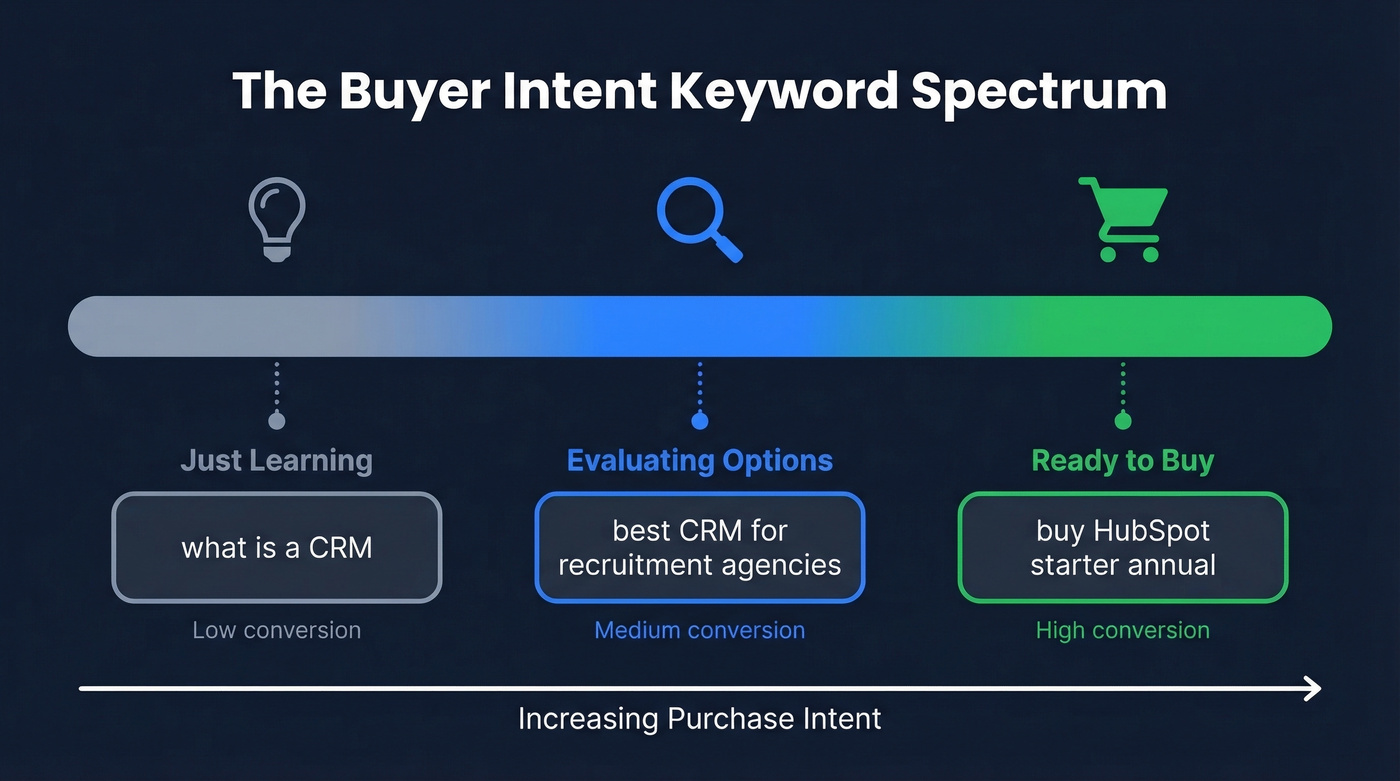
Compare these two searches: "what is a CRM" versus "best CRM for recruitment agencies." The first person is learning. The second has a problem, knows the category, and is evaluating options. That second query signals clear buying intent - and it's dramatically more likely to convert.
The spectrum isn't binary. "CRM software" sits somewhere in the middle - it could be a student writing a paper or a VP of Sales building a shortlist. Context clues like modifiers ("pricing," "vs," "demo," "for small teams") push a query toward the buyer end. Your job is to identify those modifiers for your specific market and build your keyword strategy around them.
Here's the thing: most teams optimize for volume first and intent second. That's backwards. A keyword with 50 monthly searches and clear purchase intent will outperform a 5,000-search informational term every time, because the people behind those 50 searches are actually ready to spend money.
Types of Commercial and Transactional Keywords
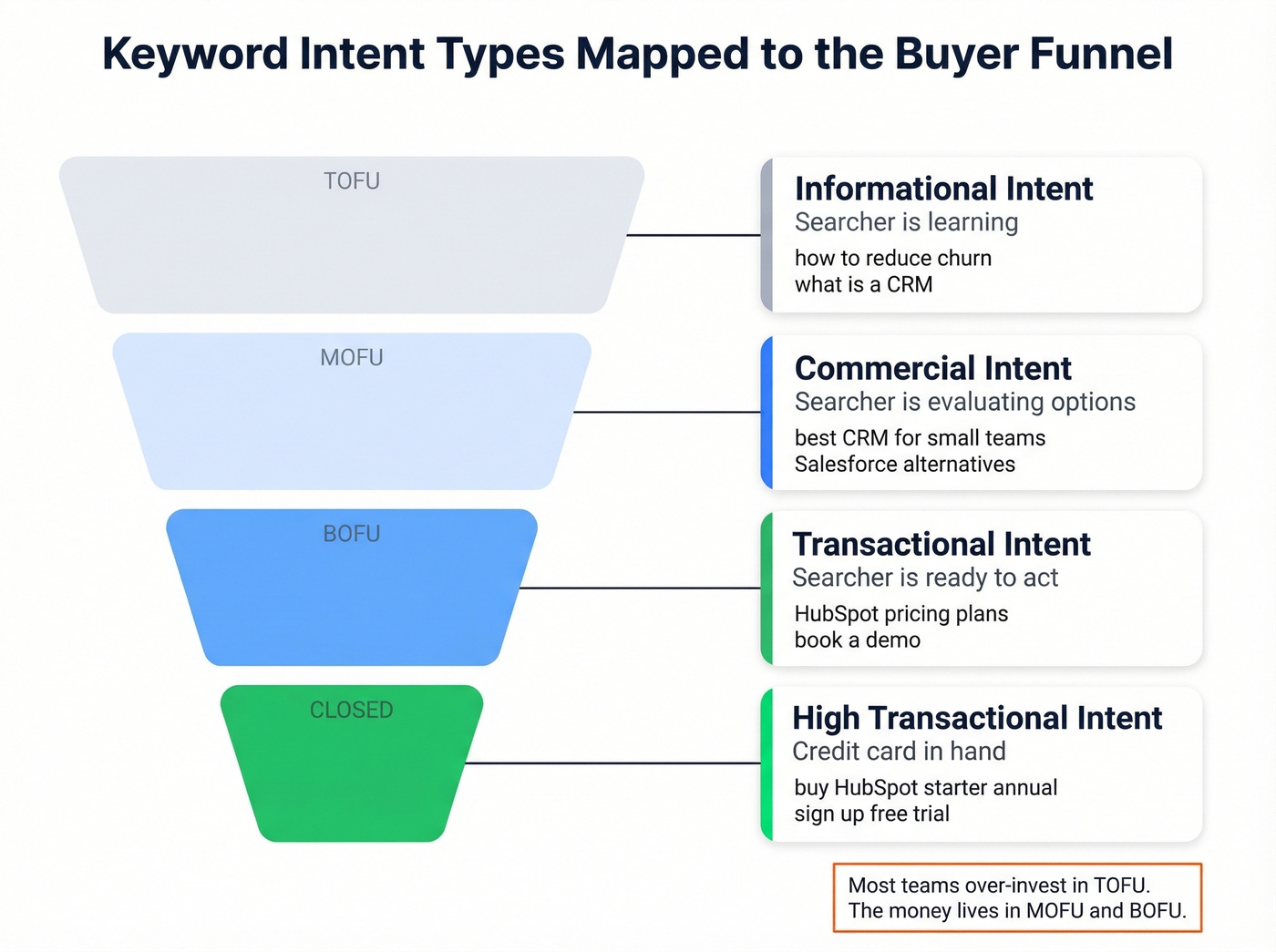
Not all intent is created equal. Here's how the four standard types map to where buyers actually sit in their journey.
| Intent Type | Buyer Stage | Example Query | Funnel Position |
|---|---|---|---|
| Informational | Problem-aware | "how to reduce churn" | TOFU |
| Navigational | Brand-aware | "HubSpot login" | Varies |
| Commercial | Solution-aware | "best CRM for small teams" | MOFU |
| Transactional | Product-aware | "HubSpot pricing plans" | BOFU |
| High Transactional | Decision-ready | "buy HubSpot starter annual" | BOFU |
Informational queries ("what is," "how to") map to the top of the funnel. These people know they have a problem but haven't started shopping. Navigational queries are brand-specific - someone already knows where they want to go.
The money lives in commercial and transactional intent. Commercial keywords ("best," "vs," "alternatives," "review") signal active evaluation. Transactional keywords ("pricing," "demo," "free trial," "buy," "sign up") signal someone with a credit card in hand.
The "high transactional" sub-category deserves its own callout. Queries like "get pricing," "book a demo," or "sign up for free trial" aren't just transactional - they're action-ready. These convert at multiples of standard commercial queries, and they're the terms your competitors are bidding hardest on.
TOFU keywords build awareness. MOFU keywords capture consideration. BOFU keywords close deals. Most teams over-invest in TOFU content because the volume looks impressive in reports. The teams that win invest disproportionately in MOFU and BOFU - that's where we've seen the biggest returns across our own campaigns and the teams we work with.
Why High-Intent Keywords Matter
93% of B2B marketers report higher conversion rates when they layer keyword intent data into their targeting. That's not an edge case - it's the baseline expectation for any team running modern campaigns.
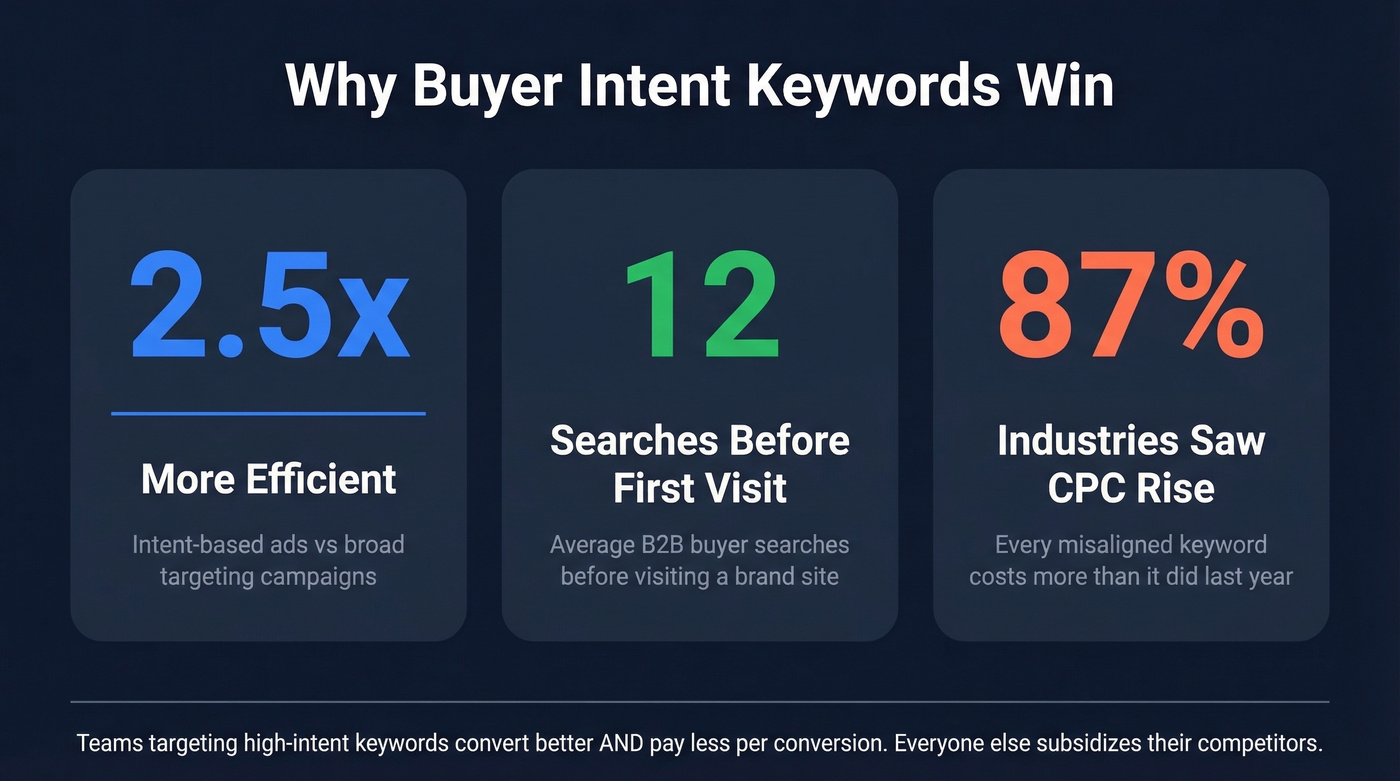
Consider the buyer's side: B2B buyers conduct an average of 12 online searches before they ever visit a specific brand's website. That's 12 opportunities to show up with the right content on the right query. If you're only targeting informational terms, you're visible for searches 1 through 4 and invisible for searches 5 through 12 - the ones where decisions actually happen.
Intent-based ads are 2.5x more efficient than broad campaigns, which means the gap between teams targeting purchase-ready keywords and everyone else is widening every quarter. The cost of getting this wrong keeps climbing too. Conversion rates increased for 65% of industries in the latest WordStream benchmarks, but CPC rose for 87%. Teams targeting high-intent keywords are converting better and paying more efficiently. Everyone else is subsidizing their competitors' results.

You're researching buyer intent keywords to reach people ready to buy. Prospeo tracks 15,000 intent topics via Bombora so you can see which companies are actively researching your exact keywords right now - then pull verified emails (98% accuracy) for decision-makers at those companies. Stop guessing who's in-market. Know.
Turn buyer intent keywords into verified contact lists in minutes.
How to Find Buyer Intent Keywords
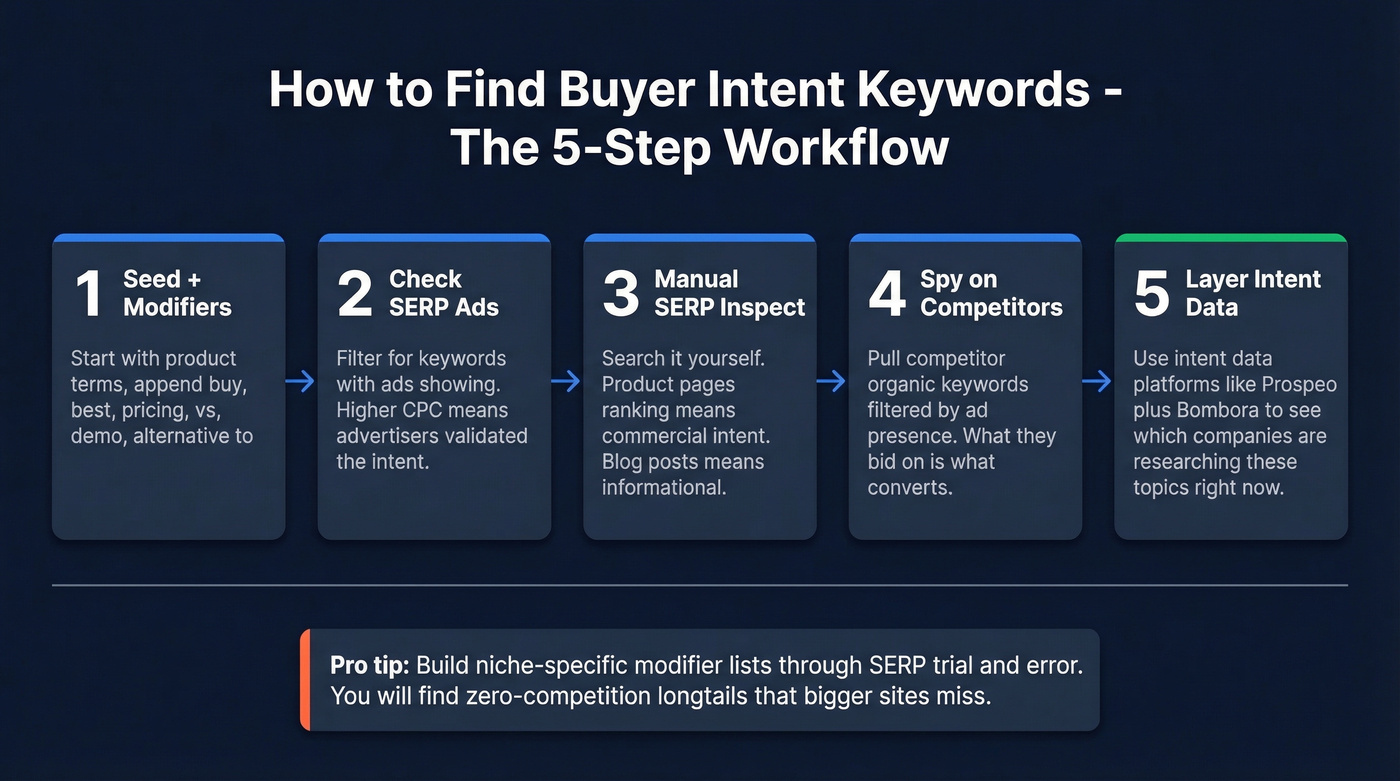
Finding these high-converting queries isn't about a single tool or trick. It's a workflow - buyer intent keyword research you build once and run continuously.
Seed Keywords + Modifiers
Start with your core product terms and append buyer-intent modifiers. The classic list: "buy," "best," "review," "pricing," "vs," "demo," "near me," "discount," "free trial," "for [use case]," "alternative to." This gives you a starting universe of queries to validate.
Validate Intent via SERP Features
The presence of ads on a SERP is the strongest signal that a keyword has commercial value. In Ahrefs, Semrush, or any keyword tool, filter your list for queries where the SERP shows top ads or shopping results. Then sort by CPC - higher CPC generally means advertisers have validated that the keyword converts. It's not perfect, but it's the fastest proxy for commercial intent at scale.
Inspect the SERP Manually
Don't trust modifiers alone. Search the keyword and look at what's actually ranking. If the top 10 results are all blog posts and educational content, the intent is informational - regardless of whether the keyword contains "best" or "top." If you see product pages, pricing pages, and comparison landing pages, you've confirmed commercial intent. In our experience, this 30-second SERP check catches intent mismatches that no tool can automate.
Analyze Competitor Keywords
Pull your competitors' organic keywords and filter by ad presence. These are terms where competitors rank organically AND advertisers are bidding - a strong double signal. Check their paid keywords reports too, filtered by your target geography. What competitors bid on tells you what converts for them.
Build a Niche-Specific Modifier List
This is the advanced move most teams skip. The consensus on r/juststart is that SEO practitioners over-rely on "best X" and "[product] review" patterns, leaving dozens of high-intent longtails completely untapped. Build a niche-specific modifier list through SERP trial-and-error. You'll find queries with zero exact-match competition - low-volume, high-intent terms that smaller sites can actually rank for.
Copying authority sites' head-term strategy fails if you don't have comparable domain authority. Win with angles and modifiers competitors aren't using. One team we worked with found that "[product category] implementation checklist" drove more demo requests than their "best [product category]" page - because the people searching for implementation checklists had already decided to buy and were choosing a vendor.
Layer Intent Data on Keywords
Keyword tools tell you what people search. Intent data platforms tell you which companies are actively researching your category right now. This is where keyword research becomes pipeline generation.
Prospeo tracks 15,000 intent topics powered by Bombora and pairs that signal with 30+ search filters - job changes, headcount growth, technographics, funding. Instead of guessing which companies are behind your high-intent searches, you can identify them by name and pull verified contact data for the decision-makers.

Examples by Industry
Abstract frameworks are useful. Concrete examples are better.
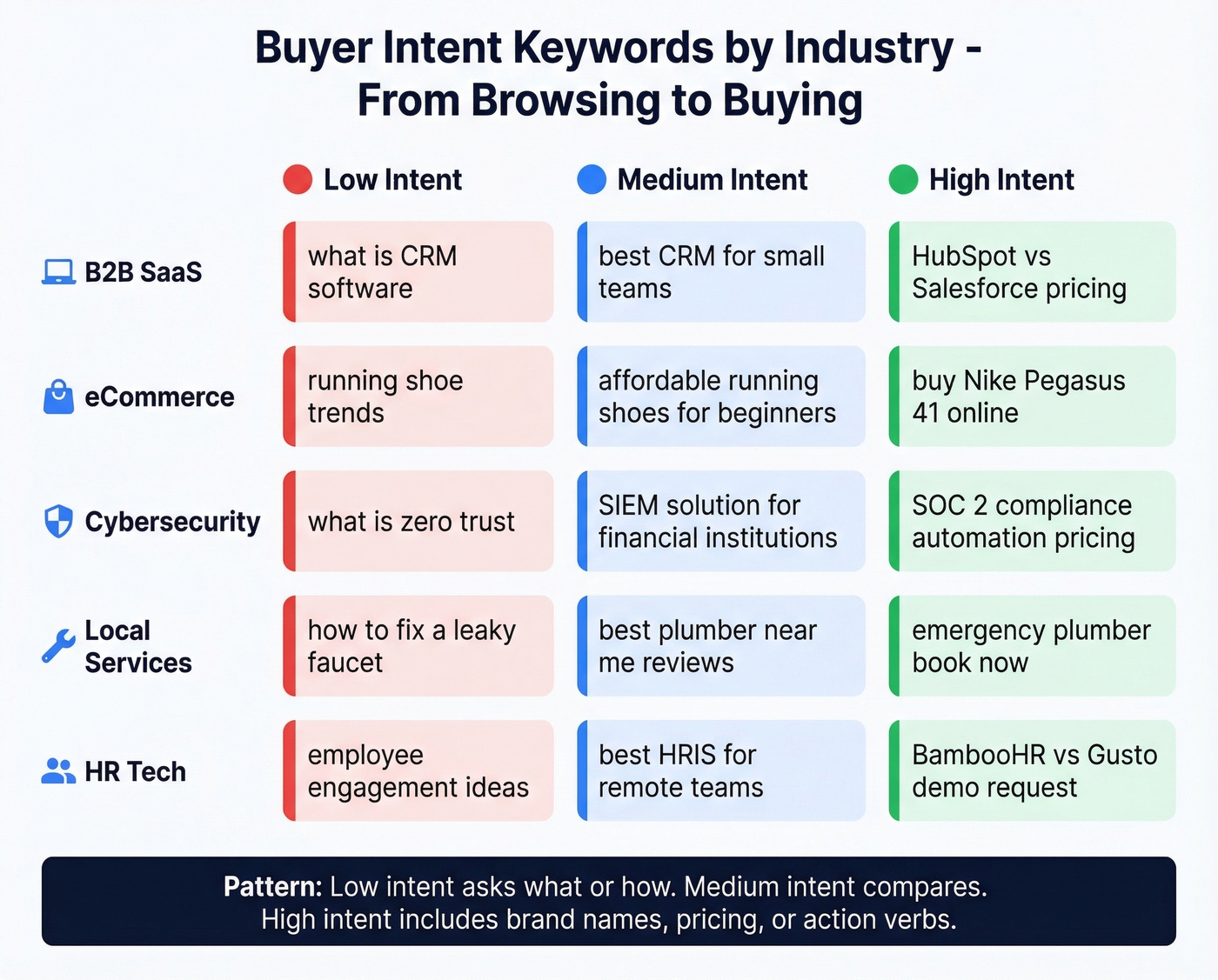
| Industry | Low Intent | Medium Intent | High Intent |
|---|---|---|---|
| B2B SaaS | "what is CRM software" | "best CRM for small teams" | "HubSpot vs Salesforce pricing" |
| eCommerce | "running shoe trends" | "affordable running shoes for beginners" | "buy Nike Pegasus 41 online" |
| Cybersecurity | "what is zero trust" | "SIEM solution for financial institutions" | "SOC 2 Type II compliance automation pricing" |
| Local Services | "how to fix a leaky faucet" | "best plumber near me reviews" | "emergency plumber [city] book now" |
| HR Tech | "employee engagement ideas" | "best HRIS for remote teams" | "BambooHR vs Gusto demo request" |
The pattern is consistent: low-intent queries ask "what" or "how." Medium-intent queries compare and evaluate. High-intent queries include brand names, pricing language, or action verbs like "buy," "book," and "demo."
B2B-specific modifiers deserve special attention. Terms like "implementation," "ROI calculator," "vs," and "for [industry]" signal a buyer who's past the education phase and into active evaluation. In cybersecurity, "zero-trust network architecture implementation" is far more valuable than "what is zero trust" - even though the latter gets 50x the search volume.
Let's be honest: if your average deal size sits below five figures, you probably don't need to rank for every informational keyword in your category. Spend 80% of your keyword budget on commercial and transactional terms. The awareness content can come later, once you've captured the people who are actually ready to buy.
Non-Linear Journeys and AI Search
The neat awareness-to-consideration-to-decision funnel is a lie. Buyers loop, skip stages, and enter from AI search engines your analytics can't even track.
Google's own research calls this the "messy middle" - buyers oscillate between exploration and evaluation in unpredictable patterns. Someone reads a comparison article, watches a demo video, goes back to an informational query, then jumps straight to a pricing page. The journey isn't a funnel. It's a pinball machine.
AI search engines make this messier. ChatGPT, Perplexity, and Google AI Overviews are now discovery channels where buyers form opinions before they ever type a query into traditional search. Your analytics won't show these touchpoints, but they're shaping purchase decisions. We've watched teams build entire content calendars around a linear funnel model and wonder why their pipeline leaks at every stage.
What this means for your keyword strategy: don't assume a keyword's funnel position based on its format alone. Validate intent per keyword through SERP inspection. A "what is" query in a niche B2B category might actually signal a decision-maker doing final due diligence, not a student writing a paper. Map your content to intent signals, not funnel stages - a pricing page can serve someone at any point in their journey.
Common Mistakes
Targeting volume over intent. "Home workout routines" gets massive search volume. It also attracts people looking for YouTube videos, not products. "Buy adjustable dumbbells" gets a fraction of the traffic and multiples of the conversions. We've seen teams blow entire quarterly budgets chasing volume metrics that look great in dashboards and produce zero pipeline.
Only using "best" and "review" modifiers. These are the most obvious purchase-intent patterns, which means they're the most competitive. "Implementation guide for [product]," "[product] vs [product] for [use case]," and "[product] ROI calculator" are all high-intent queries that most teams ignore entirely.
Ignoring negative keywords. If you're running PPC on high-intent terms, you need a negative keyword list from day one. Start with: "free," "DIY," "how-to," "tutorial," "definition," "what is," "examples."
Assuming intent from the keyword alone. A keyword that looks transactional might have an informational SERP. Always check what's actually ranking before you build a page or bid on a term. One r/Marketresearch thread put it well: product and market research tools can feel like they're showing "trending garbage" instead of what people are actually searching for. SERP validation takes 30 seconds and saves thousands in wasted spend.
Treating the funnel as linear. Real talk: stop building content for every funnel stage just because a framework told you to. The teams that win spend disproportionately on the keywords where money changes hands.
Building an Intent Scoring Model
Keywords tell you what people search. A scoring model tells you which signals to act on and how urgently. The framework is simple: fit multiplied by behavior. When you combine keyword tracking with firmographic data, you stop guessing which accounts deserve attention and start prioritizing based on evidence.
| Stage | Intent Signals | Keyword Patterns | Action |
|---|---|---|---|
| Awareness | Blog visits, social engagement | "what is," "how to" | Nurture sequence |
| Consideration | Comparison pages, case studies | "best," "vs," "alternatives" | SDR outreach |
| Decision | Pricing page visits, demo requests | "pricing," "demo," "buy" | Fast-track to AE |
A high-fit account that's visited your pricing page twice this week gets fast-tracked to sales. A low-fit account that clicked one blog post gets a nurture email and nothing more. Scoring prevents your sales team from chasing every signal equally.
Prospeo surfaces these signals at scale - 15,000 intent topics paired with 98% verified email accuracy and 125M+ verified mobile numbers. The gap between "this company is researching our category" and "we have a meeting booked" shrinks from weeks to days when you can identify the right accounts and reach verified decision-makers in the same workflow.
High-intent keywords tell you what buyers want. Intent data tells you which companies are searching those terms today. Prospeo layers Bombora intent signals across 15,000 topics with 30+ filters - job title, technographics, funding, headcount growth - so your outbound lists target live demand, not cold accounts.
Pair keyword research with real-time buyer signals at $0.01 per lead.
FAQ
What's the difference between buyer intent keywords and regular keywords?
Regular keywords describe a topic; buyer intent keywords signal the searcher is actively evaluating or ready to purchase. "CRM software" is a topic, while "best CRM for small teams pricing" signals buying intent. The practical difference is conversion rate - intent-driven terms convert at 2-5x the rate of generic queries.
How do I confirm a keyword has purchase intent?
Check three signals: does the SERP show ads? Are top results product or pricing pages rather than blog posts? Is the CPC above your industry average? Yes to two or more confirms commercial intent. SERP inspection is the single most reliable check - it takes 30 seconds and costs nothing.
Should I target these keywords with SEO or PPC?
Both. PPC gives immediate visibility on high-intent terms while you build organic authority. SEO compounds over time and reduces cost per acquisition. Start with PPC on proven converters, then build content around the same intent clusters to capture organic traffic long-term. Backlinko's keyword research guide is a solid starting point for the SEO side.
Can I identify which companies are searching my target keywords?
Yes - intent data platforms match keyword-level research activity to specific companies. Prospeo tracks 15,000 topics via Bombora and layers that signal with firmographic filters like headcount growth, funding, and technographics, so you can build outbound lists around accounts showing live demand rather than guessing.