

Call Cadence Meaning: Definition + Templates (2026)
We've watched teams rebuild their cadence three times - tweaking spacing, adding channels, swapping messaging - before realizing one in four phone numbers on their list were disconnected. The cadence was never the problem. The data was.
A lot of content about "call cadence" covers quarterback snap counts or military marching chants. This isn't that. Here's what it means in a sales context, why it matters, and how to build one that actually books meetings.
Quick Summary
A call cadence is the scheduled sequence and spacing of phone calls - plus supporting emails and voicemails - a rep uses to reach a prospect. Key numbers: expect 18+ dials to connect, aim for 8-12 touchpoints over 17-21 days, and verify your contact data before you dial. B2B contact data decays at 22.5% per year. Three templates below.
What Is a Call Cadence?
A call cadence is the sequence and frequency of phone calls, voicemails, emails, and social touches a salesperson uses to engage a prospect over a defined period. It's phone-primary but multi-channel supported.
| Term | Primary Channel | Scope |
|---|---|---|
| Call cadence | Phone calls | Phone-led, multi-channel support |
| Sales cadence | All channels | Broader sequence across email, phone, social, direct mail |
| Sales sequence | All channels | Often used interchangeably with sales cadence |
The key difference: a call cadence treats the phone as the main event. Everything else exists to make the next call more likely to connect.
Why It Matters for Pipeline
Most reps think they're persistent. They're not.
XANT's research found that reps believed they averaged 15 touches per lead. The actual number was about 6. That gap hasn't gone away - it's still one of the most common cadence execution problems we see. McKinsey found that systematic sales engagement processes drive 10-20% pipeline improvements, and Revenue.io's data shows it takes 8+ attempts to reach a prospect.
One AE tracked their meetings for a month: 24 from calls, 1 from email, 0 from social. Phones still create more meetings than any other channel, and understanding what a cadence call means in a business context is what separates teams that hit quota from teams that wonder why their pipeline is dry. Your cadence is the system that keeps reps dialing when instinct tells them to quit after attempt two.
Call Cadence Benchmarks
You need more touches than you think.
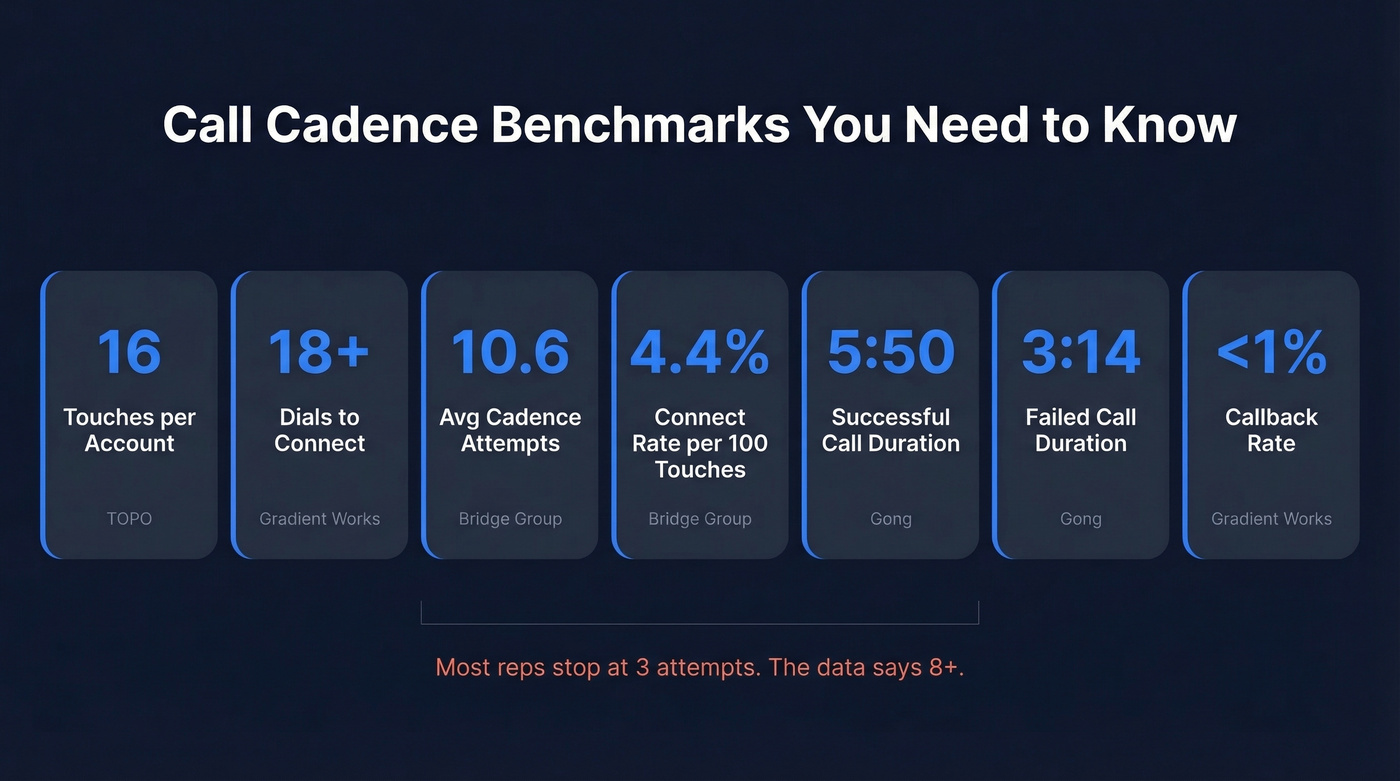
| Metric | Benchmark | Source |
|---|---|---|
| Touches per account | 16 | TOPO |
| Dials to connect | 18+ | Gradient Works |
| Avg cadence attempts | 10.6 | Bridge Group |
| Connects per 100 touches | 4.4 | Bridge Group |
| Successful call duration | 5:50 | Gong |
| Failed call duration | 3:14 | Gong |
| Callback rate | <1% | Gradient Works |

At 4.4 connects per 100 touches, you're looking at a 4.4% connect rate as the average. Stale data drops that number further. The Gong duration benchmarks matter too - if your reps' calls average closer to 3:14 than 5:50, they're getting rejected fast, which means wrong person or wrong timing.
One Reddit poster argued they book meetings by the first cold call connection or third email - and can't imagine prospects "giving in" after 15 voicemails. That skepticism is valid for certain ICPs, which is exactly why one-size-fits-all cadences fail.

At 4.4 connects per 100 touches, every dead number in your list is a wasted dial. Prospeo gives you 125M+ verified mobile numbers with a 30% pickup rate - 3x the industry average. Stop burning cadence attempts on disconnected lines.
Fix your data before you fix your cadence.
Best Days and Times to Call
ZoomInfo analyzed 1.4M outbound calls and the results are clear: Tuesday through Thursday are the money days. Tuesday and Wednesday alone account for 44% of demos booked. Friday is the worst day across every metric.
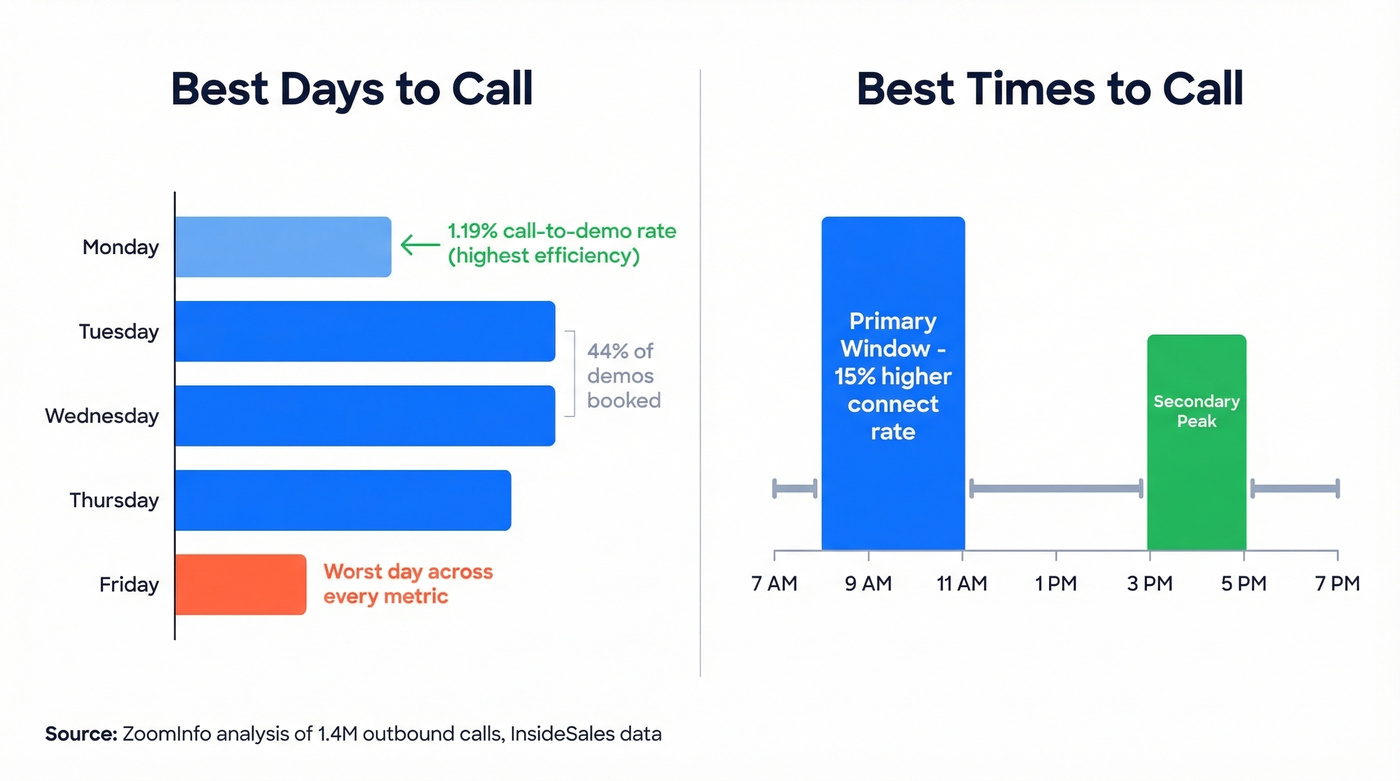
Monday has the highest call-to-demo efficiency at 1.19%, likely because fewer reps are calling. But overall volume and connect rates lag mid-week.
For time of day, the 8-11 AM local time window boosts connection rates by 15% according to InsideSales data, with a secondary peak at 4-5 PM. Run your primary call block in the morning, then a shorter blitz from 3-6 PM.
How to Build a Call Cadence
Step 1: Verify your data first. This isn't optional. Run your prospect list through a verification platform to strip out dead numbers before you design the sequence. B2B contact data decays at 2.1% per month - that's a lot of wasted dials if you skip this step.
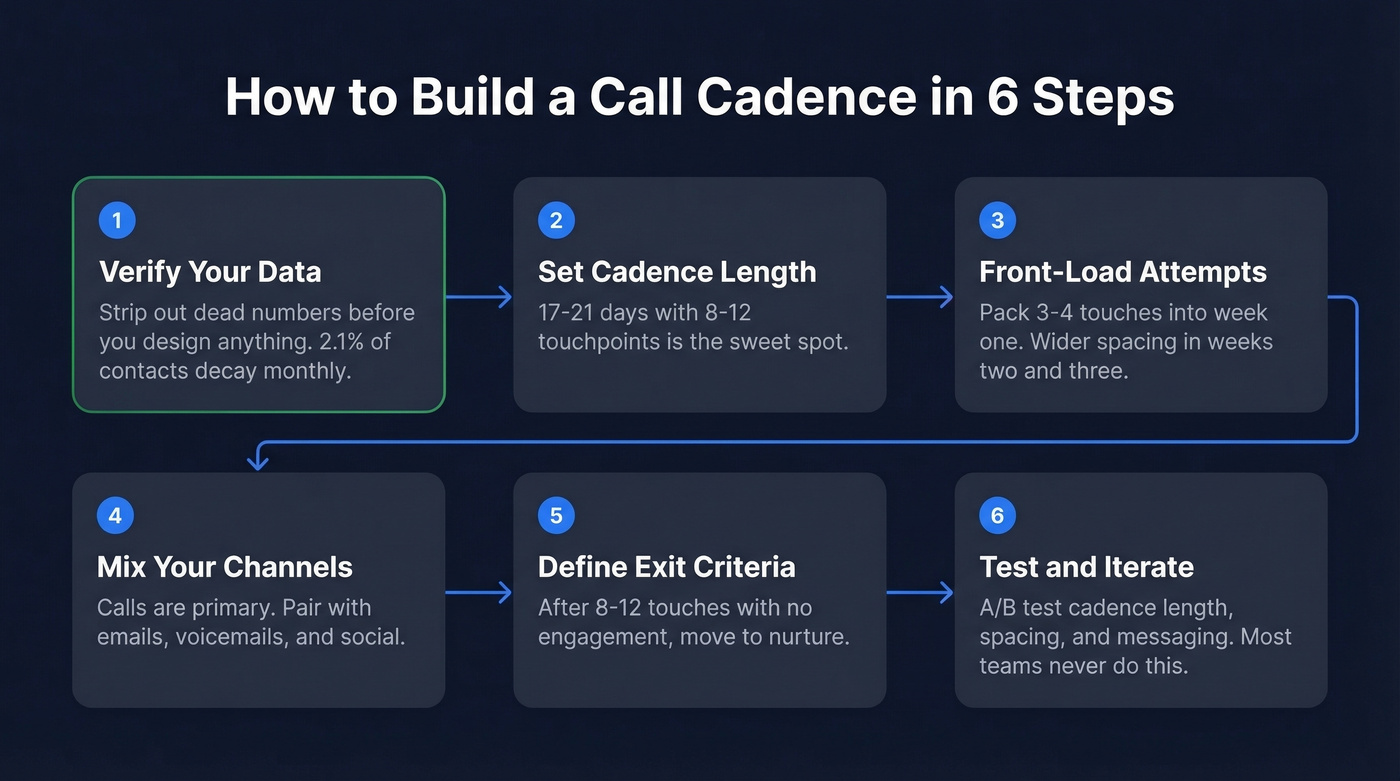
Step 2: Set your cadence length. Morgan J Ingram recommends 17-21 days. Florin Tatulea suggests 8-12 touchpoints within that window. For many cold outbound motions, 10-14 days with 7-10 touches is the sweet spot.
Step 3: Front-load your attempts. Pack your first 3-4 touches into the first week. Wider spacing in weeks two and three. Trigger-based timing - reaching out after a prospect visits your pricing page - beats day-of-week timing every time.
Step 4: Mix your channels. Calls are primary, but pair them with emails and voicemails. Double down on whatever channel gets responses.
Step 5: Define exit criteria. After 8-12 touches with no engagement, move the prospect to a long-term nurture cadence. Not another aggressive sequence.
Step 6: Test and iterate. A/B test cadence length, spacing, and messaging. Most teams never do this, and it shows.
Call Cadence Templates
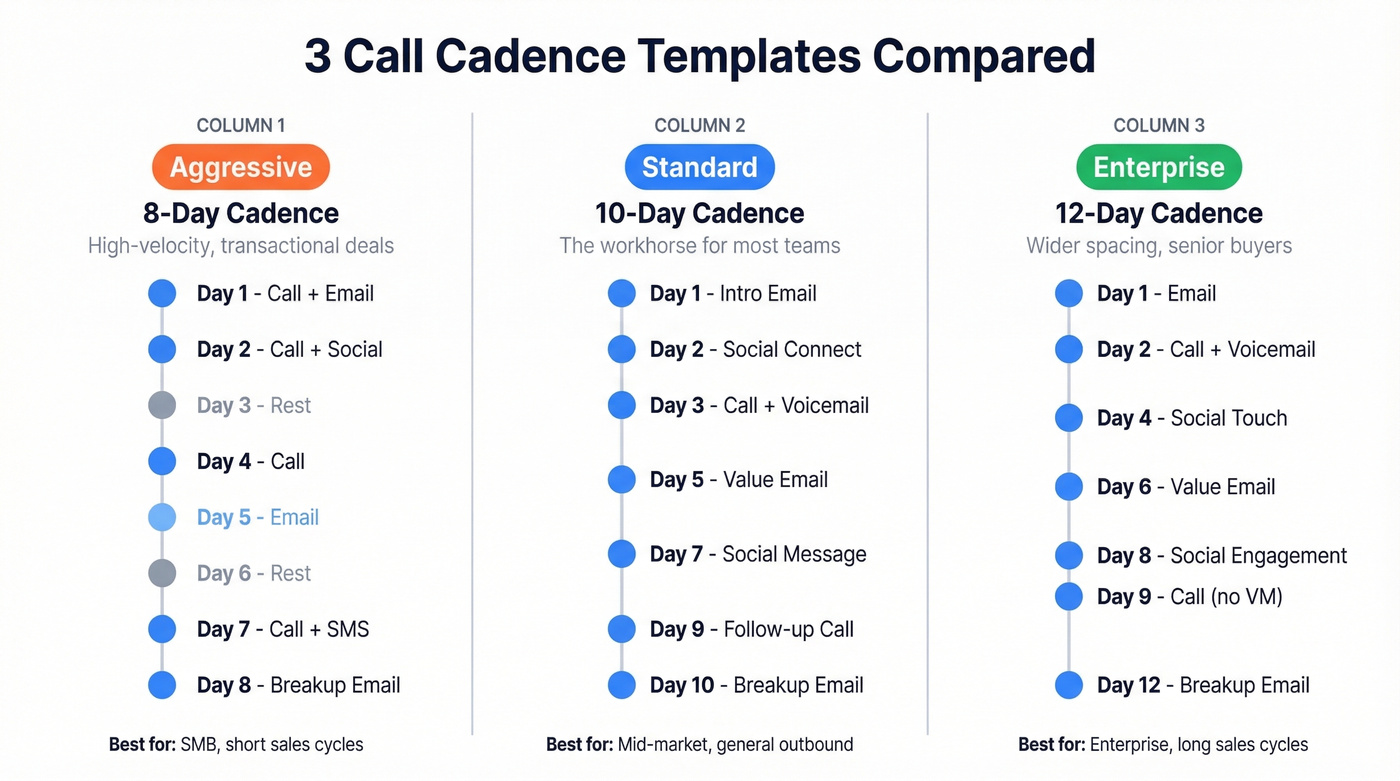
Aggressive 8-Day Cadence
Built for high-velocity sales where speed matters more than spacing.
| Day | Action |
|---|---|
| 1 | Call + email |
| 2 | Call + social touch |
| 3 | Rest |
| 4 | Call |
| 5 | |
| 6 | Rest |
| 7 | Call + SMS |
| 8 | Email (breakup) |
Best for transactional deals with short buying windows. Skip this if your ICP is enterprise - senior buyers will tune you out by Day 3.
Standard 10-Day Cadence
The workhorse.
| Day | Action |
|---|---|
| 1 | Email (intro) |
| 2 | Social connection |
| 3 | Call + voicemail |
| 5 | Value email |
| 7 | Social message |
| 9 | Follow-up call |
| 10 | Breakup email |
Voicemail rule from Cognism's playbook: leave one voicemail on your first unanswered call. Say you'll email in five minutes, then do it. Never leave another voicemail after that.
Lean 12-Day Cadence
For enterprise prospects where wider spacing signals respect.
| Day | Action |
|---|---|
| 1 | |
| 2 | Call + 15-sec voicemail mirroring email |
| 4 | Social touch |
| 6 | Email (value-add) |
| 8 | Social engagement |
| 9 | Call (no voicemail) |
| 11 | Email (case study) |
| 12 | Breakup email |
Cramming touches into a week signals desperation to senior buyers. Let's be honest - if a VP of Engineering got seven touches in five days from the same SDR, they'd block the number.
Common Cadence Mistakes
Five mistakes that kill connect rates before your cadence gets a fair test:
- Quitting after one or two attempts. The data says 8+ touches. Most reps stop at 3. That's not a cadence - it's a suggestion.
- Single-channel reliance. Calls only or emails only - either approach leaves conversion on the table.
- Ignoring the perceived vs. actual gap. Your reps think they're making 15 touches. They're making 6. Audit actual execution, not the plan on paper.
- One-size-fits-all cadences. A fintech CFO and a marketing manager at a 50-person startup don't respond to the same sequence. Adjust by ICP segment.
- Never testing. Most teams set a cadence once and run it for months without A/B testing timing, messaging, or channel mix. That's how you end up with a "best practice" that's actually just the first thing someone guessed.
Data Quality - The Cadence Killer
Here's the thing: you can build the perfect cadence and still get a 2% connect rate if your data is garbage.
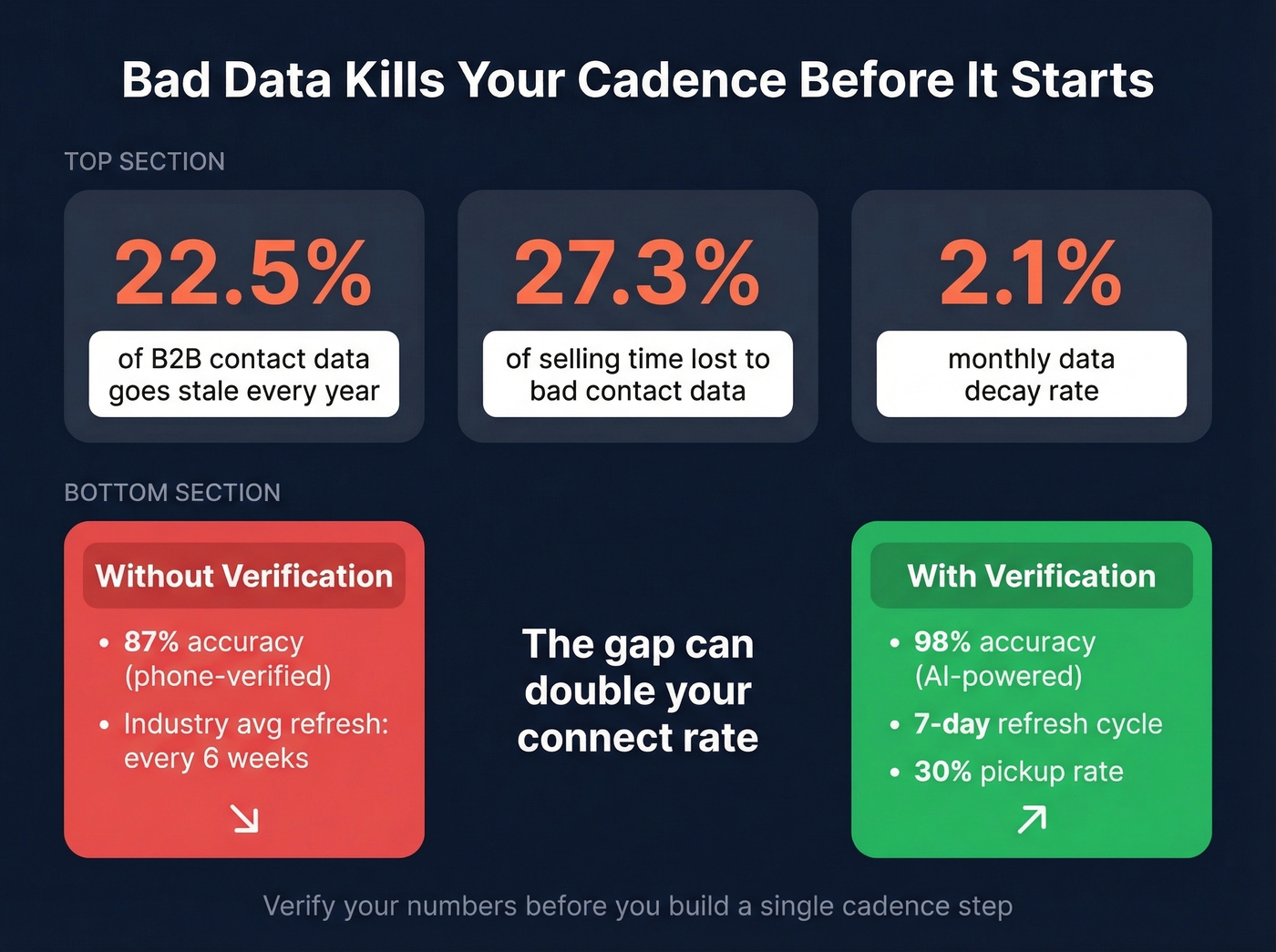
B2B contact data decays at roughly 2.1% per month - that's 22.5% annually. Reps lose 27.3% of their selling time to bad contact data. Phone-verified mobile numbers are 87% accurate; AI-powered verification hits 98%. That gap alone can double your connect rate.
We've seen this firsthand with teams we work with. They'll spend weeks optimizing their cadence structure, debating whether Day 3 or Day 4 is better for the second call, while a quarter of their list is disconnected numbers. Stop obsessing over spacing and start obsessing over whether the number you're dialing is even connected.
Before you run any cadence, verify your contact data. Prospeo refreshes its 125M+ verified mobile numbers every 7 days - compared to the 6-week industry average - delivering a 30% pickup rate that most teams don't believe until they see it.
B2B contact data decays at 2.1% per month, but Prospeo refreshes every 7 days - not the 6-week industry average. Run your prospect list through 98% accurate verification before you build a single cadence step. Teams using Prospeo book 26% more meetings than ZoomInfo users.
Verified numbers at $0.01 per lead. No contracts, no sales calls.
FAQ
How many calls should be in a call cadence?
Most research points to 8-12 touchpoints over 17-21 days. The Bridge Group average is 10.6 attempts, and it takes 18+ dials to connect with a technology buyer. Front-load the first week, then widen spacing.
What's the difference between a call cadence and a sales cadence?
A call cadence is phone-led with email and voicemail support. A sales cadence is the broader multi-channel sequence. Every call cadence is a type of sales cadence, but not every sales cadence is call-first.
What's the best day to make sales calls?
Tuesday through Thursday consistently outperform other days. ZoomInfo's analysis of 1.4M calls shows Tuesday and Wednesday account for 44% of demos booked. Friday is the worst day across every metric.
How do I improve my connect rate?
Start with verified contact data - 22.5% of B2B records go stale annually. Beyond data, call during the 8-11 AM window, front-load your first week, and actually complete all touches in the cadence. Most reps don't finish what they start, and that's the real problem.