

A five-rep SDR team made 500 dials last Tuesday. They booked two meetings. That's a 0.4% conversion rate - well below the 2.35% B2B average. The problem wasn't effort or scripts. It was everything underneath: dead numbers, no cadence structure, and reps dialing manually from a spreadsheet. Top-performing teams with targeted lists and structured scripts hit 5-8%. Let's close that gap.
What You Need (Quick Version)
To run calling campaigns that convert above the 2.35% benchmark, you need three things:
- Verified phone numbers. Not scraped lists, not purchased databases full of switchboards. Direct dials and verified mobiles. 80% of sales calls go to voicemail - bad numbers make that worse.
- A structured cadence. It takes an average of 8 attempts to reach a prospect. "Just call" isn't a strategy.
- A dialer that matches your team size. Manual dialing caps most reps around 40-60 calls per day. Even a basic power dialer can double or triple that.
What Are Calling Campaigns?
A calling campaign is a structured, repeatable effort to reach prospects or customers by phone - with defined lists, scripts, timing, and success metrics. It's not "cold calling" in the loose sense. It's an engineered outbound sales system.
Outbound campaigns target net-new prospects who haven't engaged yet. Inbound campaigns follow up on leads who've raised their hand: demo requests, content downloads, event attendees. Blended campaigns layer calls into a multichannel sequence alongside email and social touches.
The phone still works. 57% of C-level and VP buyers prefer phone contact over other channels, and 69% of buyers picked up a call from a new vendor in the past year. The channel isn't dead - most teams just run their calling campaigns badly.
How to Build Calling Campaigns
Set Your Numbers First
Work backward from your revenue target. The average cold call conversion rate is 2.35% - roughly 1 sale per 43 calls. For context, the same benchmark table lists Salesforce at 2.53% while Outreach sits closer to 0.85%.
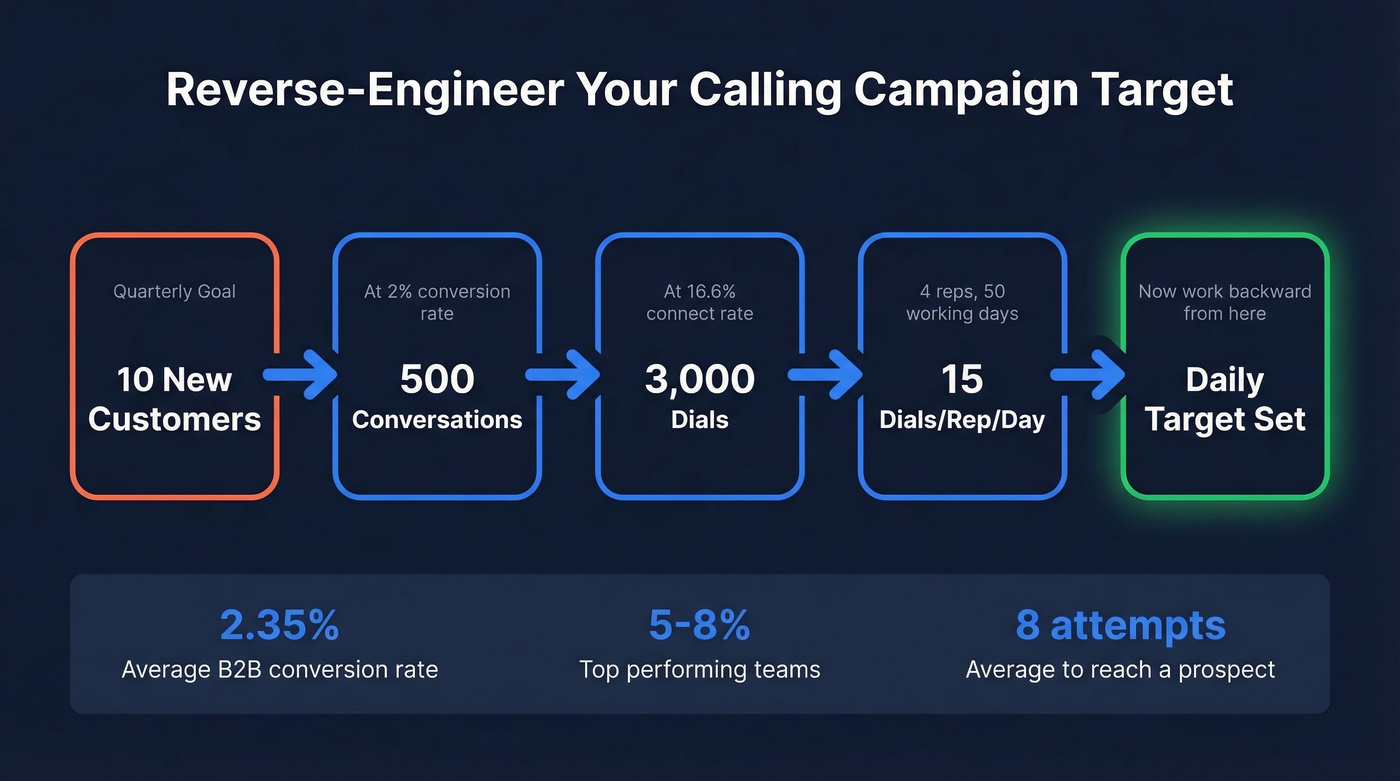
If you need 10 new customers this quarter and your conversion rate is 2%, that's 500 connected conversations. At a 16.6% connect rate, you need about 3,000 dials. Divide by reps, divide by working days, and you've got your daily dial target.
Build a List Worth Dialing
Here's the thing: 20-40% of numbers in purchased lists are wrong. Dead lines, switchboards, people who left the company six months ago. The most common complaint we see in SDR communities is that reps blame their scripts when the real problem is they're dialing into the void.
Two operational levers make an immediate difference. Ordering your list by propensity - most likely buyers first - lifts response rates by about 2%. Running a list audit before launch adds another 1.5%. Combined, that's a meaningful edge before a single rep picks up the phone.
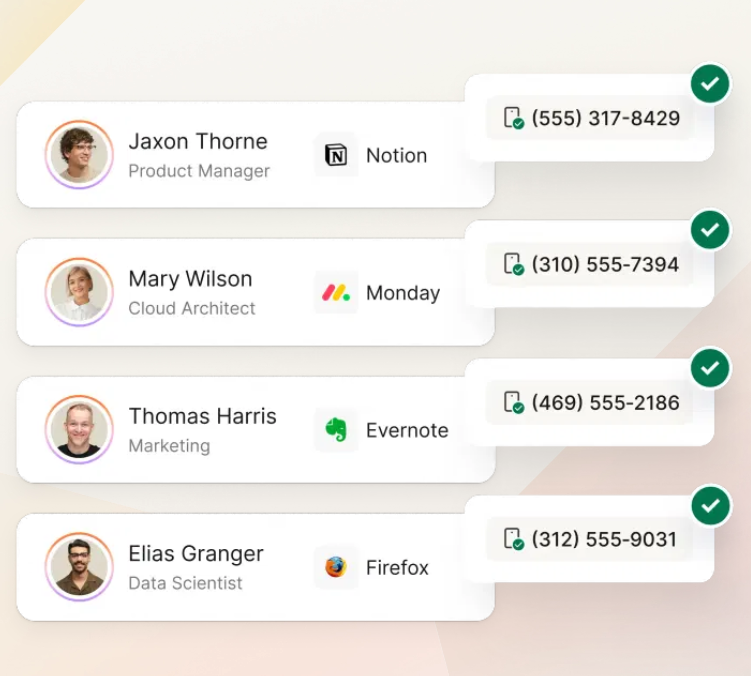
This is where your data source matters more than your dialer. Prospeo's mobile finder gives you 125M+ verified mobile numbers with a 30% pickup rate and a 7-day refresh cycle. That refresh matters - numbers go stale fast, and most providers only update every 4-6 weeks. Credit-based pricing starts free with no contracts, so you can test before committing.
Choose Your Dialer
Your dialer should match your team's volume and workflow:
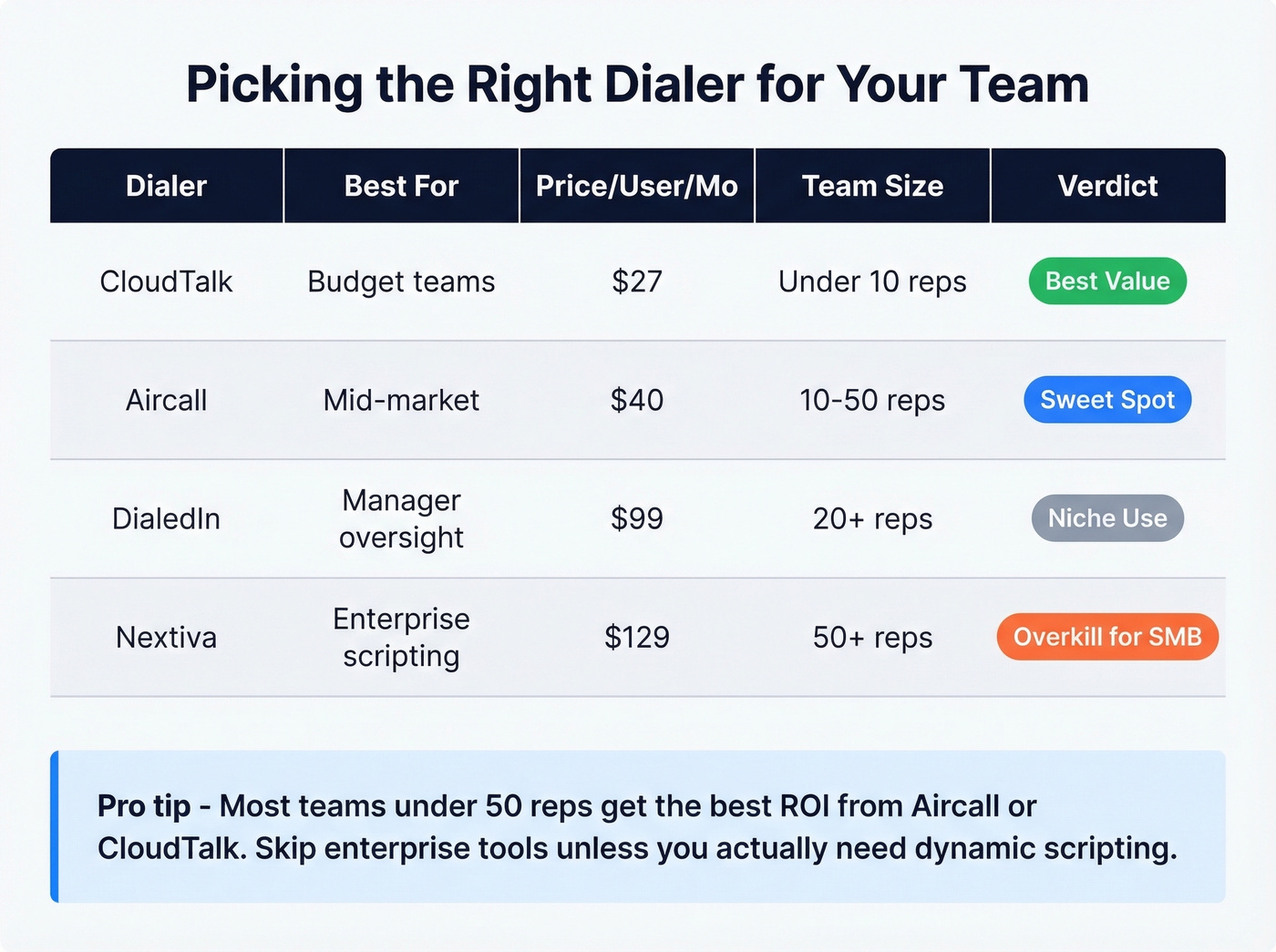
| Tool | Best For | Starting Price |
|---|---|---|
| CloudTalk | Budget teams | $27/user/mo |
| Aircall | Mid-market sweet spot | $40/user/mo |
| DialedIn | Manager oversight | $99/user/mo |
| Nextiva | Enterprise scripting | $129/user/mo |
CloudTalk is the best value for teams under 10 reps. Aircall hits the sweet spot for mid-market teams that want clean integrations without enterprise complexity. Nextiva makes sense if you need dynamic scripting and advanced call routing, but at $129/user/month, you're paying for features most SMB teams won't touch.
Skip DialedIn unless you specifically need granular supervisor controls - for most teams, it's overpriced for what it delivers.
Write Your Scripts
Scripts aren't about reading a teleprompter. They're a framework for the first 10 seconds, which is where most calls are won or lost.
Two opener frameworks show up consistently in cold-calling playbooks. The pattern interrupt ("How have you been?") shows a 6.6x higher success rate compared to standard intros. The reason statement ("The reason for my call is...") delivers a 2.1x lift. We'll cover full scripts you can steal in the next section.
Train, Launch, Optimize
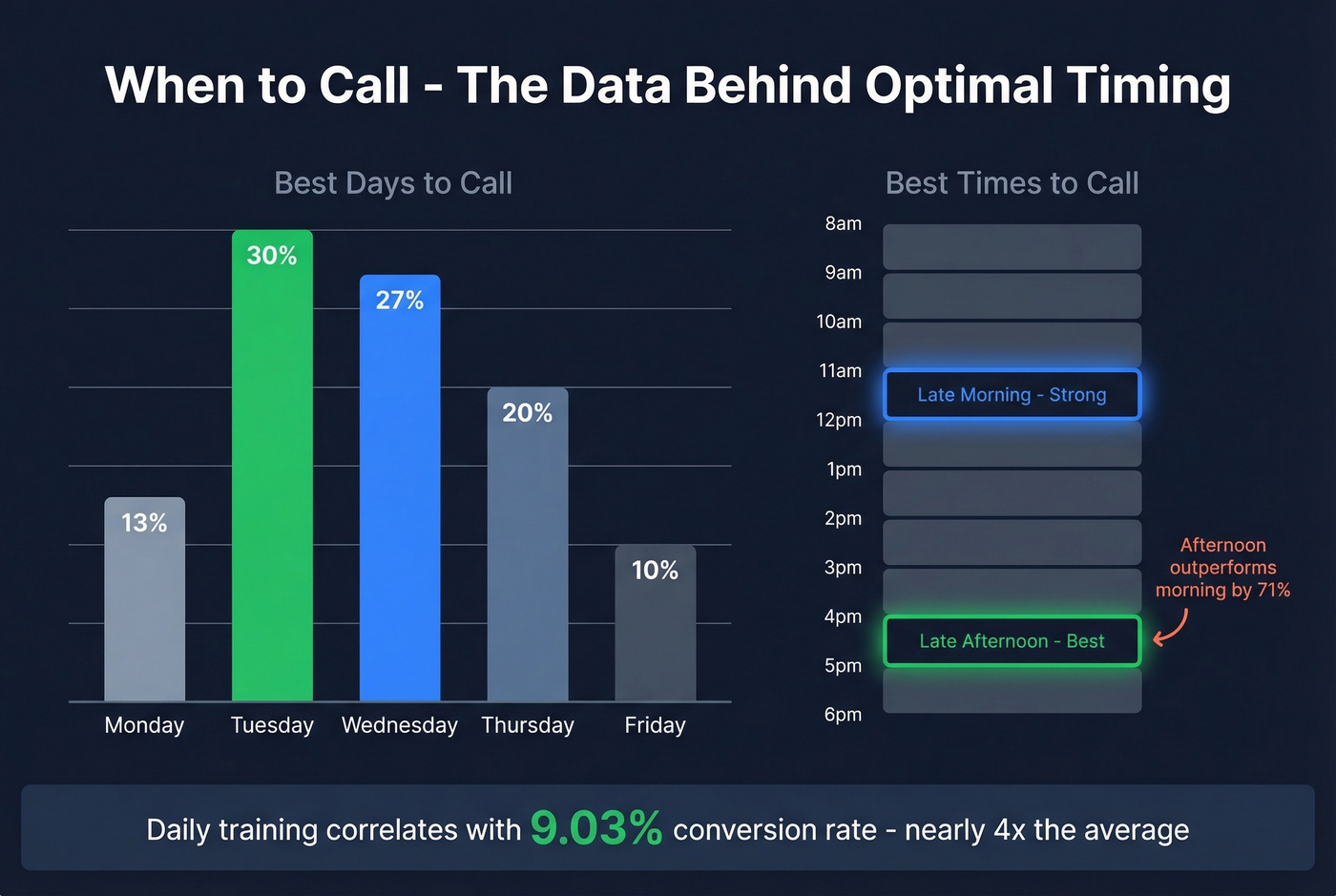
Daily training correlates with a 9.03% estimated conversion rate - nearly 4x the 2.35% average. That's not a typo. Even 15 minutes of call review and coaching each morning compounds fast.
A proven cadence baseline: 10-14 touches over 14-21 days, mixing calls, emails, and social touches. Don't run phone-only campaigns. They leave pipeline on the table.
Your launch checklist:
- Record every call for coaching, not surveillance. Log every call in your CRM automatically via dialer integration.
- Call between 11am-12pm and 4-5pm local time - the afternoon window outperforms the morning one by 71%.
- Prioritize Tuesday (30% of best outcomes) and Wednesday (27%).
- Review 3-5 calls per rep per week with specific feedback.
- Track connect rate, conversion rate, and average call duration daily.
- Voicemail strategy: When you hit voicemail, leave a 15-second message with your name, one sentence of value, and your number. Pre-recorded voicemail drops save reps 30+ minutes per day - most dialers support them.

Stop paying for bounced emails. Prospeo verifies every contact with 98% accuracy, refreshed every 7 days.
Start free and only pay for verified contacts
Cold Calling Scripts That Convert
Here are three scripts you can steal today. Adapt the value prop to your product - the structure is what matters.
Script 1: Permission/Time-Box Opener
"Hi [Name], this is [Your Name] with [Company]. In just three minutes, I can share how we help [role/industry] solve [specific problem]. Does that sound fair?"
This works because it respects the prospect's time and gives them an easy out - which paradoxically makes them more likely to stay on the line.
Script 2: Pattern Interrupt Opener
"Hi [Name], this is [Your Name]. How have you been?"
Pause. Let them respond. Then pivot: "The reason for my call - we work with [similar companies] who were dealing with [pain point]. I wanted to see if that's on your radar too." The pattern interrupt works best on prospects who've never heard of you. It breaks the "sales call" frame before it forms.
Script 3: Gatekeeper Transfer
"Hi, I'm trying to reach [Prospect Name] in [Department]. Could you transfer me, or would you have their direct line?"
Don't pitch the gatekeeper. Don't explain why you're calling. Just ask for the transfer.
When they say "I don't have time":
"Totally understand. Would Thursday at 2pm work for a quick 5-minute call?"
Always propose a specific time. "I'll call back later" is a dead end.
2026 Compliance Rules You Can't Ignore
TCPA litigation surged roughly 95% year-over-year, and the rules are getting more fragmented, not less.
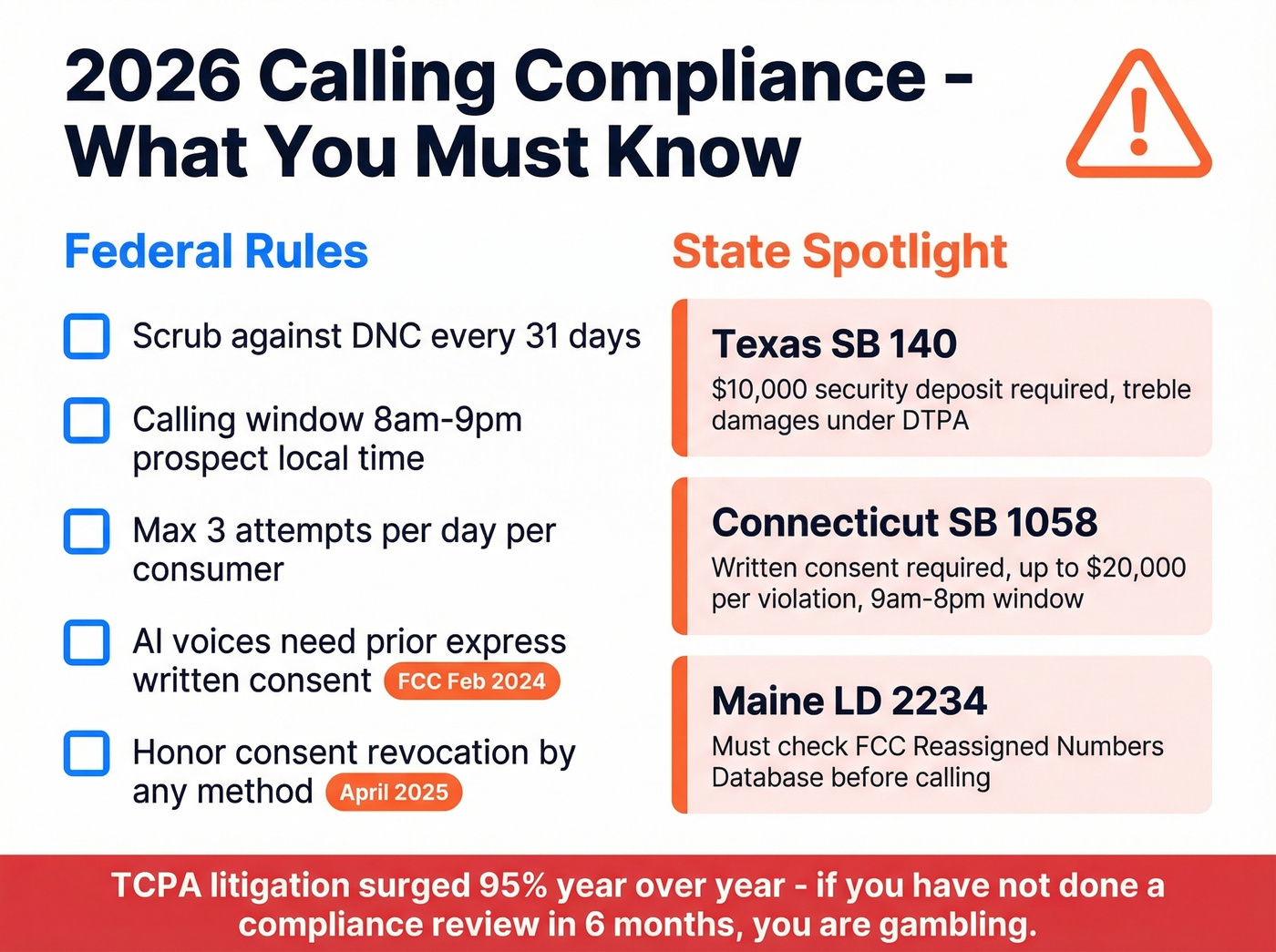
Federal rules:
- DNC scrubbing every 31 days - no exceptions. If you're scrubbing quarterly, you're exposed.
- Calling window: 8am-9pm local time for the prospect, not your office.
- Cap at 3 attempts per day per consumer.
- AI voice classification (FCC, Feb 2024): AI-generated voices count as "artificial/prerecorded" under TCPA. You need prior express written consent.
- Consent revocation (effective April 2025): Consumers can revoke consent by any reasonable method - "STOP," "unsubscribe," or even a verbal request on a call.
The McLaughlin v. McKesson ruling (June 2025) established that district courts aren't bound by FCC interpretations in civil TCPA cases, meaning enforcement varies by jurisdiction. As of early 2026, this ruling still stands.
State-level rules are tightening fast. Texas SB 140 requires a $10,000 security deposit and ties violations to the DTPA, including treble damages. Connecticut SB 1058 demands prior express written consent for any telephonic sales call, with penalties up to $20,000 per violation and a narrower 9am-8pm window. Maine LD 2234 requires checking the FCC Reassigned Numbers Database before initiating a sales call.
Real talk: if you're running calling campaigns without a compliance review in the last 6 months, you're gambling. The fines aren't theoretical anymore.
Why Calling Campaigns Fail
The data problem kills more campaigns than anything else. When 20-40% of your numbers are wrong, reps burn hours dialing dead lines. Stop obsessing over scripts. Start obsessing over your list. We've seen teams double their dial-to-connect ratio just by switching from purchased lists to verified mobiles with a weekly refresh cycle.
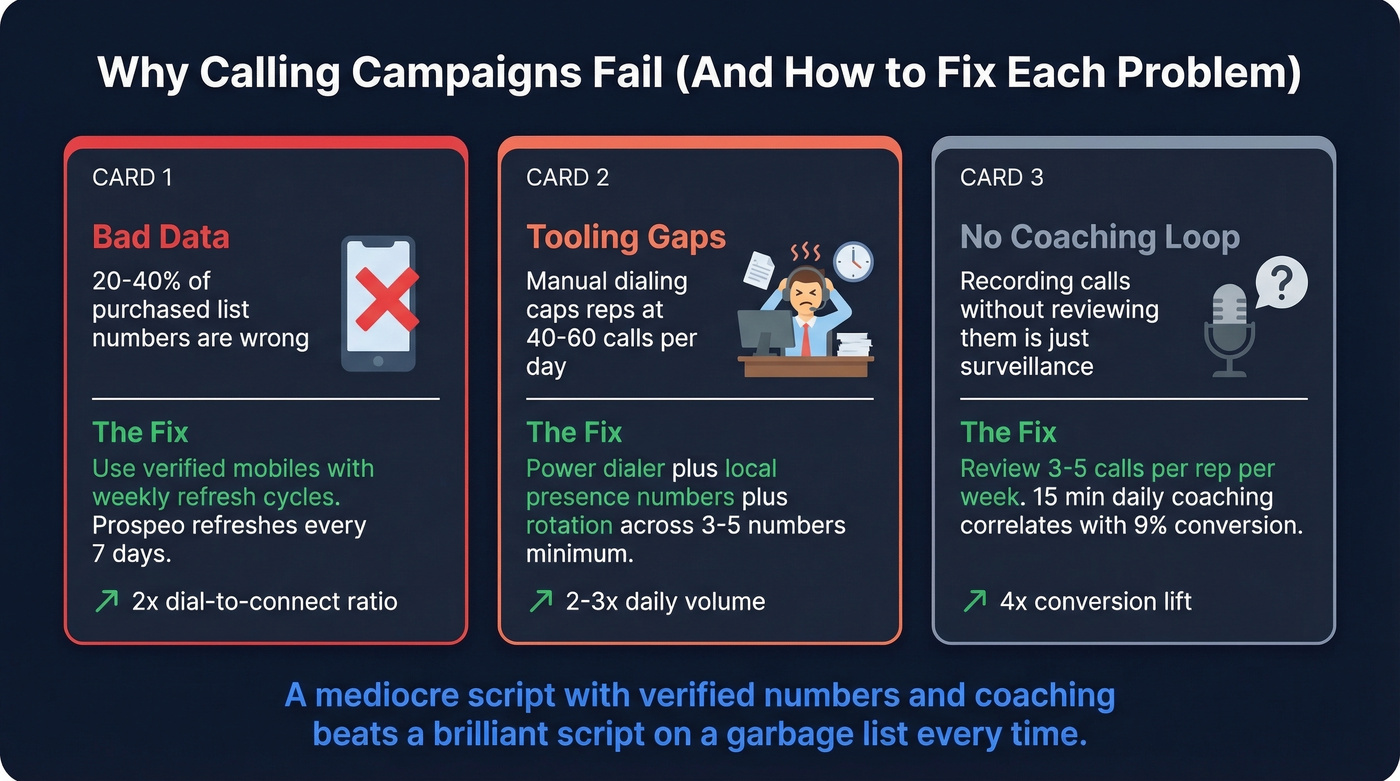
Tooling gaps compound the problem. Manual dialing kills rep energy and caps volume - there's no excuse for it in 2026. Beyond the dialer itself, you need local presence numbers because prospects don't pick up out-of-area calls, and number rotation across 3-5 numbers minimum. Dialing from the same number all day gets you flagged as spam.
Timing and coaching are the silent killers. Calling at 9am Monday is a waste. Tuesday and Wednesday, late morning and late afternoon, consistently win. But even perfect timing can't save a team without a coaching loop. Recording calls without reviewing them is just surveillance - build a weekly review cadence where you listen to 3-5 calls per rep and give specific, actionable feedback.
Look, most teams over-invest in scripts and under-invest in everything else. A mediocre script with verified numbers, proper timing, and consistent coaching will outperform a brilliant script dialed into a garbage list every single time. If your ACV is under $50k, the ROI on better data dwarfs the ROI on another script workshop. The consensus on r/sales backs this up - the top posts about cold calling almost always come back to list quality, not talk tracks.
Your outbound is only as good as your data. With 300M+ profiles and verified emails at ~$0.01 each, Prospeo keeps your pipeline full.
Try it free - no credit card required
Calling Campaign Benchmarks
Here are the numbers to measure yourself against in 2026:
| Metric | Benchmark |
|---|---|
| Connect rate | 16.6% |
| Conversion rate | 2.35% (top teams: 5-8%) |
| Attempts to reach | 8 |
| Avg live call duration | 93 seconds |
| Voicemail rate | 80% |
| Rep time actively selling | 33% |
Industry-specific conversion rates tell a sharper story:
| Industry | Conversion Rate | Calls to Close |
|---|---|---|
| Janitorial | 2.85% | ~35 |
| Business Services | 2.61% | ~38 |
| Technology/SaaS | 0.95% | ~105 |
| Industrial Equipment | 0.88% | ~114 |
If you're in SaaS, plan for 100+ dials per closed deal. That's not discouraging - it's the math you need to staff and budget correctly. Use these benchmarks to audit your own calling campaigns and find where the biggest gaps live.
FAQ
How many calls does it take to close a sale?
On average, 43 calls per sale at a 2.35% conversion rate. Enterprise deals over $1M require 85+ calls. SaaS teams average 105 calls per close. Work backward from your quarterly revenue goal to set daily dial targets.
What's a good connect rate for a cold calling campaign?
The 2026 benchmark is 16.6%. If you're below 10%, your data quality is the bottleneck. Verified mobile numbers consistently outperform generic office lines, and upgrading your data source is the fastest way to move this metric.
Do I need a dialer for calling campaigns?
Yes. Manual dialing caps most reps at 40-60 calls per day. A power dialer doubles or triples that. CloudTalk starts at $27/month - match dialer type to your needs: focus dialers for high-touch enterprise, power dialers for volume.