

5 Challenger Sales Model Examples With Dialogue You Can Actually Use
Your VP just announced the team is adopting Challenger. The training deck had frameworks, quadrants, and profile percentages - but zero scripts. So you went looking for challenger sales model examples and found ten articles that relabel the framework steps as examples without showing a single conversation.
Here's the thing: Challenger is an organizational strategy disguised as a sales book. It only works when you see it in action, hear the words, and understand why each beat matters. Below are five conversations you can model today.
The Framework in 60 Seconds
Dixon and Adamson's CEB research (now Gartner) studied 6,000+ reps. Managers assessed each rep on 44 attributes and skills to derive five seller profiles:
| Profile | % of All Reps | % of High Performers |
|---|---|---|
| Challenger | 27% | ~40% |
| Hard Worker | 21% | Not broken out |
| Relationship Builder | 21% | 7% (dead last) |
| Lone Wolf | 18% | Not broken out |
| Problem Solver | 14% | Not broken out |
53% of customer loyalty comes from the sales experience itself - not brand, product, or price. That single stat explains why Challenger works.
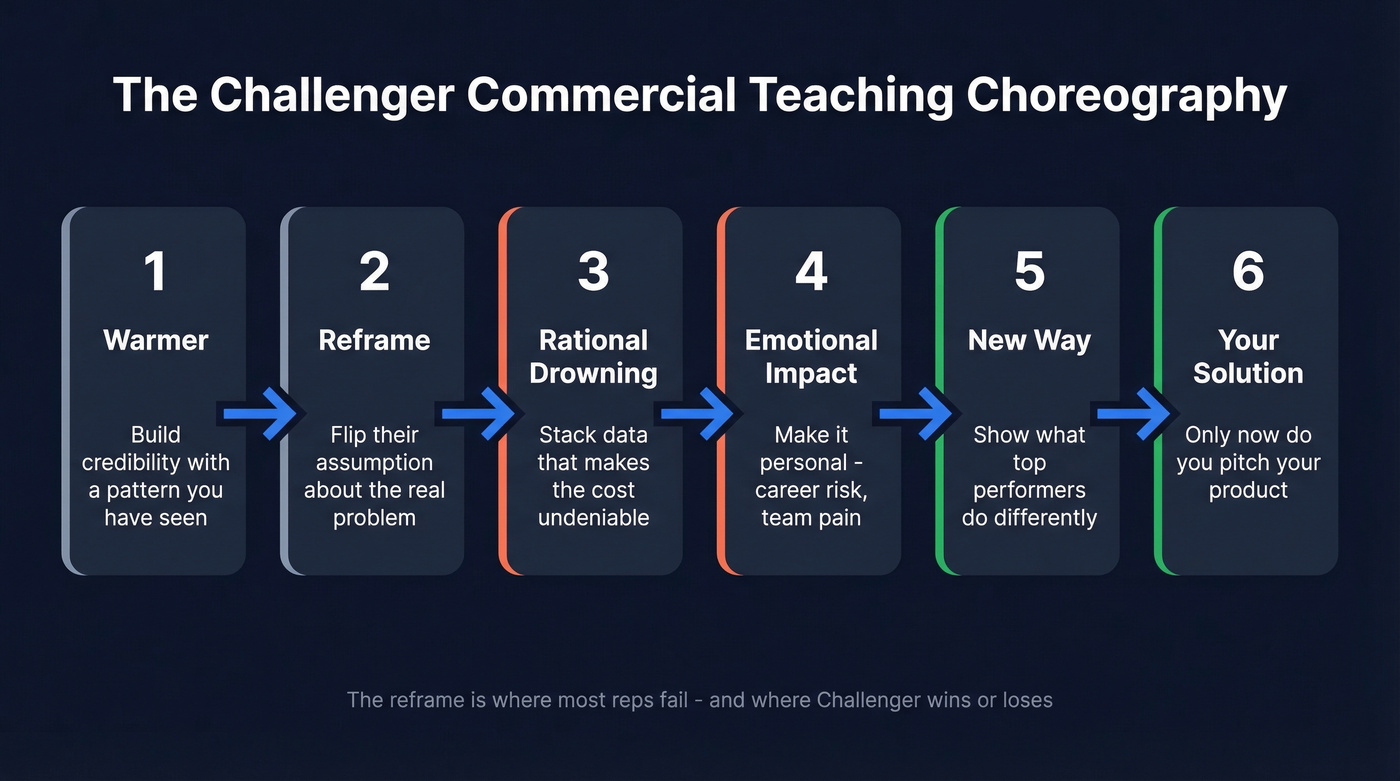
You'll see the process described in a few different ways, but the most useful "Commercial Teaching" version breaks into a 6-step choreography:
- Warmer
- Reframe
- Rational Drowning
- Emotional Impact
- New Way
- Your Solution
Challenger Inc.'s own case studies include rollouts at Flowserve, Leybold, and Franke Foodservice Solutions. Now let's hear what it actually sounds like.
Five Real Dialogue Examples
1. Marketing Automation - CMO
Full choreography. You're selling a marketing analytics platform to a CMO who thinks the problem is lead volume.
Warmer: "We work with 200+ B2B marketing teams. The pattern that keeps surfacing is that the teams generating the most leads often have the worst ROI visibility."
Reframe: "Most CMOs believe their biggest problem is lead gen. It's actually attribution - you can't tell which channels drive revenue."
Rational Drowning: "Research shows 72% of marketing budgets are misallocated because of poor attribution. At your company's spend level, that's likely $500K+ per year flowing to low-ROI channels."
Emotional Impact: "When your CEO asks 'What's our marketing ROI?' and you can't answer with hard numbers, that's not a reporting gap. That's a career risk."
New Way: "Top-performing CMOs use multi-touch attribution to track every dollar and reallocate budget monthly based on actual ROI - not gut feel."
Solution: "Our platform gives you full attribution visibility across every channel, updated in real time."
The rep never asked "What keeps you up at night?" They told the CMO what should keep them up. That inversion is the whole game.
2. Retail Workforce Analytics - Operations Leader
Emma sells workforce analytics to a retail ops leader fixated on controlling overtime costs. She agrees overtime matters - then pivots.
"I hear you on overtime. But here's what the data shows: your stores are routinely understaffed during peak hours, costing you roughly $150,000 a year in missed revenue from poor shift coverage. This isn't a cost problem - it's a revenue problem tied directly to your same-store sales goals."
The new way? Predictive scheduling that uses historical sales data to anticipate foot traffic and optimize shifts before the week starts. The pitch happens after the buyer is already leaning forward.
3. Logistics Software - CFO vs. Head of Ops
This is where Tailoring earns its keep. Same insight, two buyers.
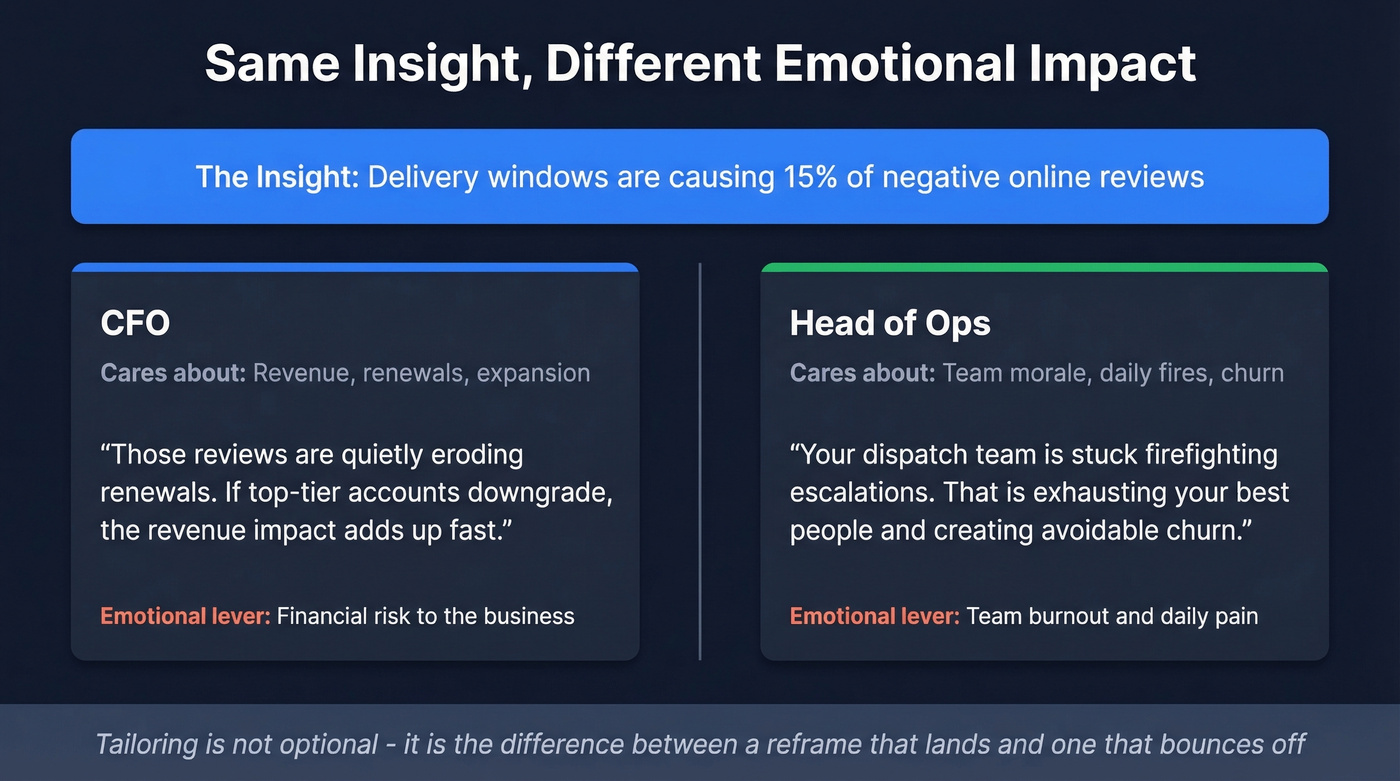
The insight: current delivery windows are directly causing 15% of negative online reviews. The customer never connected delivery speed to review scores.
To the CFO: "Those reviews are quietly eroding renewals and expansion. If even a handful of top-tier accounts downgrade because of delivery complaints, the revenue impact adds up fast."
To the Head of Ops: "Your dispatch team is stuck firefighting escalations because the system can't flex around real-time conditions. That's exhausting your best people and creating avoidable customer churn."
Same data. Different emotional impact. We've watched reps deliver the CFO version to an ops leader and get blank stares - tailoring isn't optional. It's the difference between a reframe that lands and one that bounces off.
4. SaaS Session Replay - E-Commerce Buyer
A session replay product captures everything on a website while competitors only sample.
Teach: "Your current tool only captures a small sample of sessions. That means a huge chunk of user behavior - including checkout payment failures - is invisible."
Tailor: "If you're doing $40M annually, recovering even 0.5% of annual revenue through checkout fixes is $200K. You can't fix what you can't see."
Take Control: "There's a measurable gap between your checkout conversion and where it should be. Let me show you exactly what's happening in the sessions your current tool misses."
The buyer didn't know they had a problem. That's the entire point.
5. Healthcare - Provider With Limited Access
Healthcare is a brutal test for the Challenger methodology. 61% of providers now prefer virtual meetings, and if a rep doesn't bring tangible value, there's no second call.
A Challenger rep selling a patient throughput solution doesn't lead with software capabilities. They lead with a commercial insight about workflow: where bottlenecks typically form, what top-performing sites do differently, and which sequencing changes usually reduce delays without simply "adding staff." That's an insight the provider can use whether they buy or not.
Which is exactly why they'll take the next meeting.

A Challenger reframe only works when you reach the right buyer. Prospeo gives you 300M+ profiles with 30+ filters - buyer intent, job changes, technographics - so you can tailor your commercial teaching to the exact persona. 98% email accuracy means your insight lands in their inbox, not a bounce folder.
Build the list your Challenger pitch deserves.
Reframe Templates You Can Steal
Four fill-in-the-blank formulas that work in any industry:
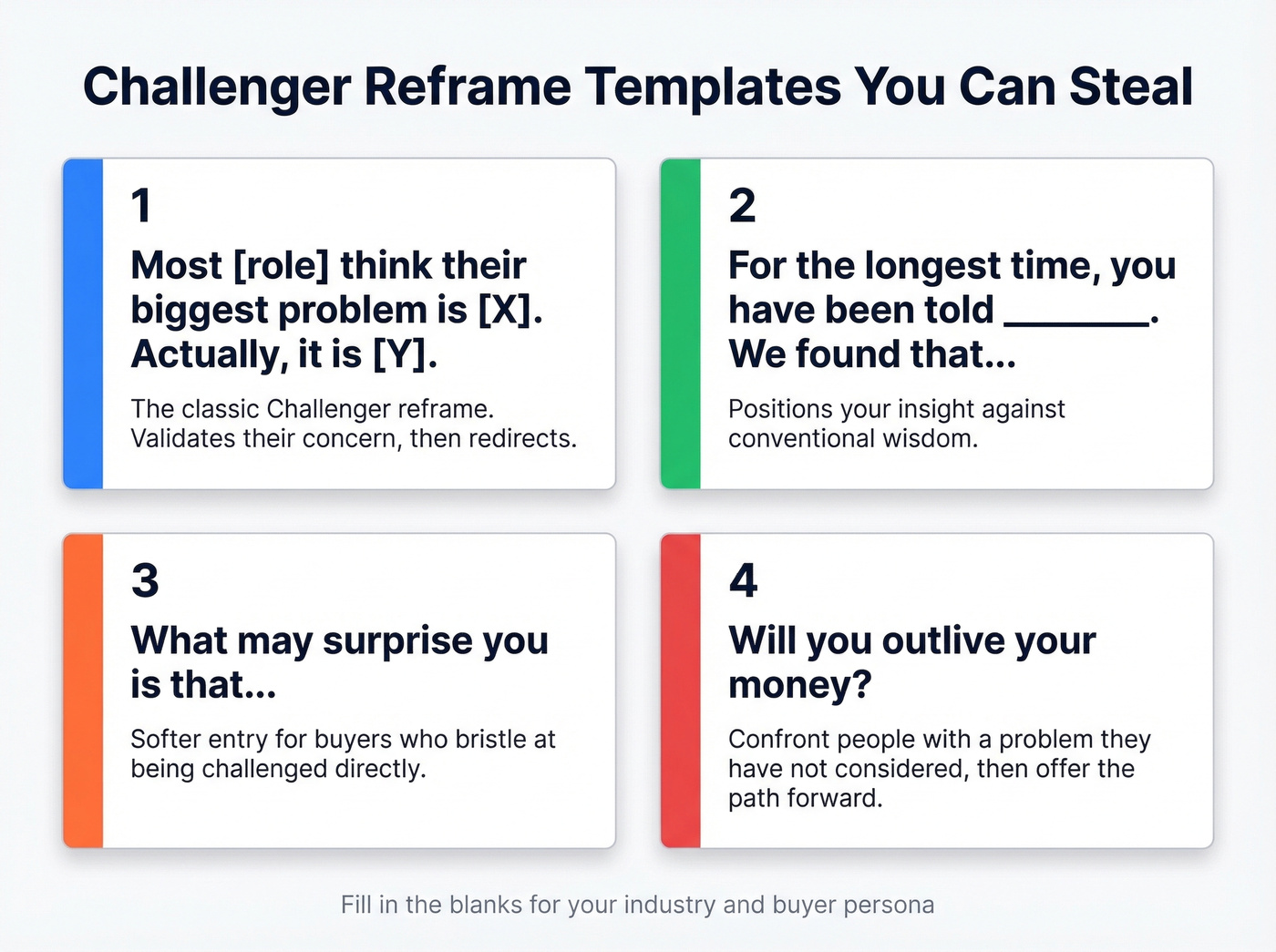
- "Most [role] think their biggest problem is [X]. Actually, it's [Y]." - The classic Challenger reframe. Validates their concern, then redirects.
- "For the longest time, you've been told ____. We found that..." - Positions your insight against conventional wisdom.
- "What may surprise you is that..." - Softer entry for buyers who bristle at being challenged directly.
- "Will you outlive your money?" - Ameriprise ran this as a billboard. Pure Challenger: confront people with a problem they haven't considered, then offer the path forward.
When the Challenger Approach Fails
One Reddit sales leader with 15+ years of experience put it bluntly: "You need the whole organization pooling together to transform value proposition to include Challenger Reframe, Commercial Teaching, or even to answer the question 'why would they buy from us over anyone else'?"
The consensus on r/sales is pretty consistent: Challenger is powerful but fragile. Three conditions where it falls apart:
Lone-rep execution. Commercial insights require marketing, enablement, and product working together. One rep can't manufacture industry-shifting data on their own.
Junior reps without industry expertise. Knowing the customer's business better than they do isn't feasible six months into your career. Skip the full choreography until you've logged enough conversations to have a genuine point of view.
Aggression without finesse. The line between "challenging" and "condescending" is razor-thin. In our experience, the reframe is where most untrained reps blow it - they push too hard before earning the right to push at all.
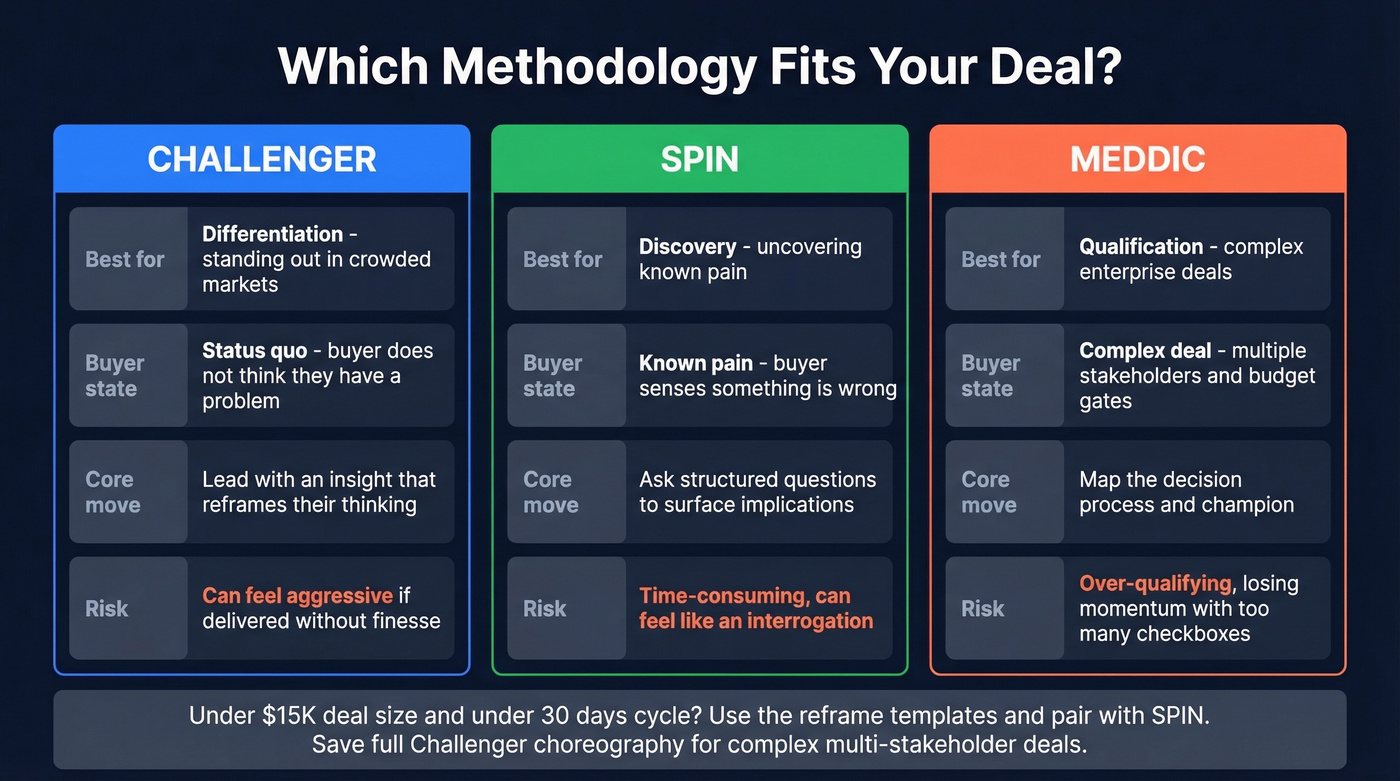
| Challenger | SPIN | MEDDIC | |
|---|---|---|---|
| Best for | Differentiation | Discovery | Qualification |
| Buyer state | Status quo | Known pain | Complex deal |
| Risk | Feels aggressive | Time-consuming | Over-qualifying |
Let's be honest: if your deal size is under $15K and your sales cycle wraps in under 30 days, you probably don't need full Challenger choreography. Use the reframe templates above and pair them with SPIN for discovery. Save the full 6-step production for complex, multi-stakeholder deals where status quo is the real competitor.
The Research Step Nobody Talks About
The warm-up phase is where Challenger attempts die. Every example above required the rep to walk in with industry-specific data, role-relevant KPIs, and a credible point of view. B2B buyers spend only 5-6% of their total decision time with any one supplier - so your window is tiny.
That preparation needs current, accurate data. Prospeo covers 300M+ professional profiles with 98% email accuracy and intent data across 15,000 topics, so you can identify which accounts are actively researching solutions and craft a relevant reframe before the first call. When you're building a reframe around a prospect's current tech stack or recent funding round, a 7-day data refresh beats stale CRM records every time.
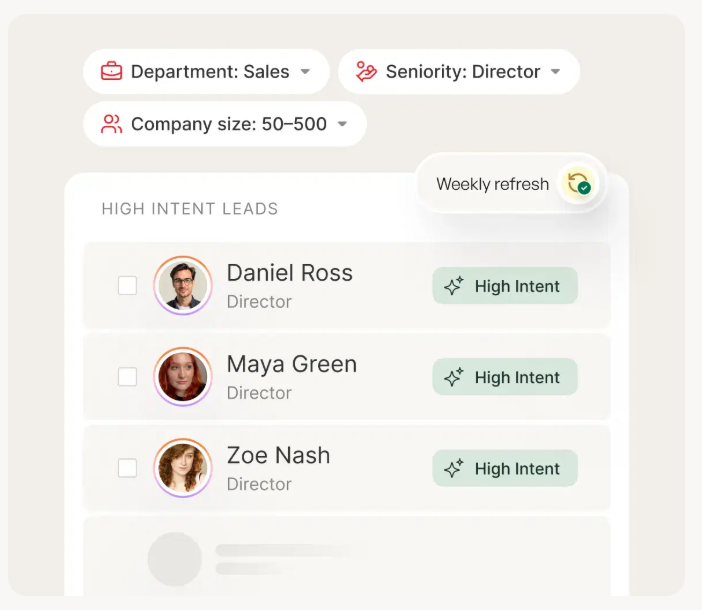
Example #3 showed why tailoring to CFOs vs. Ops leaders changes everything. Prospeo's database lets you filter by job title, department headcount, and company revenue so you prep the right reframe for the right stakeholder - with verified direct dials (125M+ mobiles, 30% pickup rate) to skip the gatekeeper entirely.
Stop pitching the CFO version to the ops leader.
FAQ
What's the difference between Challenger and SPIN Selling?
SPIN uncovers pain the buyer already knows about through structured questions. Challenger leads with insights about problems the buyer hasn't identified yet. Use SPIN to diagnose known issues; use Challenger to prescribe a new way of thinking - especially in deals where the status quo is the real competitor.
Can individual reps use Challenger without org-wide buy-in?
Yes, partially. The reframe templates and teach-tailor-take-control behaviors work solo - expect roughly 15-20% improvement in deal progression. But developing genuine commercial insights at scale typically requires marketing and enablement support to produce industry-specific research.
How do you research prospects before a Challenger conversation?
You need verified contact data, company context, and intent signals to craft a credible reframe. Prospeo surfaces which accounts are actively researching relevant topics across 15,000 intent categories and provides verified emails refreshed every 7 days - so your warm-up phase runs on current intelligence, not stale records.
Does the Challenger methodology work for small deal sizes?
For deals under $10K with short cycles, the full 6-step choreography is overkill. Instead, use the reframe and commercial teaching elements selectively - lead with one sharp insight, skip the extended rational drowning phase, and move to your solution faster. Reserve the complete choreography for complex, multi-stakeholder opportunities.