

How to Check Email Availability - And What Your Results Actually Mean
What happens when your "verified" contact list bounces 23% on the first sequence? You stop trusting the tool, then start searching for alternatives. Email lists decay at roughly 21% per year - about 1.75% per month evaporating - and most teams don't catch it until their sender reputation tanks and they're paying to send emails that never arrive. Knowing how to check email availability properly is what separates teams that book meetings from teams that burn domains.
Two Meanings of "Email Availability"
The first group searching this phrase - mostly sales, marketing, and RevOps teams - wants to confirm a prospect's email is deliverable before launching a campaign. The second group wants to know if a specific username like firstname.lastname@gmail.com is already taken so they can register it.
These are fundamentally different problems. An r/OSINT thread captures it well: a user asked for a tool to check email address availability across Gmail, Outlook, and Hotmail simultaneously. That's a registration problem. If your cold email bounce rate just spiked, you've got a deliverability problem, and every bounced email is wasted spend on a contact who was never going to see your message. Let's tackle deliverability first.
How Email Verification Works
Most people conflate validation with verification. Validation checks whether an email looks right. Verification checks whether it works. Here's the pipeline:
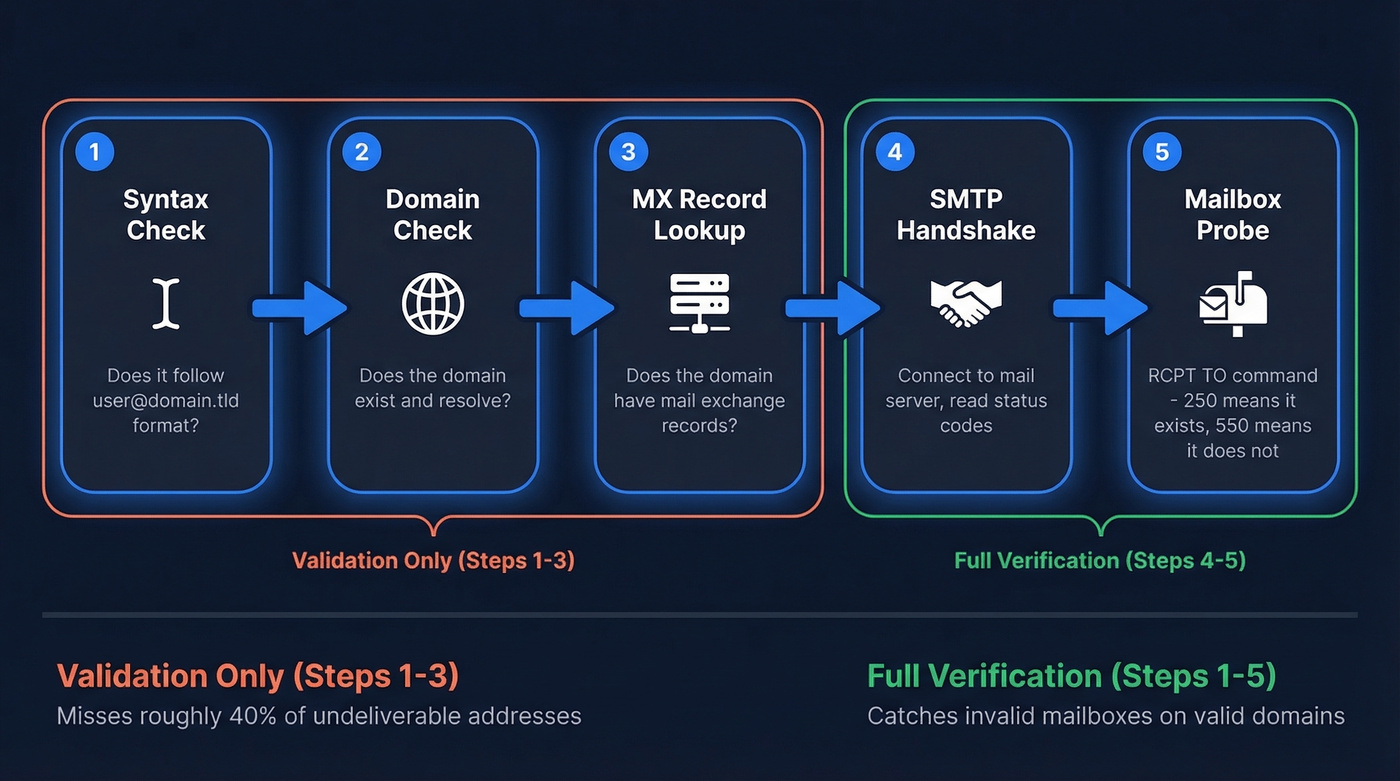
- Syntax check - Does the format follow
user@domain.tld? - Domain check - Does the domain exist and resolve?
- MX record lookup - Does the domain have mail exchange records?
- SMTP handshake - Connect to the mail server; it responds with status codes.
- Mailbox probe - Issue an RCPT TO command. A 250 response means the mailbox exists; 550 means it doesn't.
Validation alone (steps 1-3) misses undeliverable addresses on valid domains. nonexistent@valid-domain.com passes validation - the domain's real, MX records check out - but the mailbox doesn't exist. That gap is where roughly 40% of undeliverable addresses hide. Reputable verification tools don't share the emails you check, and they typically don't store them beyond temporary logs needed for maintenance and abuse prevention.
Why Your Results Say "Unknown"
If you've run a list through a verifier and gotten 30% "unknown" results, you're not alone. Between 30-40% of B2B email addresses sit on catch-all domains.
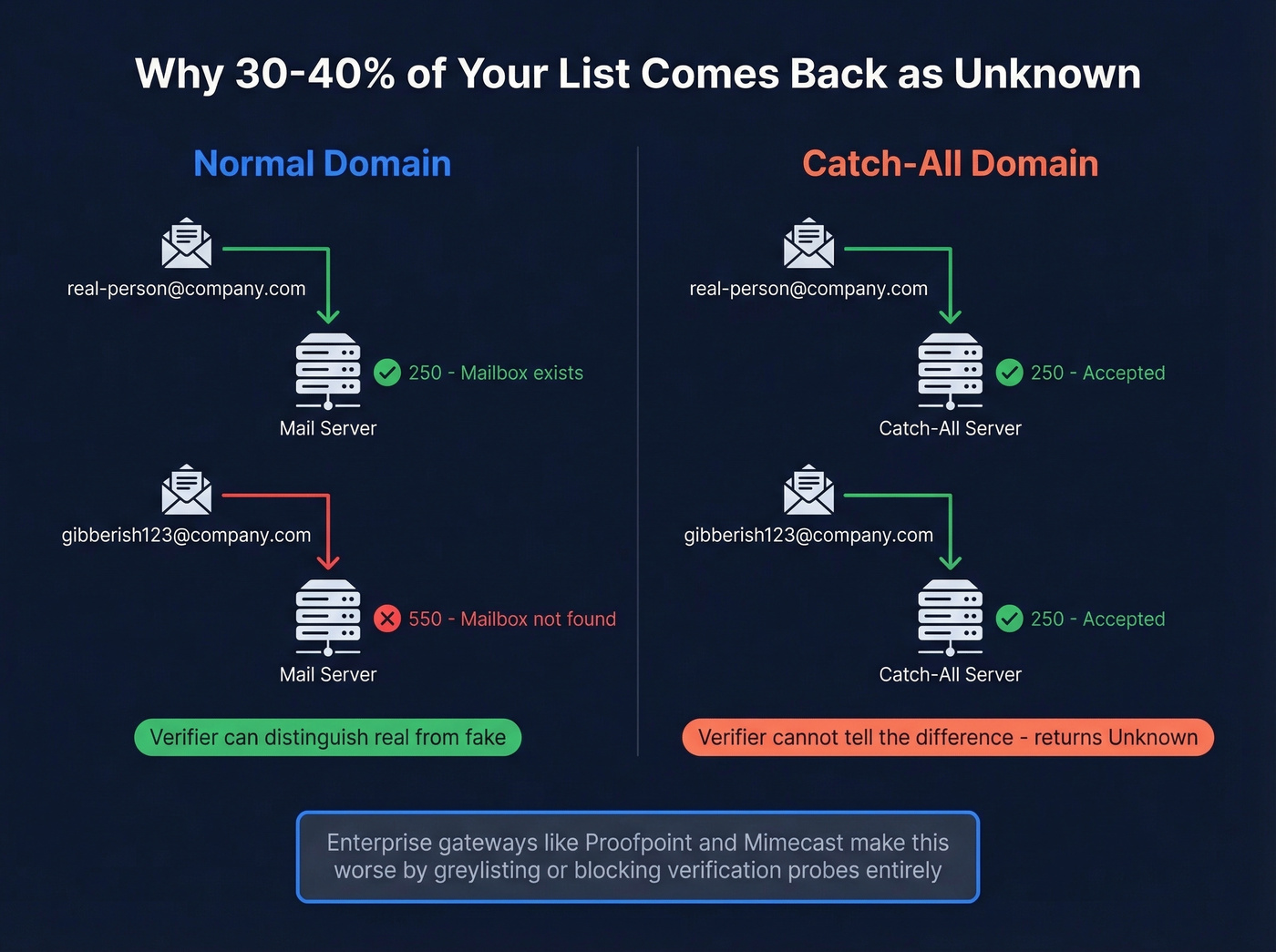
A catch-all server accepts mail sent to any address at that domain - real-person@company.com and gibberish123@company.com both get a 250 response. The verifier can't distinguish real from fake, so it returns "unknown." Enterprise Secure Email Gateways like Proofpoint and Mimecast make this worse by greylisting or blocking verification probes entirely.
The result? A third of your list in limbo. Send to all of them and risk your bounce rate. Skip them and leave pipeline on the table.
Here's what to look for in a catch-all verifier:
- Actionable verdicts (valid/invalid) instead of "unknown" labels
- Spam-trap and complainer risk signals
- API latency under 3 seconds per check
- Pricing that supports frequent re-verification

Most verification tools punt on catch-all domains and leave 30-40% of your list as "unknown." Prospeo's 5-step verification pipeline resolves catch-all addresses by default - no upsell, no guesswork. 98% accuracy, spam-trap removal, and honeypot filtering built in. Start with 75 free verifications.
Check email availability against mailbox states refreshed every 7 days, not 6 weeks.
Best Tools to Check Email Availability (2026)
The industry benchmark: keep total bounces below 2% and hard bounces under 1%. A widely cited benchmark ran multiple tools against a 10,000-email dataset - 42% corporate, 28% catch-all, 15% known invalid - within a 48-hour window. Here's how they stack up.
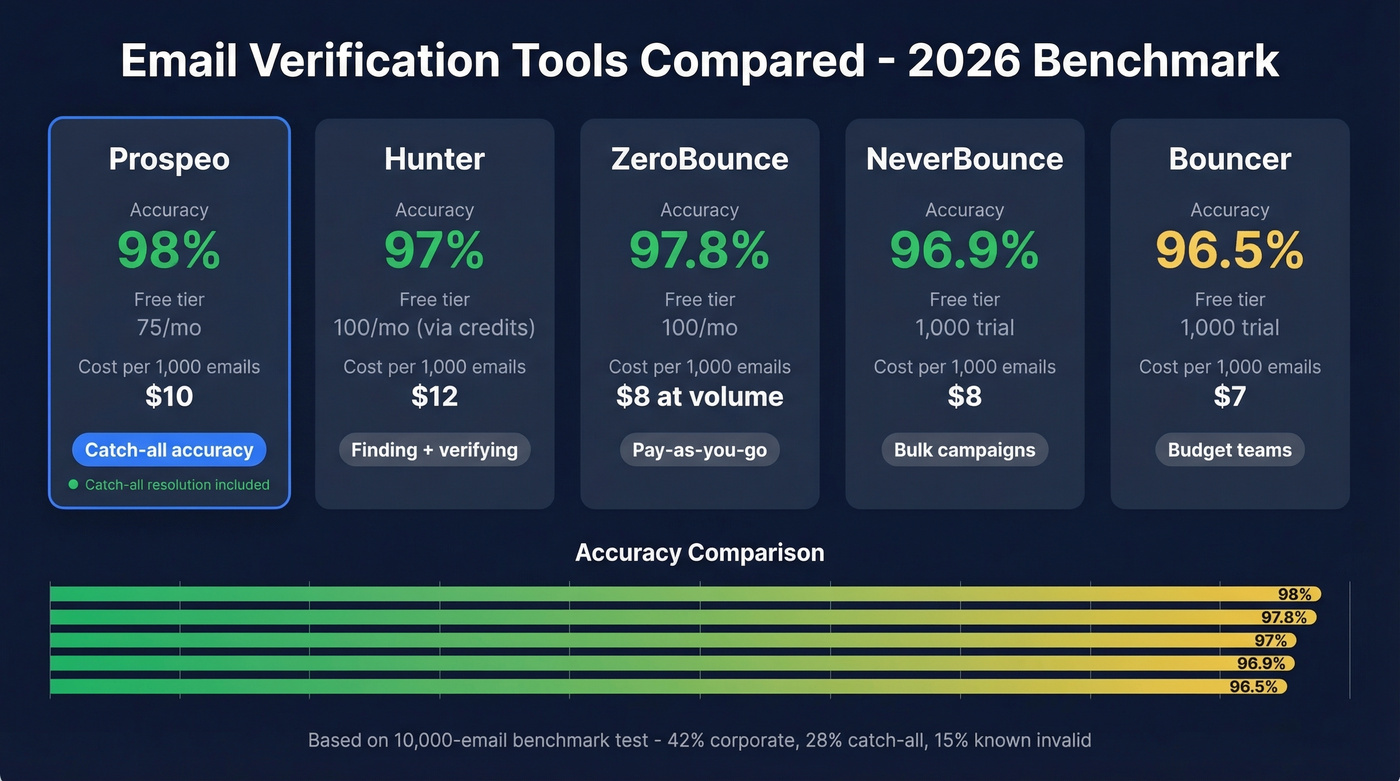
| Tool | Accuracy | Free Tier | Cost/1K | Best For |
|---|---|---|---|---|
| Prospeo | 98% | 75/mo | ~$10 | Catch-all accuracy |
| Hunter | ~97% | 100/mo (via credits) | ~$12 | Finding + verifying |
| ZeroBounce | 97.8% | 100/mo | ~$8/1K at volume | Pay-as-you-go |
| NeverBounce | 96.9% | 1,000 trial | ~$8 | Bulk campaigns |
| Bouncer | 96.5% | 1,000 trial | ~$7 | Budget teams |

Prospeo
Prospeo runs a proprietary 5-step verification pipeline across 143M+ verified emails, and catch-all resolution comes standard rather than as an upsell. The 98% accuracy rate comes from infrastructure built in-house - no reliance on third-party email providers - with spam-trap removal and honeypot filtering baked in. Data refreshes on a 7-day cycle (the industry average sits around 6 weeks), so you're verifying against current mailbox states rather than stale records.
The free tier gives you 75 verifications per month, enough to test on a real segment before committing. Paid plans run about $0.01 per email with no annual contracts. Upload a CSV, get results in minutes, push verified contacts straight to Smartlead, Instantly, or Lemlist. We've seen teams cut bounce rates from 35%+ down to under 4% within the first month of switching - Meritt, for example, tripled their pipeline from $100K to $300K per week after making that switch, largely because their emails were actually landing.
Hunter
The pitch: find an email and verify it in one workflow. The free plan gives you 50 credits per month - verification costs 0.5 credits each, so that's 100 free verifications. Starter runs $49/mo for 4,000 verifications.

Hunter flags catch-all addresses, but you can still end up with a chunk of "accept all" results requiring judgment calls. If you need email finding and basic verification in one tool and your lists aren't heavy on catch-all domains, Hunter's a solid choice. Skip it if catch-all domains are eating your list - you'll spend more time manually sorting "accept all" results than you save.
ZeroBounce
In the 10,000-email benchmark, ZeroBounce hit 97.8% accuracy. The free tier stands out: 100 validations per month, credits that never expire, and unknown results don't cost you anything. That last detail matters - you're not paying for the tool's uncertainty.
Pricing starts around $8 per 1,000 emails at volume. The AI scoring feature adds engagement prediction at 1 credit per email. In our testing, ZeroBounce's pay-as-you-go flexibility makes it the best option for teams that verify in bursts rather than on a fixed schedule. If your outbound cadence is irregular - say, agency teams spinning up new client campaigns every few weeks - the no-expiry credits are genuinely useful.
NeverBounce
Best for high-volume bulk campaigns where cost matters more than squeezing out the last percentage point of accuracy. Skip this if you're running smaller, high-value lists where every bounce counts.
One 2026 comparison test reports 94% catch-all detection accuracy across a 47,000-email test - one of the stronger catch-all numbers in the space. Overall accuracy in the 10,000-email benchmark landed at 96.9%. Pricing runs $8 per 1,000 with 1,000 free credits on signup.
Bouncer
Bouncer is the budget pick. At $7 per 1,000 emails with 1,000 free credits to start, it's the cheapest option on this list. Accuracy tested at 96.5% in the benchmark - solid, not spectacular. Catch-all handling is limited. For teams running large lists where a few percentage points of accuracy matter less than cost per thousand, Bouncer gets the job done.
Quick Mentions
Verifalia runs a 30+ step verification process with "stealth verification" that minimizes detection by aggressive mail servers. Roughly $0.01-0.02 per email.
Email Hippo offers 100 free checks per day for quick one-off lookups. Enterprise plans run above the $10/1K range typical of this category.
Mailmeteor gives you 50 free verifications per month via a Google Sheets add-on. Paid plans start around $10/mo if you need more volume.
How to Read Your Results
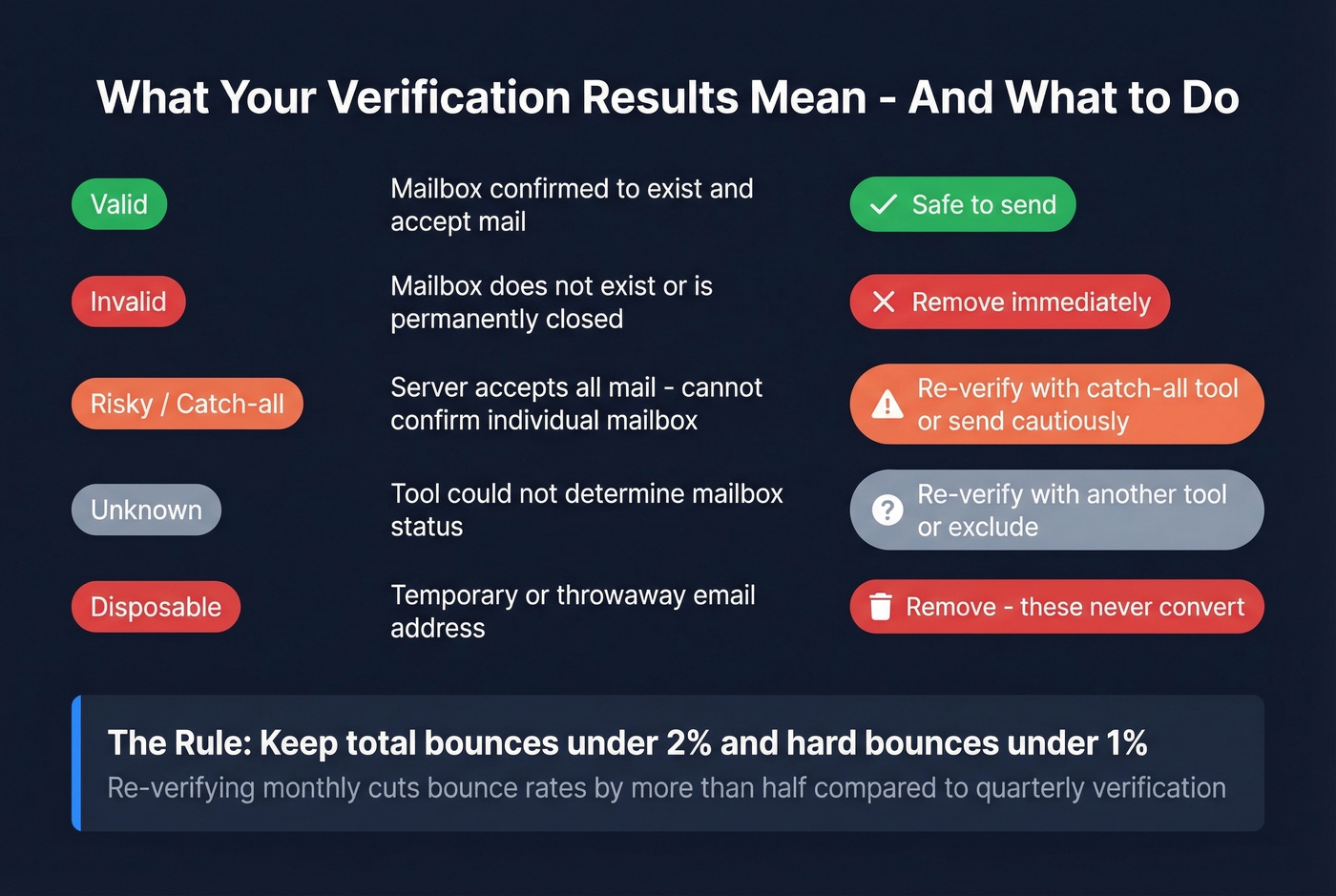
Not all verification statuses mean the same thing, and misreading them is one of the fastest ways to tank a campaign or throw away good leads.
| Status | Meaning | Action |
|---|---|---|
| Valid | Mailbox confirmed | Safe to send |
| Invalid | Mailbox doesn't exist | Remove immediately |
| Risky/Catch-all | Server accepts all mail | Re-verify with catch-all tool or send cautiously |
| Unknown | Tool couldn't determine | Re-verify or exclude |
| Disposable | Temporary address | Remove |
The operational rule: keep total bounces under 2% and hard bounces under 1%. One bad campaign can tank deliverability for weeks. In our experience, re-verifying monthly cuts bounce rates by more than half compared to quarterly verification. It's always cheaper to re-verify than to rebuild sender reputation.
Here's the thing - if your deals typically close under $15K, you probably don't need the most expensive verification tool on the market. A $7-10/1K verifier with 96%+ accuracy will keep your bounce rate in check. Save the premium budget for the data that actually finds the right prospects.
How to Check if an Email Is Available as a Username
Gmail has 1.8B+ active users. When you type a username during signup and get an instant "taken" response, that's not a database query - it's a Bloom filter. Bloom filters operate in O(1) time with no false negatives but possible false positives, meaning the system might say "taken" when it technically isn't.
There's no public API for this. Third-party tools hit rate limits and CAPTCHAs almost immediately. The most reliable method to check if an email address is available for registration is the boring one: go to the provider's signup page and try it. Takes 30 seconds.
Meritt cut their bounce rate from 35% to under 4% and tripled pipeline to $300K/week - because their emails were actually landing. Prospeo's proprietary infrastructure verifies 143M+ emails at $0.01 each with no annual contracts. Upload a CSV, get results in minutes, push clean contacts to your sequencer.
Every bounced email burns your domain. Fix it for a penny per address.
FAQ
Is there a free way to verify if an email exists?
Yes. Hunter offers 100 free verifications per month via credits, ZeroBounce gives 100 free monthly credits that never expire, and Prospeo includes 75 free verifications monthly with full catch-all handling. All are enough to test on a real list segment before committing.
What does "catch-all" mean in verification results?
The recipient's mail server accepts all incoming emails regardless of whether the specific mailbox exists. Standard SMTP checks can't confirm the address is real, so tools return "unknown." Specialized catch-all verifiers use additional signals to resolve these into actionable valid/invalid verdicts.
How do I check email availability for a new account?
For Gmail, Outlook, or any other provider, the signup page is your most reliable option. Type your desired username and the form will instantly tell you whether it's taken. No third-party tool can do this more accurately because providers block automated lookups with rate limits and CAPTCHAs.
How accurate are free email checkers?
Most free tools run syntax and MX checks only - validation, not verification. Dedicated tools with SMTP-level checks score 96-98% accuracy in benchmark tests. The gap between validation and full mailbox verification is where your bounces live.
How often should I re-verify my email list?
Before every major campaign at minimum. Lists decay at roughly 1.75% per month, so teams running weekly outbound should verify monthly. Tools priced around $0.01/email make frequent re-verification economically viable - far cheaper than rebuilding a burned sender domain.