

How to Check If an Email Account Exists Without Sending an Email
You uploaded a prospect list last Tuesday, fired off a sequence, and 15% bounced. Your ESP flagged the domain. Now you're scrambling to rebuild sender reputation that took six months to earn.
That's the reality of sending to unverified addresses. Email lists decay at roughly 25% per year, and the industry rule is simple: keep total bounces below 2%. Global inbox placement sat around 83.5% in 2024, and it hasn't gotten easier since. Verification is how you stay on the right side of that number - every time, no exceptions.
What You Need (Quick Version)
- Spot-check a single email for free: ZeroBounce gives you 100 free monthly credits. Hunter's verifier also offers up to 100 free verifications per month.
- Bulk-verify an existing list: Bouncer at $7/1K emails or NeverBounce at $8/1K will clean a CSV fast.
Never Send a Test Email
Here's the thing: sending a "test" email to see if an address exists is the worst approach you can take. Every bounce chips away at your sender reputation. And if your domain is already flagged, you'll get false results - the server rejects you, not the mailbox.
A real-time SMTP check takes about 1-2.5 seconds. There's zero reason to burn your domain finding out what a $7-per-thousand tool can tell you instantly.
How Email Verification Actually Works
Every verification tool simulates the beginning of an email delivery without actually sending anything. The process has five steps, and understanding them helps you interpret results when tools disagree with each other.
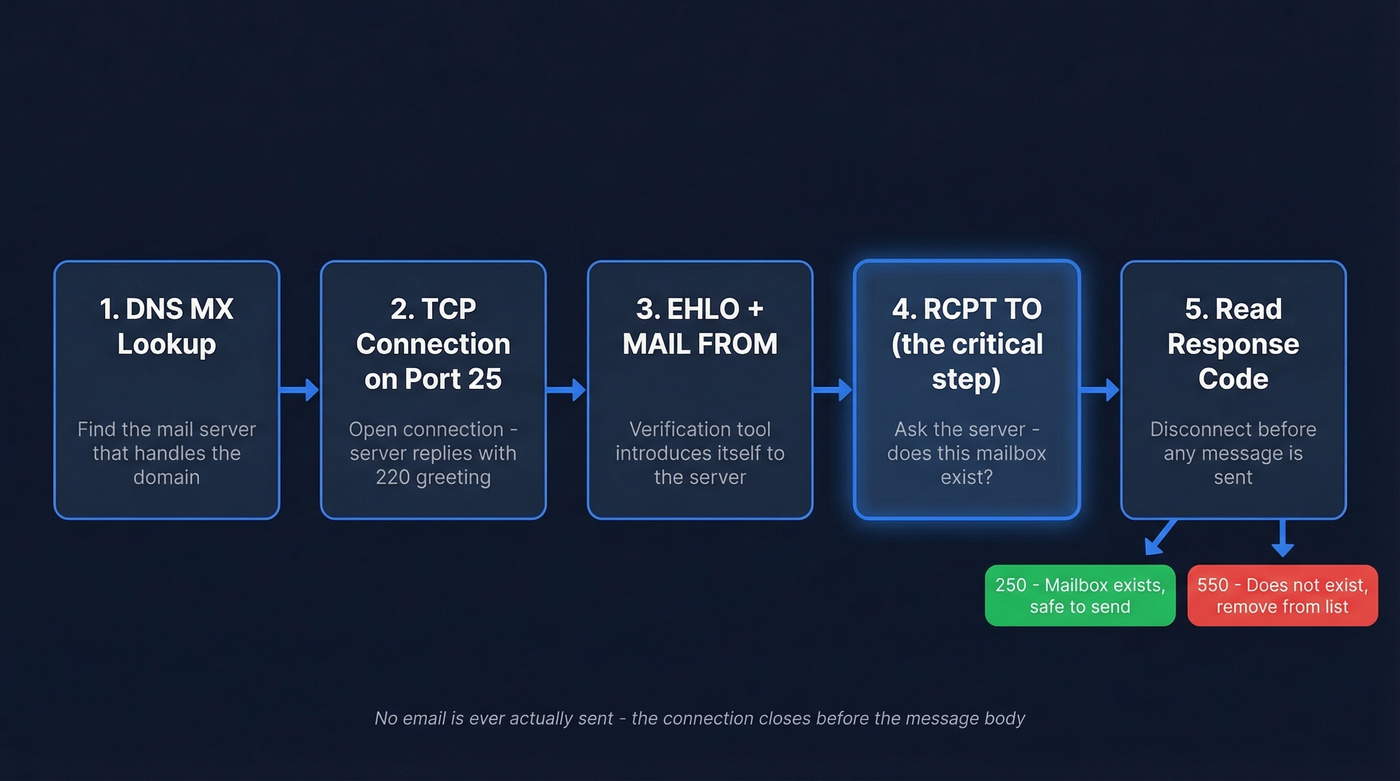
First, the tool runs a DNS MX lookup to find which mail server handles the domain, then opens a TCP connection on port 25. On a successful connection, the server responds with a 220 greeting. The tool introduces itself with EHLO, sends MAIL FROM, then hits the critical step: RCPT TO with the email you're checking. A 250 response means the mailbox is accepted as valid. A 550 means it doesn't exist. The tool disconnects before any message body is transmitted - no email ever gets sent. Some tools also check SPF and DMARC records; a missing SPF record is a red flag that the domain isn't actively managed.
| Code | Meaning | Action |
|---|---|---|
| 250 | Mailbox accepted / exists | Safe to send |
| 421 | Service unavailable | Service unavailable | Retry later |
| 450 | Temporary failure (greylisting/mailbox full) | Temporary failure (greylisting/mailbox full) | Retry later |
| 550 | Doesn't exist | Remove from list |
| 554 | Blocked / policy rejection | Check reputation |
Codes in the 4xx range are temporary - retry after a delay. 5xx codes are permanent. Remove the address immediately.

Every verification tool above fixes a problem that shouldn't exist - sending to unverified data. Prospeo's 5-step verification with catch-all handling, spam-trap removal, and honeypot filtering means every email you pull is already checked. Data refreshes every 7 days, not every 6 weeks, so addresses don't decay before you use them.
Skip the cleanup step. Start with emails that are already verified at 98% accuracy.
How to Verify Manually via CLI
If you want to validate an address at the protocol level, this method works for spot-checking a single mailbox. It's not scalable, but it's useful for understanding what the tools automate.
nslookup -q=mx example.com
telnet mail.example.com 25
EHLO test.com
MAIL FROM:<test@test.com>
RCPT TO:<target@example.com>
A 250 OK means the mailbox is accepted. A 550 means it doesn't exist. Type QUIT to disconnect.
The catch: catch-all domains accept any RCPT TO and return 250 regardless, giving you a false positive every time. This is exactly why developers build API-driven checks rather than relying on manual SMTP sessions - and it's what every tool below automates at scale.
Why Results Say "Unknown"
In our testing, catch-all domains were the single biggest source of "unknown" results. Between 30-40% of B2B email addresses sit on catch-all domains, and no tool can give you a definitive answer on them. The server accepts every address - real or fake - so the verifier honestly labels it "unknown."
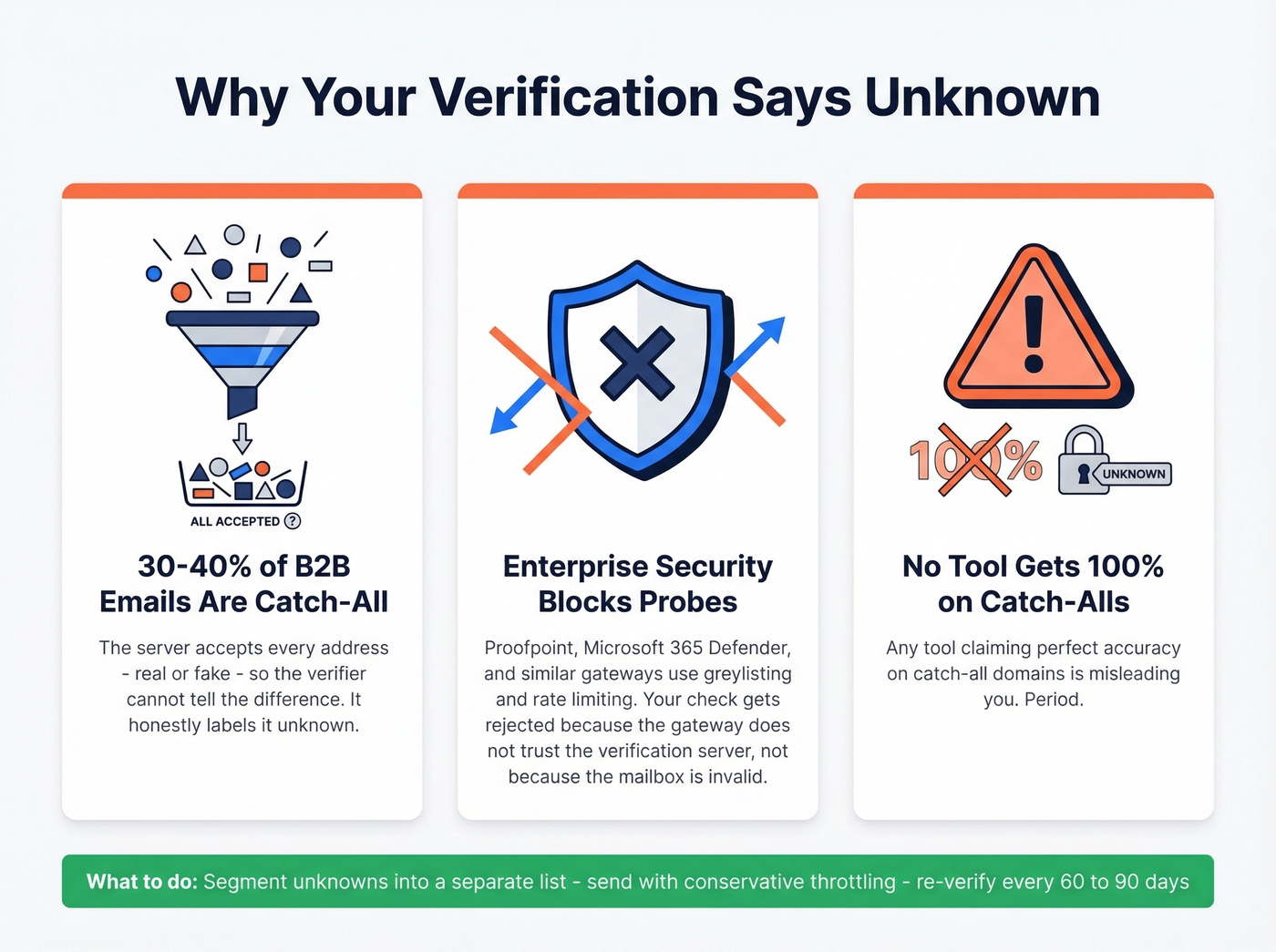
Enterprise security layers like Proofpoint and Microsoft 365 Defender also block SMTP probes through greylisting and rate limiting. Your check gets rejected not because the mailbox is invalid, but because the gateway doesn't trust your verification server.
Any tool claiming 100% accuracy on catch-all domains is lying to you. The honest move is to segment unknowns into a separate list, send cautiously with conservative throttling, and re-verify every 60-90 days. The consensus on r/coldemail backs this up - treat unknowns as a separate risk tier, not as valid addresses.
Best Tools to Verify Email Existence
We tested the major players across a 10,000-contact comparison. Expect about 1-2 seconds per real-time check; bulk tools can process 100K emails in under an hour.
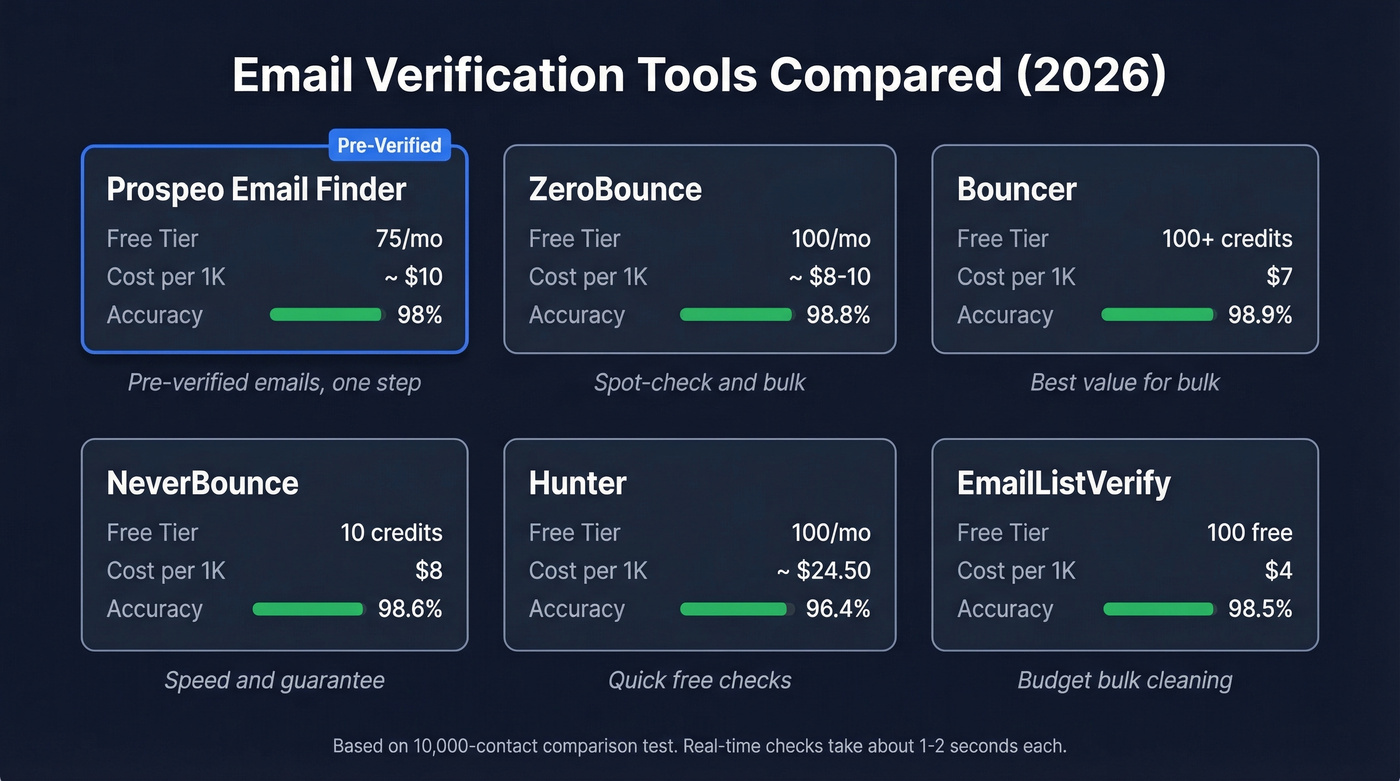
| Tool | Free Tier | Cost per 1K | Accuracy | Best For |
|---|---|---|---|---|
| Prospeo Email Finder | 75 emails/mo | ~$10 | 98% | Pre-verified emails |
| ZeroBounce | 100/mo | ~$8-10 | 98.8% | Spot-check + bulk |
| Bouncer | 100+ credits | $7 | 98.9% | Best value for bulk |
| NeverBounce | 10 credits | $8 | 98.6% | Speed + guarantee |
| Hunter | 100/mo | ~$24.50 | 96.4% | Quick free checks |
| EmailListVerify | 100 free | $4 | 98.5% | Budget bulk cleaning |
Prospeo Email Finder
Prospeo delivers contacts already verified through a 5-step process - catch-all handling, spam-trap removal, and honeypot filtering included. Data refreshes every 7 days versus the 6-week industry average. If your workflow is "find emails then verify them," Prospeo collapses that into one step. Stack Optimize built from $0 to $1M ARR using this approach, maintaining 94%+ deliverability and under 3% bounce across all clients.

ZeroBounce
The most well-rounded standalone verifier. SOC 2 Type 2 and ISO 27001 certified, 100 free monthly checks, and bulk processing handles 100K in under an hour. If you already have a list and just need it cleaned, ZeroBounce is the safe pick.
Bouncer
Edges out the field on raw accuracy at 98.9% and $7/1K - the best price-to-accuracy ratio for regular list cleaning. Skip this if you only need occasional spot-checks; the free tier is small and the value kicks in at volume.
NeverBounce
Processes a 10K list in about 3 minutes and backs results with a money-back guarantee if bounces exceed 3%. The free tier is tiny at 10 credits, so it's really a paid tool from day one.
Hunter
Charges a premium at ~$24.50/1K for 96.4% accuracy. The 100 free monthly checks work for occasional lookups, but you're paying for brand recognition more than performance at scale.
EmailListVerify
The budget play at $4/1K with 98.5% accuracy. Hard to beat for massive lists where cost is the primary constraint. EmailListVerify's documentation covers their API well if you're building verification into a pipeline.
If you're comparing verifiers beyond the shortlist above, start with a bounce-rate baseline and then evaluate alternatives by workflow (spot-check vs bulk vs API). For deeper comparisons, see Bouncer alternatives and Hunter alternatives.
You just read that 30-40% of B2B emails sit on catch-all domains - the #1 source of "unknown" results. Prospeo's proprietary infrastructure handles catch-all verification built into every lookup. Stack Optimize maintained under 3% bounce across all clients with zero domain flags using this exact process.
Stop treating catch-all domains as guesswork. Get emails you can actually send to.
FAQ
Can you check if an email account exists without sending?
Yes. Verification tools use SMTP handshake protocols to query the mail server directly - simulating delivery without transmitting a message. ZeroBounce offers 100 free monthly checks, and Hunter supports up to 100 verifications per month on its free plan.
Why do verification results say "unknown"?
Because 30-40% of B2B domains are catch-all servers that accept every address, real or fake. No tool can distinguish valid from invalid on these domains. Segment unknowns into a separate list and re-verify every 60-90 days.
What's the fastest way to get verified emails?
Use a source that verifies at collection instead of after the fact. Prospeo's Email Finder runs a 5-step verification - including catch-all handling and spam-trap removal - before delivering any contact, eliminating the separate verification step entirely. The free tier includes 75 emails per month.
Are free email verification tools accurate enough?
For spot-checking under 100 addresses monthly, free tiers from ZeroBounce or Hunter are reliable at 96-99% accuracy. For lists over 1,000 contacts, paid bulk tools like Bouncer at $7/1K deliver more consistent results and save hours of manual cleanup.