

Closing Salutations for Emails: What the Data Says (and What to Actually Use)
A colleague of ours signs every email "Warmly" - even the ones where she's rejecting a vendor proposal. Meanwhile, a UK client once told us that receiving a bare "Regards" felt like getting slapped with a wet fish. The gap between what you intend and what the reader feels is wider than most people realize, and every "50 best sign-offs" listicle makes it worse by giving you options without opinions.
Let's fix that.
The Short Version
- Safest all-purpose sign-off: "Best regards" - works across cultures, industries, and generations.
- Highest reply rate: "Thanks in advance" - 65.7% response rate in a 350K-thread study, but use with care (it can sound presumptuous).
- The rule: Any closing with "thank" in it outperforms non-thankful closings by 15+ percentage points.
- The real rule: You need 3-4 go-to closings for different contexts, not a list of 100.
What the Data Says About Email Sign-Offs
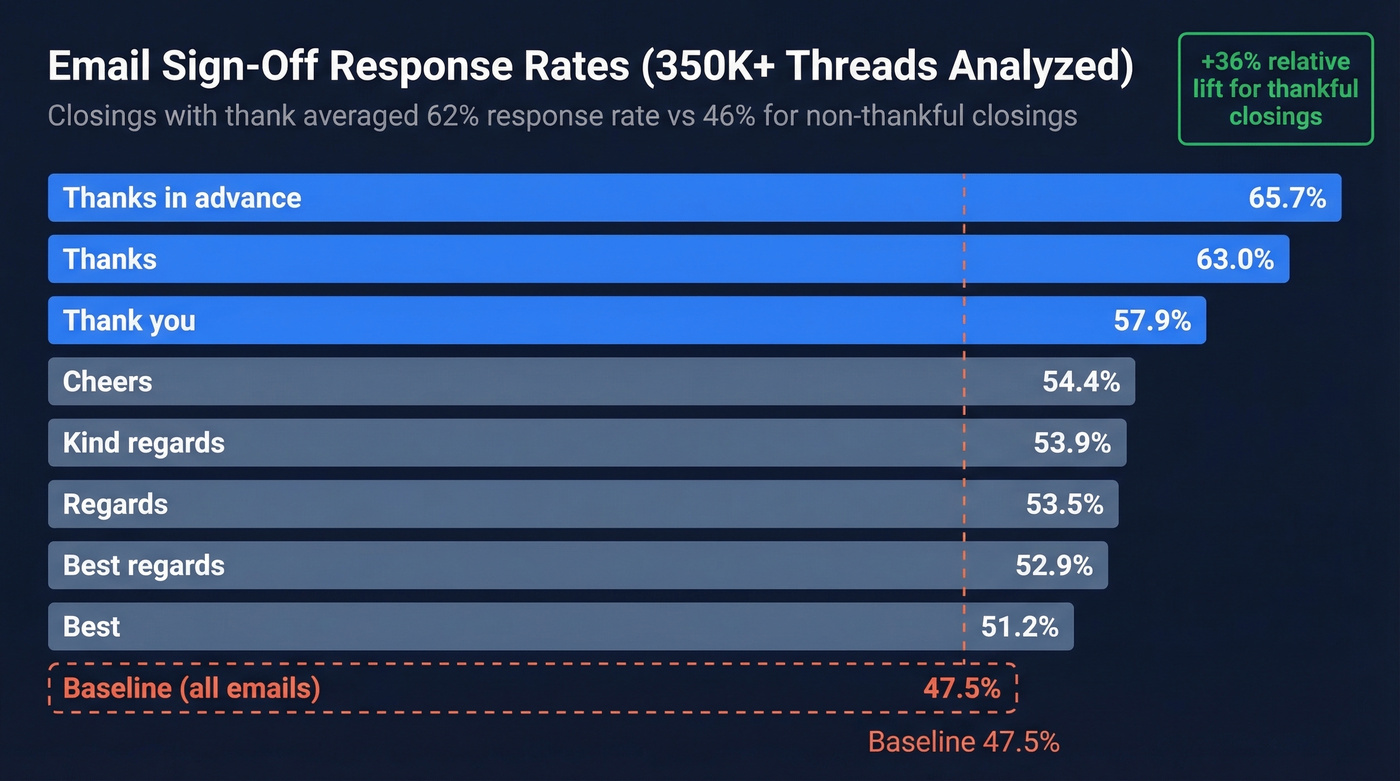
A 350,000+ email thread analysis across 20+ online communities found that the baseline response rate sat at 47.5%. Every thankful closing crushed it.
| Sign-Off | Response Rate |
|---|---|
| Thanks in advance | 65.7% |
| Thanks | 63.0% |
| Thank you | 57.9% |
| Cheers | 54.4% |
| Kind regards | 53.9% |
| Regards | 53.5% |
| Best regards | 52.9% |
| Best | 51.2% |
| Baseline (all emails) | 47.5% |
The pattern is unmistakable. Closings with "thank" averaged a 62% response rate versus 46% for non-thankful closings - a 36% relative lift. The researchers controlled for reply-seeking emails by re-running the analysis on threads containing a question mark. Same pattern held.
This lines up with a 2010 experiment by Grant and Gino where people who received a "thank you so much" helped 66% of the time versus 32% without gratitude. Gratitude isn't just polite. It's a behavioral trigger.
One caveat: the 350K-thread dataset comes from mailing-list and community email, not 1:1 corporate threads. The directional signal is strong - thankful closings outperform across contexts - though the exact percentages will shift in corporate email.
Best Email Closings by Context
Formal
"Best regards" is reliable, inoffensive, and forgettable. For first-touch emails to executives, legal correspondence, or cross-cultural communication, that's exactly what you want. "Sincerely" still works for formal letters and government correspondence, though it reads slightly stiff in everyday business email. "Respectfully" is reserved for military, government, or situations where hierarchy matters - and it should stay there.
Friendly-Professional
"Best" is the Honda Civic of sign-offs - the stripped-down version of "Best regards," slightly warmer, slightly more casual. It's the default for most knowledge workers in 2026, and defaults exist for a reason.
"Cheers" is the most underrated option in the dataset at 54.4% response rate. It reads as confident and approachable without being sloppy. If you're in tech, media, or any industry where people wear sneakers to meetings, "Cheers" is your move. We've used it on our team for years and it consistently lands well with prospects and partners alike.
Gratitude-Based
"Thanks" and "Thank you" are the workhorses. The data backs them up, and they feel natural after any email where you've asked for something. "Thanks so much" adds warmth without crossing into performative territory.
"Thanks in advance" tops the response-rate chart at 65.7%, but it's polarizing - more on that below.
Action-Oriented
"Looking forward to hearing from you" works well as a soft close on outbound emails. "Talk soon" implies a relationship already exists - use it when one does. "Let me know if you have questions" is functional but reads as filler; pair it with a real sign-off rather than using it as one.
Email Closings That Backfire
Not every closing is safe. Some actively hurt you. Here's the thing: in online discussions - especially on r/sales and r/email - these are the ones that consistently spark debate, and not the good kind.
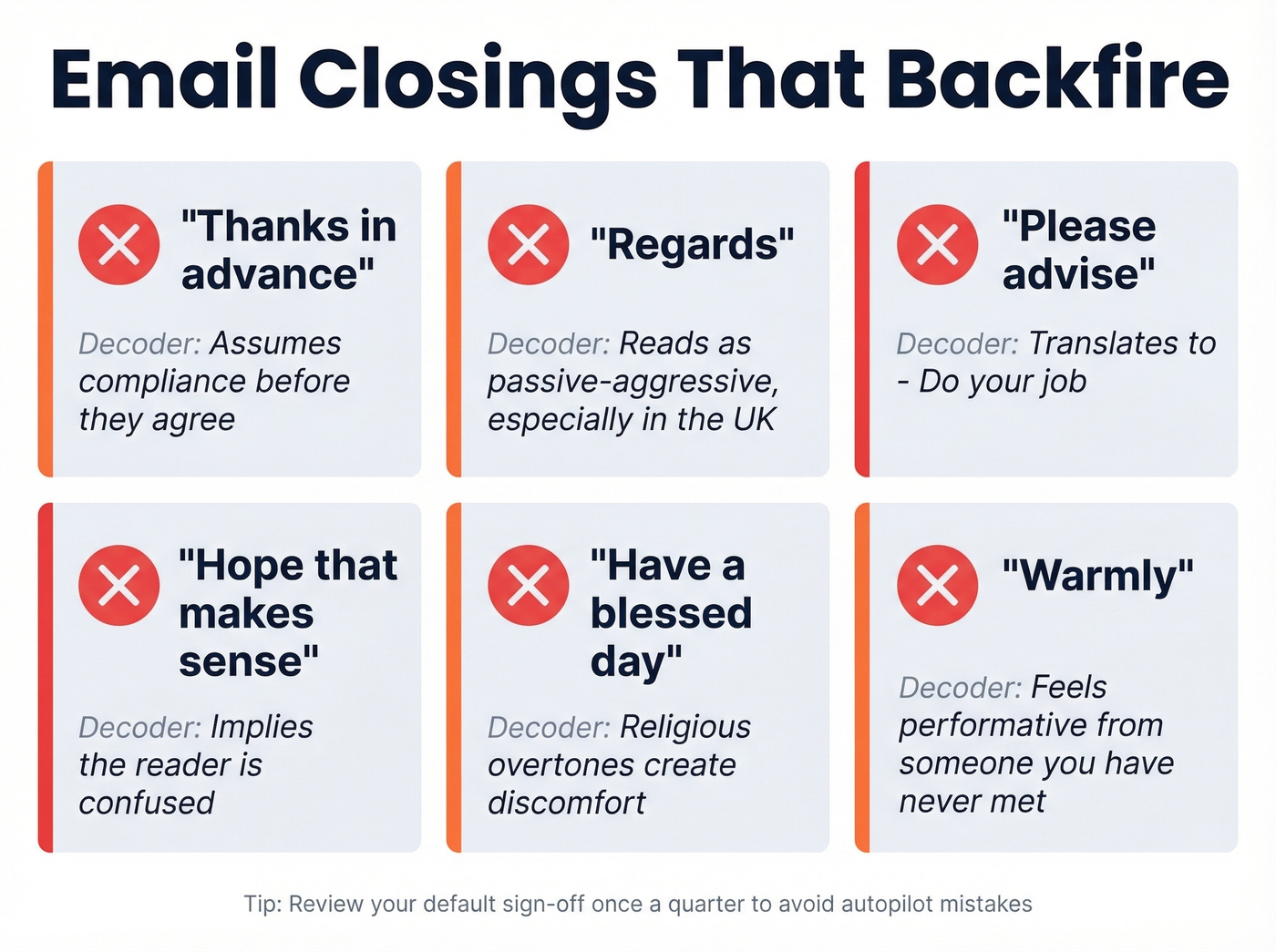
"Thanks in advance" - The data says it works. Many recipients say it's presumptuous because it assumes compliance before they've agreed to anything. Safe with peers you know well, risky with new contacts or anyone senior to you.
Bare "Regards" - Decoded: "I'm annoyed with you." What was once neutral has drifted into passive-aggressive territory, especially in the UK. Add "Best" or "Kind" in front of it.
"Please advise" - Decoded: "Do your job." It's corporate-speak that lands as a demand, not a request.
"Hope that makes sense" - Decoded: "I think you're confused." Passive-aggressive whether you intend it or not.
"Have a blessed day" - Religious overtones land differently depending on the recipient. In many professional contexts, this creates discomfort rather than warmth.
"Love" / "XOXO" - Grammarly's avoid list flags these for obvious reasons. Unless you're emailing your spouse, skip it.
"Warmly" - In community discussions, this one gets called out as performative, especially from people you've never met. It's trying too hard to be cozy.
Most sign-off disasters come from autopilot. People set a default in their email client and forget it exists. Review yours once a quarter.

A perfect closing salutation means nothing if your email never reaches the inbox. Prospeo's 98% verified emails and 7-day data refresh keep your bounce rate under 4% - so your carefully crafted sign-off actually gets read.
Stop perfecting closings for emails that bounce. Start reaching real inboxes.
The Decision Framework
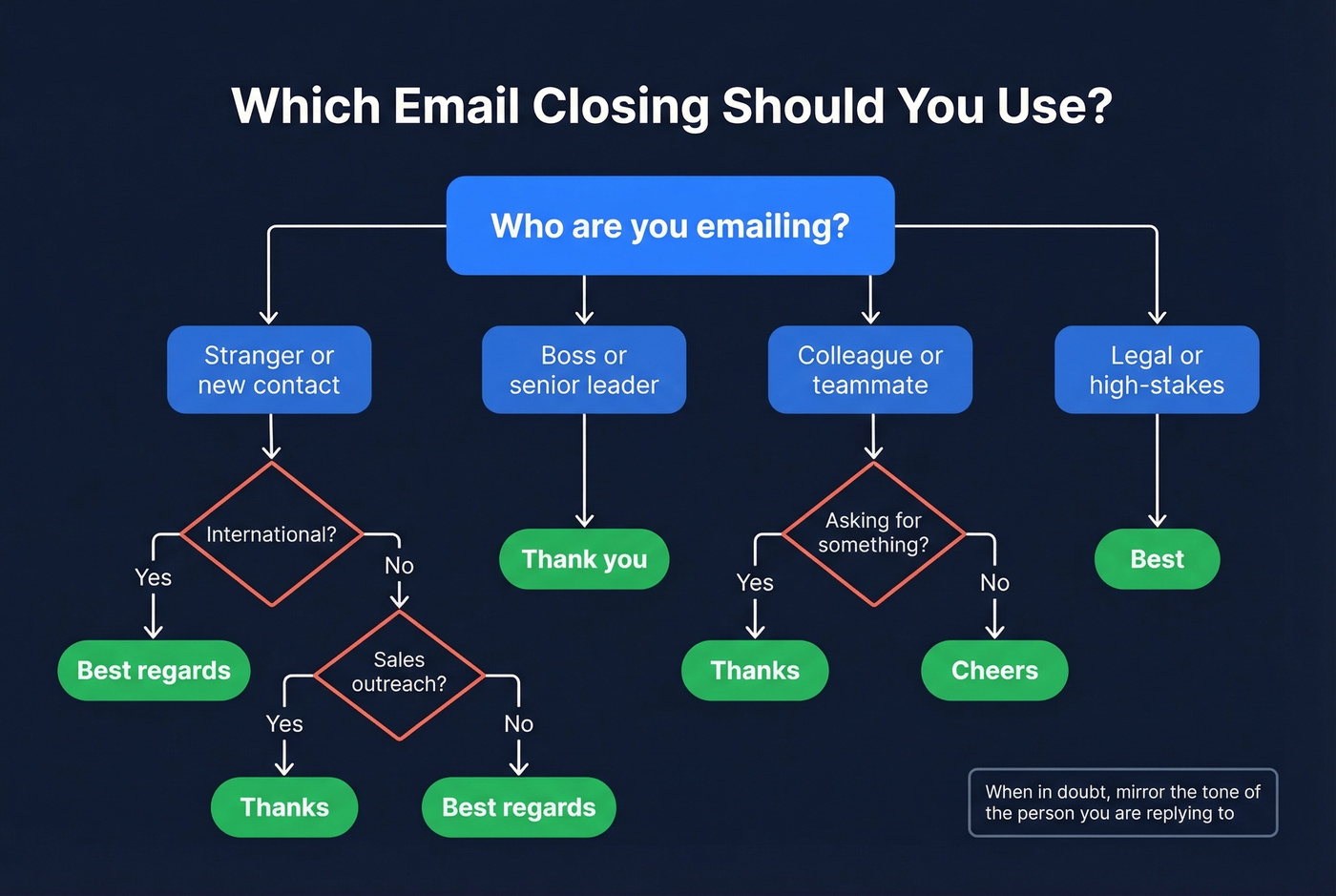
Context matters more than any single "best" closing. Etiquette expert Jacqueline Whitmore recommends mirroring the tone of the person you're replying to. That's solid advice. Here's a cheat sheet for when you're initiating:
| Context | Recommended | Why |
|---|---|---|
| First email to a stranger | Best regards | Neutral, professional, safe |
| Reply to your boss | Thank you / Thanks | Respect without stiffness |
| Cold sales outreach | Thanks | Warm, brief, non-presumptuous |
| Follow-up after meeting | Looking forward to it | Reinforces momentum |
| International recipient | Best regards | Least likely to be misread |
| Internal team chat | Cheers / Thanks | Casual is fine with colleagues |
| Legal / formal docs | Best | Clean, precise, no ambiguity |
| Asking for a favor | Thanks in advance | Data supports it - use carefully |
Special Contexts
Cross-Cultural Email Sign-Offs
Email sign-offs carry cultural weight that most people underestimate. In the UK, a bare "Regards" can read as cold or curt, while in the US it's perfectly neutral. "Kind regards" or "Best regards" is the safer UK choice.
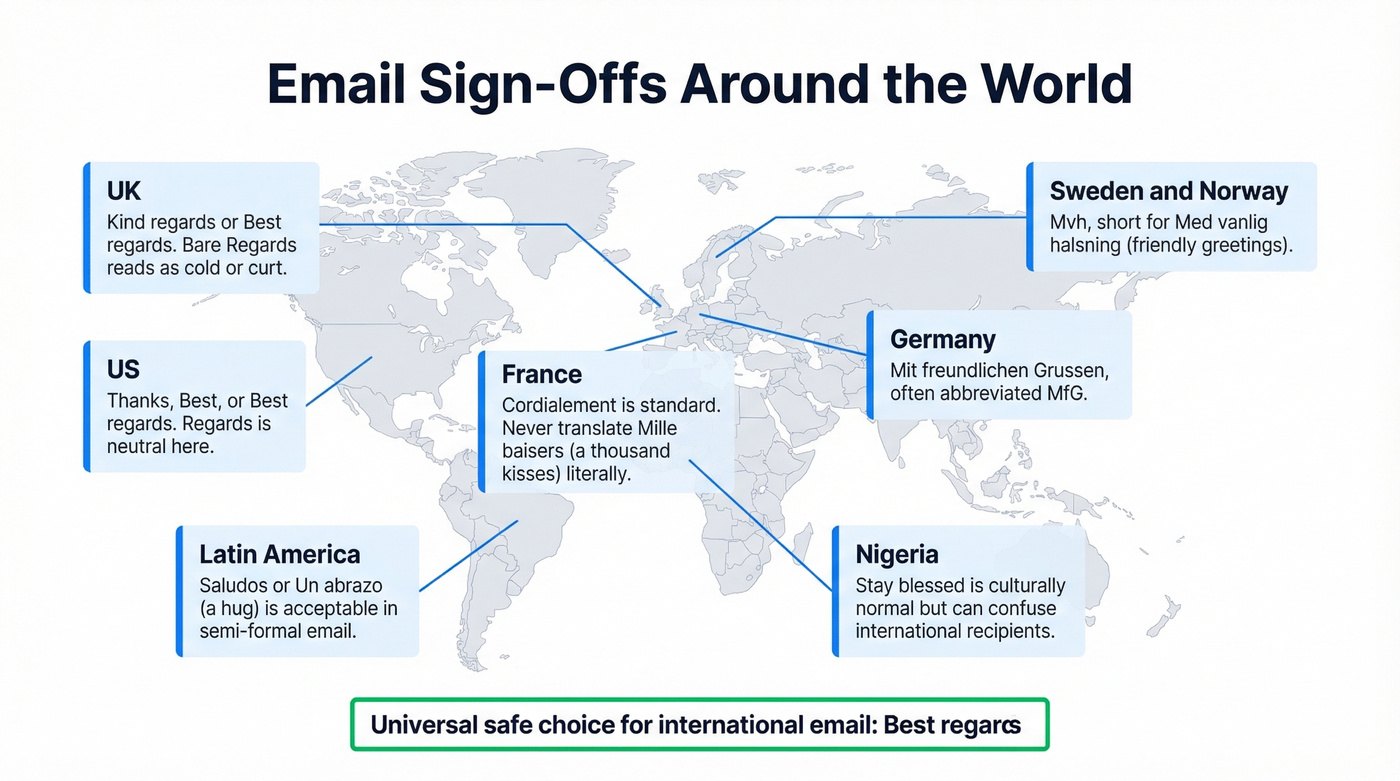
Translation pitfalls are real. The French "Mille baisers" literally means "a thousand kisses" - charming in French, wildly inappropriate in an English workplace email. In Nigeria, "Stay blessed" is culturally normal but can be misinterpreted by international recipients. A Nigerian professor's closing - "I hope to read from you soon" - was misread by a US colleague as scam-like, damaging a real networking opportunity.
In Latin America, "Saludos" or even "Un abrazo" (a hug) is acceptable in semi-formal business email, something that would raise eyebrows in a US or UK context. German business email often closes with "Mit freundlichen Grussen" (abbreviated MfG), and Sweden/Norway commonly use "Mvh" - both variants of "friendly greetings."
A Korean-Australian study found that roughly 40% of Korean respondents perceived Australian emails as impolite, versus 28% the other way around. When in doubt with international contacts, "Best regards" is your universal safe harbor.
Legal and High-Stakes Emails
In legal contexts, your email might become an exhibit. The Boston Bar Association reminds lawyers that emails can be forwarded, attached to filings, and used in discovery disputes. "Best," followed by your name, is a standard legal closing - clean, professional, and hard to misinterpret. Choosing the right sign-off in these settings isn't about style. It's about risk management.
Sales and Outbound Emails
For cold outreach, keep it simple. "Thanks" or "Looking forward to hearing from you" both work. Skip "Thanks in advance" with prospects who haven't agreed to anything yet - it reads as entitled. "Best" is a solid fallback when nothing else fits.
Here's our hot take: your closing salutation matters far less than whether the email actually lands in the inbox. A beautifully crafted sign-off on a bounced email helps nobody. If you're running outbound campaigns, verify your list first - tools like Prospeo handle real-time email verification with 98% accuracy on a 7-day data refresh cycle, so your carefully chosen sign-off actually gets read.

Punctuation Rules Nobody Taught You
A few rules that trip up even experienced professionals.
Only capitalize the first word of your closing - it's "Kind regards," not "Kind Regards." The University of Sussex style guide is clear on this. Always follow your sign-off with a comma, then your name on the next line. In US business correspondence, greetings traditionally take a colon ("Dear Mr. Jackson:"), while UK convention uses a comma. Closings take a comma in both.
"Yours sincerely" pairs with a named recipient; "Yours faithfully" pairs with "Dear Sir/Madam." This distinction is fading, but knowing it signals professionalism. And remember: the sign-off is separate from your email signature block. Your signature goes below the closing - it's not a substitute for one.
The Gen Z Shift
Gen Z now makes up 27% of the global workforce, projected to hit 31% by 2035. Their email closing habits reflect a different relationship with workplace formality. "Catch you later," "Stay awesome," "Peace out," and "Toodles" are showing up in internal emails at startups and agencies.
A video by Gen Z marketing agency NinetyEight showcasing their team's sign-offs went viral - roughly 8 million views and 1.5 million likes. The closings were playful, irreverent, and completely at odds with traditional business email norms.
This isn't a recommendation to start signing off with "Later, skater." But the formal-to-casual spectrum is widening, and awareness of where your audience sits on it matters more than ever. If you're emailing a 25-year-old startup founder, "Cheers" won't raise an eyebrow. If you're emailing a 55-year-old general counsel, stick with "Best regards."
Pick 3-4 closing salutations for your most common email contexts, set them as templates, and stop overthinking it. Our colleague still signs everything "Warmly" - but at least now she knows what it sounds like on the other end. The sign-off is the last thing your reader sees. Make it count.
Gratitude-based closings boost reply rates by 36%. But the biggest reply killer isn't your sign-off - it's outdated contact data. Prospeo delivers 143M+ verified emails refreshed every 7 days, so your outreach lands with the right person every time.
Get the email right first. The sign-off is the easy part.
FAQ
Is "Thanks in advance" rude?
It gets the highest reply rate at 65.7% in a 350K-thread study, but many recipients find it presumptuous because it assumes compliance. Safe with peers you know well; skip it with new contacts or anyone senior to you.
What's the safest email sign-off?
"Best regards" is universally understood across cultures, industries, and generations. It won't win style points, but it won't cost you a deal either - and it's the least likely to be misread by international recipients.
Should I capitalize both words in "Kind Regards"?
No. Only capitalize the first word: "Kind regards," followed by a comma. This rule applies to all multi-word closings - "Best regards," "Many thanks," "Warm regards."
Do email closings actually affect reply rates?
Yes. The 350K-thread study found thankful closings average a 62% response rate versus 46% for non-thankful ones - a 36% relative increase. Any sign-off containing "thank" outperforms alternatives by 15+ percentage points.
What if my email never reaches the inbox?
Deliverability matters more than any sign-off. Verifying your contact list before sending is the single highest-ROI step in any outbound workflow. Prospeo's free tier includes 75 verified emails per month plus 100 Chrome extension credits at prospeo.io - no contracts required.