

How to Coach Sales Managers Into Actual Coaches (Not Deal Inspectors)
A sales manager with eight reps tells Reddit they can only coach "two or three per week" - and even that's rushed, listening to call recordings at 1.5x speed while eating lunch. The rest of their coaching time reverts to pipeline reviews and deal strategy sessions because those feel more urgent. Coaching sales managers to actually develop their people - not just inspect deals - is the single highest-leverage investment a VP of Sales can make. Yet only 16% of reps hit quota in 2024, down from 53% in 2012, and 54% of managers believe they're providing optimal coaching while just 37% of reps agree.
That gap between perception and reality is where quota goes to die.
What You Need (Quick Version)
Three things. That's the whole system:
- Separate coaching from pipeline review. They aren't the same meeting. Stop pretending they are.
- Pick one diagnostic framework and one conversation structure. You don't need ten. We'll cover ROAM and PAUSE below.
- Coach the middle 60% of your team, one behavior per rep per month. Your top performers don't need you hovering. Your bottom 10% need a PIP, not a coaching session.
The Business Case
Teams receiving consistent sales coaching see 16.7% higher revenue growth than teams without it. Separate benchmarks tell the same story: weekly coaching is linked to 25% higher quota attainment and 30% more deals won, with structured coaching programs returning roughly 353% ROI - $4.53 back for every dollar spent. And yet only 26% of reps receive weekly coaching.
Now flip it. Replacing a single rep costs roughly 1.5x their base salary. With a recent average base of $130K, that's $195,000 out the door every time someone walks. Half of reps say they're considering leaving because they don't get enough development. Companies that invest in on-the-job coaching improve seller retention by about 20% each year.
The math isn't subtle. Coaching is cheaper than recruiting.

Why Most Sales "Coaching" Fails
Coaching vs. Inspection vs. Feedback
Most managers who say they're coaching are actually just telling employees what to do. That's HBR's finding, and it matches what we see constantly in the field. Here's a quick way to tell the three apart:
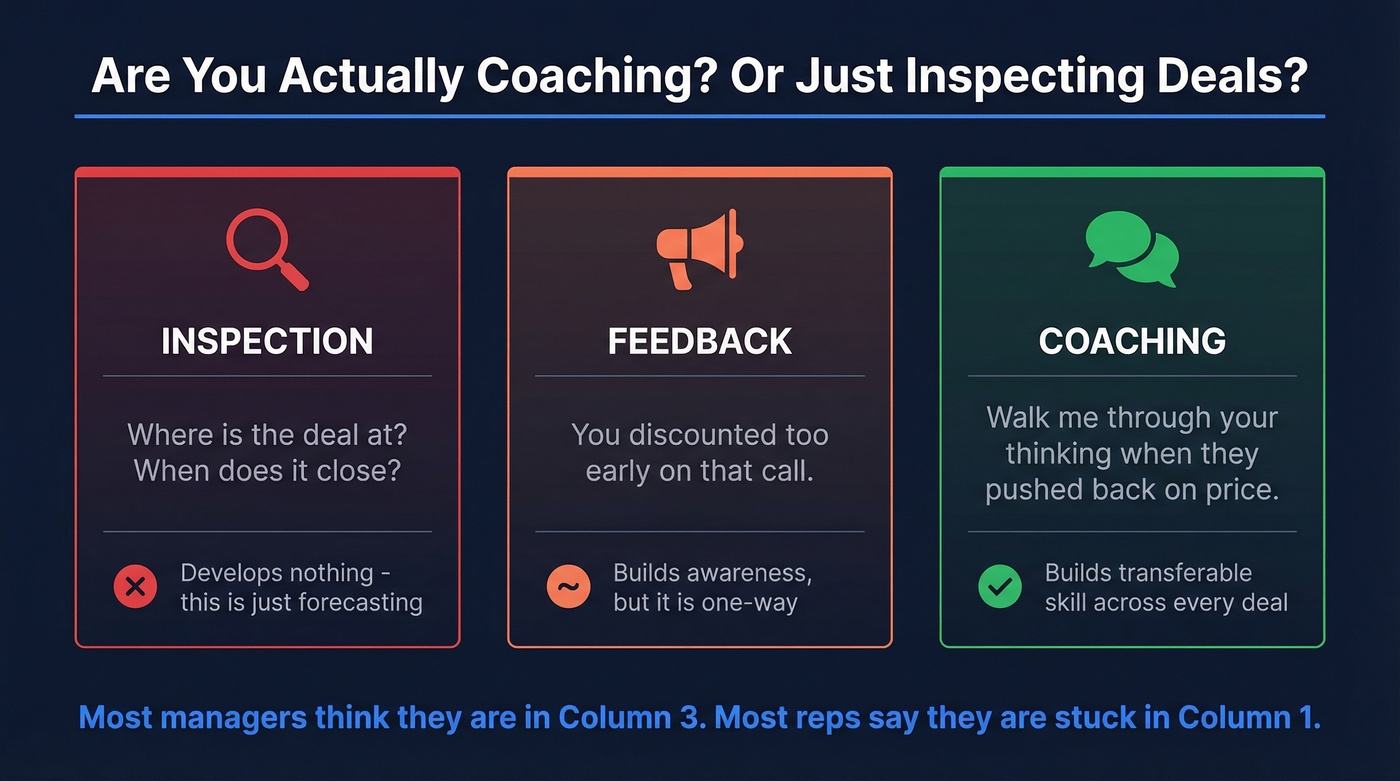
| Mode | What It Sounds Like | What It Develops |
|---|---|---|
| Inspection | "Where's the deal at? When does it close?" | Nothing - it's forecasting |
| Feedback | "You discounted too early on that call." | Awareness (one-way) |
| Coaching | "Walk me through your thinking when they pushed back on price." | Skill that transfers across deals |
The consensus among practitioners is blunt: most "coaching" sessions are deal inspection wearing a coaching hat. HBR's "Feedback Fallacy" research goes further - constant critique rarely improves performance on its own. Coaching requires dialogue, not downloads.
The Double Jump Problem
Here's a pattern we've seen destroy teams. Your best seller gets promoted to manager. They crushed quota, so they'll obviously crush management, right?
Wrong. 65% of sales organizations don't even evaluate coaching skills when promoting or hiring managers. They evaluate selling ability. So you get a brilliant closer who, instead of developing reps, starts selling deals for them - jumping on calls, taking over negotiations, creating a bottleneck. The rep never learns. The manager burns out. Attrition follows.
It's called the "double jump" because you're asking someone to leap from individual contributor to coach without ever landing on the manager step in between. Equipping sales managers with a structured coaching skillset before they take on a team is the only way to break this cycle.
Why Managers Resist
Three statements that kill coaching cultures before they start:
"I figured it out on my own, they can too." Intuitive sellers often can't break down what they do into teachable steps. Their success came from instinct, and instinct doesn't transfer through osmosis.
"I'm not a micromanager." Managers confuse coaching with micromanagement and retreat into cheerleading. But micromanagement is continuing direction when direction is no longer needed. Teaching someone a skill they haven't mastered yet isn't micromanagement - it's your job.
"It's their job to set up the deal, my job to close it." The player-coach trap. As Bill Zipp puts it, it's not a sales manager's job to close deals - it's to make sure deals get closed.
Two Frameworks That Work
ROAM for Root-Cause Diagnosis
ROAM stands for Results vs. Objectives, Activity, Methodology. It's a diagnostic flow, not a coaching conversation - use it before you ever sit down with a rep.
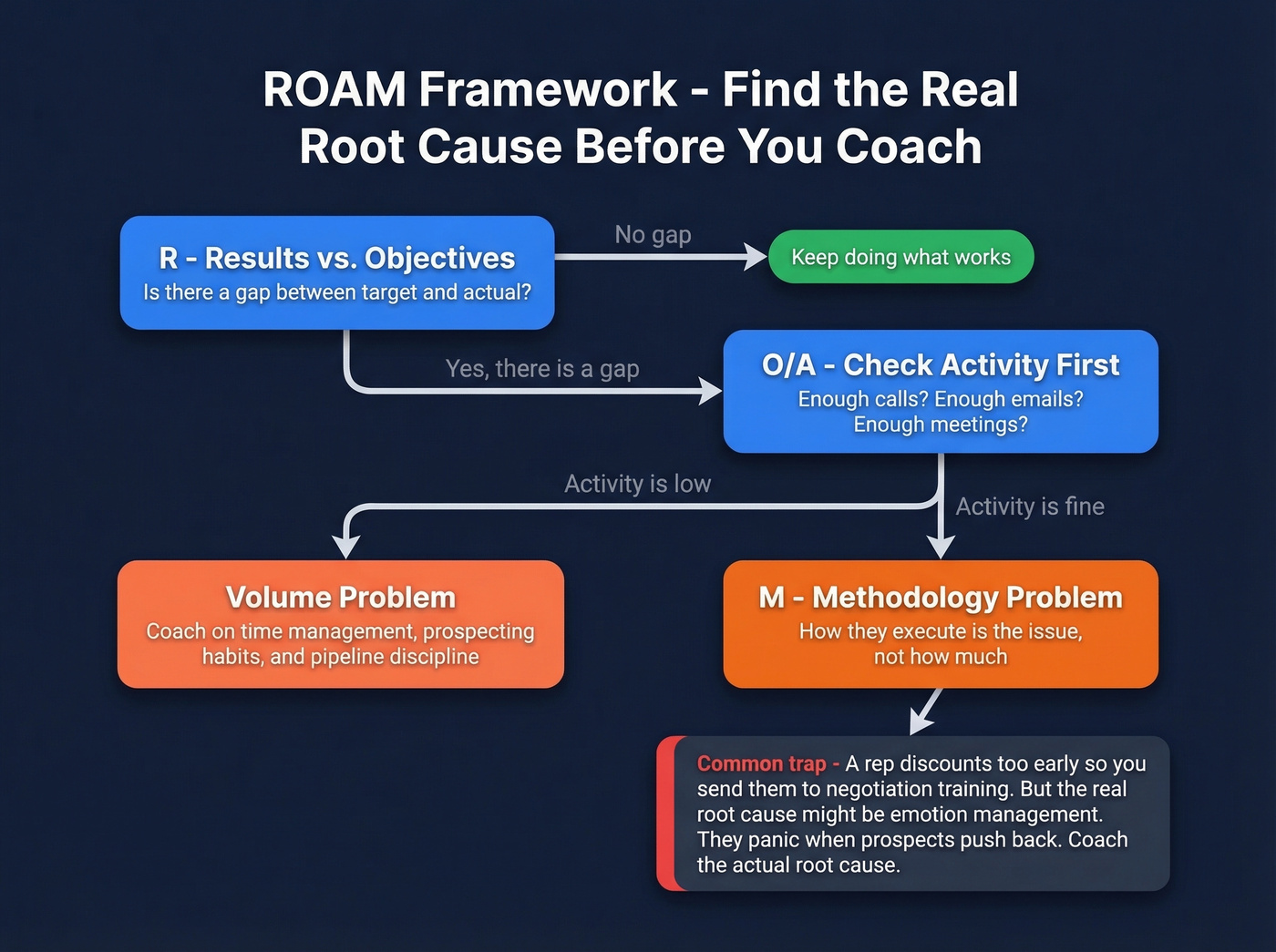
Start by comparing results to objectives. If there's a gap, look at activity first. Are they making enough calls, sending enough emails, booking enough meetings? If activity volume is fine, the problem is methodology - how they're executing, not how much.
Here's where most managers get it wrong. A rep discounts too early, so the manager sends them to negotiation training. But the real root cause might be emotion management - the rep panics when a prospect pushes back and caves on price to avoid discomfort. Coaching the wrong root cause is why the same conversation happens month after month with no improvement.
PAUSE for Coaching Conversations
Once you've diagnosed the issue with ROAM, use PAUSE to structure the actual conversation:
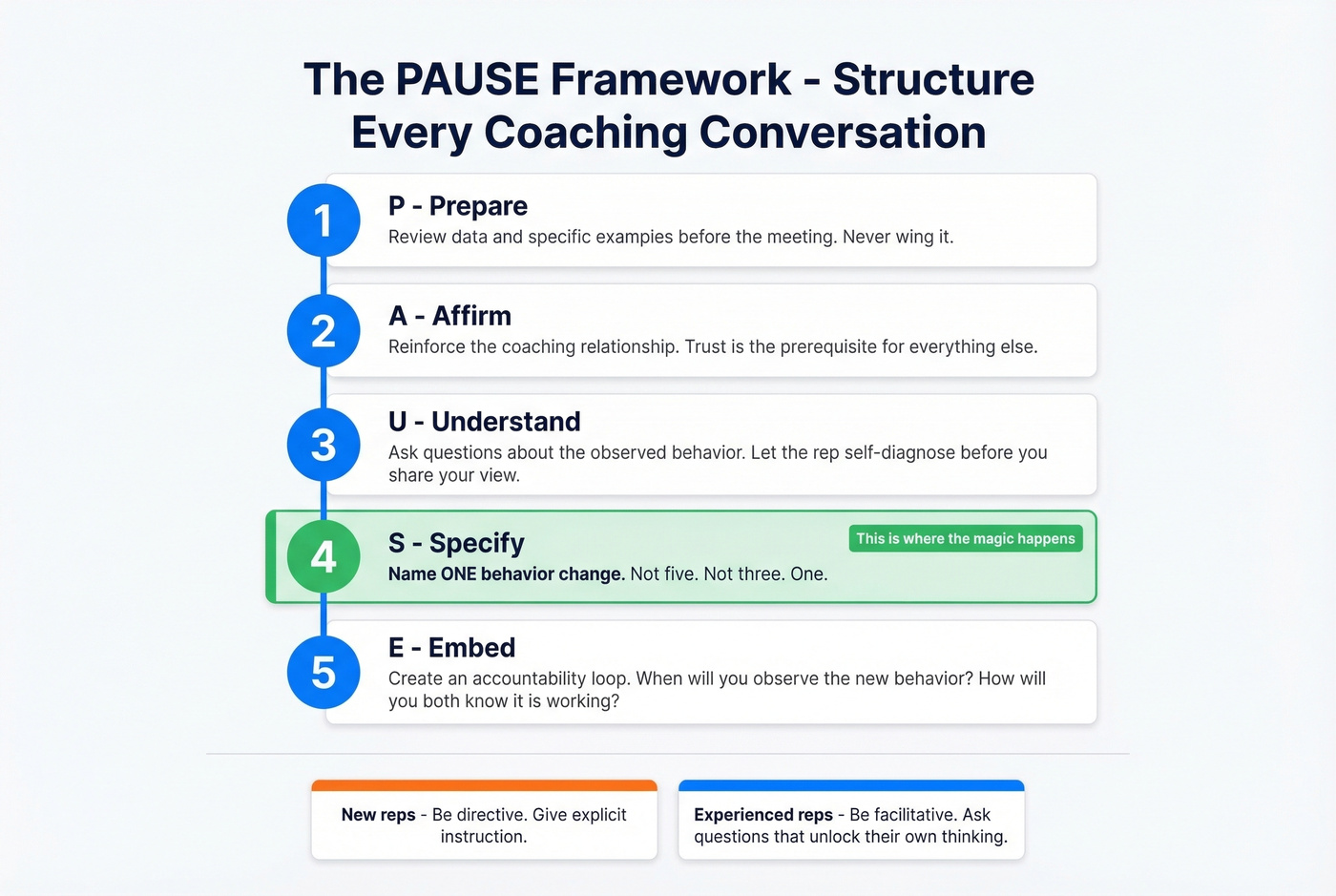
- Prepare - review the data and specific examples before the meeting. Don't wing it.
- Affirm - reinforce the coaching relationship. Trust is the prerequisite.
- Understand - ask questions about the observed behavior. Let the rep self-diagnose before you share your view.
- Specify - name one behavior change. Not five. One.
- Embed - create an accountability loop. When will you observe the new behavior? How will you both know it's working?
The magic is in step four. One behavior per conversation. One. This is where most managers overload reps with feedback and nothing sticks. Know when to be directive with new reps who need explicit instruction versus facilitative with experienced reps who need questions that unlock their own thinking. Matching the approach to the seller's skill level is what separates great coaches from well-intentioned ones.

Coaching fixes how reps sell. Bad data breaks what they sell into. When your newly coached rep finally nails the discovery call but the prospect's email bounces, that's $195K in replacement cost waiting to happen. Prospeo delivers 98% verified emails and 125M+ direct dials so your coaching investment converts to closed deals - not frustrated reps heading for the door.
Stop losing coached reps to bad data. Start with 75 free emails.
The Weekly Coaching Rhythm
RAIN Group's research shows top-performing managers spend roughly five hours per week on coaching activities. That's about 30 minutes per rep if you're managing eight to ten people - tight but doable if you protect the time.
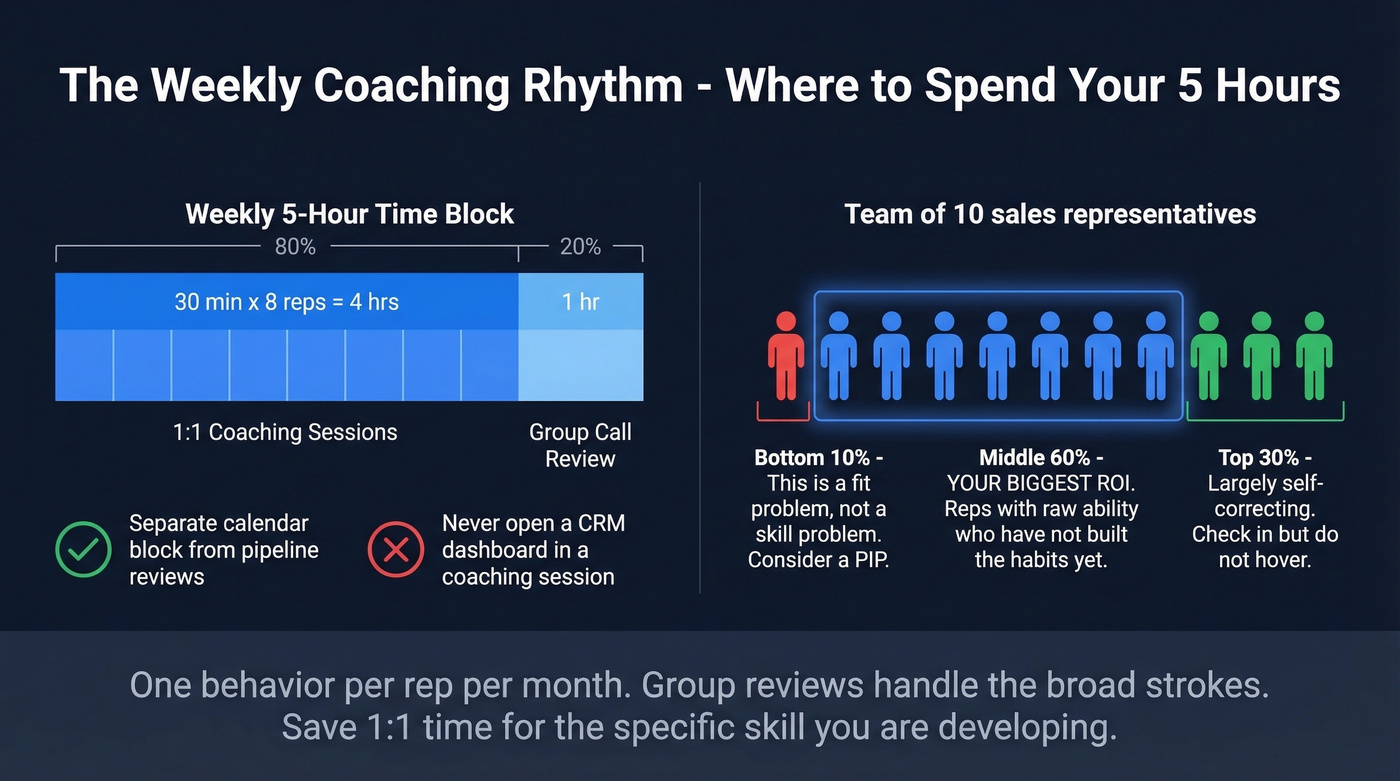
Schedule coaching 1:1s as separate calendar blocks from pipeline reviews. Never combine them. The moment you open a CRM dashboard in a coaching session, you've lost the developmental thread.
A scaling tactic that keeps surfacing in practitioner communities and our own work: focus on one behavior per rep per month. Group call reviews handle the broad strokes - everyone learns from hearing a peer's call dissected. Save 1:1 time for the specific behavior you're developing in each rep.
Let's be honest about something: if your average deal size is under $15K, your managers probably spend more time on deal inspection than the deals are worth. Redirect that time to skill-building. Coach the middle 60%. Your top performers are largely self-correcting. Your bottom 10% have a fit problem, not a skill problem. The middle 60% is where coaching creates the biggest return - reps who have the raw ability but haven't built the habits yet.
Five Mistakes That Kill Trust
Telling instead of asking. "Walk me through your thinking on that pricing conversation" gets you further than "you discounted too early." Active listening isn't a soft skill - it's the mechanism that makes coaching work.
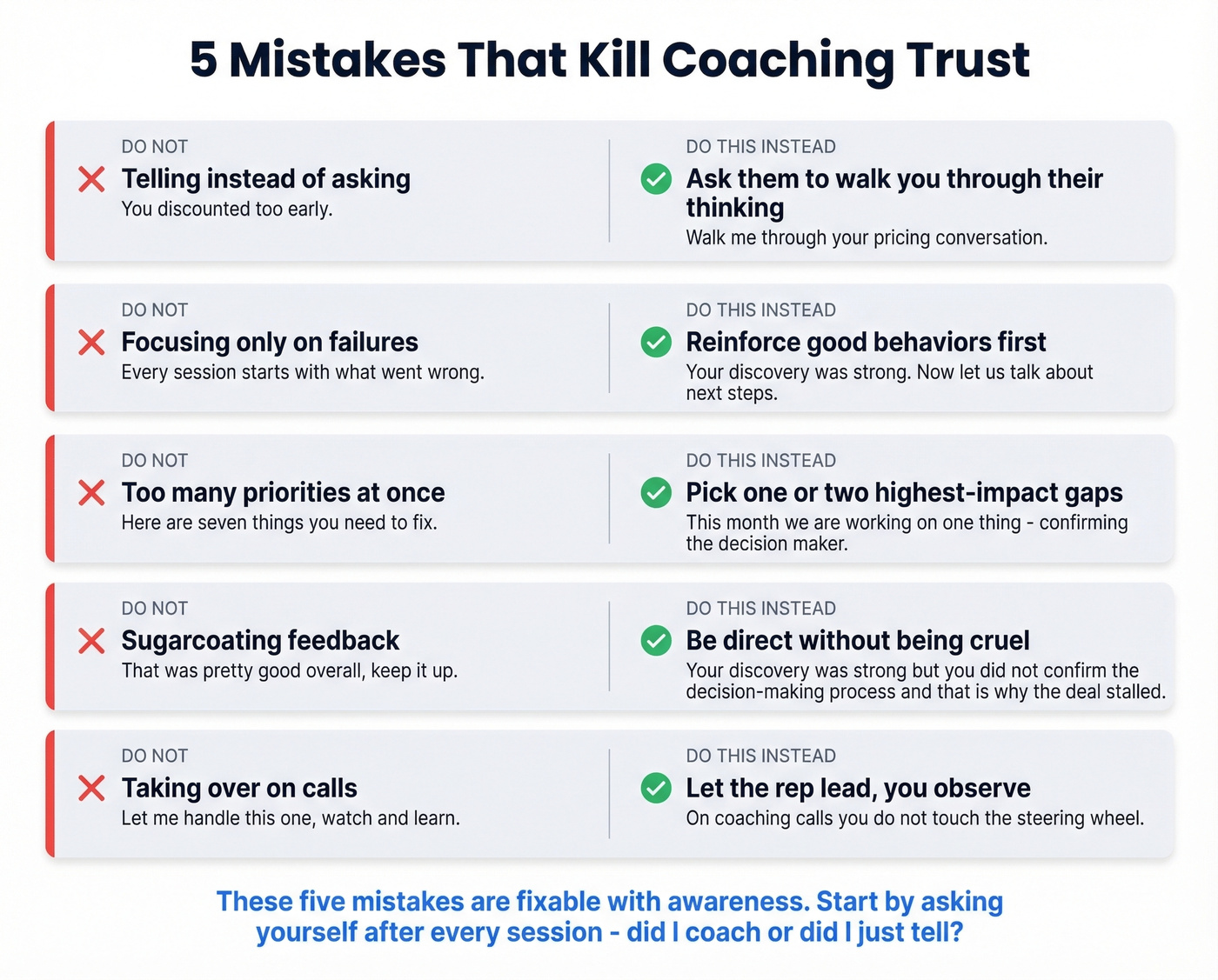
Focusing only on failures. If every session starts with what went wrong, reps stop bringing problems to you. Reinforce the behaviors you want to see more of before addressing gaps.
Too many priorities at once. We've watched managers walk out of a call review with seven things the rep needs to fix. The rep fixes zero. Pick one or two highest-impact gaps and ignore everything else until those are embedded.
Sugarcoating feedback. There's a difference between being kind and being vague. "Your discovery was strong, but you didn't confirm the decision-making process, and that's why the deal stalled" is direct without being cruel.
Taking over on calls. One Reddit thread captures this perfectly - a manager told a rep to keep calling a prospect after a clear loss. The prospect felt chased. The rep's credibility was damaged. Distinguish between a joint sales call where you help close and a coaching call where the rep leads and you observe. On coaching calls, you don't touch the steering wheel.
Those five mistakes are fixable with awareness. But there's a harder problem - when the coaching is actually working and results still don't follow.
When Coaching Works but Results Don't
Sometimes you do everything right. The manager coaches well. The rep adopts the new behavior. Discovery calls improve. Follow-up cadence tightens. And quota still doesn't move.
Before you blame the coaching, audit the inputs. If a rep executes a perfectly coached outreach sequence but 23% of their emails bounce and half their phone numbers are disconnected, the problem isn't skill - it's data. This is more common than most leaders realize. Prospeo's 98% email accuracy and 7-day data refresh cycle mean reps executing coached sequences actually reach real prospects. It's the difference between a perfectly coached cold call and a disconnected number.

AI Tools Worth Considering
AI coaching tools can scale what a single manager can't. They're supplements, not substitutes. Skip this section if your team is under five reps - you don't need tooling yet, you need reps.
| Tool | Category | Core Function | Starting Price |
|---|---|---|---|
| Prospeo | Contact data quality | Verified emails + mobiles, 7-day refresh | Free tier; ~$0.01/email |
| Gong | Conversation intel | Call recording + coaching scorecards | ~$1,200-$1,600/user/yr |
| Chorus | Conversation intel | Call analysis + scoring | ~$100-$150/user/mo |
| Highspot | Enablement | Content + coaching + training | ~$50-$80/user/mo |
| Hyperbound | AI role-play | AI sales call simulations | From ~$40/user/mo |
| Saleshood | Coaching platform | Video coaching + peer learning | $45/user/mo |
| Spekit | Just-in-time learning | In-app guidance + playbooks | From ~$25/user/mo |
The table is ordered by workflow logic: clean data first, then conversation intelligence, then enablement and practice tools. No amount of conversation intelligence helps if reps are calling disconnected numbers.
Best bets by team size: Gong is the top pick for conversation intelligence if you have 20+ reps and the budget. Hyperbound is a strong value pick for teams that need reps to practice before live calls - we've heard good things from early-stage teams running it. Saleshood works well for distributed teams that rely on async video coaching.
You just coached your middle 60% on better outreach methodology. Now make sure their activity metrics aren't tanked by 30% bounce rates from stale data. Prospeo refreshes every 7 days - not 6 weeks - so the reps you're investing hours coaching actually reach real buyers at $0.01 per email.
Great coaching deserves data that keeps up. Prospeo does.
Measuring Coaching Impact
Measure in three layers, not one.
Layer 1: Performance KPIs. Quota attainment, win rate, deal velocity, pipeline created. These are lagging indicators - they tell you if coaching worked, but only after the fact.
Layer 2: Behavioral adoption. Are the coached behaviors actually showing up? Listen to calls. Read emails. Check if the rep who was coached on discovery is now consistently confirming the decision-making process. This is the leading indicator most teams skip entirely, and it's the one that matters most for diagnosing what's working.
Layer 3: Culture signals. Retention rates, coaching satisfaction scores, and whether the perception gap is closing. If managers still rate their coaching a 9/10 while reps rate it a 6/10, you haven't moved the needle. Survey both sides quarterly and track the delta.
If you're only measuring Layer 1, you'll never know whether coaching failed or whether the inputs were broken.
FAQ
How much time should managers spend coaching per week?
About five hours across the team - roughly one 30-minute session per rep plus group call reviews. Top-performing managers in RAIN Group's research consistently hit this benchmark. Protect this time like you'd protect a forecast meeting.
What's the difference between sales coaching and sales training?
Training teaches new skills in a classroom or course setting; coaching reinforces those skills in real selling situations through observation and dialogue. Without coaching, 70% of training content is forgotten within a week. Both are necessary - neither alone is sufficient.
What's the ROI of sales coaching programs?
Structured programs return 353% ROI, with 16.7% higher revenue growth and 25% higher quota attainment from weekly sessions. The cost of not coaching: roughly $195K to replace one rep who leaves due to lack of development.
How do you ensure coached behaviors produce results?
Audit the inputs, not just the behaviors. If reps execute coached sequences perfectly but emails bounce or phones are disconnected, the problem is data quality - not skill. Clean, verified contact data eliminates this variable so you can isolate true skill gaps.
How do you coach remote sales teams effectively?
Use recorded calls for async review, run group call reviews on video, and keep 1:1 coaching sessions separate from pipeline reviews. The ROAM and PAUSE frameworks work identically over video - the key is protecting dedicated coaching time on the calendar.