

How to Build a Cold Calling Cadence That Actually Connects
Eight out of ten sales calls go to voicemail. That's not a pessimistic guess - it's the documented reality in recent benchmarks. The connect rates your VP remembers from five years ago aren't what most teams see anymore. Modern cold outbound runs 5-10% on a good day, and your cold calling cadence needs to be built for that math, not the old math.
What You Need (Quick Version)
- Cadence structure: 5 call attempts over 10 days, spaced 2-3 days apart. Leave voicemails on attempts 1, 3, and 5.
- Timing: Tuesday and Wednesday mornings (8-11 AM) or late afternoon (4-5 PM), prospect local time.
- Data: Verified direct dials - not 6-month-old list exports. Bad numbers kill cadences before they start.
The Sales Cadence Template
There's no universal cadence. SMB prospects move fast and forget faster. Enterprise prospects move slow and involve committees.
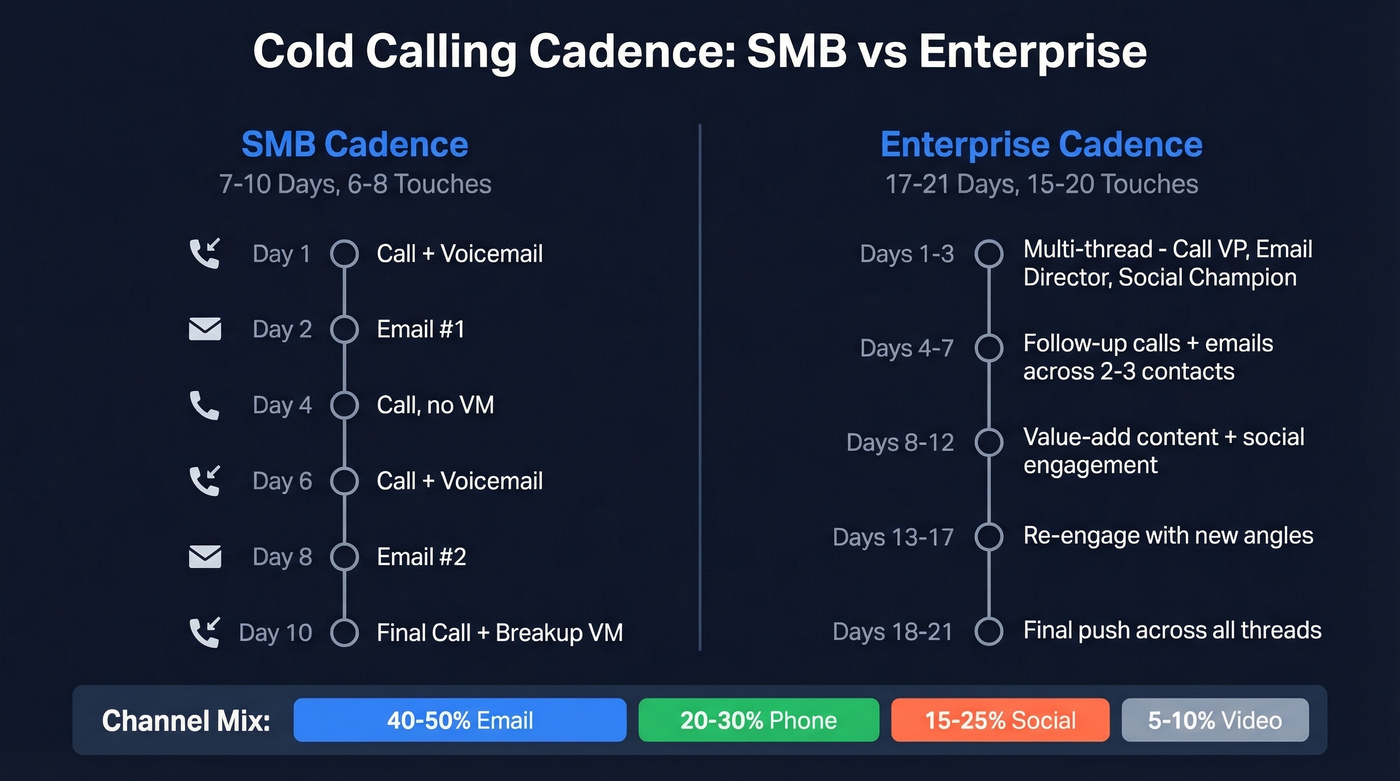
A balanced multi-channel cadence typically runs 40-50% email, 20-30% phone, 15-25% social, and 5-10% video. Phone generates disproportionate response rates even when it's a smaller share of touches.
SMB Cadence (7-10 Days)
| Day | Action | Notes |
|---|---|---|
| 1 | Call + voicemail | Intro VM, under 13 sec |
| 2 | Email #1 | Reference the call |
| 4 | Call (no VM) | Different time of day |
| 6 | Call + voicemail | New angle, same brevity |
| 8 | Email #2 | Value-add or case study |
| 10 | Call + voicemail | Final attempt, breakup |
Six to eight touches over 7-10 days is the sweet spot for SMB. RAIN Group's research shows meetings require 8 touches on average across channels, so don't bail after two unanswered calls.
Enterprise Cadence (17-21 Days)
Enterprise deals involve large buying committees - Gartner puts the average at 7 individuals in 100-500 employee buying decisions, and HubSpot data shows large strategic deals can involve 17+ contacts. Sales cycles now average 6.5 months.
Morgan J Ingram recommends 17-21 days for enterprise cadences, and we've found the same thing in our own campaigns - anything shorter just doesn't give you enough surface area. A 17-21 day enterprise sequence usually needs 15-20 touchpoints to create enough chances to connect across a committee.
Multi-thread from the start: call the VP, email the director, connect with the champion on social. A single-threaded enterprise cadence is a waste of dials.
Adjust for region too. Day-1 triple-touch can feel intrusive in DACH markets, while US prospects typically tolerate faster follow-up.
When the Cadence Ends
Most teams obsess over cadence design and completely ignore exit rules. That's a pipeline leak.
If a prospect opened your emails but didn't reply, move them to a monthly content drip - they're aware of you, and a well-timed piece of content can restart the conversation. Zero engagement across all channels? Archive and revisit in 90 days with a new angle. Dead sequences without exit rules waste future pipeline.
When to Schedule Your Calls
Two windows consistently outperform everything else.
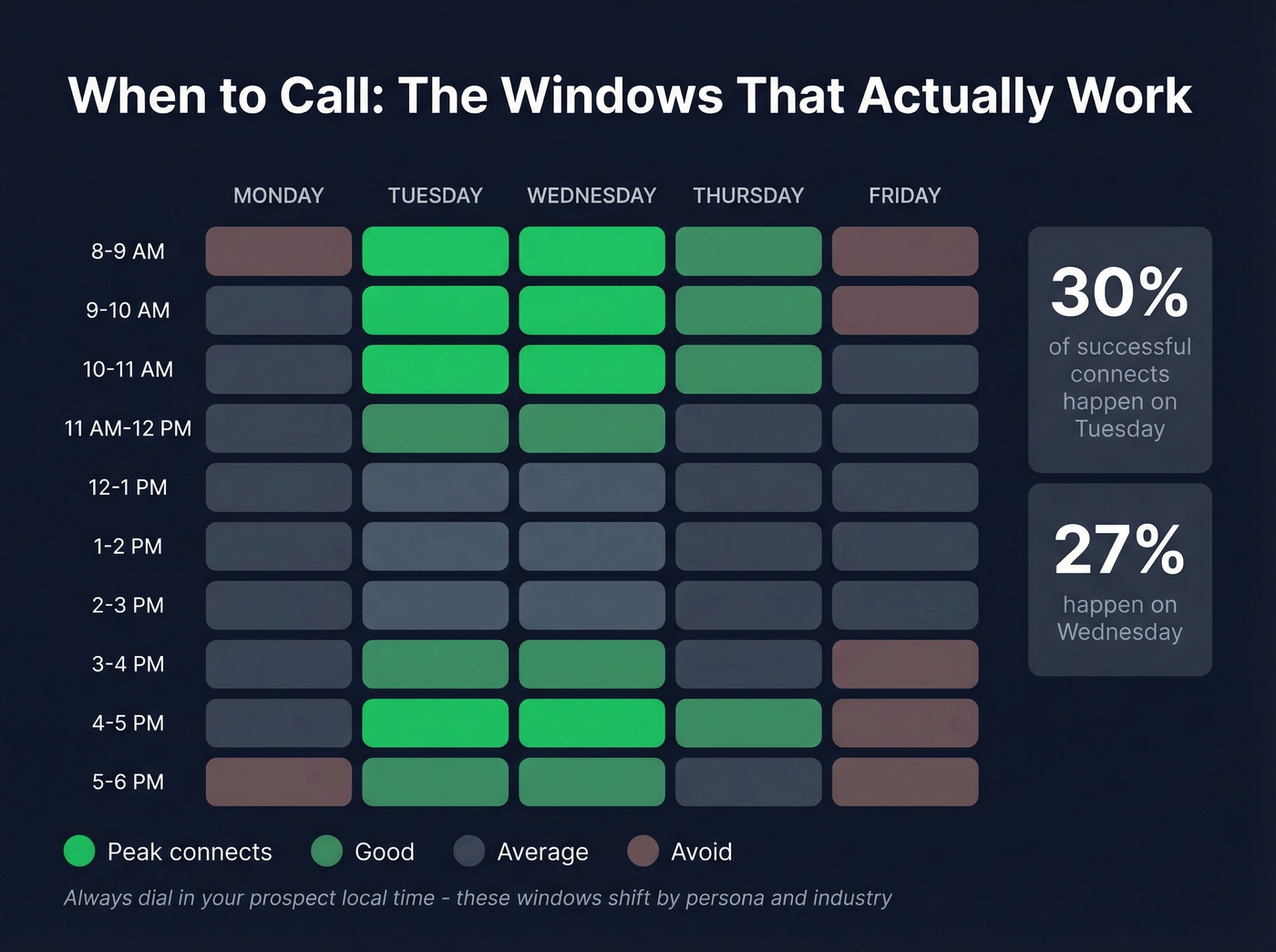
Morning calls between 8-11 AM boost connection rates by about 15% according to InsideSales data analyzed by Revenue.io. Zendesk data corroborates the late-morning window, pinpointing 11 AM-12 PM as another high-connect slot. Revenue.io's own 90-day analysis found peak engagement at 4-5 PM, with the 3-6 PM block strong across SaaS.
Best days: Tuesday pulls a 30% share of successful connects, Wednesday 27% per HubSpot data. Monday and Friday are graveyards.
Here's the thing - these windows shift by industry and persona. We've tested morning-only blocks against afternoon-only blocks across multiple campaigns, and the variance by persona is bigger than the variance by time slot. Block your mornings for one week, your afternoons the next, and compare connect rates. The data gives you a starting point, not a religion.

You just read it: B2B contact data decays at 2.1% per month. A 3-month-old list means 1 in 16 numbers is dead before you even dial. Prospeo refreshes every 7 days - not 6 weeks - and gives you 125M+ verified mobile numbers with a 30% pickup rate. Your cadence can't connect if your numbers don't work.
Stop blaming your cadence. Fix your data first.
How Many Attempts Before You Stop
Connect rates follow a decay curve that's steeper than most reps realize. Dials 1-3 typically connect at around 10%. Dials 4-5 drop to about 5%. After that, you're looking at 1% or less. The practical ceiling is 5 attempts - beyond that, you're burning time you could spend on fresh leads.
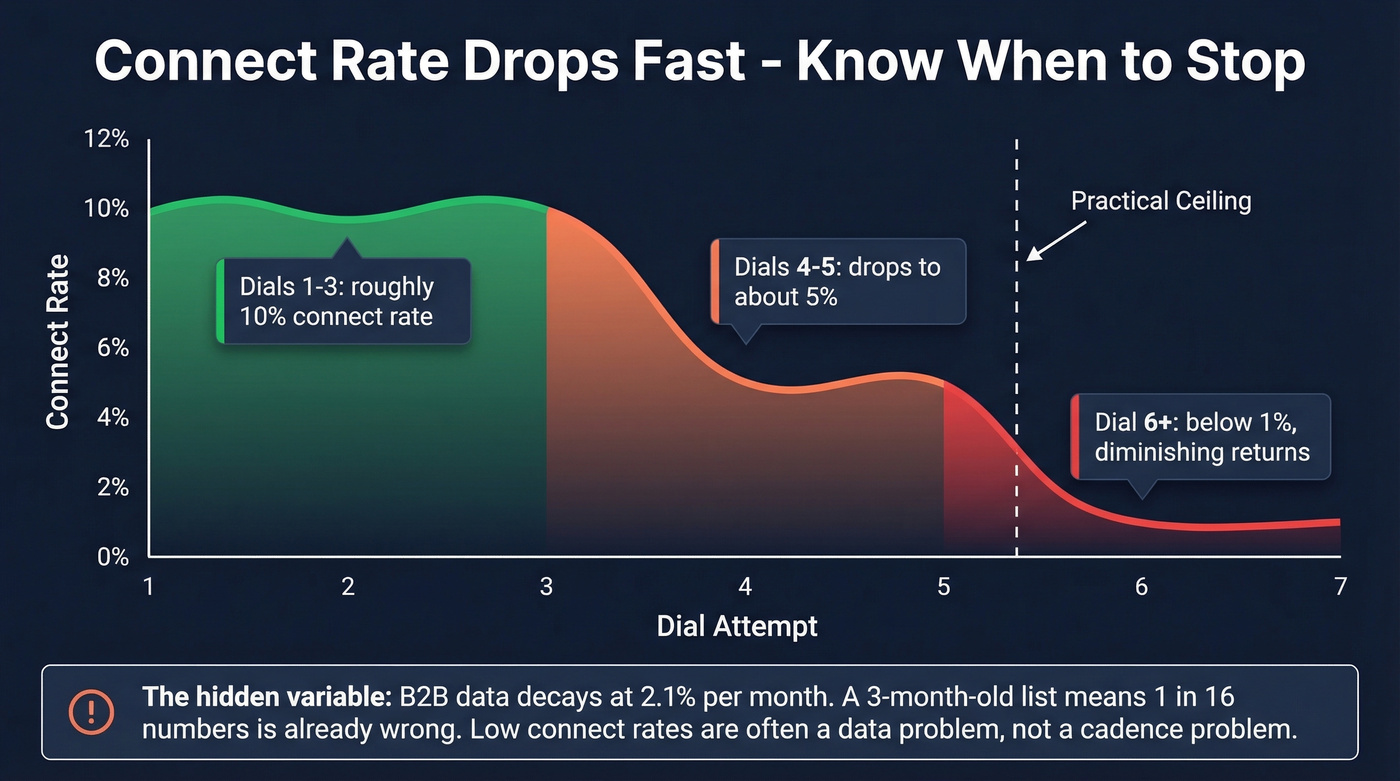
But here's the hidden variable: data quality. B2B contact data decays at 2.1% per month - that's 22.5% annually. If your list is three months old, about 1 in 16 numbers is already wrong. Your "low connect rate" isn't always a cadence problem. It's often a data problem wearing a cadence-shaped disguise.
Let's be honest: if your connect rate is stuck below 5%, redesigning your script or shifting your call window by an hour won't fix it. I've watched teams triple their connect rates just by switching from stale list exports to verified direct dials. No script change, no timing change - just better numbers.
Voicemail Strategy
Most prospects don't listen to your voicemail. They read it. iOS and Android both live-transcribe voicemails now, which means your first impression is a text preview on a lock screen. That changes everything about how you structure the message.
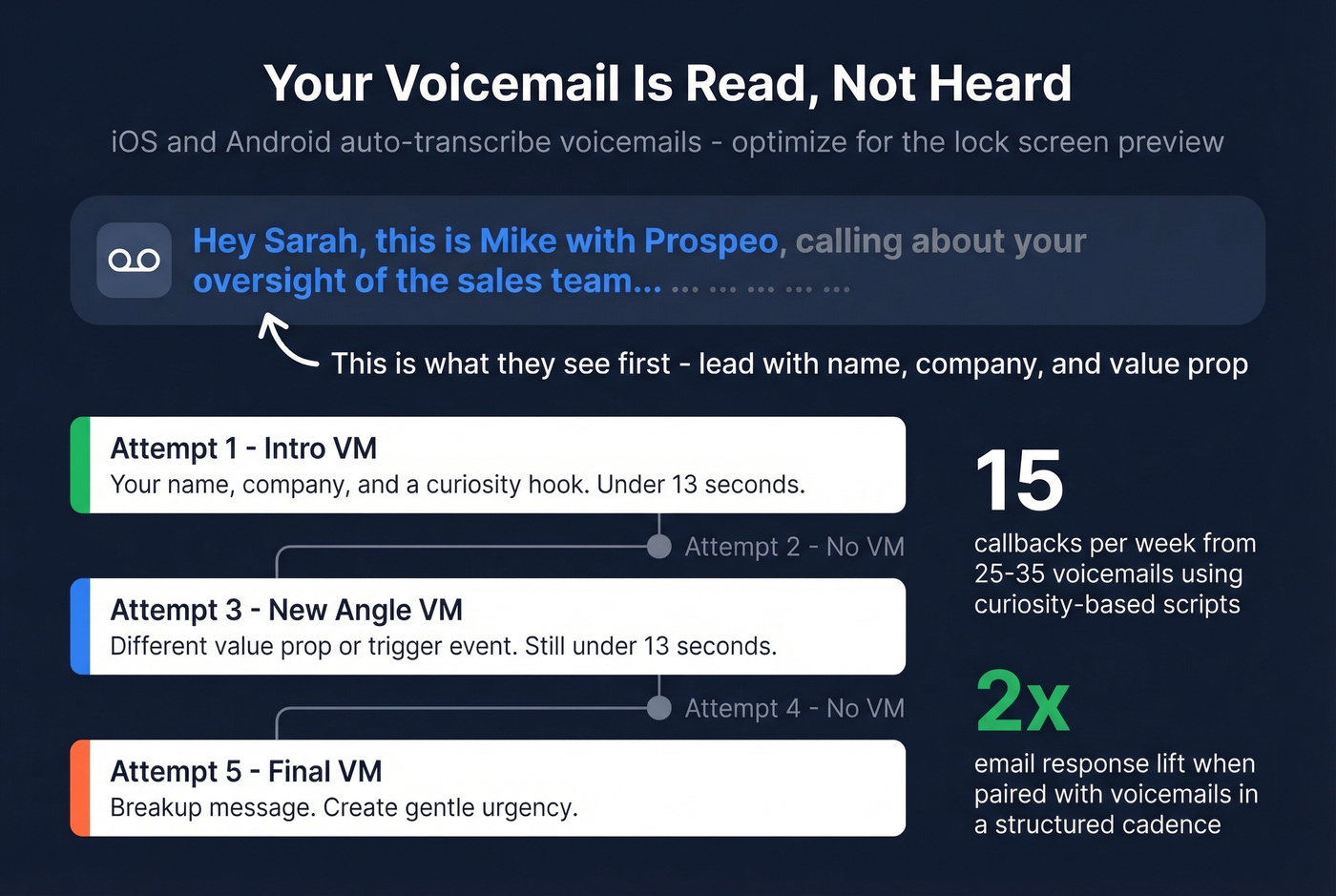
The sweet spot is 8-13 seconds. Lead with your name, company, and value prop in the first 5 seconds - that's what shows up in the transcript preview. Skip the "hope you're doing well" filler. Here's a curiosity-based script that generates callbacks:
"Hey [Name], this is [Your Name] with [Company], calling about your oversight of the [department] team. If you could give me a call back at [number]."
No pitch. No features. One practitioner on r/sales left 25-35 voicemails per week using this approach and got about 15 callbacks. When they call back, open with "Sorry, I'm a bit lost - what do you oversee at [Company] again?" This gets the prospect describing their role and pain points, giving you a natural pivot into your pitch.
Don't leave a voicemail on every attempt. Attempts 1, 3, and 5 build name recognition without becoming noise. Voicemails paired with emails inside a structured cadence can lift email response rates by 2x - the voicemail isn't the conversion event, it's the primer.
Some teams also experiment with a pre-call SMS before the first dial. A short text like "Calling you in 5 min about [topic]" can boost pickups by making the incoming number feel expected rather than random. Skip this if your prospect persona skews senior executive - unsolicited texts to C-suite contacts tend to annoy more than they help.
Tools to Run Your Cadence
Your cadence is a strategy. You still need infrastructure to execute it. Start with your data layer, then pick a sequencer.
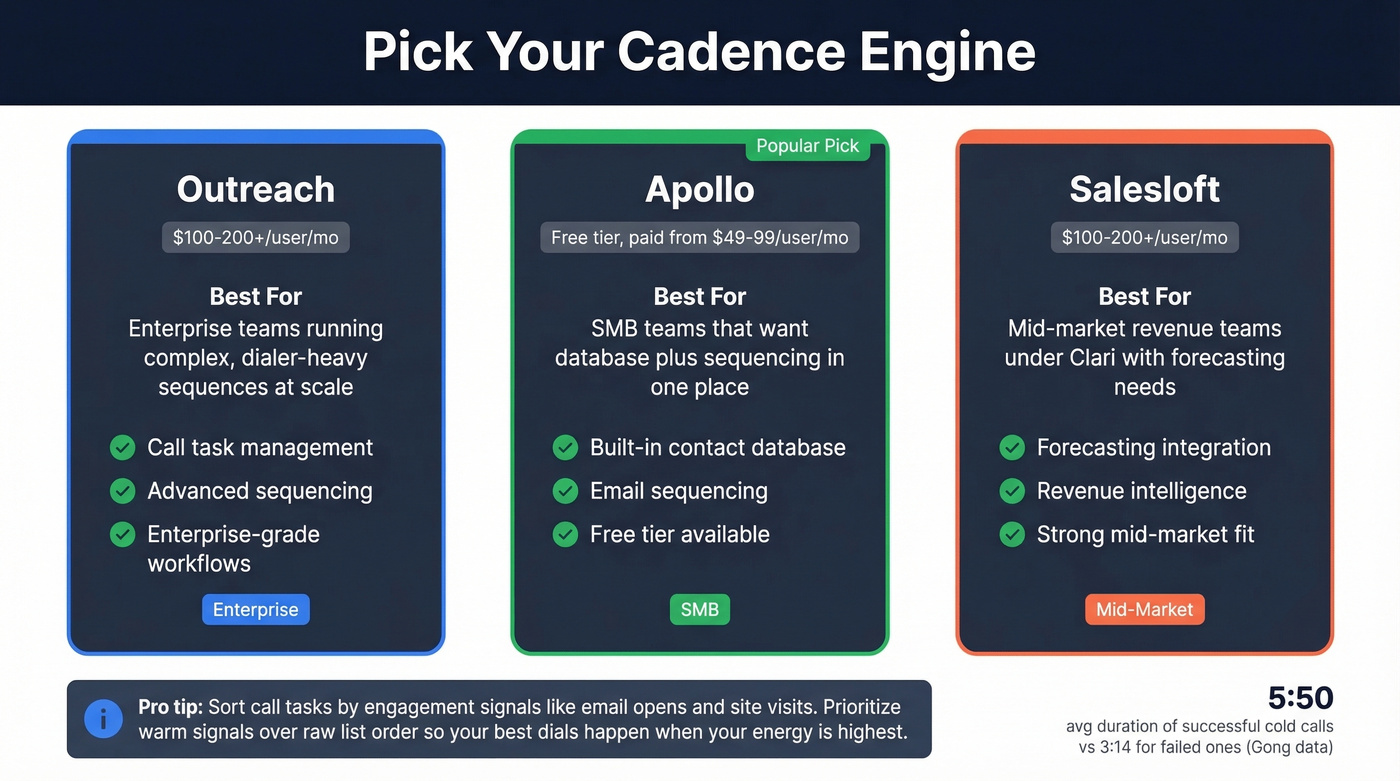
For sequencing, three platforms dominate:
Outreach runs ~$100-200+/user/mo and is the enterprise-grade option with call task management - best for teams running complex, dialer-heavy sequences at scale. Apollo offers a free tier with paid plans from ~$49-99/user/mo, bundling a built-in database with sequencing. It's the obvious starting point for SMB teams that want everything in one place. Salesloft sits at ~$100-200+/user/mo in the mid-market under Clari, with strong forecasting integration for revenue-focused orgs.
Outbound call prioritization also matters inside these tools. Most sequencers let you sort call tasks by engagement signals - email opens, website visits, profile views. Prioritizing warm signals over raw list order means your best dials happen when your energy is highest.
If you're building a full outbound stack, it helps to think in terms of a cold calling system (data + dialer + sequencer + CRM), not just a cadence.
One stat worth keeping in mind: successful cold calls average 5:50 in duration versus 3:14 for failed ones, per Gong's analysis. Your cadence gets the prospect on the phone. What you say in the first minute determines whether you get the other four.
You've got 5 attempts per prospect before connect rates hit the floor. Don't waste a single dial on a wrong number. Prospeo's verified direct dials at 98% accuracy and $0.01 per email mean your cadence reaches real buyers - not voicemail boxes attached to recycled numbers.
Make every dial in your cadence count with data that's 7 days fresh.
FAQ
How many touchpoints should a cold calling cadence have?
Plan for 6-8 touchpoints for SMB and 15-20 for enterprise prospects. RAIN Group's research shows meetings require 8 touches on average across channels. Most reps quit after 2-3 attempts, which is exactly why persistence wins.
What's a good connect rate for cold calls in 2026?
A realistic baseline is 5-10% on raw lists. Teams using verified direct dials report pickup rates around 30%. If you're consistently below 5%, audit your data quality before blaming your reps or your script.
Should I leave a voicemail on every attempt?
No. Leave voicemails on attempts 1, 3, and 5 - enough to build name recognition without becoming noise. Keep them under 13 seconds and lead with your value prop, since most prospects read the auto-transcript rather than listening.
What's the best call retry strategy?
Space retries 2-3 days apart and vary the time of day - if your first attempt was morning, try late afternoon next. This ensures you're catching prospects in different parts of their routine. After 5 attempts with no connection, move on and revisit in 90 days with a fresh angle.