

Cold Email in 2022: The Data, the Tactics, and What's Changed Since
Your cold email 2022 playbook worked - until it didn't. You didn't change anything, but the inbox providers did.
What You Need (Quick Version)
In 2022, cold email success was measured by open rates. Apple MPP killed reliable open tracking, and in February 2024 Gmail and Yahoo started enforcing bulk-sender requirements like SPF/DKIM/DMARC. Reply rate replaced opens as the metric worth watching. If you're still running a 2022 playbook, fix three things in this order: data quality, domain infrastructure, then copy.
The State of Outreach in 2022
A Hunter survey of 440 users gives us the best snapshot of what cold outreach actually looked like that year. The headline: 54.4% of practitioners said outreach had gotten harder over the prior twelve months. Even then, the writing was on the wall.
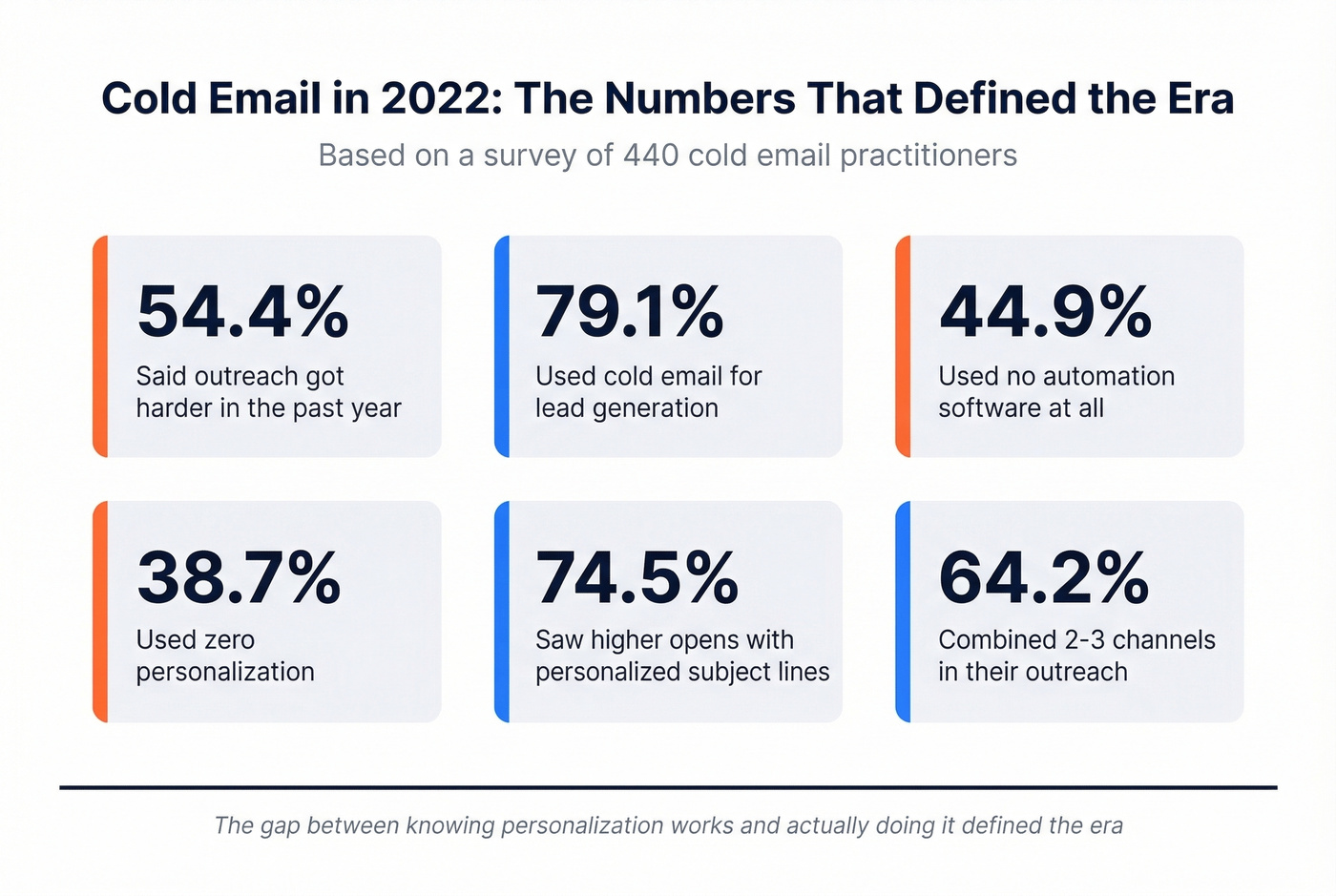
The primary use case was lead generation (79.1%), followed by networking (33.5%) and link building (18.3%). Nearly 45% of senders weren't using any automation software - still running campaigns from spreadsheets and manual sends. 53.1% reported open rates below 30%, while 74.5% saw higher opens when they personalized subject lines. Yet 38.7% used zero personalization at all. That gap between "knowing personalization works" and "actually doing it" defined the era. Most teams (72.9%) spent just 1-10 hours per month managing campaigns.
Tools were simpler. In one popular 2022 tool thread, Apollo was cited at $99/month for unlimited emails. Woodpecker and Lemlist handled sequencing. On r/sales, practitioners shared blueprints that look quaint now: prospect lists of 800-1,000 contacts, emails under 125 words, subject lines around three words and kept under roughly 60 characters to avoid truncation, sequences capped at five stages. Only 19.9% sent on weekends, and 64.2% combined two or three channels, with phone a distant second to email.
| 2022 Metric | Number |
|---|---|
| Open rate < 30% | 53.1% of senders |
| No automation | 44.9% |
| No personalization | 38.7% |
| 2-3 follow-ups | 39.8% |
| Multi-channel | 64.2% |

In 2022, 38.7% of senders used zero personalization and nearly half ran campaigns from spreadsheets. The teams hitting 10%+ reply rates in 2026 start with verified data - not better copy. Prospeo refreshes 300M+ profiles every 7 days, so you're never sending to a job someone left two years ago.
Stop sending to dead inboxes. Start with data that's 7 days fresh.
Why Those Tactics Broke
The cracks started before 2022 even began. Apple released Mail Privacy Protection in September 2021, prefetching tracking pixels regardless of whether someone actually opens your email. Campaign Monitor's analysis of 100+ billion emails showed the result: average open rates appeared stable at 21.5%, but only because Apple MPP was artificially inflating them. Click-to-open rates fell to 10.5%, exposing the gap. The KPI everyone obsessed over became meaningless overnight.
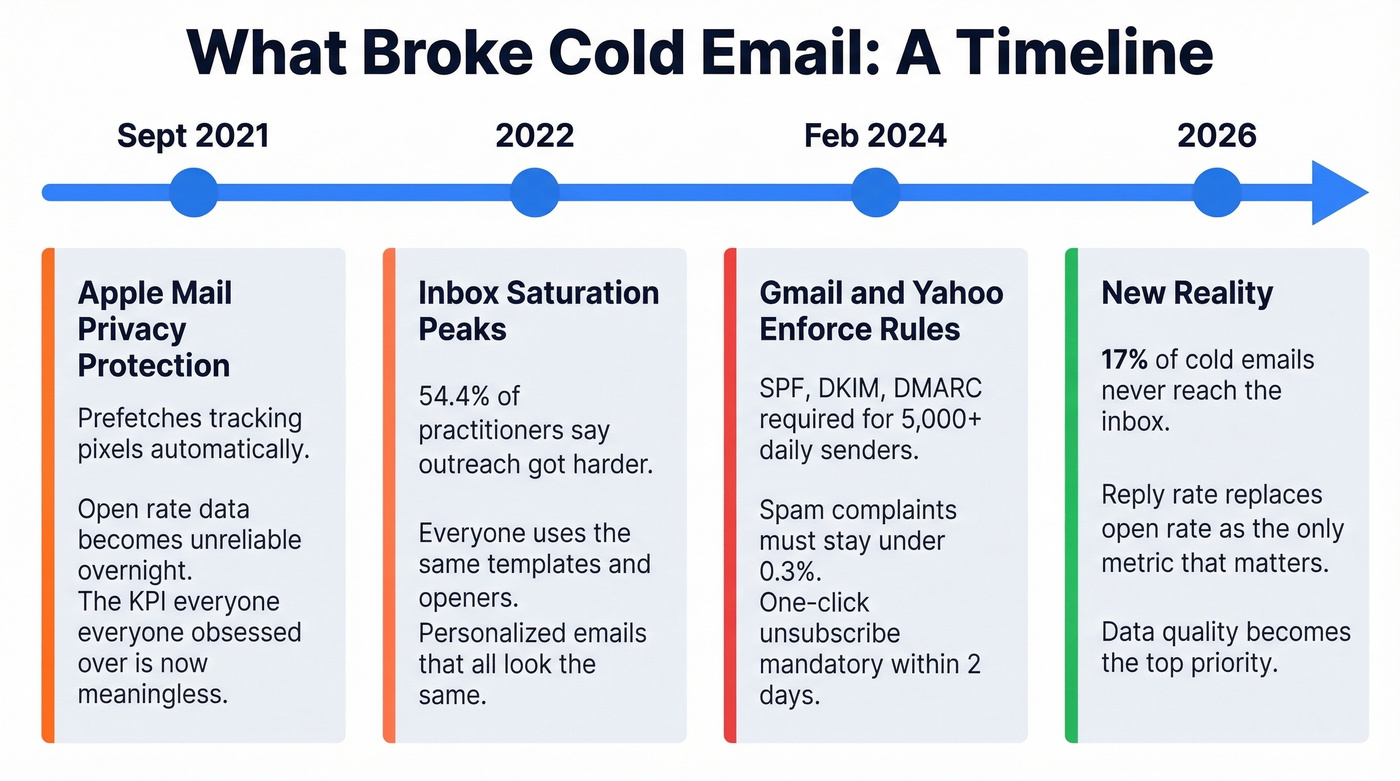
Then came real enforcement. In February 2024, Gmail and Yahoo drew a line: senders pushing more than 5,000 emails per day needed SPF, DKIM, and DMARC authentication, one-click unsubscribe honored within two days, and spam complaint rates under 0.3%.
Inbox saturation compounded everything. As one r/coldemail poster put it: "personalized emails that all look the same." Everyone adopted the same templates, the same "I noticed your company..." openers, the same sequences. When everything sounds personalized, nothing feels personal. Today, roughly 17% of cold emails never reach the inbox at all.
2022 vs 2026 Benchmarks
| Dimension | 2022 | 2026 |
|---|---|---|
| Success metric | Open rate | Reply rate |
| Avg reply rate | 1-5% | 3.43% |
| Daily volume | Higher-volume sending common | 10-20 targeted |
| Personalization | 38.7% used none | Table stakes |
| Follow-ups | 2-3, same thread | 1-2, new angle each |
| Tools | Woodpecker, Lemlist, Apollo | Instantly, Smartlead, verified data |
| Domain setup | Optional | Non-negotiable |
| Top performers | Unknown | 10.7%+ reply rate |
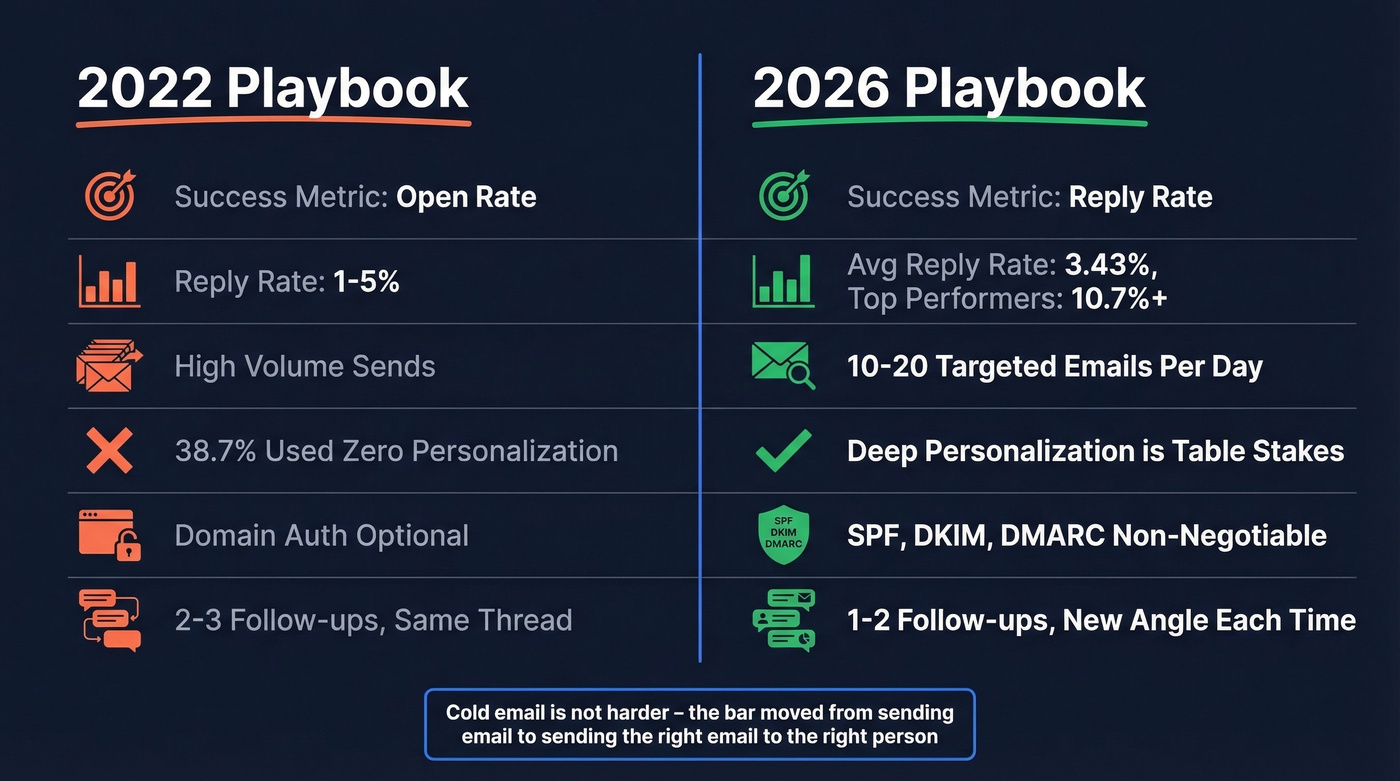
In 2022, you could get away with measuring success by who opened. In 2026, the Instantly benchmark report - built on billions of cold email interactions - shows 58% of replies come from the first email, and top performers keep first touches under 80 words. The teams exceeding 10% reply rates aren't sending more. They're sending better.
Here's the thing: cold email isn't harder in 2026. The bar just moved from "can you send email" to "can you send the right email to the right person." If your deal size justifies the effort and your list is clean, cold email still prints pipeline. The people calling it dead are the ones who refuse to update their playbook.
Modernizing Your 2022 Playbook
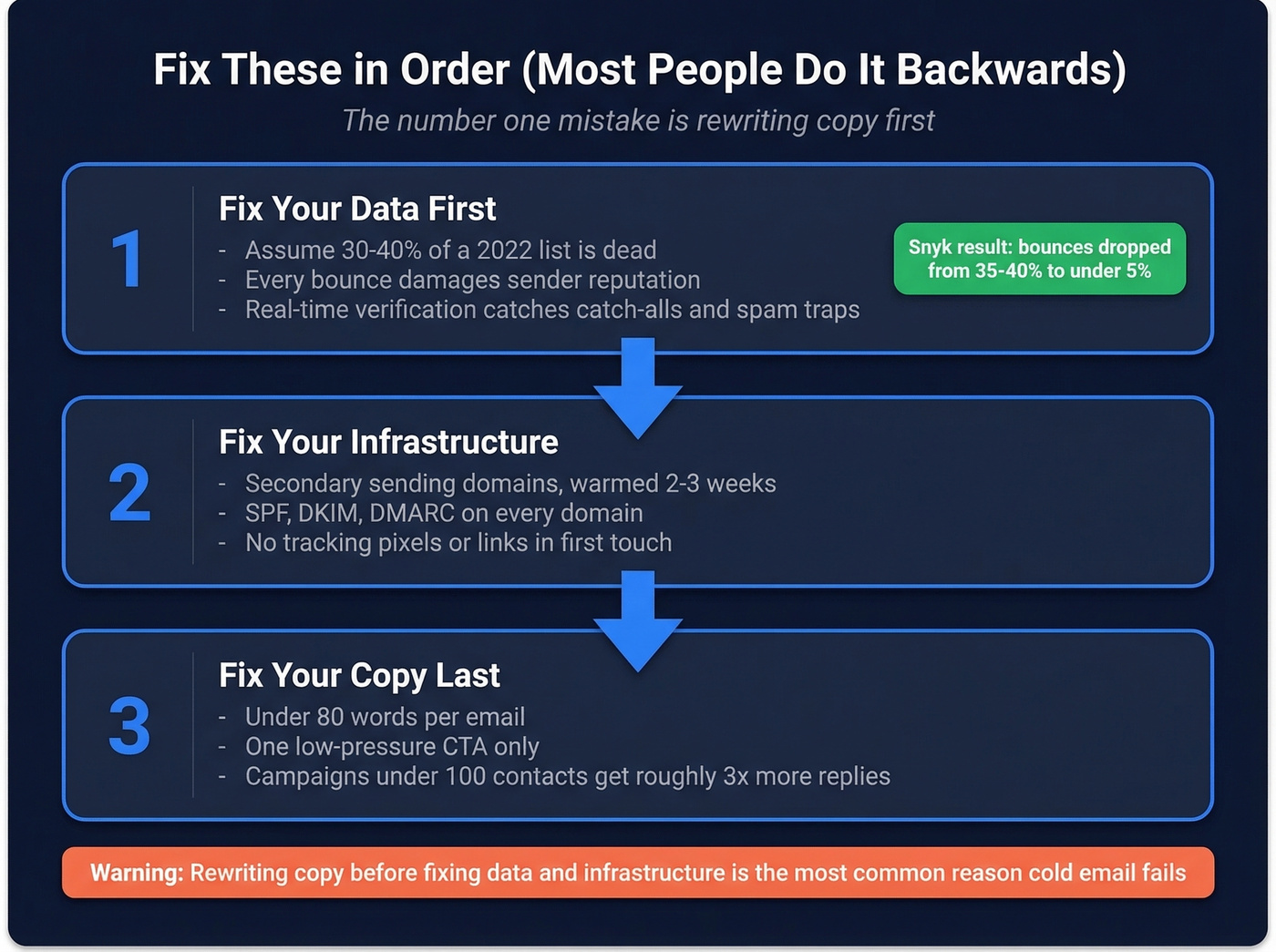
Most people do this backwards. They rewrite copy first, wonder why nothing improves, then blame "cold email being dead." Let's break this down in the right order.
Fix Your Data First
If your prospect list is from 2022, assume 30-40% of it is dead. Job changes, company closures, domain migrations - three years is an eternity in B2B contact data. Every bounced email damages your sender reputation, and we've seen domains quietly get burned within days when teams skip verification.
One of our customers, Snyk, had 50 AEs prospecting 4-6 hours a week with bounce rates of 35-40%. After switching to Prospeo's real-time verification, bounces dropped under 5% and AE-sourced pipeline jumped 180%. That's not a copy problem or a targeting problem - it's a data problem. Run your old list through verification before sending a single message.

Fix Your Infrastructure
Secondary sending domains are non-negotiable now. Warm them for 2-3 weeks before any outbound. Set up SPF, DKIM, and DMARC on every domain - Gmail and Yahoo will reject or spam-folder you without them. No tracking pixels in cold emails. Avoid links or images in your first touch. In our experience, teams that skip warmup lose more time recovering burned domains than they would've spent doing it right.
Fix Your Copy Last
Copy is the last lever, not the first. Once data and infrastructure are solid, keep emails under 80 words. One low-pressure CTA - "Worth a conversation, or not a priority right now?" - works better than calendar links and feature lists. Campaigns under 100 contacts generate roughly 3x more replies than mass sends.
For teams still running a 2022-era approach, there's one more blind spot: multichannel isn't optional anymore. In 2022, 64.2% already combined email with at least one other channel. In 2026, strong sequences layer in at least one non-email touchpoint - whether that's a direct call or a connection request - to break through inbox noise. Skip this if your ACV is under $5K and you don't have the bandwidth; for everyone else, it's where the extra 3-5% reply rate lives.
2022 was the last year you could get away with volume-first cold outreach. The playbook that replaced it isn't harder. It's just different. Better data in, better replies out.
Snyk's 50 AEs cut bounce rates from 35-40% to under 5% and grew AE-sourced pipeline 180% - by fixing data quality first. Prospeo delivers 98% email accuracy at $0.01 per email with no contracts, no sales calls, and a free tier to prove it works before you commit.
Your 2022 playbook failed because the data rotted. Fix that in minutes.
FAQ
Why did cold email 2022 tactics stop working?
Three shifts killed the old playbook: Apple MPP made open rates unreliable in late 2021, Gmail and Yahoo enforced bulk-sender authentication in 2024, and inbox saturation turned templated personalization into background noise. Reply rate - not opens - is now the only metric that matters.
Is cold outreach still effective in 2026?
Average reply rates sit at 3.43%, and top performers exceed 10%. The difference isn't volume or clever subject lines - it's verified data, proper domain infrastructure, and tight targeting. Teams pairing 7-day-refresh data with tools like Instantly or Smartlead consistently keep bounce rates under 4%.
How do I fix a prospect list from 2022?
Assume 30-40% of addresses are dead after three years. Run every contact through a real-time verification tool that catches catch-all domains, spam traps, and honeypots - basic checkers miss these. Bad data burns domains faster than bad copy, and a burned domain takes weeks to recover.