

The Cold Email Outreach Playbook That Runs Like an Ops System, Not a Copywriting Exercise
Decision-makers get about 15 cold emails per week. 71% are ignored for lack of relevance. Your sequence last quarter probably died the same way - open rates looked decent for a few days, then deliverability collapsed in week two. Bounces spiked, replies dried up, and your sending domain started landing in spam.
The sequence wasn't the problem. The infrastructure was.
Most guides start with templates and subject lines. This cold email outreach playbook starts where it should: deliverability, list quality, and the operational gates that determine whether your emails even reach an inbox. Copy matters, but it's the final step - not the first. Whether you're building an SDR workflow from scratch or overhauling an existing BDR outreach process, the system is the same.
What You Need Before Anything Else
Here's the priority stack:
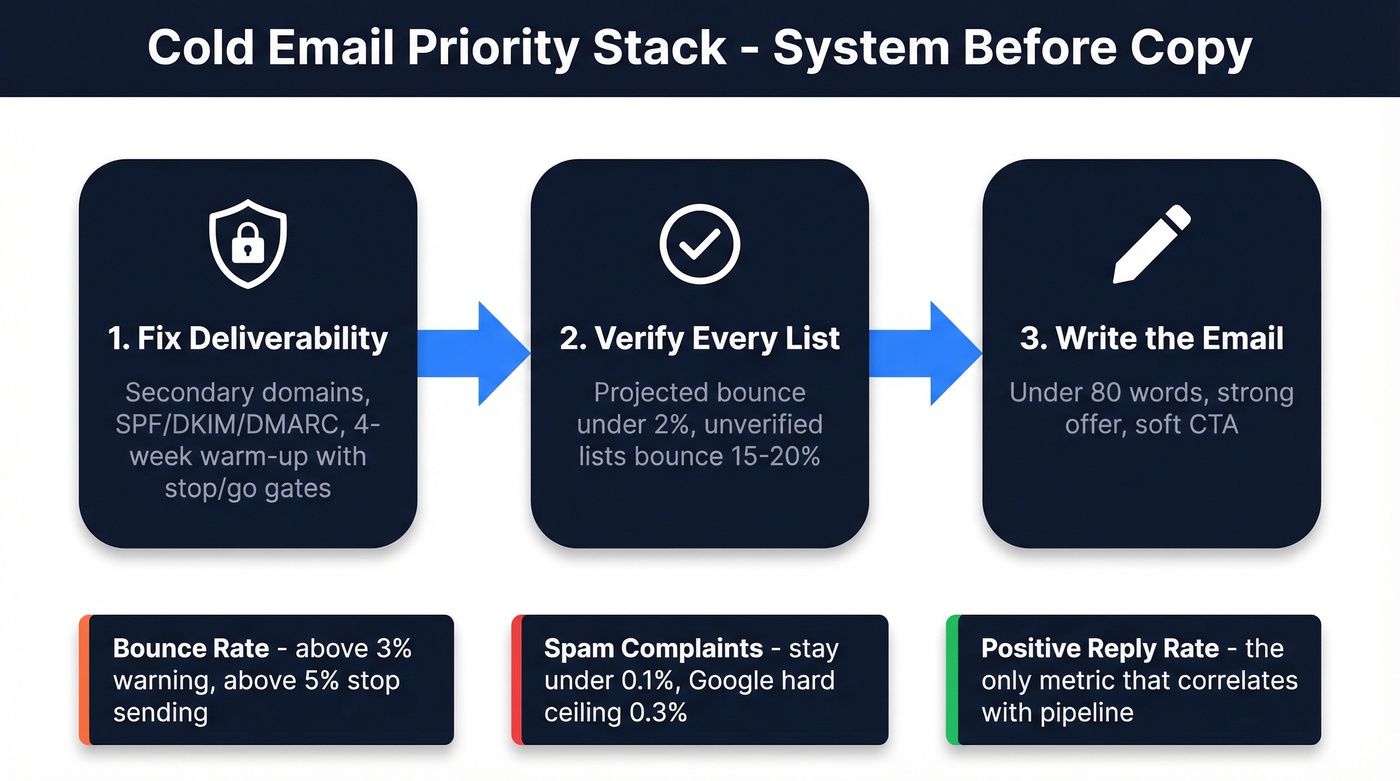
- Fix deliverability first. Secondary domains, SPF/DKIM/DMARC, a 4-week warm-up with stop/go gates. Skip this and nothing else matters.
- Verify every list before sending. Projected bounce must be under 2%. Unverified lists from some enrichment sources bounce 15-20%.
- Write under 80 words with a strong offer and a soft CTA. Personalization won't save a weak offer.
Three metrics to watch daily:
- Bounce rate - above 3% is a warning; above 5%, stop sending.
- Spam complaint rate - stay under 0.1%. Google's hard ceiling is 0.3%.
- Positive reply rate - the only metric that correlates with pipeline. Open rates are a weak optimization signal in 2026.
2026 Benchmarks for SDR Email Performance
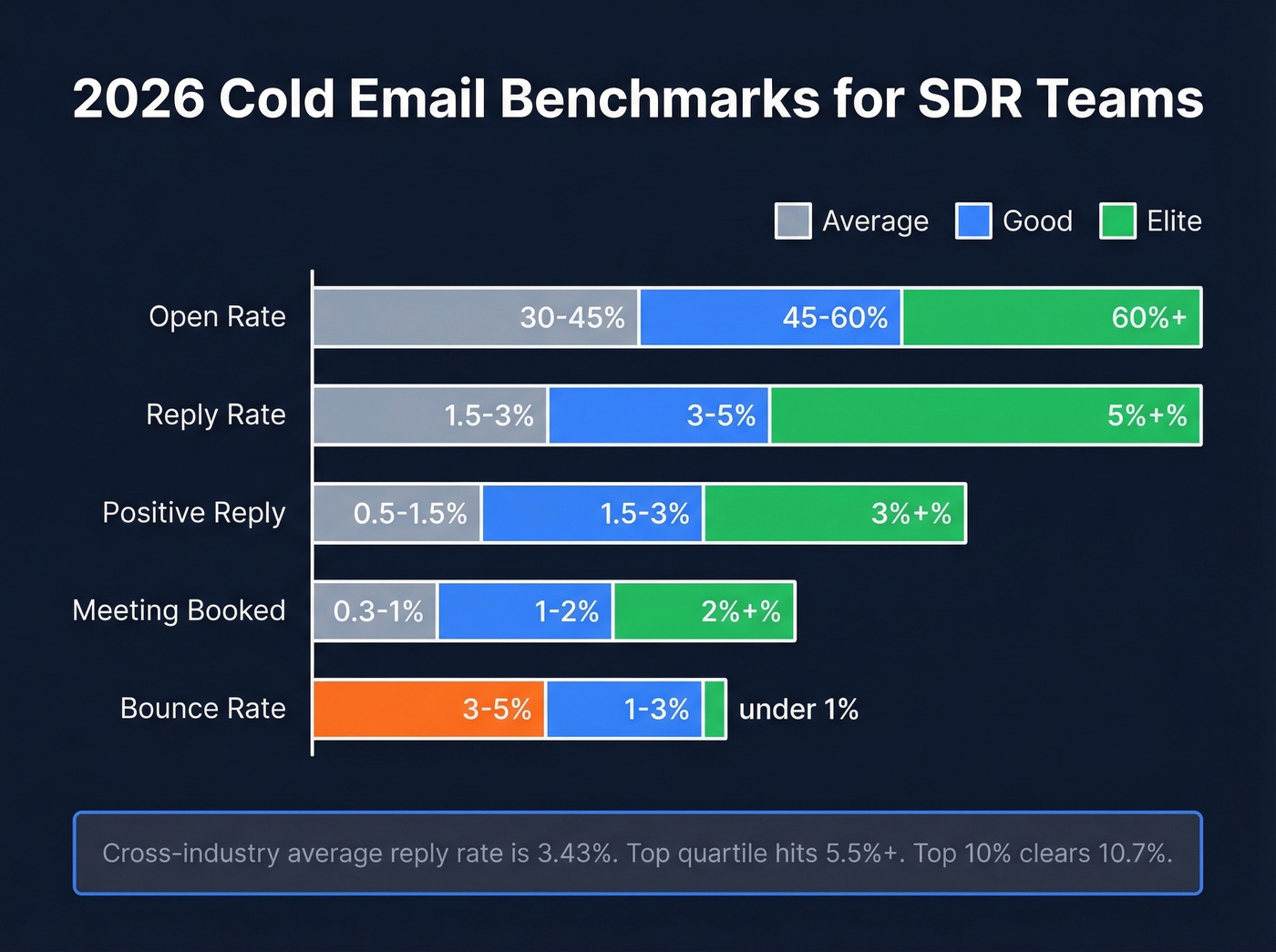
Here's what good actually looks like, based on analysis of billions of cold email interactions and SaaS-specific benchmark data:
| Metric | Average | Good | Elite |
|---|---|---|---|
| Open rate | 30-45% | 45-60% | 60%+ |
| Reply rate | 1.5-3% | 3-5% | 5%+ |
| Positive reply | 0.5-1.5% | 1.5-3% | 3%+ |
| Meeting booked | 0.3-1% | 1-2% | 2%+ |
| Bounce rate | 3-5% | 1-3% | <1% |
Ranges reflect SaaS/tech benchmarks; the cross-industry average reply rate is 3.43%. Top quartile teams hit 5.5%+. The top 10% clear 10.7%.
If you're under 2%, don't touch your copy. Fix your list quality and deliverability first.
SMB-focused campaigns see 20-40% higher reply rates than enterprise campaigns because enterprise prospects have fuller inboxes and tighter filtering. If you're targeting mid-market or below, the benchmarks above are conservative.
Here's the thing: if your average deal size is under $10K, you probably don't need a $30K/year data platform. A $40/month sending tool and verified lists will outperform an enterprise stack that nobody on your team fully uses.
Deliverability Is the Constraint
Google blocks roughly 15 billion undesired emails daily. Since the February 2024 bulk-sender enforcement, the November 2025 Gmail tightening, and Microsoft's similar Outlook.com enforcement in May 2025, SPF, DKIM, and DMARC aren't optional - they're mandatory. One-click unsubscribe is required. Spam complaints must stay under 0.3%, and Google recommends under 0.1%.
Infrastructure Checklist
- Secondary domains only. Never send cold email from your primary domain. Buy 2-3 dedicated domains and set up 2-5 inboxes per domain.
- SPF/DKIM/DMARC passing. Test via MXToolbox before sending a single email. Start DMARC at
p=none, move toquarantine, thenrejectas you build confidence. - Google Workspace or Outlook. Other providers typically cap you lower.
- Domain aged 7-14 days minimum before starting warm-up.
- Plain text only for the first 2-3 weeks. No tracking pixels, no HTML, no images.
4-Week Warm-Up Schedule
| Week | Volume/Day | Key Rules |
|---|---|---|
| 1 | 5 to 25 | Send to engagers only. 90%+ opens, 50%+ replies, 0 complaints. Space sends 2-3 min apart. |
| 2 | 25 to 50 | Pause if opens drop below 40% or any complaint appears. Reduce weekends 50-70%. |
| 3 | 75-100 | Mix in cold prospects. Never exceed 2x day-over-day volume increase. |
| 4 | 50-100 steady | Maintain 30-40% warm traffic. Some domains need 4-6 weeks - don't rush it. |
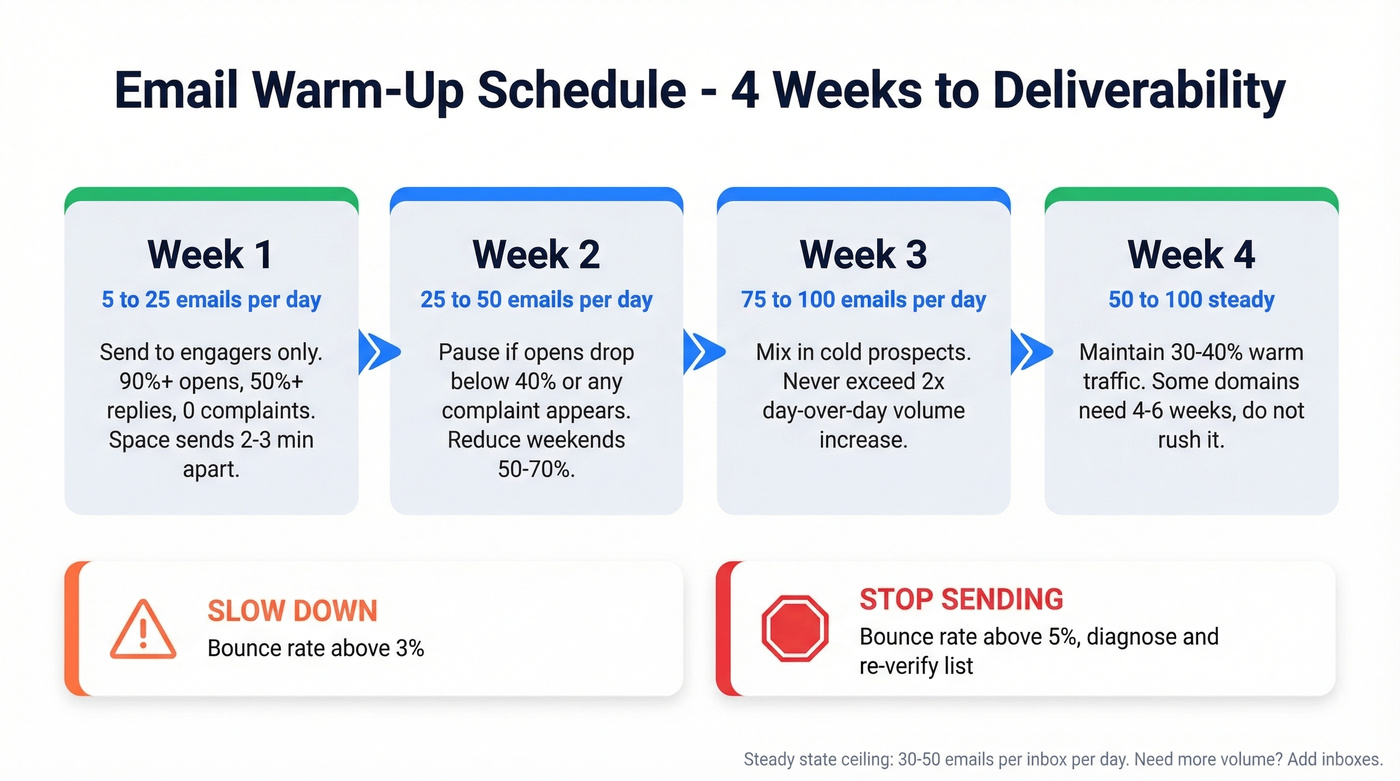
Steady-state sending should be 30-50 emails per inbox per day. That's the ceiling where elite teams operate. If you need higher volume, add inboxes - don't push individual accounts harder.
Stop/go gates during warm-up: bounce rate above 3% means slow down. Above 5% means stop, diagnose, and re-verify your list. These aren't suggestions. They're circuit breakers that protect your domain reputation.
List Building - Verification First
Do This
Build your ICP, then look for signals - funding rounds, leadership changes, hiring surges, new tech adoption. Segment into micro-cohorts of 50 contacts or fewer. Smaller cohorts achieve roughly 2.76x higher reply rates because you can tailor the message to a specific trigger event rather than blasting a generic pitch.
Think contextualization, not personalization. What's happening around the prospect matters more than flattering their bio. The reply rate data backs this up:
- No personalization: 1-3% reply rate
- Basic (name/company/title): 5-9%
- Advanced (industry pain + recent news): 9-15%
- Signal-based (trigger event + tailored value prop): 15-25%
- Multi-signal stacked: 25-40%, though few teams have the enrichment infrastructure to sustain this consistently
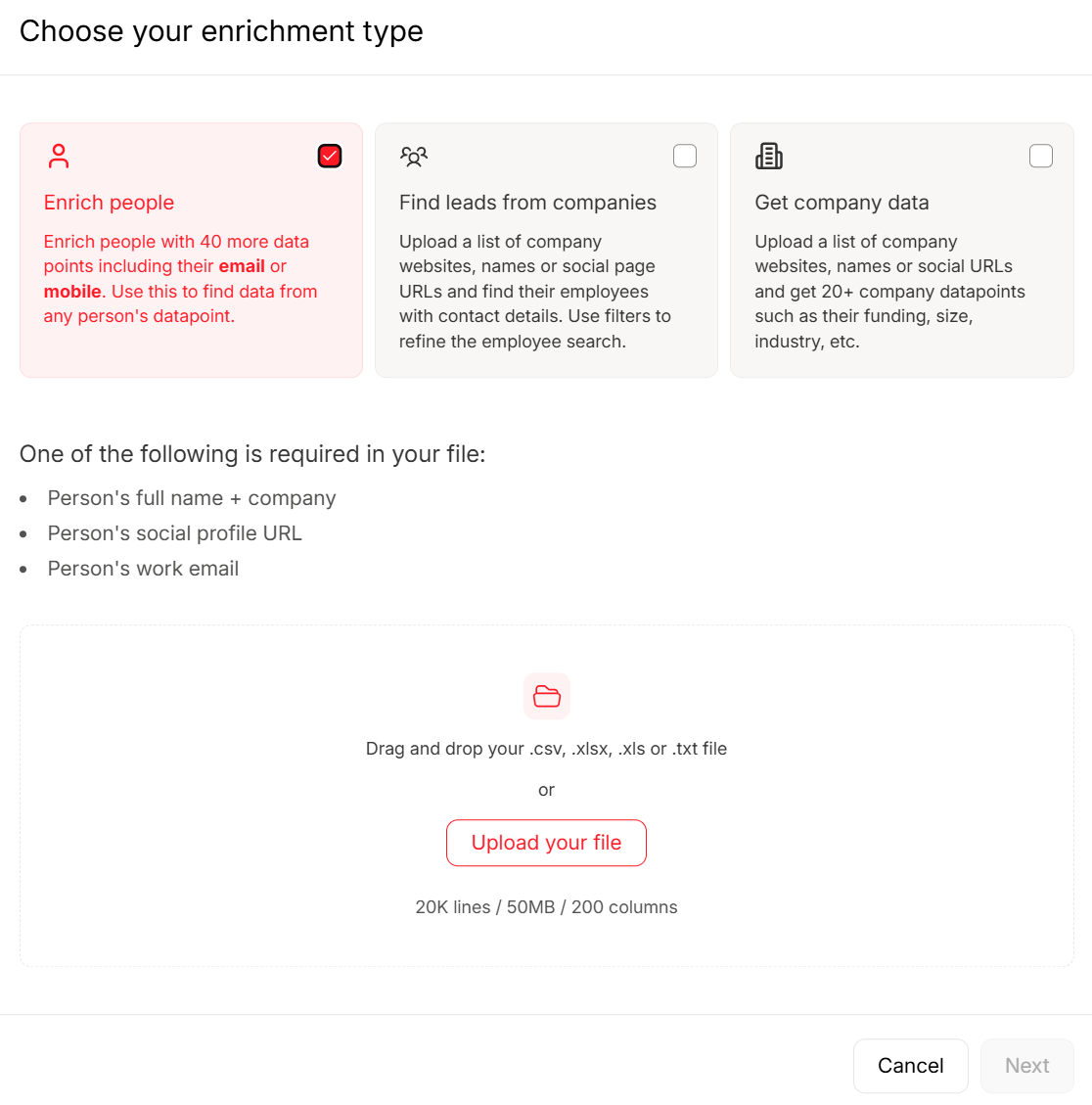
Before you send anything, run your list through a verification tool. We've been running all our verification through Prospeo, which delivers 98% email accuracy on a 7-day refresh cycle with real-time verification. Stack Optimize built from $0 to $1M ARR running all verification through the same platform - 94%+ deliverability, bounce under 3%, zero domain flags across all clients. The free tier gives you 75 verified emails per month, and paid credits run about $0.01 per email. Native integrations with Instantly, Lemlist, Smartlead, HubSpot, Salesforce, and Clay mean verification slots into your workflow without manual CSV shuffling.
Skip This If You Value Your Domains
Don't send to unverified lists. Period. We've seen enrichment sources where 15-20% of emails bounce when you skip verification. That's a domain reputation death sentence in a single campaign. Verification is step zero - not step three.

This playbook won't work if 15-20% of your list bounces. Prospeo's 5-step verification delivers 98% email accuracy on a 7-day refresh cycle - the same infrastructure Stack Optimize used to hit 94%+ deliverability and zero domain flags while scaling to $1M ARR.
Stop burning domains. Verify every email before it sends.
The Sequence Structure
Cadence: The 3-7-7 Rule
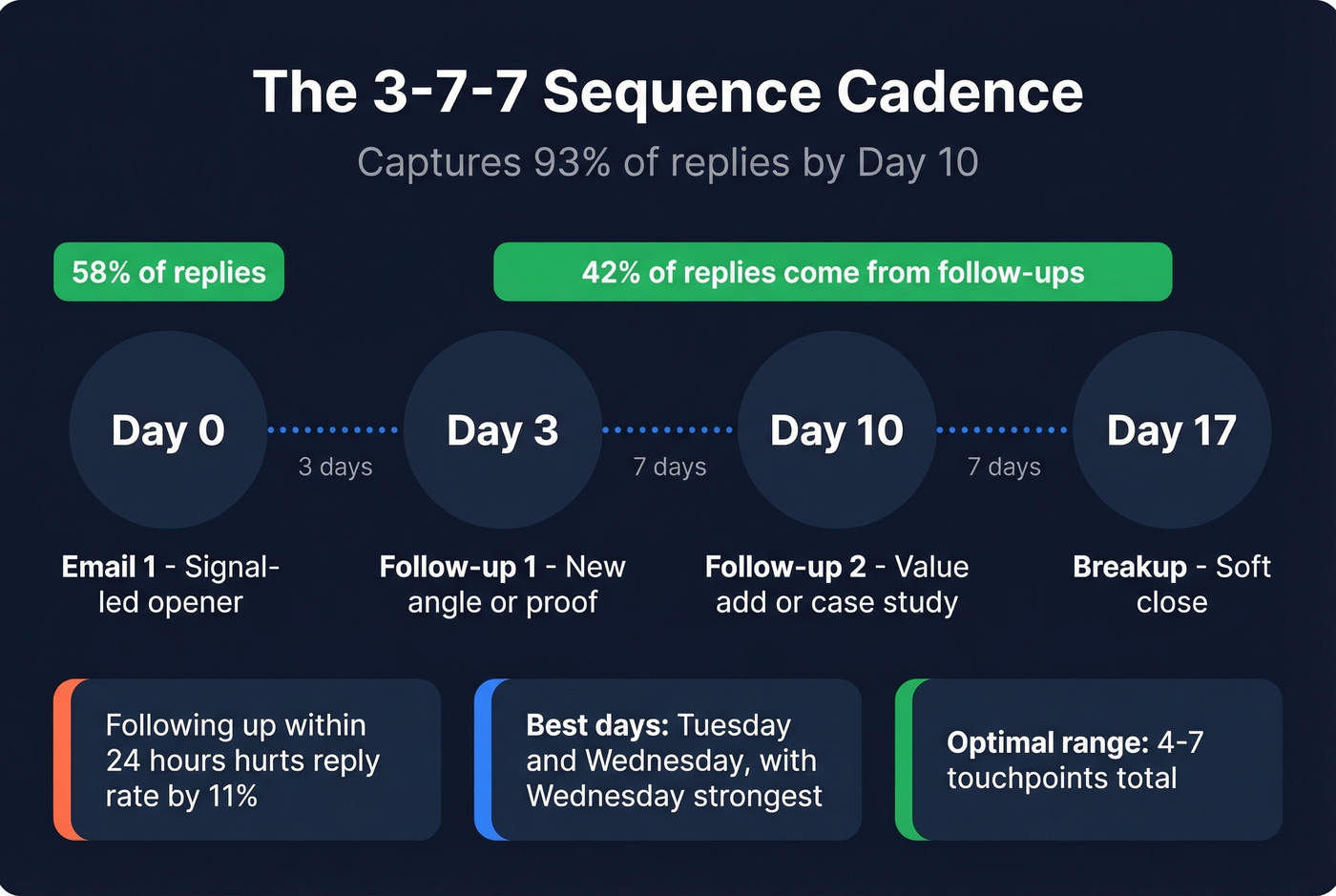
The 3-7-7 cadence captures 93% of replies by Day 10:
| Touch | Day | Purpose |
|---|---|---|
| Email #1 | 0 | Signal-led opener |
| Follow-up #1 | 3 | New angle or proof |
| Follow-up #2 | 10 | Value add or case study |
| Breakup | 17 | Soft close |
58% of replies come from email #1, but 42% come from follow-ups - so don't stop at one touch. The optimal range is 4-7 touchpoints. Beyond that, diminishing returns kick in unless each touch adds genuinely new value.
One critical timing note: following up within 24 hours hurts your chances by roughly 11%. Give prospects breathing room. Tuesday through Wednesday sees peak reply rates, with Wednesday consistently the strongest day.
Copy Rules That Move the Needle
Keep emails under 80 words. Practitioners on r/copywriting push for 40-60 words, sometimes under 30. In practice, emails under 60 words often outperform longer ones - every extra sentence increases deletes. One CTA per email. Low-commitment asks get 2x more replies than aggressive meeting requests.
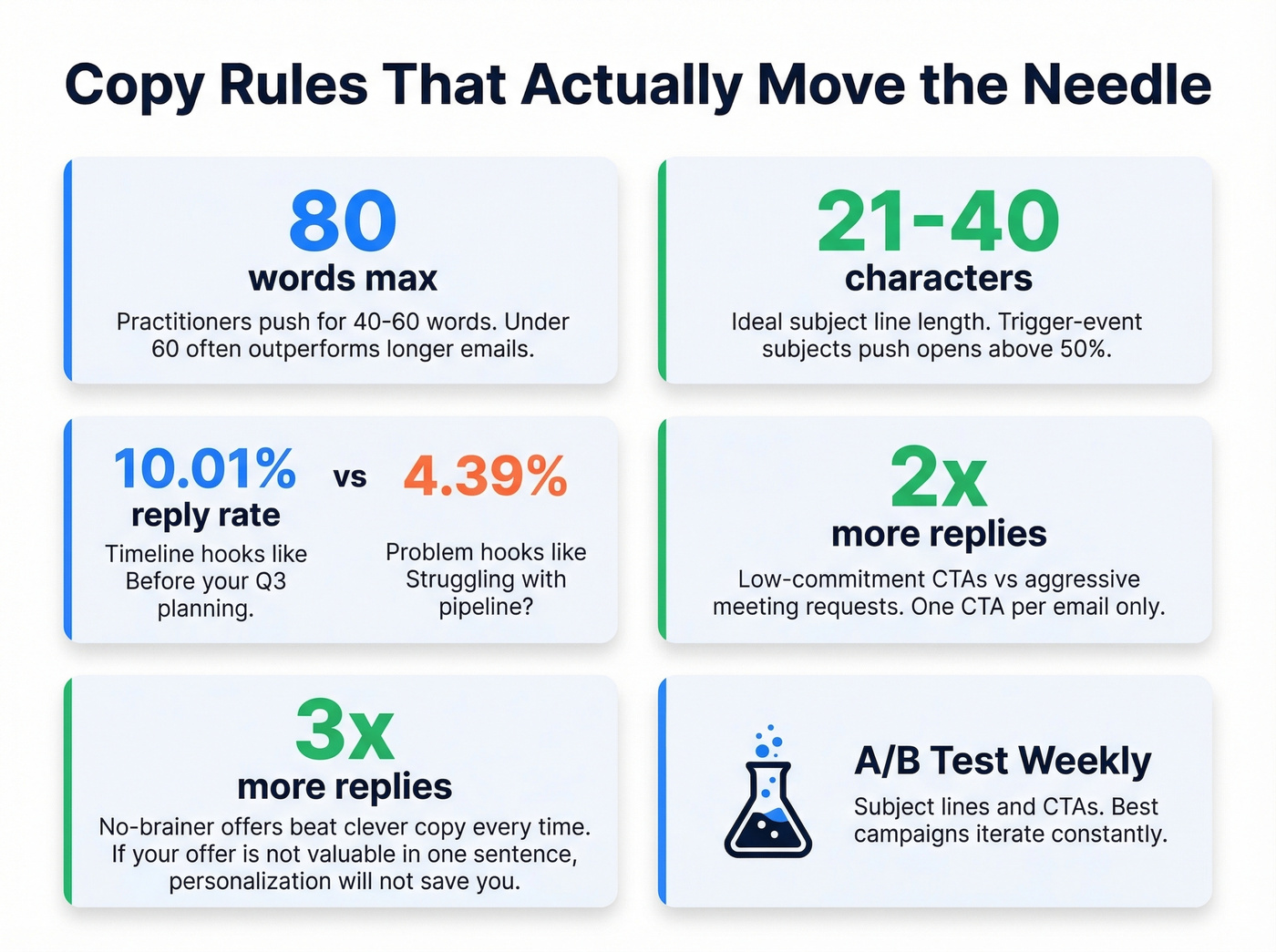
Subject lines between 21-40 characters work best. Trigger-event subject lines can push open rates above 50%. Timeline hooks outperform problem hooks by a wide margin - 10.01% reply rate vs 4.39%. "Before your Q3 planning" beats "Struggling with pipeline?" every time.
The consensus on r/GrowthHacking is blunt: no-brainer offers get 3x more replies than clever copy. If your offer isn't valuable in one sentence, personalization won't save you. A/B test subject lines and CTAs weekly - the best-performing campaigns iterate constantly.
Template Examples
Signal-led opener (52 words):
Subject: [Company]'s new [role] hire
Hi [First name],
Saw you just posted a [role title] opening - usually means [specific implication, e.g., "outbound is scaling faster than your current stack can handle"].
We helped [similar company] cut their list-building time by 60% when they hit the same inflection point.
Worth a conversation?
Breakup email (34 words):
Subject: closing the loop
Hi [First name],
I've reached out a few times - no worries if the timing's off.
If [specific pain point] becomes a priority, happy to share what's working for [industry] teams.
The template structure matters less than the offer inside it. A mediocre template with a genuinely valuable offer - free audit, personalized insight, relevant data - will outperform a beautifully crafted email pitching a generic demo every single time.
Building a Cold Emailing System
Cold email isn't a solo activity - it's an ops function. The best outbound programs treat business development emailing like a production line: verified data goes in, qualified meetings come out, and every step in between is measured.
Let's break this down by ownership. One person manages domain health and warm-up. Another handles list building and verification. Reps focus on writing and iterating sequences. When responsibilities are split this way, no single bottleneck kills the entire pipeline. We've watched teams try to have one SDR do everything - domain setup, list building, copywriting, metric tracking - and the result is always the same: burned domains and missed quota by month two.
Compliance Checklist
Cold email is legal in the US, EU/UK, Canada, and Australia - if you follow the rules.
CAN-SPAM (US): Valid sender name and physical address. Truthful subject lines. Working unsubscribe link honored within 10 business days. Penalty: $50,120 per violation.
GDPR (EU/UK): Requires explicit consent or legitimate interest basis. Penalty: EUR 20M or 4% of global annual turnover, whichever is higher.
CASL (Canada): Express or implied consent required. Unsubscribe mechanism must function for 60 days after sending. Fines up to $10M per violation.
Australia Spam Act: Explicit consent required. Penalties up to $1.1M AUD per violation.
Segment your lists by geography and apply the strictest standard when you're unsure. Include an unsubscribe link in every follow-up, not just the first email. For a deeper look at CAN-SPAM requirements, the FTC's compliance guide is the definitive reference.
Tool Stack and Budget Tiers
You don't need ten tools. You need four categories covered: data sourcing, verification, sending, and CRM.
| Category | Tool | Starting Price |
|---|---|---|
| Sending | Instantly | $37/mo |
| Sending | Lemlist | $63/user/mo (annual) |
| Sending | Saleshandy | $25/mo (annual) |
| Verification | Prospeo | Free (75/mo), ~$0.01/email |
| Data sourcing | Apollo | Free tier, paid ~$49/mo+ |
| Enrichment | Clay | ~$150-500/mo |
| CRM | HubSpot | Free tier available |
Minimal stack for a solo founder or small team: Instantly at $37/mo + free-tier verification. That's under $40/month to run a legitimate cold email operation.
Scaling stack: Full sending platform + paid verification credits + Clay for signal-based enrichment. Budget $300-700/month depending on volume and enrichment tier. At this level, your outbound should be running through a fully automated SDR workflow with daily metric reviews.
30-Day Launch Calendar
| Week | Focus |
|---|---|
| 1 | Buy secondary domains, configure SPF/DKIM/DMARC, start warm-up |
| 2 | Build ICP lists, verify all contacts, segment into micro-cohorts |
| 3 | Launch first sequence (50 contacts), monitor bounce and complaint rates daily |
| 4 | Analyze reply data, A/B test subject lines, scale to additional inboxes |
That's the entire cold email outreach playbook - infrastructure first, copy last, metrics always. The teams hitting 5%+ reply rates aren't writing better subject lines. They're running tighter systems.
Signal-based outreach needs signal-rich data. Prospeo's 30+ filters - buyer intent, job changes, funding rounds, headcount growth - let you build the micro-cohorts this playbook demands. 300M+ profiles, 143M+ verified emails, all refreshed every 7 days. Credits start at $0.01 per email.
Build trigger-based lists that hit 15%+ reply rates.
FAQ
What's a good cold email reply rate in 2026?
The cross-industry average is 3.43%, top quartile hits 5.5%+, and the top 10% exceeds 10.7%. If you're under 2%, fix list quality and deliverability before rewriting copy - bad data is the most common bottleneck.
How many follow-ups should I send?
Four to seven touches using a 3-7-7 cadence: Day 0, Day 3, Day 10, Day 17. 58% of replies come from email #1, but 42% come from follow-ups - stopping at one touch leaves nearly half your pipeline on the table.
Do I need a secondary domain?
Always. Never send cold outreach from your primary domain. Buy dedicated secondaries, configure SPF/DKIM/DMARC on each, and run 2-5 inboxes per domain to protect your main brand's sender reputation.
How do I keep my bounce rate under 2%?
Verify every email before sending. Unverified lists from some providers bounce 15-20%, which tanks domain reputation in a single campaign. A 98% accuracy verification step is the difference between a healthy domain and a blacklisted one.
How much does a full outbound tool stack cost?
A minimal stack starts under $40/month - one sending tool plus free-tier verification. A scaling stack with enrichment, data sourcing, and higher volume runs $300-700/month depending on team size and send volume.