

How to Implement a Sales Engagement Platform Without Wasting 6 Figures
A VP signs a $15K-$40K/year Outreach contract. Six weeks later, three reps are actually using it. The sequences are half-built, the CRM sync is broken, and the bounce rate is torching domain reputation. This isn't a horror story - it's the default outcome when implementing a sales engagement platform without a plan. Roughly 30-50% of deployments underperform, and the root cause is almost never the technology itself.
Forrester has rebranded the category around Revenue Orchestration Platforms, blending engagement, conversation intelligence, and RevOps - meaning these tools are more powerful and more complex to roll out. Deals closed within 50 days carry a 47% win rate; after that, it drops below 20%. A botched implementation that delays your team by even a month has real pipeline consequences.
What You Need Before Go-Live
The first step isn't choosing a platform. It's auditing your data.
Clean your data first. Verify emails, dedup your CRM, standardize fields. A platform built on dirty data just automates failure faster. Follow a 90-day phased rollout - Discovery, Build, Deploy. Don't try to go live in two weeks. And measure from day one. Set 30/60/90-day KPIs like pipeline velocity, connection rate, and win rate before you configure a single sequence.
The Readiness Assessment
Before you touch vendor demos, run an honest self-assessment. Clari's implementation framework outlines five areas worth evaluating: current state, change management plan, sales strategy and content, team skill level, and lead management workflow.
That last one matters more than people think. If you don't have buyer personas mapped to cadences and a lead scoring model that surfaces in-market accounts, you're automating chaos. Build the strategy before you automate it. One Reddit practitioner put it bluntly: "simplicity and implementation time are paramount," especially for SMB teams without dedicated ops resources.
Complexity scales with company size. Companies under 50 employees use roughly 16 SaaS apps on average; orgs over 1,000 use around 177. Small teams aiming for the fastest setup can self-guide a rollout in 4-6 weeks. Enterprise implementations with SSO, data residency requirements, and multi-system integrations? Budget 8-12 weeks.
The 90-Day Rollout Roadmap
Phase 1 - Discovery & Data Cleanup (Days 1-30)
Here's the checklist that actually matters before you configure anything:
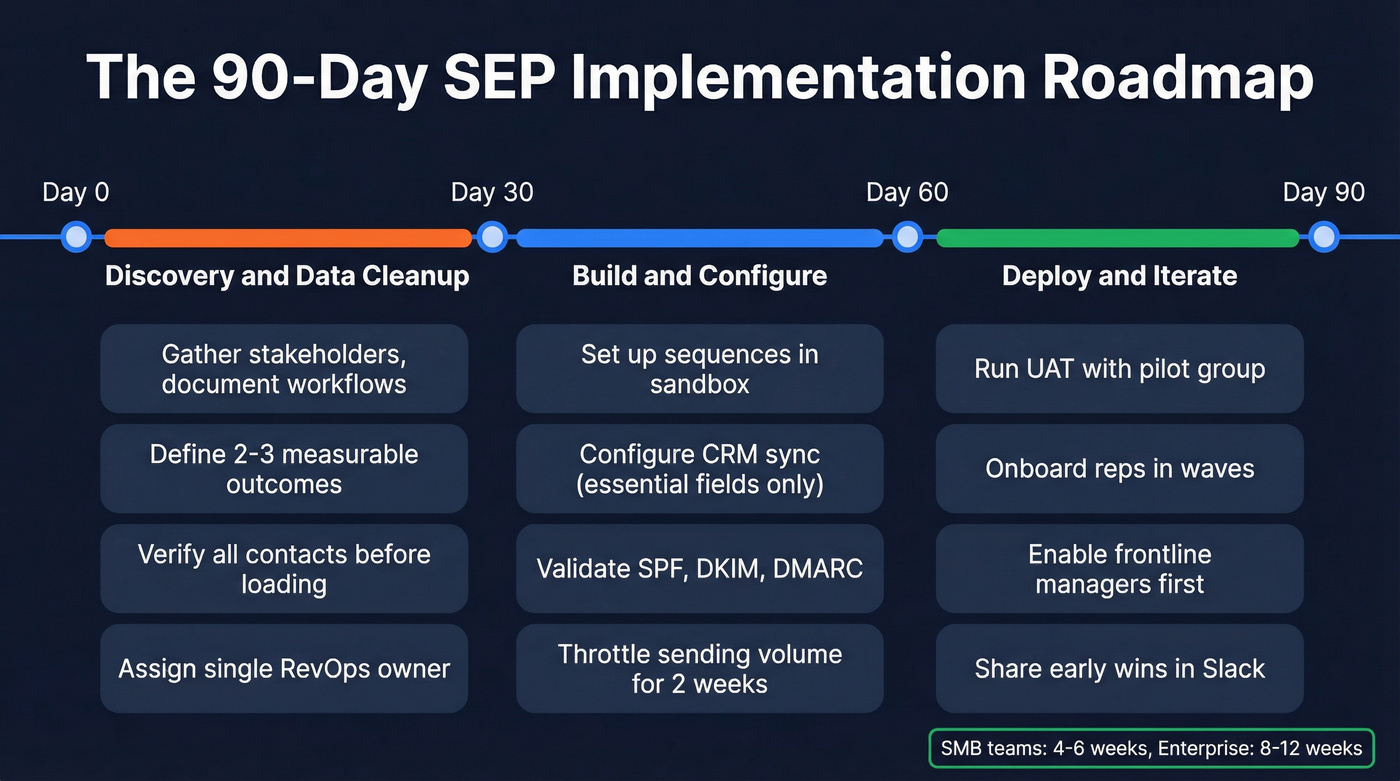
- Gather stakeholders and document current workflows
- Define 2-3 measurable outcomes for the first 90 days
- Run your contact list through a verification tool before loading anything into sequences - bad data on day one means domain damage by day five
- Assign a single owner (RevOps or Sales Ops) with authority over data standards, routing logic, and workflow governance
37% of projects fail due to undefined objectives. "We want to use Outreach" isn't an objective. "Reduce speed-to-lead from 4 hours to 15 minutes" is.
We've seen teams skip verification and spend the entire next quarter rebuilding their sender reputation. Snyk's team saw bounce rates drop from 35-40% to under 5% after running contacts through Prospeo's 5-step verification - their AE-sourced pipeline jumped 180% and they were generating 200+ new opportunities per month.

Phase 2 - Build & Configure (Days 31-60)
One Reddit user switched from Salesloft to Outreach and found their Gmail sync failing silently - sent emails weren't showing up, and a misclick between the Snooze and Schedule buttons wiped drafts. This is what happens when you skip sandbox testing.
Set up your sequences, configure CRM integration, and handle deliverability prerequisites. For the CRM sync, start with essential objects and fields only. Use strict field-level sync rules - "prefer Salesforce unless blank" prevents silent overwrites. Always test in a sandbox before going live. Your CRM owns the relationship; your SEP owns the activity. Blur that line and you'll spend months untangling data conflicts.
Most teams also need to migrate existing prospect lists during this phase. If you're pulling contacts from a legacy tool or spreadsheet via CSV import, verify every row before uploading. Importing unverified CSVs is the single fastest way to tank deliverability on a brand-new platform.
Deliverability setup is non-negotiable. Validate SPF, DKIM, and DMARC. Start DMARC in monitor mode, then tighten to quarantine. Throttle sending volume during the first two weeks. If your bounce rate crosses 10%, stop sending and clean your list immediately.
Phase 3 - Deploy & Iterate (Days 61-90)
Gartner found that 89% of sellers feel burned out. They don't want another tool. So don't launch to everyone at once.
Migrate your data, run UAT with a pilot group, and onboard reps in waves. Here's the thing: frontline sales managers are the single biggest factor in adoption success. If managers aren't using the platform in their coaching and standups, reps won't either. Share early wins in Slack, highlight reps who booked meetings through sequences, and use data to prove the platform makes their lives easier. A rep who books three meetings from a sequence in week one becomes your best internal evangelist.

Snyk's 50 AEs dropped bounce rates from 35-40% to under 5% by running contacts through Prospeo's 5-step verification before loading sequences. At $0.01 per email with 98% accuracy, cleaning your list costs less than one bounced campaign.
Verify your entire prospect list before go-live - not after the damage is done.
Mistakes That Kill Implementations
Skipping data verification tops the list. Bounced emails damage your domain, and domain damage compounds. We've watched teams burn through their sender reputation in the first week because nobody cleaned the list.
If you do get hit, you’ll want a plan for spam trap removal and to improve sender reputation before scaling volume again.
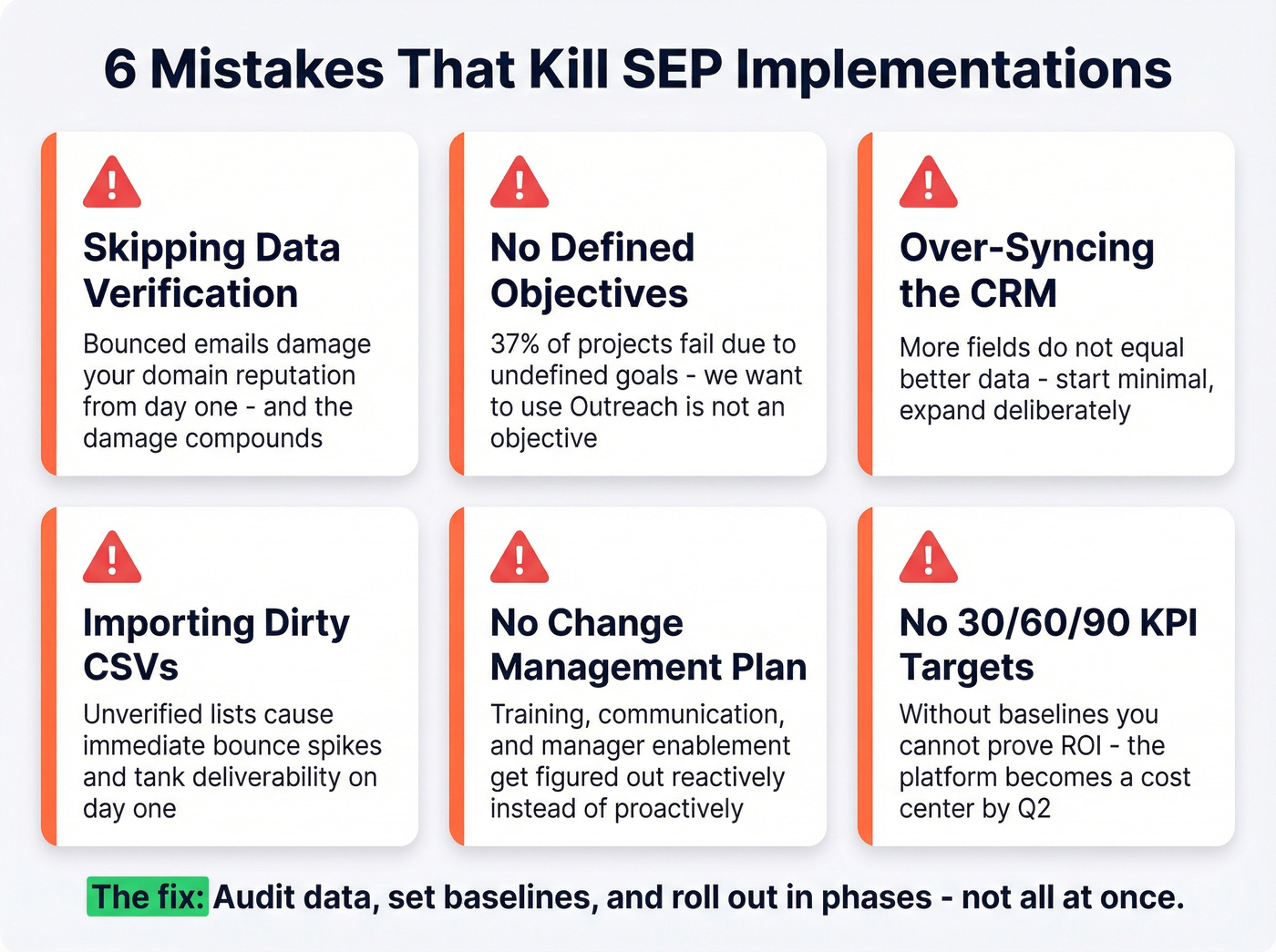
No defined objectives is a close second - that 37% failure rate isn't abstract. Set specific, measurable targets before go-live. Over-syncing the CRM is another classic trap. More fields don't equal better data. Start minimal, expand deliberately.
Then there's importing dirty CSVs. Teams pull lists from old tools without cleaning them first, leading to immediate bounce spikes on day one. No change management plan means communication cadence, training schedule, and manager enablement get figured out reactively instead of proactively. And no 30/60/90 KPI targets means you can't prove ROI, and the platform becomes a cost center by Q2.
Measuring SEP ROI
| KPI | What It Measures | Target |
|---|---|---|
| Pipeline velocity | Speed of deal flow | Faster |
| Connection rate | Calls answered / attempts | Higher |
| Win rate | Closed-won / total opps | Higher |
| Sales cycle length | Days from opp to close | Shorter |
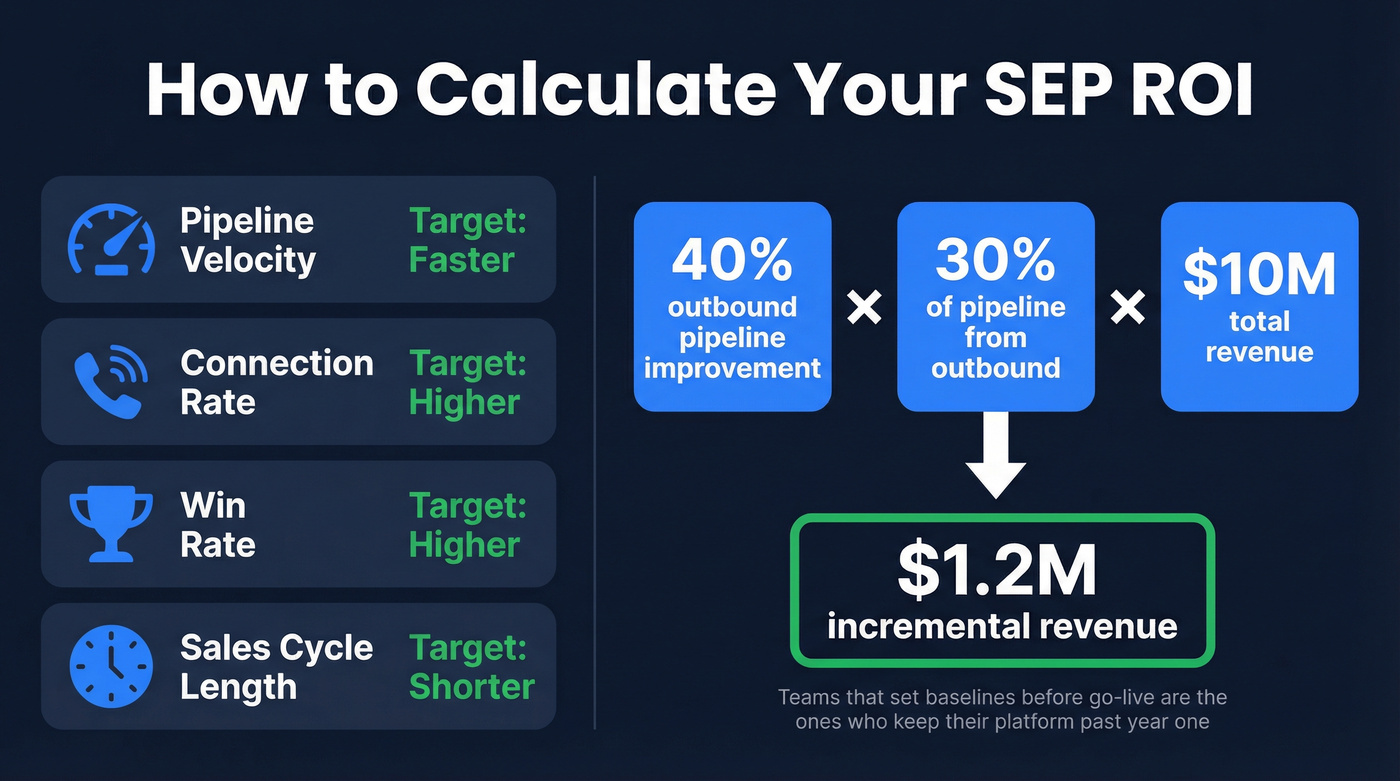
Let's break down the math. If your SEP improves outbound pipeline by 40%, and outbound represents 30% of your total pipeline on $10M in revenue, the impact is 40% x 30% x $10M = $1.2M in incremental revenue. In our experience, the teams that set baselines before go-live are the ones who keep their platform past year one.
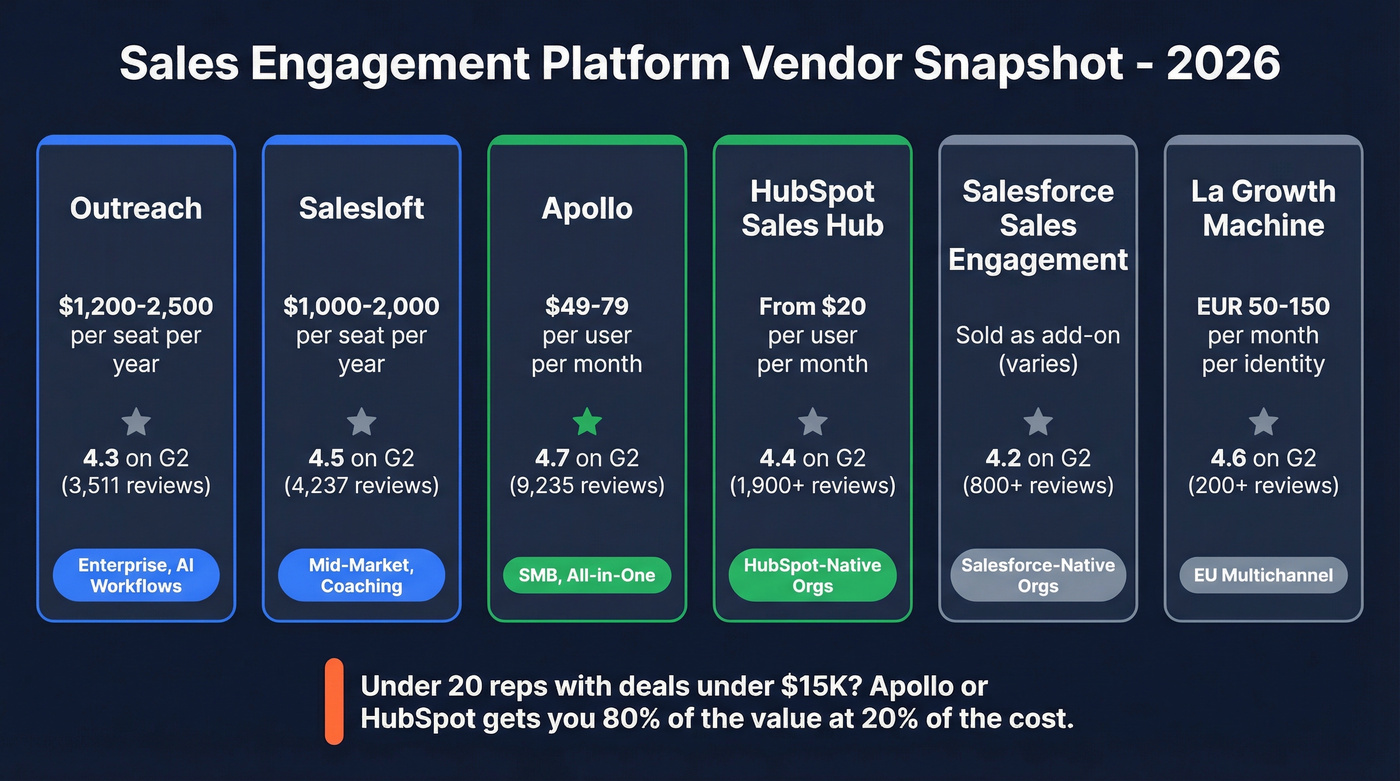
Look - most teams don't need a $100K+ enterprise SEP. If your average deal size is under $15K and your team is under 20 reps, Apollo or HubSpot Sales Hub will get you 80% of the value at 20% of the cost. Skip the enterprise platforms unless you genuinely need AI-driven deal intelligence and multi-team orchestration at scale.
Vendor Snapshot (2026)
| Platform | Pricing (Annual) | G2 Rating | Best For |
|---|---|---|---|
| Outreach | ~$1,200-2,500/seat/yr (custom) | 4.3 (3,511) | Enterprise, AI workflows |
| Salesloft | ~$1,000-2,000/seat/yr (custom) | 4.5 (4,237) | Mid-market, coaching |
| Apollo | $49-79/user/mo | 4.7 (9,235) | SMB, all-in-one |
| HubSpot Sales Hub | From $20/user/mo | - | HubSpot-native orgs |
| Salesforce Sales Engagement | Sold as add-on (varies) | - | Salesforce-native orgs |
| La Growth Machine | EUR 50-150/mo per identity | - | EU multichannel |
FAQ
How long does it take to implement a sales engagement platform?
Small teams under 50 reps can complete a self-guided rollout in 4-6 weeks. Enterprise deployments with SSO, data residency, and multi-CRM integrations typically take 8-12 weeks. The biggest variable isn't platform complexity - it's data readiness and stakeholder alignment.
What's the biggest reason SEP implementations fail?
Undefined objectives cause 37% of implementation failures. Teams that launch without specific KPIs - like "reduce speed-to-lead to 15 minutes" or "hit 8% connection rate by day 60" - can't measure progress, lose executive buy-in, and see the platform shelved within two quarters.
How do I prevent bounce rate spikes on a new platform?
Verify every contact before importing. Prospeo's 5-step verification with catch-all handling and spam-trap removal catches bad addresses before your first send - 98% email accuracy at roughly $0.01 per lead. Also validate SPF, DKIM, and DMARC, and throttle volume for the first two weeks.
Do I need an enterprise SEP if my team is small?
No. Teams with fewer than 20 reps and average deal sizes under $20K get 80% of the value from Apollo or HubSpot Sales Hub at a fraction of the cost. Enterprise platforms like Outreach and Salesloft justify their pricing through AI deal intelligence and multi-team orchestration at scale.
Implementing a sales engagement platform is a change management project as much as a technical one. The teams that succeed treat it that way - auditing data, setting baselines, and rolling out in phases rather than flipping a switch and hoping for adoption.
Importing unverified CSVs into a new sales engagement platform is the fastest way to torch your sender reputation. Prospeo's enrichment API returns 50+ data points per contact at a 92% match rate - with emails verified on a 7-day refresh cycle, not the 6-week industry average.
Clean data on day one means pipeline by day thirty.