

How to Master Consulting Sales in 2026 (Without Sounding Like a Used Car Salesman)
It's Tuesday morning. Your last project wrapped Friday. The pipeline is empty, and the next three months look like a desert. You open your inbox hoping for a referral that isn't coming, and the panic sets in - time to start "doing business development" again, which really means sending awkward LinkedIn messages to people you haven't talked to in two years.
Over half of consulting firms don't have a documented sales strategy. Two out of three lack an ongoing sales improvement plan. That's not a data gap - it's the reason most consultants ride the feast-or-famine rollercoaster until they burn out or go back to a corporate job.
TL;DR - The three things that move the needle most: a daily 30-minute prospecting habit, a formalized sales methodology you actually follow, and proposals with three-tier pricing and customized executive summaries. If you only read one section, read the pipeline math - it tells you exactly how many conversations you need each week to hit your revenue target.
What Consulting Sales Actually Means
"Consulting sales" means two different things depending on who's talking. There's selling consulting services - the focus of this guide - and there's sales consulting, where an advisor helps companies improve how they sell. Related, but not the same job.
Selling consulting services is harder than selling software or widgets. You're selling an intangible outcome delivered by people the client hasn't met yet. No free trial. No product demo. The "product" is your expertise, your judgment, and your ability to solve a problem the client may not fully understand. That makes professional services sales fundamentally trust-dependent, with deals involving multiple stakeholders, long evaluation cycles, and a buyer who's often been burned by a previous consultant.
How the 2026 Buyer Has Changed
Your golf-and-referrals strategy worked in 2010. It's not enough anymore.
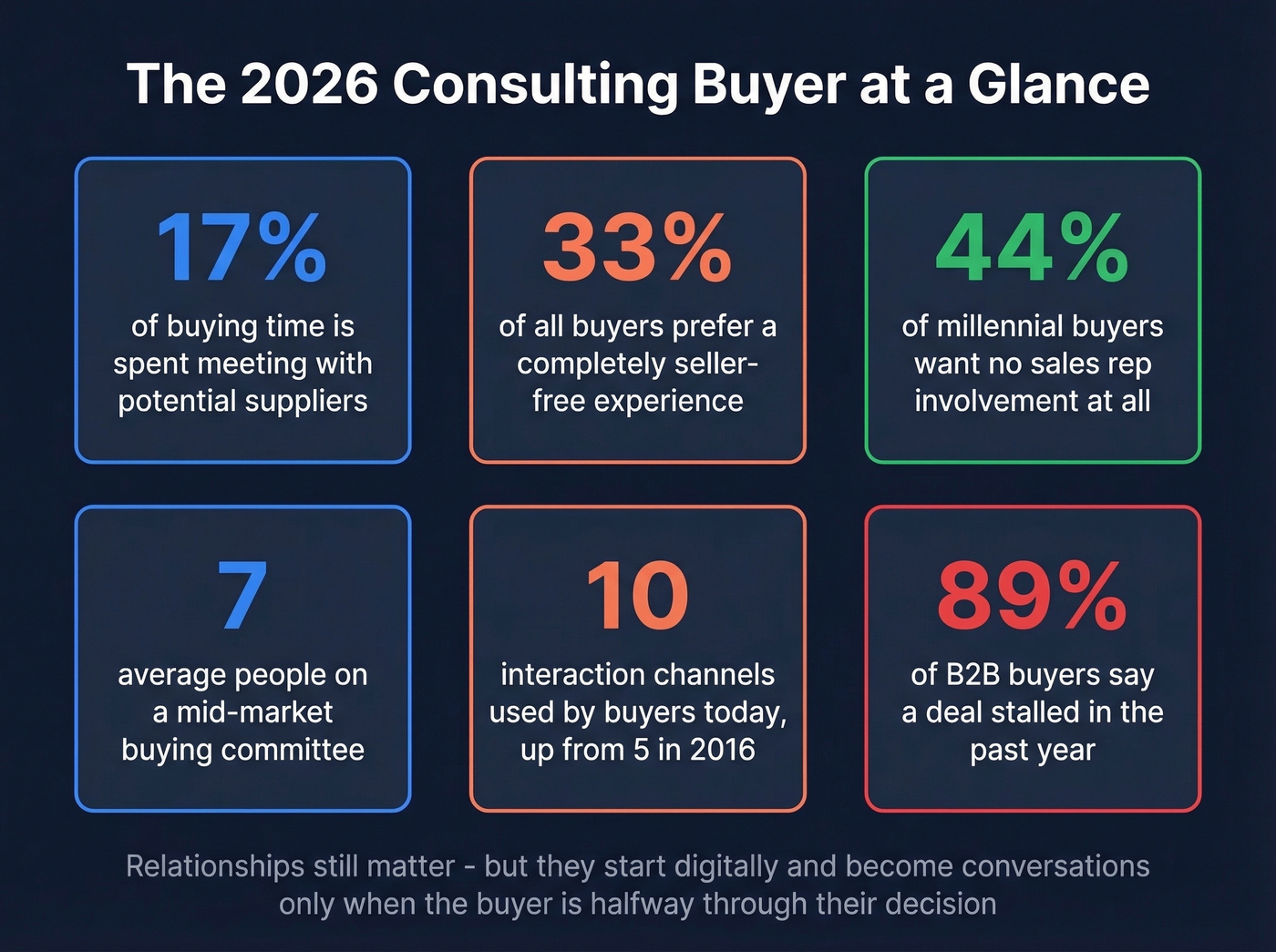
Gartner projected that 80% of B2B sales interactions would occur through digital channels by 2025, and in 2026 that shift is the new baseline. Buyers spend only 17% of their buying time meeting with potential suppliers. The rest happens in Slack threads, peer reviews, analyst reports, and internal committee meetings you'll never see.
McKinsey's rule of thirds still holds: at any stage, roughly one-third of buyers prefer in-person, one-third prefer remote, and one-third want digital self-serve. A full 33% of all buyers prefer a seller-free experience entirely - that number jumps to 44% among millennials, who now make up the majority of mid-level decision-makers. And 89% of B2B buyers report a purchase deal stalled in the past year, which explains why consulting engagement cycles feel so agonizingly slow.
The average buying committee at a mid-sized firm involves 7 people. You're not selling to a person - you're selling to a committee that uses roughly 10 interaction channels on average, up from 5 in 2016. Your proposal needs to survive being forwarded, screenshotted, and summarized in a Slack message by someone who attended your call but isn't the decision-maker.
Relationships still matter. But the relationship starts digitally, progresses through content and credibility signals, and only becomes a conversation when the buyer is already more than halfway through their decision.
Pipeline Math - Your "Magic Number"
Most consultants have no idea how many conversations they need to hit their revenue target. We've watched consultants triple their pipeline just by doing this math and committing to a weekly number.
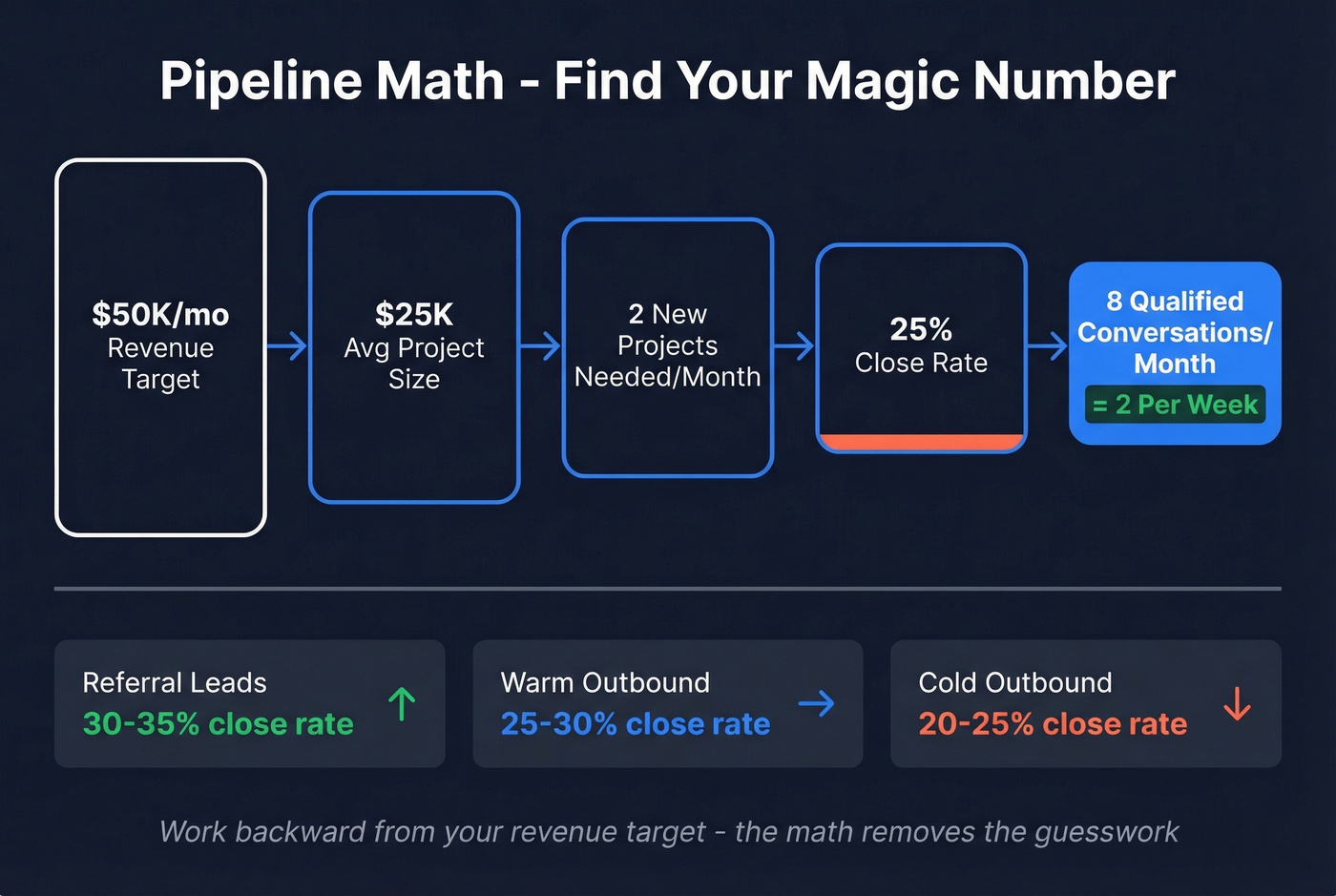
Say you need $50K/month in revenue. Your average project is $25K. That means you need 2 new projects per month. If your close rate is 25%, you need 8 qualified conversations per month - roughly 2 per week.
That's your magic number. Two real conversations per week with ideal-fit prospects.
The close rate assumption matters a lot here. Consulting-specific close rates range from 20-35% depending on lead source and deal size, and the average B2B close rate across industries sits around 29%. Referral-sourced leads close higher; cold outbound closes lower. Sales cycles run 2-8 weeks for small projects and 2-6 months for enterprise multi-stakeholder engagements, with about 8% of high-value deals exceeding 5 months.
To calibrate your own funnel, here are conversion benchmarks by industry:
| Industry | Lead to MQL | MQL to SQL | SQL to Opp | SQL to Closed |
|---|---|---|---|---|
| Financial Services | 29% | 38% | 49% | 53% |
| Legal Services | 32% | 35% | 48% | 46% |
| IT / Managed Services | 19% | 38% | 41% | 46% |
| Software Dev | 28% | 39% | 60% | 59% |
Work backward from your revenue target. The math doesn't lie, and it removes the guesswork from "am I doing enough business development?"
Pick a Sales Methodology (Then Actually Use It)
Organizations with a formalized sales methodology achieve 27% higher win rates and 21% higher quota attainment compared to those winging it. Only 30% of organizations follow a formal methodology consistently. The gap between knowing and doing is where most consulting revenue dies.
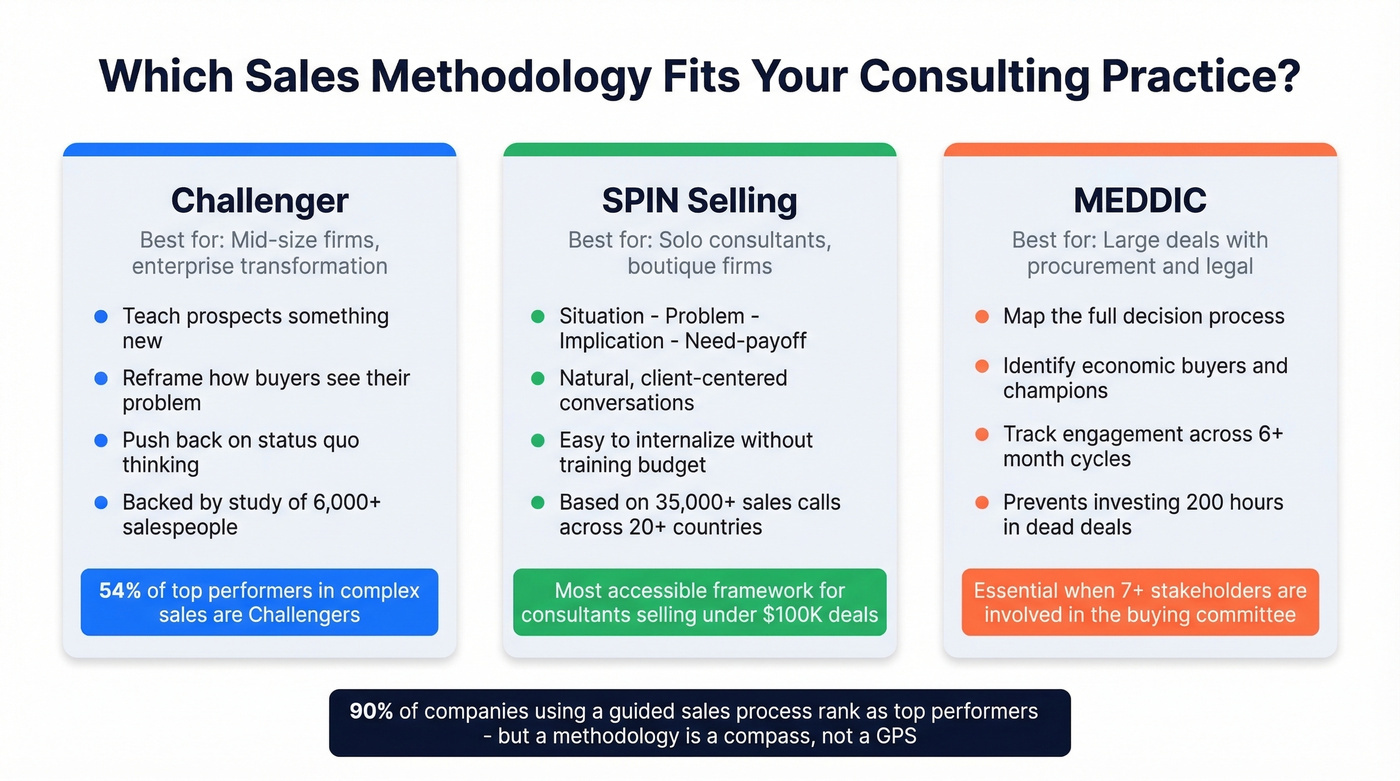
Three frameworks dominate complex B2B selling, and each fits a different consulting profile.
Challenger works best for mid-size firms selling enterprise transformation. The research behind it - a study of 6,000+ B2B salespeople - found that 54% of top performers in complex sales were Challengers, while only 4% were relationship builders. If you're selling six-figure engagements to C-suite buyers who think they already know the answer, this is your framework.
SPIN Selling is the better fit for solo consultants and boutique firms. Developed from analysis of 35,000+ sales calls across 20+ countries, SPIN's Situation-Problem-Implication-Need-payoff sequence is simple enough to internalize without a training budget. It keeps discovery conversations natural and client-centered.
MEDDIC shines for large deal qualification - when you need to map the decision process, identify economic buyers, and track champion engagement across a 6-month cycle. If your deals regularly involve procurement and legal review, MEDDIC prevents you from investing 200 hours in a deal that was never going to close.
90% of companies using a guided sales process rank as top performers. But over-systematization kills authenticity. One rep used a canned discovery question - "What's keeping you up at night?" - and the prospect responded, "Are you reading from a script?" then hung up. A methodology is a compass, not a GPS.
Prospecting That Doesn't Feel Like Begging
Win Work Before the RFP
If you're finding out about an opportunity when the RFP lands, you've already lost. The consensus on r/consulting is blunt: by the time a formal RFP goes out, the winner has usually been decided.
Two paths get you in before the RFP. First, extend existing engagements - during delivery, identify adjacent challenges and propose a new scope before the current project wraps. Second, help the client write the scope of work for their next initiative. When you've shaped the requirements, you're not responding to an RFP. You wrote it.
The 30-Minute Daily Habit
The feast-or-famine cycle works like this: pipeline dries up, you panic and do outreach for two weeks, land a project, get busy delivering, stop all business development, finish the project, look up, and the pipeline is empty again. Repeat forever.
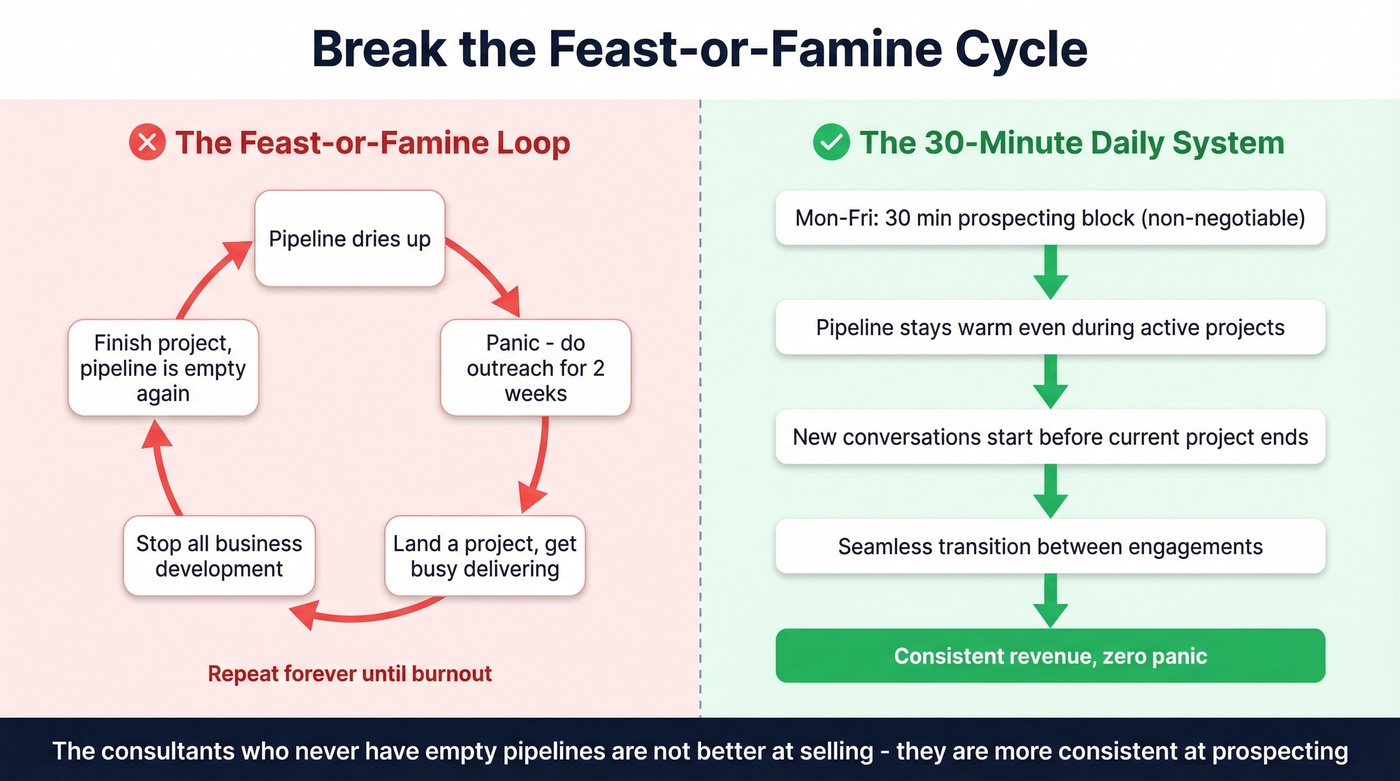
Business development is a system, not a project. The consultants who never have empty pipelines aren't better at selling - they're more consistent at prospecting.
Modern Prospecting Tools
Here's the thing most consultants don't think about: your domain reputation is your brand. One bad outreach campaign with a 15% bounce rate can land your domain on a blacklist, and suddenly even your legitimate client emails hit spam folders.
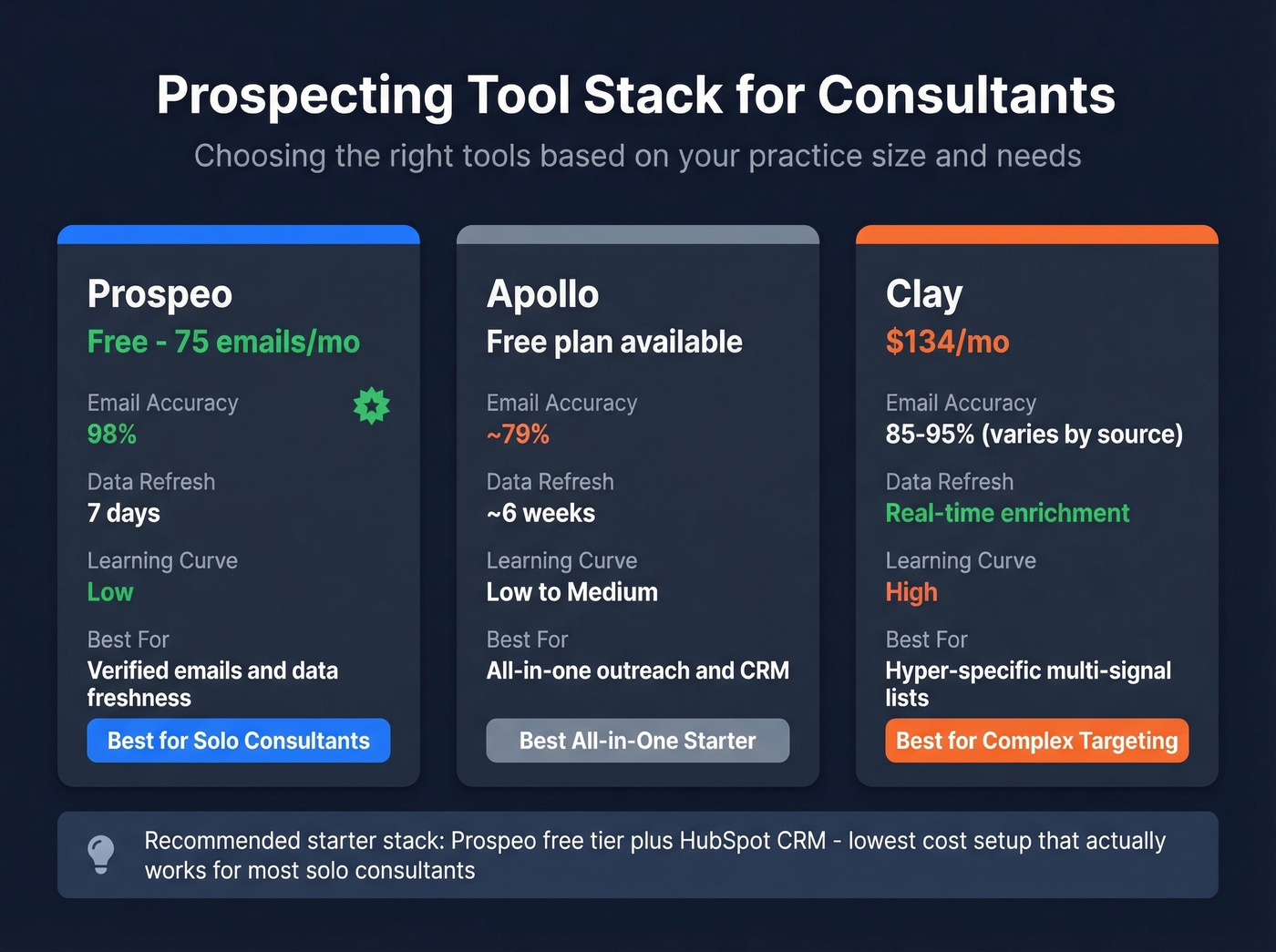
Apollo is the easiest all-in-one starting point if you want a database, sequencing, and basic CRM in one tool. Free plan available, paid tiers from around $49/mo. Data quality gets spotty in smaller markets, but for North American mid-market prospecting, it's fast and functional.
Clay is for consultants who need hyper-specific lists - say, "Series B fintech companies in the Midwest that just hired a new CFO." You chain enrichment steps together to build exactly the list you need. Starting at $134/mo for 2,000 credits, it's setup-heavy but powerful once configured.
HubSpot CRM rounds out the stack with a free tier for pipeline management.
| Feature | Prospeo | Apollo | Clay |
|---|---|---|---|
| Starting price | Free (75 emails/mo) | Free plan | $134/mo |
| Email accuracy | 98% | ~79% | 85-95% (source-dependent) |
| Data refresh | 7 days | ~6 weeks | Real-time enrichment |
| Best for | Verified emails + freshness | All-in-one outreach | Hyper-specific lists |
| Learning curve | Low | Low-medium | High |
For most solo consultants, Prospeo's free tier plus HubSpot CRM is the lowest-cost stack that actually works. Skip Clay unless you're building complex, multi-signal prospect lists - the setup time isn't worth it for simple outreach.

You just calculated your magic number - now you need verified contacts to hit it. Prospeo gives you 300M+ professional profiles with 30+ filters like buyer intent, headcount growth, and technographics so you can find decision-makers at your ideal consulting clients. 98% email accuracy means your outreach actually lands.
Two qualified conversations a week start with data that connects you to real buyers.
Discovery Calls That Convert
Let's talk about that "Are you reading from a script?" moment. A rep sat through six hours of consultative selling training, memorized the framework, and opened their next call with the textbook opener. The prospect called it out immediately and hung up. The r/sales thread about this blew up because every salesperson recognized the problem: over-systematized discovery sounds fake.
In consulting, this is even more dangerous. Your prospect is a senior executive who's been sold to hundreds of times. They can smell a framework from the first question. The fix isn't abandoning structure - it's internalizing it so deeply that it becomes genuine curiosity rather than a checklist.
The Pre-Call Checklist
Before any discovery call, make sure the prospect has reviewed your authority content (case studies, methodology pages, or a relevant article you've published), understands the call's purpose, and has completed a brief intake questionnaire. Even three questions - "What triggered this initiative? What have you tried? What does success look like?" - give you a running start and signal professionalism.
Buyers evaluate consultants on process as much as expertise. A structured pre-call experience separates you from the consultant who shows up and wings it.
Questions That Work
In our experience, the best discovery calls feel like a conversation the prospect didn't want to end. Four questions that consistently get you there:
- "Walk me through what happened that made this a priority now." This maps the situation and the trigger event - far more useful than "tell me about your business."
- "What's the cost of not solving this in the next 6 months?" Surfaces the implication in their language, not yours.
- "Who else needs to be convinced this is worth doing?" Natural stakeholder mapping without sounding like you're running a playbook.
- "If we nailed this, what does success look like for you personally - not just the company?" This is where you find the real motivation behind the project.
Elite consultants ask deep, meaningful questions more than they offer ideas. The discovery call isn't your chance to prove you're smart. It's your chance to prove you listen.
Proposals That Close at 36%
Proposify analyzed 1.3M+ proposals across 27 industries. Companies using best practices hit 36% close rates vs. the 20% industry average. Nearly double - and the differences are surprisingly tactical.
The biggest lever is executive summary customization. When roughly 30% of the executive summary is customized per prospect, close rates jump by 50%. Reference their specific challenges, their language from discovery, and the outcomes they told you matter. Generic "About Us" sections kill deals - replace them with "Why Us" backed by social proof, relevant case studies, and a clear articulation of why you're the right fit for this specific problem.
This proposal structure consistently closes:
- Customized executive summary - their words, their problems, your angle
- Scope including what you won't do (exclusions prevent scope creep and build trust)
- Specific, measurable deliverables
- Timeline with milestones and dependencies called out
- Three-tier fees and payment terms
- Your approach to the work
- Clear next steps that make the path to "yes" frictionless
- Brief terms and conditions
Three-tier pricing uses anchoring bias to your advantage. Offer a base engagement, a recommended option, and a premium option. Most buyers pick the middle tier, which should be your target price. The premium tier makes the middle feel reasonable.
For consultants struggling to get a foot in the door, consider a discovery offer - a paid diagnostic engagement at $1,500-$15,000 that reduces the client's risk and gives you a chance to prove your value before the big proposal. One differentiation tactic worth testing: a one-page proposal with a video voiceover walking through the details. It's personal, it's different, and it takes less time than a 20-page deck.
Pricing - Stop Discounting Yourself to Death
Here's my hot take: if your average engagement lands under $15K, your problem isn't sales - it's positioning. You're competing on price in a market where the winners compete on expertise. Fix the positioning first, then worry about close rates.
Now, the math that should haunt every consultant who reflexively offers a discount:
If your revenue is $1M with $200K profit (20% margin), eliminating a consistent 10% discount increases profits by 50%.
That's not a typo. A 10% discount on a 20% margin cuts your profit in half. Every time you say "I can do it for 10% less," you're not giving up 10% of revenue - you're giving up 50% of profit. Stop discounting.
Three pricing models dominate consulting, and each sends a different signal. Hourly billing is the default, but it penalizes efficiency and caps your upside. Value-based pricing ties your fee to the outcome - if you're saving a client $2M, charging $200K is a bargain regardless of hours. Performance pricing (fees tied to results) is the most aggressive: 68% of firms using performance pricing expect 26%+ revenue growth in the next 12 months, vs. 40% of firms that don't.
Deal sizes vary predictably by firm type. Solo consultants and boutiques typically land initial projects in the $10K-$50K range, while mid-size firms sell $50K-$250K+ engagements with retainers and transformation work pushing higher. Know your range, price to it, and stop apologizing for what you charge. Invoice promptly and require deposits on projects over $25K - cash flow kills more consulting businesses than bad sales.
Aligning Sales and Delivery
The r/consulting thread puts it perfectly: "Sales says 'Yes, absolutely, no problem.' Delivery inherits the frustration." This is the single most common trust-killer in consulting. A salesperson promises customization; the delivery team discovers it requires configuration that wasn't scoped. The client feels lied to. The delivery team gets blamed.
Three fixes work consistently. First, better qualification - don't sell what you can't deliver, and involve a delivery lead in late-stage calls so promises get reality-checked before they're made. Second, written scope agreements with explicit exclusions, signed before the contract closes. Third, a structured handoff meeting where the delivery team hears the client's expectations directly, not filtered through sales notes.
For firms developing delivery professionals into client-facing sellers, the transition is harder than it looks. Compensation insecurity, credit disputes over who "owns" a renewal, and fundamentally different skill sets all create friction. The enablement path that works: mentoring, realistic ramp targets during the transition, and in-field coaching rather than classroom training.
7 Mistakes That Kill Your Pipeline
1. No documented sales strategy. Over half of consulting firms don't have one. If your "strategy" lives in your head, it's not a strategy - it's a hope.
2. The feast-or-famine BD cycle. Panic outreach when the pipeline is empty, then radio silence when you're busy delivering. Consistency beats intensity every time.
3. Underpricing and reflexive discounting. Remember the math: 10% off a 20% margin = 50% less profit. Price to value, not to fear.
4. Unclear scope without exclusions. If your SOW doesn't say what you won't do, every client expectation gap becomes your fault.
5. Taking any client who'll pay. Ignoring your ICP leads to miserable engagements, scope creep, and referrals you don't want. Saying no is a sales skill.
6. Skipping discovery. We've all spent 20 hours on a proposal for a prospect we never properly qualified, only to get ghosted. Stop.
7. An invisible personal brand. Someone half as good as you but twice as visible will win the work. Thought leadership isn't vanity - it's a pipeline channel. Buyers are more than halfway through their decision before they reach out. If they've never heard of you, you're not in the consideration set.
That 30-minute daily prospecting habit falls apart when you're spending 15 of those minutes hunting for contact data. Prospeo's Chrome extension lets 40,000+ users pull verified emails and direct dials from any company website or LinkedIn profile in one click - so your half-hour goes to conversations, not research.
Stop researching. Start reaching the 2 prospects per week your pipeline demands.
FAQ
What is consulting sales?
Consulting sales is the process of winning client engagements - generating pipeline, running discovery, writing proposals, and closing deals for advisory and project-based work. It's distinct from sales consulting, where an advisor helps companies improve their own selling processes.
How long is a typical sales cycle for consultants?
Small projects (under $50K) close in 2-8 weeks. Enterprise engagements run 2-6 months, with about 8% of high-value deals exceeding 5 months. The biggest variable is committee size - 7 decision-makers move slower than a founder writing a check.
What's a good close rate for consulting proposals?
A healthy close rate falls between 20-35%, depending on lead source and deal size. Referral-sourced leads close at the high end; cold outbound sits lower. Proposify data shows firms using customized executive summaries and three-tier pricing hit 36%.
Which sales methodology works best for consultants?
SPIN Selling fits solo consultants and boutiques - it's simple to internalize and keeps discovery natural. Challenger works better for mid-size firms selling enterprise engagements. Formalized methodologies drive 27% higher win rates regardless of which one you pick, so the best methodology is the one you'll actually use.