

Coresignal vs Apollo.io: Different Tools, Different Jobs
Comparing Coresignal to Apollo.io is like comparing AWS to Mailchimp. One is data infrastructure for engineers. The other is a sales platform for reps who need to book meetings by Friday. They both touch "B2B data," but they aren't really competitors - a practitioner on r/automation nailed it, calling Apollo "a sales tool" and Coresignal "a different category entirely." Let's stop pretending this is an apples-to-apples fight and figure out which one you actually need.
30-Second Verdict
Choose Coresignal if you're building data products, enrichment pipelines, or AI agents and need 859M+ professional profiles via API. You have engineers on staff.
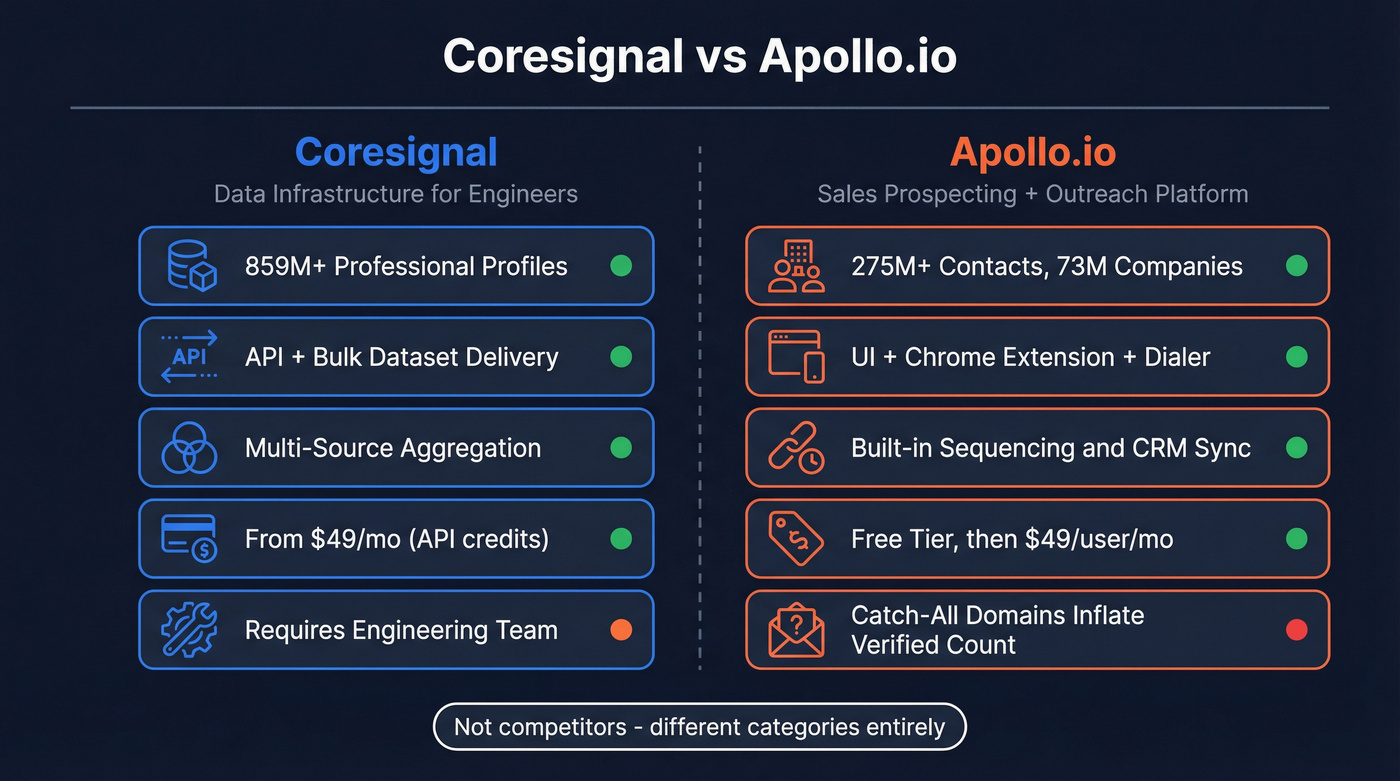
Choose Apollo if your sales team needs an all-in-one prospecting and outreach platform with sequencing, a dialer, and a Chrome extension. You want to start free - but watch out for catch-all domains inflating your "verified" numbers.
Skip both if you just need verified emails and direct dials that actually connect. More on that below.
Feature-by-Feature Comparison
| Feature | Coresignal | Apollo.io | Winner |
|---|---|---|---|
| Primary use | Data infrastructure / API | Sales prospecting + outreach | Depends on role |
| Database size | 859M+ professional profiles | 275M+ contacts, 73M companies | Coresignal (volume) |
| Data delivery | API + bulk dataset delivery | UI + Chrome extension + API | Apollo (accessibility) |
| Pricing model | API credits + dataset licenses | Per-seat + credit tiers | Apollo (free tier) |
| Data refresh | Continuous for some datasets; monthly for others | Not publicly stated | Coresignal |
| Best for | Developers, data teams, AI | SDRs, AEs, sales leaders | Depends on role |
| Compliance | Public web data, GDPR-aligned | SOC 2, GDPR | Tie |
Coresignal offers multiple processing levels - raw, clean, and multi-source - and its multi-source datasets are designed for deduplication and consistency. Apollo packages its database inside a sales workflow optimized for prospecting and outreach. Different philosophies, different numbers.
Coresignal: Detailed Breakdown
Here's the thing: if your average deal size is under $15k and you don't have a data engineer, Coresignal is overkill. It's the most powerful raw data source most sales teams will never need.
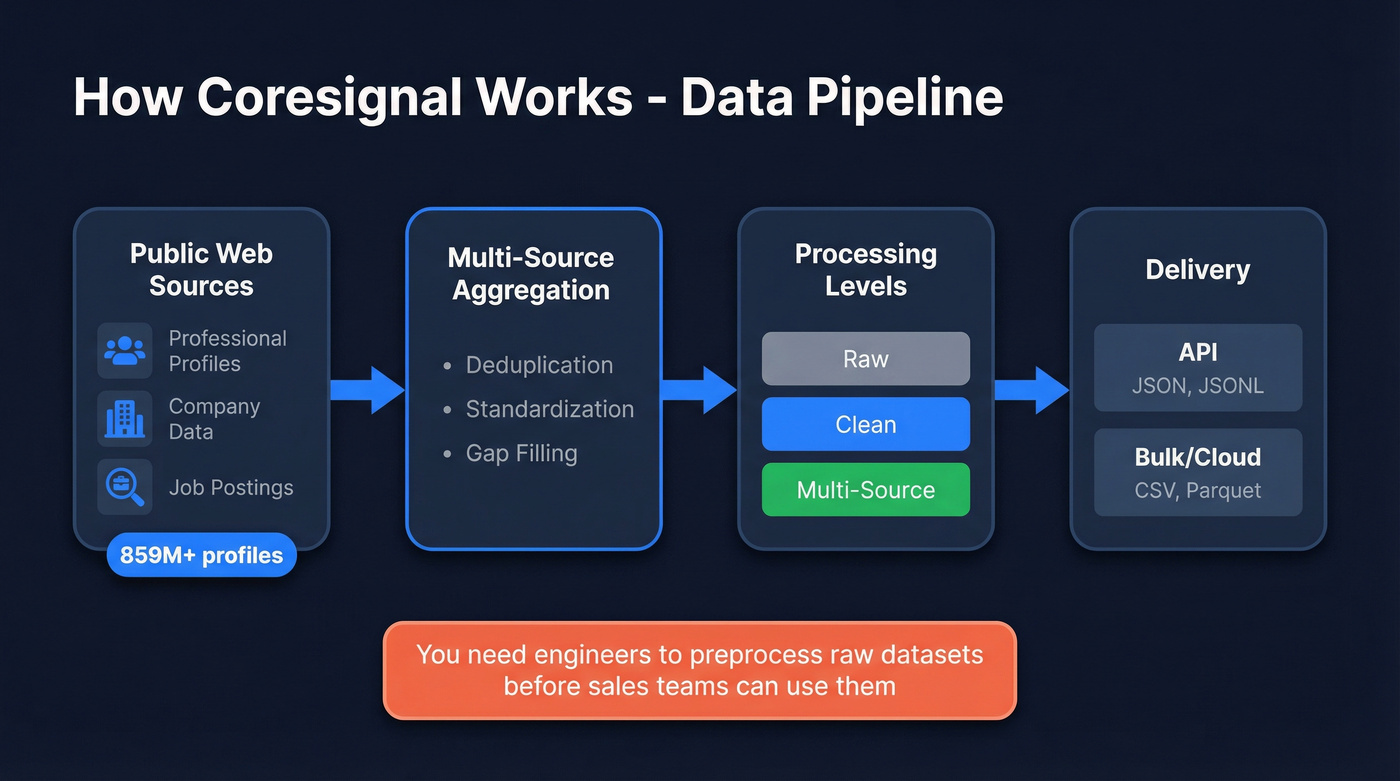
Coresignal's 859M+ professional profiles, 75M+ company profiles, and 448M+ job posting records are delivered via API and bulk/cloud delivery. You can work with exports in JSON, JSONL, CSV, or Parquet. The Elasticsearch query interface is powerful if your team knows how to wield it, and their MCP server and AI Query Builder show they're leaning hard into the AI infrastructure play. One reviewer on r/BitToBite praised the "super easy AI prompting" for searches.

Multi-source aggregation is the real differentiator. Instead of pulling from a single source, Coresignal aggregates and standardizes across multiple public web sources, which improves work history depth and reduces gaps versus single-source profiles. We've seen this matter most for international datasets where any single source has patchy coverage.
The tradeoffs are real, though. That same Reddit reviewer gave the UI a 6/10, noting the AI search is "a little glitchy" and searches don't save. Data can run 3-4 months stale for time-sensitive workflows. And you'll need engineers to preprocess raw datasets before anyone on your sales team can touch them.
Pricing includes a Free plan, then paid API plans from $49/mo (Starter) to $800/mo (Pro) to $1,500+/mo (Premium). Dataset licenses start at $1,000. Cheaper than ZoomInfo for raw data volume - but you're paying in engineering hours instead of platform fees.

Coresignal's raw datasets need engineering hours before your sales team can use them. Apollo's catch-all domains inflate your "verified" numbers and tank deliverability. Prospeo's 5-step verification handles catch-all domains natively - 98% email accuracy, 7-day data refresh, and bounce rates under 4%. No data engineers required.
Stop choosing between raw data and bad data. Get verified contacts now.
Apollo.io: What the Reviews Actually Say
Apollo holds a 4.7/5 on G2 from 9,500+ reviews. Ease of use and lead generation dominate the praise, and the free tier is genuinely useful: unlimited email credits subject to fair use, 5 mobile credits/month, and 10 export credits/month.
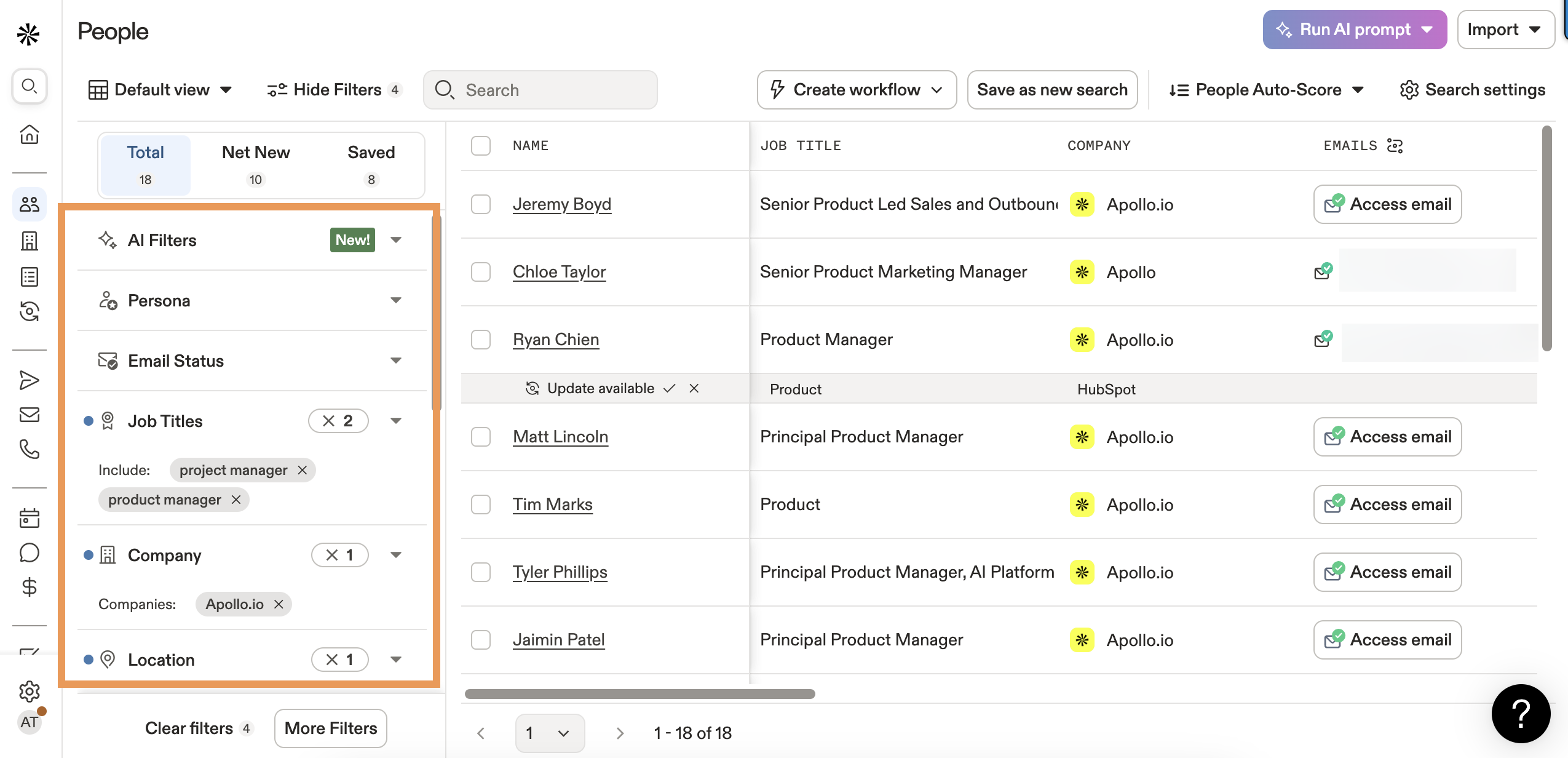
But here's what the marketing page won't tell you. Apollo's "verified" label can include catch-all domains - addresses that accept any email regardless of whether the contact actually exists. Without additional verification, expect higher bounce rates than the platform suggests when catch-all domains are in the mix.
G2 reviewers flagged inaccurate or outdated data 503 times - one of the most common complaints. One frustrated user on r/coldemail described "burning through your budget with Apollo Official pricing or Clay extortion," and that tracks with what we've seen at scale. Overages cost $0.20/credit with a 250-credit minimum, and mobile numbers burn credits at roughly 8x the rate of emails. Those costs sneak up fast on growing teams.
Compared to ZoomInfo, Apollo wins on accessibility and price. ZoomInfo still wins on US database depth and workflow breadth for larger orgs.
Pricing Compared
| Tier | Coresignal | Apollo.io |
|---|---|---|
| Entry | Free or $49/mo (Starter API) | Free |
| Basic | - | $49/user/mo (annual) |
| Mid-tier | $800/mo (Pro API) | $79/user/mo (Professional) |
| Top tier | $1,500+/mo (Premium) | $119/user/mo (Org, 3-seat min) |
| Datasets | From $1,000 | N/A |
| Overages | Credit-based | $0.20/credit (250 min) |
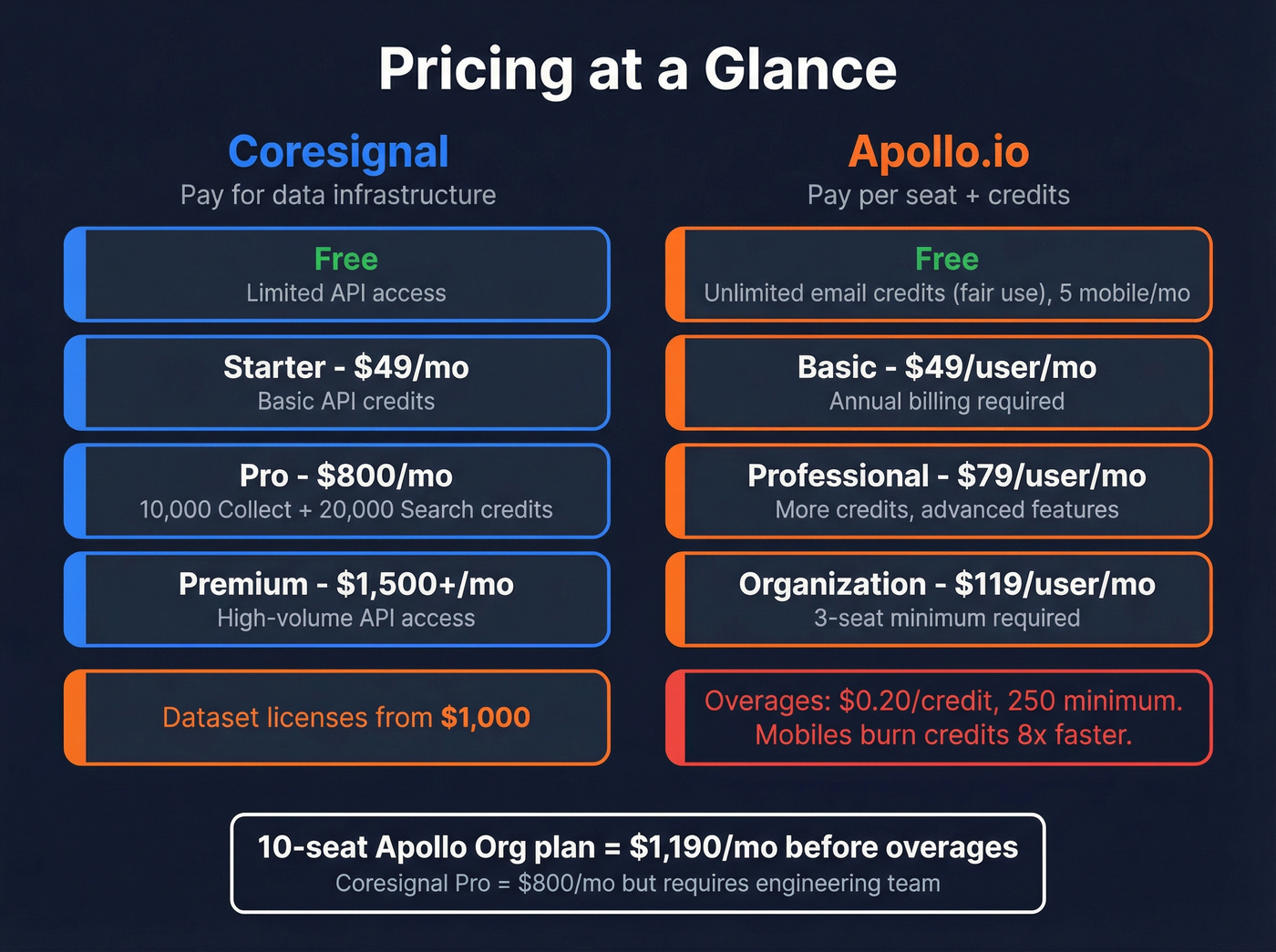
Completely different pricing models. Coresignal charges for data infrastructure access - API calls and dataset licenses. Apollo charges per seat with credit tiers that can surprise you.
A 10-seat Apollo Org plan runs $1,190/mo before overages. A Coresignal Pro plan starts at $800/mo and includes at least 10,000 Collect credits/month plus 20,000 Search credits/month. The math only makes sense for Coresignal if you have the engineering team to turn raw data into pipeline.
Which Should You Choose?
Choose Coresignal if you're building data products, AI agents, or enrichment pipelines. You need bulk professional data via API, you have engineering resources, and you care more about data structure than a polished UI.
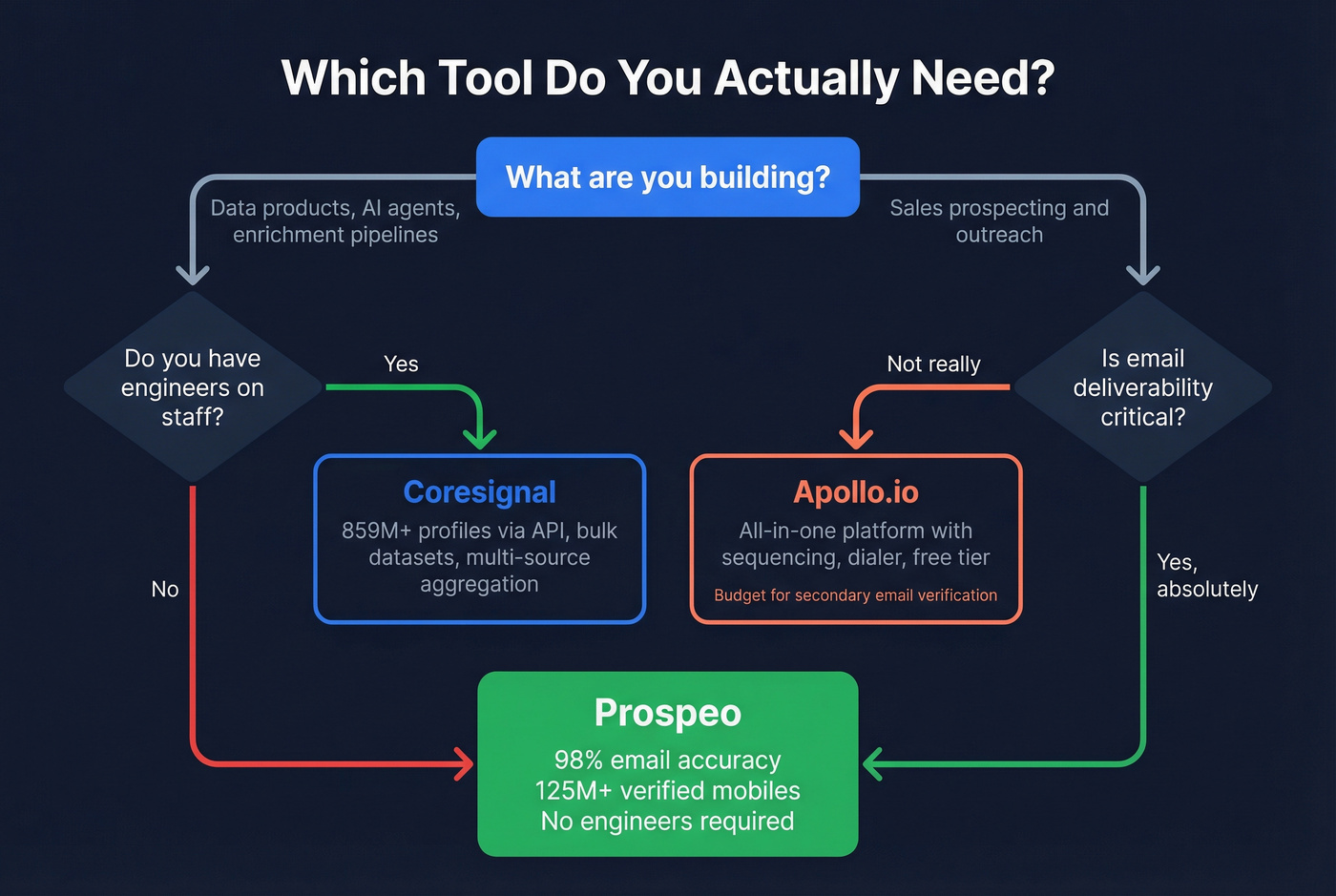
Choose Apollo if your sales team needs an all-in-one platform with prospecting, sequencing, and a dialer built in. You want a free tier to start and CRM integrations out of the box. Just budget for a secondary email verification step - your domain reputation will thank you.
Skip both if you just need verified contact data that works. Emails that don't bounce, phone numbers that connect, no raw datasets to wrangle and no credit complexity to navigate. That's where Prospeo fits: 300M+ professional profiles with 98% email accuracy from a 5-step verification process that handles catch-all domains, 125M+ verified mobile numbers with a 30% pickup rate, and a 7-day data refresh cycle. Self-serve, no contracts, with a free tier that includes 75 emails and 100 Chrome extension credits per month. In our experience, teams using Prospeo book 35% more meetings than those on Apollo and see bounce rates drop below 4%.

Apollo's overages hit $0.20/credit and mobile numbers burn credits 8x faster. Prospeo delivers 300M+ profiles at ~$0.01/email with 125M+ verified mobiles that connect 30% of the time - nearly 3x Apollo's pickup rate. Self-serve, no contracts, cancel anytime.
Teams on Prospeo book 35% more meetings than Apollo users. See why.
FAQ
Can you use Coresignal and Apollo.io together?
Yes - some teams use Coresignal's bulk datasets for enrichment pipelines and Apollo for outreach execution. This requires engineering resources and adds cost. If you just need verified contact data for outbound, a single platform is simpler and cheaper than stitching two together.
Does Apollo.io actually verify emails?
Apollo marks emails "verified," but this can include catch-all domains - addresses that accept any email regardless of whether the contact exists. Without a secondary verification step, expect higher bounce rates than the platform suggests. Tools with dedicated catch-all handling produce more reliable deliverability.
Is Coresignal worth it for small sales teams?
No. Coresignal is built for developers and data teams who need bulk datasets via API. Small sales teams without engineering resources will find the raw data difficult to operationalize and the UI underwhelming. Apollo's free tier or a self-serve data platform are better starting points for teams under 10 reps.
What's the best alternative if neither tool fits?
For teams that need verified emails and direct dials without managing raw data infrastructure or navigating per-seat credit complexity, look at platforms built specifically for accuracy and deliverability. Key things to evaluate: email verification depth, catch-all domain handling, data refresh frequency, and whether you're locked into annual contracts.