


Coresignal vs Kaspr: Different Tools for Different Jobs
The Coresignal vs Kaspr comparison keeps coming up, but here's the thing - these tools have almost nothing in common. Coresignal is data infrastructure. Kaspr is a Chrome extension. We've seen this exact scenario play out: a data team asks for bulk employee datasets, someone on the sales floor suggests Kaspr because "it finds phone numbers," and suddenly you're comparing apples to excavators.
Let's sort this out fast.
30-Second Verdict
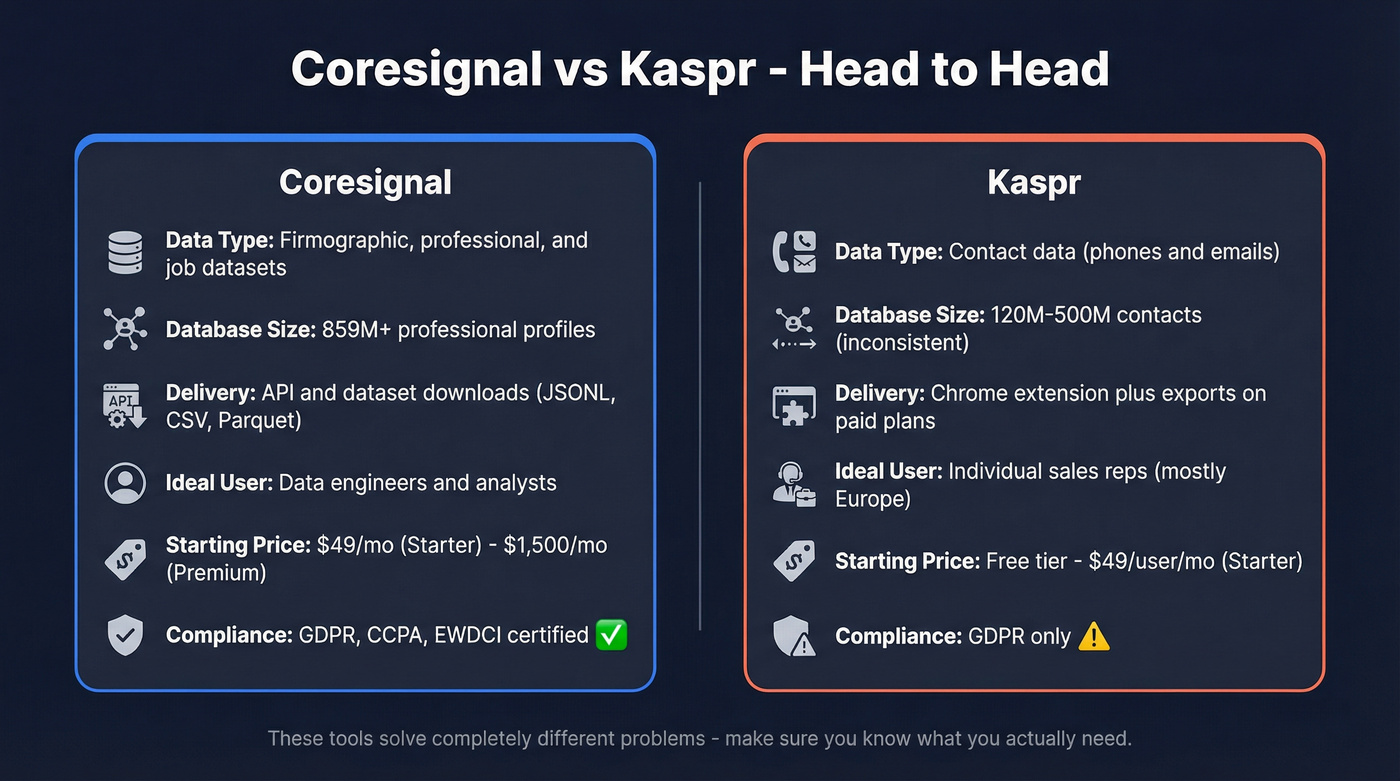
Coresignal is for data engineers and analysts who need raw company, professional, and job posting datasets at scale - delivered via API or dataset downloads (CSV/JSONL/Parquet). It's not a prospecting tool.
Kaspr is for individual sales reps (especially in Europe) who want to pull phone numbers and emails from professional profiles via a Chrome extension - primarily one by one, with exports and API access on paid plans. It's not a data platform.
Feature Comparison at a Glance
| Dimension | Coresignal | Kaspr |
|---|---|---|
| Data type | Firmographic/professional + jobs datasets | Contact data (phones, emails) |
| Database | 859M+ professional profiles | 120M-500M contacts (varies by source) |
| Delivery | API / dataset downloads | Chrome extension + exports on paid plans |
| Ideal user | Data engineers, analysts | Individual sales reps |
| Starting price | $49/mo (Starter) | Free tier; $49/user/mo (Starter) |
| Compliance | GDPR / CCPA-aligned; EWDCI certified | GDPR |
| Reviews | Datarade 4.8/5 (12 reviews) | G2 4.4/5 (833 reviews) |
What Coresignal Actually Does
Coresignal aggregates public web data from 15+ sources into structured datasets covering 859M+ professional profiles, 75M+ company profiles, and 448M+ job posting records. Everything's delivered via API or downloadable datasets - you query with Elasticsearch Query DSL and get structured data back in JSONL, with webhook notifications for employee changes.

Use this if you're building data pipelines, feeding ML models, or running competitive intelligence at scale. The consensus on r/automation is that Coresignal's schema stability and transparency about data sourcing are genuine strengths.
Skip this if you need contact data for outbound sales. Coresignal doesn't provide verified emails or phone numbers - it's raw firmographic data that requires preprocessing. The monthly refresh cadence also means some records can be 3-4 months old, which matters when you're trying to reach someone who changed jobs last quarter.
Pricing: Free trial with 200 Collect + 400 Search credits over 14 days. Starter from $49/mo, Pro from $800/mo, Premium from $1,500/mo. Per-record costs range from $0.005 to $0.196 depending on tier.

Coresignal doesn't give you contact data. Kaspr charges $0.36/credit for phones and throttles your extension. Prospeo delivers 98% accurate emails at ~$0.01 each and 125M+ verified mobiles - all refreshed every 7 days, not monthly.
Stop choosing between raw data and overpriced credits.
What Kaspr Actually Does
Kaspr is a Chrome extension that reveals phone numbers and emails when you browse professional profiles. With 40,000+ users, its base skews heavily European - 699 of its 833 G2 reviews come from Europe. The G2 consensus highlights ease of use and fast contact retrieval as genuine strengths.

Skip this if you need volume. The top complaint on Reddit is that pricing scales terribly. Annual add-on phone credit packs run $0.21 to $0.36 per credit depending on volume - and Kaspr even recommends hiding its Chrome extension to reduce the risk of platform restrictions. That's not a great sign.
Here's a detail that erodes trust: Kaspr's alternatives page says "over 120M contacts." Their blog says "over 500M phone numbers and email addresses." That's a 4x gap. The lower number is probably closer to unique verified contacts, but the inconsistency isn't confidence-inspiring.
Pricing: Free ($0, 5 phone credits/mo). Starter $49/user/mo annual ($65 monthly). Business $79/user/mo annual ($99 monthly). Enterprise is custom.
The Real Architectural Differences
Comparing these two is like comparing a data warehouse to a CRM plugin. Three architectural differences matter most.
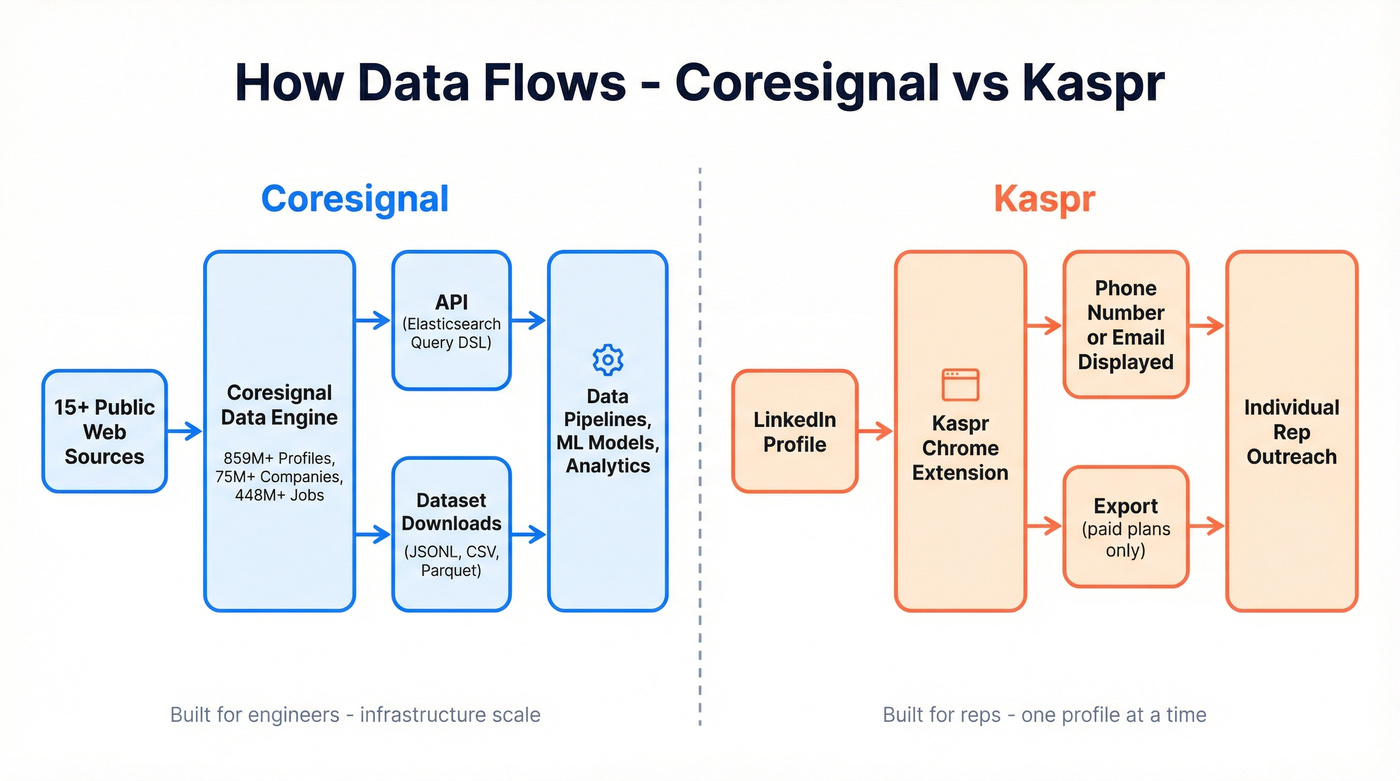
Data type. Coresignal delivers raw company, professional, and job posting data for analytics and product development. Kaspr delivers phone numbers and emails for outbound prospecting. Completely different outputs.
Delivery method. Coresignal runs on APIs and dataset downloads - you query with Elasticsearch and get structured data back in formats like JSONL. Kaspr runs on a Chrome extension that overlays contact data while you browse. One's for engineers, the other's for reps.
Scale economics. This is where it gets interesting. Coresignal charges per record at infrastructure pricing ($0.005-$0.196/record). Kaspr charges per user with credit caps that punish high-volume teams.
A 10-person team on Kaspr Business (annual) runs $79 x 10 x 12 = $9,480/year in seat costs alone, and that includes just 200 phone credits per user per month. If that same team needs an extra 200 phone credits per user per month - so 2,000 extra credits across the team - add-on costs stack fast, and you're still dealing with extension-based pacing and flagging risk. A Coresignal Pro plan at $800/month ($9,600/year) delivers orders of magnitude more data, just not the kind sales reps can use directly.
Real talk: if your team has more than five reps doing outbound, per-credit Chrome extension pricing is a trap. You'll always outgrow it.
Which One Should You Pick?
Pick Coresignal if you're building data pipelines, feeding ML models, or running competitive intelligence at scale. You should be comfortable with API integration and budgeting $800-$1,500+/month for infrastructure-level data. This isn't a tool you hand to your SDR team.
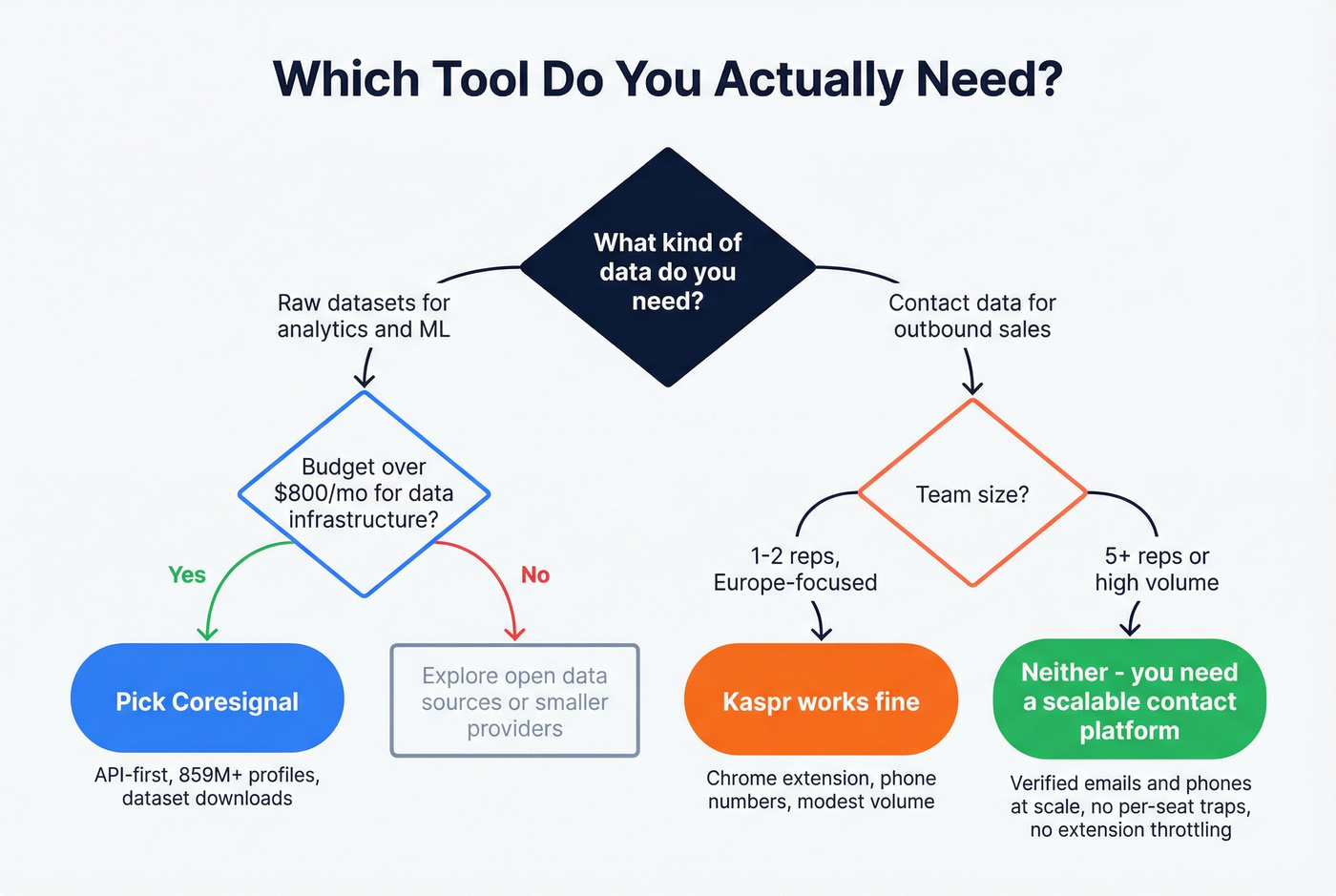
Pick Kaspr if you're an individual rep in Europe doing phone-based outreach on modest monthly volume. You're comfortable with extension pacing risks and working with a per-seat budget under $100/month. For a solo rep or a two-person team, it works fine.
When Neither Tool Fits
Coresignal gives you raw data infrastructure. Kaspr gives you a Chrome extension. But what if you need verified emails and direct dials at scale - without throttling risk or $0.36/credit phone add-ons?
That's the gap we built Prospeo to fill. It covers 300M+ profiles with 98% email accuracy and 125M+ verified mobiles, all refreshed every 7 days (the industry average is about 6 weeks). Pricing starts at roughly $0.01/email with a free tier. No extension throttling, no contracts, and a 92% API match rate for enrichment workflows. In our testing, teams using Prospeo book 26% more meetings than those on ZoomInfo and 35% more than Apollo - the data freshness makes a real difference when you're reaching out to people who changed roles recently.

A 10-person team on Kaspr burns $9,480/year and still hits credit caps. Prospeo gives you 300M+ profiles, direct dials, and a 92% API match rate - no per-seat traps, no extension flagging risk, no contracts.
Scale your outbound without scaling your costs.
FAQ
Is Coresignal a direct competitor to Kaspr?
No. Coresignal sells bulk datasets and APIs for data teams building analytics pipelines. Kaspr is a Chrome extension for individual reps finding phone numbers. The overlap is essentially zero - choosing between them usually means you haven't defined your actual use case yet.
Why does Kaspr list different database sizes?
Their blog claims "over 500M" while their alternatives page says "over 120M contacts." The gap likely reflects different counting methods - total data points vs. unique verified contacts. Use the lower number when evaluating coverage.
What's a good alternative if neither Coresignal nor Kaspr fits?
For teams that need verified contact data at scale without raw data preprocessing or extension throttling, Prospeo offers 300M+ profiles, 98% email accuracy, 125M+ verified mobiles, and a 7-day refresh cycle - with self-serve pricing and a free tier of 75 emails per month.