


Coresignal vs Lusha: Which B2B Data Tool Fits Your Team?
Coresignal and Lusha show up in the same "B2B data" conversations, but comparing them is like comparing AWS to a CRM plugin. One is an API-first data provider built for engineers who want to pull 859M+ employee records into custom pipelines. The other is a Chrome extension that lets sales reps reveal contact details in a couple of clicks.
Side-by-Side Comparison
| Feature | Coresignal | Lusha |
|---|---|---|
| Database | 859M+ employee profiles | 100M+ business profiles |
| Delivery | API / cloud (GCS, Azure, S3) | Chrome extension + CRM push |
| Starting price | Free trial (200 Collect + 400 Search credits, 14 days) | Free (70 credits/mo) |
| Chrome extension | No | Yes |
| CRM integrations | None - API-first | HubSpot, Salesforce, Zoho, 10+ |
| Data freshness | Monthly refresh for standard datasets | Not published |
| G2 rating | Limited presence | 4.3/5 (1,619 reviews) |
| Built for | Data engineers | Sales reps |
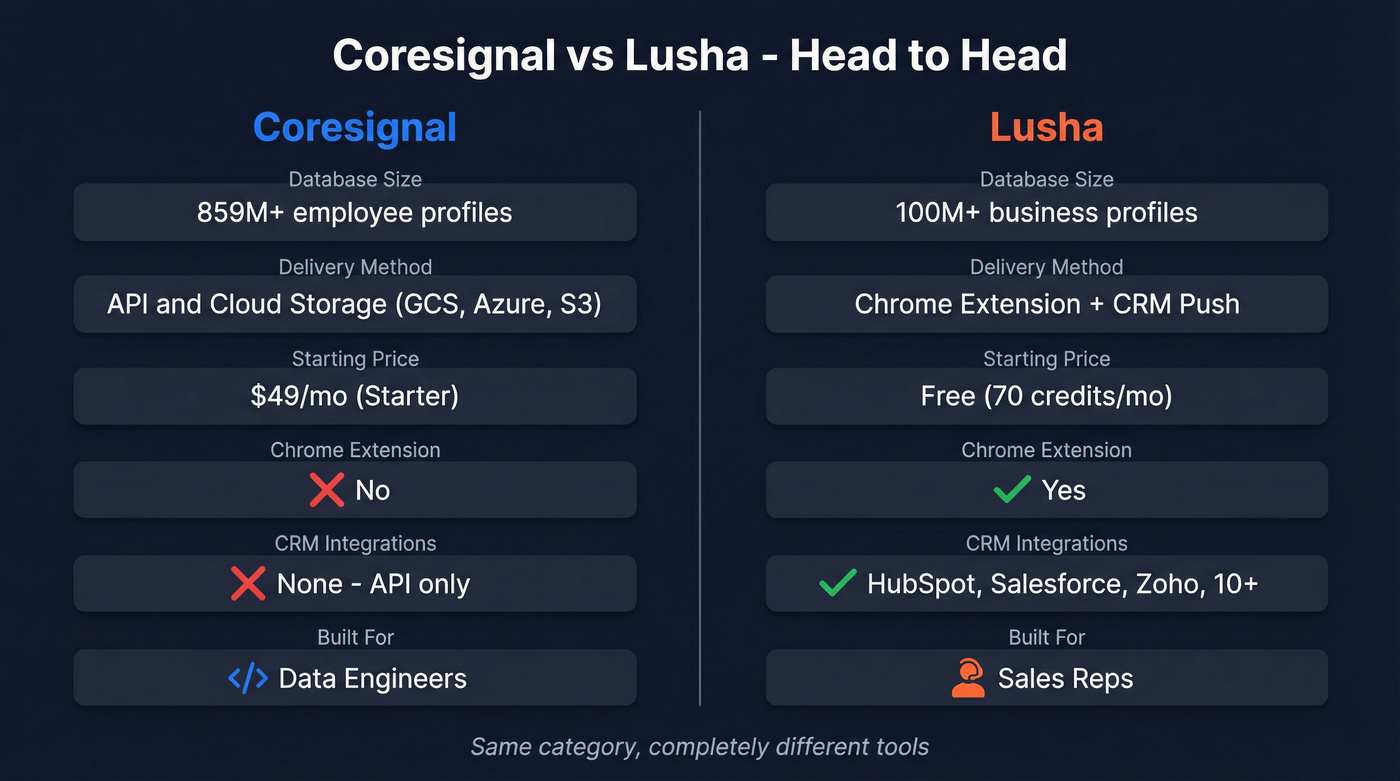
These two tools occupy completely different lanes. The comparison only makes sense if you're deciding where your data budget goes.
Coresignal - What You Get
Use this if you're building custom data pipelines and have engineering resources to normalize datasets. Coresignal's 859M+ employee profiles, 75M+ companies, and 448M+ job postings make it one of the largest API-first B2B data sources available. Delivery happens via API or cloud storage - think batch pulls and enrichment workflows, not rep-led browser lookups.
One practitioner on r/SaaSSales put it well: "So far Coresignal has been the best we've found in terms of freshness and coverage." That tracks with what we've seen. The raw volume is impressive, though industry feedback consistently points to data that's 3-4 months old in practice, which matters for time-sensitive outreach.
Pricing is credit-based: a free trial gives 200 Collect + 400 Search credits valid for 14 days. Paid tiers run from $49/mo (Starter) to $1,500/mo (Premium), with Pro at $800/mo. Annual plans deliver all credits upfront with a 20% discount, but monthly credits don't roll over. Dataset purchases start at $1,000 with custom terms, and enterprise implementations often land in the $5,000-$10,000+/mo range depending on licensing and volume.
Skip this if you're a sales team expecting plug-and-play contact data. There's no Chrome extension, and the data typically needs significant preprocessing before it's actionable.

Coresignal charges $800/mo and still needs an engineer to make the data usable. Lusha's 250 credits buy you just 25 phone numbers. Prospeo gives you 300M+ profiles, 98% verified emails, and 125M+ mobile numbers - all self-serve with a Chrome extension and CRM integrations. No preprocessing. No credit math.
Skip the infrastructure tax and the credit crunch. Start free.
Lusha - What You Get
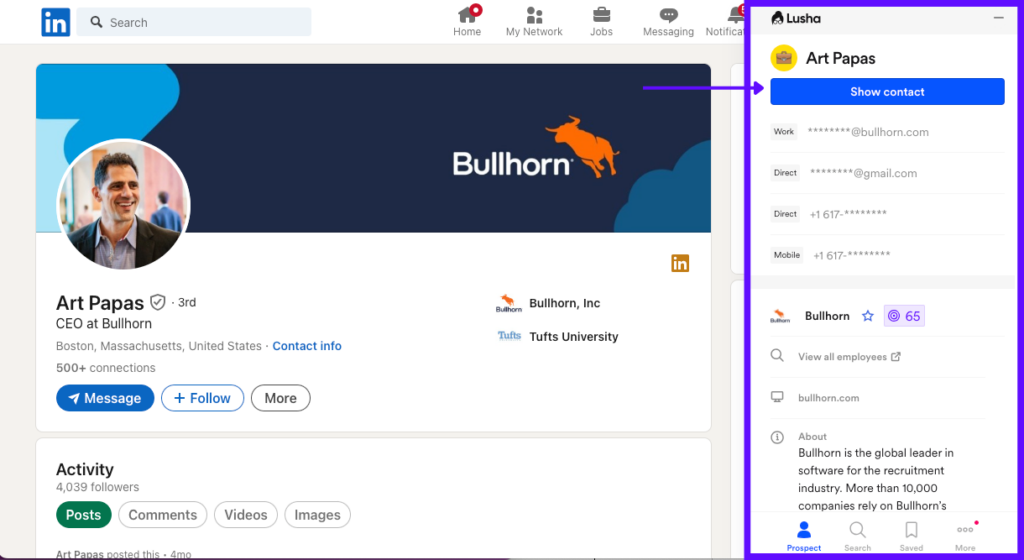
Here's the thing about Lusha that nobody mentions upfront: phone reveals cost 10 credits each. On the Pro plan with 250 credits, that's a maximum of 25 phone numbers per month. Not a typo. If you're also revealing emails from the same credit pool, the number drops further. Credits drain fast, coverage outside North America is weaker, and key features like per-user usage limits are gated behind Scale.
That said, Lusha's Chrome extension is fast, and native integrations with HubSpot, Salesforce, Zoho, Outreach, Salesloft, Pipedrive, and Zapier mean contacts flow into your workflow immediately. The 4.3/5 G2 rating from 1,619 reviews reflects strong ease-of-use scores. Monthly credits also roll over and accumulate up to 2x your plan limit - a small buffer Coresignal doesn't offer.
Free plan gives you 70 credits/mo. Pro starts at $22.45/user/mo on annual billing, Premium is $52.45/user/mo. Scale is custom and often starts around ~$95/user/mo.
Real Cost Per Contact
We ran the numbers on a typical mid-market scenario: 500 emails and 100 phone numbers per month.
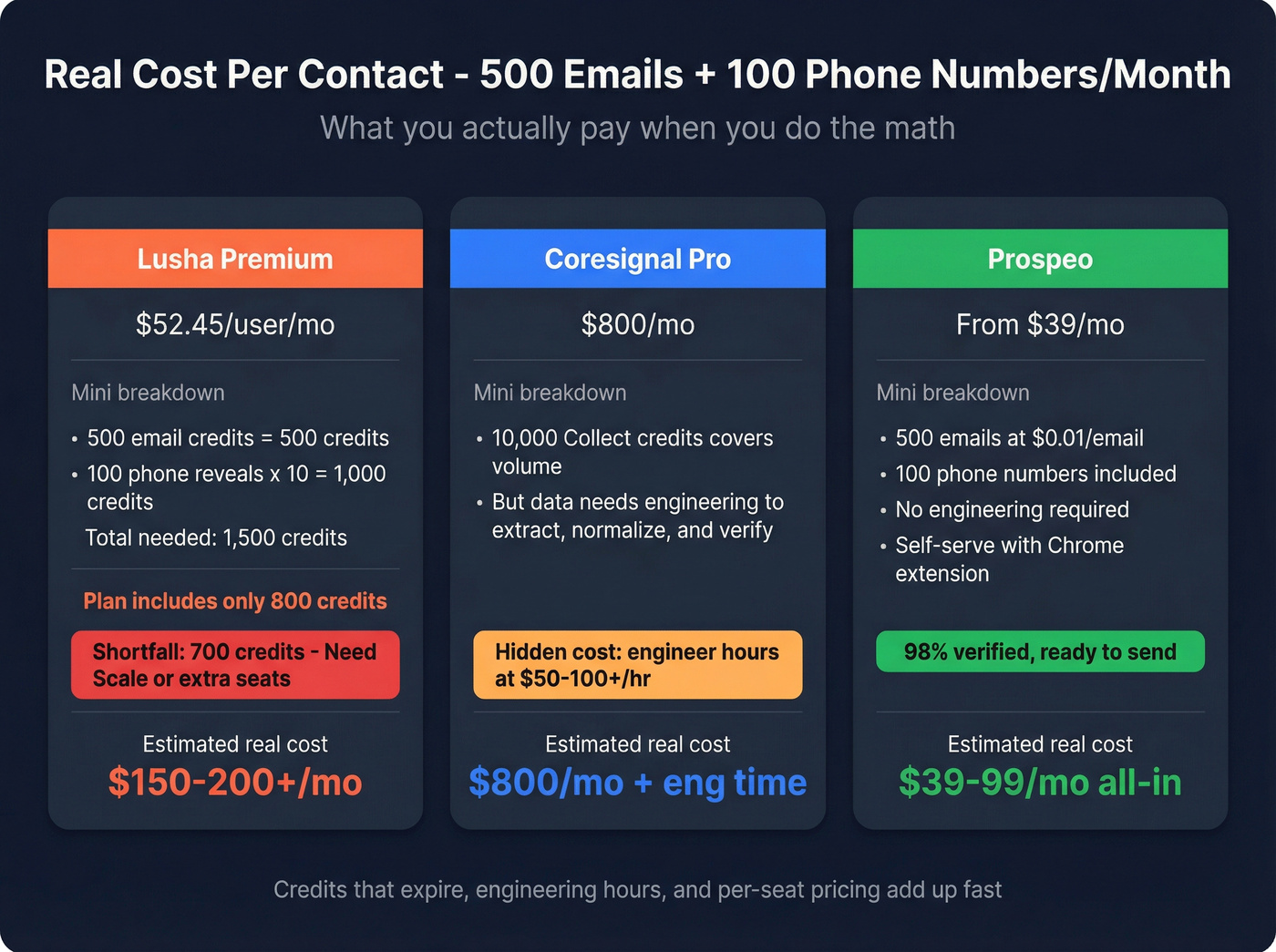
With Lusha Premium, that's 500 + (100 x 10) = 1,500 credits needed, but the plan only includes 800. You'd need Scale or multiple seats. With Coresignal Pro at $800/mo, the 10,000 Collect credits cover the volume, but you need an engineer to extract, normalize, and verify the data before anyone can actually send an email. Neither option is cheap once you factor in the hidden costs.
Which Tool Fits Your Team?
Choose Coresignal if:
- You have data engineers on staff
- You need bulk datasets for custom enrichment pipelines
- You're building proprietary data infrastructure, not running outbound sequences
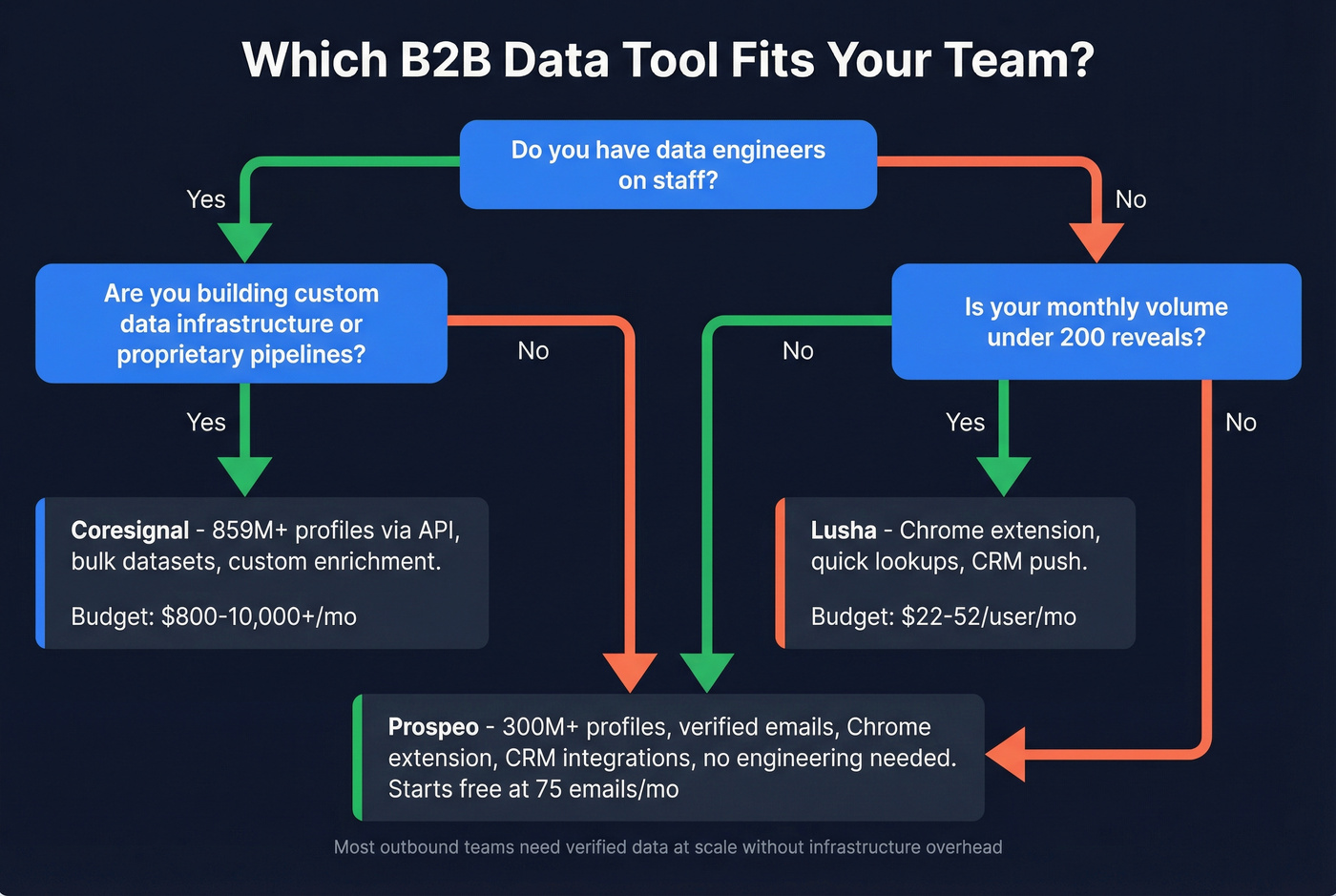
Choose Lusha if:
- You need quick contact lookups from a browser
- You already use HubSpot or Salesforce and want native push
- Your monthly volume stays under a few hundred reveals
Let's be honest: most teams don't need either of these tools. Coresignal is overkill unless you have engineers who'll actually build on top of it. Lusha is underpowered unless your volume is genuinely low. If your average deal size is under $50k and you're running outbound at any real scale, you need something in between - verified data, self-serve, no infrastructure tax. That's what Prospeo's B2B database delivers: 300M+ profiles, 98% email accuracy, a Chrome extension with 40,000+ users, and CRM integrations, starting free at 75 emails/month.

Both Coresignal and Lusha leave you paying hidden costs - engineering hours or per-seat credit limits. Prospeo delivers verified data at $0.01/email with a 7-day refresh cycle, 30+ search filters, and intent data across 15,000 topics. That's enterprise-grade data without enterprise pricing or headcount.
15,000+ companies stopped choosing between power and simplicity.
FAQ
Does Coresignal have a Chrome extension?
No. Coresignal delivers data exclusively via API or cloud storage (GCS, Azure, AWS S3). It's built for engineering-led workflows, not browser-based prospecting.
How many phone numbers can you get on Lusha's Pro plan?
25 maximum. Pro includes 250 credits, and phone reveals cost 10 credits each. That number drops further if you're also revealing emails from the same pool.
Is there a tool that combines data depth with ease of use?
Prospeo offers 300M+ profiles with a self-serve interface, Chrome extension, native CRM integrations (Salesforce, HubSpot, Smartlead, Instantly), and 98% email accuracy - no engineering required. Data refreshes every 7 days, and the free tier includes 75 emails/month.
Which is better for outbound sales teams?
Lusha is the better fit of the two since it offers a Chrome extension and CRM integrations that sales reps can use immediately. Coresignal requires engineering resources to extract and normalize data before it's usable for outreach. For high-volume outbound, though, neither is ideal - teams running real pipeline need verified data at scale with 30+ search filters and intent signals, which is where purpose-built outbound platforms fill the gap.