

Corporate Sales: What It Is, What It Pays, and How to Win in 2026
A veteran enterprise seller once closed a $3.9M contract off a cold call - the kind of deal that makes a quarter. His reward? Getting publicly called out for being last on the team in automated emails sent. That's corporate sales in a nutshell: a world where the biggest wins come from deep research and relationship-building, but the machinery around you keeps pushing for volume metrics. A Reddit thread on r/sales put it bluntly - reps now spend roughly 25% of their time in internal meetings, not selling. The game has changed, but the fundamentals of closing large deals haven't.
What You Need (Quick Version)
Selling into corporations usually means targeting organizations with 100+ employees, buying committees of 6-12+ stakeholders, and cycles measured in months - sometimes over a year. Deal sizes often land in the $25K-$100K+ range, and can go much higher. Three things separate closers from pipeline tourists:
- Understand how the buyer's side works. Procurement, RFPs, scorecards, legal reviews - if you don't know the internal process, you can't navigate it.
- Multi-thread every deal above $30K ACV. Single-threading your champion is the number-one way enterprise deals die quietly.
- Invest in data quality before engagement tools. A bounced email to the economic buyer in a 6-month cycle costs you weeks, not minutes.
What Is Corporate Sales?
Corporate sales is B2B selling into mid-market and large organizations - companies big enough to have formal procurement processes, multiple decision-makers, and budgets that require executive sign-off.
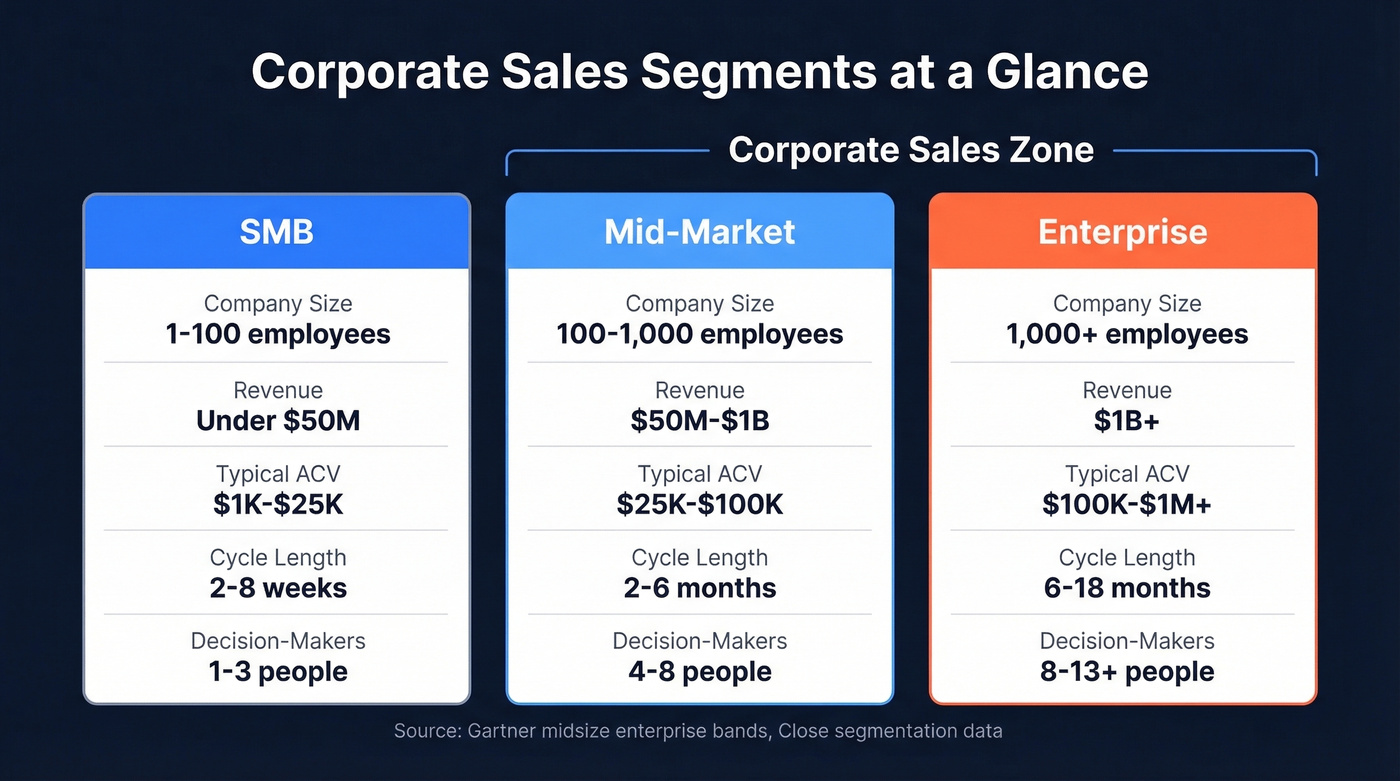
The term gets conflated with "enterprise sales" constantly. The distinction matters in practice: corporate sales is the broader umbrella for selling into larger organizations, from mid-market through enterprise. Enterprise sales is the most complex end of that spectrum - typically Fortune 500-style selling with bigger ACVs and longer cycles.
| Segment | Size (Employees / Revenue) | Typical ACV | Cycle Length | Decision-Makers |
|---|---|---|---|---|
| SMB | 1-100 / <$50M | $1K-$25K | 2-8 weeks | 1-3 |
| Mid-Market | 100-1,000 / $50M-$1B | $25K-$100K | 2-6 months | 4-8 |
| Enterprise | 1,000+ / $1B+ | $100K-$1M+ | 6-18 months | 8-13+ |
Corporate sales spans mid-market and enterprise - the bottom two rows of this table. The mid-market definition here follows Gartner's midsize enterprise bands as summarized in Close's segmentation breakdown: 100-1,000 employees or $50M-$1B in revenue.
For contrast, 70%+ of SMB B2B decision-makers prefer digital self-serve or remote interactions. Corporate buyers operate differently. They want a partner who understands their internal politics and can guide a deal through procurement.
How Corporations Actually Buy
If you've only sold to SMBs, the corporate buying process will feel like a different sport. It's not one person saying yes. It's a committee - procurement, IT, legal, security, finance, and the end-users who'll actually live with your product - all evaluating you simultaneously through different lenses.
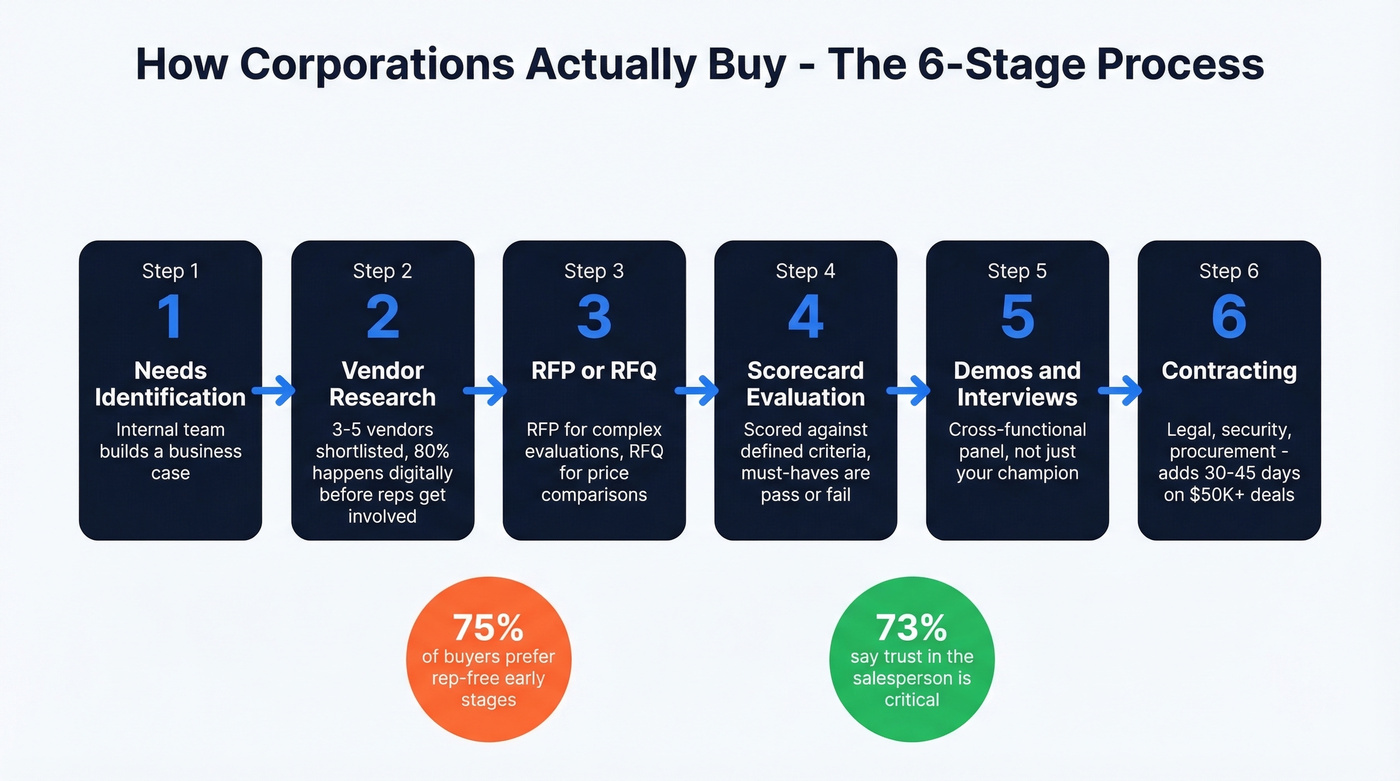
The typical flow from the buyer's side:
- Needs identification. An internal team recognizes a gap and builds a business case.
- Vendor research. They shortlist 3-5 vendors, often before you even know you're being evaluated. 80% of buyer interactions now happen digitally before a rep gets involved.
- RFP or RFQ. An RFP is for complex, technical evaluations. An RFQ is a straight price comparison. Know which one you're responding to; the strategy is completely different.
- Scorecard evaluation. Your proposal gets scored against defined criteria. If you don't meet a must-have requirement, you're eliminated before the demo.
- Demos and interviews. You finally get face time - but you're presenting to a cross-functional panel, not just your champion.
- Contracting. Legal redlines, security reviews, procurement negotiations. This phase alone commonly adds 30-45 days in $50K+ deals.
The evaluation criteria go beyond features and price. Buyers assess financial stability, delivery capability, references, and total cost of ownership - not just the sticker price.
Here's something most sellers underestimate: 73% of B2B buyers say trust in the salesperson is critical to the purchase decision, and 71% prefer a rep who understands their needs over one offering the cheapest price. Supplier relationships often fail not because of capability, but because of cultural misalignment between the two organizations. If you can't demonstrate that you understand how the buyer works internally, you'll lose to a competitor who can - even with an inferior product.
And by the time they talk to you, they've already formed opinions. 75% of B2B buyers prefer a rep-free experience in the early stages. Your job isn't to introduce your product - it's to reshape the evaluation criteria in your favor.
How Long Do Sales Cycles Take?
58% of B2B professionals say their sales cycles got longer over the past year. That tracks with what we see in the field - more stakeholders, more security reviews, more legal scrutiny.
By Deal Size
| ACV Range | Median Cycle | Top Quartile | Drag Signal |
|---|---|---|---|
| $10K-$25K | 38 days | 26 days | >55 days |
| $25K-$50K | 72 days | 51 days | >100 days |
| $50K-$100K | 128 days | 94 days | >175 days |
| $100K-$500K | 187 days | 142 days | >250 days |
| $500K+ | 270 days | ~200 days | >330 days |
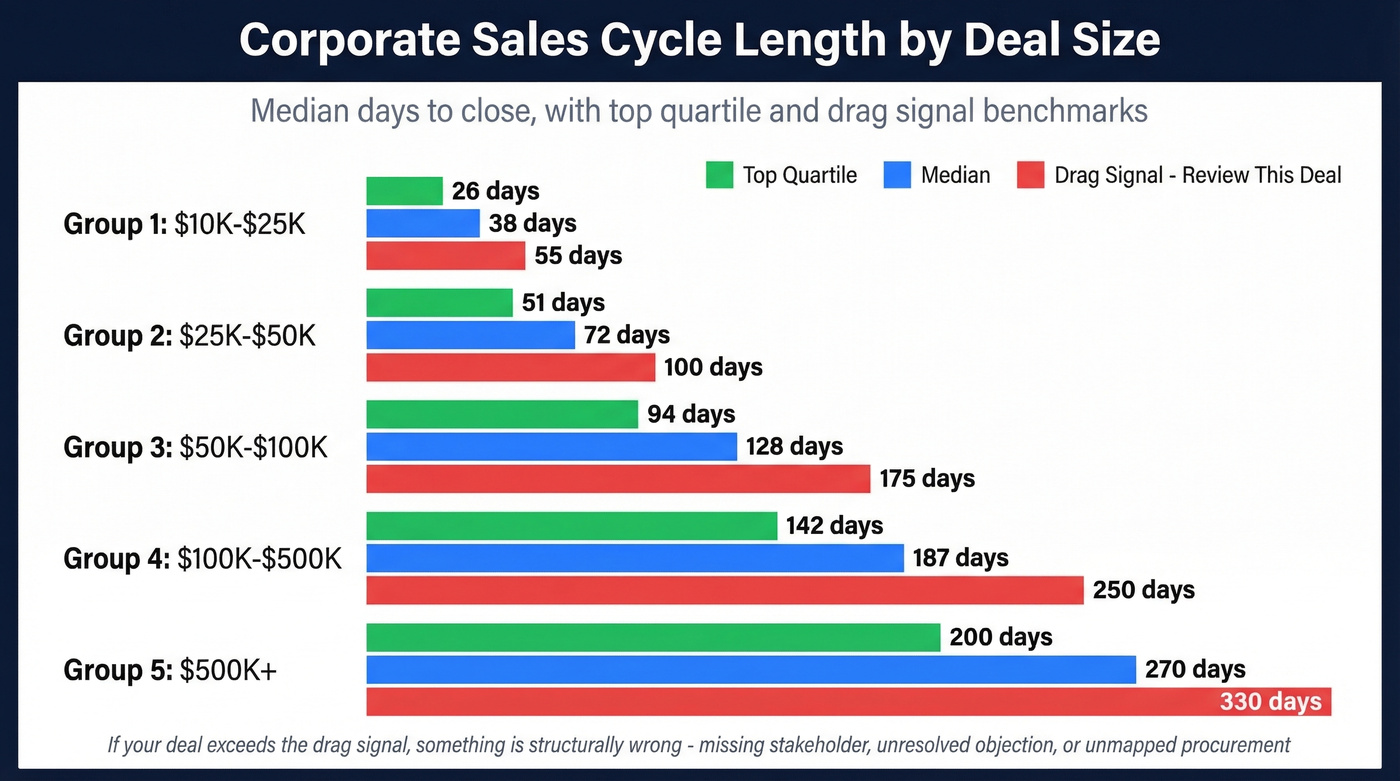
The "drag signal" column should trigger a deal review. If your $75K deal is past 175 days, something is structurally wrong - a missing stakeholder, an unresolved objection, or a procurement process you haven't mapped. Procurement, legal, and security reviews add 30-45 days in the $50K-$100K band. Run those in parallel via a mutual close plan, not sequentially.
By Industry
| Industry | Avg. Cycle (Days) |
|---|---|
| Retail | 70 |
| Software | 90 |
| Financial Services | 98 |
| Real Estate | 102 |
| Consulting | 105 |
| Technology | 110 |
| Telecom | 112 |
| Healthcare | 125 |
| Manufacturing | 130 |
| Pharmaceuticals | 138 |
Company size matters just as much. Selling to a 10-person startup averages 38 days. Selling to a 10,000+ employee organization averages 185 days. That's nearly 5x longer - and it's not because the product evaluation takes longer. It's because the internal approval chain does.
The B2B Corporate Sales Process
Selling to corporations isn't a funnel. It's a puzzle with pieces that move simultaneously. Here's the 8-stage process that works for deals in the $50K+ range.
Define your ICP. Get specific - industry, company size, tech stack, growth signals, funding stage. Vague targeting wastes months because the cycles are so long that a bad-fit deal burns a quarter.
Build your target account list. This is where most teams underinvest. A curated list of 50-100 accounts beats a spray-and-pray list of 5,000. Use intent signals, technographic data, and headcount growth to prioritize.
Map the buying committee. Every stakeholder - economic buyer, technical evaluator, end-user champion, legal, procurement. You need names, titles, and verified contact information for each one.
Multi-channel outreach. Email, phone, events, warm introductions. The average sale requires up to 8 touchpoints before closing. Corporate deals often need more. Referrals close in 20 days on average versus 60 for cold outreach - warm introductions should always be your first play.
Discovery and qualification. This is where MEDDIC earns its reputation. Understand the metrics that matter to the buyer, identify the economic buyer, and map the decision process before you pitch anything.
Solution presentation. Tailor the demo to each stakeholder's priorities. The CFO cares about ROI and total cost of ownership. The IT lead cares about integration and security. The end-user cares about workflow friction.
Navigate procurement and legal. Start this early - don't wait until the deal is "almost closed." Security questionnaires, legal redlines, and vendor onboarding can add 4-8 weeks.
Close and expand. The first deal is the beachhead. Land-and-expand is the real revenue play, and it's where pipeline velocity compounds.
Multi-Threading - The Non-Negotiable
Buying committees are often described in the 6-12 stakeholder range, and 2026 benchmarks put the average at 13 decision-makers per deal.
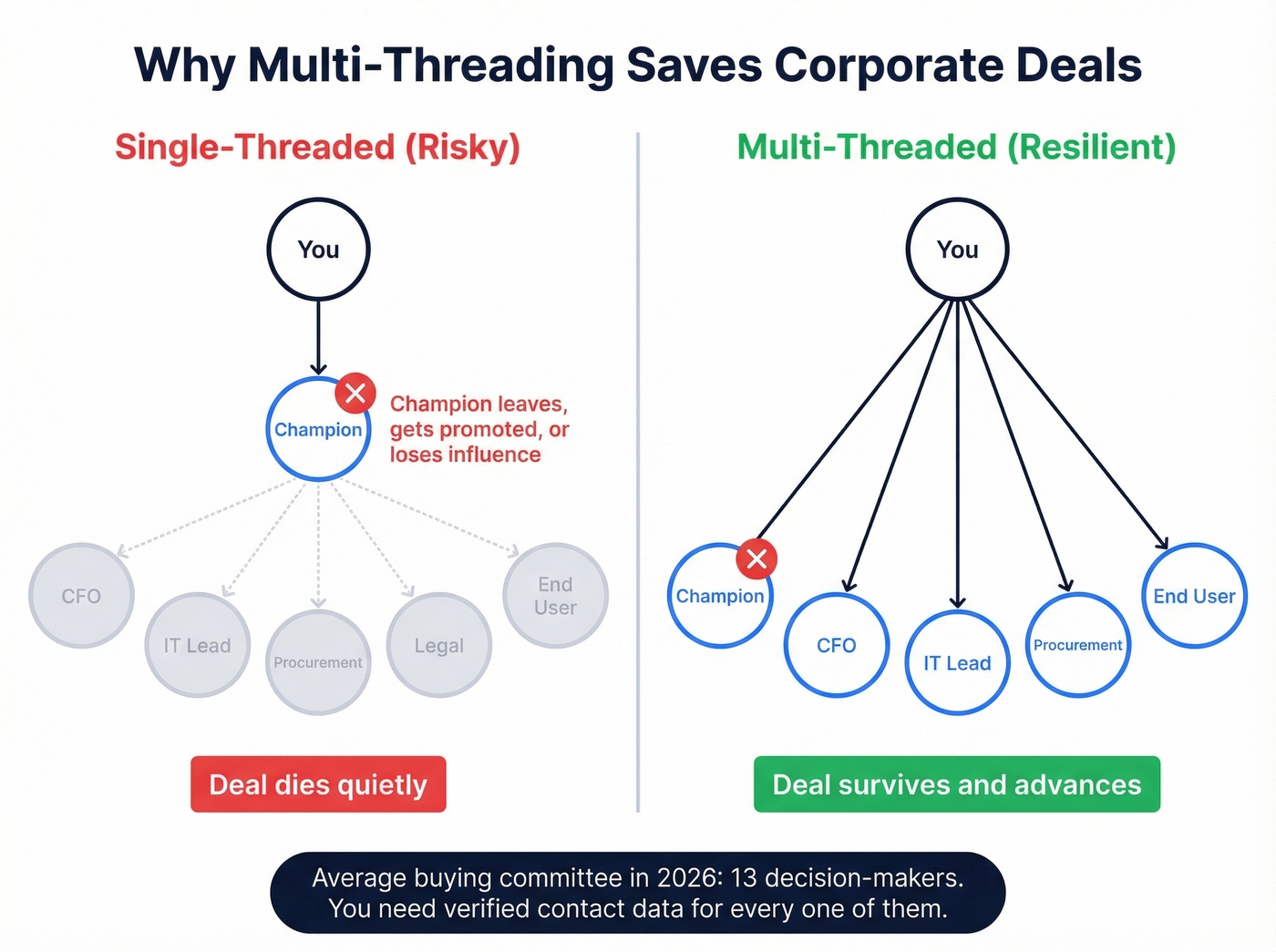
Use this approach if you're selling anything above $30K ACV. Multi-threading - engaging multiple stakeholders in parallel, not sequentially - is the single biggest lever for deal velocity. When your champion goes on vacation, gets promoted, or loses internal influence, a single-threaded deal dies. A multi-threaded deal survives.
Skip this if you're closing transactional deals under $10K with a single decision-maker. Speed matters more than breadth at that level.
When you're mapping a 13-person buying committee, you need verified emails and mobile numbers for every stakeholder - not bounced addresses. Prospeo's 143M+ verified emails and 125M+ verified mobile numbers, refreshed every 7 days, mean your outreach actually reaches the right person instead of disappearing into a dead inbox.

You just read that a bounced email to the economic buyer costs you weeks in a 6-month corporate sales cycle. Prospeo's 98% email accuracy and 5-step verification ensure your outreach lands with every stakeholder on the buying committee - not in a spam folder.
Stop losing corporate deals to bad data. Start at $0.01 per verified email.
Methodologies That Close Deals
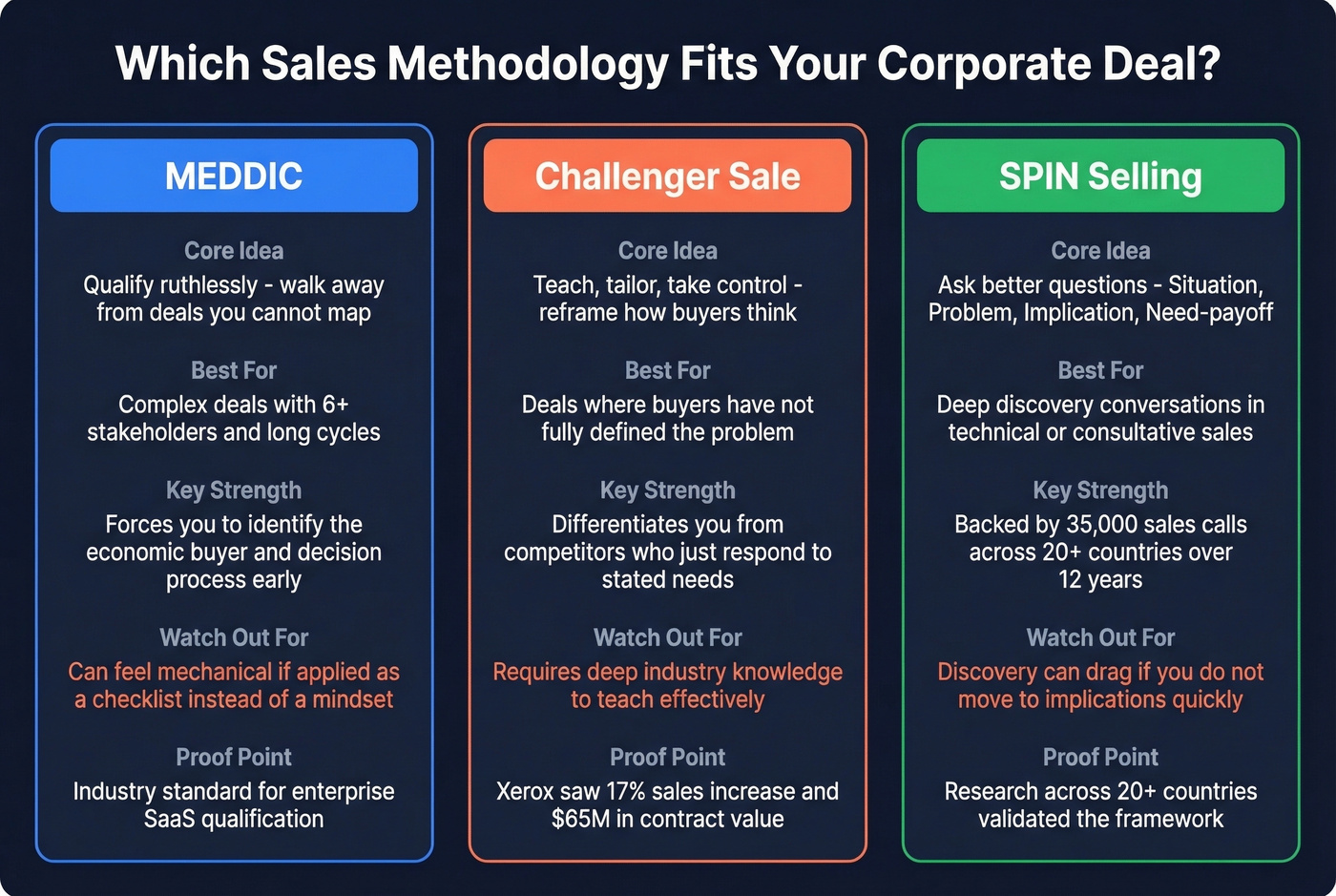
Frameworks aren't religion, but the best sellers in this space have internalized at least one. Let's break down the ones that actually hold up.
MEDDIC
If you only learn one methodology, learn MEDDIC. It stands for Metrics, Economic buyer, Decision criteria, Decision process, Identify pain, and Champion. The power isn't the acronym - it's the discipline of walking away from deals where you can't identify the economic buyer or map the decision process. In large-deal selling, that discipline saves quarters.
Challenger Sale
Built on CEB research across 6,000+ sales reps, the Challenger model argues that reps who teach, tailor, and take control of the conversation consistently outperform relationship builders. Xerox implemented it and saw a 17% increase in sales and $65M in contract value. The core insight: don't respond to the buyer's stated needs. Reframe how they think about the problem.
SPIN Selling
Neil Rackham's research analyzed 35,000 sales calls across 20+ countries over 12 years. The framework - Situation, Problem, Implication, Need-payoff - is best for complex discovery conversations where the buyer hasn't fully articulated their pain. Less prescriptive than MEDDIC, but excellent for early-stage deals with large organizations.
Account-Based Selling
ABS is the preferred operating model for large enterprise deals. It requires tight sales-marketing alignment and deep account intelligence. Pair it with MEDDIC for qualification and Challenger for messaging, and you've got a complete system.
The Corporate Sales Tech Stack
Most teams are over-tooled and sitting on bad data. Here's the thing: they've got six-figure engagement platforms on top of a contact database that bounces 20% of emails. The priority order should be CRM first, then data and prospecting, then engagement, then intent, then forecasting.
| Category | Tools | Pricing Range |
|---|---|---|
| CRM | Salesforce, HubSpot | $25-$300/user/mo |
| Prospecting & Data | Prospeo, Apollo, ZoomInfo | Free-$40K/yr |
| Engagement | Outreach, Salesloft | ~$100-$150/user/mo |
| Intent & ABM | 6sense, Demandbase | $30K-$100K+/yr |
| Forecasting | Clari, Gong | ~$50K-$150K+/yr |
Data quality is the most underrated lever in the entire stack. In a 6-month sales cycle, one bounced email to the economic buyer costs you weeks - not because the email failed, but because you don't realize it failed until the deal stalls and you can't figure out why. Revenue operations teams that treat data as infrastructure rather than an afterthought consistently see higher win rates.

Apollo runs $49-$99/user/month for common self-serve tiers and is strong for SMB-to-mid-market prospecting with built-in sequencing. ZoomInfo typically lands in the $15K-$40K/year range - deep US database, broad feature set, but you're paying for modules you'll never activate. We've seen teams spend $30K+ on ZoomInfo and still supplement with a second data source for mobile numbers.
If your average deal is under $50K ACV, you almost certainly don't need a $30K/year data platform. A self-serve tool with accurate emails and verified mobile numbers will outperform an enterprise suite you're only using at 20% capacity. Spend the difference on better discovery training.
Multi-threading a $50K+ deal means reaching 6-12 stakeholders with verified contact data. Prospeo gives you 30+ filters - buyer intent, headcount growth, tech stack - to build precise target account lists and enrich every contact with 50+ data points.
Build your corporate account list in minutes, not weeks.
Metrics and Funnel Benchmarks
The median B2B conversion rate is 2.9% - for every 100 leads entering the top of the funnel, roughly 3 become customers. That number feels low until you see the stage-by-stage breakdown.
| Funnel Stage | Conversion Rate |
|---|---|
| Lead to MQL | 35-45% |
| MQL to SQL | 15% |
| SQL to Opportunity | 25-30% |
| Opportunity to Closed-Won | 6-9% |
| Overall Lead to Customer | 1.5-2.5% |
The biggest leakage point is MQL to SQL - only 15% of marketing-qualified leads survive sales qualification. That's either a marketing targeting problem or a qualification framework problem, and usually it's both. If your MQL-to-SQL rate is below 10%, fix your ICP definition before spending another dollar on top-of-funnel volume.
89% of revenue organizations now use AI, up from 34% in 2023. The teams winning in 2026 aren't selling harder - they're selling with better data, more precise targeting, and tighter pipeline velocity metrics. If you're not tracking win rate by segment, average deal velocity, and stage-specific conversion, you're flying blind.
Corporate Sales Compensation
Selling to large organizations pays well because it's hard. Here's the 2026 compensation data from RepVue, which tracks self-reported comp across thousands of sales professionals.
| Role | Base Salary | OTE | Quota Attainment |
|---|---|---|---|
| SDR | $60K | $85K | 57.3% |
| SMB AE | $70K | $130K | 44.8% |
| Mid-Market AE | $90K | $175K | 43.9% |
| Enterprise AE | $135K | $265K | 40.9% |
| Strategic AE | $150K | $300K | 47.0% |
| Sales Manager | $150K | $280K | 51.3% |
| Sales Engineer | $145K | $200K | 56.8% |
Enterprise AEs hit quota only 40.9% of the time. Read that again. The role pays $265K OTE because fewer than half the people in it reach target. The variable comp is genuinely variable - it's not a guaranteed bonus, it's a bet that you can navigate 6-18 month cycles, 13-person buying committees, and procurement processes that exist to slow you down.
If you're considering a move from mid-market to enterprise, expect your attainment percentage to drop even as your OTE climbs. The deals are bigger but the win rate is lower, and the emotional toll of losing a deal you've worked for 9 months is real. The sales engineers at 56.8% attainment and $200K OTE are quietly having the best risk-adjusted outcome on this table.
Mistakes That Kill Corporate Deals
Seven patterns we see destroy deals that should've closed.
Single-threading the champion. Your champion leaves, gets reassigned, or loses political capital. If they're your only contact, the deal dies with their influence. We watched a $180K deal evaporate in Q3 last year because the champion took a new role and nobody else in the account knew the rep's name. Multi-thread from day one - no exceptions.
Speaking to the wrong stakeholders. Spending three months building a relationship with a director who can't sign anything above $25K. Map the org chart and the approval authority early.
Overemphasizing features over business outcomes. Nobody in the C-suite cares about your API documentation. They care about revenue impact, risk reduction, and time-to-value. The before/after: "Our platform supports 47 integrations" becomes "Your team eliminates 12 hours of manual data entry per week, which at your headcount saves $340K annually." Same product, completely different conversation.
Poor qualification and neglected follow-up are two sides of the same coin. Skipping MEDDIC - or running it once and never updating it - means you're investing months in deals that were never real. And in a 6-month cycle, going quiet for three weeks kills momentum just as effectively as a bad qualification. Build a structured follow-up plan with value-add touchpoints, not "just checking in" emails.
Ignoring procurement and legal timelines. Starting the security questionnaire in month five of a six-month deal is a recipe for a slipped quarter. Engage procurement early and run legal review in parallel with technical evaluation.
Using bad data. Bounced emails and dead phone numbers don't just waste individual outreach attempts - they waste months in long cycles. When you can't reach the economic buyer because the email address is stale, you don't find out until the deal is already stalling.
Corporate Sales FAQ
What's the difference between corporate and enterprise sales?
Corporate sales is the broader category covering B2B deals with mid-market and large organizations. Enterprise sales sits at the most complex end: Fortune 500 accounts, $100K+ ACVs, 12+ month cycles, and 13+ stakeholders. The skills overlap, but enterprise involves deeper procurement timelines and more organizational complexity.
How long does a typical deal cycle take?
For $25K-$50K deals, expect roughly 72 days. The $50K-$100K range averages 128 days. Above $100K, cycles stretch to 187 days, and $500K+ deals average 270 days. Add 30-45 days for procurement, legal, and security reviews in most $50K+ engagements.
What does an enterprise AE earn in 2026?
Median OTE is $265K with a $135K base. Strategic AEs earn roughly $300K OTE. Only 40.9% of enterprise AEs hit quota - the role pays well precisely because fewer than half reach target in any given year.
What skills matter most for selling to large organizations?
Stakeholder mapping, multi-threading, MEDDIC-based discovery and qualification, executive communication, and patience. The best sellers in this space are part strategist, part project manager, part psychologist.
What tools help find corporate decision-makers?
Most teams combine a B2B data platform with a CRM and engagement tools. For pipeline management, Salesforce or HubSpot handles the CRM side, while Outreach or Salesloft covers sequencing. On the data side, accuracy matters more than database size - a 98% verified email rate and weekly data refresh prevent the stale-contact problem that quietly kills long-cycle deals.