

The Best CRM Apps in 2026 (Ranked by Teams That Actually Use Them)
A RevOps lead we know pitted three CRM apps against each other last quarter. The winner wasn't the one with the most features - it was the one reps actually opened on Monday morning. That's the thesis behind this entire list: adoption beats features, every time.
The CRM market hits $126.17 billion in 2026, and companies using a CRM see 29% higher sales and 34% better productivity. But that ROI only materializes if your team uses the thing. 91% of companies with 10+ employees run a CRM, and the most common complaint on r/CRM isn't missing features - it's that nobody wants to log in. We narrowed 100+ options down to the 12 that real teams stick with.
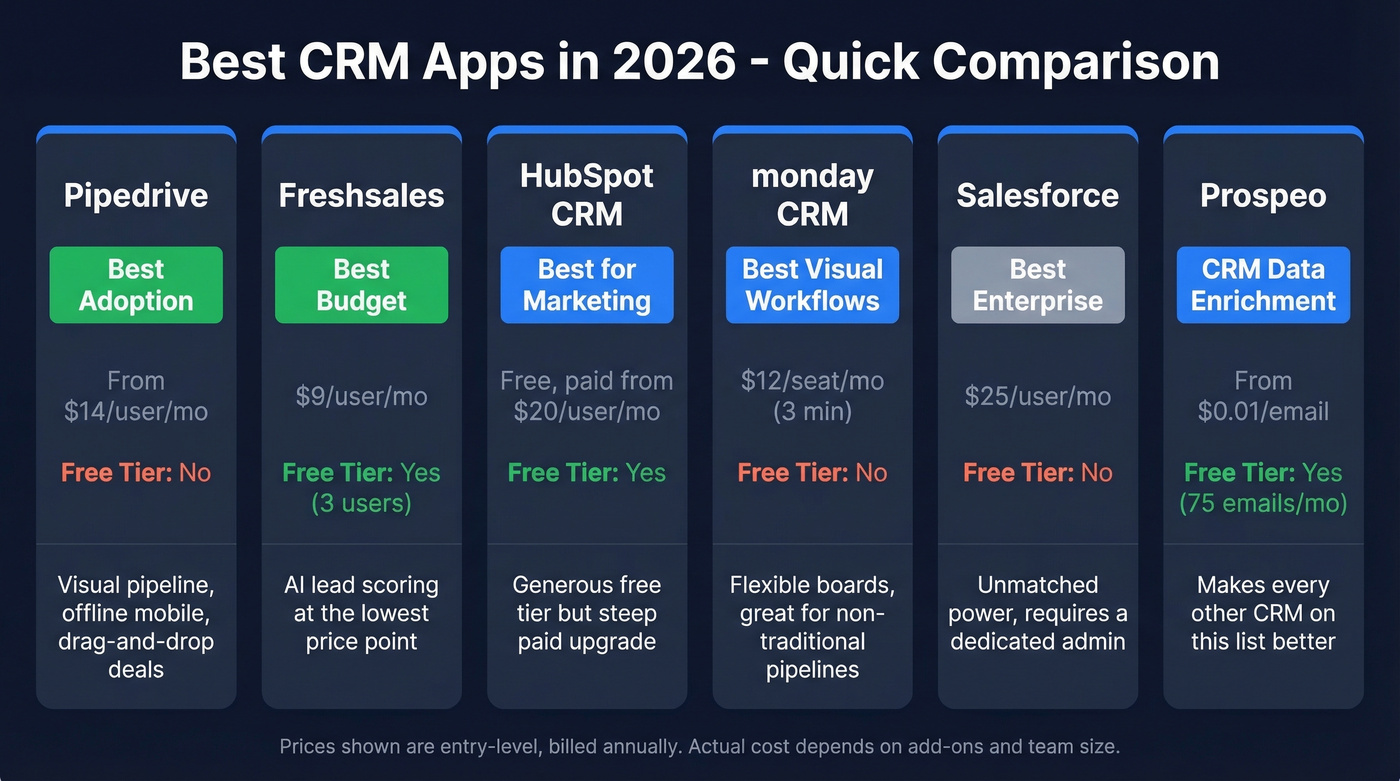
Our Picks at a Glance
| Tool | Best For | Starting Price | Free Tier? | Our Take |
|---|---|---|---|---|
| Pipedrive | Adoption over features | ~$14/user/mo | No (14-day trial) | The CRM people actually open |
| Freshsales | Budget-conscious teams | $9/user/mo (annual) | Yes (3 users) | Best value entry point |
| HubSpot CRM | Marketing-heavy orgs | Free; paid $20/user/mo | Yes | Generous free, steep upgrade |
| monday CRM | Visual workflows | $12/seat/mo (3-seat min) | No (14-day trial) | Bends to your process |
| Salesforce | Enterprise (100+ reps) | $25/user/mo | No | Unmatched power + complexity |
| Prospeo | CRM data enrichment | ~$0.01/email | Yes (75 emails/mo) | Makes every CRM here better |
What CRM Tools Actually Cost in 2026
Sticker prices are misleading. Here's what teams actually pay.
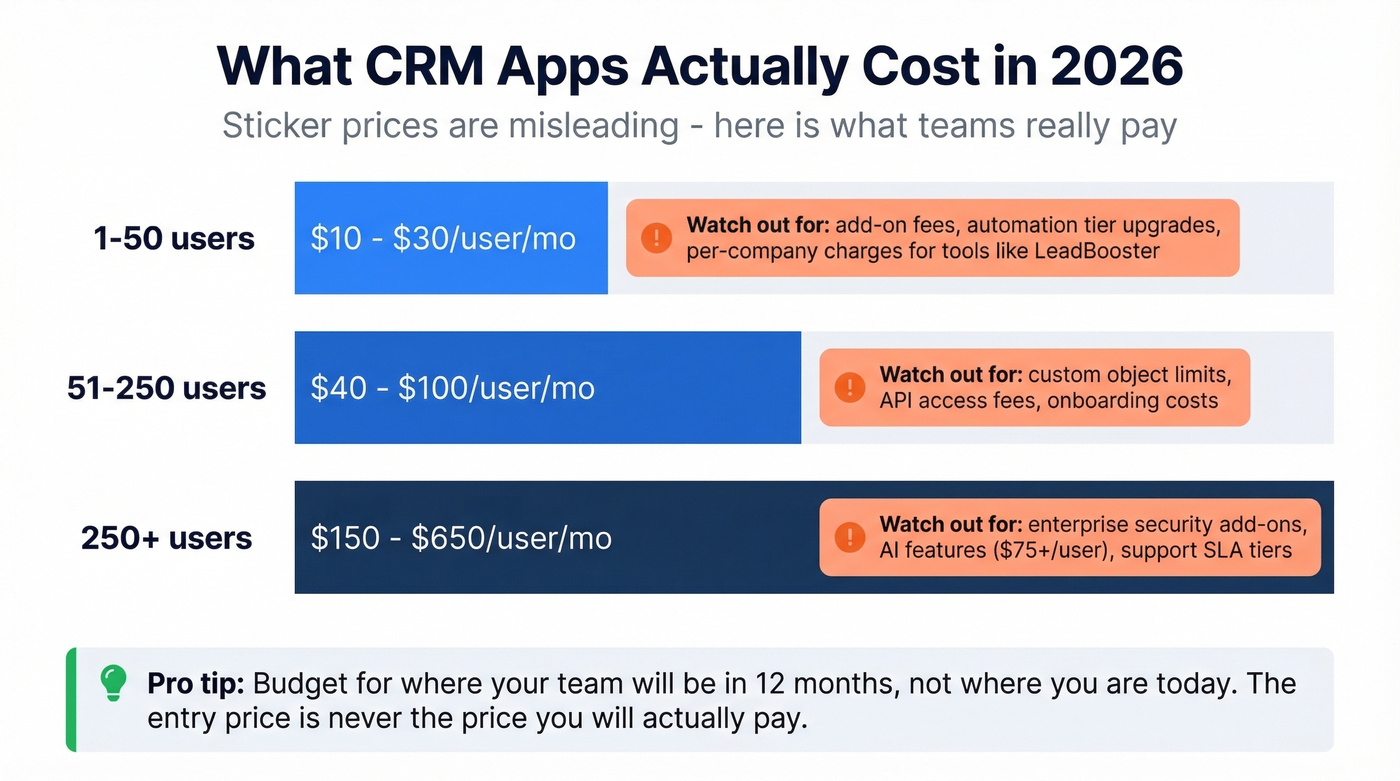
| Team Size | Typical Range | What Drives Cost Up |
|---|---|---|
| 1-50 users | $10-$30/user/mo | Add-ons, automation tiers |
| 51-250 users | $40-$100/user/mo | Custom objects, API access |
| 250+ users | $150-$650/user/mo | Enterprise security, AI, support SLAs |
A few traps worth knowing. HubSpot's free tier is genuinely useful - until you need automation and advanced sales features, at which point the jump to Professional pricing is a cliff, not a slope. monday CRM's $12/seat/mo sounds cheap until you realize there's a 3-seat minimum, so your real starting cost is $36/mo even for a solo founder. And Salesforce Einstein AI add-ons start at $75/user/mo on top of your base license.
Budget for where you'll be in 12 months, not where you are today. The entry price is never the price you'll actually pay.
How We Evaluated These CRM Apps
We weighted six criteria, in this order:
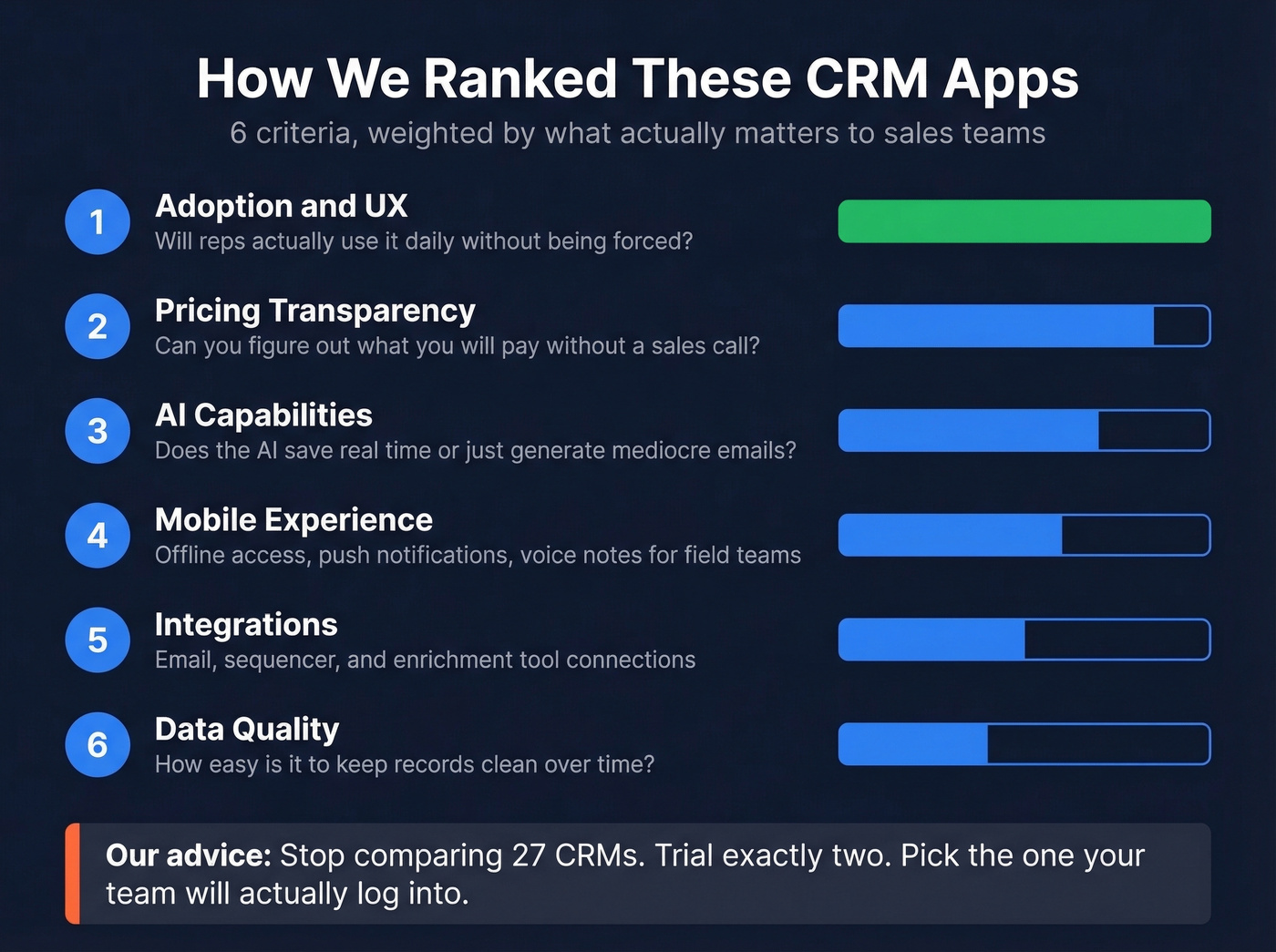
- Adoption and UX - Will reps actually use it daily without being forced?
- Pricing transparency - Can you figure out what you'll pay without a sales call?
- AI capabilities - Does the AI save time, or just generate mediocre email drafts?
- Mobile experience - Offline access, push notifications, voice notes for field teams.
- Integrations - Does it connect to your email, sequencer, and enrichment tools?
- Data quality - How easy is it to keep records clean over time?
Here's the thing: stop comparing 27 CRM systems. Trial exactly two. Pick the one that fits your workflow and the one your team will actually log into. If your average deal size is under five figures, you almost certainly don't need Salesforce-level tooling - and you'll sell more with a simpler platform your reps actually adopt.
The 12 Best CRM Apps for 2026
Pipedrive - Best for Daily Adoption
Use this if you want a CRM your reps will open every single day without being nagged. Pipedrive's visual pipeline is the most intuitive drag-and-drop interface in the category, and the mobile app works offline with auto-sync and Google Maps integration for field reps.

Skip this if you need deep marketing automation or a free tier - Pipedrive doesn't offer one.
Pricing runs ~$14/user/mo for Essential (billed annually), $39 for Growth, and $79 for Ultimate. Watch the add-ons: LeadBooster, Smart Docs, and Campaigns cost $13-$42/mo per company on top of your per-seat price. A 10-person team on Growth with two add-ons can hit $550+/mo fast.
We've seen teams migrate from Salesforce to Pipedrive and see higher CRM usage within the first week. It's not the most powerful platform - it's the most used one.
Freshsales - Best Budget CRM
Use this if you're a small team that needs a real CRM without spending real money. Freshsales starts at $9/user/mo for Growth (billed annually), $39 for Pro, and $59 for Enterprise. The free tier supports 3 users with basic contact and deal management.
Skip this if you need a massive integration ecosystem or enterprise-grade reporting.
Freddy AI handles lead scoring and conversation insights, which is remarkable at that price point. The mobile app punches above its weight - push notifications, check-in for field visits, offline access, and voice notes. For teams selling under five figures per deal, Freshsales is the most affordable functional paid CRM that doesn't feel like a toy.
HubSpot CRM - Best for Marketing-Led Teams
HubSpot's free CRM is a brilliant acquisition funnel. You get deal tracking, basic reporting, and up to 1,000 contacts - enough to get hooked. The problem is what happens next. Pros:
- Breeze AI is genuinely useful for predictive scoring and writing assistance
- The marketing-to-sales handoff works well if you're already on HubSpot Marketing Hub
- Massive integration marketplace
Cons:
- Starter ($20/user/mo for Sales Hub Starter) is fine, but Professional jumps to $100/user/mo
- Sales Hub Enterprise hits $150/user/mo plus a $3,500 onboarding fee
- Reddit is full of teams of 3-5 who outgrow the free tier within months and face sticker shock
The consensus on r/CRM is clear: HubSpot free is great until it isn't, and the paid jump is steep. Budget for the upgrade from day one.
monday CRM - Best for Visual Workflows
Use this if your team's process doesn't fit a traditional CRM mold. monday CRM bends to your workflow instead of forcing you into theirs. The board-based interface lets you build custom pipelines, track projects alongside deals, and automate follow-ups without writing code.
Skip this if you're a solo user - the 3-seat minimum means your real starting cost is $36/mo on Basic, $51/mo on Standard, or $84/mo on Pro.
Pricing: Basic $12/seat/mo, Standard $17, Pro $28. monday AI kicks in on the Pro plan with task automation and follow-up suggestions. For teams that already use monday.com for project management, adding the CRM module is a no-brainer - everything lives in one workspace.
Salesforce Sales Cloud - Best for Enterprise
Use this if you have 100+ employees, a dedicated Salesforce admin, and the budget to do it right. Salesforce is the most powerful CRM on the planet. It's also the most complex. Sales Cloud pricing starts at $25/user/mo. Einstein AI add-ons start at $75/user/mo extra.
Skip this if you don't have a full-time admin. We've watched small teams buy Salesforce because it's "the standard," then spend six months configuring it instead of selling. G2 backs the power claim with 25,479 reviews at 4.4/5 - but that rating comes from companies with the resources to implement it properly.
Zoho CRM - Feature-Rich, Rough Around the Edges
Zoho packs incredible feature density: free for 3 users, Standard at $14/user/mo, Professional $23, Ultimate $52. Zia AI offers workflow suggestions, anomaly detection, and best-time-to-contact predictions. The mobile app includes a business card scanner and RouteIQ geolocation.
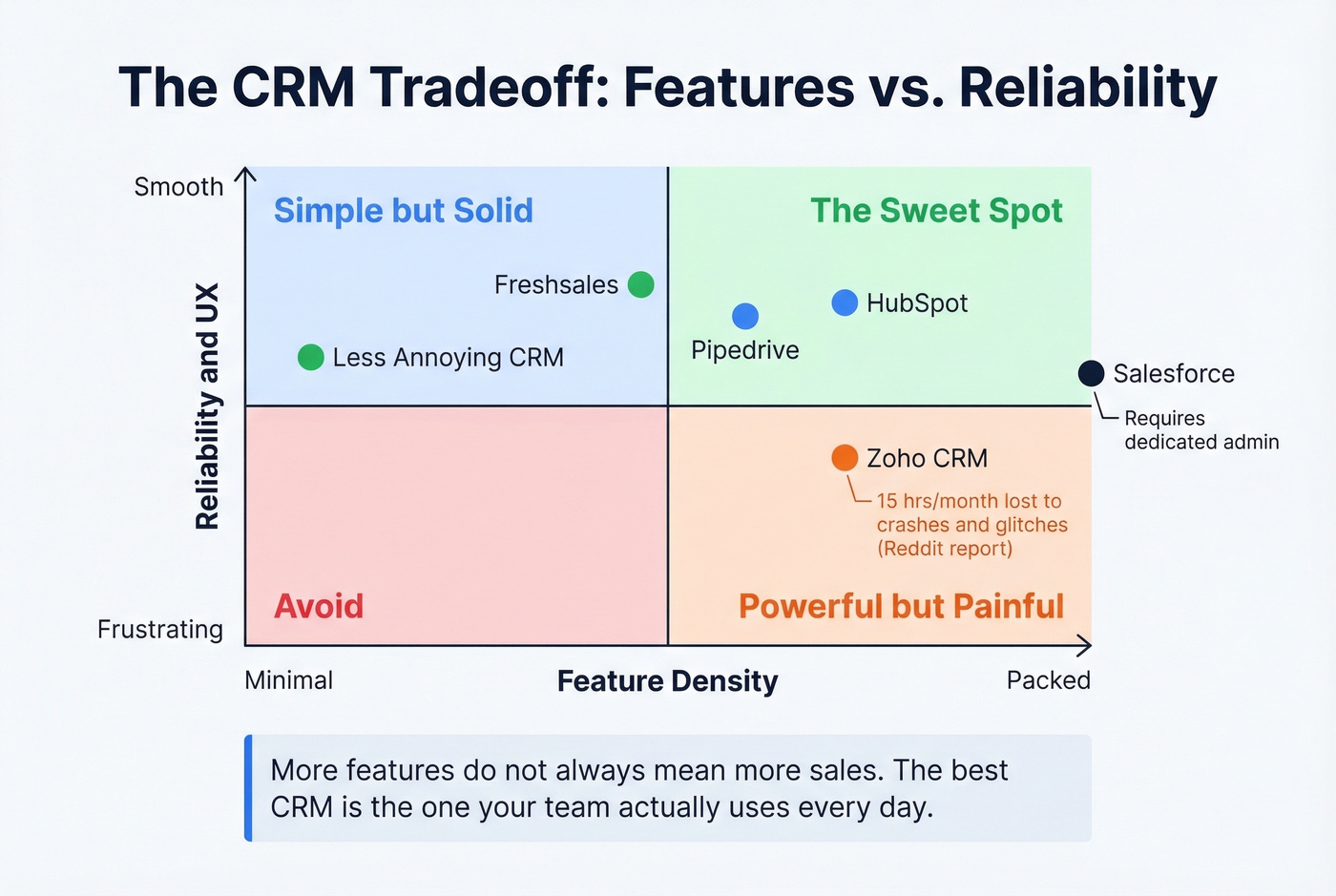
But the #1 Zoho complaint on Reddit is reliability. One small business owner reported roughly 15 hours per month wasted on crashes, glitchy custom fields, and a mobile app that lags on basic searches. Email integration drops threads. Reports take forever to load or crash entirely.
Zoho looks unbeatable on a feature comparison chart. In practice, the experience gap between Zoho and Pipedrive or HubSpot is noticeable. If your team's patience is thin, look elsewhere.
Copper - A CRM That Lives Inside Gmail
Copper is built for Google Workspace teams. Its Chrome extension sits inside Gmail and Google Calendar - you manage contacts, log emails, and update deals without constantly context-switching. For teams whose entire workflow runs through Google apps, that integration is the whole point.
The tradeoff: Copper is limited outside the Google ecosystem. Reporting is basic compared to Pipedrive or HubSpot, and if anyone on your team uses Outlook, you'll hit a wall immediately. Pricing starts at $12/user/mo. A solid pick for all-Google shops; skip it for everyone else.
folk CRM - Best for Solopreneurs
folk feels like editing a spreadsheet, which is exactly why people who've been managing contacts in Google Sheets love it. Inline editing and bulk updates are fast, and Magic Fields uses AI to auto-populate custom fields from contact data.
A third-party test onboarded 3 reps in under 45 minutes, and folk's AI matched 87% of imported contacts to enriched profiles. That's fast. The tradeoff: email sequences and API access are gated behind Premium at $48/member/mo, and a 5-person team at that tier costs $2,880/year - nearly 4x what Pipedrive Essential would run. Standard is $24/member/mo, Custom from $80.
Close - Built for Phone-Heavy Teams
Close exists for one reason: inside sales velocity. Where most CRM software bolts on calling as an afterthought, Close built the dialer, SMS, and email sequences directly into the platform. No third-party tools, no tab-switching, no sync issues. Pricing starts at $19/mo for solo users and from $49/user/mo for teams.
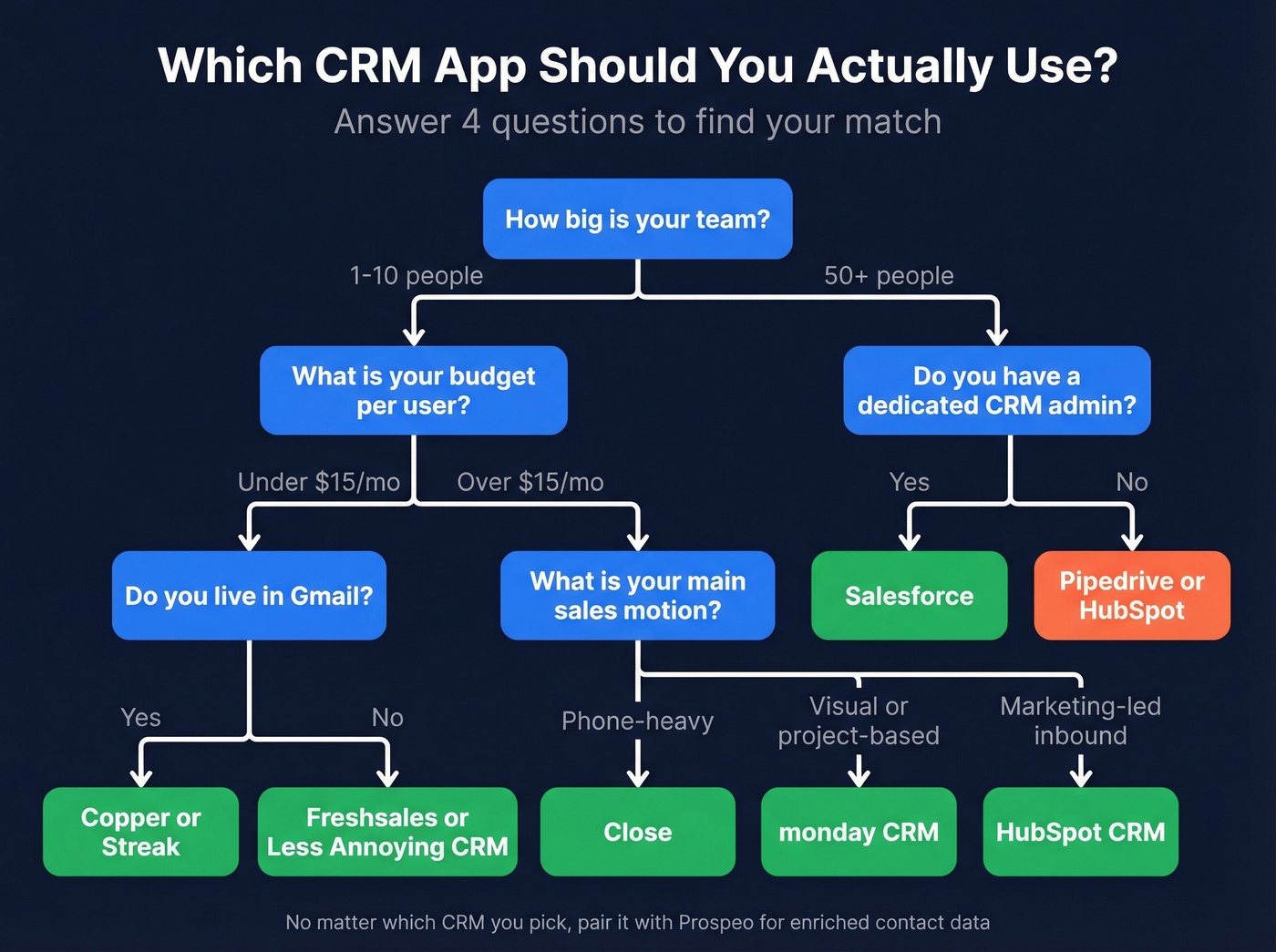
The flip side is that Close doesn't try to be anything else. No field sales features, no marketing alignment, no project management. If your reps live on the phone and close deals in 1-3 calls, Close is purpose-built for that motion. If you need anything broader, keep scrolling.
Attio - The One to Watch
Attio earned G2's "Top Trending" CRM badge, and the hype is warranted. It feels like someone rebuilt Airtable specifically for CRM - flexible data models, relationship intelligence, and a UI that doesn't look like it was designed in 2014. Pricing typically lands around $25-$50/user/mo. It's gaining traction fast among startups and VC-backed teams, and it's firmly on our radar for a full review.
Streak - Best Gmail-Only CRM
Streak lives entirely inside Gmail. Solo at $15/mo, Pro $49, Enterprise $129. There's no offline editing - a dealbreaker for field reps between meetings with no signal. For inbox-first teams who never leave Gmail, it's lightweight and effective.
Less Annoying CRM - Simplest Option Available
$15/user/mo. One tier. No upsells. No enterprise plan. No feature gating. G2 named it "Easiest to Use" in the CRM category. If you hate complexity, start here.
Bigin by Zoho CRM - Cheapest Functional CRM
Bigin strips CRM down to the essentials and charges accordingly: free for 1 user, $7/user/mo for Express, $12/user/mo for Premier. PCMag gave it Editors' Choice for SMB CRM. Think of it as a lightweight, low-cost option for small teams that just need pipeline basics without the Zoho reliability headaches.

Every CRM app on this list has the same weakness: garbage data in, garbage pipeline out. Prospeo enriches your CRM records with 98% verified emails, 125M+ direct dials, and 50+ data points per contact - refreshed every 7 days, not every 6 weeks.
Stop paying for a CRM your reps ignore because the contacts bounce.
Full Pricing Comparison
All prices are per user/month, billed annually.
| Tool | Free Tier? | Entry Price | Mid-Tier | Enterprise |
|---|---|---|---|---|
| Pipedrive | No | ~$14 | $39 | $79 |
| Freshsales | Yes (3 users) | $9 | $39 | $59 |
| HubSpot | Yes | $20 | $100 | $150 + $3.5K onboard |
| monday CRM | No | $12 (3-seat min) | $17 | $28+ |
| Salesforce | No | $25 | Custom | Custom |
| Zoho CRM | Yes (3 users) | $14 | $23 | $52 |
| Copper | No | $12 | Custom | Custom |
| folk | No | $24 | $48 | $80+ |
| Close | No | $19 (Solo) | $49+ | Custom |
| Attio | No | ~$25-$50 | Custom | Custom |
| Streak | No | $15 | $49 | $129 |
| Less Annoying | No | $15 | N/A | N/A |
| Bigin | Yes (1 user) | $7 | $12 | N/A |
Hidden costs to watch: HubSpot's $3,500 onboarding fee on Sales Hub Enterprise, monday's 3-seat minimum, Salesforce Einstein at $75/user/mo extra, and folk gating email sequences behind Premium.
AI Features Worth Paying For
Every CRM vendor slaps "AI-powered" on their marketing page. Here's what actually saves time versus what generates mediocre email drafts you'll rewrite anyway.
| Tool | AI Product | What It Does | Available From |
|---|---|---|---|
| Salesforce | Einstein | Lead scoring, email sentiment, forecasting | $75/user/mo add-on |
| HubSpot | Breeze | Writing assistant, predictive scoring | Starter+ |
| Zoho | Zia | Workflow suggestions, anomaly detection, best-time-to-contact | Standard+ |
| Freshsales | Freddy | Lead scoring, conversation insights | Paid plans |
| monday CRM | monday AI | Task automation, follow-up suggestions | Pro ($28/mo) |
| folk | Magic Fields | AI-powered custom fields | Standard ($24/mo) |
Freshsales wins the value play - Freddy AI at $9/user/mo is hard to beat. Salesforce Einstein is the most powerful, but at $75/user/mo on top of your base license, it's enterprise-only territory. Our take: AI lead scoring is genuinely useful. AI email writing is mostly a gimmick. Prioritize accordingly.
The Data Problem Nobody Talks About
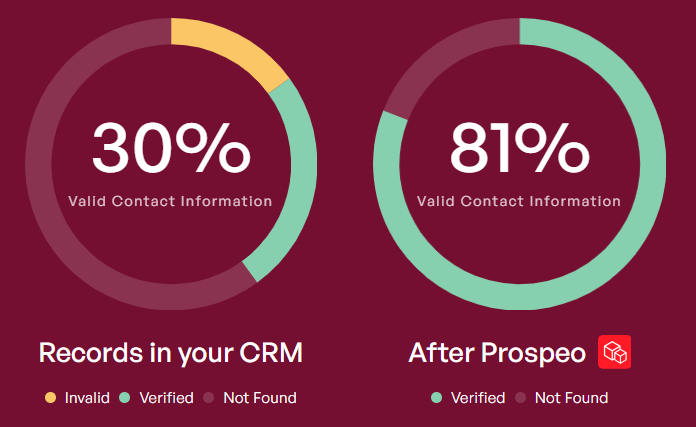
Your CRM is only as valuable as the data inside it. Most CRM databases are 30-40% stale within a year as people change jobs, companies get acquired, and email addresses bounce.
Here's a scenario we see constantly: your sales manager pulls a report and discovers half the contacts have bounced emails. Reps have been sequencing dead addresses for weeks. Pipeline numbers are inflated. The CRM everyone fought to implement is now a liability instead of an asset, and nobody trusts the numbers coming out of it.
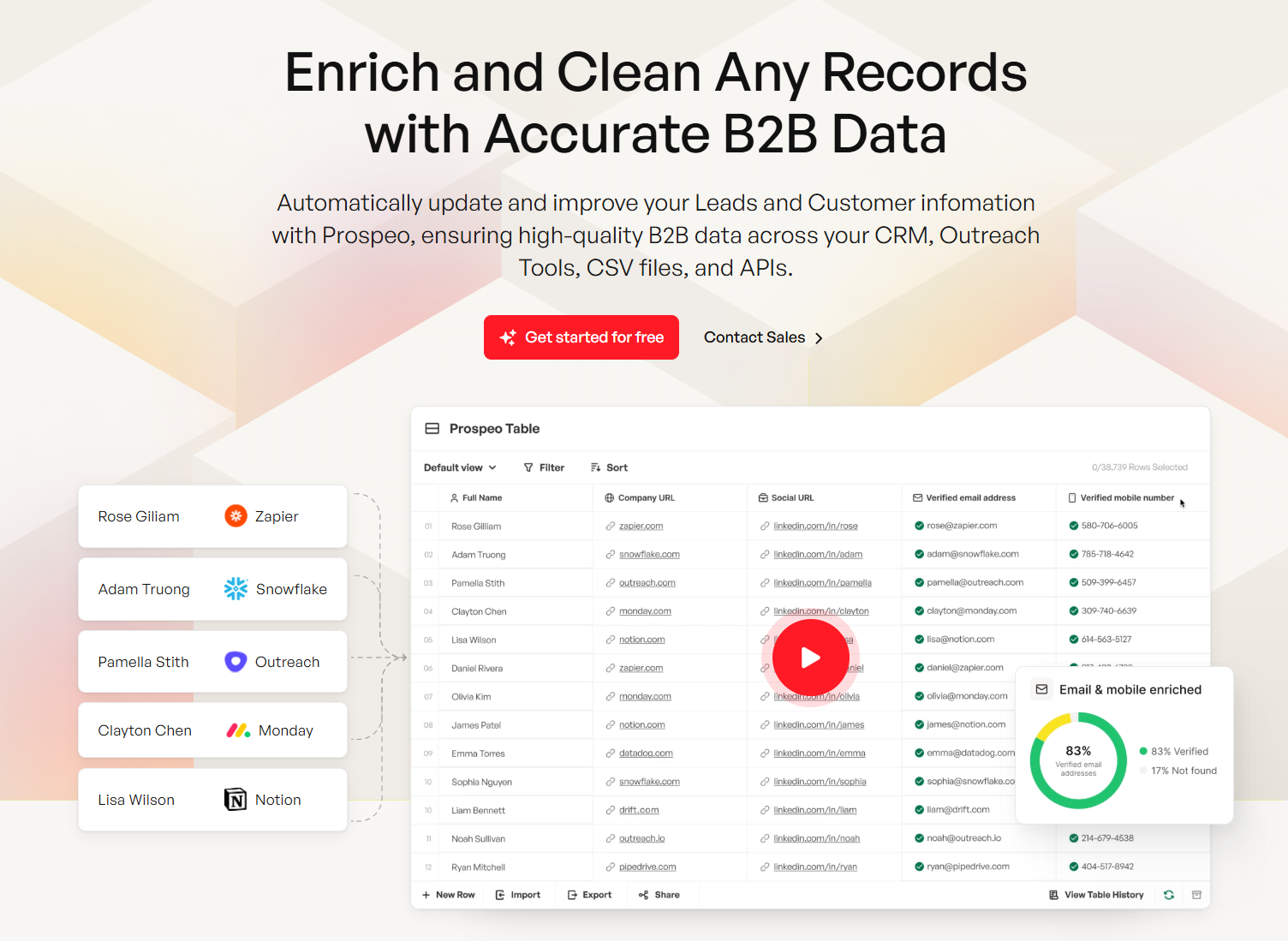
Prospeo solves this at the data layer. It covers 300M+ professional profiles with 98% email accuracy and an 83% enrichment match rate, returning 50+ data points per contact. The 7-day data refresh cycle keeps records current while the industry average sits at six weeks. Native integrations with HubSpot and Salesforce mean enrichment runs automatically - no CSV exports, no manual cleanup. Snyk's 50-person sales team dropped their bounce rate from 35-40% to under 5% after plugging Prospeo into their workflow, and AE-sourced pipeline jumped 180%.
5 CRM Mistakes That Cost You Months
Defaulting to the biggest brand without trialing. Salesforce is the default. It's also overkill for 80% of teams under 50 people. One team cut operational latency 30% by switching from a big-name CRM to one that integrated with their ERP. Trial two options for two weeks each. Pick the one your reps prefer, not the one your board recognizes.
Budgeting for entry price, not 12-month cost. That ~$14/user/mo Pipedrive plan becomes $39 once you need workflow automation. HubSpot free becomes $100/user/mo once you need advanced sales features. Budget for the tier you'll actually need in a year.
Choosing features over adoption. The Reddit consensus nails it: "Most CRMs don't fail because they're missing features - they fail because no one wants to use them." A simpler tool with 90% adoption beats a powerful one at 40%.
Ignoring mobile for field teams. If your reps are in the field, offline access isn't optional. Pipedrive and Freshsales handle this well. Streak doesn't. Businesses using mobile CRM are 150% more likely to exceed sales goals.
Loading garbage data into a new CRM. This is the most expensive mistake on the list. You spend weeks migrating contacts, only to discover 30% of emails bounce on the first sequence. Verify and enrich contacts before importing - tools like Prospeo catch invalid emails before they poison your pipeline.
One more thing: Zendesk announced it's retiring Zendesk Sell on August 31, 2027. If you're evaluating CRM apps right now, check vendor viability. Picking a tool that sunsets in 18 months is a mistake you can avoid today.
You just picked your CRM. Now fill it with data reps actually trust. Prospeo's native integrations with Salesforce and HubSpot push verified emails and mobiles straight into your pipeline - at $0.01 per email with an 83% enrichment match rate.
Clean data is the difference between a CRM and a digital graveyard.
FAQ
What is a CRM app?
A CRM (customer relationship management) app organizes contacts, tracks deals through a pipeline, automates follow-ups, and gives your team a single source of truth for every customer interaction. Most modern options are cloud-based with mobile access included, though some like Streak and Copper run as browser extensions tied to Gmail.
Are free CRM apps worth it?
HubSpot and Freshsales both offer functional free tiers supporting up to 3 users with basic contact and deal management. Expect to outgrow them within 6-12 months once you need automation or advanced reporting - budget for the paid upgrade from day one.
What's the best CRM app for a small business?
Pipedrive for sales-driven teams, Freshsales if budget is tight, and HubSpot if marketing drives your pipeline. Let's be real: trial two for two weeks and pick the one with higher daily adoption. That's the only metric that matters for ROI.
How do I keep my CRM data accurate?
CRM data decays 30-40% per year as people change jobs and emails bounce. Use an enrichment tool to refresh contacts automatically on a weekly cycle with verified emails, so reps aren't sequencing dead addresses.
How much should a small team budget for CRM?
Expect $10-$30/user/month for a team of 1-50. Factor in add-ons, onboarding fees, and the cost of the tier you'll actually need in 12 months - not just the entry price on the pricing page.