

CRM Data Cleansing Services: What You Actually Need in 2026
Your SDR pulls 200 "decision-makers" from the CRM. Forty-three have no phone number. Twenty-seven emails bounce. Eleven are duplicates of each other. That's not a database - it's a liability.
CRM data cleansing services exist to fix this, but most teams don't need what they're selling. A Validity survey of 602 CRM users found 37% lost revenue directly because of poor data quality, and 76% said less than half their CRM data is accurate. Let's be honest: if three-quarters of your records are unreliable, you're not running a pipeline. You're running a guessing game.
What You Need (Quick Version)
If your database exceeds 500K records or you have zero internal ops capacity, then outsource - expect $5,000-$25,000 per project. Most CRM data cleaning solutions on the market handle the basics fine; the real question is whether you need hands-on-keyboard help or just better tooling.
What Is CRM Data Cleansing?
CRM data cleansing removes, repairs, and standardizes the records already in your CRM - duplicates, outdated contacts, formatting inconsistencies, dead emails, wrong job titles. It's distinct from enrichment, which adds new data from external sources. The distinction matters because cleansing is always the first step. There's no point appending fresh phone numbers to a record that's a duplicate of three others, all with different spellings of the same company name.
What Dirty Data Actually Costs
Fullcast estimates poor data quality costs businesses 15-25% of total revenue annually. Each bad record costs $10-$100 to remediate. A widely cited Gartner benchmark puts the average cost of poor data quality at $12.9M per year across organizations.
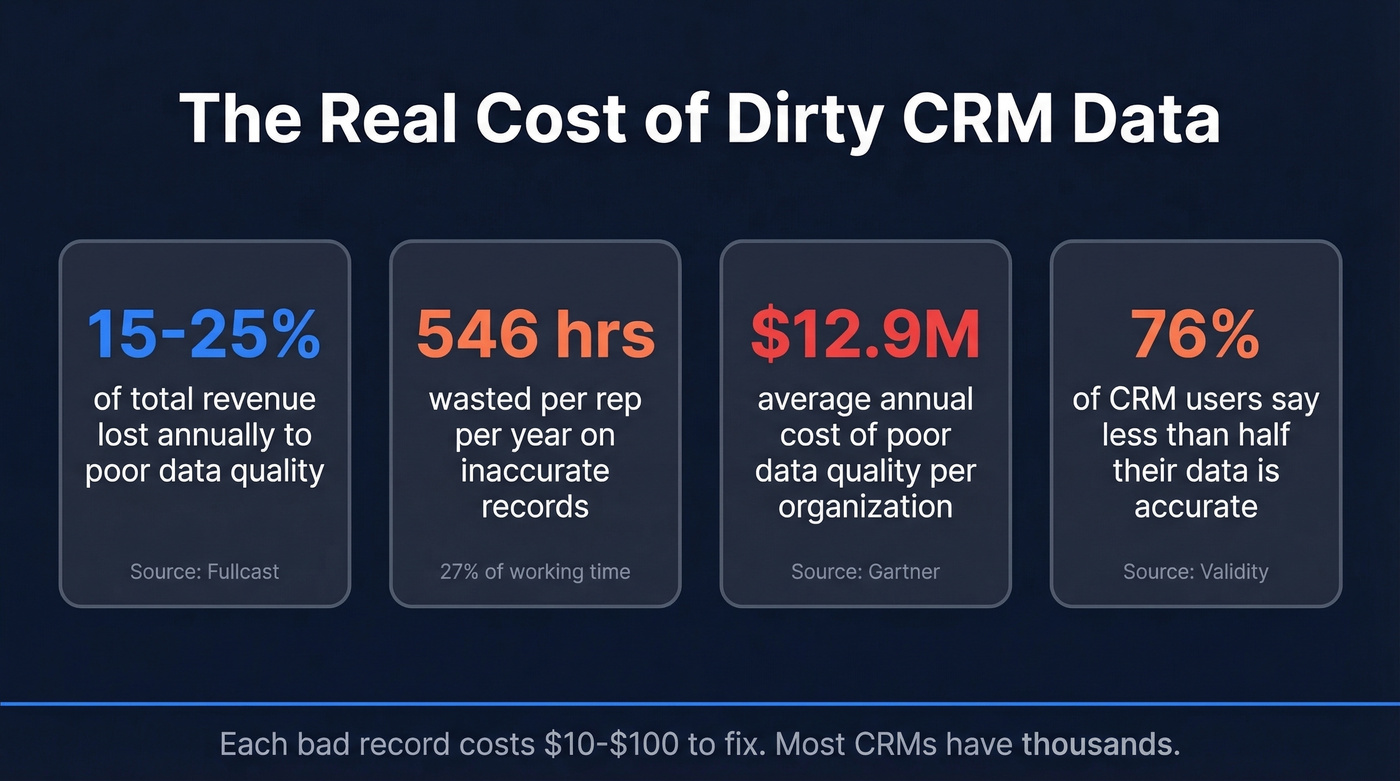
On the ground floor, inside sales reps waste roughly 546 hours per year dealing with inaccurate records - 27% of their working time spent finding, correcting, and confirming data instead of selling. We've seen teams where reps spend the first hour of every day just cleaning up their call lists. That's not a data problem. It's a revenue problem hiding in plain sight.
Dirty CRM data also creates compliance exposure. Stale records with outdated permissions, orphaned integrations pulling from contacts that no longer exist, and unverified email addresses that open the door to phishing vectors - all of these stack up quietly until an audit or a breach forces the conversation. GDPR fines can reach EUR20M or 4% of annual global turnover, and your CRM full of mishandled personal data is exactly the kind of thing regulators look for.


Deduplication fixes the structure. Verification fixes the substance. Prospeo's 5-step verification process catches dead emails, spam traps, and honeypots that dedup tools miss entirely - with 98% email accuracy and a 7-day refresh cycle so you're never enriching against stale data.
Stop cleaning your CRM with dirty data from other providers.
Services vs. Software vs. Hybrid
Most "CRM data cleansing services" are actually software tools with a services page bolted on. If you need a true managed service - someone who'll log into your CRM, audit your schema, deduplicate 400K records, and hand it back clean - you're looking at boutique consultancies.
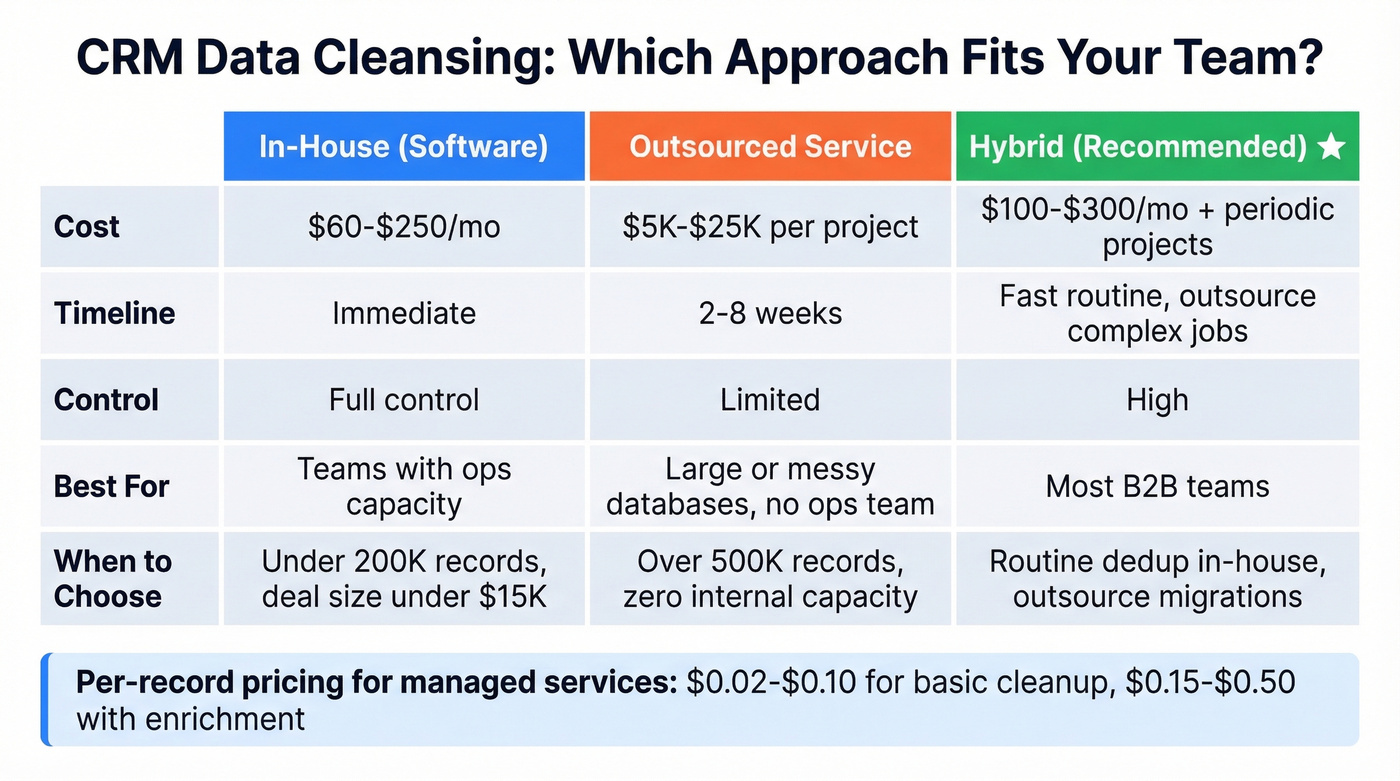
| Factor | In-House (Software) | Outsourced Service | Hybrid |
|---|---|---|---|
| Cost | $60-$250/mo | $5K-$25K/project | $100-$300/mo + periodic |
| Control | Full | Limited | High |
| Speed | Immediate | Typically 2-8 weeks | Fast routine, outsource complex |
| Best for | Teams with ops capacity | Large/messy DBs, no ops | Most B2B teams |
The Damco framework lays this out well: in-house gives you control and speed, outsourcing gives you expertise and scalability. For managed database cleansing, typical pricing lands around $0.02-$0.10 per record for basic cleanup and $0.15-$0.50 per record with enrichment. The hybrid approach - handle routine dedup internally, outsource complex one-time migrations - works best for most B2B teams.
Here's the thing: if your average deal size is under $15k and your database is under 200K records, you'll never recoup the cost of a managed cleansing service. Buy the software, set a quarterly calendar reminder, and spend the savings on better outbound tooling.
How to Clean Your CRM in 5 Steps
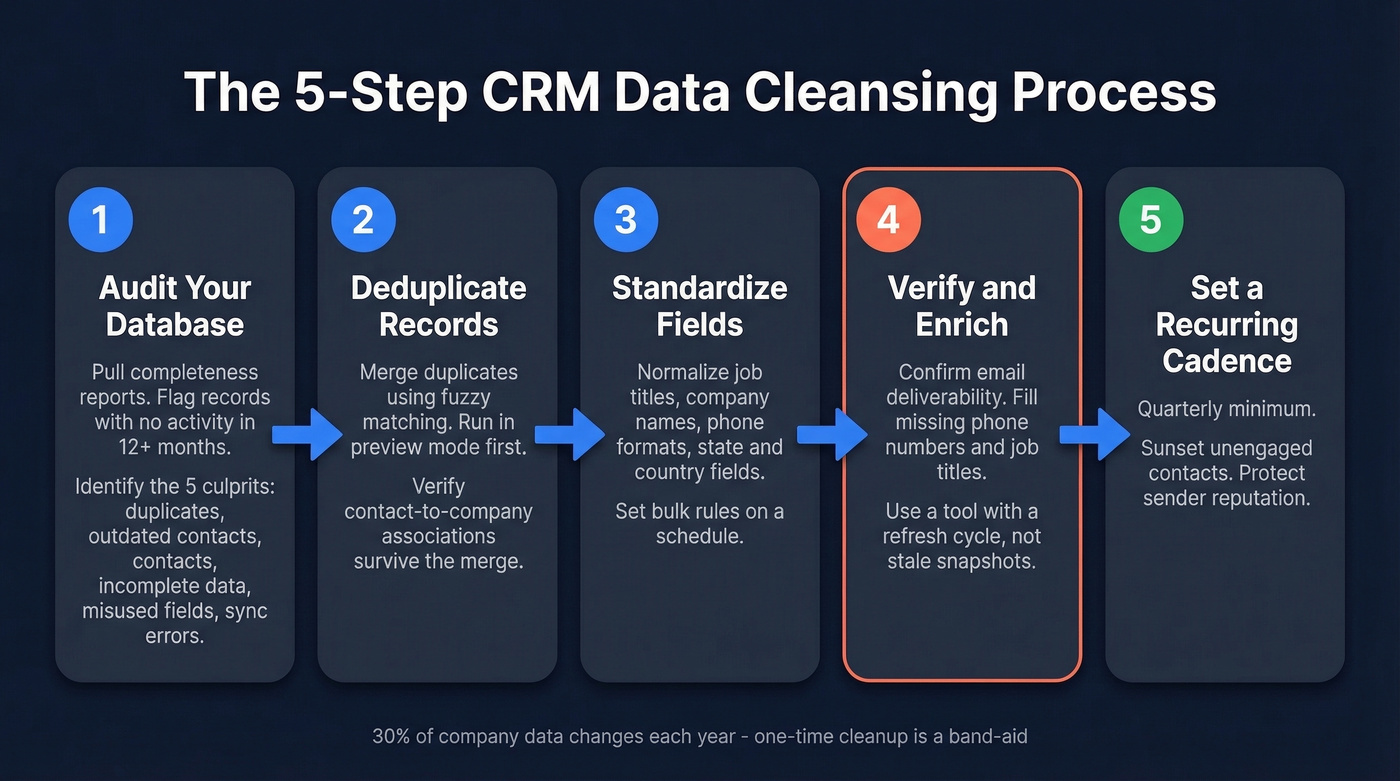
1. Audit Your Database
Pull a report on record completeness: what percentage of contacts have a valid email, phone number, job title, and company? Flag records with no activity in 12+ months. The consensus on r/CRM confirms the five recurring culprits: duplicates, outdated contacts, incomplete data, misused fields, and integration sync errors.
2. Deduplicate Records
Merge duplicate records before doing anything else. Fuzzy matching catches the non-obvious ones - "Acme Corp" vs. "Acme Corporation" vs. "ACME Corp Inc." Tools like Insycle or Cloudingo handle this natively. Set your merge rules, run in preview mode first, and verify that contact-to-company associations survive the merge intact. Broken associations are just as damaging as the duplicates themselves.
3. Standardize Fields
Job titles are the worst offender. "VP Sales," "Vice President of Sales," "VP, Sales & Marketing," and "Head of Sales" might all describe the same buyer. Standardize titles, company names, phone formats, and state/country fields into consistent values.
Tedious but essential for segmentation and routing. This is where tools like Insycle earn their keep - bulk standardization rules that run on a schedule beat manual spreadsheet work every time.
4. Verify and Enrich
Run your cleaned list through a verification tool to confirm email deliverability and fill in missing phone numbers. Prospeo's 7-day refresh cycle checks against current data, not a snapshot from six weeks ago. At 98% email accuracy and 125M+ verified mobiles, this step catches the dead emails and missing direct dials that dedup tools don't touch.
5. Set a Recurring Cadence
About 30% of company data changes each year. A one-time cleanup is a band-aid.
Set a quarterly cadence at minimum, and sunset contacts with no engagement on a defined policy to protect sender reputation. Stale contacts don't just waste rep time - they increase the odds you keep mailing invalid addresses and spam traps, which tanks your domain deliverability over time in ways that are expensive and slow to reverse.
Best CRM Data Cleansing Tools
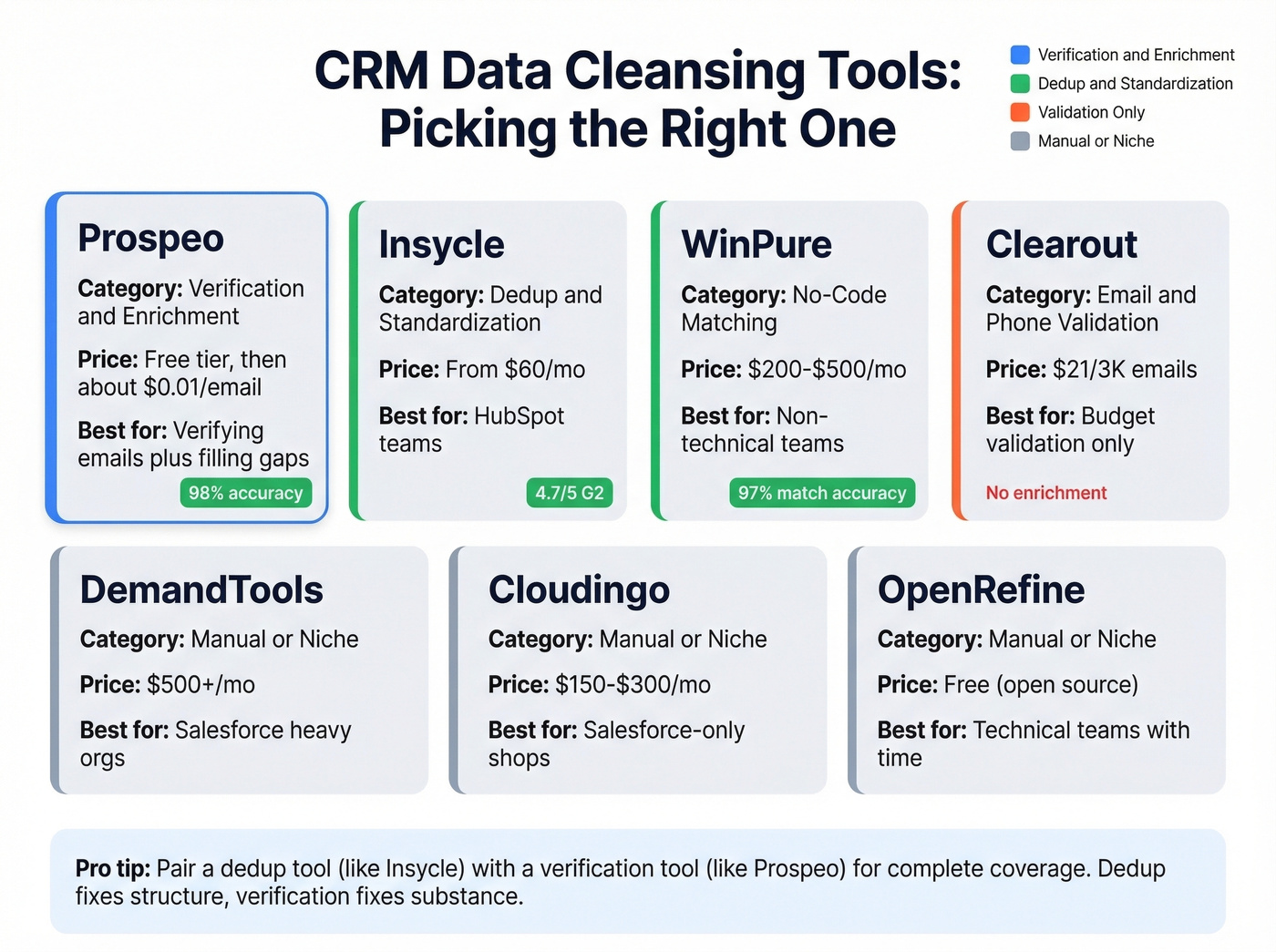
| Tool | Category | Starting Price | Best For |
|---|---|---|---|
| Prospeo | Verification & Enrichment | Free (75 emails/mo); ~$0.01/email paid | Verify emails + fill gaps |
| Insycle | Dedup & Standardization | $60/mo | HubSpot teams |
| WinPure | All-in-One Matching | ~$200-$500/mo | Non-technical teams |
| Clearout | Email/Phone Validation | $21/3K emails | Budget email validation |
| DemandTools | Salesforce Dedup | ~$500+/mo | Salesforce-heavy orgs |
| Cloudingo | Salesforce Dedup | ~$150-$300/mo | Salesforce-only shops |
| OpenRefine | Manual Data Cleaning | Free (open-source) | Technical teams with time |
Prospeo - Verification and Enrichment
This is the verification and enrichment layer that pairs with any dedup tool. Prospeo returns 50+ data points per contact at a 92% API match rate, covering verified emails, direct dials, job titles, and company firmographics. Its 5-step verification process - catch-all handling, spam-trap removal, honeypot filtering - delivers 98% email accuracy, which directly protects your sender reputation after a cleanup.
The free tier gives you 75 emails/month to test before committing, and native integrations with Salesforce, HubSpot, Clay, and Zapier mean enrichment runs inside your existing workflows without CSV gymnastics. At roughly $0.01 per email, it's a fraction of what legacy data vendors charge for comparable accuracy. One of our agency clients, Stack Optimize, built to $1M ARR using Prospeo for enrichment with deliverability consistently above 94% and bounce rates under 3% across all their client campaigns.
Insycle - Dedup and Standardization
The go-to for HubSpot teams. Insycle scores 4.7/5 on G2 across 192 reviews, with praise centered on fuzzy matching and bulk operations. It works directly with HubSpot workflows, so dedup rules, field standardization, and automated cleanup schedules run without manual intervention.
We've run this tool alongside verification workflows for multiple clients - the learning curve is real (G2 reviewers flag it consistently), but it's worth the two-week ramp if you're on HubSpot. Starting around $60/month.
WinPure - No-Code Matching
For teams where the ops person isn't technical and you need matching without writing rules from scratch, WinPure is the path of least resistance. It holds 4.7/5 on G2 with 74 reviews, and its strength is accessibility: fuzzy matching with 97% accuracy, an intuitive UI that business users can operate without engineering support, and a free trial to test before committing. Expect $200-$500/month.
Skip Clearout If You Need Enrichment
Clearout works fine for teams that only need email and phone validation. At $21 for 3,000 email verifications, it's one of the cheapest per-verification options available, with phone verification covering 250+ countries and bounce rates under 3%. But if you also need enrichment - missing job titles, direct dials, company data - you'll end up stacking another tool on top and paying more than if you'd started with a combined solution.
Other Tools Worth Knowing
DemandTools handles deduplication for Salesforce and Microsoft Dynamics 365. Pricing isn't public, but it typically lands $500+/month for teams that need mass dedup and data manipulation at scale.
Cloudingo is Salesforce-only with duplicate merging and bulk updates, typically $150-$300/month for mid-market orgs. Preview merges carefully to avoid errors.
OpenRefine is free, open-source, and genuinely powerful for data transformation. But recommending OpenRefine for CRM cleansing is like recommending a manual transmission to someone who just wants to get to work. If you've got the technical chops and the time, it's excellent. Most teams don't.
At $0.01 per email, re-verifying your entire CRM costs less than a single bad deal lost to bounced outreach. Prospeo returns 50+ data points per contact at a 92% match rate - turning your freshly cleaned records into a pipeline-ready database.
A 200K-record CRM costs $2,000 to verify. One lost deal costs more.
How Often to Clean Your CRM
One case study from Sentia describes a 75-rep, $50M ARR org that went from 42% data accuracy to 94% after a 90-day cleanup, with win rates jumping from 22% to 29.5%. The investment was $180K; the attributed revenue lift was $8.7M. At that scale, data cleaning almost always requires a phased approach - trying to clean everything in a single sprint introduces more errors than it resolves.
| Team Type | Recommended Cadence |
|---|---|
| High-growth / outbound-heavy | Monthly |
| Mid-market / steady pipeline | Quarterly |
| Small team / low volume | Every 5-6 months |
Look, if you haven't cleaned your CRM in over six months, your next outbound campaign will hurt your domain reputation more than it helps your pipeline. Set the cadence, automate what you can, and treat data hygiene like pipeline reviews - it isn't optional. The right CRM data cleansing tools make this sustainable instead of painful.
FAQ
What's the difference between data cleansing and enrichment?
Cleansing removes and repairs bad data - duplicates, outdated records, formatting errors. Enrichment adds missing data from external sources, like phone numbers or job titles. Cleansing typically comes first; enrichment fills the gaps that remain. Most bundled cleanup services include both steps, but you should understand which one you're actually paying for.
How much does CRM data cleansing cost?
Managed services typically charge $0.02-$0.10 per record for basic cleansing and $0.15-$0.50 per record with enrichment. Project minimums usually start around $5,000 and can run $25,000+ for enterprise databases. Software tools like Insycle start around $60/month; Prospeo's verification starts free at 75 emails/month, with paid plans at roughly $0.01 per email.
Can CRM data cleansing be automated?
Yes, partially. Tools like Insycle and Cloudingo let you schedule recurring dedup and standardization rules inside your CRM. Verification and enrichment can run on a cadence through API integrations - Prospeo's enrichment API, for example, returns 50+ data points at a 92% match rate on scheduled runs. The initial audit and rule-setting require human judgment, but once configured, ongoing maintenance runs hands-off.
What should I look for in a cleansing tool?
Focus on three things: native integration with your CRM (HubSpot, Salesforce, etc.), fuzzy matching quality for deduplication, and whether the tool handles verification alongside standardization. Many solutions only cover one piece of the puzzle, forcing you to stack multiple tools. A combined approach - dedup plus verification plus enrichment - reduces cost and complexity for most B2B teams.