

CRM User Adoption Is a Data Problem Disguised as a People Problem
Your VP of Sales pulls up the pipeline report on Monday morning. Half the opportunities haven't been updated in three weeks. The forecast is fiction. And leadership's first instinct is always the same: "we need more CRM training."
Here's the thing - you don't need more training. You need better data. CRM user adoption delivers $8.71 for every $1 invested, and companies that get it right see 29% higher sales, 34% better productivity, and 42% more accurate forecasts. But 91% of companies with 11+ employees already use a CRM. The software isn't the problem. The data inside it is.
Tie every pipeline review to CRM data, fix your data before retraining your team, and measure adoption by role - not login counts. That's the short version. Let's break down the long one.
What Adoption Actually Means
Adoption isn't implementation. You can buy Salesforce, configure it, migrate your data, train your team, and still have 30% adoption six months later. Real adoption means the CRM is the daily operating system for every revenue-facing role - not a reporting tool reps grudgingly update on Friday afternoons.
Roughly half of CRM initiatives underdeliver due to adoption and data quality issues, not because the software itself is wrong. SaaS license utilization averages just 54% across all categories. CRMs aren't immune. When a CRM is underperforming, the instinct is to blame the platform, but the real culprit is almost always how it's being used - or more accurately, how it's not being used.
Why CRM Adoption Fails
The data quality death spiral
This is the big one. 76% of CRM users say less than half their data is accurate or complete. Reps open a contact record, see a wrong phone number and a bounced email, and mentally check out. Reps open a contact record, see a wrong phone number and a bounced email, and mentally check out. They revert to spreadsheets. The CRM data gets worse because nobody's updating it. Each bad record pushes reps further away, and the cycle accelerates until the system is essentially abandoned.
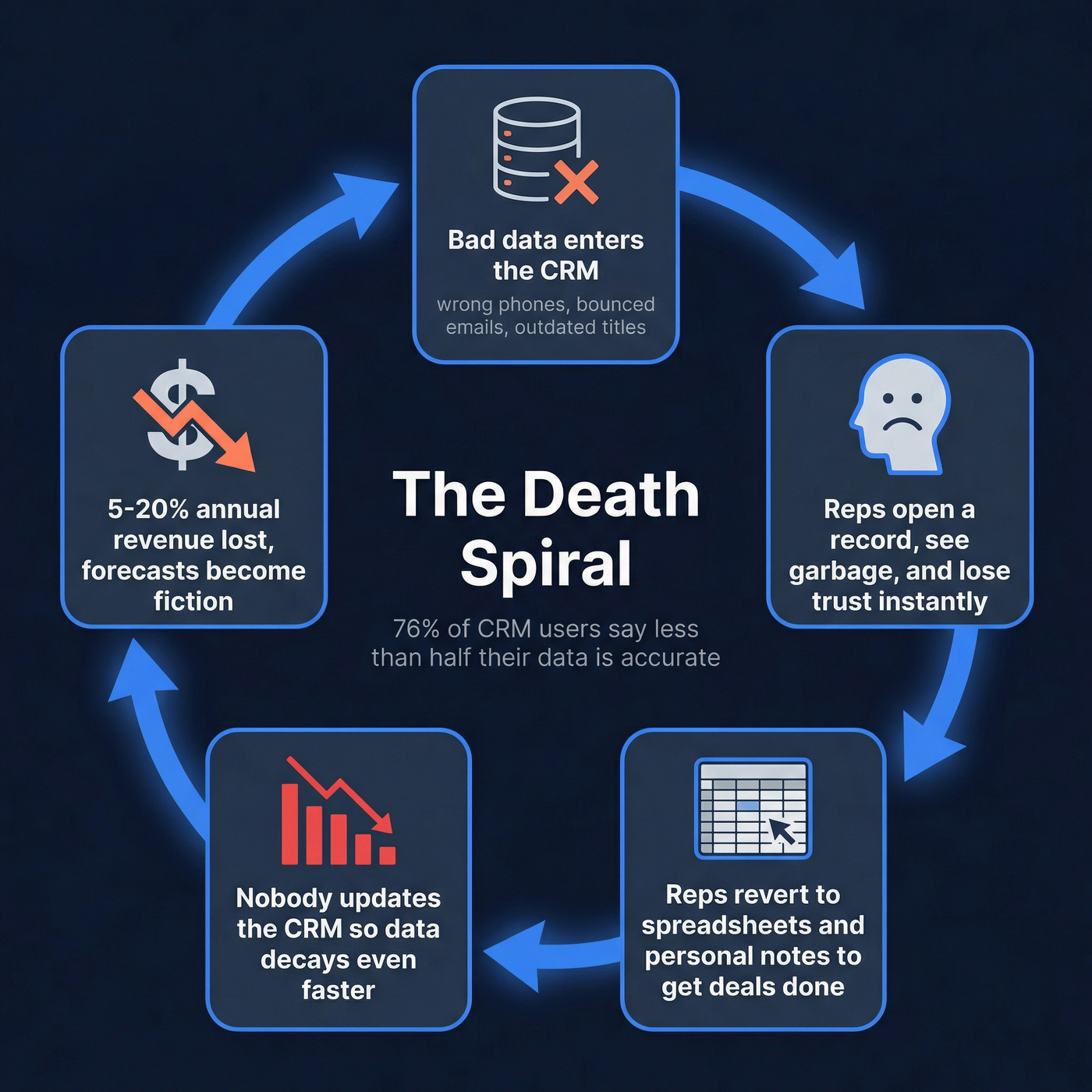
Bad data causes 5-20% annual revenue loss, and the average rep already spends 17% of their day on manual data entry. That's nearly a full day per week lost to typing instead of selling.

Leadership doesn't use CRM reports
If your VP runs the forecast from a separate spreadsheet, you've told every rep the CRM doesn't matter. We've seen this pattern kill adoption faster than any technical issue. The fix is cultural: deal reviews happen in the CRM or they don't happen.
Per-seat pricing creates partial adoption
A 10-person company buys 3 seats at $50-100/user/month. As one small-business owner on r/CRMSoftware put it, "I'm paying $300/mo for 3 seats and my project managers still can't see what was sold." The CRM becomes one person's tool instead of the company's operating system. That's not adoption - that's a glorified Rolodex.
Setup complexity kills momentum
SMBs often Frankenstein 5+ tools together, and customer data fragments across all of them. Meanwhile, reps in heavy industries are putting out fires all day - they don't have desk time for a complex CRM. If setup drags on for months, small teams churn through platforms before adoption even starts.
Why Salespeople Resist the CRM
Understanding resistance starts with empathy for the rep's daily reality. Salespeople are coin-operated - they want to sell, not administrate. When the CRM adds friction without visible payoff, non-usage isn't rebellion. It's rational behavior.
The most common complaints we hear: too many required fields, data they don't trust, and zero feedback loop showing how CRM entries help them close. Compliance drops fastest when reps see the system as a management surveillance tool rather than a selling tool. If you want reps to actually use the CRM, show them how the data directly shortens their sales cycle - not how it helps leadership build dashboards they'll never see.

Your reps aren't lazy - they're working with bad data. Prospeo enriches Salesforce and HubSpot contacts with 50+ verified data points at an 83% match rate. Every record refreshes every 7 days, not every 6 weeks. When reps open a contact and see a real phone number and a verified email, they stop using spreadsheets.
Fix the data first. Adoption follows. Start enriching for $0.01 per email.
Measuring Adoption Effectively
Login counts are vanity metrics. Track what matters:
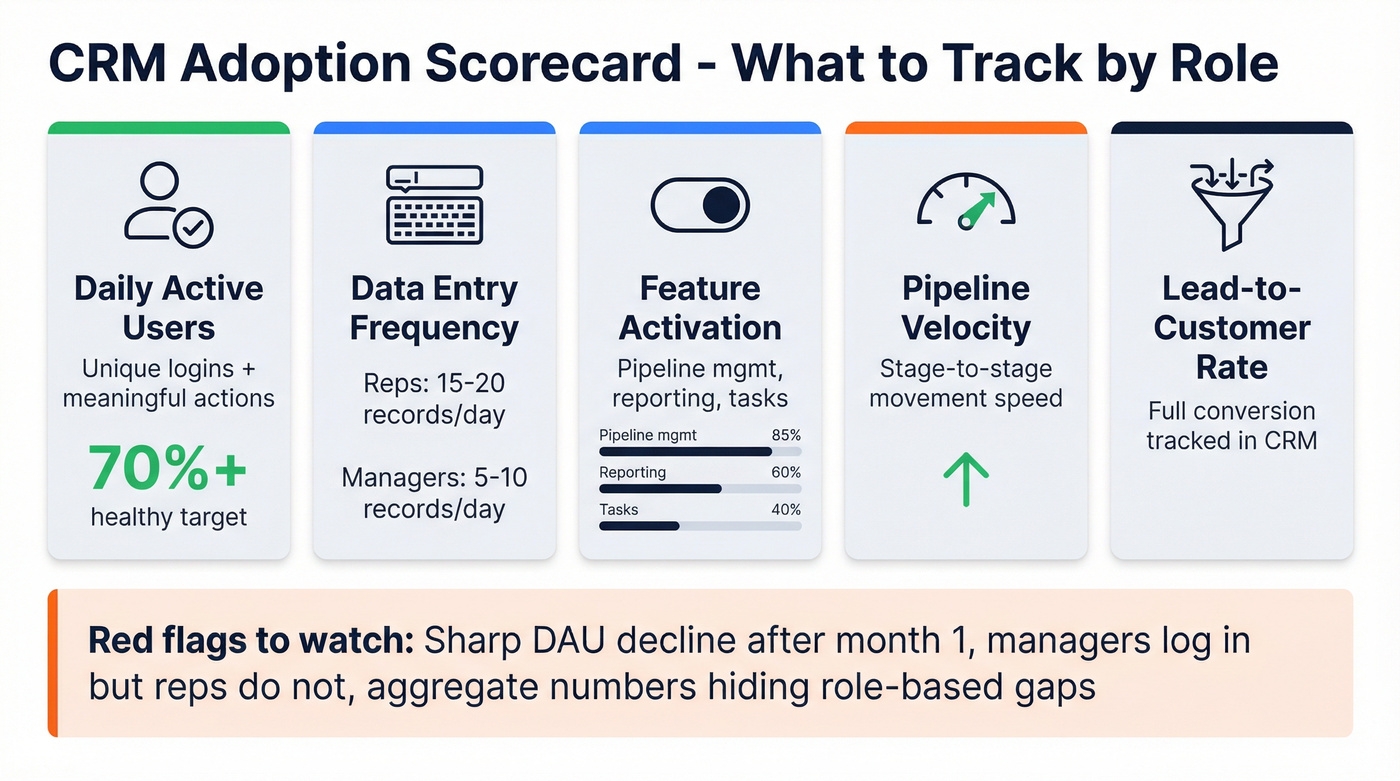
| Metric | What to Track |
|---|---|
| Daily Active Users | Unique logins + meaningful actions taken |
| Data Entry Frequency | New records per role/day (Reps: 15-20, Mgrs: 5-10) |
| Feature Usage | Core features activated - pipeline management, reporting, tasks |
| Pipeline Velocity | Stage-to-stage movement speed |
| Lead-to-Customer Rate | Conversion tracked through CRM |
Watch for sharp DAU declines after month one and role-based gaps where managers log in but reps don't. Both signal structural problems, not laziness. Tracking compliance rates by team and role reveals where adoption is breaking down far more precisely than aggregate numbers ever will.
Tactics That Actually Work
Tie deal reviews to CRM data exclusively
No spreadsheet sidecars. If it's not in the CRM, it doesn't exist. This is the single highest-leverage change you can make, and it costs nothing. When a rep says "I've got a deal at 80% close probability" and there's no corresponding record, the answer is simple: that deal isn't real yet.
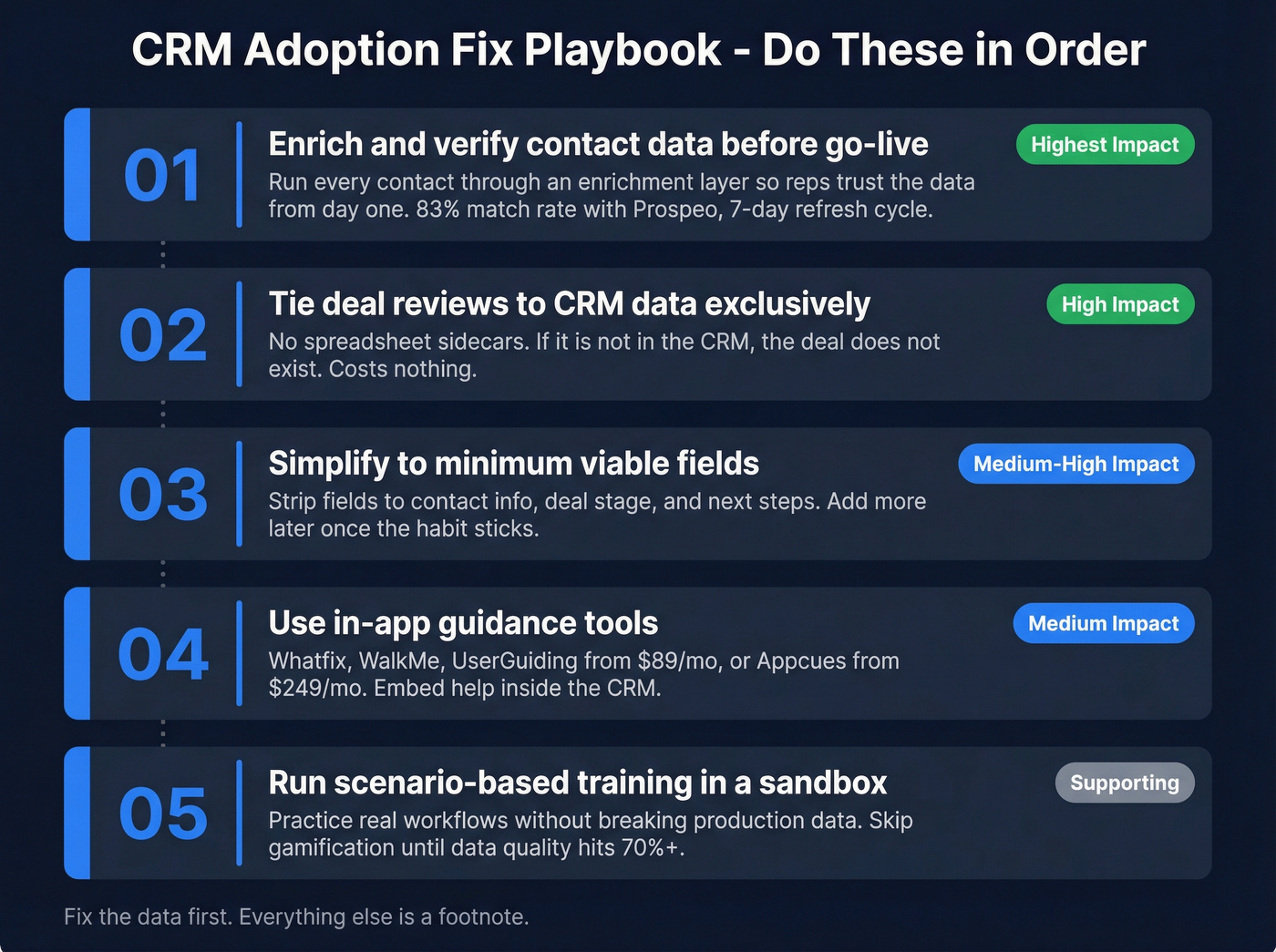
Enrich and verify contact data before go-live
The "garbage in, garbage out" problem is the root cause of most adoption failures. Before you launch or relaunch your CRM, run every contact through an enrichment layer. Prospeo integrates natively with Salesforce and HubSpot, enriching contacts with 50+ verified data points at an 83% match rate - so reps trust the data from day one. With a 7-day data refresh cycle versus the 6-week industry average, records stay current long after initial enrichment.
Simplify to minimum viable fields
Every unnecessary required field is a tax on adoption. Strip your CRM fields to the minimum viable set for launch. Reps need contact info, deal stage, and next steps. Managers need forecast fields. That's it for go-live. You can always add fields later once the habit is established - you can't add them back after reps have already given up.
Use in-app guidance tools
Digital adoption platforms like Whatfix, WalkMe, or lighter options like UserGuiding (from $89/mo) and Appcues (from $249/mo) embed help directly inside the CRM. Even basic tooltip layers reduce support tickets and cut the "I don't know how to do X" excuse off at the source.
Run scenario-based training in a sandbox
Classroom training doesn't stick. Give reps a sandbox where they practice real workflows - logging a call, advancing a deal, running a report - without breaking production data. One manufacturing org used interactive checklists guiding reps through every click and hit 99% adoption before launch day.
Skip gamification and leaderboards if your data quality is below 70%. Badges don't fix broken phone numbers. Most CRM adoption programs fail because they treat the symptom (reps not logging in) instead of the disease (reps not trusting the data). If 76% of users say less than half your CRM data is accurate, no amount of points or prizes will save you. Fix the data first. Everything else is a footnote.
Stack Optimize built a $1M agency with under 3% bounce rates across every client. Snyk dropped bounce rates from 35% to under 5% across 50 AEs. The difference wasn't training - it was 98% accurate contact data inside the CRM from day one.
Stop retraining reps on a CRM full of dead emails. Replace the data instead.
Proof It Works
Avison Young went from 23% to 90% adoption in four months. The commercial real estate firm had fragmented data across four CRMs with Excel-based forecasting. After consolidating onto a single platform, they hit 90% adoption and tracked 95% of North American revenue through the system. The fix wasn't training - it was eliminating data fragmentation.
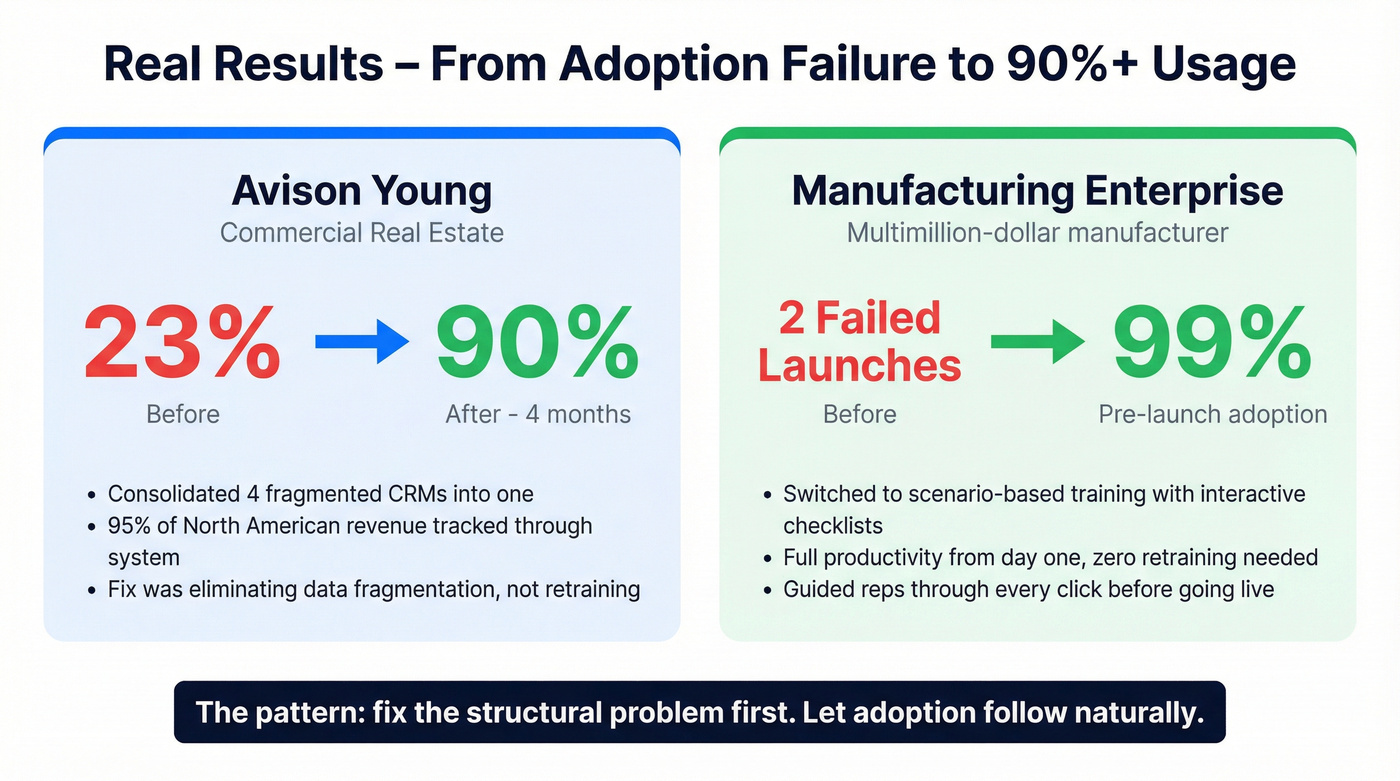
A multimillion-dollar manufacturer hit 99% Salesforce adoption pre-launch. After two failed implementations, they switched to scenario-based training with interactive checklists guiding reps through every click. Result: 99% adoption before launch day and full productivity immediately. No retraining needed.
The pattern in both cases is the same: they fixed the structural problem first and let adoption follow naturally.
FAQ
What's a good CRM adoption rate?
90%+ active usage across revenue-facing roles is a strong target for 2026. Below 70% signals systemic issues with data quality, training, or workflow fit. Industry benchmarks put the average closer to 50%, which is why deliberate adoption strategy matters more than software selection.
How does data quality affect CRM user adoption?
Bad data is the single biggest adoption killer. When 76% of users report that less than half their CRM records are accurate, reps stop trusting the system and revert to spreadsheets. Enriching contacts with verified data before go-live breaks the distrust cycle before it starts.
Why do salespeople refuse to use the CRM?
Reps avoid the CRM when it adds friction without visible payoff to their quota. The top drivers are unreliable contact data, too many required fields, and no feedback loop showing how entries help them close deals. Fixing data quality and trimming fields to a minimum viable set resolves the majority of compliance issues.
How long does it take to improve adoption rates?
Teams that address data quality and enforce CRM-only deal reviews typically see measurable improvement within 60-90 days. Avison Young went from 23% to 90% in four months by consolidating fragmented data into a single clean system - no retraining required.